
A bronze statue is made by lost-wax casting: a wax copy of the sculpture is coated in ceramic, the wax is melted out, and molten bronze fills the space it leaves. Our foundry does this in eight steps, from a design drawing and a clay or 3D model to patina, inspection and crating. A life-size statue takes 35–45 days.
- Casting method
- Lost-wax casting
- Copper content
- 85% or more
- Wall thickness
- 5–8 mm (about 1/4 in)
- Production time
- 35–45 days for a life-size statue
- Client approvals
- Design drawing, clay or 3D model, color
- Protective finish
- Wax, renewed every 6–12 months outdoors
What is lost-wax casting?
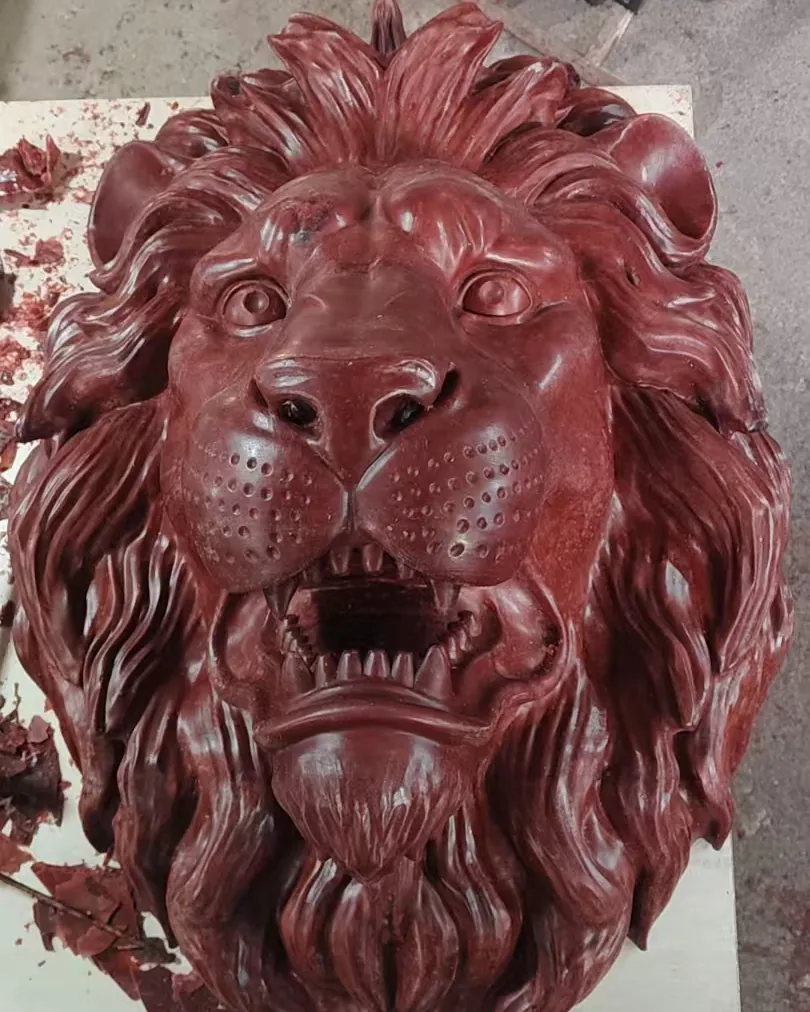
Lost-wax casting makes a bronze statue by replacing a wax pattern with molten metal inside a ceramic shell. Most bronze statues are made this way, and every one we cast in Quyang is. The red lion head below is still wax, yet you can already recognize the mane and muzzle before any bronze is poured.
Imagine following the fold of a sleeve from the sculptor’s model to the finished figure. First the sculptor shapes the ridge and the hollow beneath it. A mold picks up that surface, wax takes its shape from the mold, and a ceramic shell forms around the wax. When the wax melts out, the shell retains the impression of the fold for the bronze to fill.
The process carries fine details such as fingers, strands of hair and folds of clothing from the model into metal. That also explains why the client’s review of the model matters so much. The caster will be working from the features the client sees at that stage.
Step 1: Design drawing
We start with a design drawing based on the client’s photos, sketches or other reference images. If you are commissioning a particular person, animal or mascot, send the photo that best shows the pose you have in mind. If you want us to develop the design, describe the effect you want and include your preferred size if you know it.
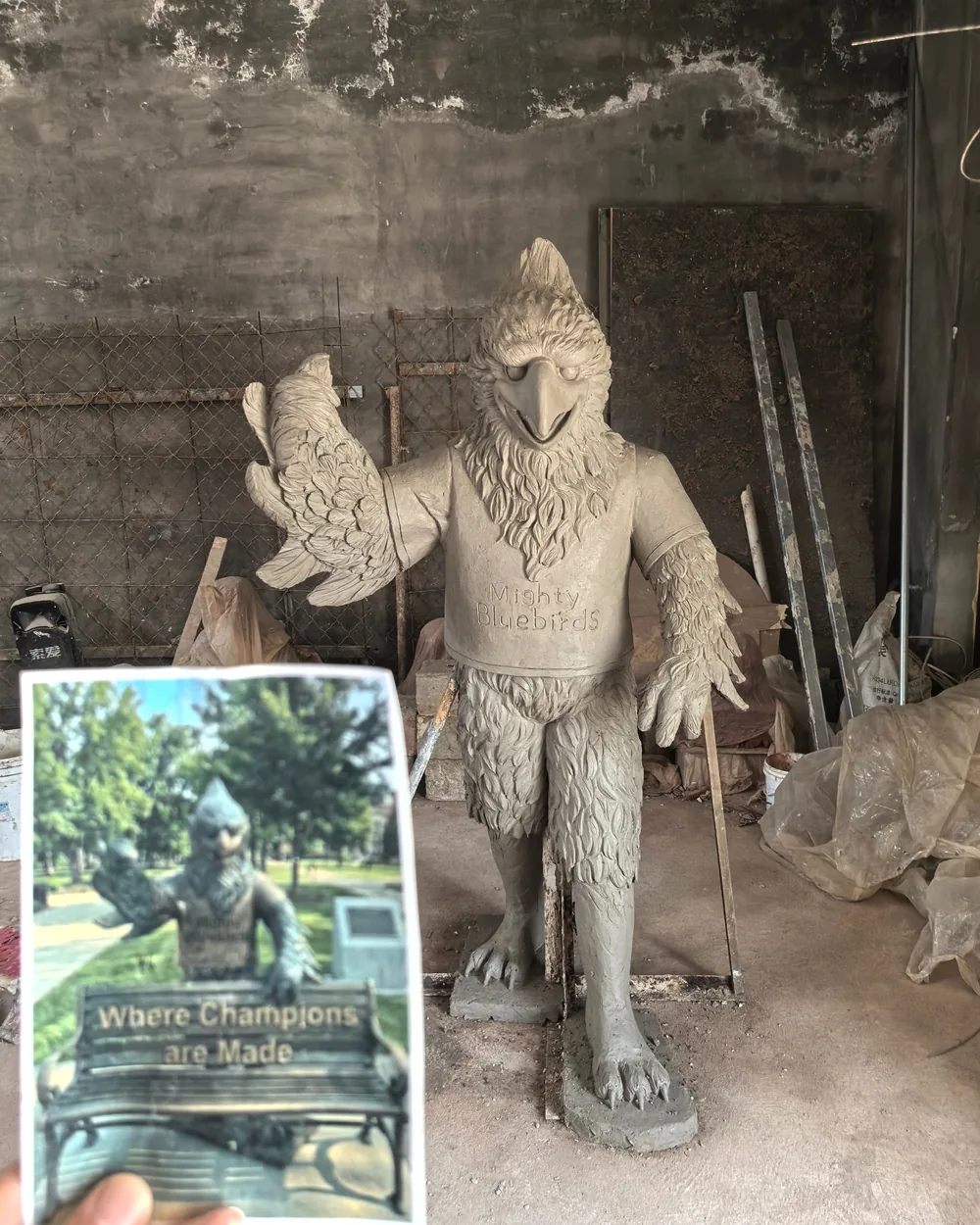
For the Arkansas school bluebirds, the starting reference was a photograph of a mascot costume. The drawing gave the sculptor a way to carry the character of that costume into a bronze bird. In the workshop photo, you can see the printed drawing beside the clay and compare the shape on paper directly with the model.
Once you approve the free design drawing, it stays with the job. The sculptor uses it to shape the model, and the patina follows its colors unless you request a different finish. Free design drawing and quote within 12 hours. No deposit needed.
Step 2: Clay or 3D model
We choose clay or a digital 3D model according to the design. Modeling is included in the order at no extra cost with either method. The client reviews photos or video, and we keep revising the model until the client is satisfied with the shape.
Clay model
The clay goes over a rough steel rebar armature. We use one on large statues too, so the clay does not slump while the sculptor works.
Our project to cast two bronze bluebird mascots for an Arkansas school began with clay models. The drawings showed the same character in different poses. One bird wears a T-shirt and waves, while the other raises its arms and flexes. Each was designed to go with a bench, so the gesture of each bird was part of what the client was reviewing.
The client approved the clay models in one round. The workshop photos follow those same birds through the ceramic shell, casting and welding to the final patina. You can use the wave or the raised arms to follow a familiar shape as the material changes.
3D model and full-size 3D print
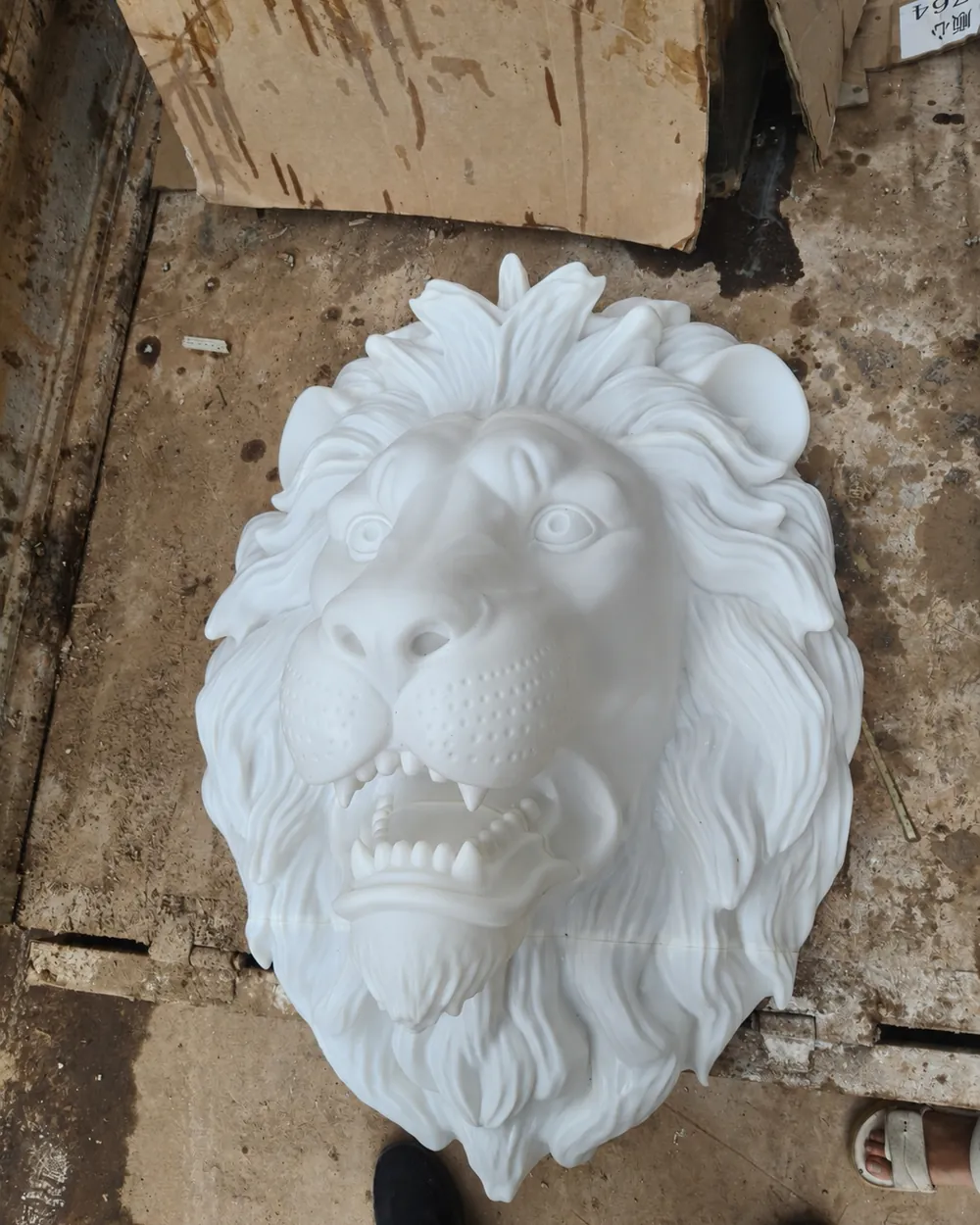
For a wall-mounted lion-head fountain in Georgia, the client reviewed the digital model in two rounds. After approval, we printed the lion head at full size. The white head in the photo is that print, the physical model from which we could make the mold. The red version shown earlier is the wax pattern that came next.
Step 3: Mold and wax pattern
We take a mold from the clay sculpture or full-size print. Wherever the surface has detail, the mold is silicone; plain, smooth areas, such as the belly of a horse, can be molded in sand or plaster. Large statues are divided into sections at this stage. We cut through the simple areas and keep areas with dense detail, such as a face or a hand, in one piece, so the welds later fall away from the fine work.
From the mold we make a hollow wax pattern with walls 5–8 mm thick, the same thickness the bronze will have. We touch up details in the wax, attach wax channels called sprues, and fill the hollow wax with a heat-resistant core. Once the wax has melted out of the ceramic, molten bronze can flow through those channels.
In the bronze lion-head wall fountain project, the white print gave us the form to mold. The red wax pattern reproduced the open mouth and the relief of the mane. This was the opportunity to sharpen a line or smooth a mark in wax before the shell took its impression.
An existing mold can save time on a repeat design because it gives us a starting point for the new wax. For bronze horse designs we already have molds for, production is about 10–15 days shorter. Each horse is still cast to order.
Step 4: Ceramic shell
We build the ceramic shell by dipping the wax pattern in slurry and coating it with sand, about 8–10 coats in all, letting each coat dry. For a life-size statue, building the shell takes about 10 days. The ceramic in contact with the wax picks up the surface that will show on the bronze.
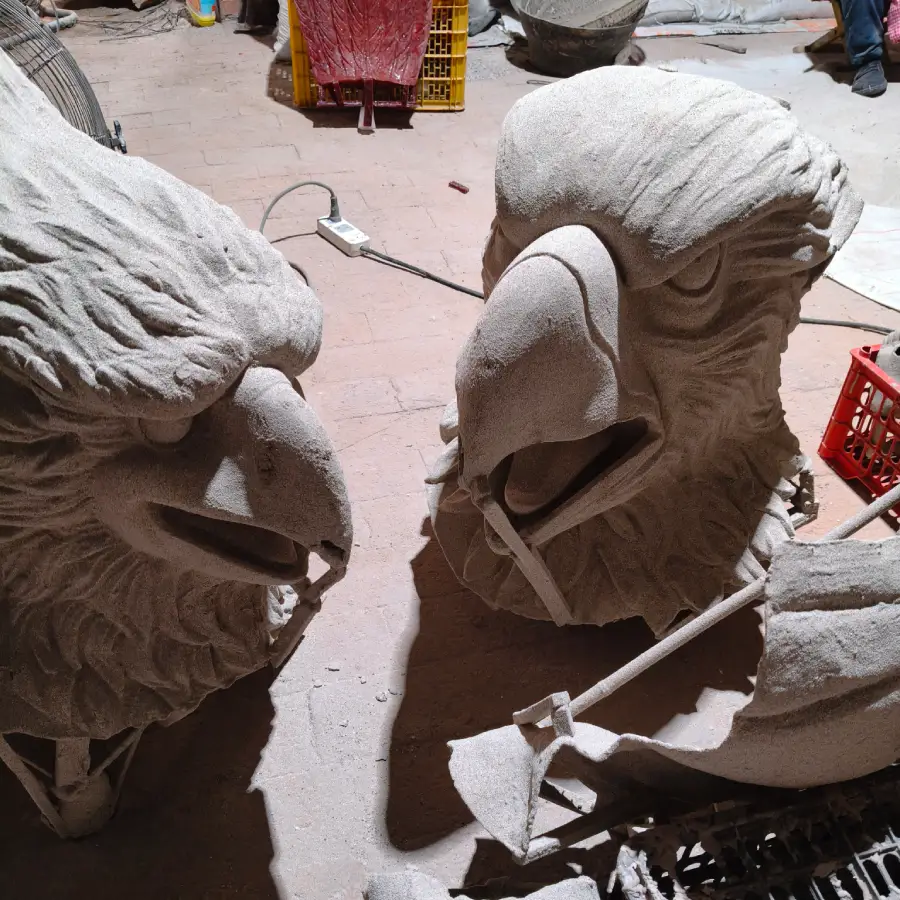
In the bluebird photo, the shell is grey and rough, yet the beak and eye of each head still show through the coating. That outer face is only the back of the mold. The surface that matters on the finished bird, down to the contours of its costume, lies on the inside against the wax.
Once the shell is ready, we heat it to about 800°C (about 1,470°F) so the wax melts and drains out. That is the point at which the process earns its name. The shell now holds an empty space in the shape of the wax pattern, connected to the channels that will carry the bronze.
Step 5: Pouring the bronze
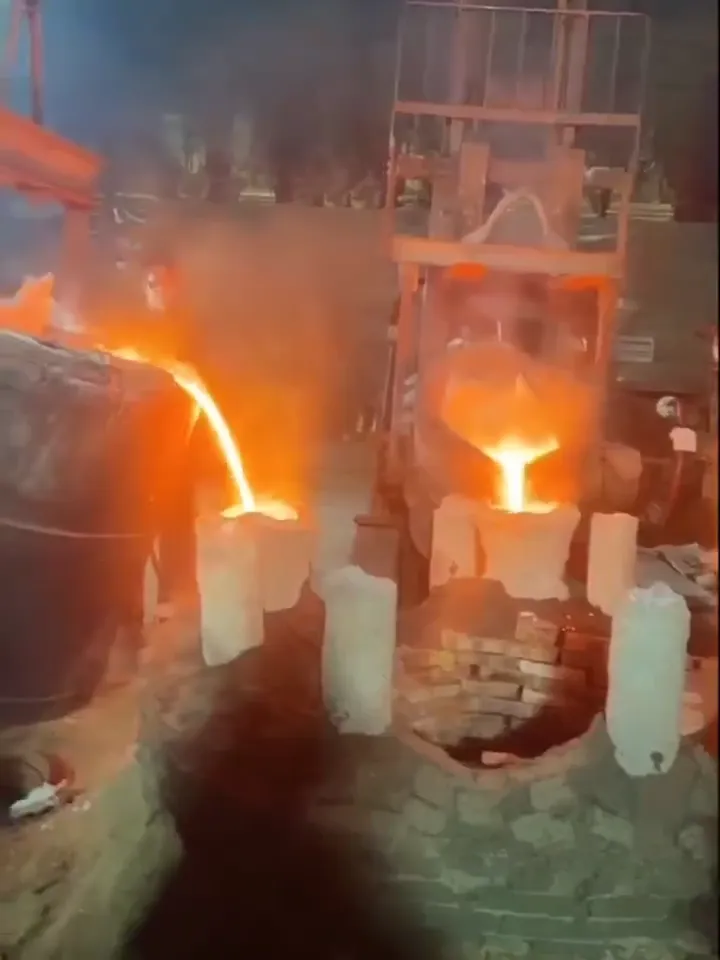
We melt the casting alloy and pour it, at about 1,200°C (about 2,200°F), into the preheated ceramic shell. At this stage of the bronze casting process, the sprue channels guide the metal into the space left by the pattern. The caster sees only the outside of the ceramic as it fills. The details of the bronze surface stay hidden until we break the shell.
How are bronze sculptures made hollow? The heat-resistant core fills the inside of the wax and the ceramic shell surrounds the outside, so the bronze can only fill the thin space the wax wall left. Large statues are cast in sections; the sections are then welded together, ground and refinished.
Our statuary bronze contains 85% or more copper. A spectrometer test report of our casting alloy is available on request. The green or brown surface you might choose for the finished statue comes later, during patination.
Step 6: Breaking the shell, welding and chasing
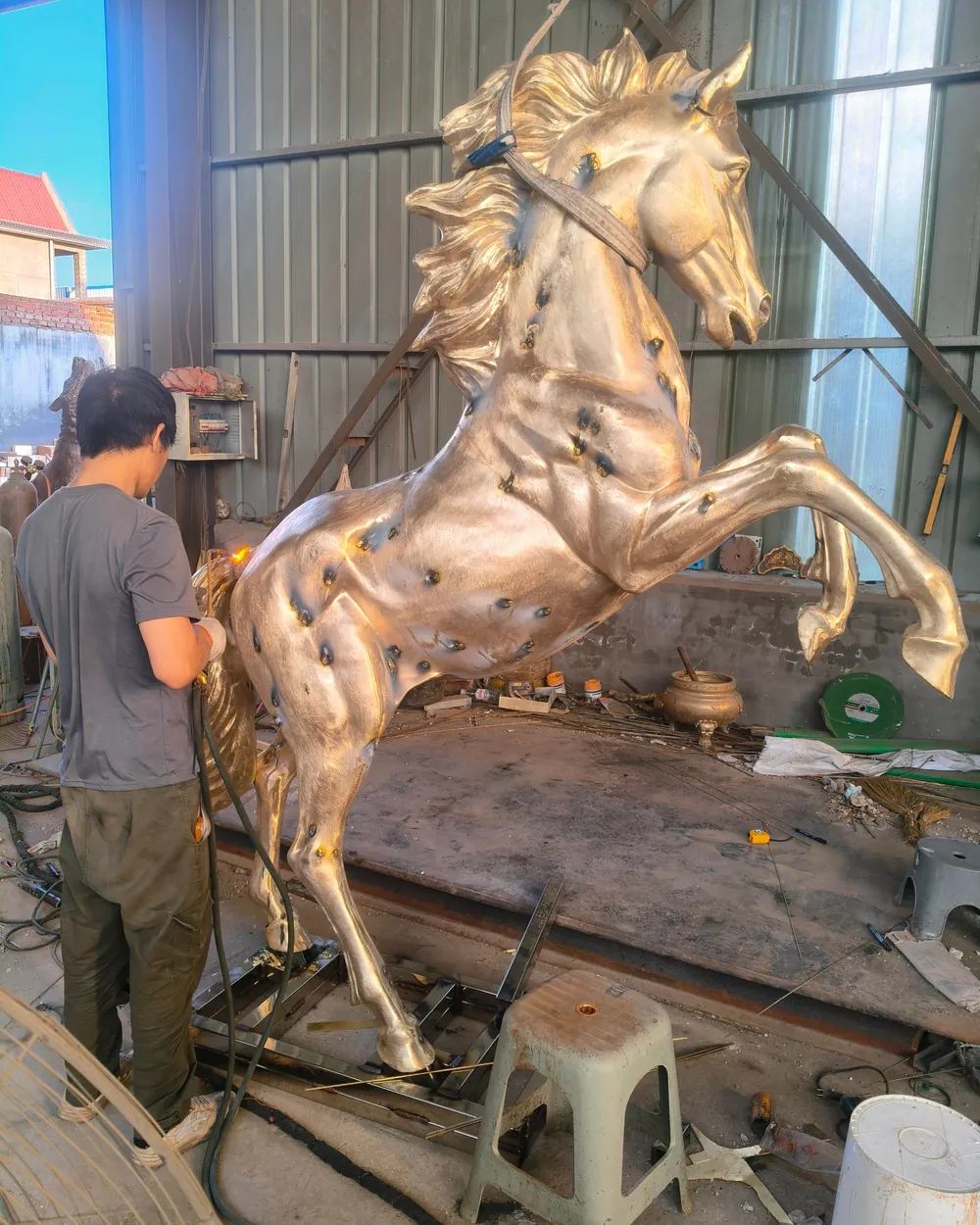
We break away the shell after the bronze has cooled, sandblast every casting to clear ceramic from the recesses, then cut off the sprues to expose the raw casting. You can see this stage in the workshop photos of the horses. The rough metal still needs work wherever a sprue met the sculpture or a welded join crosses a modeled surface. On a large statue, the sections cast separately are welded together at this stage. We join them by argon-arc (TIG) and gas-torch welding with pure copper filler rod.
Chasing is the finishing work that restores the sculpted detail in the metal. On a smooth flank, the worker blends the repaired area into the curve around it. Where a join runs through a textured surface, the texture needs to continue across it. The Arkansas bluebirds went through welding and surface finishing before their color was applied.
The walls of our cast bronze are 5–8 mm thick. Inside a rearing horse, galvanized steel pipe supports the figure, and the pose determines where it meets the base. When the hind hooves are set apart front to back, they can provide the two points of contact. When the hind hooves stand side by side, the tail meets the base as a third point.
We weld the contact points to a channel-steel base before the horse leaves the foundry. The buyer has the foundation built locally, so the installer only needs to weld that base to the anchor plate in the foundation. Our bronze horse page shows how rearing bronze horses are supported in each pose.
Step 7: Patina and wax
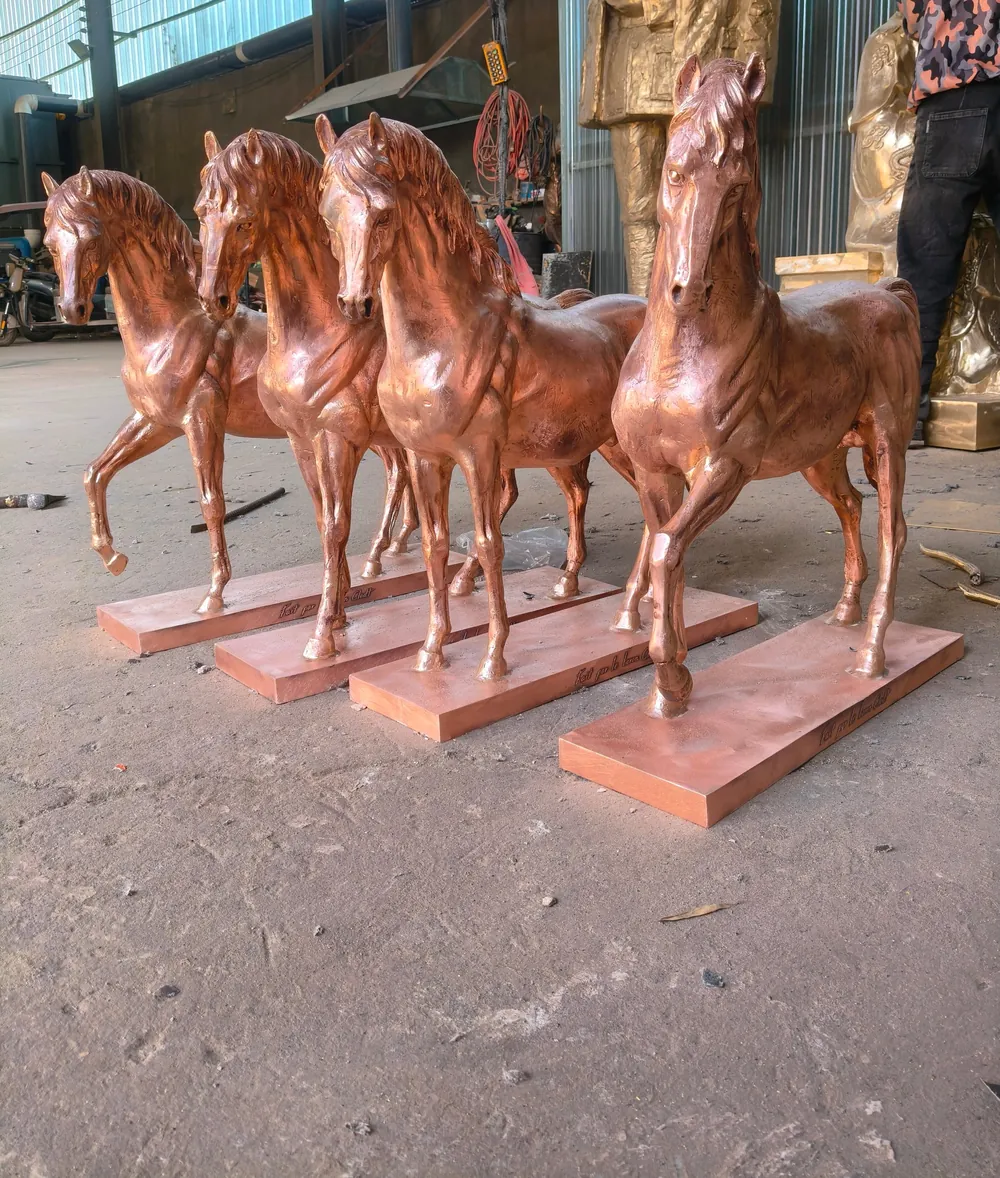
We create the patina by applying chemicals to the bronze with heat, then seal the finished surface with clear wax. Common chemicals include ferric nitrate, which gives reddish browns, and liver of sulfur, which gives browns to black. The client can specify a color. If there is no separate color request, we follow the effect in the approved design drawing.
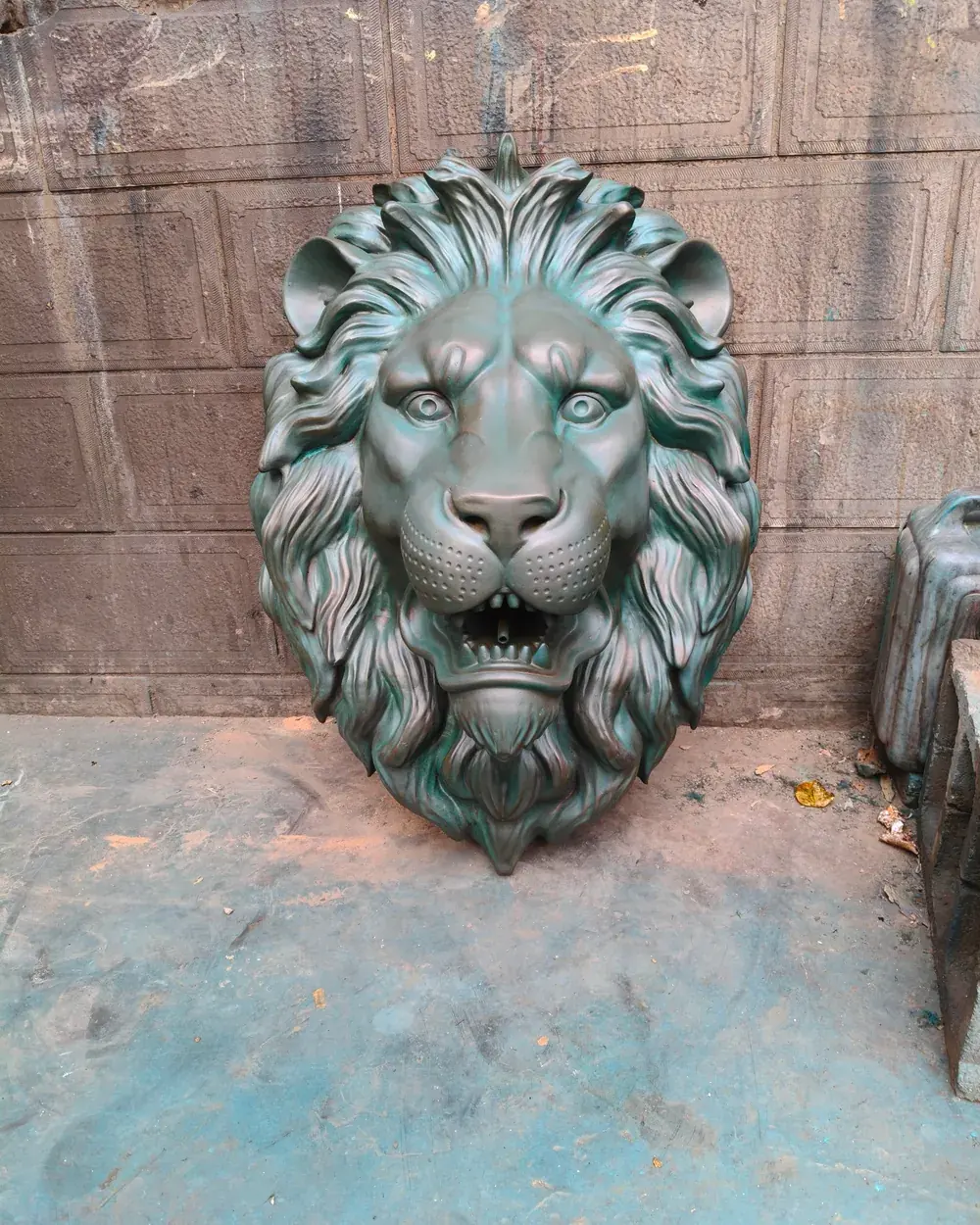
For the Georgia fountain, the red wax and the green bronze mark very different moments in the job. After casting the lion head, we tested water flow through the fountain. We then gave the bronze the green patina shown in the finished photograph and sealed it with wax. You can see how that green sits in the contours of the face by comparing the finished fountain with the white print of the same head.
Outdoors, bronze slowly oxidizes. Depending on the surroundings, its surface can turn brown, dark brown, black, green or blue-green. Renew the clear wax every 6–12 months, adjusting the interval to the local climate. Our care guide explains how to clean and maintain an outdoor bronze statue between waxings.
Our bronze warranty runs for 3 years and covers weld failures and breakage caused by quality problems. Changes in surface color fall outside that coverage.
Step 8: Inspection, photos and crating
We inspect the finished bronze, photograph it and pack it in a fully enclosed wooden crate. The final photos are part of the same record the client has seen throughout the job. We send photos and videos at each key stage, from review of the model to the finished surface.
For a client reviewing from a distance, each set of pictures answers a different question. With the clay or digital model, you can compare the pose with the drawing. With the finished bronze, you can see how the patina reads across those features before the statue goes into its crate.
We line the crate with foam and add a welded steel-tube frame when the piece needs extra protection. Shipping includes insurance. If you are preparing the site while the piece is at the foundry, our guide to shipping and installing a large bronze statue covers that next part of the job.
How long it takes and what it costs
A life-size bronze statue takes about 35–45 days to produce at our foundry. The price depends on size, detail and quantity. The production estimate covers the work on the piece, so allow separately for shipping when planning its arrival.
The breakdown below assumes the client approves the clay model in one round. Time for the design drawing and client reviews is not included, and each extra round of model changes adds to it.
| Stage | Typical time |
|---|---|
| Clay model | About 7 days |
| Mold | About 1 day |
| Wax pattern | 3–5 days |
| Ceramic shell | About 10 days |
| Pouring | About 1 day |
| Welding, sandblasting and chasing | About 10 days |
| Patina and wax | 3–5 days |
| Inspection and crating | 1–2 days |
To compare prices, start with the way each sculpture is measured. The portrait bust in the table is measured by its full height, while the dog and standing horse are measured at the shoulder. The standing figure is measured at its full life-size height. Matching both the subject and the measurement will give you a better starting point for a quote.
The four reference prices below are FOB Tianjin. If you need delivery to your door, we quote that separately for the address and weight. Door-to-door (DDP) shipping usually adds about US$800–2,000, except for remote areas. Our guide to what a custom bronze statue costs explains the factors behind an individual quote.
For a price on your own piece, send a reference image or a description, the size you have in mind and the quantity. Free design drawing and quote within 12 hours. No deposit needed.
What a bronze statue costs from our foundry
The prices below apply to the subject and size listed in each row. For the standing horse, the figure shown is a starting price.
| Statue | Size | Bronze price |
|---|---|---|
| Portrait bust | Life-size, about 60–70 cm (24–28 in) tall | US$2,800 |
| Dog statue | Large breed, about 60 cm (24 in) at the shoulder | US$2,900 |
| Standing horse | About 100 cm (39 in) at the shoulder | From US$3,600 |
| Standing figure | Life-size, about 180 cm (6 ft) | US$5,000–9,000 |
- 35–45 daysProduction time
- 3-yearBronze warranty
- Free designDrawing within 12 hours
Get a free bronze statue design
Tell us the piece, size, patina and delivery country. Free design drawing and quote within 12 hours. No deposit needed.
Frequently asked questions
How much does a bronze statue cost to make?
A life-size portrait bust is US$2,800, and a life-size standing figure is US$5,000–9,000, both FOB Tianjin. The price of an individual piece depends on size, detail and quantity. Free design drawing and quote within 12 hours. No deposit needed.
How is bronze made?
Bronze is made by combining copper with other metals to form an alloy. Our statuary bronze contains 85% or more copper. A spectrometer test report of our casting alloy is available on request.
How long does it take to make a bronze statue?
A life-size bronze statue takes about 35–45 days to produce. For bronze horse designs we already have molds for, production is about 10–15 days shorter.
What should you not clean bronze with?
Avoid acidic or ammonia-based cleaners, steel wool, wire brushes and polishing compounds. Use clean water with a soft cloth or soft brush and mild, pH-neutral soap. Outdoors, renew the clear paste wax every 6–12 months, adjusting the interval to your local climate.
How do you tell if a statue is bronze?
Real bronze is heavy for its size, and a magnet will not stick to it; if a magnet holds, the piece is likely cast iron or resin filled with iron powder. Look at the underside or inside, where there is no patina: bronze shows copper-colored metal there. You can also ask the maker for an alloy test report. A spectrometer test report of our casting alloy is available on request.
- Written by
- The Yun Sculpture workshop team in Quyang, Hebei, China. Our sculptors and casters have more than 20 years of experience.
- How we checked
- Prices, lead times, alloy and warranty terms come from our factory records. Other facts come from the sources below.
- Last updated
- November 2026
- Sources
- Yun Sculpture factory records: casting alloy (85% or more copper, spectrometer report on file), wall thickness, casting steps and stage times, approval stages and crating.
- Yun Sculpture project records: bluebird mascots for an Arkansas school (2026) and a bronze lion-head wall fountain for Georgia (2026).
