Get in touch with Yun-Sculpture company
Personalized Dog Statue: How to Commission a True Portrait, Not Just a Breed Figure

In 1934, the city of Tokyo installed a bronze statue of an Akita at Shibuya Station. Hachiko had waited there every evening for nine years after his owner’s death, returning to the exit where they had always met, apparently not yet understanding that the reunion would not happen. The statue was installed while Hachiko was still alive — the city wanted him to see it. When people commission a personalized dog statue today, they are participating in something much older than they usually realize: the human instinct to make the presence of a particular dog permanent. Not a dog. That dog. This guide covers what separates a portrait from a breed figure, why the distinction matters in every production decision, and what your reference material actually needs to show for the commission to succeed.
Table of Contents
Table of Contents
Portrait vs. Breed Figure — The Only Distinction That Matters
A breed figure is a technically accurate representation of a type. A Labrador Retriever in the standard sitting pose, coat correctly proportioned, head correctly shaped, expression generically alert. You could give it to any Labrador owner and they would recognize it as a Labrador. That is the ceiling of what it achieves.
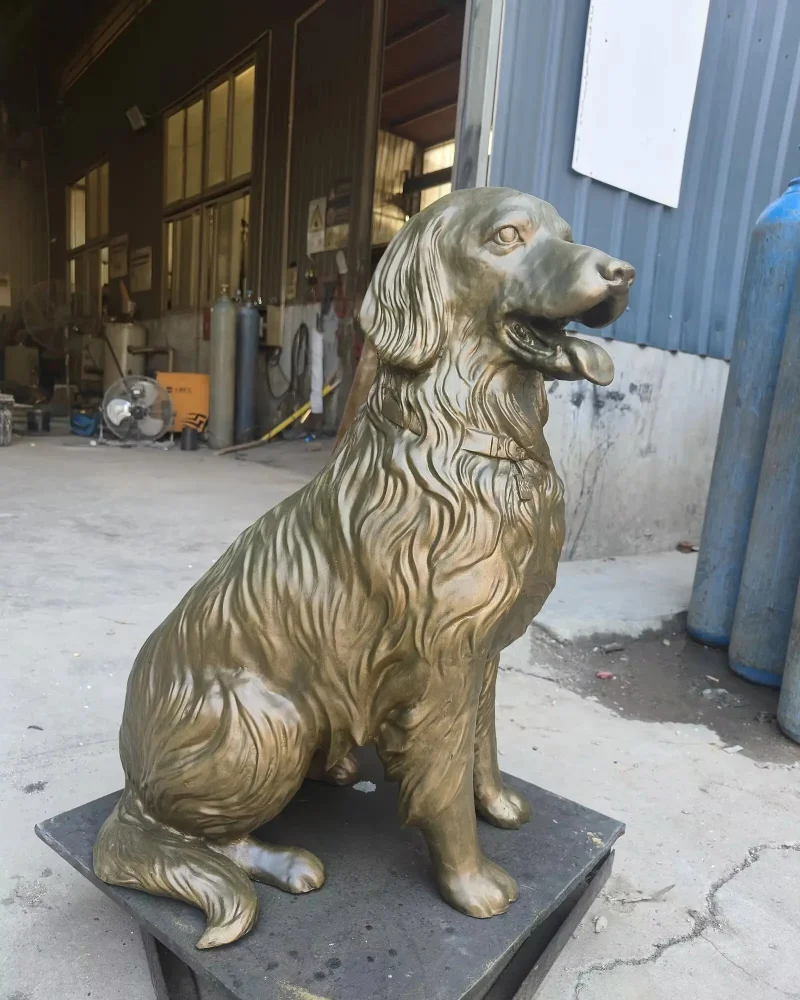
A portrait is a representation of a specific individual. The particular angle at which your dog holds its head. The way it sits with one paw slightly forward and one tucked back. The expression in a moment of complete attention versus the softer look when it is settling in for the evening. These are not breed characteristics — they are behavioral signatures that belong to one animal and no other. They are also exactly what makes the commission worth having, and exactly what most foundries do not ask for when they request reference material.
The practical consequence of this distinction runs through every stage of the commission. Reference photography requirements are different. The clay model stage requires a different kind of client involvement — not “does this look like a Labrador” but “does this look like my Labrador.” The pose selection is not a catalog choice but a conversation about what posture best captures the specific quality that defined your dog’s presence. None of this is more expensive than ordering a breed figure. It requires more thought at the beginning. The result is not comparable.
Coat Type Example Breeds Sculpting Detail Production Time
Short / Smooth Coat Greyhound, Doberman, Vizsla, Weimaraner, Boxer Muscle form and anatomy dominate — clean planes, minimal texture chasing 30–40 days
Medium / Rough Coat Labrador, Beagle, German Shepherd, Bulldog, Pointer Moderate texture; coat direction and break points require careful chasing 35–50 days
Long / Flowing Coat Golden Retriever, Afghan Hound, Irish Setter, Bernese Mountain Dog Elaborate texture throughout; feathering on legs and tail requires extended chasing time 35–55 days
Double / Dense Coat Samoyed, Chow Chow, Pomeranian, Old English Sheepdog, Keeshond Most complex — coat volume and layering require maximum chasing time; highest detail fidelity 45–60 days
Reference Photography — What Actually Captures a Dog
Dogs do not pose. This is the fundamental challenge of reference photography for a canine portrait commission, and it cannot be solved by attempting to make the dog pose — the result is always a stiff and uncharacteristic image that produces a stiff and uncharacteristic sculpture. The photographs that matter for a dog portrait are the ones that were not staged: the shot taken from across the room while the dog was watching something, the photograph from below while it was standing over the camera, the image where someone called the dog’s name a second before the shutter closed.
The reference set for a portrait commission should cover three things: the dog’s face from multiple angles including profile and slightly below eye level, the dog’s body in its most characteristic resting and standing positions, and at least one photograph that shows the specific behavioral signature you most want the sculpture to capture. This last category is the one most families underestimate. If your dog had a characteristic way of lying with its chin on its paws, or a tilt it always did when curious, or a way of sitting that was almost but not quite symmetrical — that photograph is more valuable than any number of technically perfect profile shots.
Video is an underused reference source for dog commissions. A short video clip of the dog moving, settling, and at rest gives a sculptor access to three-dimensional information that no set of still photographs can fully provide — particularly for the relationship between the head and the neck, the way the back slopes from shoulders to hips, and the habitual position of the tail. We welcome video reference in addition to photography for any dog commission where the client has footage available.
For memorial commissions where the dog has passed, the reference set is fixed: what exists is all that will exist. I ask families to search beyond the obvious formal photographs — phone camera rolls from the last year of the dog’s life, photographs taken during walks or in the garden, images where the dog appears in the background of a family photograph. These incidental images often capture the dog more truly than any photograph taken specifically to document its appearance.
Three Commission Contexts — Which One Applies to You
A personalized dog statue commission begins from one of three emotional contexts, and each context affects what the commission is actually trying to achieve.
A memorial commission marks the absence of a specific dog. The piece is not primarily decorative — it is a material acknowledgment that this individual existed and mattered. The standard of success is recognition: does the person who knew the dog recognize it? Can they see the specific quality of presence that made that dog itself? For memorial commissions, I prioritize the reference material review at the very start of the process, before any brief is agreed, because the reference available determines what the commission can achieve. There is no later stage at which a reference gap can be filled.
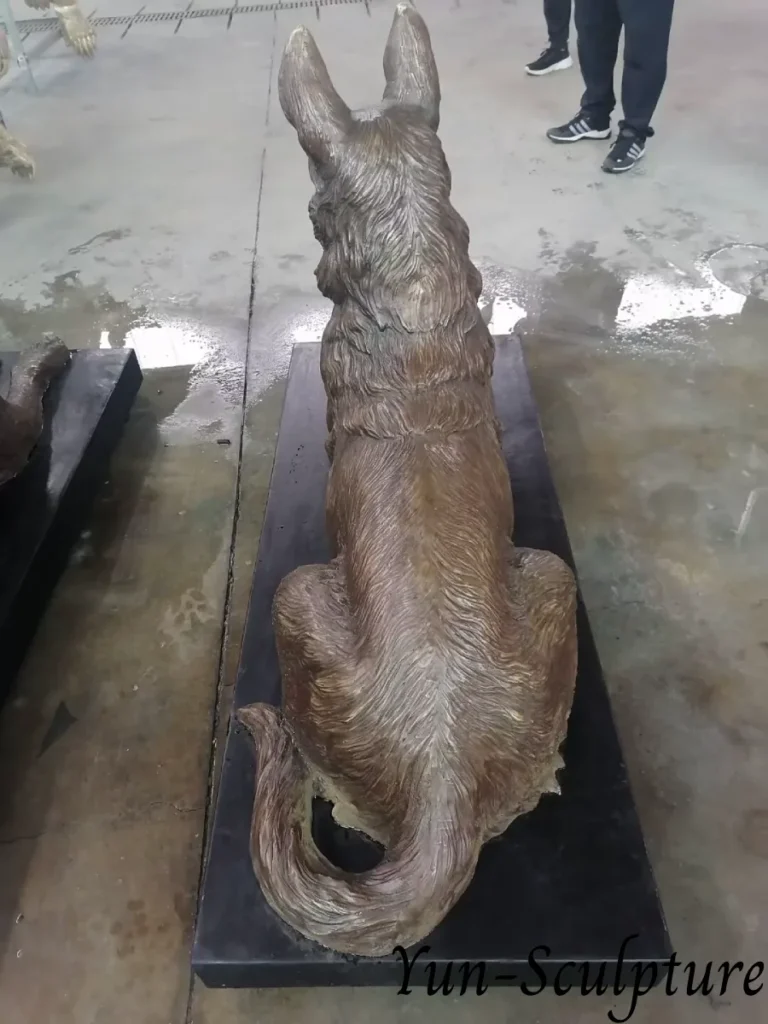
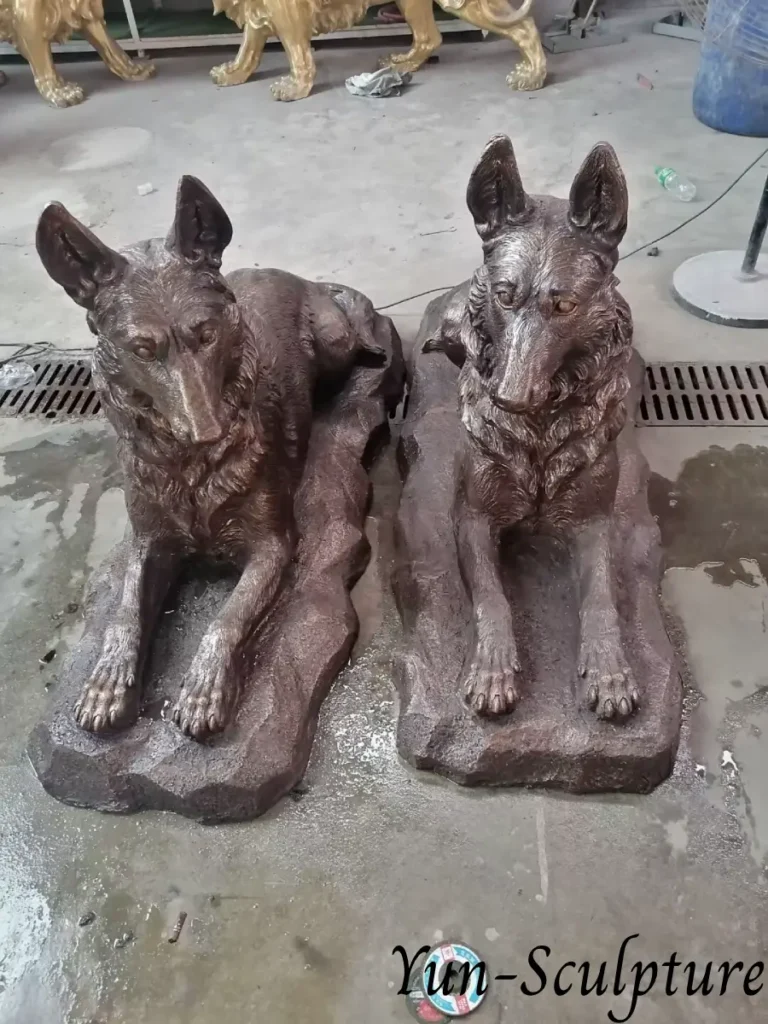
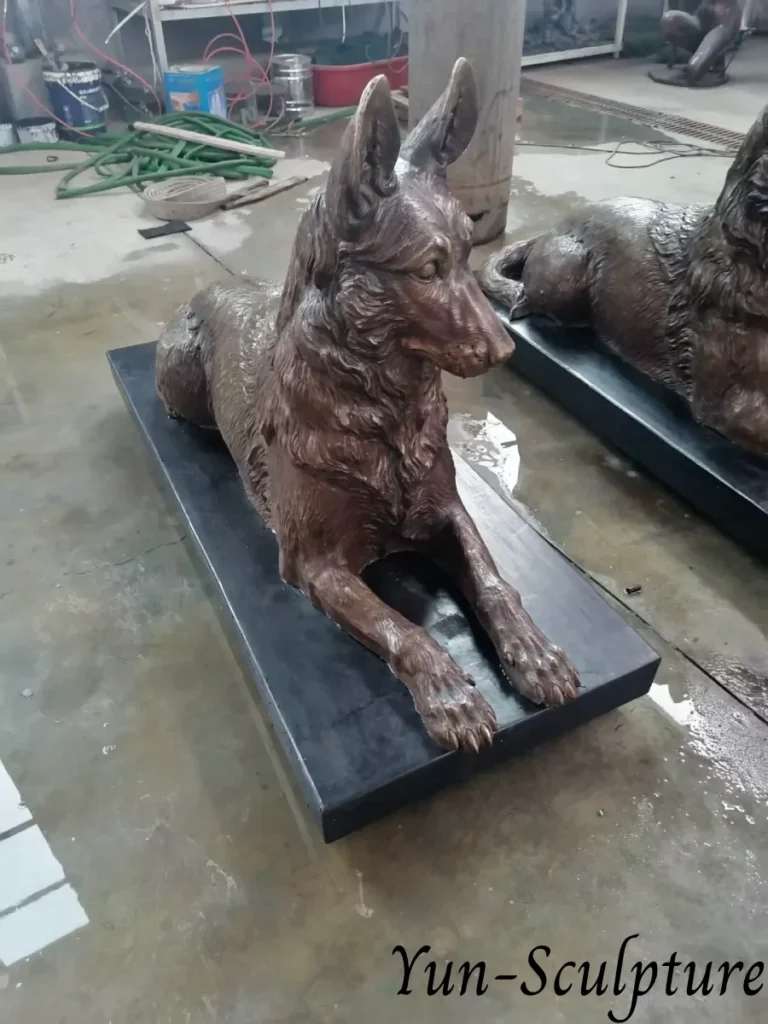
A living portrait commission produces a permanent tribute to a dog that is still present. The statue will eventually become memorial — that is the nature of dogs and time — but it is commissioned in a different spirit: as an act of appreciation rather than commemoration. For this type, the client often has abundant reference material and the dog can be photographed again if specific references are needed. The commission has the same technical requirements as a memorial, but the emotional stakes at the reference stage are lower because gaps can be filled.
An institutional or mascot commission places a dog in a public context — a school, a business, a sporting club, a veterinary practice, a working dog organization. Here the dog may be a specific individual (a retired police dog, a famous therapy dog, a beloved clinic mascot) or a representative type (a breed associated with the institution’s values or history). For institutional commissions, the approval process typically involves more stakeholders than a private commission, and the scale is often larger — a mascot figure at a school entrance or a working dog memorial at a police headquarters are life-size or heroic-scale commissions with institutional review requirements.
Scale Guide for Dog Commissions
Dog commissions present a scale question that human figure commissions do not: life-size means something very different depending on the breed. A life-size Chihuahua is a 20-centimeter sculpture. A life-size Great Dane is a 90-centimeter sculpture at the shoulder. The practical and emotional weight of these two commissions is entirely different, and the price and production time reflect this.
For indoor memorial placements — on a mantelpiece, a side table, beside a reading chair — a life-size commission for a small or medium breed is often the correct choice. The figure occupies the space with presence without overwhelming it, and the detail quality at life-size for a 40-to-60-centimeter dog is excellent. For large and giant breeds, a life-size indoor commission can be unexpectedly large — a life-size Newfoundland or Saint Bernard in a domestic interior is a significant sculptural presence that requires space planned for it.
For garden placements, I recommend erring toward life-size or slightly above for any breed. Garden scale is unforgiving: a figure that reads powerfully indoors can appear diminished against open planting and sky. A large breed at life-size in a garden — a German Shepherd sitting at a garden gate, a Golden Retriever at the edge of a lawn — carries the kind of presence that makes the garden feel inhabited.
| Commission Scale | Breed Size Examples | Best Setting | Price Range (USD) |
|---|---|---|---|
| Portrait bust / head | Any breed | Mantelpiece, desk, bookshelf — close-range daily presence | $1,500 – $4,000 |
| Life-size — small breed | Chihuahua, Dachshund, Shih Tzu (20–35 cm at shoulder) | Indoor alcove, side table, covered garden terrace | $2,000 – $5,000 |
| Life-size — medium breed | Beagle, Cocker Spaniel, Bulldog (35–55 cm at shoulder) | Garden path, indoor pedestal, entrance hall | $3,000 – $12,000 |
| Life-size — large breed | Labrador, German Shepherd, Golden Retriever (55–75 cm at shoulder) | Garden focal point, entrance gate, institutional setting | $5,000 – $20,000 |
| Life-size — giant breed | Great Dane, Mastiff, Newfoundland, Saint Bernard (75–95 cm at shoulder) | Large garden, estate, public memorial setting | $8,000 – $25,000 |
Frequently Asked Questions
How do you honor a dog who passed away?
A commissioned bronze portrait is among the most permanent ways to honor a dog who has died — bronze preserves likenesses for thousands of years, and a properly executed portrait captures not just the breed but the specific individual: the characteristic pose, the expression, the behavioral signatures that belonged to that dog alone. Of the available options, a bronze portrait is the only one that creates a physical presence — the dog occupying a specific place in the space it knew — rather than a commemorative record.
Is it good to keep a dog statue at home?
A dog statue at home functions as a memorial to a specific animal, a tribute to a living dog, or a decorative expression of affinity for dogs. As a memorial, many families find the physical presence of a portrait statue — one that captures the specific dog’s characteristic pose and expression — a meaningful way to maintain connection with an animal that was part of daily life. There are no negative cultural associations with dog statues in Western domestic settings. In some traditional Asian contexts, specific postures carry symbolic associations with loyalty and protection.
How much does a life size dog statue cost?
Cost depends on breed size and coat complexity. Small breeds (Chihuahua, Dachshund): $2,000–$5,000. Medium breeds (Beagle, Cocker Spaniel): $3,000–$12,000. Large breeds (Labrador, German Shepherd, Golden Retriever): $5,000–$20,000. Giant breeds (Great Dane, Newfoundland): $8,000–$25,000. Long and double-coated breeds add approximately 20–30% to production time and cost compared to smooth-coated breeds of the same size. A portrait bust of any breed starts at approximately $1,500.
Did Hachiko really wait for 9 years?
Yes. Hachiko was an Akita belonging to Professor Hidesaburo Ueno of Tokyo Imperial University. After Ueno’s sudden death in May 1925, Hachiko returned to Shibuya Station every evening — where he had always met his owner — for approximately nine years until his own death in March 1935. Railway workers fed and cared for him throughout. A bronze statue was installed at Shibuya Station in 1934 while Hachiko was still alive. The current bronze, installed in 1948, remains one of the most visited sculptures in the world and one of the most recognized symbols of canine loyalty in human culture.
How long does it take to make a personalized dog statue?
Production runs 30 to 80 working days from approved clay model, depending on breed size and coat complexity. Short-coated breeds at smaller sizes: 30–40 days. Large long-coated breeds (Golden Retriever, Afghan Hound): 45–65 days. Double-coated breeds (Samoyed, Chow Chow): 55–80 days. The clay modeling stage adds 2–3 weeks before production begins. International shipping to North American destinations adds 15–25 days.
Factory Direct · Quyang, China
Commission a Portrait of Your Dog
Not a breed figure — a portrait of your specific dog. Every coat type, any breed, any scale. The commission begins with your reference photographs and a conversation about the pose that captures who your dog was.