Get in touch with Yun-Sculpture company
The Magic of kugel ball fountain: How Massive Granite Spheres Float on Water

🔥 At a Glance
- Core Mechanism: Hydrostatic Bearing (Laminar Flow Film)
- Required Pressure: 8–15 PSI (High-flow pool pumps are strictly prohibited)
- Machining Tolerance: ≤ 0.05mm variance (via Multi-axis CNC)
- Mandatory Material: High-Density Granite (e.g., Shanxi Black). Note: Marble is structurally incompatible.
- Maintenance Profile: Self-purging micro-gap prevents debris intrusion
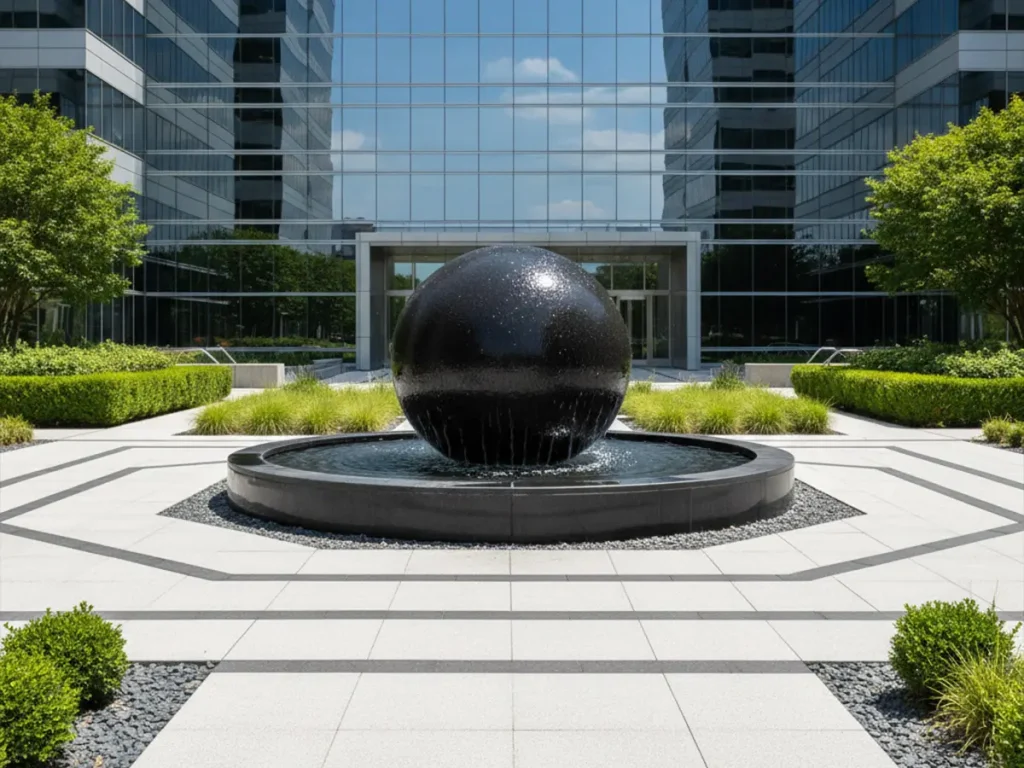
- Architectural Style: Modern Minimalist, Corporate Plazas, Feng Shui Wealth Activation
Table of Contents
Table of Contents
Introduction: The Illusion of “Magic” vs. the Mathematics of Pressure
When people see a two-ton granite sphere rotating effortlessly on a thin sheet of water, they call it “magic.” Some even say “anti-gravity.” I am Donghui Zhang, and I have spent twenty years building these systems. There is no magic, and gravity has not been defeated. What you are looking at is controlled load distribution, calculated surface area, and a stable hydrostatic equilibrium created by precisely regulated water pressure.
Gravity is not removed. It is counterbalanced. The entire mass of the sphere is supported by distributed water pressure acting over a defined bearing area. If the pressure multiplied by the effective contact area equals the weight of the sphere, the ball lifts. If it exceeds the weight slightly, a stable water film forms. If it is insufficient, the stone drags, grinds, and eventually destroys itself.
I have seen what happens when this is not understood. A budget supplier once attempted to install a 1.8-ton granite kugel without properly calculating the effective bearing surface. Their socket geometry was crude, the contact area smaller than assumed, and they compensated by increasing pump pressure. They required more than 40 psi just to initiate lift. Even then, the sphere dragged intermittently because the pressure distribution was uneven. The pump screamed, the energy consumption tripled, and the stone surface began to scar within weeks. That installation was marketed as “high-performance.” It was, in reality, an engineering failure.
What appears effortless is, in fact, the result of strict mathematical discipline.
The Physics of the Hydrostatic Bearing (How It Actually Works)
A kugel fountain operates on the principle of a hydrostatic bearing. This is not a decorative term; it is a well-established mechanical engineering concept used in heavy industrial machinery. In a hydrostatic bearing, a pressurized fluid creates a load-carrying film between two surfaces. The fluid completely separates them, eliminating solid-to-solid contact.
In the kugel system, the lower hemispherical socket contains a precisely machined pressure chamber. Water is pumped into this chamber and distributed through calibrated channels toward the center. As pressure builds, water escapes radially between the sphere and the socket, forming a laminar flow film. That thin film—often less than a fraction of a millimeter—supports the entire weight of the stone.
The mathematics is direct.
Force equals pressure multiplied by effective bearing area.
A two-ton granite sphere weighs approximately 18,000–20,000 newtons per metric ton, so roughly 36,000–40,000 newtons total. If the effective bearing area is, for example, 0.05 square meters, then:
Pressure = Force / Area
≈ 40,000 N / 0.05 m²
≈ 800,000 Pa
Eight hundred kilopascals is approximately 8 bar? No. That would be incorrect. Eight hundred kilopascals is 0.8 MPa, which equals roughly 116 psi. But here is the mistake amateurs make: they assume the effective area is tiny. In reality, the true hydrostatic pocket and pressure distribution geometry increase the effective area significantly. With proper socket design, the load-bearing area is much larger than a naive geometric estimate.
In correctly engineered systems, it only requires 8–15 psi to lift a two-ton sphere. That is not a large number. The reason is controlled pressure distribution across a broad hydrostatic pocket. The water does not act at a single point; it acts across a carefully shaped spherical interface designed to maximize stable support.
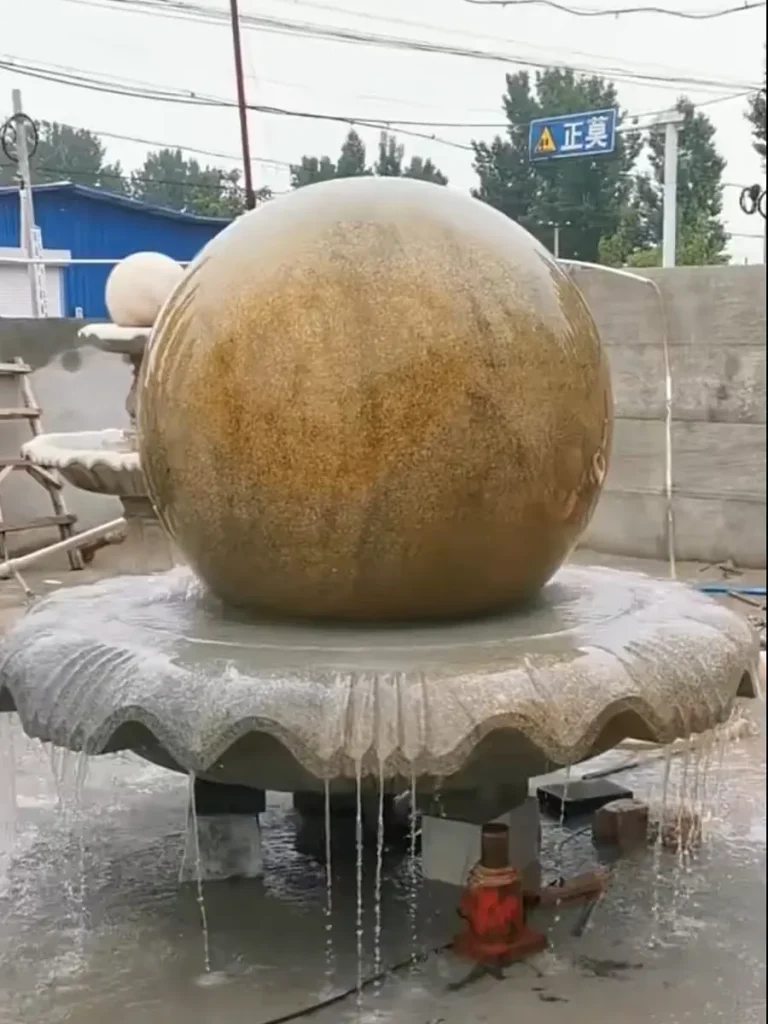
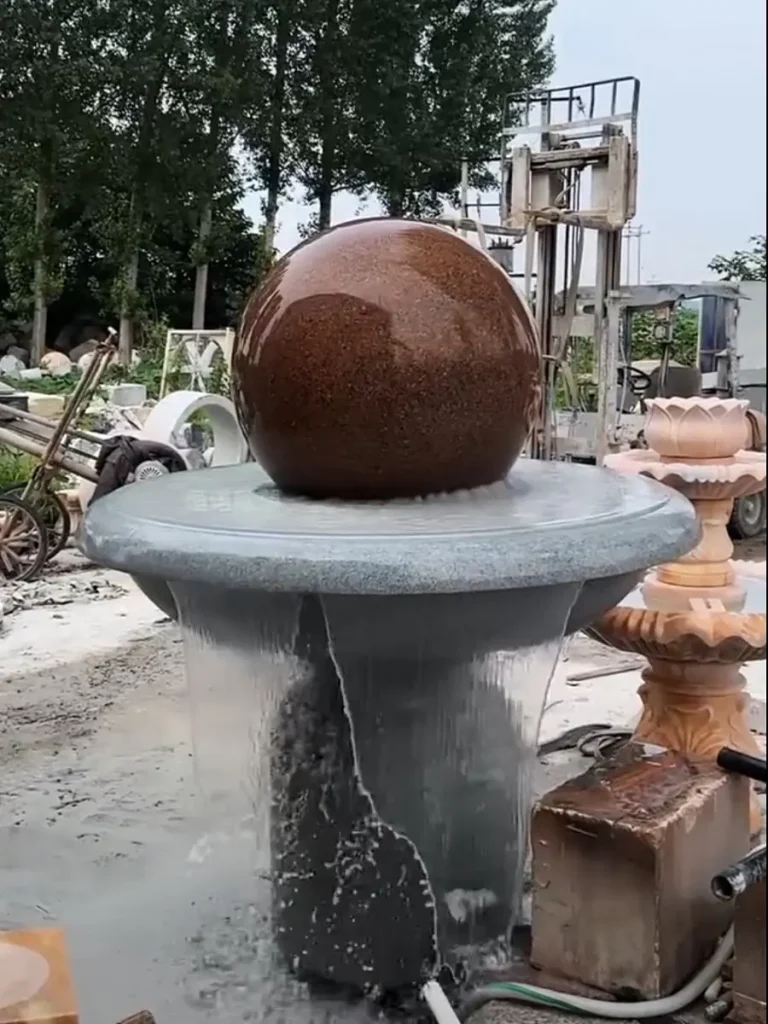
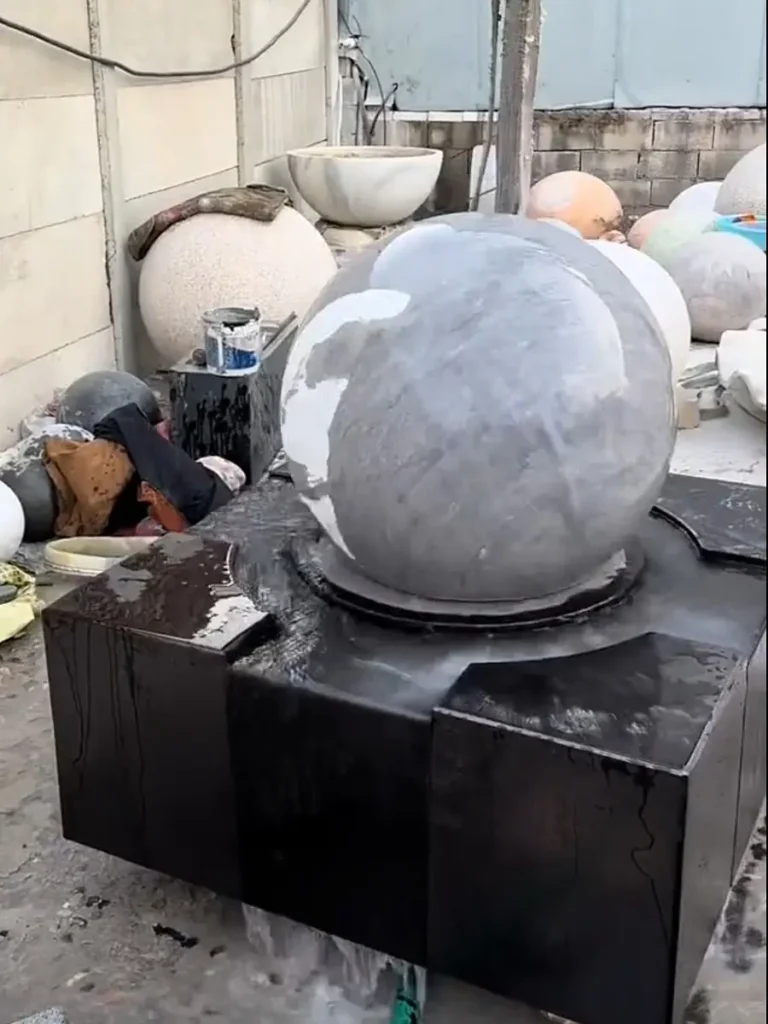
Now we must address a persistent myth: the “high-horsepower pump” solution. I despise this misconception. Pressure and flow rate are independent variables. A high-flow pump designed for swimming pools moves large volumes of water but does not inherently provide stable pressure regulation. What a kugel bearing requires is controlled pressure, not chaotic flow.
I once inspected a failed installation where contractors used an oversized pool pump because they believed “more power” meant better lift. The pump delivered excessive flow with unstable pressure fluctuations. The result was oscillation. The sphere would rise unevenly, tilt microscopically, and then settle repeatedly. That micro-oscillation destroyed the laminar film stability. Within months, scoring marks appeared along the lower hemisphere. The system consumed triple the intended energy and still performed worse than a properly engineered 1-horsepower regulated pump.
Hydrostatic bearings demand stability. Pressure must be constant, evenly distributed, and precisely matched to the load. Anything else is noise masquerading as engineering.
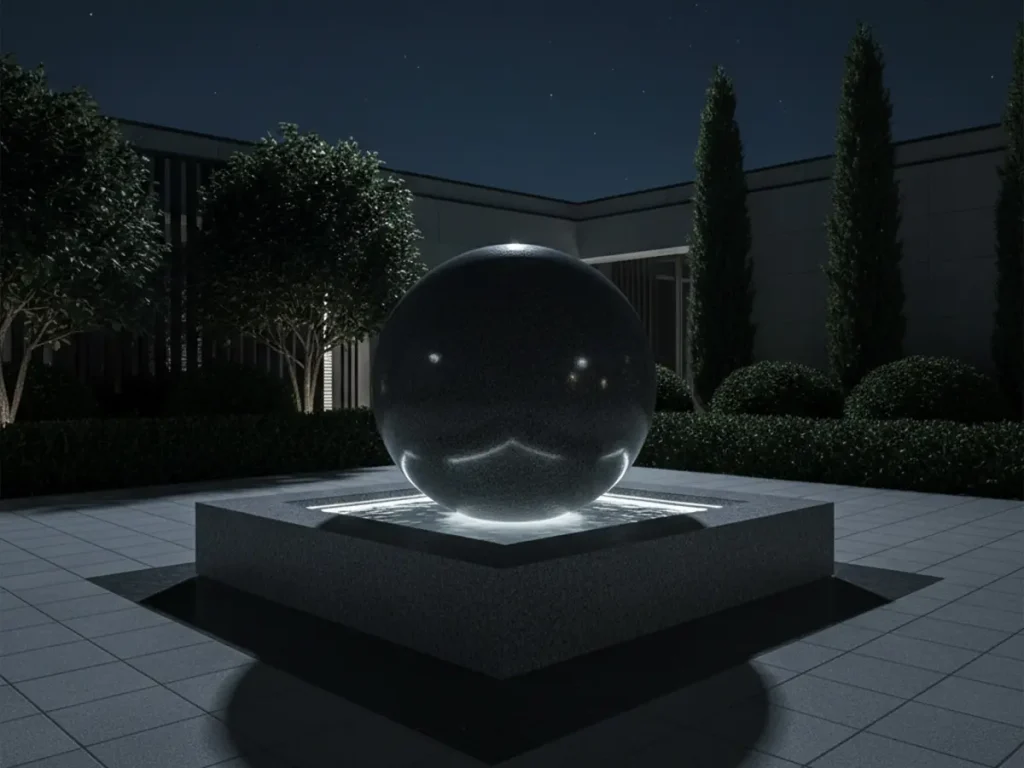
The 0.05mm Tolerance Secret — Precision CNC vs. Crude Carving
The true secret of a successful kugel fountain is not the pump. It is the tolerance.
The maximum permissible variance between the sphere and the socket in our systems is 0.05 millimeters. That is fifty microns. For reference, a human hair is approximately 70 microns thick. If the gap varies beyond this range around the circumference, pressure distribution collapses.
We achieve this tolerance using multi-axis CNC machining. The sphere is turned and finished on precision-controlled equipment, and the socket is machined using calibrated tooling paths verified by CMM—coordinate measuring machines. Concentricity tolerance is tightly controlled. Surface roughness is maintained below Ra 0.8 micrometers to ensure laminar flow stability. Rough surfaces create turbulence; turbulence disrupts uniform pressure distribution; disruption leads to dry contact.
Some factories attempt to carve spheres manually and “polish to fit.” They grind by eye. They test by hand rotation. This is unacceptable. A hydrostatic bearing is not a sculpture base; it is a load-bearing fluid system. Eyeballing tolerances is not craftsmanship—it is negligence.
I investigated a catastrophic failure involving a marble kugel that lasted less than six months. The tolerance gap varied by 0.6 millimeters around the circumference. That is twelve times beyond acceptable deviation. When pressure was applied, certain regions developed adequate film thickness, while others made intermittent solid contact. These dry contact points carried localized loads exceeding the compressive strength limits of the stone surface finish.
The result was predictable. Micro-fractures formed. Powdered marble accumulated within the bearing pocket. The abrasive slurry accelerated wear, widening the inconsistent gap further. Within half a year, the lower hemisphere had visibly flattened in sections, and the socket geometry was irreversibly damaged. The supplier blamed “water quality.” The true cause was crude machining.
A kugel fountain succeeds or fails at the micron level. If you cannot measure it, you cannot build it. If you cannot machine it concentrically, you cannot stabilize it. And if you do not respect the mathematics of pressure and tolerance, gravity will remind you very quickly that it has not been defeated.
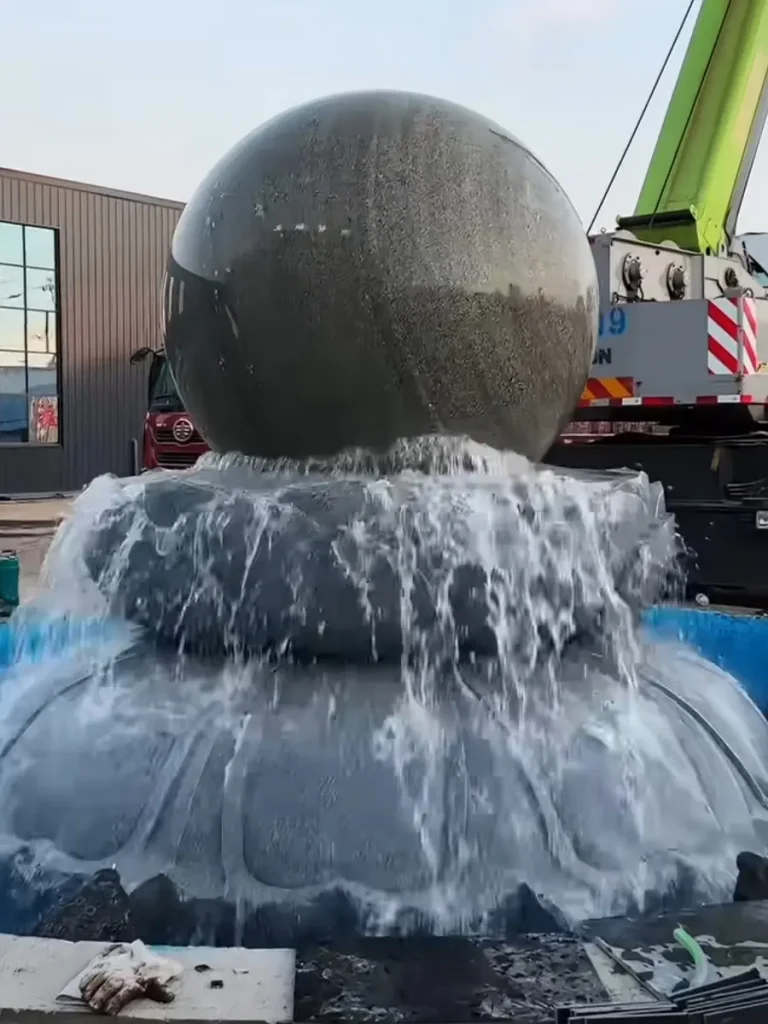
Material Science — Why High-Density Granite Is Mandatory
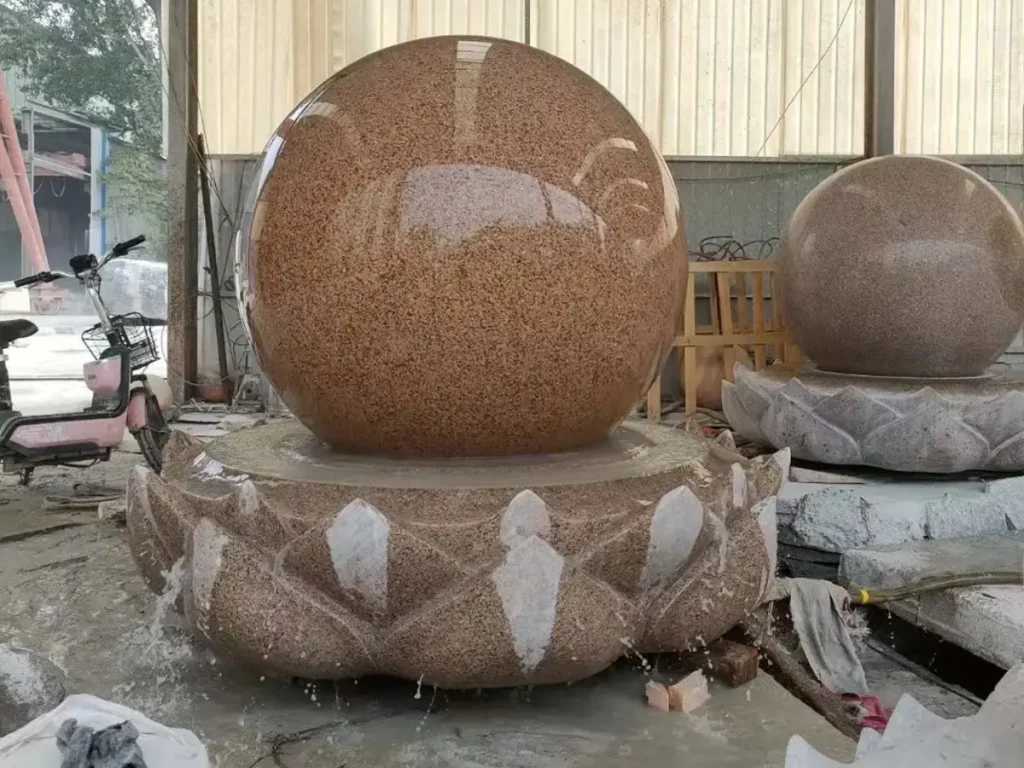
A hydrostatic bearing system is only as durable as the material resisting compressive load at the contact band. For kugel fountains, high-density granite is not a preference; it is a requirement. On the Mohs hardness scale, premium black granites such as Black Galaxy and Shanxi Black typically rate around 6 to 7. Marble averages closer to 3 to 4. That difference is not cosmetic. It directly affects abrasion resistance under micro-load conditions inside a pressurized fluid film.
Compressive strength tells the same story. Dense granite commonly exceeds 180–250 MPa. Many marbles fall within 70–120 MPa. Under hydrostatic lift, the sphere is supported by water, but during startup, shutdown, and micro-instabilities, transient contact can occur. When that happens, a harder material survives. A softer one erodes. Water absorption rate is another silent factor; granite typically absorbs less than 0.2%, while marble can exceed 0.5%. Higher absorption means more internal moisture variation, more microfractures under freeze cycles, and faster surface degradation.
The verdict is simple. Marble is fundamentally too soft and too porous for a precision hydrostatic bearing system. It can function decoratively. It cannot function mechanically.
I once worked with a client who insisted on white marble for aesthetic purity. I advised against it repeatedly. The system was built with correct geometry and correct pressure calculations, but material properties do not negotiate. Within months, a faint matte band appeared along the equatorial contact zone. That band widened as microscopic abrasion generated marble slurry. The slurry migrated into the pressure channels and began clogging the manifold. Flow distribution became uneven. Uneven flow destroyed film stability. The pump compensated by running longer cycles, ingesting abrasive paste that accelerated impeller wear.
Total system failure occurred in under twelve months. The sphere required replacement. The socket required resurfacing. The pump required rebuilding. All of it was predictable.
Dense black granite, by contrast, maintains surface polish and dimensional stability for decades. Its reflective finish is one reason it is heavily favored in modern Zen landscapes, particularly in projects influenced by principles outlined in our Feng Shui Guide. Material science and visual harmony can coexist. But the physics comes first.
The “Self-Cleaning” and Low Maintenance Mechanics
A correctly machined 0.05 mm tolerance gap does more than support weight. It creates what I call a micro-gap exclusion zone. Because the bearing clearance is extremely small and pressure is constantly maintained, a continuous laminar purge flow is generated outward from the center of the socket. Water is always exiting the interface. Debris would have to travel against pressure to enter. It cannot.
This outward purge flow prevents sand, leaves, and particulate matter from infiltrating the bearing cavity. The film acts as both support and shield. The sphere rotates freely, and the bearing chamber remains isolated from contamination under normal operating conditions.
Cheap decorative fountains ignore this principle. They use open basins with poorly separated pump intakes. Sand enters the circulation system, passes through inadequate filtration, and eventually reaches the socket. Granite is hard, but sand is quartz. Quartz scores stone surfaces. Once scoring begins, laminar flow becomes turbulent. Turbulence destabilizes lift. Wear accelerates.
Proper filtration chamber design, intake separation, and service access are not optional details. They are core engineering elements, which is why we document them thoroughly in our Fountain Installation Guide. Maintenance becomes minimal only when the system is designed to exclude contamination at the mechanical level. Otherwise, “low maintenance” is marketing fiction.
Why Architects & Feng Shui Masters Love Them
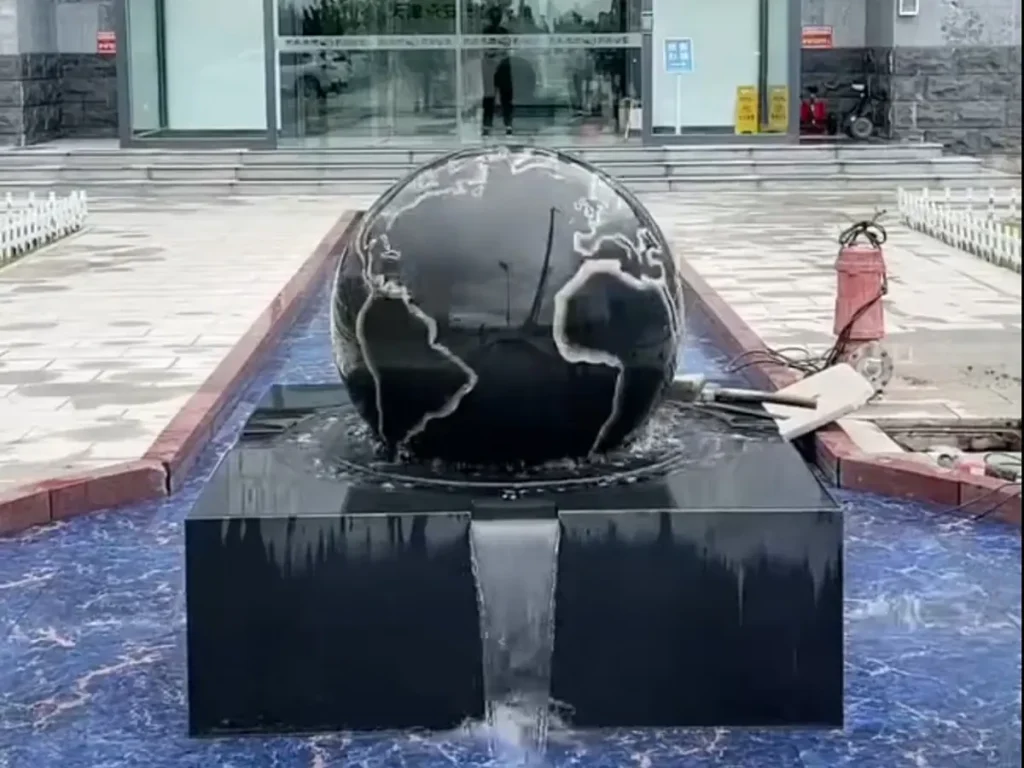
From a structural standpoint, kugel fountains exhibit continuous rotational inertia and perfect axial symmetry. Once lifted, the mass of the sphere creates a stable kinetic presence with extremely low friction. The rotation is smooth because the load is uniformly distributed across a spherical interface. There are no gears. No visible mechanics. Only controlled fluid dynamics.
Modern minimalist architecture relies on strong geometric anchors. A rotating granite sphere provides a kinetic focal point without visual complexity. The eye is drawn to symmetry. The mind registers stability. The motion is constant but restrained. Architects appreciate this because it integrates with steel, glass, and concrete environments without ornamental excess.
Feng Shui consultants approach the same object differently. Continuous motion symbolizes uninterrupted energy flow. The sphere represents unity and completeness. When positioned properly, it is believed to activate prosperity and circulation of wealth energy. That symbolism pairs naturally with installations selected from our Modern Fountain Collection, where material discipline meets spatial philosophy.
Engineers focus on pressure distribution. Designers focus on visual gravity. Both perspectives converge in a properly executed kugel system.
Frequently Asked Questions
1. How do you winterize it?
Water expands approximately 9% when it freezes. If ice forms inside the manifold or socket cavity, expansion forces exceed the compressive limits of stone interfaces and internal fittings. The procedure is straightforward: shut down the pump, drain the manifold through integrated valves, and ensure no standing water remains in the pressure chamber. Do not allow water to remain trapped in the socket during freezing conditions. Freeze expansion is physics. It does not forgive oversight.
2. Is it safe for children?
Yes. The hydrostatic film creates minimal friction, but the rotational inertia is still governed by mass and pressure equilibrium. When external force is applied by hand, the sphere stops immediately because pressure distribution equalizes and rotational momentum is low. There are no exposed gears, no pinch points, and no mechanical drive components. It is fluid-supported motion, not motor-driven torque.
3. Can marble be used?
No.
Marble erodes under micro-abrasion. It generates slurry. Slurry contaminates the manifold. Contamination destabilizes pressure. Instability destroys the bearing. The aesthetic argument does not override the mechanical reality.
Engineering Excellence, Not Illusion
A kugel fountain is not a decorative afterthought. It requires structural load calculation for the base slab, reinforcement design to support concentrated mass, and precise plumbing schematics to maintain stable hydrostatic pressure. The foundation must account for static load plus dynamic water mass. The socket geometry must be machined concentrically. The manifold must be dimensioned correctly for controlled distribution.
We provide serious buyers with base structure CAD drawings and plumbing schematics at no additional cost. These are not marketing diagrams. They are technical documents prepared for contractors and architects who understand that precision matters.
Physics does not tolerate shortcuts.
– Donghui Zhang
Technical Director, Yun Sculpture