Get in touch with Yun-Sculpture company
How Much Does a Large Outdoor Fountain Cost? (2026 Factory Price Guide)

Table of Contents
Table of Contents
The Middleman Tax – Why Most Fountain Prices Are Inflated
You search for weeks. Every website shows beautiful fountains. Every product page says the same thing: “Call for Price.”
You call. No straight answer. Just a sales rep feeling you out.
I’m Boss Zhang. I run the factory floor. I see the raw stone blocks before they’re cut, and I sign off on the bronze pours when the metal is still glowing. I don’t sit in a showroom. I stand next to cranes, water saws, and carving benches.
Here’s the truth.
Most estate fountain prices are inflated by what I call the Middleman Tax.
A retail gallery in California or Florida buys a large marble estate fountain from a factory like mine for $20,000. That’s the real manufacturing cost plus our margin. Then they put it in a catalog, fly to trade shows, rent a warehouse, hire commission-based sales staff, and quote the end client $60,000.
The stone didn’t change.
The craftsmanship didn’t change.
The address on the invoice did.
You’re not paying three times more for better marble. You’re paying for showroom rent, marketing agencies, polished brochures, and a sales team in pressed suits.
I don’t despise profit. I despise waste. If you’re a high-net-worth estate owner or a developer building 20 luxury homes, you should know exactly where your money goes.
Now let’s talk real numbers.
Marble Fountain Pricing (Tiered & Statuary Models)
Marble is the classic choice. Roman lines. French estates. Symmetry and gravity.
But pricing varies wildly. A small two-tier garden fountain and a 12-foot estate centerpiece are not even in the same universe. The stone block size changes. The crane capacity changes. The carving team changes. And the risk changes.
Here’s what factory-direct reality looks like in 2026.

Typical Price Ranges by Size & Complexity (2026 Data)
| Size & Type | Factory Direct Price (USD) | Retail Gallery Price (USD) |
|---|---|---|
| 4–6 ft (2-tier) | $2,000 – $8,500 | $12,000 – $20,000 |
| 6–8 ft (3-tier) | $3,500 – $18,000 | $25,000 – $45,000 |
| 8–12 ft (Estate-level, statuary) | $20,000 – $45,000+ | $60,000 – $120,000+ |
These are not internet guesses. These are container-loading numbers.
Why does it cost this much even at factory level?
First, block yield rate. When we buy a 12-ton raw marble block from the quarry, we never turn 12 tons into finished fountain. Between cutting, shaping, coring for plumbing, and removing flawed sections, we lose 30–50% of the raw material. That waste is not optional. If we try to “save” stone by leaving weak areas inside the bowl, it will fail in five years.
Second, labor is not equal across designs. A clean Roman-profile tier with smooth curvature can be shaped efficiently with CNC roughing followed by skilled hand finishing. A high-relief statuary fountain with cherubs, horses, or mythological figures is another story. Deep undercuts, flowing drapery, and facial detail require senior carvers. Not machine operators. Carvers. Their hands are the difference between museum quality and tourist souvenir.
An 8-foot simple tiered fountain might take a few weeks. A 10-foot multi-figure estate fountain can occupy a carving team for months.
That is where the money goes. Stone loss and human skill.
A-Grade vs B-Grade Stone (The Truth Nobody Tells You)
This is the part almost nobody explains clearly.
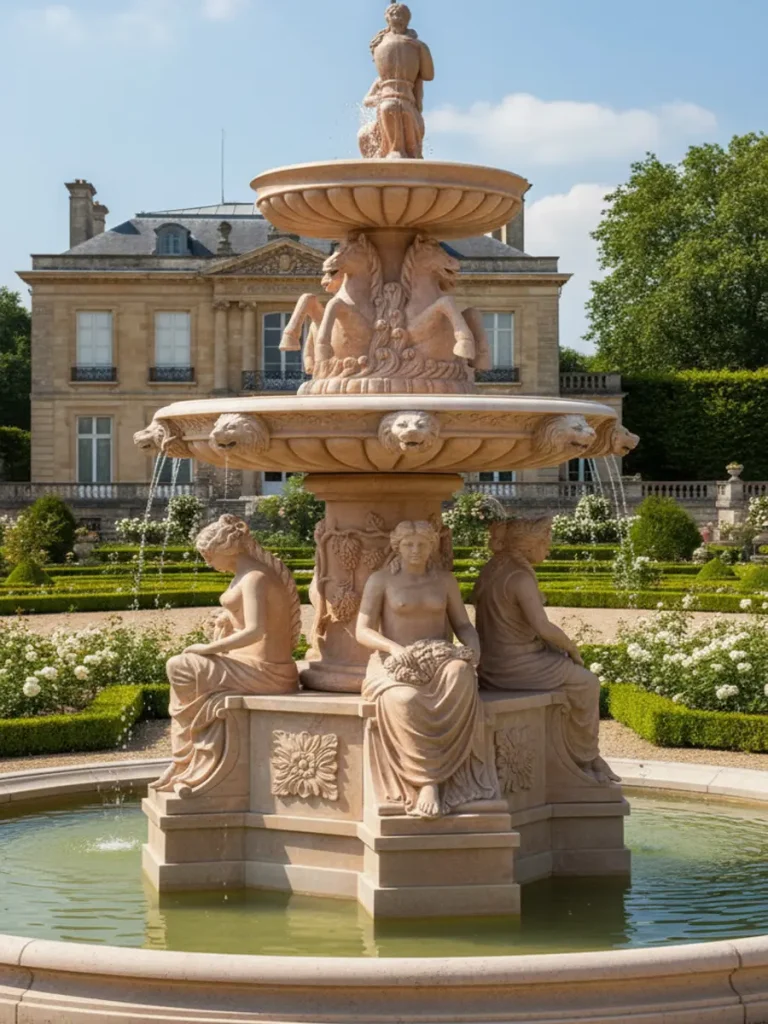
A-Grade Marble
Dense structure. Low porosity. Minimal unstable veining. No structural cracks. No resin injection patches in critical load areas. When we core the plumbing channels through the central column, the internal stone remains solid and tight.
B-Grade Marble
Visible or hidden micro-fractures. Resin-filled cracks. Putty patches. Higher porosity. More dramatic veining that looks beautiful in photos but weakens the internal structure.
B-Grade is cheaper at the quarry. Sometimes dramatically cheaper. That savings tempts inexperienced buyers and aggressive online sellers.
I’ll tell you a real story.
A client in the Midwest bought a “$3,000 marble fountain” online from another supplier. The photos looked fine. White marble. Two tiers. Delivered on a pallet.
The first summer was okay. Then winter came.
Water seeped into the micro-fractures inside the main bowl. When temperatures dropped below freezing, that water expanded. Freeze-thaw pressure builds from inside the stone. Not from the surface.
By spring, the entire main bowl had cracked through. Structurally finished.
He called the original seller. No real solution. Shipping damage, they said.
He came to us after that. We rebuilt the fountain properly with dense A-grade marble and correct drainage design. It cost more than $3,000. But he only had to buy it once.
Cheap stone is expensive in cold climates.
If you live in an area with serious freeze cycles and you don’t want to deal with stone maintenance at all, I often advise clients to consider switching materials. That’s exactly why we wrote a detailed comparison breaking down bronze versus marble fountains — because sometimes the right answer is not more stone, it’s smarter material selection.
Next, we talk about bronze — and why molten metal behaves very differently from carved rock.
Bronze Fountain Pricing (Animal Sculptures & Grand Tiered Designs)
Now we shift materials.
Marble is carved away. Bronze is built up. Completely different economics. Completely different risks.
When I approve a bronze fountain, I am not thinking about block yield rate. I am thinking about metal weight, copper markets, furnace temperature, weld integrity, and patina chemistry. Bronze is not just art. It is heavy industrial casting wearing a beautiful face.
How Copper Commodity Prices Affect Your Fountain
Bronze is typically 85–90% copper, with tin and trace elements added for strength and flow characteristics. That means your fountain is tied directly to global copper pricing. If copper jumps 15% in a quarter, our raw material cost jumps with it. There is no way around that.
A life-size animal fountain can weigh 800 to 1,500 pounds in finished bronze. A grand tiered estate fountain can exceed several tons once you include the basins, central column, and internal support structure. We purchase copper ingots and high-grade recycled material, and every pour includes what we call scrap loss—gates, risers, overflow channels. Those excess bronze structures are cut off after casting and sent back for remelting. That’s the remelt factor. It sounds efficient, but every remelt cycle costs energy, labor, and material degradation.
This is metal commodity pricing, not decorative markup.
Here are realistic 2026 factory-direct ranges:
- Life-Size Animal Bronze Fountain: $15,000 – $30,000
- Grand Tiered Bronze Estate Fountain: $20,000 – $40,000+
Retail galleries? The same pieces routinely sell for $70,000 and well beyond. I’ve seen identical horse fountains quoted at $95,000 simply because they sat under showroom lighting with a champagne reception.
The bronze didn’t change. The address changed again.
Lost Wax Casting – Why Labor Multiplies the Cost
People see bronze and think, “Metal is cheaper than stone.”
They are wrong.
The lost wax casting process is brutal in labor.
First, a full-scale clay model is sculpted by hand. Not a sketch. A complete, anatomically correct form. Then we create a multi-part silicone mold over that sculpture. Inside that mold, wax replicas are produced. Those wax sections are assembled with wax sprues and gating systems so molten metal can flow correctly.
Next comes the ceramic shell process. Each wax assembly is dipped repeatedly into slurry and sand, layer after layer, until it forms a hardened shell. Then it is baked in a kiln. The wax melts out. That’s the “lost wax.”
Only then do we pour bronze at nearly 2,000°F (1,100°C) into the cavity.
A large bronze tiered fountain is almost never poured in one piece. It would be structurally unstable and impossible to transport. Instead, it may require 30, 40, sometimes 50 separately cast sections. Bowls. Figures. Decorative elements. Internal reinforcement structures.
After casting, the real grind begins. Cutting off gates. Grinding. Welding seams invisibly. Chasing surface details back into the metal by hand so you cannot see where one section ends and another begins. Then patination—chemical treatments applied with heat to create the final surface color. Brown, verde, black, golden highlights.
When a client asks for complex multi-figure designs—galloping horses with raised legs, roaring lions with open jaws, children intertwined with dolphins—the labor hours explode. Structural engineering becomes part of the sculpture. Balance, weight distribution, internal stainless armatures. This is why in our detailed Animal & Statue Fountain Guide, we explain how complexity directly multiplies cost. More limbs in the air means more hidden steel and more welding hours.
Bronze is permanent. But permanence is expensive.
Kugel (Rolling Sphere) Fountain Pricing – Precision Engineering Costs
Now we move from classical to modern.
Kugel fountains look simple. A massive stone sphere floating and rotating on water. Minimalist. Clean. Corporate plaza style.
Do not be fooled.
Factory pricing for Kugel fountains typically ranges from $3,000 to $8,000+, depending on sphere diameter and stone selection. Large architectural installations go far beyond that.
The cost is not about carving beauty. It is about mathematics.
A Kugel fountain works through hydrostatic pressure. Water is pumped into a precisely machined socket. That pressurized water forms a thin film between the sphere and its base. The sphere—sometimes weighing one or two tons—floats on that microscopic water layer. With a gentle push, it rotates in any direction.
The engineering secret is tolerance.
The gap between the socket and the sphere must be machined to roughly 0.05 millimeters. That’s thinner than a human hair multiplied a few times. Too tight, and the sphere grinds. Too loose, and water pressure escapes. The ball wobbles and loses lift.
We use multi-axis CNC machines to achieve that precision. This is not traditional carving. It is industrial machining.
Cheap Kugels fail for two main reasons.
First, uneven stone density. If the granite has internal density variations, the sphere’s weight distribution becomes uneven. It will favor one side and refuse to rotate smoothly.
Second, poor machining accuracy. If the socket is off by a fraction of a millimeter, hydrostatic pressure cannot distribute evenly. The ball spins for a week. Then it starts sticking. Eventually it grinds to a halt.
And material matters. High-density granite is mandatory. Marble is too soft. Over time, marble will wear under rotational friction and pressure. The tolerance widens. Performance collapses.
For corporate headquarters, civic plazas, and minimalist estates, this geometric style is unmatched. It communicates engineering confidence. That’s why we often compare Kugel systems against other contemporary designs in our Modern Steel vs Stone Fountain Guide, especially when clients are deciding between raw industrial steel aesthetics and pure geometric stone precision.
Stone can be art.
Bronze can be sculpture.
Kugel is engineering discipline carved into rock.
Next, we will talk about the hidden costs most suppliers conveniently forget to mention.
The Hidden Costs Galleries Never Mention
This is where most budgets explode.
Retail galleries love to show you a beautiful number on a polished quote sheet. What they don’t show you is the second page. The third page. The “oh by the way” page that appears after you’ve already committed.
I don’t play that game. I put the real numbers on the table day one.
Ocean Freight & Crating
Large fountains do not ship in cardboard boxes.
We calculate freight by CBM — cubic meter volume. The size of the crate, not just the weight, determines your shipping cost. A 6-foot marble fountain might require a crate measuring 2.5m x 2.5m x 1.8m once properly packed and braced. That volume adds up quickly.
And the crate itself is not cheap wood from a hardware store. We use heavy-duty, export-grade, fumigated wooden crates with internal steel bracing when necessary. Marble bowls cannot shift even one inch during ocean transit. If they do, they crack. So we overbuild the crate.
In 2026, realistic ocean freight for a large fountain ranges from $1,500 to $4,000, depending on crate size and destination port in the U.S. West Coast is usually lower. East Coast or inland routing costs more.
Galleries often quote a “product price” that excludes freight. Then you’re surprised later.
Not with me.
Crane Installation & Site Access
Estate fountains weigh tons. Literally.
An 8-foot marble fountain can weigh 6,000 to 12,000 pounds. A large bronze estate fountain with basins can easily reach similar weight once assembled. You are not setting this with a forklift from Home Depot.
You need a crane.
Crane day rates vary by region, but expect $800 to $2,000 per day depending on lifting capacity and location. If the installation site has tight access, trees, gates, or a long driveway, that number can increase. Sometimes we need to coordinate street permits.
And here is where planning matters.
The turning radius of a crane, the extension of the boom, the load angle — these are not small details. In our Circular Driveway Fountain Design Guide, we spend real time explaining how to design your driveway layout so the crane does not crush fresh pavers or landscaping during installation. I have seen six-figure landscaping jobs destroyed in one careless lift.
Stone is heavy. Gravity always wins.
Commercial-Grade Pumps, Plumbing & Foundation (The Heartbeat)
A fountain is not just sculpture. It is a mechanical system.
Under that marble or bronze sits a reinforced concrete pad. Not decorative. Structural. It must be level, properly cured, and thick enough to handle static and dynamic load. Water adds weight. Movement adds stress.
Electrical work must include GFCI protection. Safety is not optional around water.
Now let me talk about something that irritates me.
Cheap fountains use flimsy plastic hoses and $50 aquarium pumps. They burn out in a month. Then the water stagnates. Algae grows. The owner blames the sculpture.
At Yun Sculpture, we pre-install commercial-grade pump housings, heavy-duty submersible pumps, and properly sized copper or reinforced piping systems. We pressure-test before shipment. It costs more upfront. It saves you years of frustration.
The pump is the heartbeat. If the heartbeat fails, the beauty dies.
Frequently Asked Questions (FAQ)
1. Do outdoor fountains use a lot of water and electricity?
No.
The water recirculates in a closed loop. You are not constantly filling it like a swimming pool. Evaporation loss is minor and easily topped off with a hose. The pump typically uses about the same electricity as a few household lightbulbs running continuously. It is not a power-hungry system.
2. How long does it take to manufacture and ship a custom fountain?
For marble carving or bronze casting, plan 4 to 8 weeks depending on size and complexity. Deep statuary or complex bronze assemblies take longer. After manufacturing, ocean freight to the United States typically requires 4 to 6 weeks, plus local customs clearance and final delivery.
If someone promises you a massive custom estate fountain in three weeks, they are not carving it. They are selling you old stock.
3. What is the annual maintenance?
Simple.
If you live in a freezing climate, drain the fountain before winter. Do not let water sit inside bowls during freeze cycles. In warm climates, wipe down algae occasionally and check the pump filter. That’s it.
Stone and bronze are durable materials. Treat them with basic respect and they will outlive you.
Investment vs. Expense (Is a Fountain Worth It?)
Let’s compare honestly.
A swimming pool often costs $100,000 or more once excavation, plumbing, tile, and decking are included. It requires chemicals, cleaning, seasonal maintenance, and in many regions it is usable three months a year.
A properly built estate marble or bronze fountain costs $20,000 to $40,000 at factory-direct pricing. It stands as an architectural sculpture 365 days a year. Even when the pump is off, it remains a visual anchor for your property. It frames your entrance. It elevates perceived value instantly.
Real estate is about emotion and first impression. A grand fountain at the entrance of an estate communicates permanence and authority before anyone steps inside.
That is not an expense. That is positioning.
Stop Guessing. Stop Overpaying Galleries.
You now know the real numbers.
Material. Labor. Freight. Installation. No mystery. No showroom lighting tricks.
If you want a precise, door-to-door factory quote — including material, manufacturing, crating, and realistic freight — we will give it to you. No hidden fees. No inflated gallery markup. Just direct manufacturing truth.
We also offer a free design consultation. Send us your site dimensions, photos, and location. We will tell you what works structurally, what makes visual impact, and what fits your budget without wasting a dollar.
Stone is heavy.
Bronze is permanent.
Precision matters.
– Boss Zhang
Founder & Factory Director, Yun Sculpture