Get in touch with Yun-Sculpture company
The Weight of Sacrifice: The Ultimate Guide to Custom Bronze Jesus on Cross Statues

In 2019, a church architect named David Morales was commissioned to assess a crucifix in a Louisiana parish — a piece cast in iron sometime in the 1880s, surface corroded, one arm cracked at the wrist from a century of coastal humidity. Standard restoration work, or so he expected.
When his team removed the corpus from the cross for structural repair, they found something in the hollow of the figure’s ribcage. Scratched into the inner surface of the iron, in careful letters no larger than a thumbnail: J. Beaulieu, 1883.
A foundry worker — unknown, unrecorded in any parish document — had signed his name on the inside of Christ’s body. Not for recognition. For no one would ever see it. He signed it because he knew this object would outlast him by centuries, and he wanted to be, in some private and permanent way, inside it.
That jesus on cross statue has now stood for over 140 years. The resin replica purchased to replace it during the restoration — ordered from an online catalog, delivered in a cardboard box — had yellowed and cracked within eight years of installation.
This is the distance between a manufactured object and a work of permanent faith. A statue of jesus on the cross executed in bronze or iron is not a religious accessory. It is a convergence of three disciplines that must function as one: theology, which determines what the figure must mean; anatomy, which determines what the figure must show; and metallurgy, which determines how long the figure must endure.
A jesus cross statue built to this standard does not require replacement. It requires inheritance.
Table of Contents
Table of Contents
The Theology of the Crucifix: What Separates a Great Statue from a Mere Object
A client who contacts us having already decided they want a crucifix has made only the first of many decisions. The question that follows — the one that determines everything about the sculptural brief — is: which Christ do you need?
The answer is not aesthetic. It is theological. And the history of Christian art has produced three distinct answers.
Three Moments of the Passion — Three Distinct Iconographic Forms
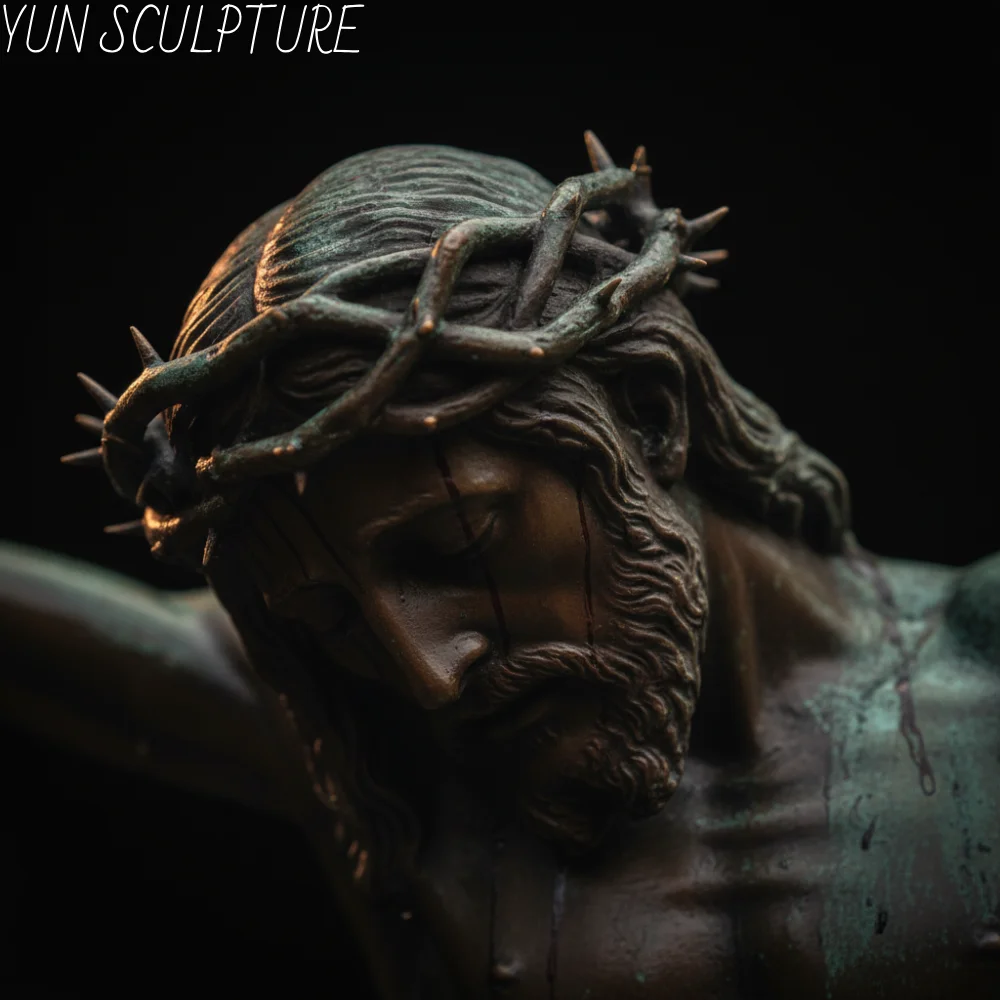
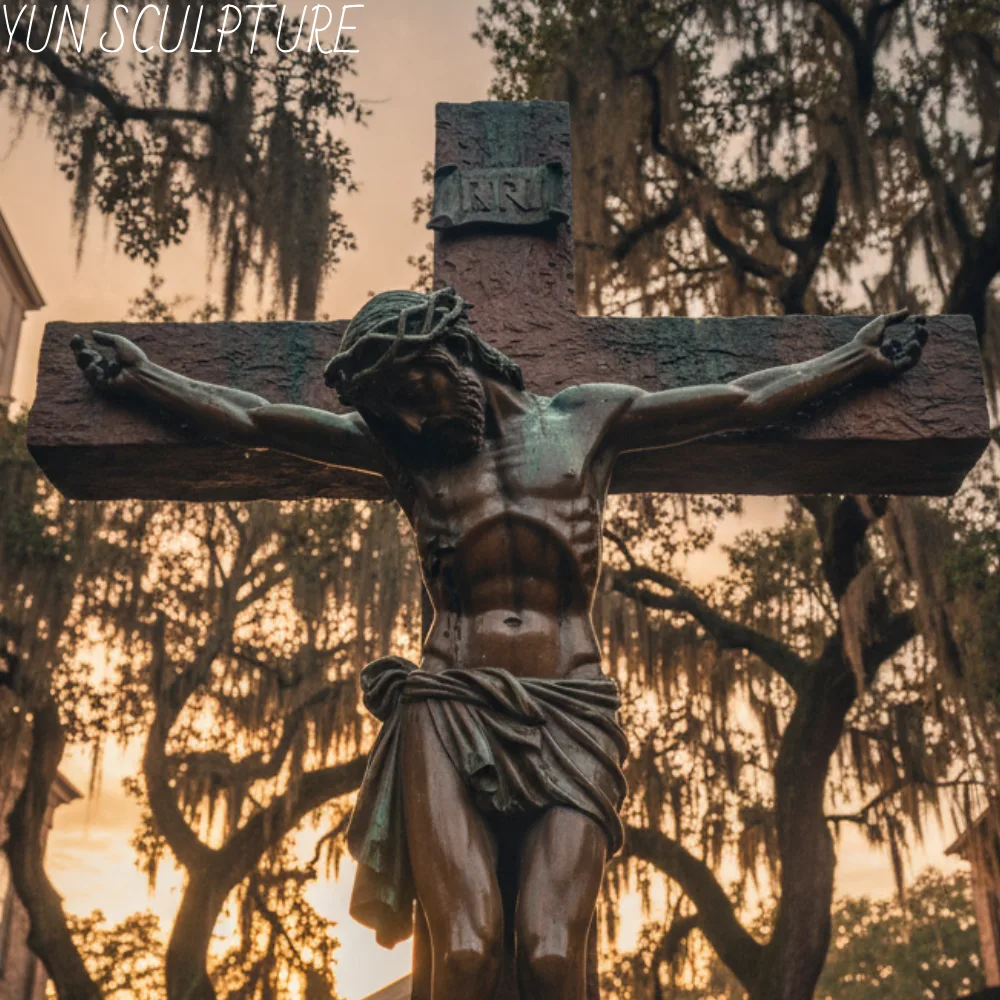
The oldest tradition in monumental crucifix sculpture is the Christus Triumphans — the Triumphant Christ. In this form, the body does not suffer. The spine is erect. The arms extend horizontally with muscular composure, not the slack weight of a dying man. The eyes are open, the gaze direct and sovereign. This is Christ on the cross before — or perhaps beyond — death, occupying an eternal dimension that the physical event of crucifixion cannot touch. Byzantine and Eastern Orthodox traditions have long favored this form, and it remains the dominant iconographic mode in Eastern churches today.
The Christus Patiens — the Suffering Christ — arrived in Western European devotional art through the Franciscan movement of the 13th century, a direct expression of Saint Francis of Assisi’s theology of compassionate identification with Christ’s physical agony. Here the body yields to gravity. The head falls forward or to one side, eyes closed. The chest compresses under the effort of breathing. The musculature no longer performs composure — it records pain. This is the form that became standard in Roman Catholic churches from the medieval period onward, and it is the type most commonly requested by Catholic parishes commissioning a jesus crucified statue today.
The Corpus Doloroso — the Body of Anguish — is the furthest point of realist devotional intention. Developed with particular intensity in late medieval German and Spanish sacred art, this form does not generalize suffering. It documents it. The wounds are anatomically specific. The skin shows the marks of the scourging. The face holds the physiognomy of a man at the threshold of death. Commissions for this form require our sculptors to work from both iconographic tradition and medical reference — the two disciplines must agree before the clay is touched.
Different ecclesial communities hold clear preferences. Crucified jesus statue commissions from Roman Catholic dioceses in the United States almost always specify the Christus Patiens form. Eastern Catholic and Orthodox commissions request the Triumphant Christ. Commissions for jesus crucifixion statue pieces destined for contemplative retreat centers or Passion devotional chapels frequently specify the Corpus Doloroso. Protestant commissions — less frequent by tradition, but present — often request a bare cross, or a figure in the Triumphant mode that emphasizes resurrection over suffering.
The Stations of the Cross — When One Statue Becomes Fourteen
A single crucifix commission is a significant undertaking. A full set of stations of the cross statues is an entirely different category of work — architecturally, spiritually, and logistically.
The Stations of the Cross is a devotional journey through fourteen sequential moments of Christ’s Passion, from his condemnation by Pilate to his burial. In most Catholic churches, these stations line the interior walls of the nave, one on each side, guiding the faithful through a physical act of accompaniment. In pilgrimage sites and outdoor shrine complexes, they may be installed across hundreds of meters of landscaped terrain.
The third station — Christ falls beneath the weight of the cross for the first time — demands a figure that few sculptors approach without hesitation. A jesus carrying the cross statue at the moment of collapse must resolve an almost contradictory set of physical and spiritual requirements: the body must communicate exhaustion and collapse, while the face must communicate something other than defeat. The knees touch the ground. The cross presses down. And yet this is not the end. The sculptor must hold both realities simultaneously in the clay.
The eighth station — Christ meets the women of Jerusalem, who weep for him — introduces an entirely different challenge: the figure is not isolated. It exists in relational space, and the emotional exchange between Christ and the grieving women must be legible across the viewing distance of a church nave. Proportion, gaze angle, and gesture must all be calibrated for that specific spatial relationship.
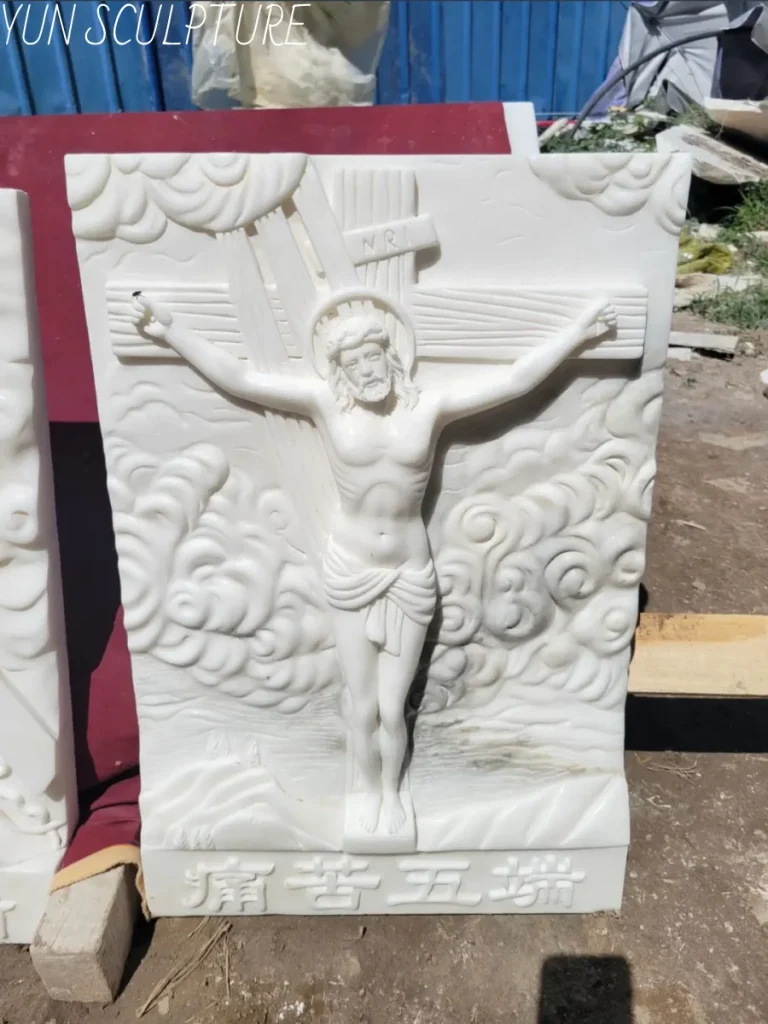
The eleventh station — Christ is nailed to the cross — is, for many of our clients, the devotional heart of the entire commission. This is the moment that the jesus carrying cross statue narrative has been building toward. The body is now horizontal. The act of nailing is either implied or, in more intense commissions, depicted explicitly through the position of the arms and the soldiers attending the execution.
Many commissions also include a jesus scourged statue — Christ at the pillar, before the journey to Calvary begins — as either a preliminary station or a standalone devotional piece. The scourging presents its own anatomical challenge: a standing figure, arms bound above the head, body marked by the instruments of punishment. It requires the same forensic attention to musculature under stress that the crucifix demands, but in a different axis entirely.
A complete set of fourteen stations in bronze, each figure modeled to 90-centimeter scale, represents between 3 and 4 months of foundry work. It is the most sustained single commission our studio undertakes. Parishes that have completed this project describe the installation day — when all fourteen figures are placed in their final positions and the devotional sequence becomes physically walkable — as among the most significant events in their institutional history.
We have been present at several of those installations. The weight of the occasion is not metaphorical.
The Anatomy of Anguish: What Makes a Bronze Crucifix Technically Extraordinary
Every sculptor who has attempted a serious bronze crucifix statue will tell you the same thing: the standing figure is a solved problem. The proportions are known. The weight distribution is stable. The musculature at rest has been studied and rendered ten thousand times across the history of Western art.
The crucified figure is not a solved problem.
It is a body in a state that the human form was never designed to occupy — suspended, compressed, fighting for breath against its own weight. Every muscle group is doing something abnormal. Every tendon is under stress it was not built to sustain. To sculpt this accurately is to model not beauty, but physiological crisis. The standard of difficulty is not three times higher than a standing figure. It is a different discipline entirely.
The Sculptor’s Hardest Challenge — The Human Body Under Extreme Stress
Our anatomical reference library for crucifix commissions includes medical texts, forensic studies of crucifixion mechanics, and the physical examination of the great bronze and stone crucifixes of European history. Before the clay is touched, the sculptor must understand what the body is actually doing.
The Pectoralis Major Under Suspension
When the arms are nailed or bound at full horizontal extension and the body’s weight drops, the pectoralis major — the large chest muscle — is stretched beyond its functional range. The origin points at the sternum and clavicle pull taut. The muscle does not flex. It strains. In a bronze jesus statue of the Christus Patiens type, this stretch must be visible as a subtle but anatomically precise flattening of the chest, the muscle origin lines readable beneath the surface. A sculptor who renders the chest as it appears in a standing figure has already made an error.
The Rectus Abdominis and the Mechanism of Asphyxiation
Historical and medical analysis of crucifixion indicates that the primary cause of death was asphyxiation — the inability to exhale fully when the body’s weight compresses the diaphragm. To breathe, the condemned had to push upward on the foot nail, temporarily relieving chest compression. The rectus abdominis — the central abdominal muscle group — records this effort in a pattern of visible spasm and tension unlike anything seen in a figure at rest. Rendering this correctly requires understanding not just anatomy but the specific biomechanics of the dying process.
The Pronator Teres at the Nail Point
The forearm’s pronator teres muscle, which controls rotational movement of the wrist, is placed under acute torsional stress at the point of nail penetration. The hand does not hang passively. It twists inward, the fingers curling in a pattern consistent with nerve compression at the median nerve pathway. This detail — a slight inward rotation of the wrist and the specific curl of the fingers — is one of the most frequently incorrect elements in commercially produced crucifixes, and one of the most immediately noticeable errors to a trained eye.
The Crown of Thorns — Thirty Individual Casting Problems
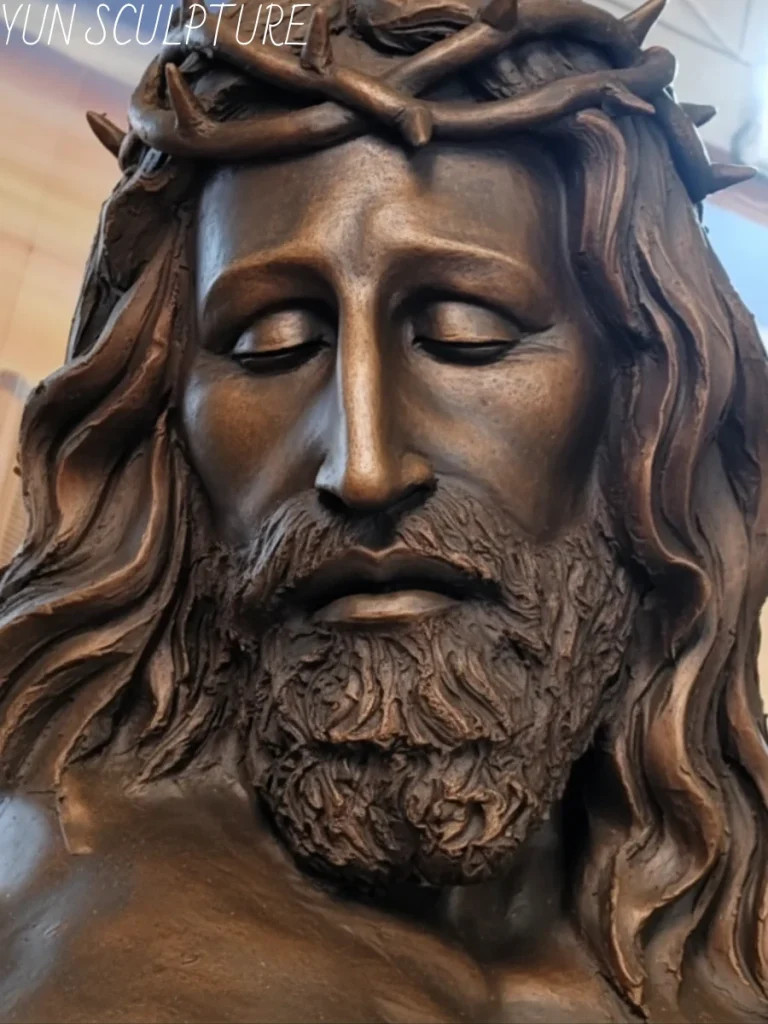
The crown of thorns on a serious commission is not cast as a single decorative band. Each thorn is modeled individually in the clay original, which means each thorn is individually reproduced in the lost-wax process. A typical crown carries between twenty-eight and forty thorn elements, each requiring clean wax reproduction, clean ceramic shell formation, and clean bronze fill without porosity.
The blood flow from the thorn wounds must obey gravity. On a figure with the head inclined forward and to one side, the blood tracks must run downward from each penetration point in a direction consistent with the head’s angle during the Passion. Blood that runs upward, or horizontally, or in directions inconsistent with the figure’s posture, reads as false to any careful observer.
The negative space between the thorns and the hair beneath them is among the most technically demanding areas of the entire figure. The hair must be modeled so that it interweaves with the crown structure in a way that reads as physically plausible — thorn elements pressing into strands, strands displaced by pressure — without creating undercut geometries that prevent clean mold release.
The Five Wounds — Where Theology and Forensics Converge
The placement of the nail wounds has been debated by theologians, historians, and medical researchers for centuries. The iconographic tradition favors the palms. The forensic and structural argument — that nail placement through the palms would not support the weight of a full human body without tearing through the tissue — favors the wrists, specifically the space between the radius and ulna known as Destot’s space.
We present both options to our clients and explain the implications of each. Many Roman Catholic commissions specify the palm placement out of fidelity to established iconographic tradition. Commissions with a strong realist theological brief frequently specify the wrist. We execute both with equal precision.
The wound in the right side of the torso — made by the spear of the soldier named Longinus in the Gospel of John — enters at an upward angle of approximately 45 degrees, consistent with a spear thrust delivered by a man on horseback or standing ground level to a figure elevated on a cross. The wound’s orientation in the bronze must reflect this geometry.
The foot nail configuration — a single nail through both feet placed one over the other, or two separate nails — varies by iconographic tradition and client specification. Both require careful structural consideration, as the foot assembly must integrate cleanly with the cross surface while maintaining the correct torsional angle of the lower legs.
The INRI Titulus and Architectural Integration
The plaque affixed above the corpus — bearing the inscription ordered by Pontius Pilate — carries four languages in its complete form: Latin (Iesus Nazarenus Rex Iudaeorum), Greek (Ἰησοῦς ὁ Ναζωραῖος ὁ Βασιλεὺς τῶν Ἰουδαίων), Hebrew (ישוע הנצרי ומלך היהודים), and Aramaic in some theological traditions. Most commissions select one or two languages. The font selection — Roman lapidary capitals, uncial script, or period-specific letterforms — is a separate design decision that our clients make with reference to the broader architectural language of their space.
The cross itself is a structural engineering object before it is a devotional one. A life-size bronze corpus at 180 centimeters height, cast in Grade A Foundry Bronze, weighs between 180 and 260 kilograms depending on wall thickness. The cross must carry this load at the attachment points — typically at the hands and the suppedaneum foot support — transferring it through the cross structure to the wall anchor or pedestal base. The cross-section of the vertical beam and the horizontal patibulum must be engineered to this load, not merely approximated aesthetically.
The surface texture of the cross is a theological and aesthetic choice with significant technical implications. An olive wood texture — the traditional wood of the True Cross in devotional literature — requires the sculptor to model convincing wood grain, knot structures, and bark irregularities across the full surface area of the cross in clay, which is then reproduced in bronze. A smooth stone texture, referencing the Roman practice of using dressed timber, simplifies the surface but changes the devotional register entirely. A rough-hewn timber texture occupies the middle ground. Each produces a distinct crucifix statue character, and each requires a different modeling approach.
Material Science — Bronze, Marble, and Cast Iron for Crucifixes
Why Bronze Remains the Liturgical Gold Standard
A church interior is not a benign environment for metal. Candles produce acidic combustion byproducts. Incense deposits oily residue on every surface. The accumulated breath and body moisture of congregations raises the ambient humidity consistently above outdoor averages. In coastal parishes, salt air enters through every ventilation point.
Grade A Foundry Bronze — the silicon-bronze alloy our foundry uses for all liturgical commissions — performs with chemical stability in precisely these conditions. The copper oxide patina layer that forms on the surface is not damaged by acidic atmospheres. It is thickened by them. Incense residue wipes cleanly from a waxed bronze surface without affecting the underlying metal. The bronze jesus statue installed above an altar in 1920 looks, in most cases, more distinguished today than it did when it was new. The patina has deepened. The surface has acquired the visual weight of accumulated time.
No other material available to the devotional sculptor offers this combination of surface fidelity, structural strength, environmental resilience, and aesthetic improvement over time.
The Case for Marble — Altar Pieces and Indoor Masterworks
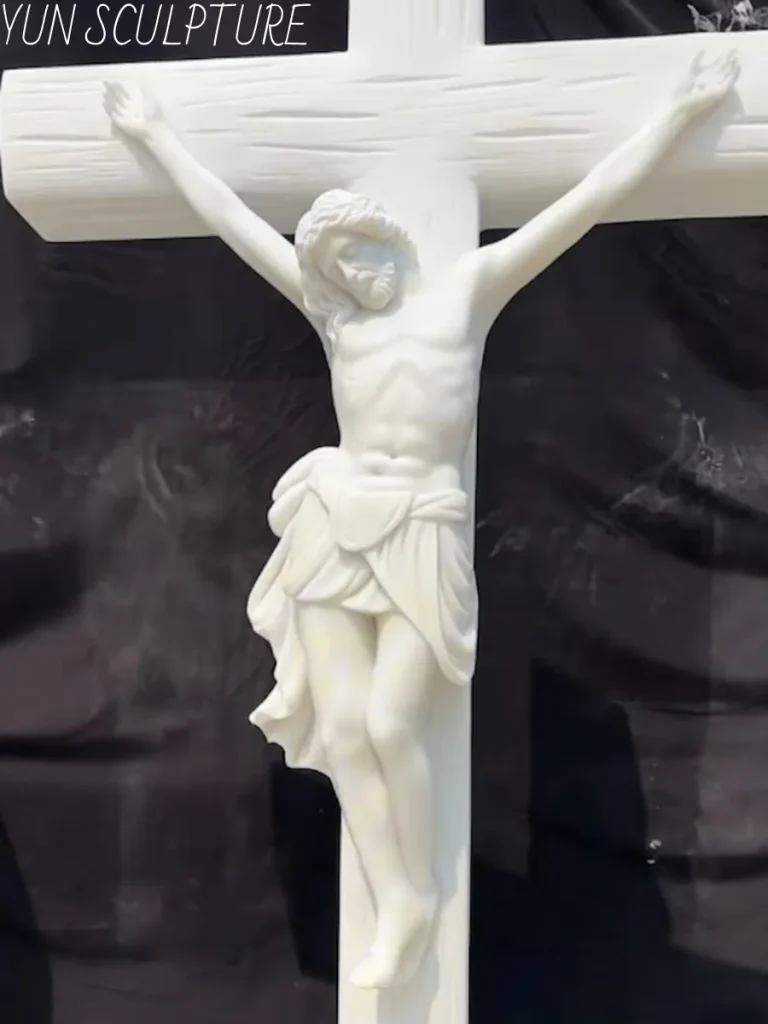
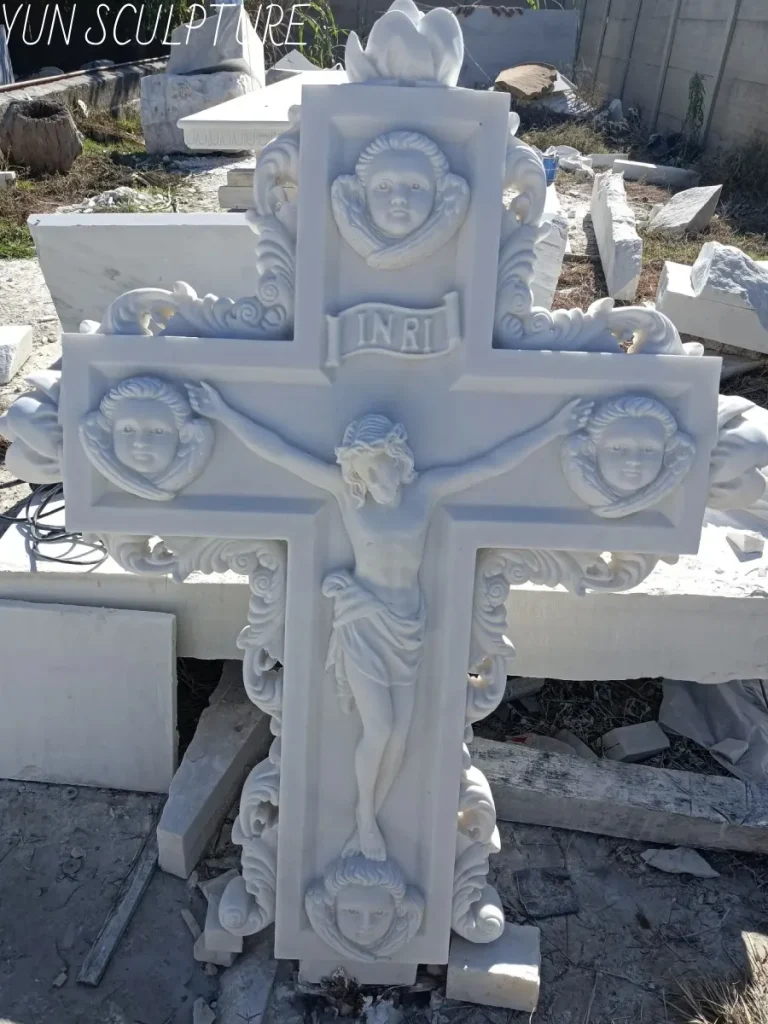
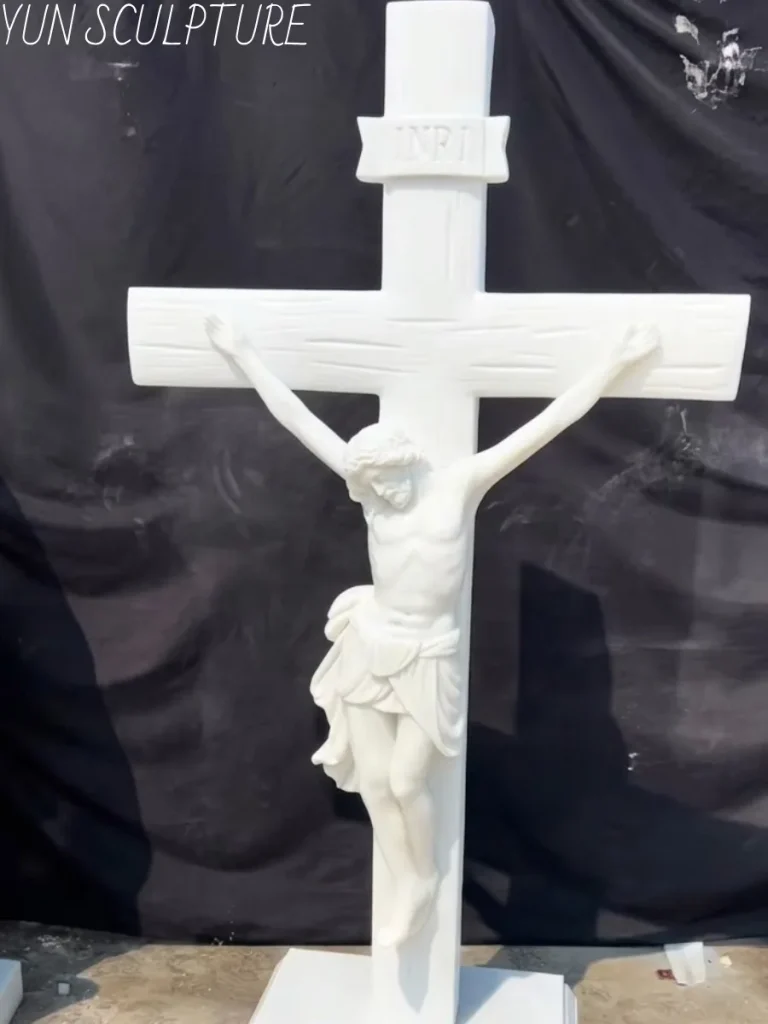
A marble jesus statue occupies a different aesthetic register than bronze — cooler, more luminous, carrying the weight of a sculptural tradition that runs from ancient Greece through Michelangelo to the present. In a white-stone interior, a jesus marble statue can achieve a quality of visual integration that no bronze can replicate.
White Carrara marble from the quarries of Tuscany is the Western canonical standard — dense, fine-grained, capable of holding the finest surface detail the sculptor can produce. Chinese Hanbaiyu white marble, quarried primarily in Hebei province, offers comparable density and whiteness at significantly different economics, and has been used in monumental architectural contexts for centuries. Our sculptors work with both materials and can advise on the specific grain and vein characteristics of current quarry stock.
Marble carries one absolute limitation: it is not an outdoor material in most climates. Water infiltration through micro-fractures, freeze-thaw cycling, and biological surface growth set a hard ceiling on exterior lifespan regardless of stone quality or sealing treatment. Every marble crucifix we produce is specified for interior installation only, and our commissioning documents state this explicitly.
The labor economics of marble also differ substantially from bronze. A marble jesus statue at 180 centimeters requires between 30 and 50 percent more skilled labor hours than an equivalent bronze commission, because every error in stone is permanent and every correction is a subtraction. The clay model forgives revision. Marble does not.
Replicating the Antique — Cast Iron Crucifixes and Heritage Restoration
Between approximately 1840 and 1920, foundries across France, Belgium, and the German states produced large numbers of cast iron crucifixes for export to Catholic parishes throughout Europe and the Americas. These pieces — heavy, dark, surface-detailed, carrying the particular visual gravity of industrial-era religious manufacture — now occupy a specific position in the heritage of Catholic devotional art. Many have survived in remarkable condition. Many have not.
A large cast iron antique christ statue crucifix from this period presents a set of properties that distinguish it fundamentally from bronze. Cast iron has a carbon content between 2 and 4 percent, which gives it high compressive strength but significant brittleness. It does not bend under impact — it fractures. It rusts aggressively in the presence of moisture without constant surface maintenance. An antique christ statue crucifix that has been stored in a damp undercroft, or exposed to decades of coastal humidity, may have suffered structural fractures, surface spalling, and deep rust penetration that renders it unrestorable in its original material.

Our heritage restoration process for these pieces begins with documentation: detailed photographic survey and, where the original is sufficiently intact, direct molding using professional-grade silicone rubber over the original iron surface. This produces a mold of extraordinary fidelity — every original tool mark, every surface irregularity, every detail of the 19th-century foundry’s work is captured and preserved.
From this mold, we produce wax positives and cast the corpus in Grade A Foundry Bronze. The resulting piece carries the full visual and sculptural character of the original cast iron work — the same proportions, the same surface detail, the same iconographic choices made by the original foundry master — but in a material that will resist corrosion, survive impact, and endure the next two centuries without the structural vulnerabilities that ended the service life of the iron original.
The parishes and heritage institutions that commission this work are not replacing their antique crucifixes. They are translating them — from a material that has reached its limit into one that has not yet found its own.
Sizing Guide — From Altar Corpus to Landmark Crucifix
The single most common sizing error in crucifix commissions is selecting the corpus height in isolation. The corpus — the bronze figure of Christ — is only one element of a two-part architectural object. Its proportions must be determined in direct relationship to the cross that carries it.
The classical liturgical standard, refined across centuries of European church architecture, holds that the corpus height should occupy between 55 and 65 percent of the total cross height. A corpus at 180 centimeters therefore calls for a cross standing between 275 and 330 centimeters. This ratio ensures that neither element visually dominates the other — that the figure is legible and present without the cross becoming a mere bracket, and without the figure reducing the cross to a backdrop.
Deviation from this ratio is immediately perceptible to the eye, even for observers who cannot articulate why the piece feels wrong. We present this proportion framework to every client before any size discussion begins.
Interior Altar Installations
A life size jesus statue — corpus at 180 centimeters, or six feet — is the most frequently commissioned scale for parish altar installations. It is the scale at which the figure meets the standing adult congregation member at approximately eye level when viewed from the nave, creating the devotional intimacy that altar placement requires. Our jesus statue 180cm tall for sale represents the anchor point of our interior commission range, and it is the size against which all other scales are calibrated.
| Installation Context | Corpus Height | Total Cross Height | Recommended Material |
|---|---|---|---|
| Home Prayer Room | 30 – 60 cm | 50 – 100 cm | Bronze or Marble |
| Small Chapel | 90 – 120 cm | 150 – 200 cm | Bronze |
| Parish Church Altar | 150 – 180 cm | 250 – 300 cm | Bronze |
| Cathedral Main Altar | 200 – 300 cm | 400 – 600 cm | Bronze + Steel Armature |
| Outdoor Landmark | 300 cm + | 600 cm + | Bronze + Engineered Steel |
For cathedral-scale commissions — corpus above 200 centimeters — the cross structure transitions from a purely sculptural object into a structural engineering system. The patibulum and vertical beam must be internally engineered to carry the bronze corpus weight at the attachment points while managing the bending moment introduced by that off-center load. At this scale, the cross is designed in our structural department before it is modeled in our sculpture studio.
Outdoor and Landmark Crucifixes — Engineering at Scale
An outdoor jesus statue in standing posture presents a calculable wind resistance based primarily on the frontal area of the figure. A crucified figure changes this calculation substantially.
The outstretched arms of a corpus at 180 centimeters extend the lateral windage area to approximately two and a half times that of a standing figure of equivalent height. At a corpus scale of 300 centimeters, this lateral area becomes an engineering variable that must be addressed in the foundation and anchor system design. We calculate wind load using the maximum recorded wind speed at the installation site, then engineer to a safety factor of 3.0 above that figure. The anchor system is not sized to survive normal conditions. It is sized to survive the event that has not happened yet.
A large jesus statue installation above 3 meters in corpus height requires a primary internal stainless steel skeleton — a load-bearing armature welded inside the bronze shell before the exterior sections are assembled. This armature carries the static load of the bronze skin, distributes the dynamic wind load across multiple anchor points, and provides the structural continuity that allows a figure assembled from cast segments to behave as a single integrated object.
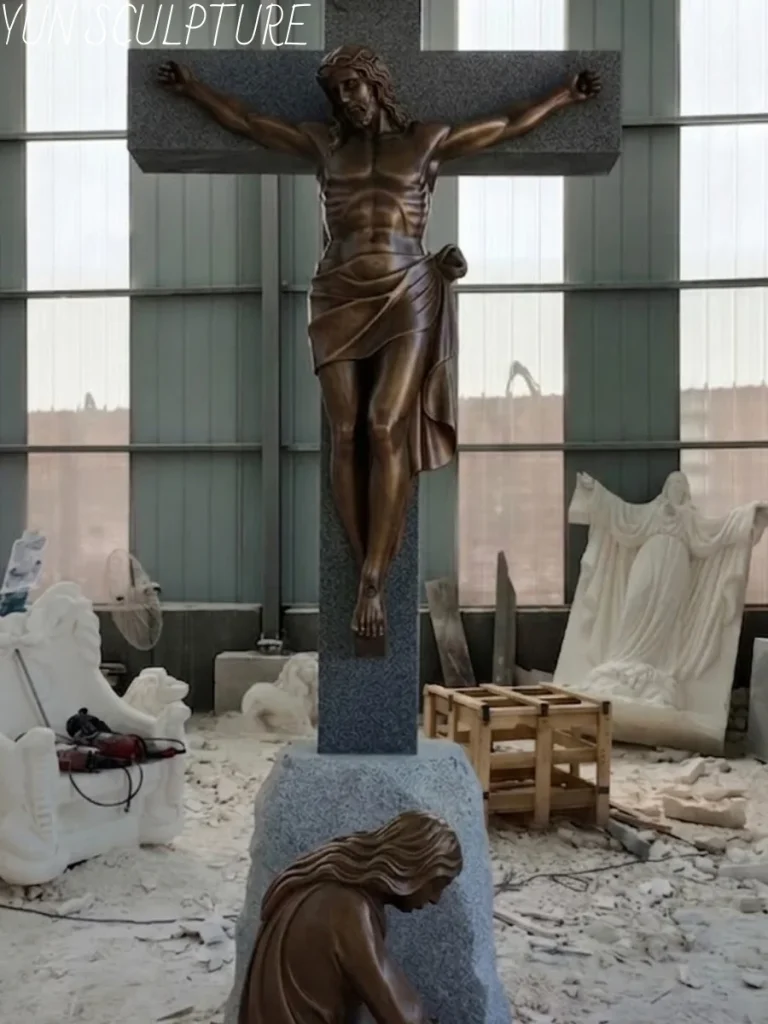
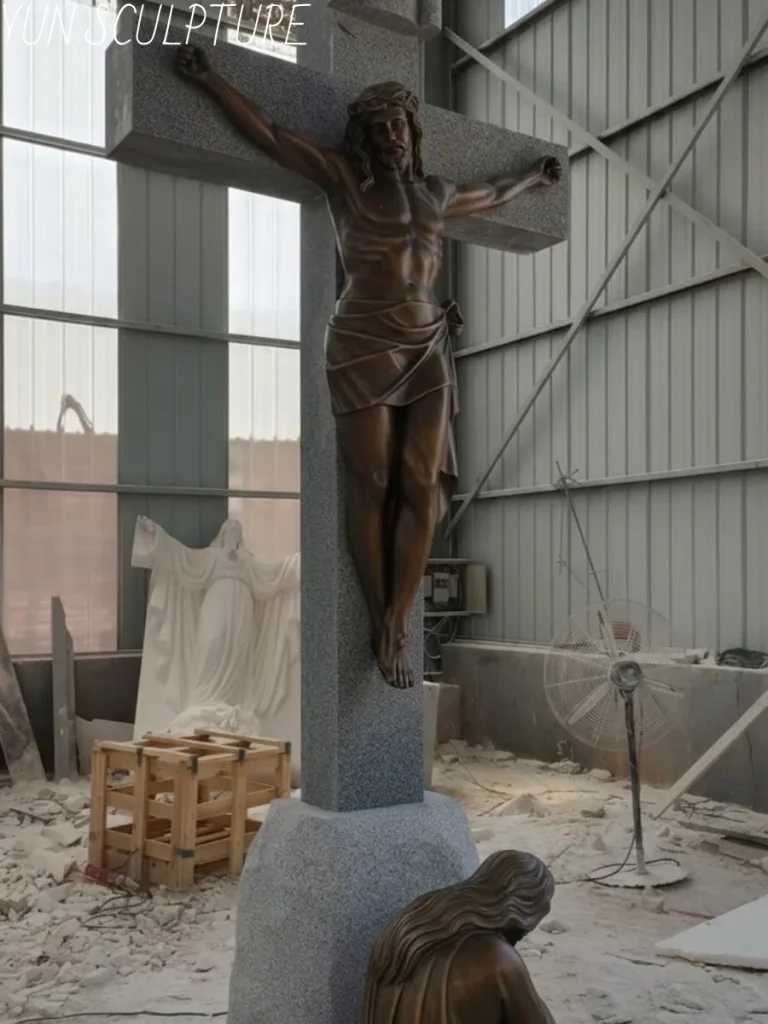
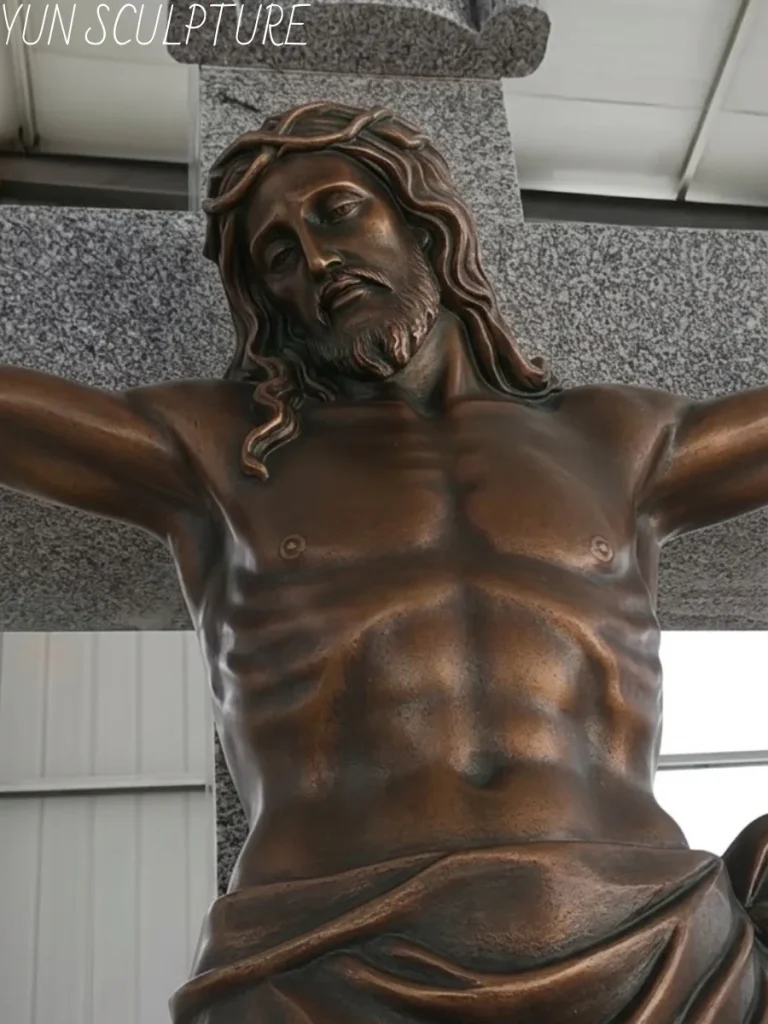
For a jesus garden statue or outdoor memorial installation, transport and on-site assembly follow a defined sequence. Large corpus pieces are cast and finished in sections — torso, arms, head, lower body — each section completed to final patina before crating. On site, sections are assembled onto the internal armature using TIG welding, weld points are chased and patinated to match the surrounding surface, and the completed figure is lowered onto the prepared foundation anchor system by crane. The cross structure, similarly segmented for transport, is assembled and anchored first, then the corpus is attached.
We provide a complete installation package for every outdoor commission: foundation engineering drawings, anchor bolt specifications, assembly sequence documentation, and on-site technical support for the installation crew.
Who Commissions a Jesus on Cross Statue?
The crucifix is the most universally distributed object in the history of Christian sacred art. It appears at every scale, in every material, in every institutional and private context where Christian faith is practiced. The range of clients who commission custom work reflects this breadth.
Catholic Parish and Diocese commissions represent the largest segment of our work, and the broadest range of scales. A single diocese may commission simultaneously: a small corpus for a new hospital chapel, a full parish-scale altar crucifix for a church renovation, and a complete set of Stations of the Cross statues for an outdoor pilgrimage garden. These projects may proceed in parallel, coordinated through a single diocesan art and architecture committee, or they may arrive years apart. We maintain long-term relationships with diocese procurement offices precisely because the commissioning cycle is ongoing.
Funeral Home and Cemetery clients understand the crucifix as the primary visual language of Western commemoration. In Catholic cemetery culture, the crucifix is not optional — it is the defining object of the landscape. Commissions range from individual grave monuments with integrated bronze corpus pieces to large entrance crucifixes that establish the devotional character of the entire grounds. Headstone-integrated bronze corpus pieces in the 60 to 90 centimeter range are among our most consistently requested cemetery products.
Hospital and Healthcare Chapel clients occupy a distinct theological space. The connection between a suffering Christ and a suffering patient is not incidental — it is the explicit pastoral intention of hospital chapel design. A corpus that shows the Christus Patiens form, with its anatomically accurate rendering of physical anguish, speaks directly to a patient or family member in acute distress in a way that no other devotional object can. These commissions are typically modest in scale — corpus at 60 to 120 centimeters — and specified for wall mounting in intimate chapel spaces. The emotional weight they carry is entirely disproportionate to their physical size.
Private Collector and Estate Chapel clients bring the highest degree of individual artistic specification to the commissioning process. These are clients building or restoring private devotional spaces — a family chapel on an estate, a personal oratory, a private memorial garden — and they approach the commission with the same deliberation they would bring to acquiring a significant work of art. Antique-style replication commissions are particularly frequent in this segment: clients who have encountered a 19th-century cast iron or bronze crucifix in a European church and want a faithful reproduction executed in durable foundry bronze.
Heritage Restoration Projects — museums, historic church trusts, architectural conservation bodies — commission reproduction work when original pieces have deteriorated beyond repair or when a documented historical crucifix must be reproduced for a restored interior. These clients bring the most rigorous documentation requirements: material certificates, provenance records, photographic archives of the original piece. We welcome this standard. It produces the most precisely specified and historically faithful work we do.
The Commission Process — From Passion Narrative to Bronze Reality
Every crucifix commission begins with a conversation that has nothing to do with dimensions or materials. It begins with theology.
Step 1: Theological Brief
Before a size is discussed or a material selected, we ask the client to identify their iconographic intention. Which of the three forms — Christus Triumphans, Christus Patiens, or Corpus Doloroso — speaks to the theological and devotional character of the installation space? This decision determines the sculptural brief that every subsequent step must honor. A Corpus Doloroso commission and a Christus Triumphans commission are, in practical terms, two different statues that happen to depict the same subject.
Step 2: Anatomical Reference Study
Once the iconographic form is established, our sculptors assemble a reference library specific to that commission. Medical anatomical references for musculature under suspension stress. Historical and forensic scholarship on crucifixion mechanics. Photographic documentation of the great historical crucifixes in the relevant tradition. This study phase is not preliminary to the real work. It is the foundation that makes the real work possible.
Step 3: 1:1 Clay Sculpting — The Support Problem
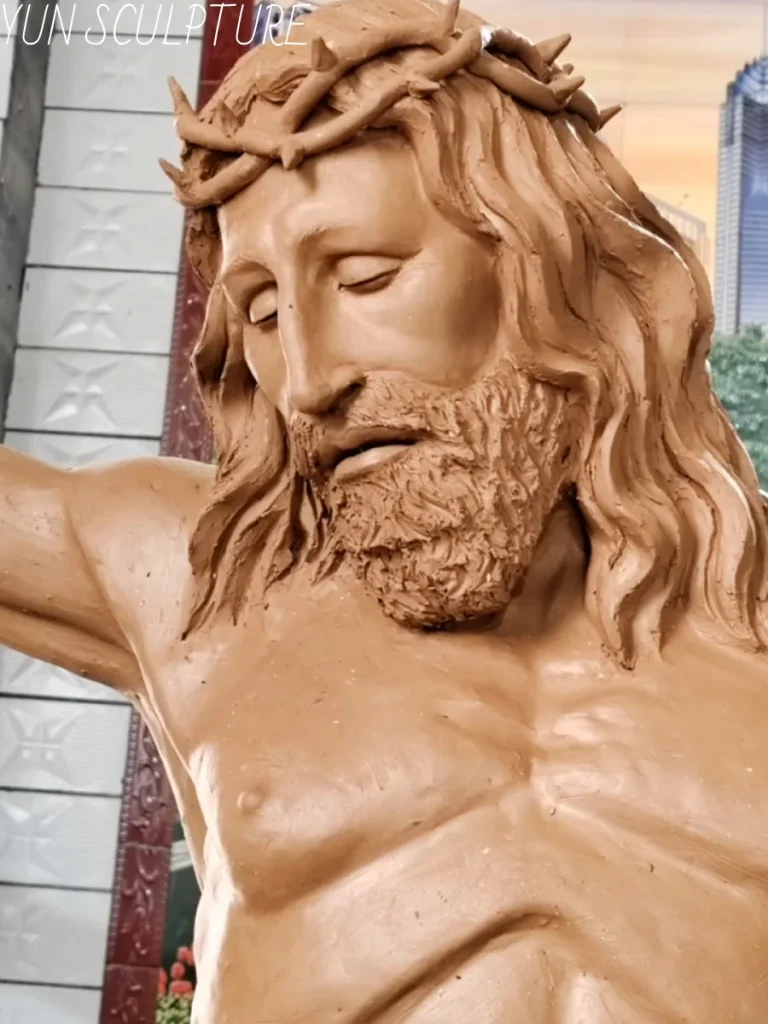
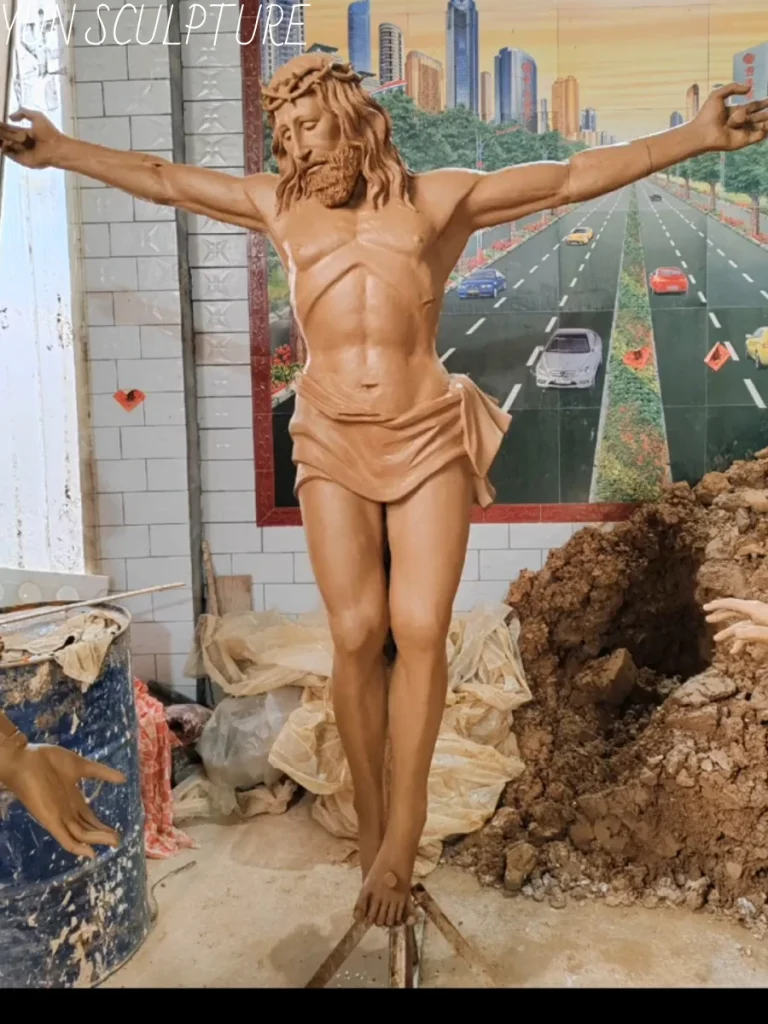
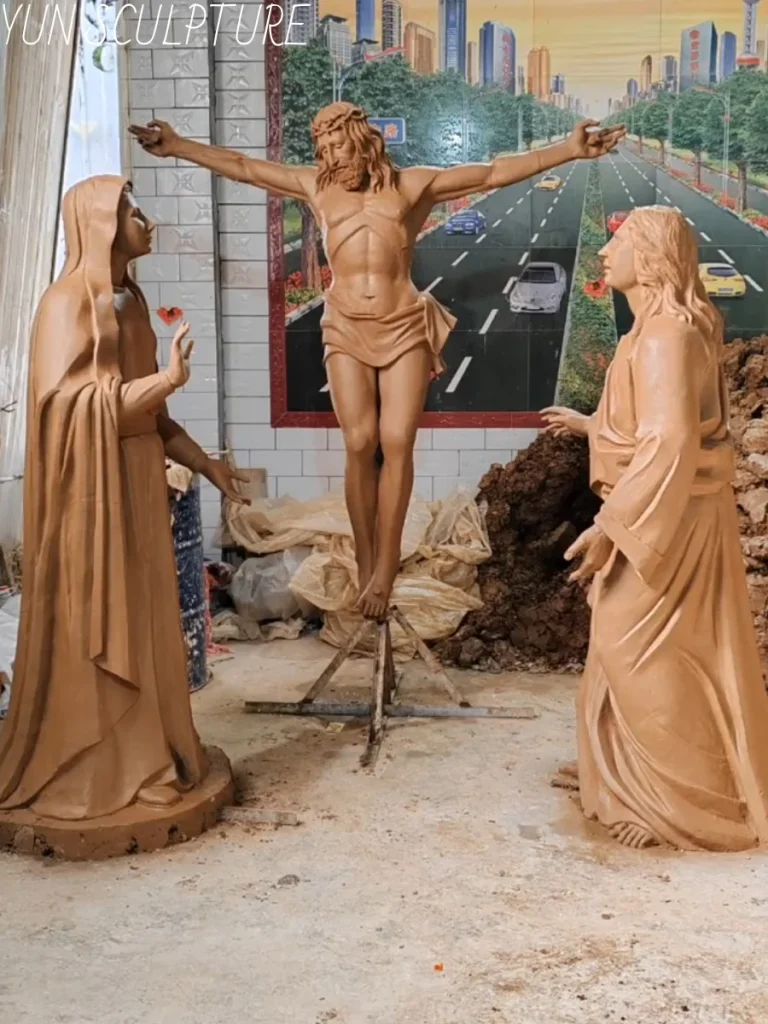
A standing figure in clay is supported by its own base. A crucified figure is not. The corpus must be built on an internal support armature that holds the body in the correct suspended posture while the clay is being modeled — arms extended, weight dropping, head inclined — without the armature itself distorting the clay surface. This is a technical challenge that beginning sculptors underestimate. Our armature systems for crucifix modeling have been refined over years of practice.
Step 4: Lost-Wax Casting — Small Parts, Large Precision
The crown of thorns, the INRI titulus, and the nail elements are cast separately from the main corpus in most commissions, then attached during the chasing and finishing stage. This allows each element to receive the individual attention its detail demands. The main corpus sections — torso, arms, head, lower body — are cast following the same lost-wax ceramic shell process described in our Risen Christ guide.
Step 5: Corpus and Cross Assembly
The corpus and cross are cast and finished as independent objects, then permanently joined during final assembly. The attachment points — at the hands, and at the suppedaneum foot support where specified — are engineered connection details, not simply weld joints. They carry load. They are designed accordingly.
Step 6: Patination — The Color of Sacrifice
Crucifix commissions most frequently specify a deep, dark patina — statuary brown to near-black, with warm highlights on the raised surfaces of the anatomy. This is not the verde antique palette of the Risen Christ. The theological register is different. The suffering corpus calls for a patina that reads as weight, shadow, and gravity. We use ferric nitrate and liver of sulfur applications, heat-controlled to produce the specific depth of tone the commission requires.
Step 7: Structural Installation
Wall-mounted crucifixes are anchored through a concealed plate system welded inside the bronze cross. Freestanding pieces are anchored to prepared concrete bases using the same stainless steel bolt system specified for our outdoor monumental work.
The corpus of risen christ for statue making — the technical term for the figure element of a resurrection statue — follows a related but distinct process, one we detail fully in our companion guide to Risen Christ commissions. The crucifix corpus and the resurrection corpus represent the two poles of Christian Passion iconography. Together, they define the complete range of what bronze can be asked to carry.
FAQ — 12 Core Questions Answered
What is the difference between a crucifix and a cross?
A cross is the bare geometric form — two intersecting beams, carrying no figure. A crucifix includes the corpus: the sculpted body of Jesus Christ attached to the cross, making the instrument of execution inseparable from the person executed upon it. The distinction is not merely visual. It is theological. The cross emphasizes the redemptive structure. The crucifix emphasizes the redemptive act — the specific, physical, historical sacrifice of a specific person.
What is the corpus of a crucifix?
The corpus — from the Latin word for body — refers specifically to the sculpted figure of Christ attached to the cross. It is the element that transforms a geometric symbol into a devotional object. In commissioning language, when we discuss scale, material, anatomical complexity, and casting process, we are discussing the corpus. The cross that carries it is a separate engineering and aesthetic object, specified in relationship to the corpus proportions.
Why do Catholic churches have statues of Jesus on the cross?
The crucifix serves as the primary visual anchor for the Catholic Mass — a constant reminder that the Eucharist celebrated at the altar is inseparable from the sacrifice enacted on Calvary. It is not decorative. It is doctrinal. The figure above the altar directs the faithful toward the theological reality the liturgy makes present: that the body broken in the bread is the same body depicted in bronze above them. It also functions as a focal point for individual meditation on the Passion — the suffering, the love, and the cost of redemption.
Is a statue of Jesus a graven image?
Theologically, no. The biblical prohibition against graven images addresses the worship of false gods — the attribution of divine power to an object in itself. In Catholic and Orthodox traditions, a statue is not worshipped. It is venerated, which carries a precise and different meaning: the statue directs the mind, the heart, and the prayer of the believer toward the divine reality the statue represents. The object is a threshold, not a destination. This distinction was formally defined at the Second Council of Nicaea in 787 AD and remains the authoritative theological position. A jesus on cross statue is an act of sacred art, not an act of idolatry.
What sculpture showed Jesus dying on the cross?
The iconographic form specifically depicting the moment of death is the Corpus Doloroso — the Agonizing Christ. This tradition, developed with particular intensity in late medieval German and Spanish devotional art, is distinguished by hyper-realistic anatomical detail: the full weight of the body dropping against the nails, the chest compressed by the final failure of the respiratory effort, the face bearing the physiognomy of a man at the precise threshold between life and death. The wounds are specific, not symbolic. The musculature records not suffering in general but the particular biomechanics of crucifixion. It is the most technically demanding of the three iconographic forms, and the one that makes the greatest demands on the sculptor’s anatomical knowledge.
What are the stations of the cross statues?
The Stations of the Cross is a sequence of fourteen sculptures depicting the final hours of Christ’s life — from his condemnation by Pontius Pilate through the carrying of the cross, the three falls, the encounters along the Via Dolorosa, the crucifixion, and the burial. Each station is a self-contained sculptural work, but the fourteen pieces function as a single devotional narrative, installed in sequence to allow the faithful to walk the Passion physically as an act of prayer. In churches, they line the nave walls. In pilgrimage sanctuaries and outdoor shrine complexes, they may extend across hundreds of meters of terrain. A complete commission of fourteen bronze stations is among the most sustained and significant projects a religious sculpture foundry undertakes.
How much does a life-size bronze crucifix cost?
A custom life-size commission — corpus at 180 centimeters, or six feet — cast in Grade A Foundry Bronze generally ranges from $8,000 to $25,000 and above. The lower end reflects a Christus Patiens corpus with standard robe and anatomy treatment, a single-tone dark patina, and a straightforward cross structure. The upper end reflects a Corpus Doloroso commission with individually cast crown of thorns elements, forensically detailed wound treatment, complex multi-tone patination, and a cross engineered to carry the full corpus weight at the required installation height. Monumental commissions above 300 centimeters corpus height are quoted individually following structural analysis.
What is the correct proportion for an altar crucifix?
The corpus should occupy approximately one-half to two-thirds of the vertical length of the cross. This ratio — refined across centuries of European liturgical art and architecture — ensures that neither element overwhelms the other: the figure is present and legible without reducing the cross to a mere bracket, and the cross retains its own visual authority without dwarfing the corpus. Deviation from this range in either direction is immediately perceptible, even to observers who cannot articulate the source of the visual discomfort. We present proportion calculations to every client before any final size decision is made.
Can you replicate an antique cast iron crucifix in bronze?
Yes, and this work is among the most historically significant we undertake. Where the original cast iron piece is sufficiently intact, we apply professional-grade silicone rubber directly to the original surface to produce a mold of complete fidelity — capturing every tool mark, every surface irregularity, every detail of the original foundry master’s work. From this mold, we produce wax positives and cast the corpus in Grade A Foundry Bronze. The resulting piece carries the full visual and sculptural character of the 19th-century original, in a material that eliminates the brittleness and aggressive rust vulnerability of iron and will resist deterioration for the next two centuries. The original is preserved. Its character is translated into a material worthy of its permanence.
How is a large outdoor crucifix installed safely?
A reinforced concrete foundation is the non-negotiable baseline for any outdoor crucifix installation above 150 centimeters total height. The cross must incorporate an internal stainless steel skeleton — an engineered load-bearing structure within the bronze shell — that carries the static weight of the corpus at the attachment points and distributes lateral wind loads through the cross structure to the anchor system below. Heavy-duty expansion anchor bolts, set in epoxy grout into the cured concrete foundation, connect the cross base to the ground. We provide stamped engineering drawings for all outdoor commissions, specifying foundation depth, bolt pattern, bolt grade, and load calculations. Many municipalities require these documents for permit approval.
How do you maintain a large outdoor Jesus statue to prevent oxidation?
Annual maintenance is straightforward and requires no specialized equipment. Wash the entire bronze surface with mild soap and water using a soft-bristle brush, working into the recesses of the drapery and anatomy where biological deposits accumulate. Rinse thoroughly and allow to dry completely. Apply a coat of professional microcrystalline wax — the same product used for museum bronze conservation — and buff to a light, even sheen. This wax layer seals the existing patina against acid rain, UV degradation, and salt spray, preventing the formation of unwanted green verdigris on surfaces where the dark patina is intended to be preserved. In coastal environments, a second wax application in early spring is recommended. A bronze crucifix maintained to this standard requires no significant restoration work for forty to sixty years.
Where do you buy a high-quality Jesus statue?
The answer begins with what to avoid. Mass-produced resin and fiberglass pieces sold through online catalogs offer low entry cost and immediate availability. They also offer surfaces that yellow and crack within a decade, anatomical proportions that bear no relationship to human physiology, and no recourse when the piece deteriorates. For a devotional object intended to serve a parish, a chapel, or a sacred space across generations, the correct approach is a direct commission from a professional sculpture foundry specializing in lost-wax bronze casting, liturgical iconography, and structural engineering for permanent installation. This means working with a team that asks theological questions before design questions, that produces a 1:1 clay model for client approval before bronze is poured, and that delivers not just a finished object but the engineering documentation the installation requires. Quality in this category is not a product feature. It is a process.
The Wager on Eternity
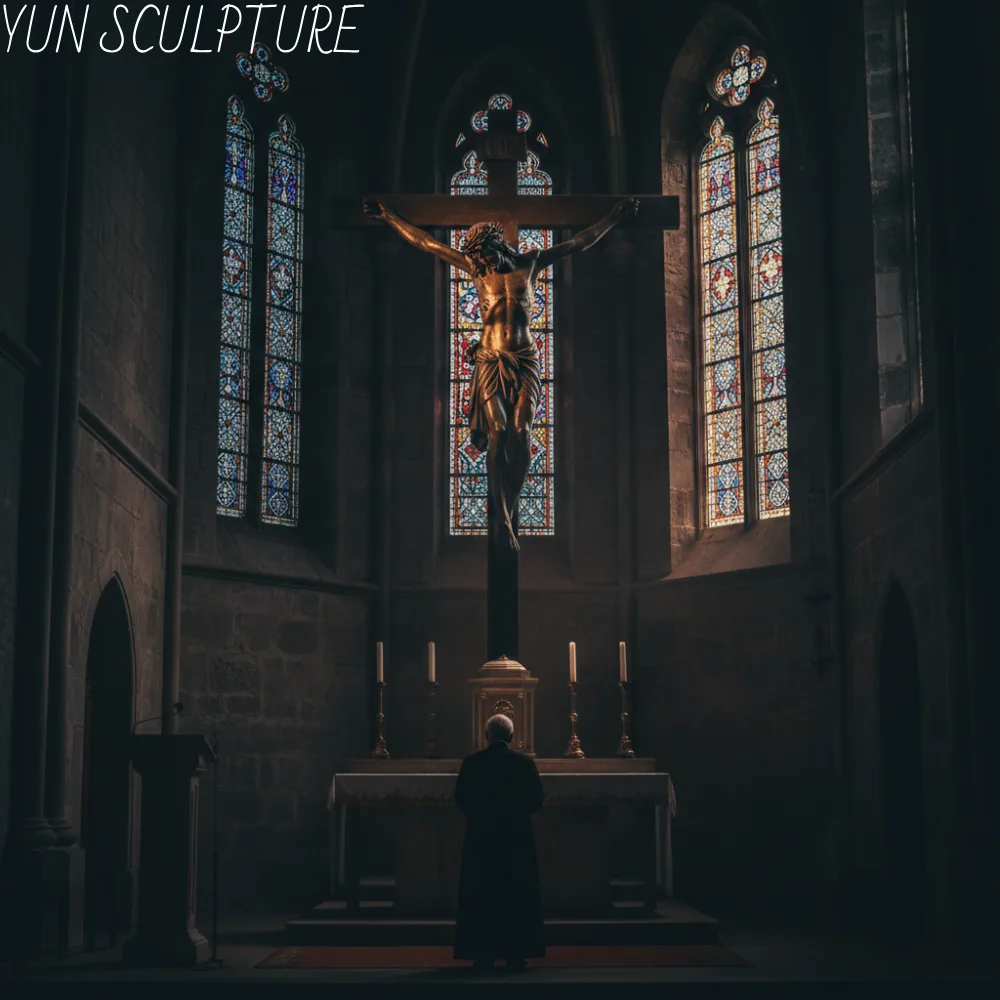
J. Beaulieu scratched his name into the ribcage of a Christ figure in 1883 and sealed it inside the iron. He left no other record. The parish that commissioned the piece has no document bearing his name. He is known only because the bronze revealed him, 140 years later, when a restorer opened what the foundry worker had closed.
He signed his name there because he understood something that every serious craftsman who works in permanent materials eventually understands: that the object will outlast the maker, that the work is a wager placed on a future the maker will not see, and that the only honest response to that knowledge is to put your name on it anyway — privately, permanently, inside the thing itself.
Every crucifix we cast at Yun Sculpture carries that same wager. The theological brief, the anatomical study, the months of clay work, the lost-wax casting, the chasing and patination — none of it is undertaken with the assumption that the result will serve one generation and be replaced. It is undertaken with the assumption that it will still be standing when no one currently alive remembers who made it.
That is not ambition. It is the only standard appropriate to the subject.
— Elena Zhang & Donghui Zhang, Yun Sculpture