Get in touch with Yun-Sculpture company
Mary Undoer of Knots Meaning: The 1615 Marriage, Pope Francis & the Theology Behind Every Knot

The mary undoer of knots meaning begins not with an apparition, not with a papal decree, but with a marriage in distress on a September afternoon in 1615 — and a Jesuit priest holding a white ribbon in his hands. What happened in that room became the seed of one of the most human and most theologically precise Marian devotions in the Catholic tradition. And it became, four centuries later, the devotion of a pope.
Table of Contents
Table of Contents
What Is the Story Behind Mary Undoer of Knots?
On September 28, 1615, a German nobleman named Wolfgang Langenmantel arrived in Ingolstadt in a state of desperation. Three years into his marriage to Sophia Rentz, the union had reached collapse. He had come to Father Jakob Rem, a Jesuit priest known for his spiritual discernment, not as a last resort but as a genuine act of faith before making a final decision.
What Wolfgang brought with him was a white ribbon — the same one used to bind the couple together during their wedding ceremony. According to the account preserved through the Langenmantel family, the ribbon now carried knots. Whether these were literal knots tied during quarrels, or whether this detail was added symbolically in the retelling, the image holds: a ribbon of unity, twisted by discord.
Father Rem did not cut the ribbon. He held it before an image of Our Lady of the Snows and prayed. Slowly, according to the witness account, the knots released themselves one by one until the ribbon lay completely smooth and, as the record describes it, exceptionally white.
Wolfgang and Sophia reconciled. The marriage survived.
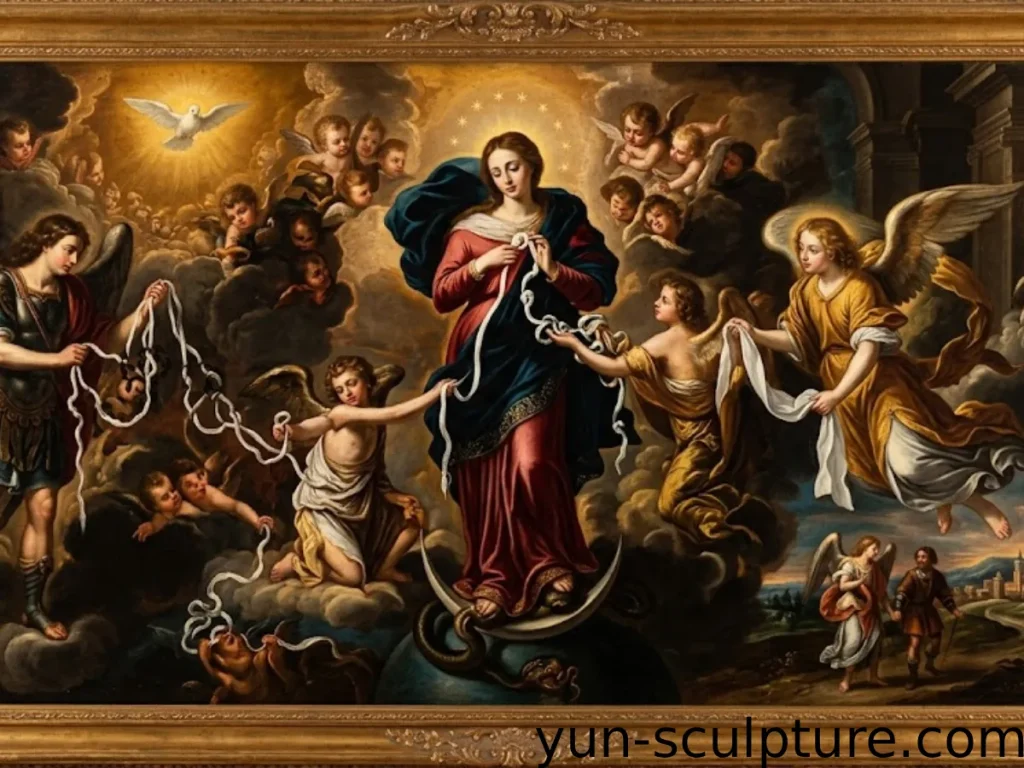
Nearly a century later, Wolfgang’s grandson Hieronymus Ambrosius Langenmantel commissioned a painting to commemorate what had happened in that room. Around 1700, the Augsburg painter Johann Georg Melchior Schmidtner completed the work. It measures six feet high and nearly four feet wide. It shows Mary standing between heaven and earth, her hands working a long ribbon marked by knots. One angel presents the tangled length from the right; another receives the smooth ribbon from the left. A dove hovers above. Beneath her feet, a serpent lies subdued.
The painting has hung in the Church of St. Peter am Perlach in Augsburg ever since. It survived wars, revolutions, and two centuries of obscurity. It is still there today.
What I find remarkable about this origin story — and what separates it from most Marian devotions — is its complete ordinariness. No apparition. No miracle in the sky. A marriage in difficulty, a priest with a ribbon, and a prayer. The theology that emerged from this is all the more powerful for being rooted in something that happens in ordinary households every day.
Why Is Mary Called the Undoer of Knots?
The title did not originate in 1615. It has roots that reach back fourteen centuries further.
In the second century, Saint Irenaeus of Lyon — one of the most important early Church Fathers — articulated a theological parallel that would shape Catholic Marian thought for two millennia. In his work Adversus Haereses, he wrote: “The knot of Eve’s disobedience was loosed by the obedience of Mary. For what the Virgin Eve had bound fast through unbelief, this did the Virgin Mary set free through faith.”
The structure of this claim is precise. Eve’s act — the disobedience in the garden — is described as a knot: something that bound humanity into a condition it could not escape through its own effort. Mary’s act — her fiat, her complete consent to God’s will at the Annunciation — is the loosening of that knot. The parallel is not decorative. It is structural. One woman’s refusal created the entanglement; another woman’s obedience began the restoration.
This is not, for Irenaeus, a statement about Mary’s independent power. The loosening happens through her obedience to God — her cooperation with divine grace, not her autonomous action. The knot is loosened because Mary says yes, and because that yes allows salvation to enter human history.
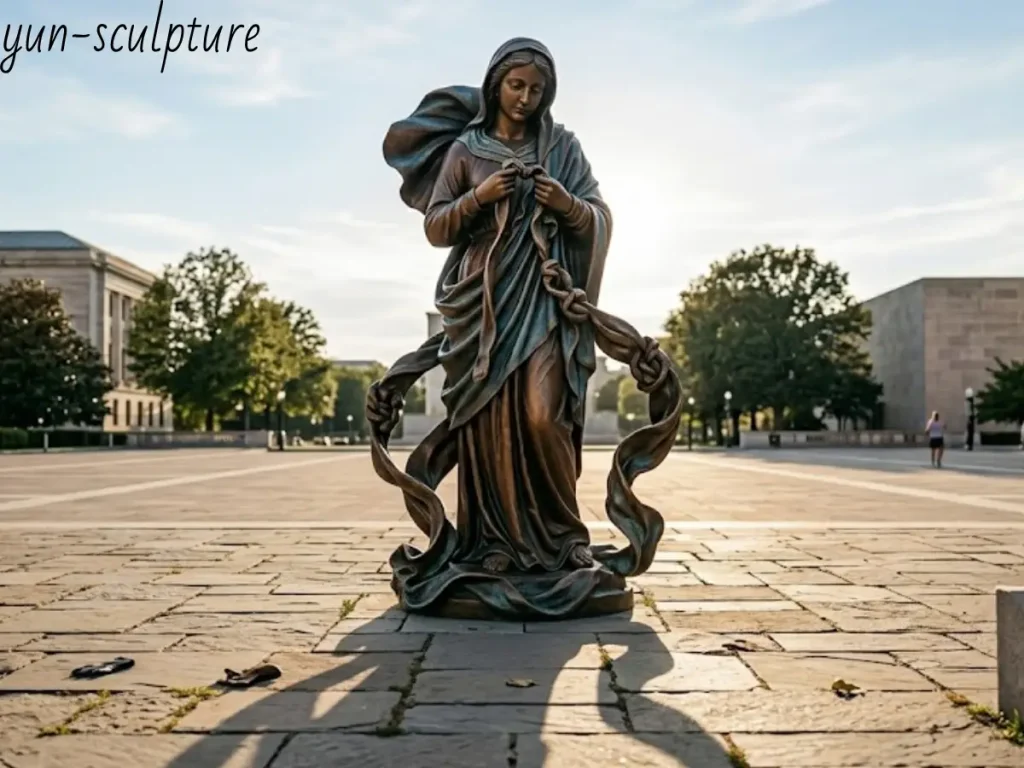
When Father Rem prayed over Wolfgang’s ribbon in 1615, he was working within this theological framework, even if unconsciously. The knots on that wedding ribbon were a visible, physical expression of the same condition Irenaeus had described: human life entangled by choices, conflicts, and failures that cannot be resolved through human effort alone.
The ribbon’s knots are not evil in themselves. They are the natural accumulation of human struggle — the kind that happens in every marriage, every family, every life. What the devotion offers is not the cutting of the ribbon but its patient restoration. Grace does not destroy what has been lived. It transforms it.
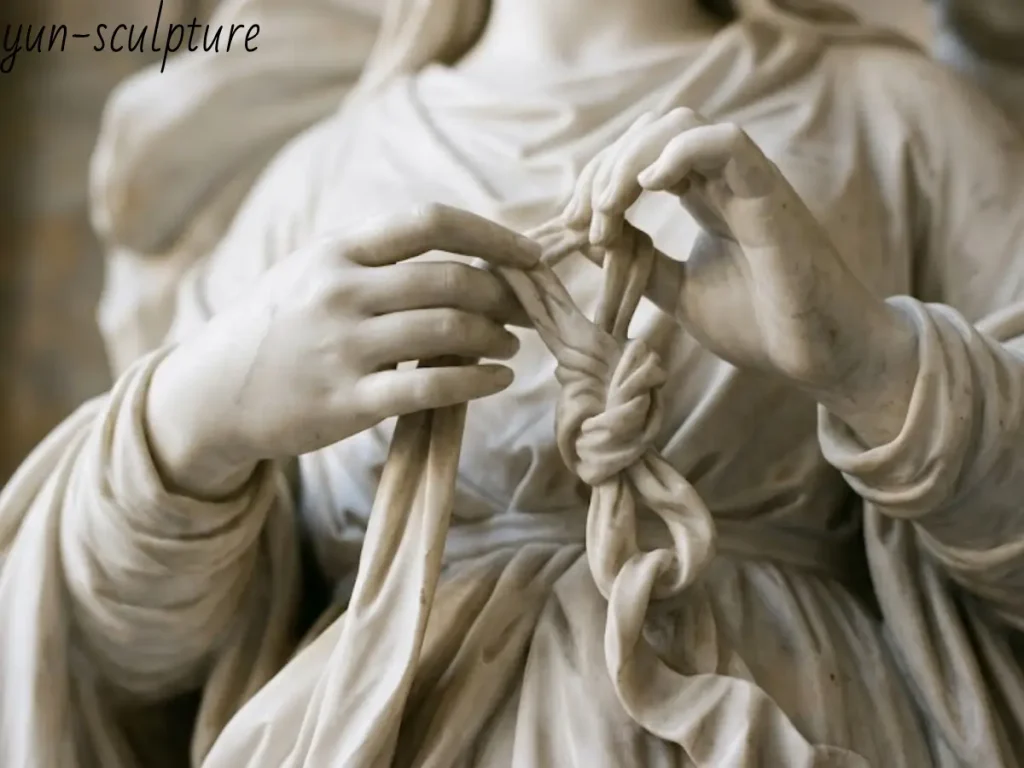
For a sculptor, this theology has a direct visual consequence. Mary’s hands must not appear to be pulling or tearing the ribbon. They must appear to be working it — patient, deliberate, attentive. The posture communicates cooperation with something larger than the act itself. This is one reason why the expression of the face matters so much in this commission: focused, not triumphant; present, not detached.
What Is the Difference Between “Undoer” and “Untier”?
The original German title is Maria Knotenlöserin. “Knoten” means knots. “Löserin” comes from “lösen” — to loosen, to release, to solve. The German carries no sense of force. It implies understanding, patience, the careful working-through of something that resists quick resolution.
English produced two translations, and they are not equivalent.
“Undoer” suggests completion. The knot has been undone — the problem resolved, the condition reversed, the past erased. It is a title of triumph. The emphasis falls on the result.
“Untier” is a slower word. It suggests process. Each knot is approached individually, worked through patiently. It reflects ongoing intercession rather than instantaneous resolution. The emphasis falls on the act itself, which continues as long as human lives continue to generate knots.
Both translations are in use. Neither is officially incorrect. But for someone commissioning a sculpture, the distinction shapes every decision.
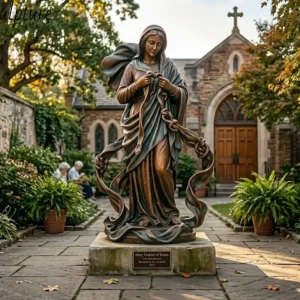
A statue designed around “Undoer” tends toward resolution: the ribbon flows freely, the knots are minimal or subdued, Mary’s posture is composed and triumphant. The narrative is complete. The sculpture communicates that grace has already prevailed.
A statue designed around “Untier” captures the moment of action: multiple knots are visible and fully articulated, Mary’s hands engage them directly, the ribbon holds both tension and release simultaneously. The narrative is ongoing. The sculpture communicates that grace is at work right now, in this moment, in the lives of the people who stand before it.
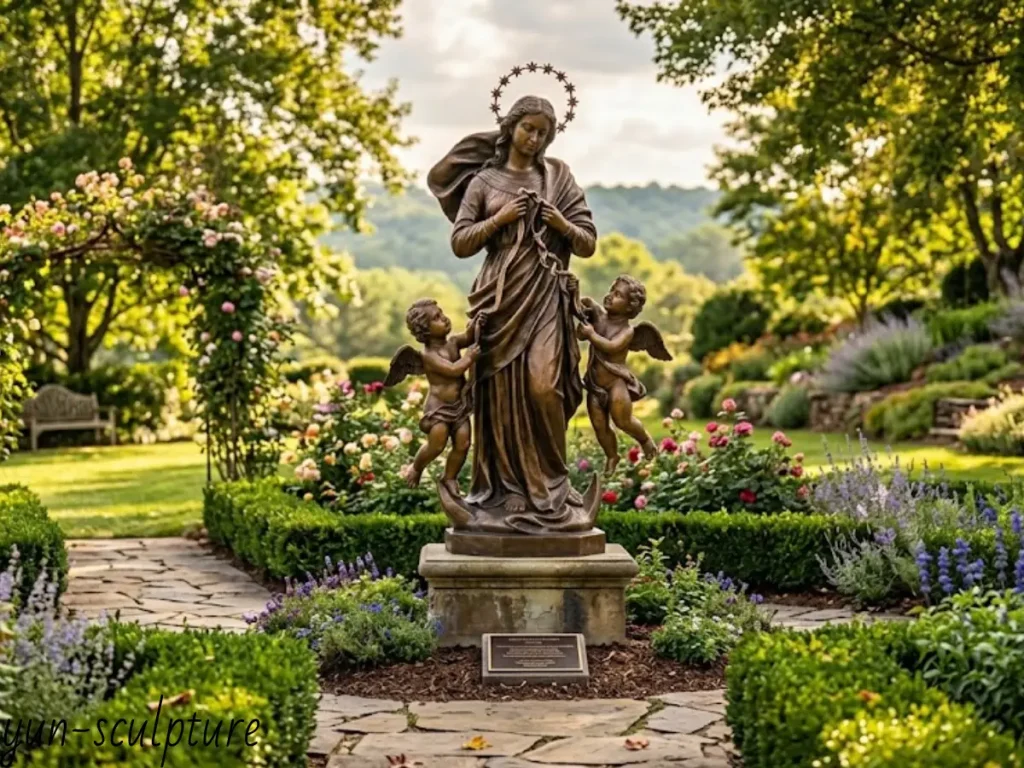
I have had clients spend considerable time with this distinction before deciding which commission to pursue. A retreat center serving people in active crisis tends toward the “Untier” framing — the work is not done, the knots are real and present, Mary’s hands are still engaged. A parish memorial commissioned to honor something already resolved tends toward the “Undoer” framing — grace has prevailed, the ribbon is smooth, the moment is one of thanksgiving.
The name you choose defines the story your statue tells. And for the sculptor, that definition becomes the foundation upon which every cut, every contour, and every carved knot is built.
For a detailed guide to how this distinction affects material selection, knot count, and ribbon engineering, our Mary Undoer of Knots statue commission guide covers the technical decisions in full.
How Did the Devotion Travel From Augsburg to the World?
For two centuries after Schmidtner completed the painting, the devotion remained local — a Bavarian regional piety, known to German Catholics but largely unknown elsewhere. The painting hung in its church. The Langenmantel family’s story was preserved in Augsburg parish records. The devotion did not travel.
The first expansion came in the late 20th century through an unexpected catalyst. In 1986, the Chernobyl nuclear disaster sent fear through Central Europe. In 1989, a chapel dedicated to Mary Untier of Knots was completed in Styria, Austria — the first chapel to bear that name — as a specific act of supplication in response to the disaster and its invisible, ongoing consequences. The knots were no longer only personal struggles. They were contamination, collective fear, damage that could not be seen or measured. The image expanded beyond marital difficulty into something wider.
But the decisive moment came in the 1980s, in Augsburg itself, when a young Argentinian Jesuit priest came to Germany to complete his doctoral thesis on the theologian Romano Guardini. He walked into the Church of St. Peter am Perlach. He encountered the Schmidtner painting.
His name was Jorge Mario Bergoglio.
Bergoglio returned to Buenos Aires carrying a reproduction of the image. He introduced it quietly to his parishioners. In the context of Argentina in the late 1980s and 1990s — economic instability, social fracture, families under pressure from forces they could not control — the image of a mother patiently working through knots found immediate resonance. In 1996, the devotion was formally established at the Church of San José del Talar in Buenos Aires. In 1997, Father Ramon Celeiro, Bergoglio’s parish priest, wrote a novena specifically for the devotion. That novena spread worldwide within years.
When Bergoglio became Pope Francis in 2013, the devotion went global overnight. The Guardian described it as a “religious craze” spreading through Latin America. The Brazilian sanctuary in Campinas, São Paulo — now the largest Mary Undoer of Knots site in the world — receives approximately 600,000 pilgrims annually. Churches across Argentina, Brazil, Mexico, the United States, and the Philippines have commissioned altars, shrines, and statues.
What began as a private act of prayer in a room in Ingolstadt in 1615 is now one of the most widely practiced Marian devotions in the world. The ribbon that Father Rem held in his hands that September afternoon has become a universal symbol — recognized across languages, cultures, and continents — for the experience of being entangled and the hope of being released.
For institutions commissioning a statue to anchor this devotion — a parish in Buenos Aires, a retreat center in São Paulo, a chapel in Los Angeles serving a Filipino or Hispanic community — understanding this history is not background information. It is the context that gives the sculpture its weight.
For related Marian commissions where this cultural and devotional context shapes the commission decisions, our Our Lady of Guadalupe outdoor statue guide covers comparable considerations for the Latin American market.
FAQ
What is the story behind Mary Undoer of Knots?
The devotion originates with the saving of a marriage in Ingolstadt on September 28, 1615, through the prayer of a Jesuit priest, Father Jakob Rem, who held a knotted wedding ribbon before an image of Our Lady. We cover the full story — Wolfgang Langenmantel, the ribbon, the reconciliation, and the painting commissioned a century later — in detail in the first section above.
What does Mary’s untier of knots mean?
The title refers to Mary’s role as intercessor for human struggles — the “knots” of life that human effort cannot resolve alone — rooted in Saint Irenaeus’s second-century theology that Mary’s obedience loosed the knot of Eve’s disobedience. We cover the full theological meaning, including the distinction between “Undoer” and “Untier” and why it matters for a statue commission, in detail above.
What is the controversial painting of Mary?
The Schmidtner painting at the Church of St. Peter am Perlach in Augsburg is sometimes described as unusual or controversial in the context of Marian art because it depicts Mary in an active, working posture — hands engaged with a ribbon, flanked by angels in what looks almost like a celestial production line — rather than the more traditional postures of prayer, contemplation, or maternal holding. US Catholic magazine described its Baroque style as potentially appearing “a bit saccharine” at first glance, with Mary’s blue robe described as billowing “like a hero’s cape or a supermodel’s scarf.” The painting’s power, however, lies precisely in this active, engaged quality — Mary is not observing human struggle from a distance but working with it directly. This visual quality is what made the image immediately legible and emotionally accessible to the Latin American faithful who encountered it through Bergoglio’s reproduction in Buenos Aires.
Where did Mary Undoer of Knots come from?
The devotion comes from Augsburg, Bavaria, Germany — from a 1615 event and a painting commissioned around 1700 to commemorate it. We trace the full journey from that painting to the world, including the Chernobyl chapel, Bergoglio’s discovery of the image, and the devotion’s extraordinary spread through Latin America, in the final section above.
The Ribbon That Crossed Four Centuries
A marriage in distress. A priest with a ribbon. A prayer that was answered.
That is where this devotion begins. What it has become — the largest Marian devotion in Latin America, a personal devotion of the pope, the subject of hundreds of thousands of annual pilgrimages — grew from that single, ordinary, human moment.
The ribbon in the statue is not a decorative element. It is the thread that connects all of this — the theology of Irenaeus, the prayer of Father Rem, the faith of Bergoglio’s parishioners, and the person standing in front of the sculpture right now, holding their own knots.
Factory Direct · Quyang, China
Get an Exact Quote for Your Mary Statue
Tell us the size, pose, and any custom requirements — we respond within 24 hours with a detailed price breakdown, no obligations.