Get in touch with Yun-Sculpture company
The Triumph Over Death: The Ultimate Guide to Custom Bronze Risen Christ Statues

Father Michael had one request when he contacted us in 2022: “I need something that will still be standing when my grandchildren’s grandchildren are priests.”
His previous outdoor risen christ statue had been a fiberglass replica, ordered from a catalog for $800. It lasted eleven years before Hurricane Ida reduced it to fragments across the church lawn. What remained was not a symbol of triumph — it was a symbol of impermanence.
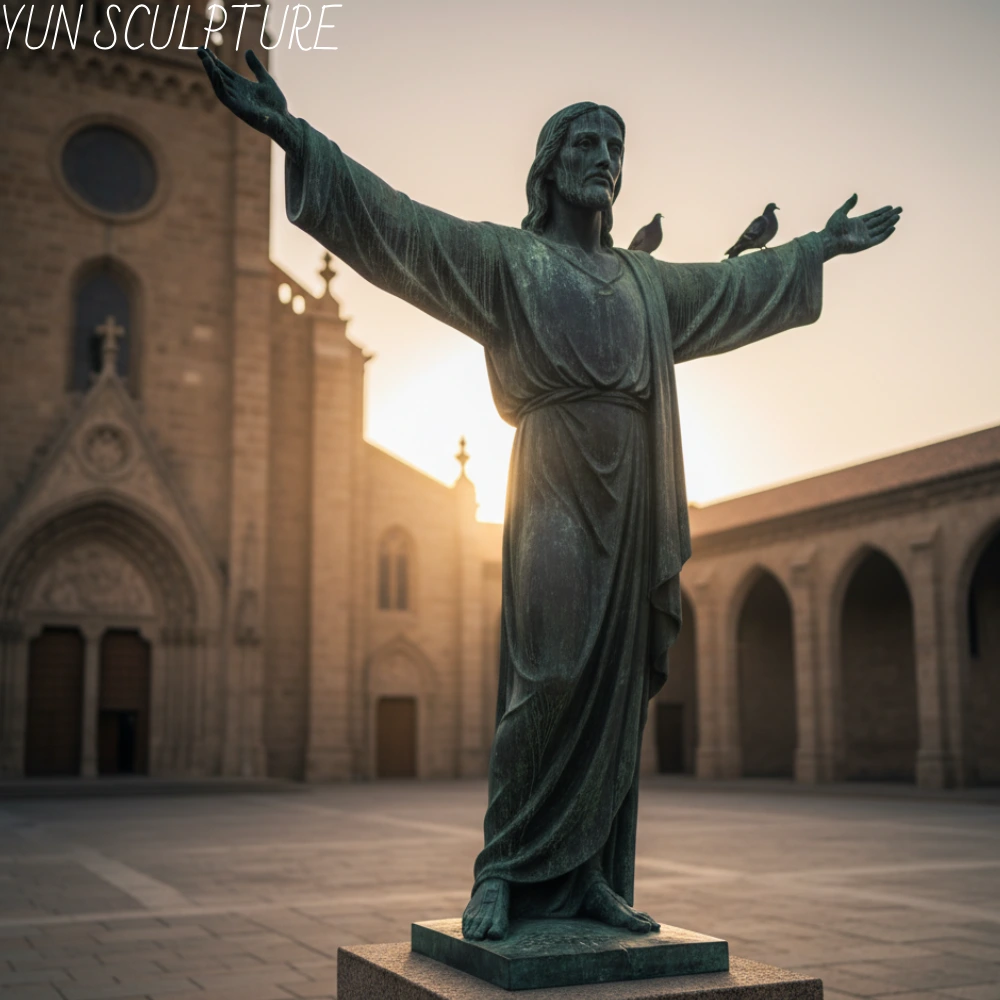
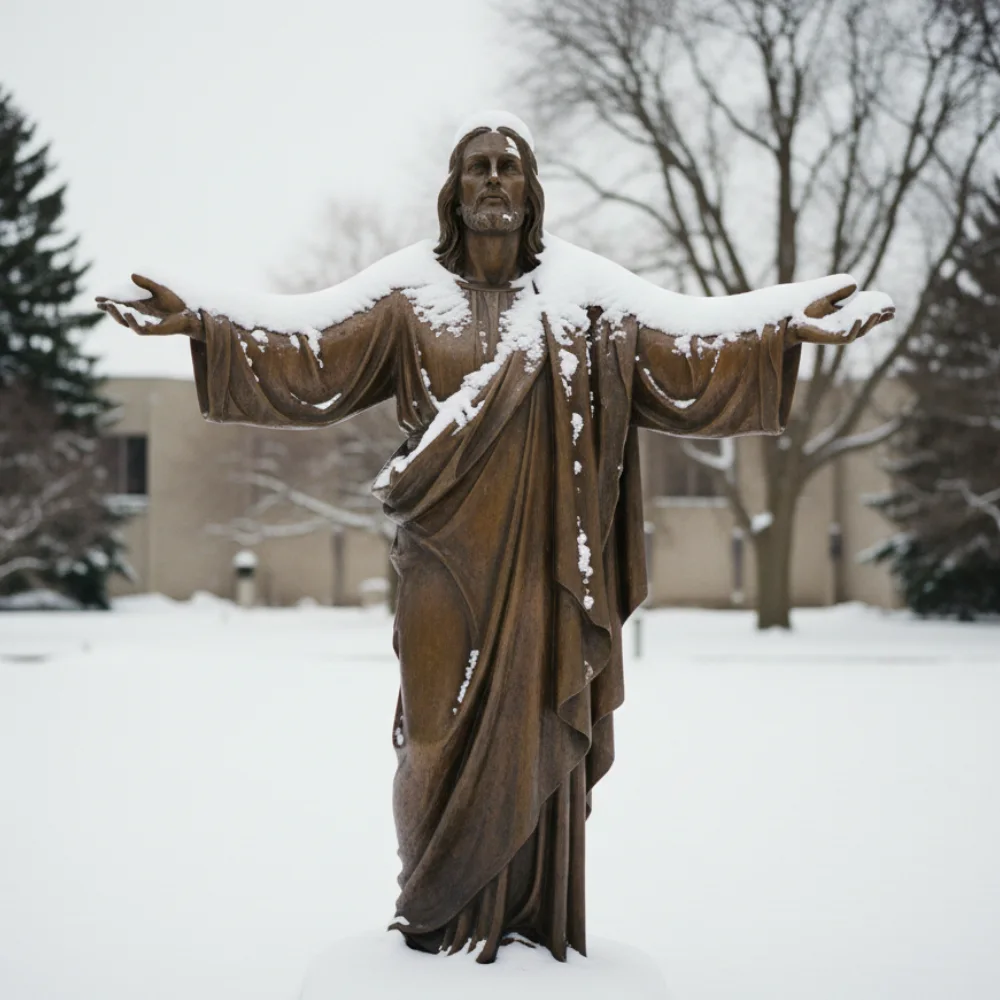
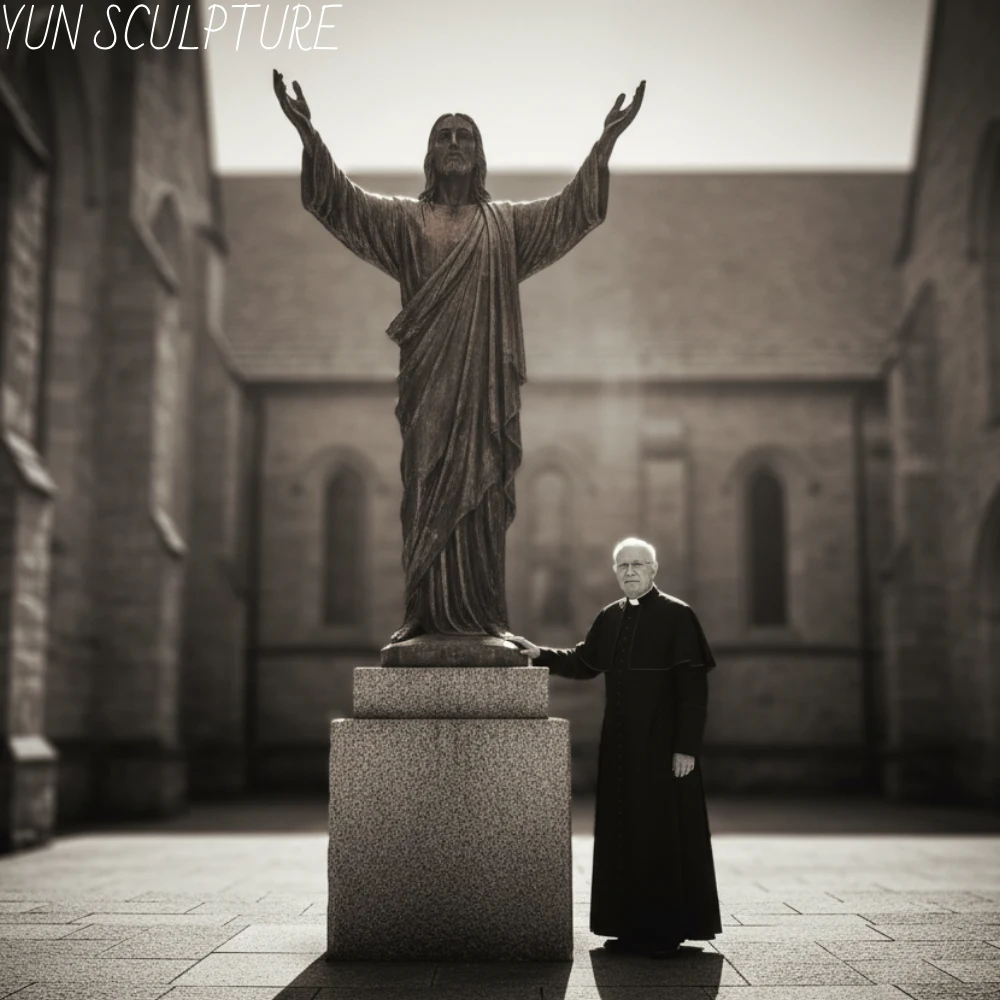
This is the decision that brings most of our clients to us. A statue of the risen christ placed at the entrance of a parish, a cemetery, or a pilgrimage site is not decoration. It is a declaration. It is an engineering practice of faith — one that must endure salt air, acid rain, vandalism, and centuries of theological witness.
A risen jesus christ statue with arms outstretched toward the sky carries the full weight of Christian doctrine in a single gesture. When commissions arrive from dioceses in Texas, from shrines in the Philippines, from memorial gardens in rural Australia, the question is never simply “what should it look like?” The question is always: “How long must it last?”
A resurrected jesus statue built to last a generation is a compromise. Built in bronze, by hands that understand both metallurgy and iconography, it becomes a landmark.
Table of Contents
Table of Contents
What is a Risen Christ Statue? Decoding the Theology of Triumph
To understand why this particular pose carries such profound weight, you must first understand what it is not.
A jesus on cross statue — the crucifix — depicts the moment of ultimate sacrifice. The body is broken. The head bows. It is the theology of suffering, of redemption purchased at the highest price. Many of our clients already have a crucifix above their altar. They come to us because they want something beyond Golgotha.
A sacred heart of jesus statue — or statue of the sacred heart of jesus — depicts Christ in mercy. The gaze is gentle, the heart exposed and luminous. It speaks of divine compassion extended to the living.
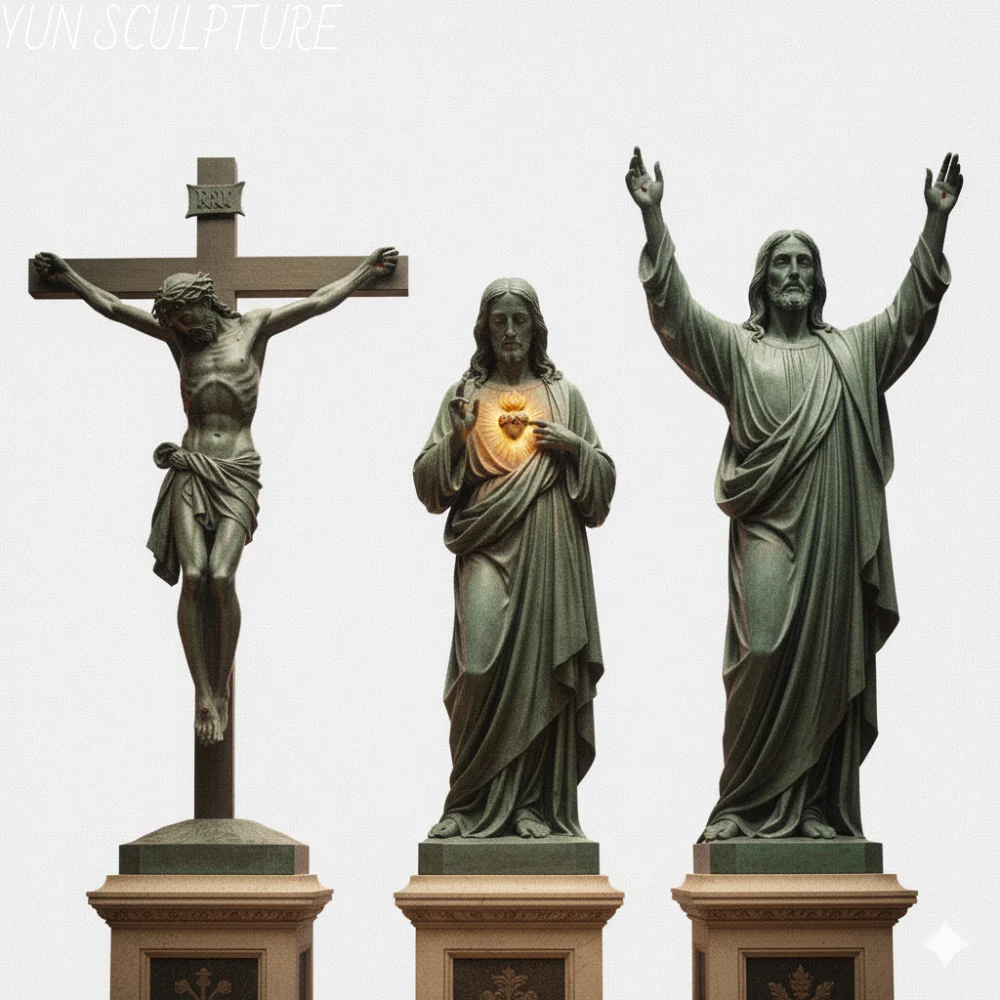
The Risen Christ is neither of these. This is the theology of triumph.
The open arms do not merely welcome — they declare. They announce that the tomb is empty, that death has been defeated, that the resurrection of jesus statue form we have studied and cast for decades is the visual culmination of the entire Christian narrative. No crown of thorns. No wounds displayed in anguish. Only a statue of jesus christ standing in sovereign, radiant victory.
For a catholic jesus statue placed at a church entrance or on a hillside visible for miles, this posture communicates something no sermon can replicate: He is not here. He is risen.
Global Landmarks: From Cochabamba to Medjugorje
The world’s most visited religious landmarks tell us something important about ambition — and about the hidden costs of the wrong material.
Cristo de la Concordia in Cochabamba, Bolivia, completed in 1994, stands 34.2 meters tall — taller and heavier than Christ the Redeemer in Rio. It was constructed from concrete and stone, a choice made for budget and scale. Today, it requires ongoing structural intervention to address surface cracking and internal rebar corrosion.
Christ the Redeemer in Rio de Janeiro, completed in 1931, stands 30 meters and is clad in soapstone tiles. It is arguably the most recognized religious statue on earth. It has also undergone multiple major restorations — including lightning damage repairs and full tile replacements — at costs reaching into the millions.
Christ of the Ozarks in Eureka Springs, Arkansas, completed in 1966, stands 21 meters in reinforced concrete. Its stark, columnar form was a deliberate engineering choice. It has required significant restoration work as the concrete surface weathers and stains.
The pattern is consistent and undeniable.
These landmarks were built with concrete — a material that requires major restoration every 20 to 30 years. Our clients choose bronze precisely because a properly cast and finished bronze sculpture does not crack, does not spall, does not surrender its surface to weather. It patinates — developing a protective oxide layer that actually strengthens the metal’s resistance over time. The landmarks above were built to be seen. A bronze risen christ statue is built to endure.
The Material Battle: Why Bronze Reigns Supreme for Outdoor Sanctuaries
I have reviewed restoration reports from concrete religious monuments on four continents. The conclusion is always the same: the material chosen at the moment of commission determines the cost paid by every generation that follows.
When a diocese asks me which material to choose for their risen christ bronze statue, I do not give them a sales answer. I give them an engineering answer. The data speaks without sentiment.
Stone and Marble: Beautiful, But Brittle
A marble jesus statue carved from Carrara or Hunan white stone is undeniably magnificent in controlled environments. The Renaissance masters understood this. Michelangelo’s Pietà has survived five centuries — indoors, in climate-controlled sanctuaries, behind bulletproof glass.
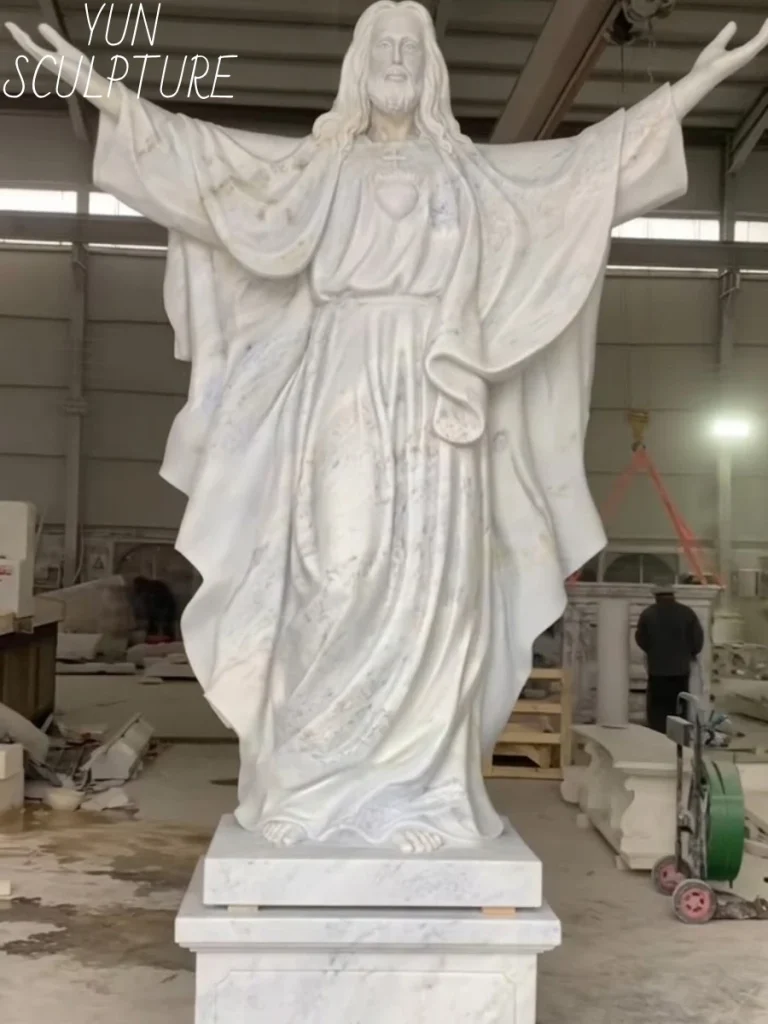
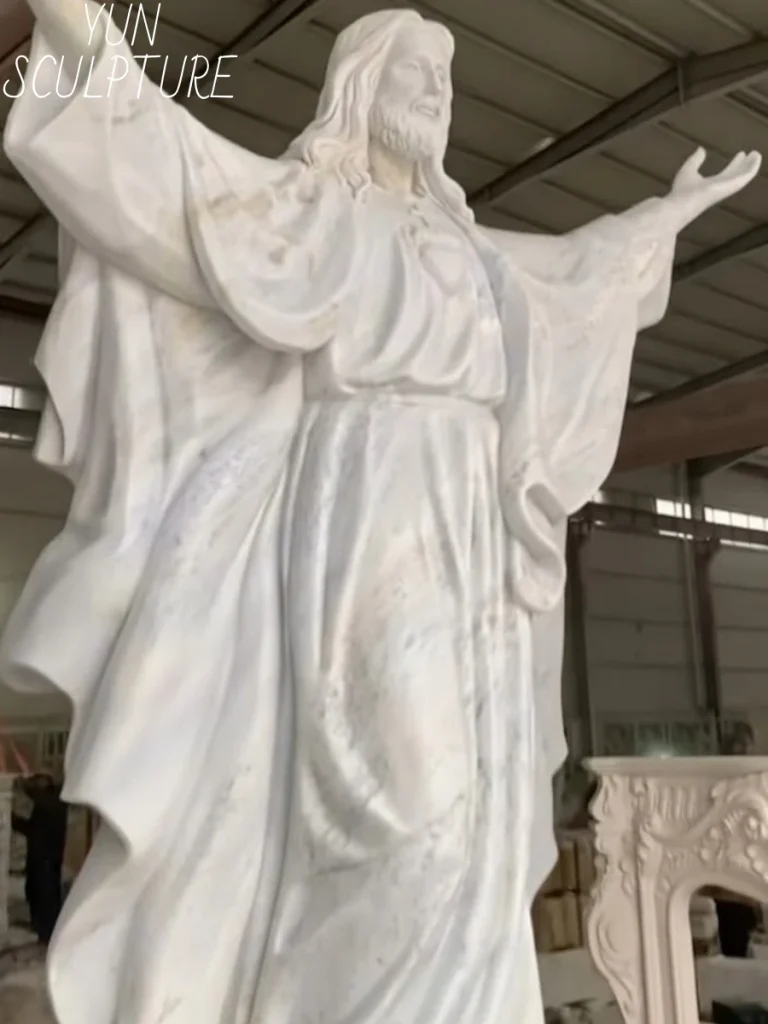
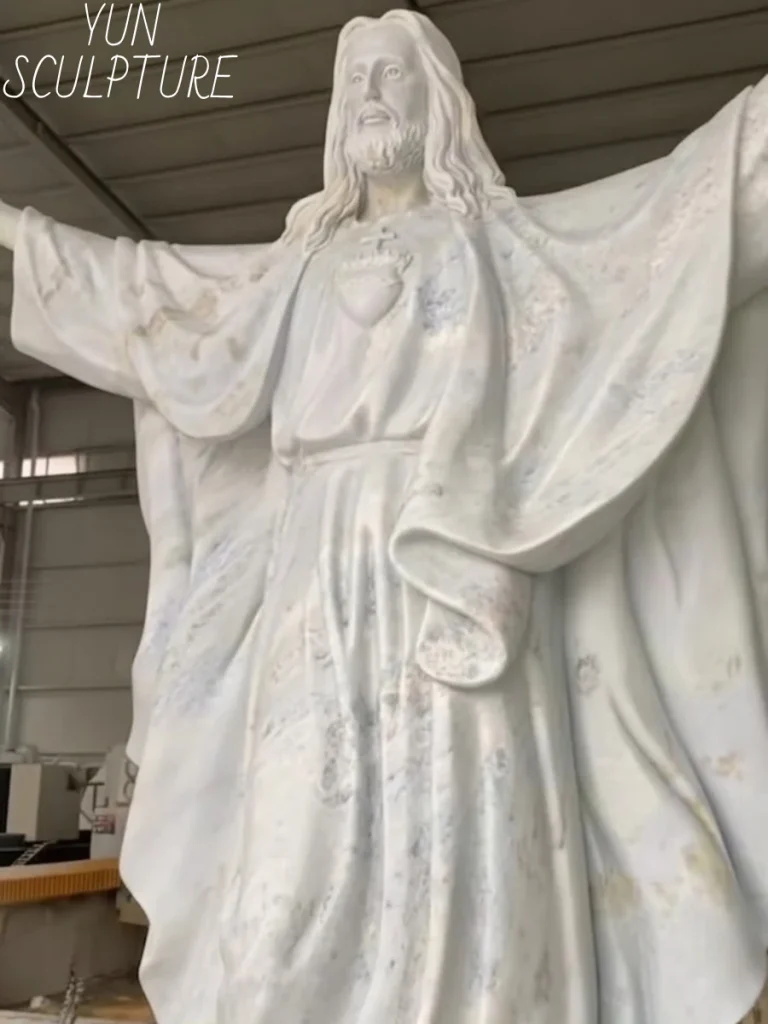
Place that same jesus marble statue outdoors in coastal Louisiana, in the Philippine typhoon belt, or in the freeze-thaw cycles of Minnesota winters, and the calculation changes entirely. Marble is porous. Water infiltrates micro-fractures, freezes, expands, and fractures the stone from within. Surface detail — the folds of a robe, the expression of a face — erodes within decades. A stone statue does not age gracefully outdoors. It dissolves.
Concrete and Cast Iron: Engineering Without Artistry
A concrete jesus statue offers scale at low cost. The landmarks we discussed in Part 1 prove this. But concrete is inherently alkaline, and outdoor exposure acidifies its surface over time. Rebar corrodes. Sections spall. The face that was expressive at installation becomes featureless within a generation.
Older large cast iron antique christ statue crucifix pieces found in 19th-century European cemeteries tell a similar story — cast iron rusts aggressively without constant maintenance, and its brittleness means a single impact event can cause catastrophic fracture with no possibility of field repair.
Wood: Sacred in Tradition, Vulnerable in Reality
A wooden jesus statue carries profound meaning in certain liturgical traditions — hand-carved polychrome figures in Spanish colonial churches remain among the most moving religious objects in existence. But outdoor installation is simply not within wood’s material competency. UV degradation, moisture cycling, and biological attack from fungi and insects set a hard ceiling on lifespan regardless of sealant quality.
Why a Bronze Statue of Jesus Stands Alone

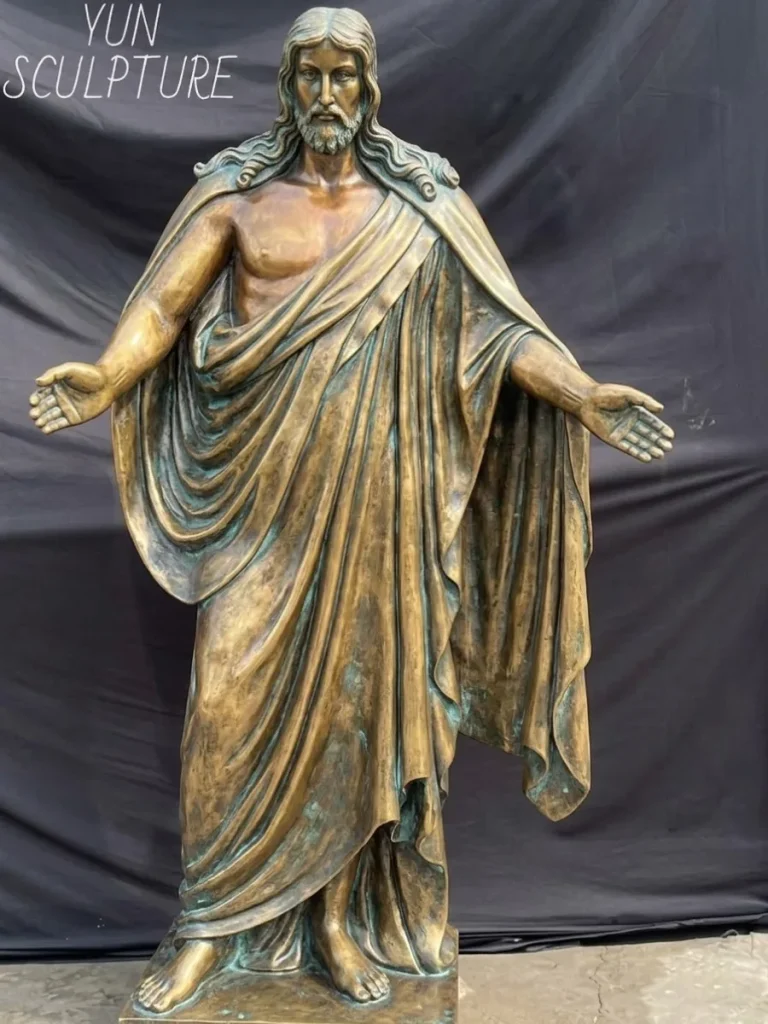
A bronze jesus statue — specifically one cast from Grade A Foundry Bronze, an alloy of approximately 90% copper, 6% tin, and trace zinc — operates on an entirely different timescale.
| Property | Bronze | Marble | Concrete | Wood |
|---|---|---|---|---|
| Outdoor Lifespan | 100–300+ years | 100–200 years | 30–50 years | 10–20 years |
| Detail Precision | Exceptional | High | Low | High |
| Freeze-Thaw Resistance | Complete | Poor | Moderate | Poor |
| Salt Spray Resistance | Excellent | Poor | Poor | Very Poor |
| Restorability | Full | Limited | Difficult | None |
| Impact Resistance | High | Brittle | Brittle | Moderate |
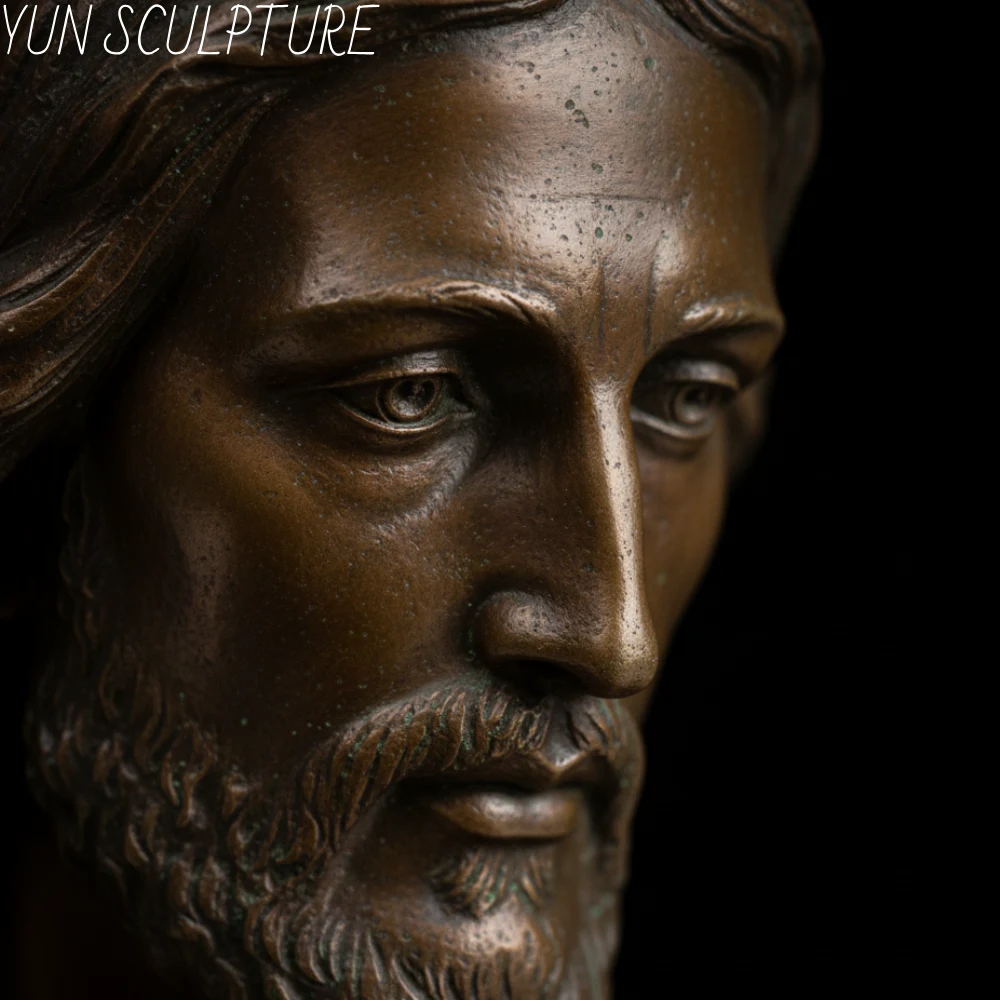
The chemistry is straightforward. When our jesus statue bronze is exposed to atmosphere, the copper surface oxidizes to form cuprite, then stabilizes into patina — a dense, adherent layer of copper carbonate that actively resists further corrosion. Acid rain does not eat bronze. It feeds the patina. Salt spray does not pit the surface. It deepens the color.
This is why the bronze doors of the Pantheon in Rome have survived two thousand years of Roman weather. This is why every serious outdoor bronze statue of jesus commissioned for a permanent landmark is cast in this alloy, to this standard.
The risen christ bronze statue we deliver is not maintained against time. It is aligned with it.
The Genesis of Eternity: The 7-Step Bronze Casting Process
Every corpus of risen christ for statue making begins not with metal, but with dialogue. Before a single gram of clay is touched, we sit with the client — the parish architect, the diocese committee, the private donor — and we ask the questions that no catalog can answer.
What height will create the right visual impact at the installation distance? What posture speaks to this specific community’s theology? What patina finish — warm antique gold, solemn verde antique, or deep statuary bronze — matches the surrounding architecture?
Only when those questions have answers does the process begin.
Step 1: 3D Conceptual Modeling
Our sculptors build a precise digital model using professional 3D software, establishing exact proportions, posture geometry, and surface detail hierarchy. For large commissions — anything above 2.4 meters — we run structural load calculations at this stage, determining internal armature requirements before a single physical element is produced. The client reviews and approves the model before we proceed.
Step 2: 1:1 Clay Sculpting — The Soul of the Statue
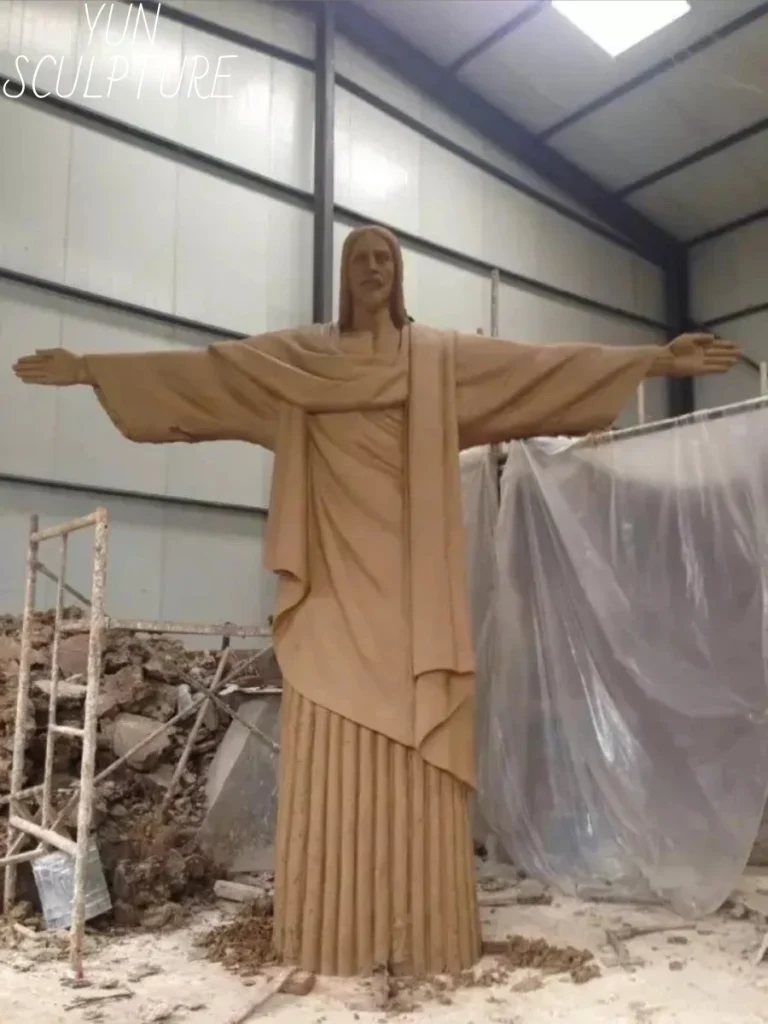
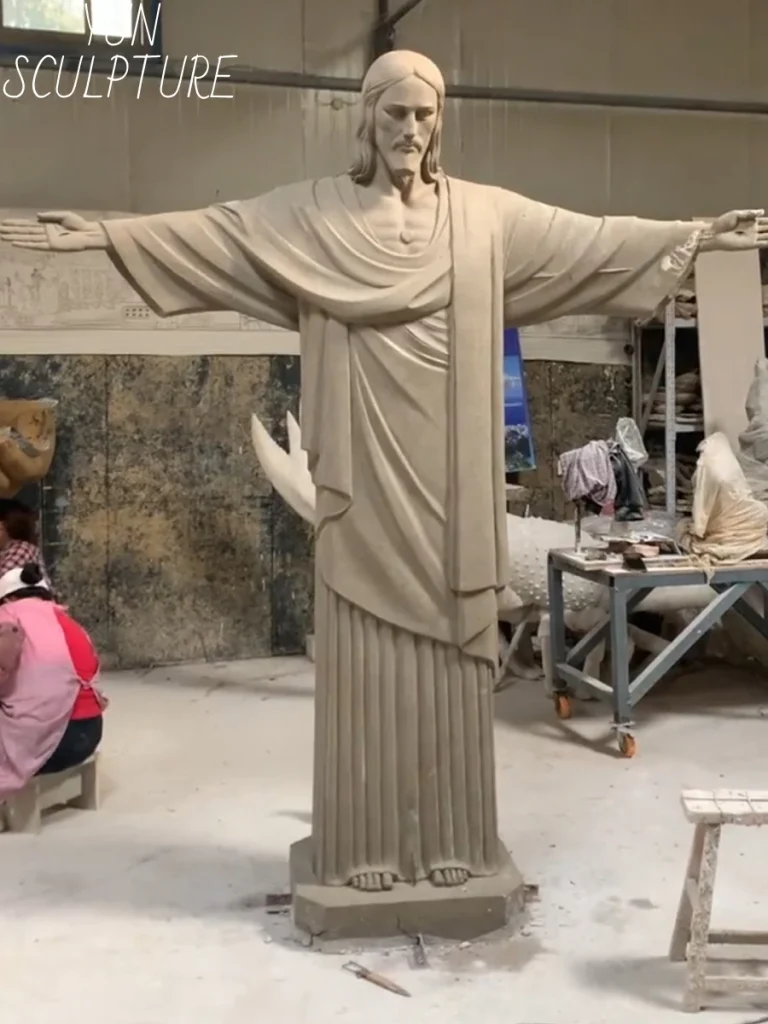
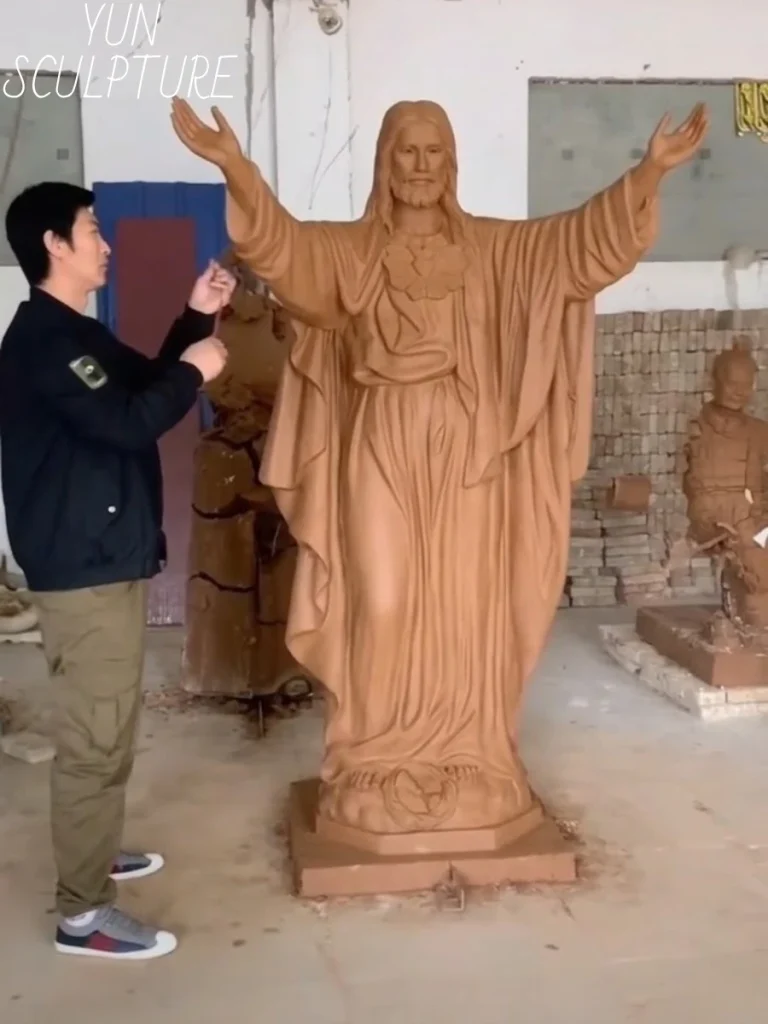
This is the step that separates foundry work from manufacturing. Our master sculptors build a full-scale clay original by hand, working from the approved digital model as a reference but trusting the human eye for the details that matter most: the weight of a draped robe, the tension in an outstretched hand, the precise quality of a facial expression that must communicate resurrection and triumph across fifty meters of open courtyard.
The clay original is where the statue receives its soul. No subsequent step can repair what is lost here.
Step 3: Mold Making
A multi-layer silicone rubber mold is constructed over the clay original, capturing every surface detail down to the texture of the skin and the individual strands of hair. This mold is then reinforced with a rigid fiberglass mother mold. For large statues, the figure is divided into logical segments — torso, arms, head, robes — each molded independently for casting.
Step 4: Lost-Wax Casting — The Industry Gold Standard
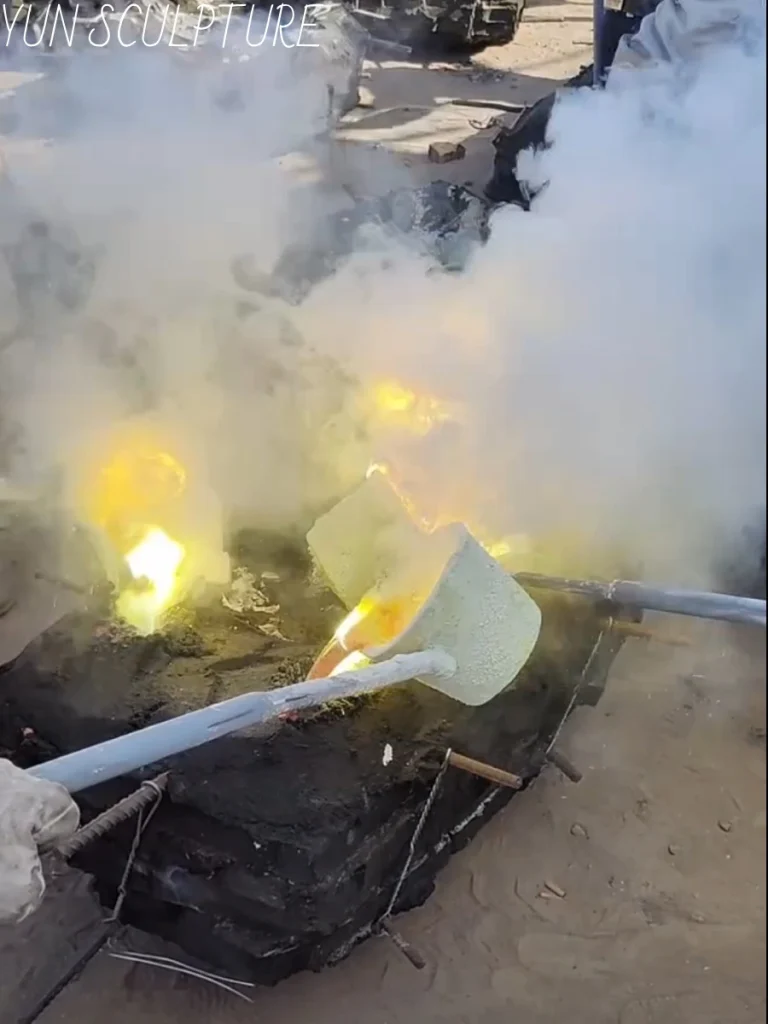
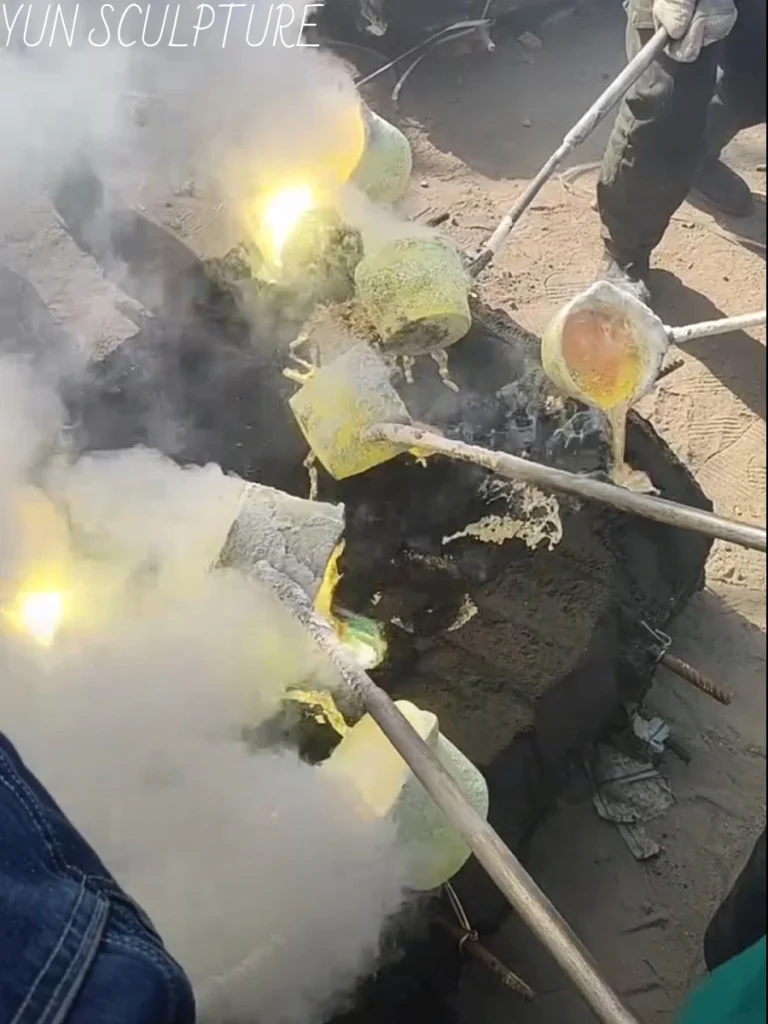
Molten wax is poured into each mold section to create hollow wax positives. These wax forms are coated in multiple layers of ceramic shell, then fired in a kiln — the wax melts away, leaving a precise ceramic cavity. Molten Grade A Foundry Bronze, heated to approximately 1,100°C, is poured into these ceramic shells. When cooled and the shell is broken away, what remains is a bronze section of extraordinary fidelity to the original clay.
Lost-wax casting has been the technical foundation of monumental bronze sculpture for three thousand years. There is no superior method for this work.
Step 5: Chasing and Welding
Each bronze section is removed from its ceramic shell and inspected. Surface imperfections — minor porosity, casting lines, small voids — are addressed by hand using chisels, grinders, and welding equipment. This process, called chasing, is highly skilled finish work. A section may require forty hours of chasing before it is ready for assembly.
Step 6: Large-Scale Assembly — Structural Integrity Above All
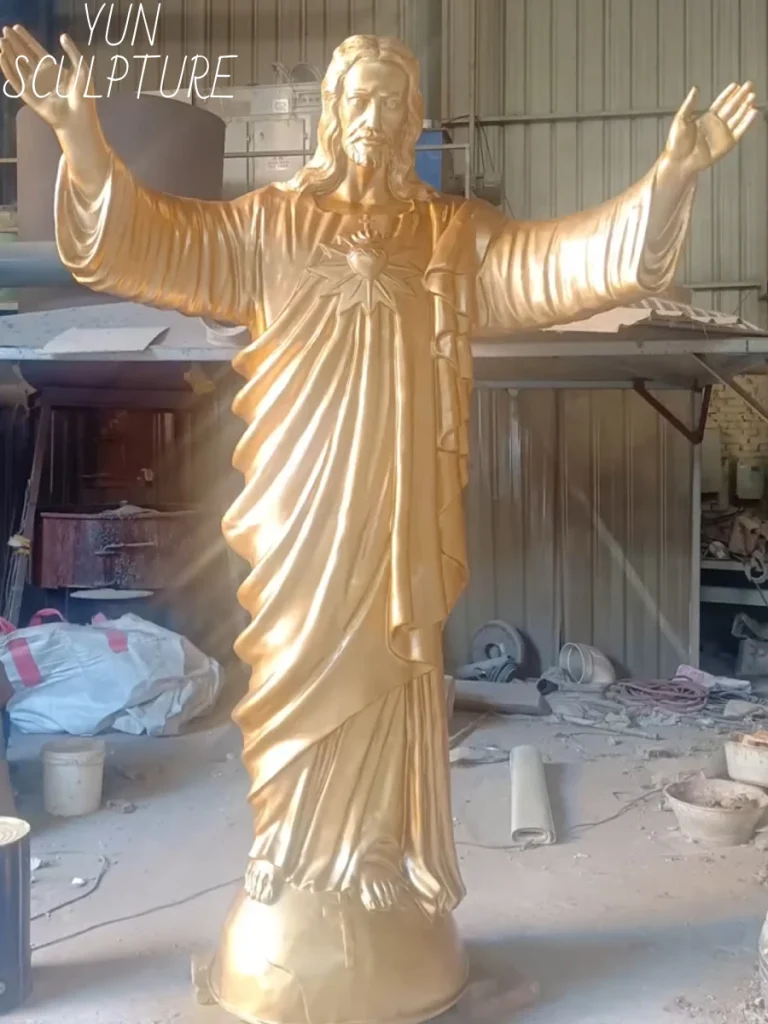
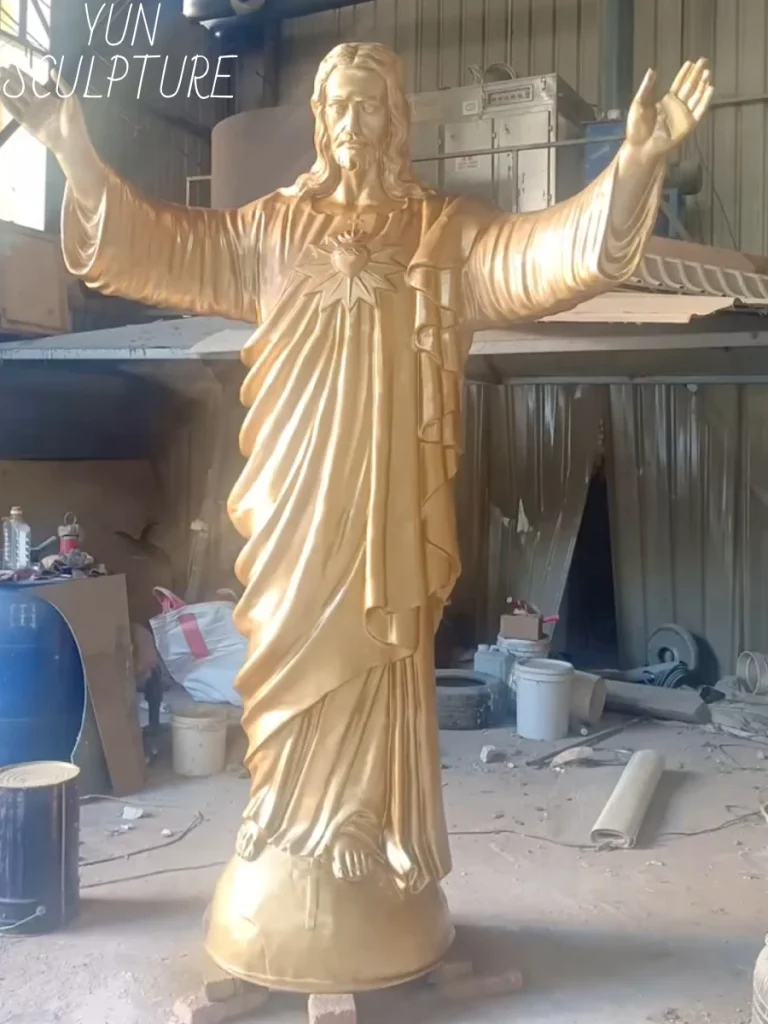
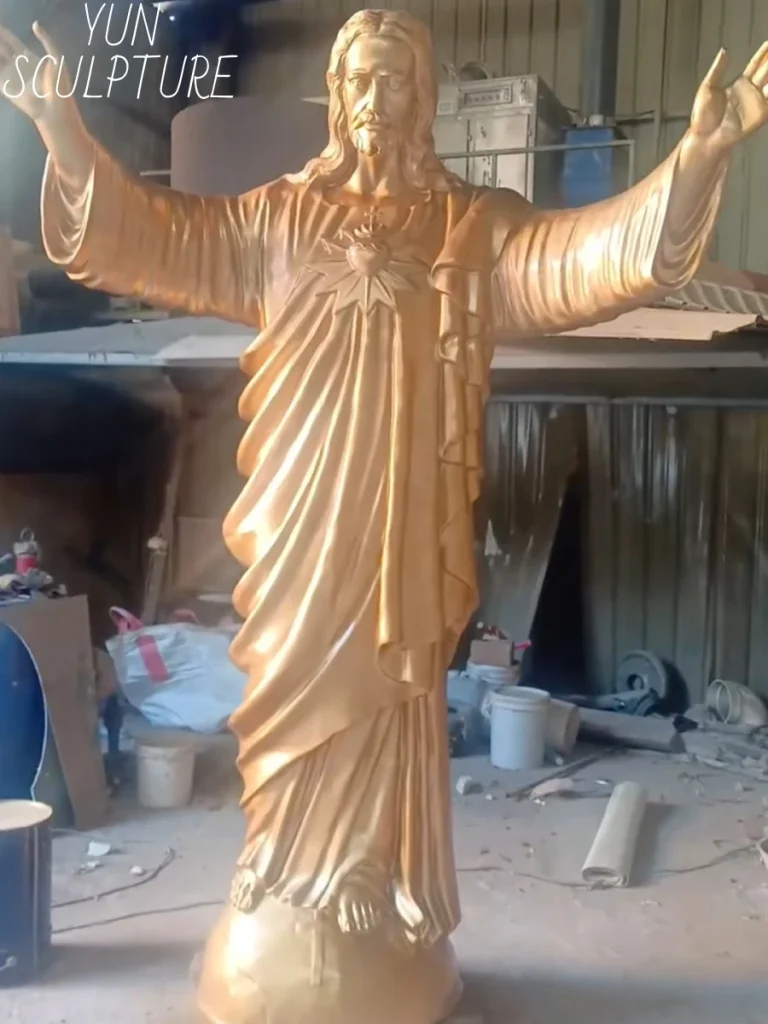
Individual bronze sections are welded together into the complete figure using TIG welding. For statues above 3 meters in height, this stage includes the installation of a primary internal steel armature — a engineered skeletal framework designed to carry the static load of the bronze skin, resist wind lateral forces, and interface securely with the foundation anchor system below.
We calculate wind load at the installation site’s recorded maximum. We design for a safety factor of 3.0 above that figure. A risen christ outdoor statue standing with arms outstretched presents significant wind resistance at elevation. This is a structural engineering problem, not an aesthetic one, and it is treated accordingly.
Step 7: Patination — The Language of Time
Chemical patination is applied to the finished, assembled bronze using controlled application of heat and patination compounds — liver of sulfur, ferric nitrate, cupric nitrate — each producing a distinct color range from warm golden brown through deep verde antique to near-black statuary finishes.
The final surface is sealed with a professional-grade microcrystalline wax, renewable on a ten-year maintenance cycle. This final treatment does not merely protect the bronze. It communicates — in the language of materials — that this object was made to outlast the institution that commissioned it.
Sizing and Specification Guide for Sacred Spaces
The most common mistake a parish committee makes is choosing a statue size based on budget, then installing it — and discovering that a figure scaled for an intimate chapel reads as insignificant against a thirty-meter facade, or that a monument designed for an open hillside overwhelms a courtyard garden.
Scale is not an aesthetic preference. It is a theological statement. The right size, in the right space, creates the right encounter.
Interior and Altar Installations
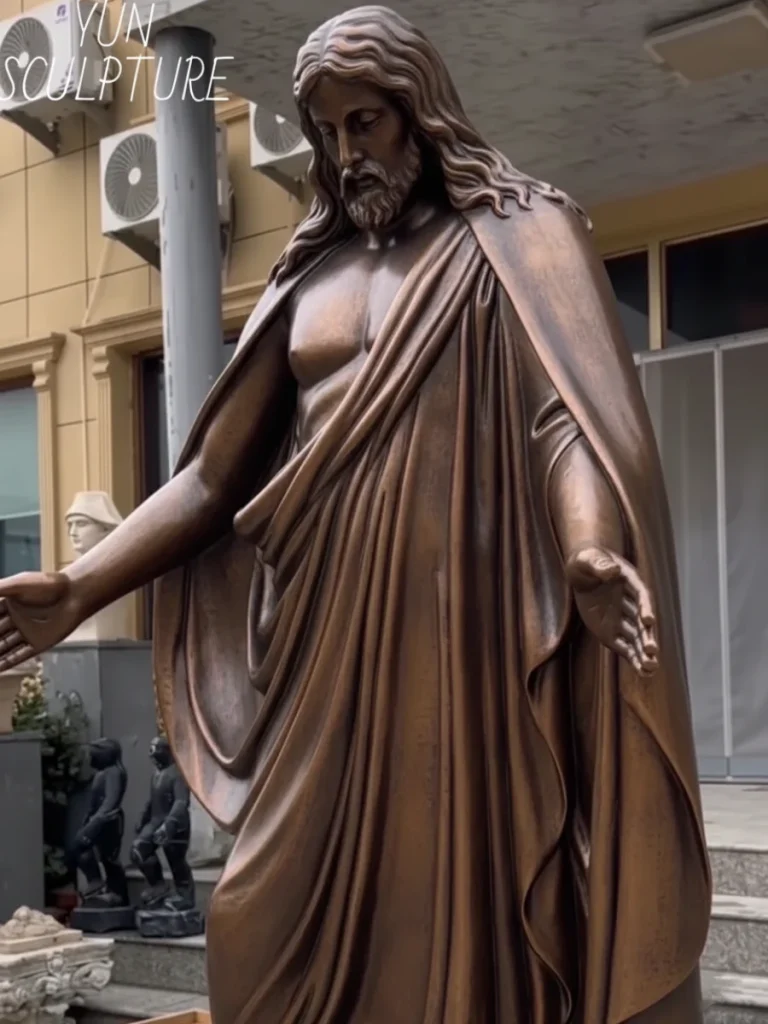
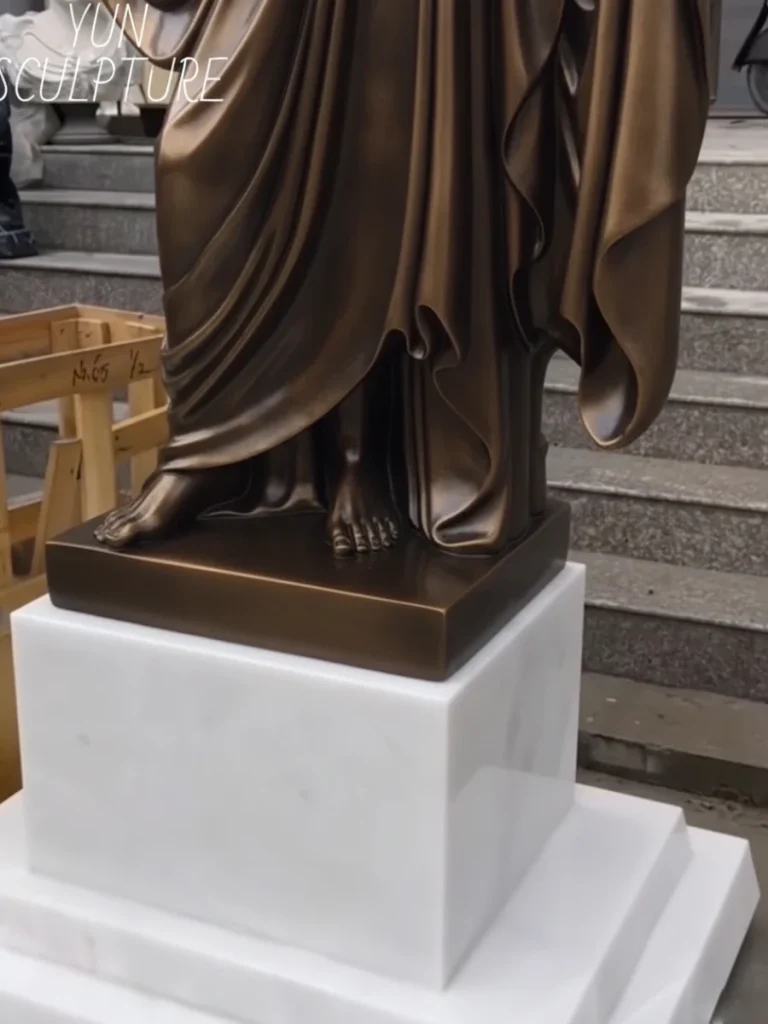
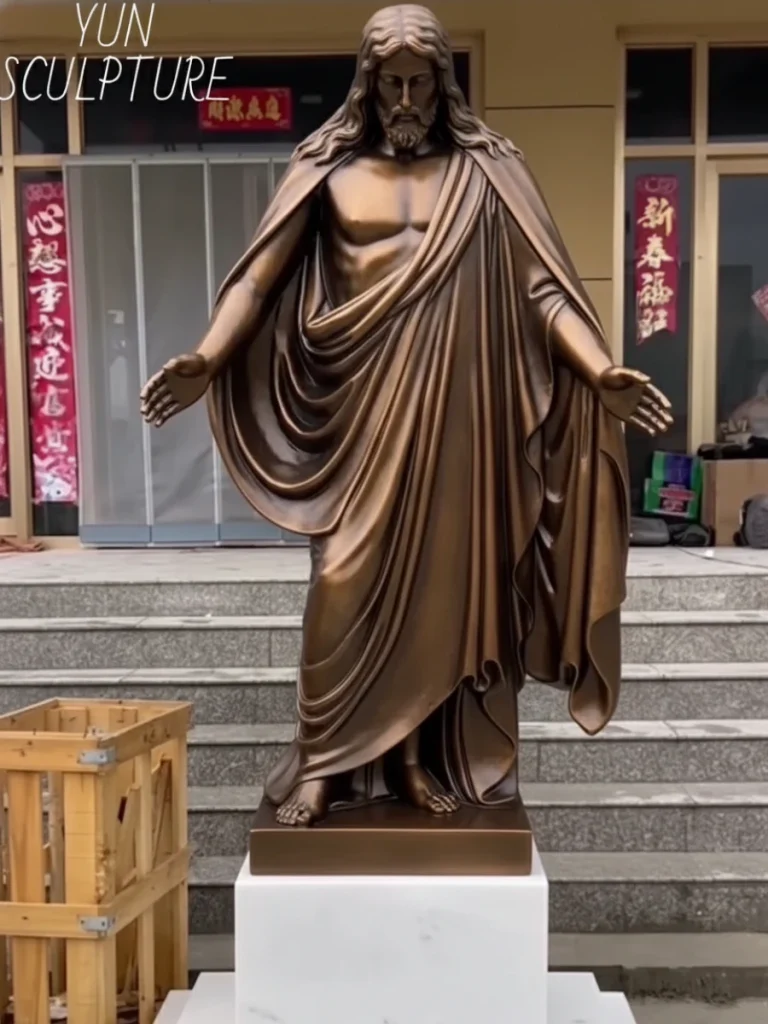
A life size jesus statue — 1.8 meters, or six feet — is the classical standard for interior sanctuary placement. At this height, the figure meets the eye of a standing adult at chest level. The gaze descends slightly. The effect is intimate, devotional, immediate. This scale works at the foot of an altar, in a side chapel, or at the entrance of a sacristy.
The jesus statue 180cm tall for sale represents our most frequently commissioned architectural size, requested by parishes across the United States, Australia, and the Philippines. It is the scale at which bronze craftsmanship is most fully legible — the folds of the robe, the expression of the face, the musculature of the outstretched hands — all resolved at a distance of three to eight meters.
Outdoor Monuments and Landmark Commissions
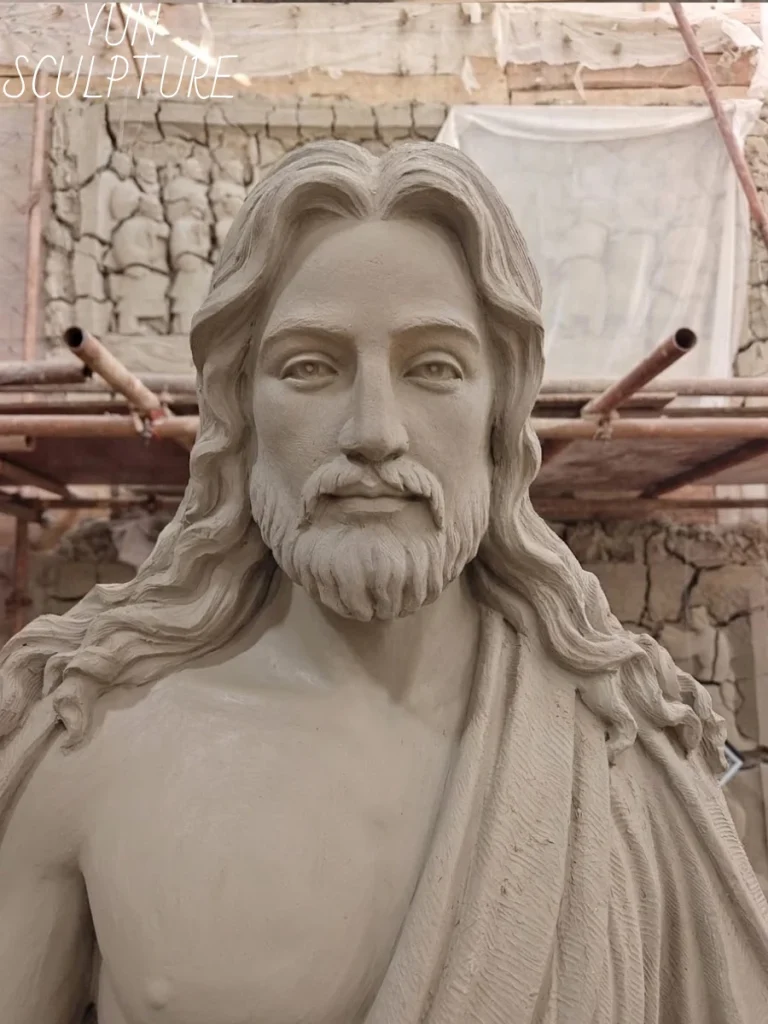
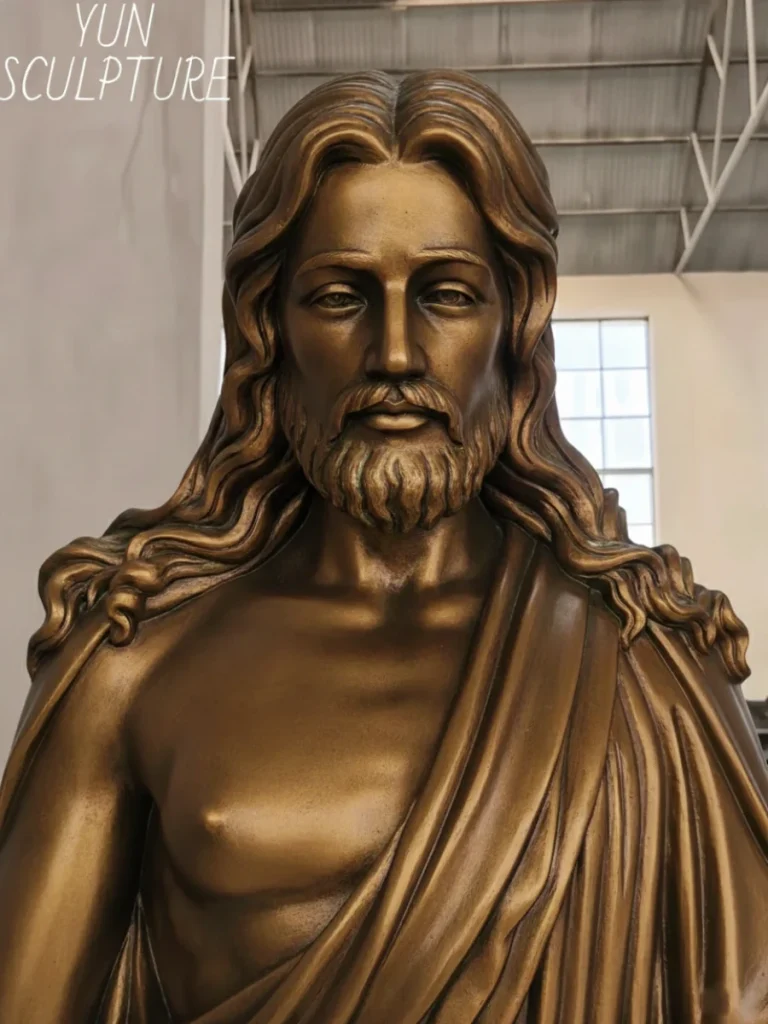
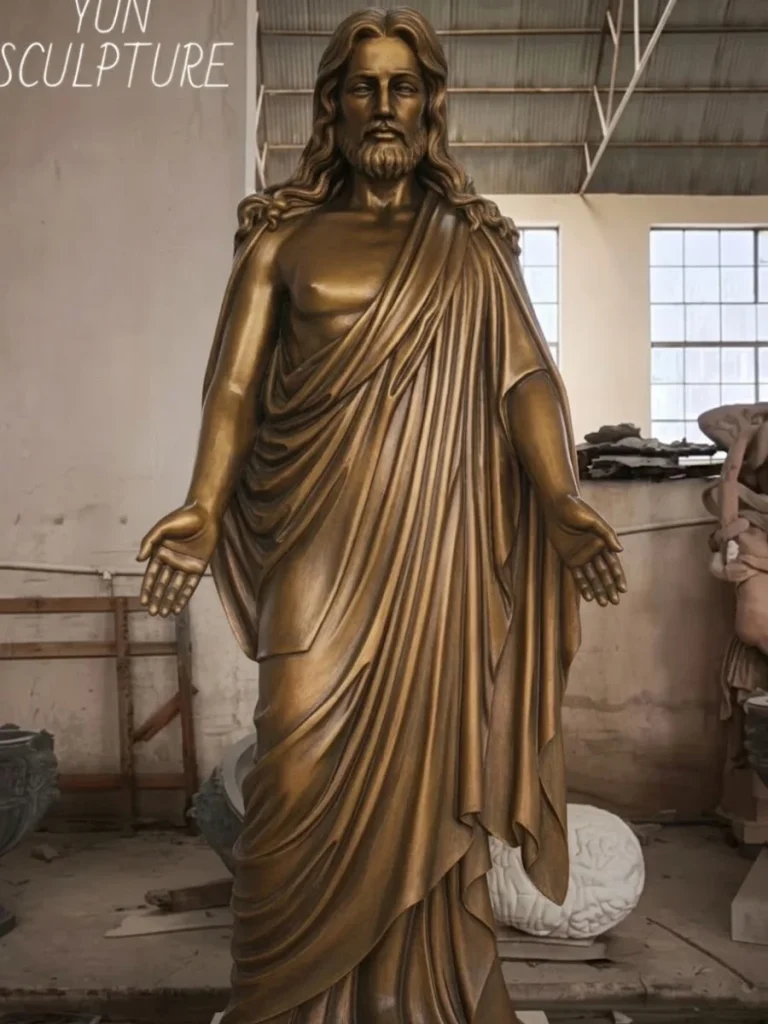
A large jesus statue intended for outdoor courtyard installation typically begins at 2.4 meters and scales upward based on the surrounding architecture and the intended viewing distance. The general rule our engineers apply: for every ten meters of primary viewing distance, add one meter of statue height to maintain visual presence.
A big jesus statue in the 4 to 6 meter range becomes a landmark within its immediate geography — visible above surrounding walls, readable from moving vehicles, capable of anchoring a pilgrimage destination. A giant jesus statue commission in the 10 to 30 meter range enters the category of civic infrastructure. The structural engineering at this scale requires site-specific wind load analysis, foundation engineering reports, and in most jurisdictions, formal building permits.
For clients who ask about a concept like a 200-foot figure — the scale of the great concrete landmarks discussed in Part 1 — our position is direct: bronze remains technically feasible through segmented panel construction, but the economics and logistics require a dedicated project team and multi-year planning. We have had these conversations. We are equipped for them.
Smaller Formats: Devotional and Architectural Accents
Not every commission is a landmark. Some of our most meaningful work is intimate.
A 24 risen christ statue — approximately 60 centimeters — is the standard size for a sacristy credenza, a hospital chapel, or a private home altar. The 16 risen christ wall statue and formats in the risen christ statue 24 to 36 inch range serve as devotional focal points in corridors, offices, and domestic prayer spaces. A risen jesus christ hanging wall statue or risen jesus christ cross statue format integrates the resurrection imagery with the cross structure itself — a theologically layered object that acknowledges Calvary and the empty tomb simultaneously.
A small risen christ statue in the 30 to 45 centimeter range is frequently commissioned as a commemorative gift — for an ordination, a parish anniversary, a bishop’s installation. A jesus bust statue, focusing on the head and shoulders of the Risen Christ, serves similar commemorative functions with exceptional sculptural intimacy.
Engineering Foundation Requirements
For any risen christ outdoor statue installed above 1.5 meters, Donghui Zhang specifies the following as minimum requirements: a reinforced concrete foundation with a depth of not less than 1.2 times the statue height, 316-grade stainless steel anchor bolts with epoxy grouting, and a drainage void within the base to prevent water accumulation around the lower armature connections. We provide stamped engineering drawings for all commissions above 2 meters. Many dioceses and municipalities require them.
Who Orders a Risen Christ Statue?
The range of clients who commission this specific iconographic form is broader than most people expect. It is not exclusively a parish project.
Catholic Diocese and Parish commissions represent the largest segment of our work. These are typically exterior landmark installations — placed at church entrances, in memorial gardens adjacent to the nave, or as the focal point of outdoor Stations of the Cross.
Cemetery and Memorial Garden clients commission the Risen Christ because the theology of resurrection speaks directly to the purpose of a burial ground. The open arms become an image of welcome — of the promise held by every grave beneath them.
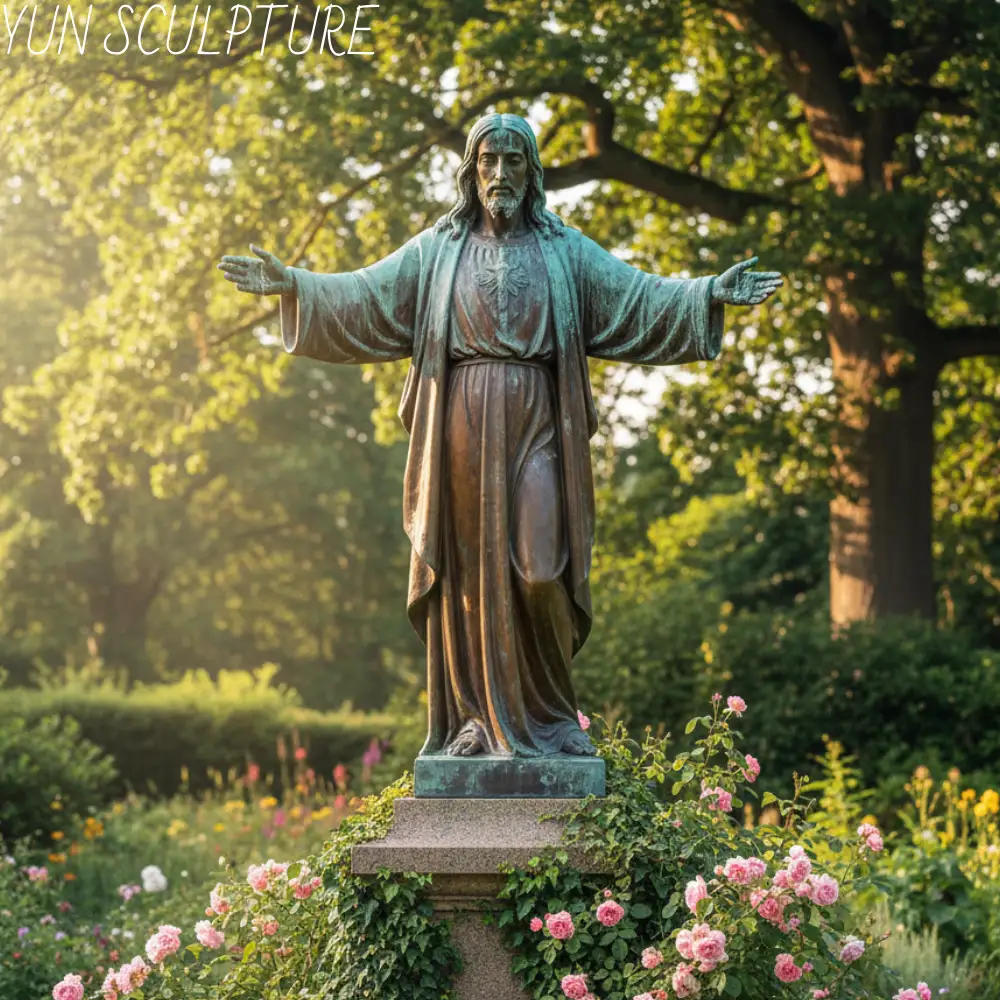
Private Chapel and Estate commissions come from individuals of significant means who are building or restoring a personal devotional space. These clients typically have the highest degree of artistic input and the longest decision timelines.
Religious Tourism Landmarks — shrines, retreat centers, pilgrimage destinations — commission statues as anchor objects for their site’s identity. A single powerful image, properly scaled and positioned, can define a destination across decades of pilgrimage traffic.
Shrine and Pilgrimage Site clients understand better than anyone the relationship between a physical object and a spiritual journey. They know that pilgrims travel thousands of miles to stand before a specific statue in a specific place. They commission accordingly.
The Medjugorje Phenomenon: Replicating a Modern Miracle
There is one version of the Risen Christ that our clients request by name more than any other. They do not always know its exact provenance. They recognize it immediately.
It is the medjugorje risen christ statue — and its influence on Catholic devotional art over the past four decades is without parallel among contemporary religious sculptures.
A Statue Born from Apparition
The risen christ statue in medjugorje is located in Međugorje, Bosnia and Herzegovina — a town that since 1981 has been one of the most visited Catholic pilgrimage sites on earth, drawing an estimated one million visitors annually based on the reported Marian apparitions to six local visionaries.
Međugorje’s risen christ statue stands near Apparition Hill — Podbrdo — the rocky limestone slope where the apparitions were first reported. The christ has risen statue in medjugorje occupies a position within a landscape of extraordinary spiritual density. Pilgrims who climb barefoot over the stones of that hill pass this figure as part of their physical act of devotion.
Međugorje’s risen christ statue on Apparition Hill is not simply an object placed in a famous location. For many of the pilgrims who have stood before it, it is inseparable from the experience of the place itself. Its image has been carried back to parishes, seminaries, and private chapels on every continent.
The Distinctive Form
What makes this particular figure iconographically distinct is the specific quality of its posture and expression.
Where many Risen Christ figures present an attitude of universal proclamation — arms raised high, face lifted toward heaven — the Međugorje figure projects something more intimate. The arms extend forward and outward at a lower angle, as though reaching specifically toward the viewer rather than addressing an infinite horizon. The body carries a slight forward inclination — not dramatic, not theatrical, but present. It suggests approach rather than distance.
The facial expression holds what our sculptors describe as composed tenderness: neither the anguish of the crucifix nor the radiant triumph of the ascending Christ, but something in the middle — the expression of a person who has passed through death and returned, and who looks at the living with complete, unhurried recognition.
The relationship to the cross in this iconographic version is also notable. The figure does not carry the cross, does not stand before it in triumph. The body has separated from it — the wounds are present but not foregrounded. The posture communicates that the cross was the passage, not the destination.
Faithful Replication for Global Commissions


Clients who have made the pilgrimage to Međugorje — or whose parishes were founded by priests who did — frequently arrive at our studio with risen christ statue medjugorje photos taken on their own phones, printed devotional cards, or small resin replicas purchased at the site’s gift stalls. They want this specific figure. They want it in bronze. They want it scaled for their courtyard, their garden, their sanctuary entrance.
We have replicated this iconographic type multiple times, in sizes ranging from 90 centimeters to 3.8 meters. Each commission begins with a careful study of the reference materials the client brings, followed by a detailed conversation about which elements are essential to their devotional intent and which structural adaptations the new scale requires.
The Međugorje figure was not designed as a monument. At larger scales, the forward-inclining posture requires internal armature adjustments to maintain correct center-of-gravity alignment. The extended arms at low angle present different wind load geometry than a high-raised posture. These are engineering problems that must be solved without sacrificing the iconographic fidelity that makes the commission meaningful.
We solve them. This is precisely the intersection where art history and structural engineering must work as one discipline.
The Commissioning Process: From Concept to Delivery
A commission for a risen christ statue for sale is not a purchase. It is a partnership measured in months of collaborative craft and decades of shared legacy.
Our standard production cycle runs 60 to 100 days from signed approval to completed bronze. The lower end of that range applies to commissions where the iconographic brief is clear, the size is within our established range, and the patina selected is a standard finish — statuary brown, verde antique, or natural oxidized bronze. The upper end applies to commissions requiring original clay sculpting from a new reference, complex multi-tone patination, or internal structural engineering for figures above 3 meters.
The timeline does not compress without cost to quality. The lost-wax casting process has its own physics. The ceramic shell must cure fully before bronze is poured. The chasing and welding stages cannot be rushed without introducing surface defects that will be visible for a century. We protect the timeline because we are protecting the object.
International Delivery: DDP to Your Door
We maintain established shipping infrastructure for our three primary export markets.
For clients in the United States, bronze sculptures ship via sea freight in custom-built timber crating with foam-cushioned internal bracing. We handle customs clearance and deliver DDP — Delivered Duty Paid — to the installation site. Most continental US deliveries complete within 18 to 25 days of departure from our foundry.
For clients in Australia, our logistics partner manages all biosecurity documentation requirements. Timber crating meets Australian quarantine standards. DDP delivery to major Australian cities typically adds 22 to 30 days transit time.
For clients seeking a risen christ statue for sale in the Philippines — our most active Southeast Asian market — we ship through Manila port with full customs documentation. The Philippines represents one of the largest per-capita markets for devotional bronze sculpture in the world, and our experience with Filipino dioceses, parish committees, and private collectors reflects that relationship.
For all international commissions, we provide a complete documentation package: commercial invoice, certificate of origin, packing list, and our foundry’s certificate of material composition for the bronze alloy.
12 Core Questions Answered
Where is the famous Jesus statue located?
The most recognized is Christ the Redeemer in Rio de Janeiro, Brazil — 30 meters of reinforced concrete and soapstone, completed in 1931, and arguably the most photographed religious monument on earth. Cristo de la Concordia in Cochabamba, Bolivia, at 34.2 meters, is technically taller and heavier. The risen christ statue in Medjugorje, Bosnia and Herzegovina, carries a different kind of fame — not the fame of scale, but the fame of pilgrimage. For millions of Catholic faithful, it is the most personally significant of the three.
How do you maintain an outdoor Jesus statue?
For a bronze outdoor jesus statue or jesus garden statue, the maintenance protocol is straightforward. Wash the surface annually with mild soap and water using a soft brush — never abrasive compounds. Once dry, apply a coat of microcrystalline wax and buff to a light sheen. This single step seals the patina against acid rain, salt spray, and biological growth. In coastal environments, we recommend a second wax application in spring. A properly maintained bronze requires no restoration for 40 to 60 years under normal outdoor conditions.
Is a statue of Jesus a graven image?
Theologically, no. The prohibition against graven images in the Decalogue addresses the worship of false gods — the attribution of divine power to an object itself. In Catholic and many other Christian traditions, a statue is not worshipped. It is venerated — meaning it directs the mind, the heart, and the prayer of the believer toward the divine reality the statue represents. The statue is a threshold, not a destination. This distinction has been formally articulated in Catholic teaching since the Second Council of Nicaea in 787 AD.
How long does a custom Risen Christ statue take to make?
Typically 60 to 100 days from final design approval. This encompasses clay sculpting, mold making, lost-wax casting, chasing, assembly, patination, and crating. Commissions requiring original sculptural design from reference photographs — such as Medjugorje replications — sit at the higher end of this range. Rush production is not something we offer. The process has its own integrity.
What is the average cost of a life-size bronze Risen Christ statue?
A custom life-size figure at 1.8 meters — six feet — cast in Grade A Foundry Bronze generally ranges from $8,000 to $18,000. The lower end reflects a straightforward posture, standard robe treatment, and a single-tone patina. The upper end reflects complex original sculpting, multi-tone chemical patination, and internal engineering requirements. Monumental commissions above 3 meters are quoted individually based on structural analysis and site conditions.
What is the difference between a Risen Christ and Christ the Redeemer statue?
Christ the Redeemer presents arms extended horizontally — a welcoming, cross-shaped silhouette that reads from a distance as embrace. The Risen Christ typically features arms raised upward or extended forward at an ascending angle, the body in forward motion, the posture communicating active triumph over the grave rather than static welcome. Unlike a jesus crucifixion statue, which anchors the theology in sacrifice, both the Risen Christ and Christ the Redeemer forms are resurrection iconography — but they express resurrection in fundamentally different emotional registers.
Can you replicate the Medjugorje Risen Christ design?
Yes, with full iconographic fidelity. Our master sculptors study the reference materials our clients bring — photographs, devotional cards, small resin replicas — and rebuild the figure at the required scale in clay before a gram of bronze is poured. The specific forward inclination of the torso, the low-angle arm extension, the drape and weight of the garments, the quality of composed tenderness in the facial expression — all of these are recoverable through skilled sculptural analysis. The client reviews and approves the clay model before casting begins.
How is the statue installed outdoors?
A poured reinforced concrete foundation is required for all outdoor installations above 1.5 meters. During fabrication, we weld precision stainless steel mounting plates inside the bronze base of the statue. On site, your contractors pour the foundation to our specification drawings, set heavy-duty expansion anchor bolts into the cured concrete, and the statue is lowered onto the bolts and secured with lock nuts. The connection is engineered for the specific wind load conditions of the installation geography.
Does bronze turn green? Is that normal?
Yes, and it is chemically correct. The green surface — called verdigris or patina — is copper carbonate, formed by the reaction of copper with atmospheric moisture and carbon dioxide. It is not damage. It is the bronze stabilizing itself. The great bronze doors of ancient cathedrals are green. If a client prefers to maintain the original warm brown color, regular microcrystalline wax application will prevent the verde layer from forming. If a client prefers the natural aging process, no intervention is required. Both outcomes are legitimate and beautiful.
Can you make life-size or larger than life-size?
We specialize in monumental casting. Our foundry has produced figures ranging from 45-centimeter devotional pieces to exterior landmarks at 3.8 meters. For figures above this height, we engineer primary internal steel armatures — structural skeletons calculated to carry the static load of the bronze skin and resist the lateral forces of wind at the installation elevation. Figures of 10 feet, 20 feet, and beyond are within our technical competency. Scale changes the engineering. It does not change the craft.
Do you provide installation drawings?
Yes. For all architectural commissions — any figure intended for permanent outdoor installation — we provide a complete CAD drawing package: foundation plan, anchor bolt layout, bolt specification, and base connection detail. These drawings are formatted for submission to local contractors and, where required, to municipal building departments for permit approval. We have provided compliant documentation for installations in the United States, Australia, the Philippines, and across Western Europe.
Can the diocese request specific facial features or robes?
Yes, and this is one of the most important conversations we have with our clients. During the 1:1 clay modeling phase — before the mold is made, before any bronze is poured — we document the work-in-progress with detailed photographs and short video walkthroughs sent directly to the commissioning committee. The diocese can request adjustments to the angle of the gaze, the set of the jaw, the weight and flow of the garments. These changes cost nothing at this stage. They are impossible to reverse after casting. We protect the client’s vision precisely because we know where the point of no return is.
A Permanent Testament
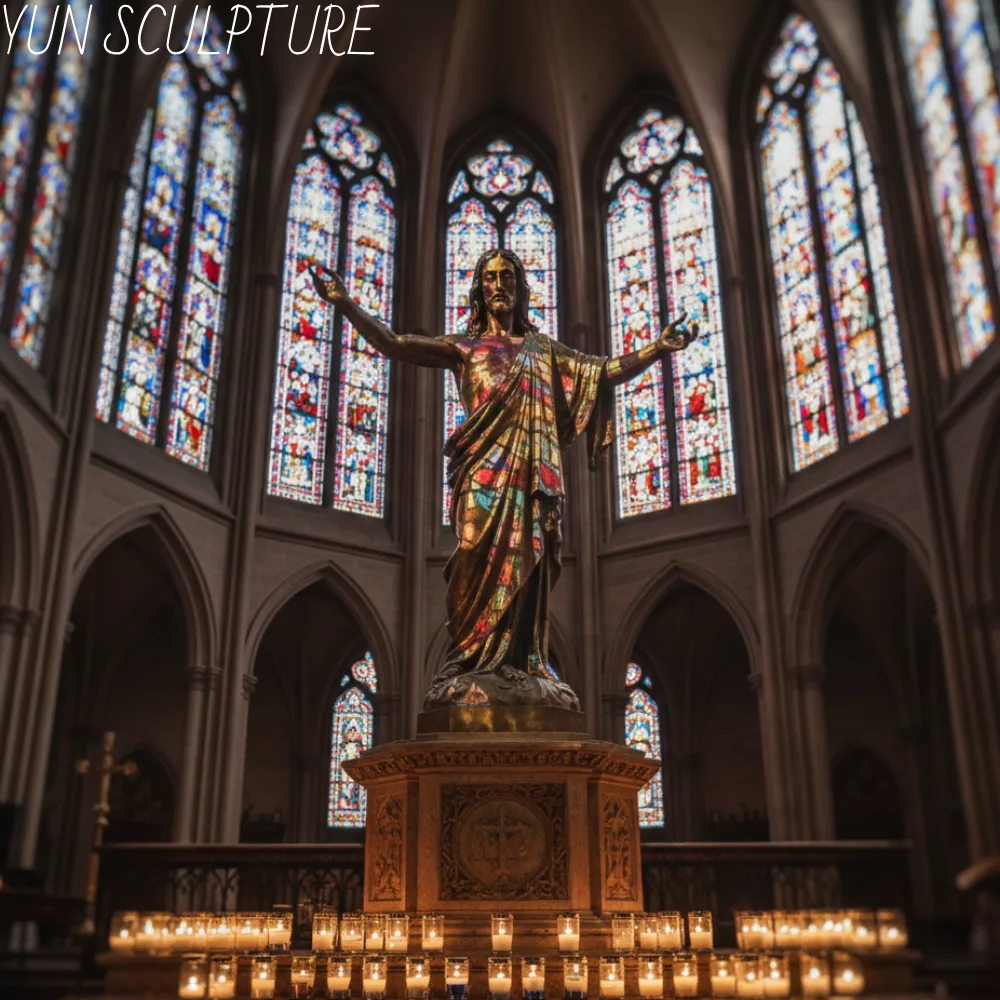
A bronze risen christ statue is not acquired. It is entrusted.
Every parish that has placed one at its entrance, every cemetery that has installed one above its garden of graves, every shrine that has oriented its pilgrimage path toward one — they have made the same calculation that the great cathedral builders made centuries before them. They have decided to build for people they will never meet, for prayers that will be offered in decades and centuries they cannot imagine.
The bronze will outlast the committee that commissioned it. It will outlast the priest who blessed it. It will stand in the weather, develop its patina, and receive the hands of pilgrims across generations — hands that will wear smooth the bronze of the feet and the hem of the robe, leaving behind the most honest record of devotion that any material can hold.
This is why the material question is not merely technical. Bronze is not chosen because it is durable. It is chosen because permanence is a theological statement. A faith that believes in resurrection does not build in materials that decay.
We have been honored to carry this responsibility for the clients who have trusted us with it. We are prepared to carry it for you.
— Elena Zhang, Religious Art Historian & Donghui Zhang, Yun Sculpture