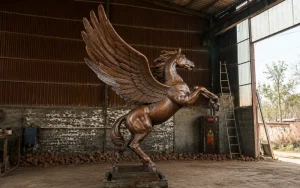
Get in touch with Yun-Sculpture company
Bronze Horse Statue Value: Antiques, Artist Casts & Replicas

Identify the casting: maker, model, cast date, foundry, and edition.
Check comparable sales: match the cast category, condition, and provenance.
Define the purpose: resale value, insurance replacement, or a new commission quote.
Bronze horse statue value depends on the identity and history of the particular object. A familiar pose, a heavy base, or an old-looking finish gives you something to investigate; none supplies a reliable price on its own.
An inherited tabletop horse may need research into its maker and casting history. A new custom bronze horse statue needs a quotation for present-day design and production. Start by deciding which question you are trying to answer.

01 / Identify the market
Which kind of bronze horse are you valuing?
Age, authorship, and the relationship to an earlier model are separate questions. An antique can also be an authorized artist’s cast; a newly made sculpture can be an original contemporary work or a reproduction. These descriptions overlap.
| Description | What to establish | Useful price evidence |
|---|---|---|
| Antique or older decorative horse | Actual period, maker, material, condition, and ownership history | Sold objects of comparable age, type, quality, and attribution |
| Artist’s authorized casting | Artist and model, authorization, foundry, cast date, and edition or cast records | The same model, size, and comparable casting category |
| Modern reproduction | What it reproduces, who made it, material, dimensions, and finish | Sales of comparable reproductions from the relevant maker or market |
| New commission | Approved design, dimensions, material, fabrication, finish, and delivery scope | A current, itemized manufacturing quotation |
Swipe the table horizontally to read all columns.
“Antique finish” describes an appearance. It does not establish that the object is an antique. Likewise, a newly commissioned bronze may have considerable modeling and finishing work behind it without having an established resale market.
Before requesting a valuation, say whether you intend to sell, insure, or document the sculpture for an estate. Give the valuation date and currency you need. A replacement figure for insurance should not be treated as the amount a buyer will offer today.
02 / Separate material from attribution
Real bronze does not establish who made it
There are two checks: what the object is made from, and whether the claimed artist, date, and casting history are supported. A modern reproduction can be cast in bronze. Establishing the metal therefore does not establish an artist’s original casting.
Ask whether the description means cast metal, bronze-resin, a plated object, or simply a bronze-colored finish. Weight includes the base and any other components. A magnet’s response and the sound of a tap are insufficient on their own to identify the whole object, much less its age.
Hollow construction is not evidence of a fake. Musée Rodin’s explanation of bronze casting describes metal poured around a core that is later removed, leaving a hollow work. Ask a specialist to examine uncertain materials; avoid scratching, drilling, or acid-testing a sculpture you may wish to preserve.
Patina is a surface, not a clock
Brown, black, and green surfaces can occur on copper-alloy objects through natural change or deliberate finishing. The Canadian Conservation Institute describes both natural and artificial patinas. Color alone cannot date a horse or confirm the metal beneath the surface.
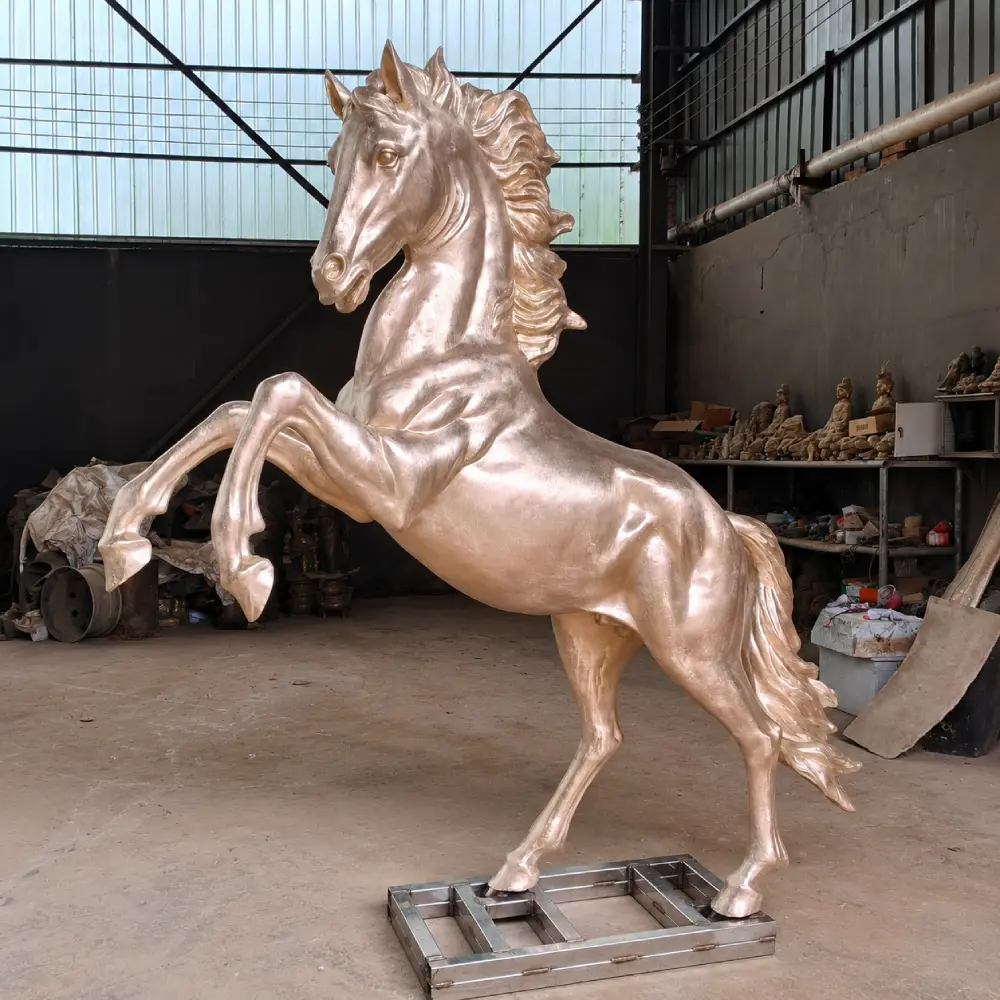
Before patination
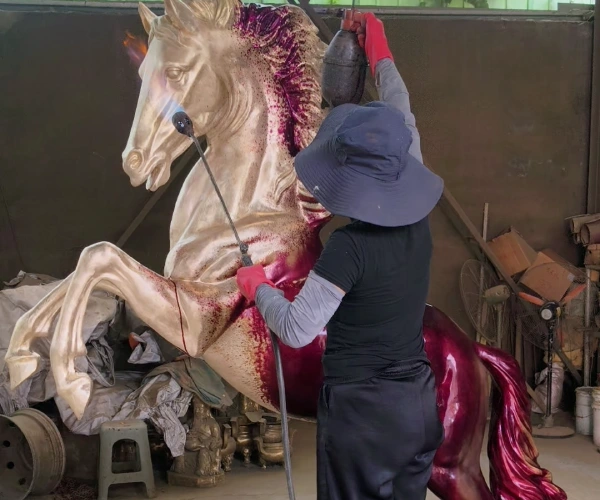
Surface finishing in progress
03 / Connect the marks to records
Read signatures, foundry marks, and dates together
Photograph every inscription exactly as it appears, including punctuation and any difficult letters. Check the base edge, rear, and accessible underside. Capture a close-up and a wider view so a specialist can see where each mark sits on the object.
An artist’s name is a starting point for research. The Remington Museum of Art warns that reproductions are marketed with descriptions such as “signed” or “vintage.” The wording of an advertisement cannot substitute for a casting history.
A foundry mark should agree with the maker, model, and proposed period. A number might be a cast identifier, an edition number, or something else; do not read a solitary number as the size of a limited edition. Ask how it relates to documented production records.
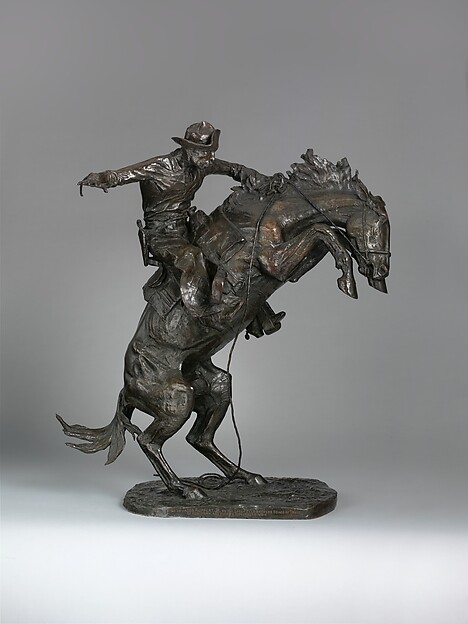
One model can have several relevant dates
The Met’s record for this Broncho Buster distinguishes the model’s date, a revision, and the casting of the particular object:
- 1895
- Model originated
- 1909
- Revised model
- By November 1910
- This bronze cast
Remington died in 1909, before bronzes of this enlarged version were produced. The earliest date associated with a model is therefore not necessarily the date of the bronze in front of you.
A posthumous cast is not automatically an unauthorized copy. Its authorization and place in the artist’s casting history need to be established. The Remington Museum documents continued casting under Eva Remington after the artist’s death; that history is distinct from a modern reproduction.
Build a small evidence file
Keep invoices, old auction references, certificates, dated photographs, and any correspondence about the piece. Check that each document actually describes this object: dimensions, cast number, base, and distinguishing details should agree. A document bearing an impressive name is less useful if it cannot be connected to the sculpture.
- 1Whole objectFront, back, and both sides.
- 2Base & undersideLabels and fixings; access only if safe.
- 3Marks in contextA close-up and a wider location view.
- 4Condition detailsEars, reins, tail, and joins.
04 / Record the condition
Look closely at projecting details and the surface
On a horse, inspect the legs and their attachment to the base, the ears, tail, and any reins or rider’s accessories. Record missing elements, bends, joins, cracks, repairs, and changes in surface appearance. Photograph them separately rather than relying on a distant full view.
Wear, original modeling texture, an old repair, and fresh damage are different observations. Describe what you can see without assigning an age or cause that has not been established.
Green is not automatically a fault. CCI distinguishes stable patinas from active corrosion, which can produce loose powder or flaking. If material is appearing or being lost, have the surface examined. Its appearance in a photograph alone is not a complete diagnosis.
Preserve an unidentified older piece before trying to improve its shine. CCI’s metal-care guidance explains that polishing removes surface material and can damage thin plating. Ask a conservator before cleaning, waxing, or refinishing a potentially collectible object.
05 / Compare like with like
Use recorded sales with a clear price basis
A dealer’s asking price shows what a seller hopes to receive. An auction estimate is a forecast before the sale. A recorded sale tells you what happened to that particular lot at that time. Keep those categories separate when researching bronze horse statue value.
Reading a documented auction result
Christie’s American Art Online, lot 158, closed on 21 November 2017, recorded the following:
- Catalogued work
- Frederic Remington, The Broncho Buster
- Identifying details
- Roman Bronze Works mark; cast number 274
- Height
- 22½ in. / 57.2 cm
- Reported price realised
- US$100,000
In Christie’s terminology, price realised includes the hammer price and buyer’s premium. It is not the seller’s net proceeds or the buyer’s complete delivered cost.
This historical result belongs to an identified casting with its own provenance and condition. The museum bronze illustrated above is a different object. Neither its image nor this auction price establishes the value of a similar-looking reproduction.
What makes a useful comparable?
- Attribution and model: match the artist and subject; read qualifications such as “after” in the catalogue.
- Casting category: compare the foundry, size, cast date, authorization, and edition information.
- Condition and history: account for documented repairs, missing details, surface changes, and provenance.
- Transaction: record the sale date, currency, and whether the figure is hammer-only or includes premium; note taxes and transport separately.
Start with the closest documented sold examples available, then widen the search only when you can explain the differences. If the maker or cast status remains uncertain, ask for an estimate under that uncertainty instead of attaching the price of an authenticated work.
06 / Choose the next step
Request an appraisal or a manufacturing quote
For an older or attributed sculpture, look for an appraiser or specialist with experience in that artist, period, or type of bronze. Ask what identification, physical inspection, and market evidence the opinion will involve. An authentication opinion and a written monetary appraisal answer related but different questions.
Send front, back, side, and base photographs; dimensions with and without the base; all inscriptions; known ownership history; and condition details. Do not lift or dismantle a heavy or fragile sculpture just to photograph its underside. State the purpose of the valuation before commissioning a written report.
For a new piece, compare quotations on the same design and scope. Modeling, casting, assembly, surface finish, base, packing, freight, and site work should be clearly described. Our life-size horse production cost guide introduces the manufacturing questions; obtain a current quotation for your specific project.

For a new outdoor casting, agree a care plan for its actual finish and location; our outdoor bronze maintenance guide is a starting point for that discussion. An unidentified antique should first receive advice appropriate to its existing surface.
07 / Common questions
Bronze horse value FAQ
How can I tell whether my horse statue is bronze?
Gather the material description, maker’s records, and photographs of any already exposed surfaces. Color, weight, a magnet, or tapping cannot establish the material by themselves. If it matters to a purchase or valuation, arrange a specialist examination without making a new scratch or test hole.
How can I tell whether a bronze horse is antique?
Research the object’s casting date, maker, foundry marks, construction, and ownership records together. An old model date, an artist’s signature, or an antique-colored finish does not by itself date the particular casting.
Can an unsigned horse figurine be worth anything?
Yes, an unsigned object can have decorative or collector interest. The useful comparison is with similarly attributed or unattributed objects of the same type and condition. A familiar pose alone does not justify assigning it a named artist’s auction value.
Is a brass horse worth less than a bronze horse?
The material label alone does not settle that question. Maker, age, quality, condition, and the market for the particular object still matter. Establish whether it is brass, bronze, another metal, or a coated material before selecting comparisons.
Does a hollow bronze horse mean it is a reproduction?
No. Hollow casting is used for bronze artworks as well as contemporary sculpture. It tells you something about construction, not whether the artist authorized the cast or when it was made.
Should I polish a bronze horse before having it valued?
Preserve its current surface until you have appropriate advice. Polishing can remove patina, surface detail, or plating. Clear photographs of the object as it is are more useful than a newly altered surface.
Start with identification and a clear purpose
Collect the photographs and records, establish which casting you have, and compare the appropriate market. For a newly made horse, specify the design and production scope so quotations can be assessed on the same basis.
Sources & further reading
- Remington Museum of Art: Remington Originals vs. Reproductions.
- The Metropolitan Museum of Art: The Broncho Buster, object 39.65.45 — model, revision, casting date, and public-domain image.
- Musée Rodin: Lost-wax bronze casting — hollow construction and finishing.
- Canadian Conservation Institute: Recognizing Active Corrosion and Caring for metal objects.
- Christie’s: American Art Online, lot 158, closed 21 November 2017; Auction glossary for the price basis.