Get in touch with Yun-Sculpture company
Pegasus vs Unicorn: How to Tell the Sculptures Apart

Pegasus: a horse with wings and no horn in the classical image.
Unicorn: a creature with one forehead horn, traditionally shown without wings.
Winged unicorn: both wings and a horn; often called an alicorn in modern fantasy.
The quickest way to compare Pegasus vs unicorn is to look for two features: wings and a single horn. For a sculpture, the next question is how clearly those features read from the place where you will actually see it.
A wing can disappear behind the body in a photograph. A pointed ear can look like a horn. And an impressive wingspan can extend well beyond a statue’s base. This guide explains the names, their artistic context, and the details to check when choosing a design from a horse sculpture collection.

01 / Read the shape
Pegasus vs unicorn vs alicorn at a glance
Start with the anatomy, then check the title or artist’s description. These are useful visual conventions, rather than rules that every fantasy artist must follow.
PegasusWings · No horn
UnicornOne horn · No wings
Winged unicornWings + horn · Alicorn in modern fantasy
| Feature | Pegasus | Unicorn | Winged unicorn / alicorn |
|---|---|---|---|
| Wings | Yes | Usually absent | Yes |
| Forehead horn | No in the classical image | One | One |
| Context to check | Greek myth or a later winged-horse design | Historical artwork, heraldry, or a fantasy design | The naming used by the particular story or artist |
| Main sculpture detail | Wing outline and full spread | Horn position and projection | Whether both horn and wings remain visible |
Swipe the table horizontally to compare all three.
Color does not settle the distinction. A white horse with wings and no horn is a Pegasus-type image; a white horse with a forehead horn and no wings is a unicorn. Brown, black, green, or polished metal finishes do not change those identifying features.
02 / Understand the name
What is a winged unicorn called?
“Winged unicorn” is the clearest descriptive name. Alicorn is also used in modern fantasy for a creature combining Pegasus wings with a unicorn horn. For example, Hasbro’s official description of Princess Celestia uses the word in that sense.
The word has another meaning, however: Merriam-Webster defines alicorn as a unicorn’s horn. A dictionary entry, a historical catalogue, and a fantasy series may therefore use the same word differently. It should not be presented as a universal ancient Greek name for a winged, horned horse.
03 / Look at the artwork
Different stories, different artistic meanings
Pegasus: the winged horse of Greek myth
Pegasus is a particular named horse in Greek mythology, as well as the model for many later winged-horse images. The Metropolitan Museum of Art’s account of Paul Manship’s Bellerophon and Pegasus (1930) describes Pegasus springing from Medusa’s severed head and being mastered by Bellerophon with a golden bridle supplied by Athena.
That distinction matters when identifying a figure riding Pegasus: Bellerophon belongs to this classical story. A later film, illustration, or commissioned sculpture may rearrange the characters. Identify a named hero from the work’s documentation, rather than assuming that every rider is the same person.
In a contemporary sculpture, raised wings can suggest ascent or freedom. That is a visual interpretation of the pose, not a fixed meaning shared by every Pegasus artwork.
Unicorns in medieval European art
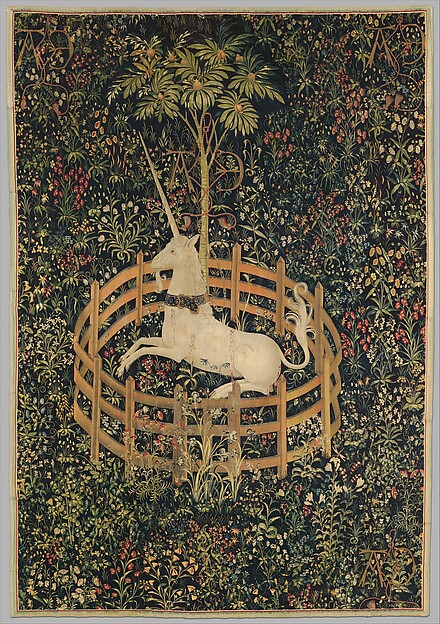
Medieval European art offers a useful contrast with today’s smooth, horse-shaped fantasy unicorn. Look at the tapestry here: the creature has one long horn, a small beard, and a slender, tufted tail. There are no wings.
Its meaning also needs context. Getty’s introduction to medieval bestiaries explains how the unicorn and the maiden could represent Christ and the Virgin Mary, while the story also developed associations with courtly love.
The Met’s interpretation of this particular garden tapestry includes the idea of a beloved willingly remaining bound, with plants associated with marriage and fertility. It is more informative to name that work and context than to say that every unicorn sculpture means only “purity” or “magic.”
For a historically inspired design, decide whether you want these older animal features or a modern equine form. They produce noticeably different faces, tails, and overall characters.
04 / Choose the design
What changes when the image becomes a sculpture?
A name tells you which creature to request. The wings, horn, pose, and viewing angle determine how the finished form will occupy a room, garden, or entrance. Compare those decisions before choosing a surface color.
Measure the wings as part of the whole sculpture
Wings raised steeply above the back create a tall composition. Wings opened sideways create a broader one. Neither is automatically the better choice for a garden or public space: the useful question is which outline fits the available view and circulation route.
Ask for overall height, maximum width, and front-to-back depth, including the wing tips and any projecting horn. Record the base dimensions separately. A compact base does not mean that the sculpture above it stays inside the same footprint.
Check the front view as carefully as the profile
A side view can show the horse’s head, chest, and feathers clearly while hiding how the two wings overlap from the front. Ask for front, side, and three-quarter views at the intended viewing height. For an entrance seen first from a driveway, give that approach view priority.
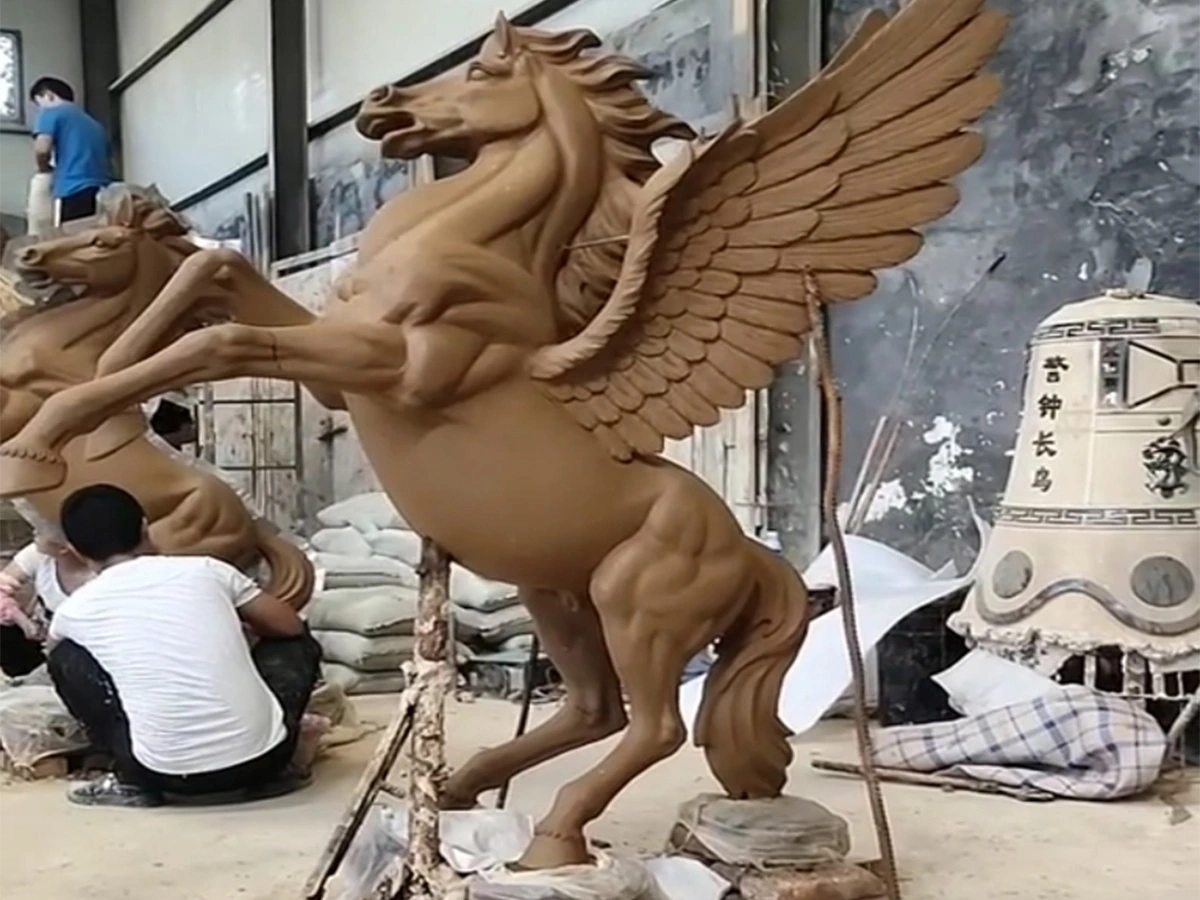
Also compare the outline against its background. A horn can merge with a bright wall; dark feathers can disappear against dense trees. A site photograph from the main approach helps reveal those conflicts before the proportions are settled.
Make the horn readable without ignoring its projection
On a unicorn, look for the horn emerging from the forehead, rather than mistaking one of the ears or a swept-up lock of mane for it. From a low angle, a short horn may overlap an ear; in profile, a long horn may project substantially beyond the muzzle.
For a winged unicorn, the horn and wings need to remain legible together. A dramatic wing placed directly behind the head can obscure the feature that distinguishes it from Pegasus. Check the three-quarter view instead of approving those details in separate close-ups.
Keep projecting features away from normal walking routes. Wing connections, horn attachment, anchoring, and public access need a design-specific review; a photograph cannot establish their strength. Material and finish can then be compared through the bronze horse statue collection, rather than inferred from the color of a reference image.
Trace the wings to the body they belong to
In a group sculpture, wings near a horse may belong to an accompanying person. Follow their connection instead of naming the work from the most conspicuous feathered shape. A figure’s costume, bridle, or position beside the horse may help, but a specific mythological identity still needs a title or supporting description.

Finally, choose the pose independently of the name. A unicorn can rear; a Pegasus can stand with its wings folded or raised. The wing-and-horn distinction is more useful than a rule that one creature must look gentle and the other must look powerful.
05 / Common questions
Pegasus and unicorn FAQ
Is a Pegasus a unicorn?
No in the usual visual distinction. Pegasus has wings and no horn; a unicorn has one forehead horn and is traditionally shown without wings. A design with both is more clearly described as a winged unicorn.
Does Pegasus have a horn?
The classical Pegasus image has no horn. If a modern design combines wings and a forehead horn, “winged unicorn” describes what you are seeing; its artist or fictional setting may also call it an alicorn.
What is a unicorn and Pegasus combined called?
“Winged unicorn” is the most explicit name. “Alicorn” is used for that combination in modern fantasy, but the word can also mean a unicorn’s horn. For a sculpture order, specify both features and attach a reference.
Can unicorns fly?
A traditional wingless unicorn is not identified by flight. Modern stories can give unicorns different powers. If you want a sculpture to show flight through feathered wings, request a winged unicorn rather than relying on the word “unicorn” alone.
What is a white horse with wings called?
With wings and no horn, it is commonly described as Pegasus or a Pegasus-type winged horse. If it also has a forehead horn, “winged unicorn” is the clearer description. White coloring alone does not identify either creature.
Are Pegasus and unicorns real animals?
The creatures discussed here belong to mythology, historical imagery, and fantasy, rather than documented living horse species. A photograph of a sculpture shows an artistic representation; it does not establish that the creature exists in nature.
Put the identifying features in your brief
For a recognizable design, specify wings, horn, pose, overall dimensions, and the main viewing direction. Add the historical work or reference image that gives the sculpture its character. Those details communicate far more than a name alone.
Sources & further reading
- The Metropolitan Museum of Art: Bellerophon and Pegasus, Paul Manship, 1930 — the Pegasus and Bellerophon story.
- Getty: An Introduction to the Bestiary — medieval unicorn imagery and interpretation.
- The Metropolitan Museum of Art: The Unicorn Rests in a Garden, 1495–1505 — artwork, interpretation, and public-domain image.
- Merriam-Webster: alicorn — the unicorn-horn definition.
- Hasbro: Princess Celestia product description — an example of modern fantasy’s winged-unicorn usage.