Get in touch with Yun-Sculpture company
Dog Statues for the Front Porch: A Practical Guide to Size, Pairs and Placement

A dog sculpture beside the front door can feel as familiar as the companion who once waited there. It can also give an entrance a stronger architectural identity: a quiet seated figure beside a column, a standing dog along a garden approach, or a coordinated pair framing the doorway.
The right choice depends on how that entrance works. A beautiful sculpture needs room for its nose, tail and base, a position that people can comfortably pass, and a route by which it can actually reach the porch.
When choosing dog statues for a front porch, start with the complete shape of the piece and the usable space around it. Breed, color and detail matter, but a change in pose or orientation can make a greater difference to fit than a small change in height.
This guide helps you select a figure, test its position and prepare a clear brief for the people involved in your purchase.
| Your porch situation | A useful starting point | The detail to check first |
|---|---|---|
| A narrow pocket beside the door | One seated figure | Complete width and depth, including the base |
| A long space beside a wall | A standing or reclining dog | Nose-to-tail length and direction of projection |
| Usable space on both sides of the entrance | A coordinated pair | Both footprints, both door movements and the relationship between the figures |
| Unequal spaces beside the doorway | One figure or two complementary poses | Whether each piece fits its own position |
| A portrait of your own dog | A familiar pose adapted to the site | Individual character together with the available footprint |
Start with the role of the sculpture
A decorative breed figure, an individual pet portrait and a formal entrance pair are different starting points.
For a decorative figure, you may be looking for a recognizable silhouette or a mood that suits the house. A seated dog can suggest companionship; a standing figure can give the entrance a more alert presence. These are design interpretations, and your own association with the dog matters more than a prescribed meaning.
For a pet portrait, the place may already have emotional significance. Perhaps your dog used to sit beside the steps or watch visitors from a sheltered corner. Preserve that connection while checking whether the familiar pose fits the space. A portrait does not have to be placed in the busiest part of the entrance to remain visible and meaningful.
A coordinated pair gives the doorway a more deliberate frame. It also creates two separate placement and delivery decisions. Before choosing two dogs, establish that both sides have usable space.
Finally, consider whether you want an existing design or a commission. An existing design may suit you when its size, pose and finish already fit. Custom work becomes useful when the figure needs a particular likeness, altered proportions, a different head direction or a base made for a specific position.
If you are looking for Chinese guardian lions, often called Foo Dogs, they have a separate visual and cultural tradition. See the Foo Dog meaning and placement guide before applying that tradition to a realistic dog sculpture.
Measure the porch as you actually use it
The full width of a porch is rarely the width available for sculpture. Doors, columns, railings, furniture and the route from the steps all divide that space.
Start with a photograph showing the whole entrance. Then make a simple plan from above. Mark the walls, door openings, steps, columns and the proposed position. Precision matters most where the sculpture comes close to an obstacle.
Check every door, including the screen door
Open the main door and any storm or screen door through their normal range. Include handles and anything else that projects from them. An inward-opening main door does not tell you what the outward-opening screen door needs.
Mark the space occupied by the moving door. A base might sit outside that area while the dog’s muzzle or tail extends into it. Check the complete sculpture, not just where its feet touch the floor.
Also leave room for normal use of the entrance. Someone standing at the door, carrying shopping or helping another person inside occupies space that an empty photograph does not show.
Keep the daily route visible on your plan
Trace the route between the steps, doorway and porch seating. Include the handrail and any place where people turn. Test it with the things you normally carry or move through the entrance, such as a stroller, luggage or a mobility aid.
Keep the proposed sculpture outside the route you need to preserve. Where an entrance has accessibility or building requirements, have the applicable clearances checked for the property. A layout sketch helps selection; it does not establish compliance.
Measure the usable pocket on each side
Record the width and depth of each proposed position after accounting for doors and circulation. Note nearby level changes, drains and exposed edges. If you want a pair, measure both sides separately, even if the facade looks symmetrical.
A useful description is: “The left position has a usable rectangle of this width and depth, beside this column.” That gives a sculptor or designer much more to work with than “We have a large porch.”
Read statue dimensions in three layers
“Life-size” describes a relationship to a dog. It does not provide the dimensions needed to plan a porch.
Ask for dimensions of the animal, the base and the assembled piece. Have the supplier label front and side views so that everyone uses the same meaning of length, width and height.
| Dimension | What it should describe | Why it matters |
|---|---|---|
| Dog height | Highest point of the animal in the selected pose | Ears or the head may be higher than the shoulder |
| Dog length | Furthest projection from nose to tail in the stated view | A long muzzle or extended tail can reach beyond the paws |
| Dog width | Widest part of the animal in the stated view | A turned head, elbow or tail can change it |
| Base dimensions | Width, depth and height of each base component | The base may project beyond the animal |
| Assembled dimensions | Maximum extent of the complete figure and base | This is the piece you must fit beside the entrance |
| Contact or mounting footprint | The area or points through which the piece is supported | Your installer needs this for the support arrangement |
The contact footprint and the visible outline can be different. Four paws may occupy a relatively small area while the body extends farther out. A broad pedestal may create the opposite situation.
For a separate pedestal, specify whether the dog’s quoted height includes it. In a straightforward arrangement where the statue sits on top, a 30-inch figure on a 6-inch pedestal reaches 36 inches overall. Those are illustrative numbers, not a standard product size.
When comparing suppliers, normalize their specifications first. One listing may use shoulder height, another maximum height, and another the largest of three dimensions. An apparently smaller option may still occupy more of your porch.
Test the complete footprint before choosing the size
A floor template turns an uncertain visual judgment into a practical comparison. Use cardboard or a removable marking method appropriate for your surface. Mark the base and the furthest projections of the dog, then test the doors and walking route again.
A worked example: height alone does not reveal fit
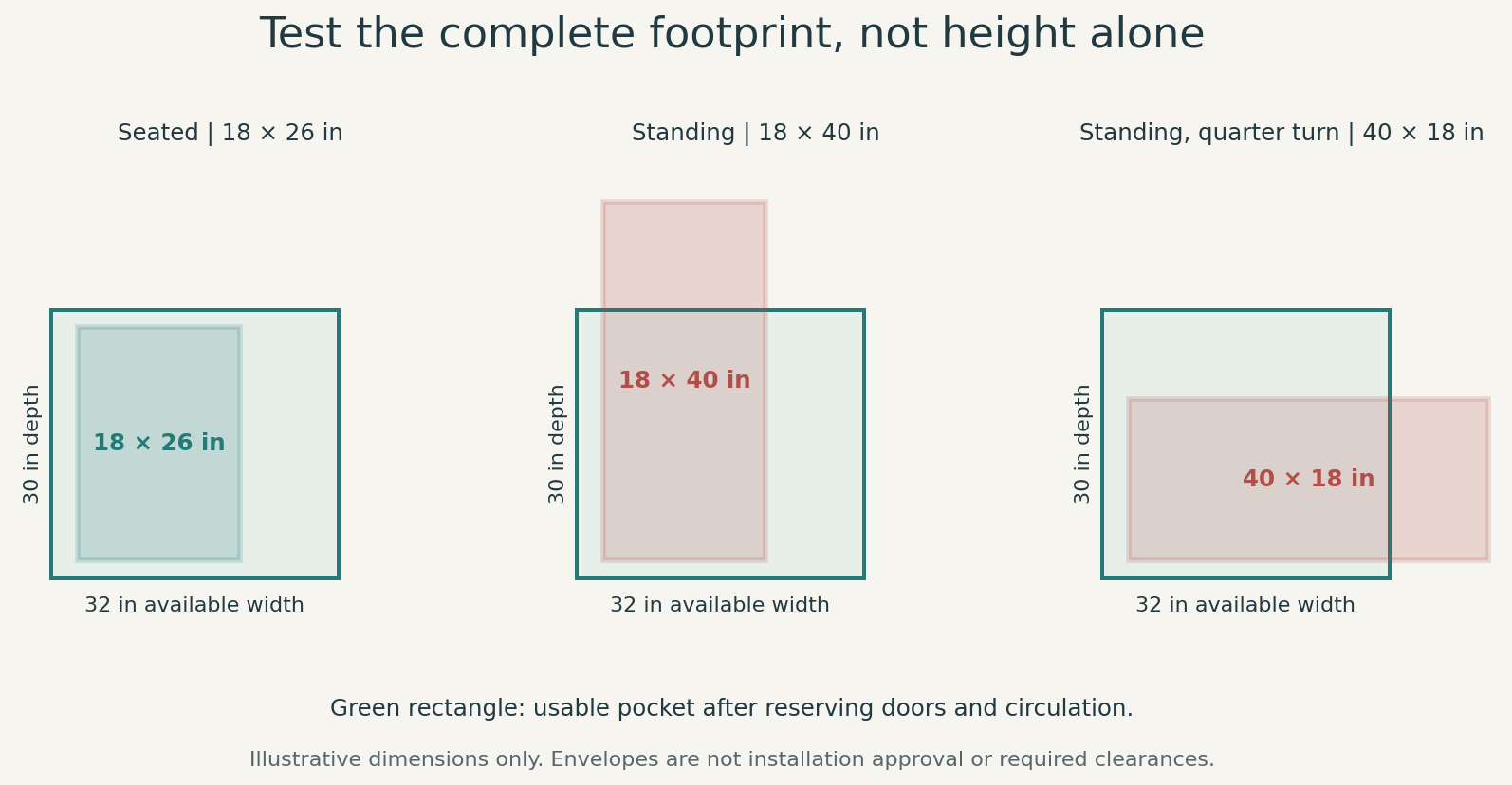
Suppose a homeowner has identified a 32-inch-wide by 30-inch-deep usable pocket beside the door. That pocket has already been kept separate from the door movement and the route the household wants to preserve.
They are comparing two hypothetical designs:
| Design | Complete width across the pocket | Complete depth into the porch | Maximum height | Initial result |
|---|---|---|---|---|
| Seated dog | 18 in | 26 in | 36 in | Its rectangular envelope fits the stated pocket |
| Standing dog facing forward | 18 in | 40 in | 30 in | It extends 10 in beyond the available depth |
The shorter dog is the one that does not fit in that orientation. The seated design leaves 14 inches of unused width and 4 inches of unused depth in this simplified comparison. Those amounts are geometric remainders, not recommended clearances or approval of the installation.
Turning the standing design through 90 degrees changes its envelope to 40 inches across the pocket and 18 inches deep. It now exceeds the available width. Rotation has moved the problem rather than solved it.
The next useful choices are a different position, a different pose or a proportionally smaller design. Check the sculpture’s actual outline before deciding; these rectangles represent maximum dimensions, not detailed mounting plans.
Angling a figure can increase its envelope
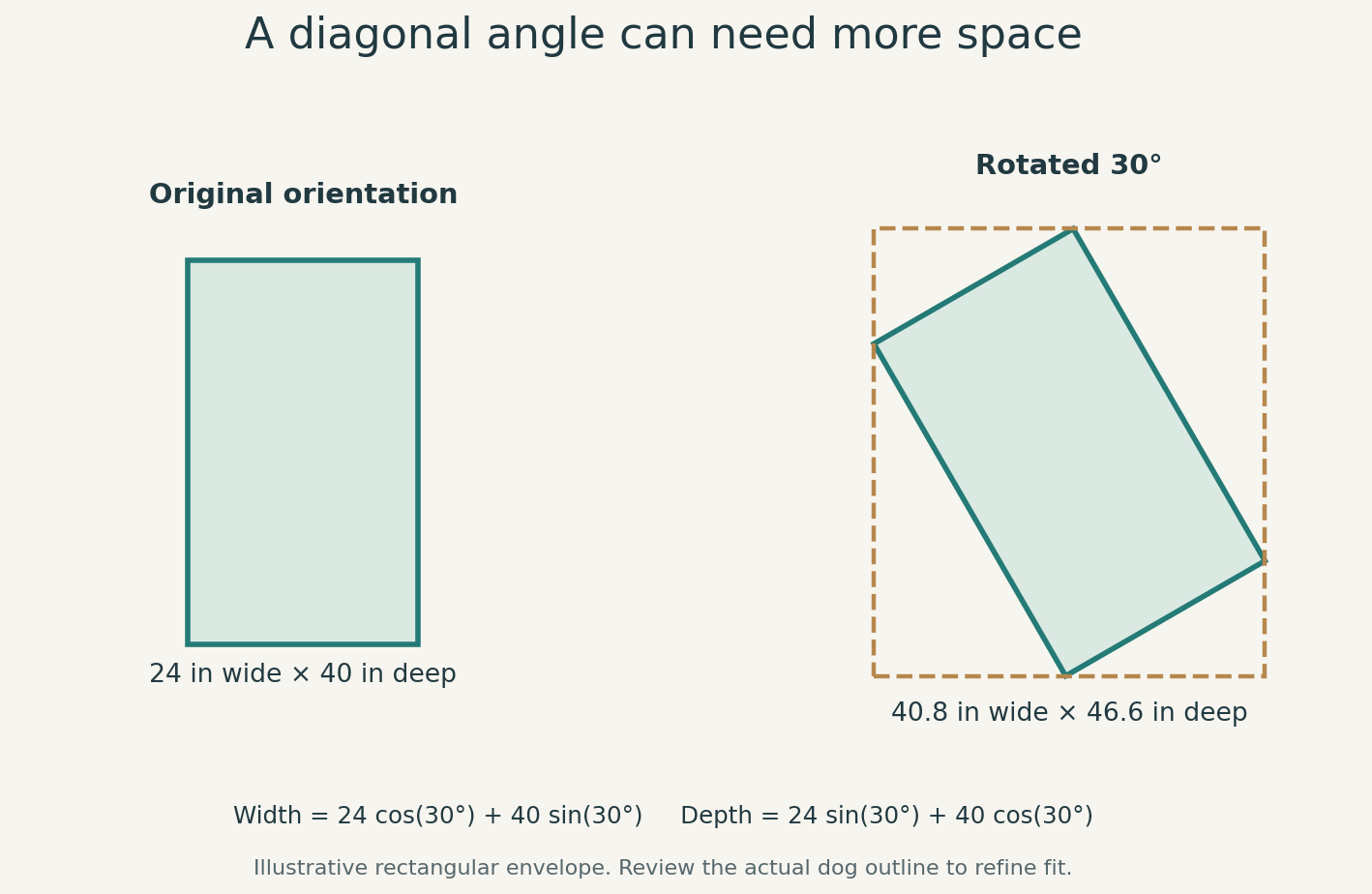
A diagonal arrangement sometimes looks softer beside a doorway, but it does not automatically save space. A rectangular envelope 24 inches wide and 40 inches deep, rotated 30 degrees from its original orientation, requires approximately 40.8 inches across and 46.6 inches in depth for its new enclosing rectangle.
That calculation uses the outer rectangle. The exact shape may leave empty corners, so a plan of the actual dog can refine the result. The practical lesson is to test the desired angle rather than assume the original dimensions still apply.
For a larger piece, add a lightweight height marker or cardboard side profile. View it from the street, the steps and inside the doorway. A floor template checks fit; the height marker helps you judge presence.
Choose pose and direction together
Pose affects the relationship between height, floor space and the view people see first. It should be selected alongside placement, not after the size is fixed.
Seated dogs: compare the chest, head and base
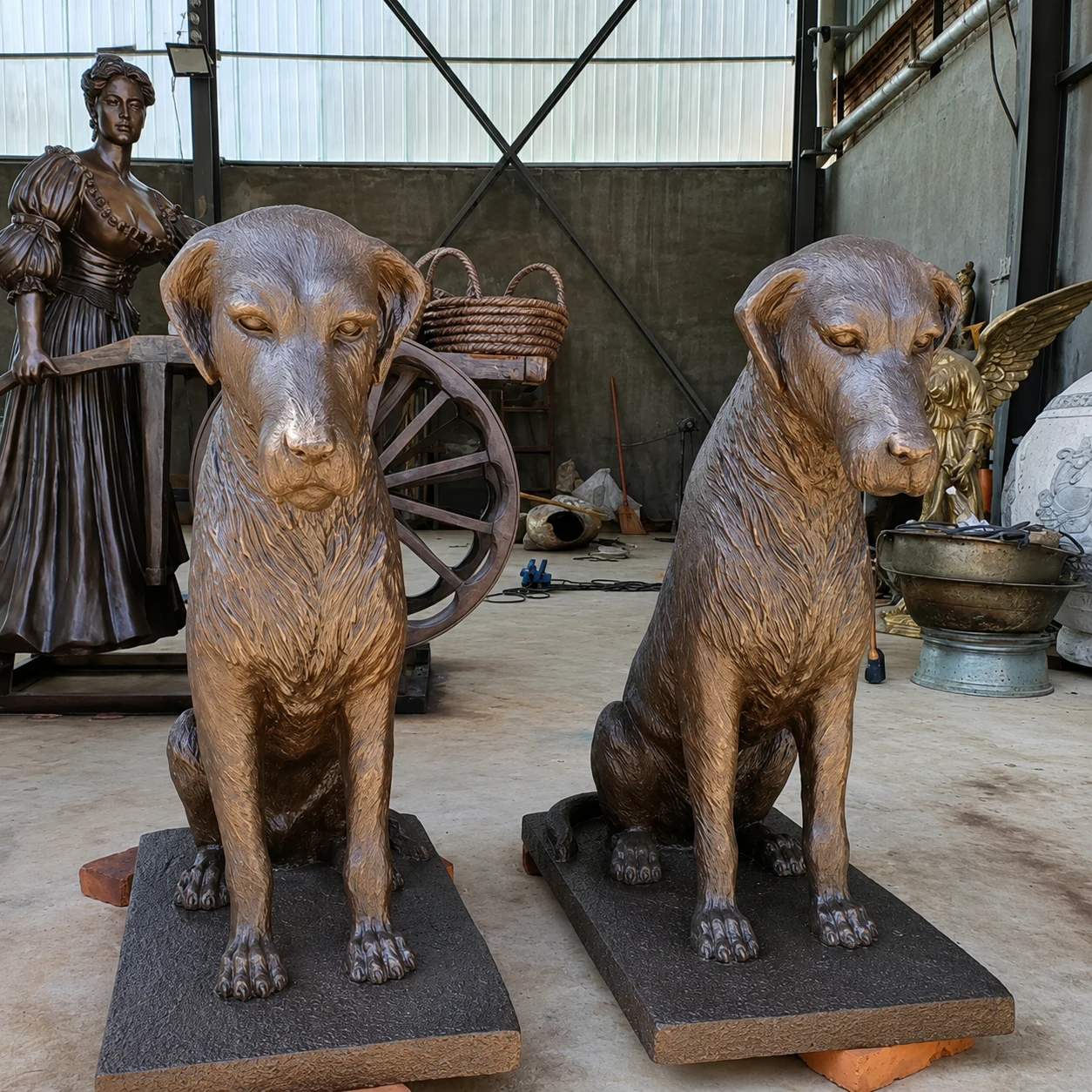
A seated design is worth considering in a compact side position, but seated dogs are not automatically small. A broad chest, outward elbows, a curled tail or a generous base can still require substantial width or depth.
Look at how the head relates to the door hardware, window sill or porch rail. A tall head may be visible above nearby planting even when the body sits in a sheltered corner. From close range, the face may become the main point of connection.
Standing dogs: give the nose and tail a deliberate place
A standing figure can work well along a wall or beside the approach. Its longest dimension usually needs careful attention, particularly when the dog faces across the porch rather than along it.
Body direction and head direction need separate decisions. Turning only the head may create the desired greeting while keeping the body aligned with the available space. Ask for the revised maximum dimensions, because the muzzle’s projection changes with that adjustment.
A dog-and-puppy group needs a group footprint
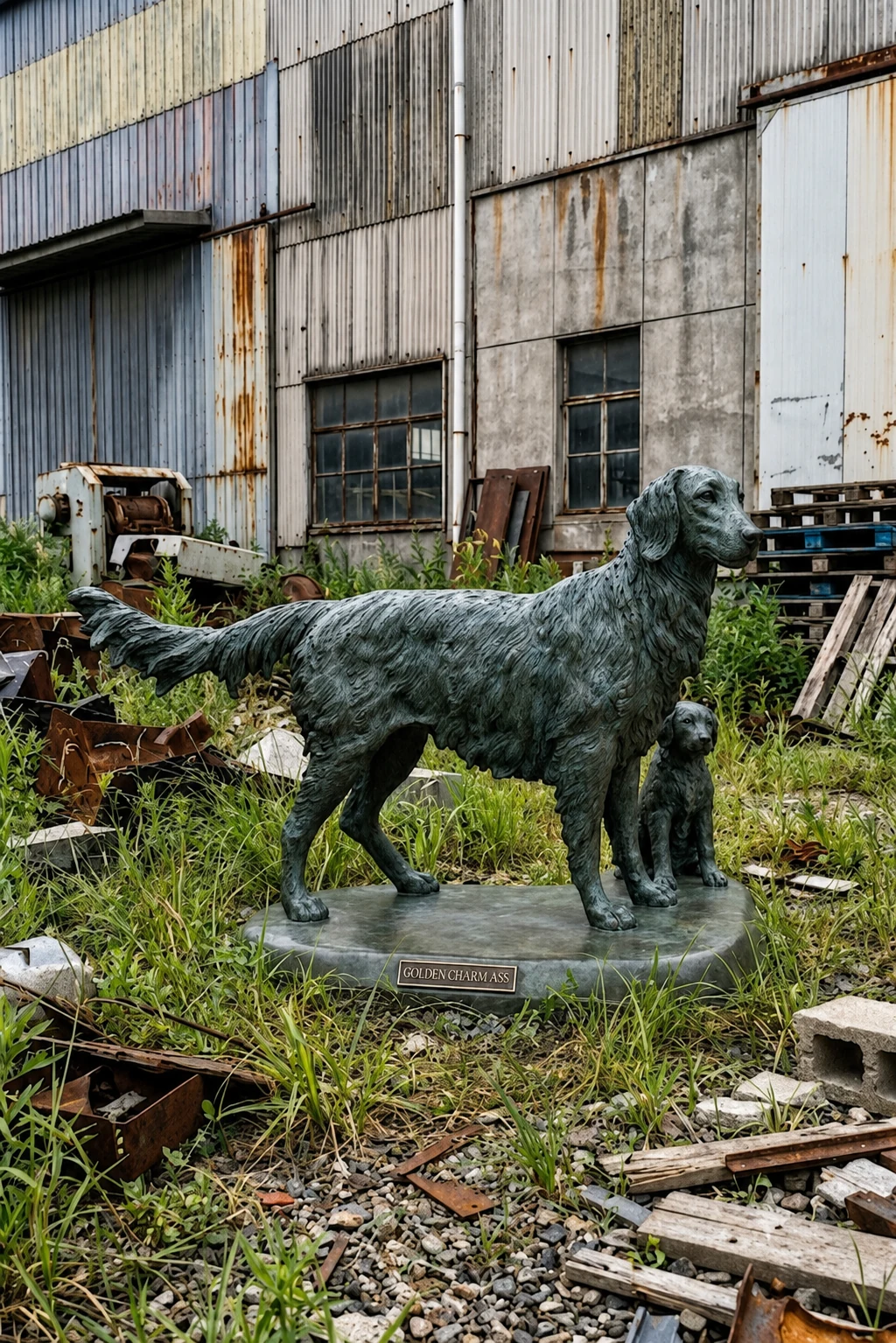
A composition with an adult dog and a puppy introduces another measurement: the complete group. The puppy may fit beneath or beside the larger dog visually, while the shared base extends farther across the porch than either animal’s feet.
In the workshop photograph below, look at the adult dog’s projecting tail, the puppy beside its front legs and the outer edge of the common base. All three belong in the placement check. Record the furthest point in each direction rather than adding the two dogs’ dimensions together or using the adult dog’s height as the group size.
A shared base also fixes the relationship between the figures. If you need to move the puppy to the other side to fit the entrance, discuss that before approving the composition. It is a change to the design rather than a placement adjustment after delivery.
Reclining dogs: check the view from the approach
A reclining figure can suit a low wall, a deeper side area or a setting beside porch seating. Its length still needs room, and a low sculpture may be hidden by a planter or furniture when viewed from the street.
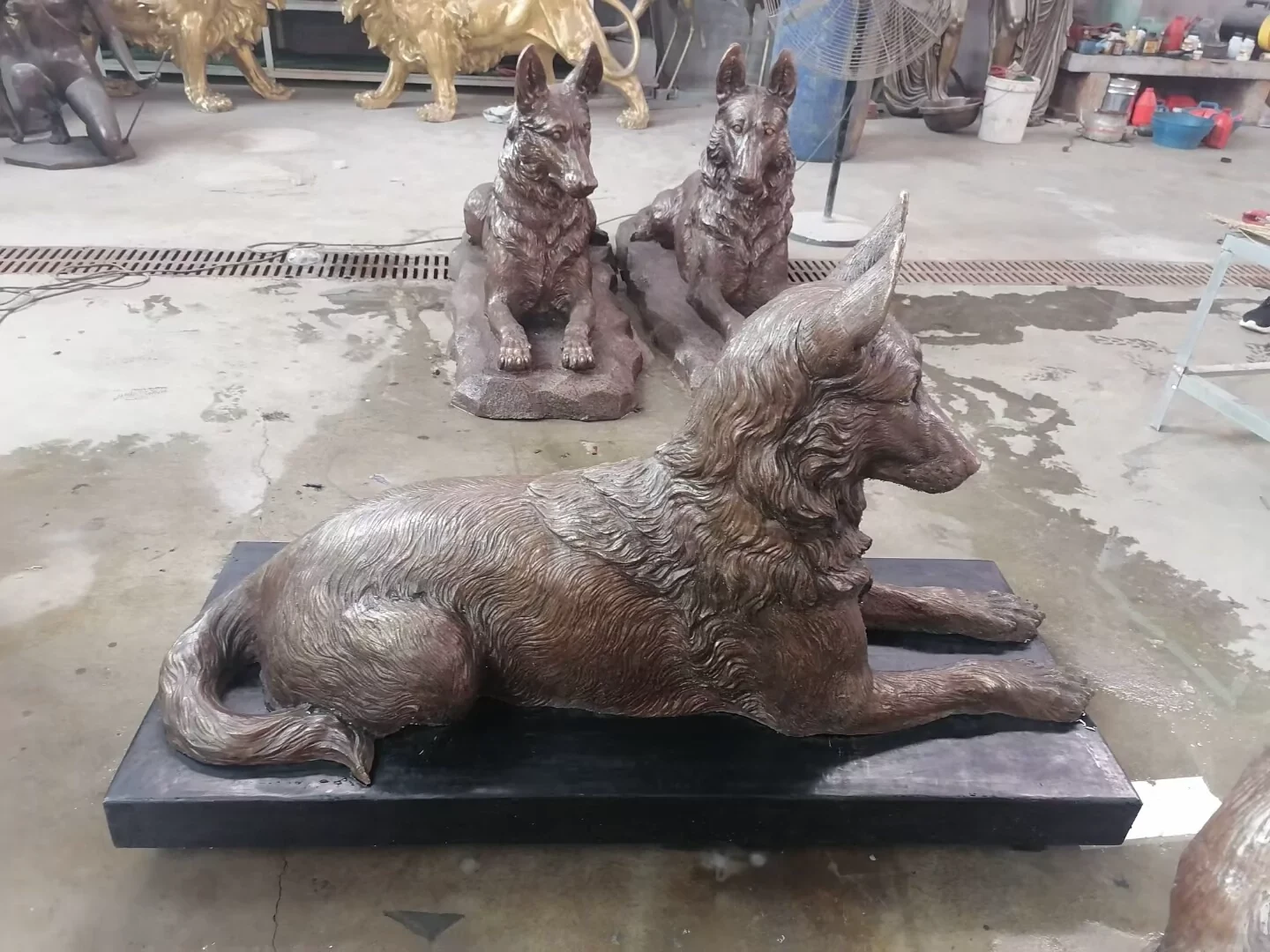
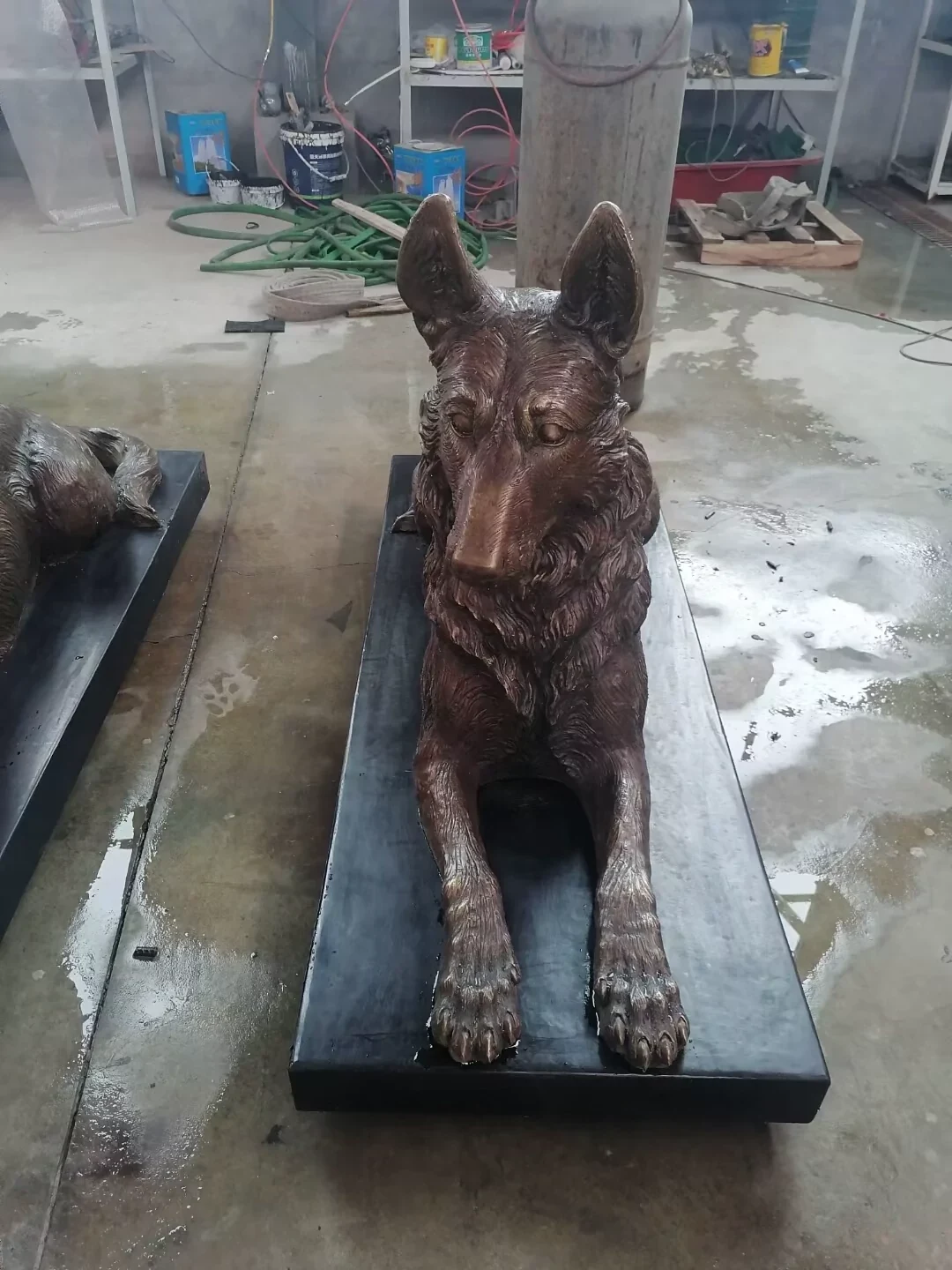
Compare this view with the German Shepherd front view earlier in the guide. The face is prominent from the front, but the side view makes the long body and base easier to assess. Ask for both views when planning a reclining figure. A portrait photograph alone cannot establish its complete footprint.
Choose a pose with a recognizable outline from the approach. Fine coat detail adds interest close up, but cannot compensate for a figure whose head disappears behind a chair.
For all poses, review front, side and approach views. A portrait might face the place where the family spends time; a decorative figure might address arriving visitors. Neither needs a universal facing rule. The appropriate direction is the one that supports your intended view and preserves the usable entrance.
Specify exactly what you mean by a pair
Two dog statues can frame a porch beautifully, but “a pair” is an incomplete design instruction. Agree on the relationship between the figures before the models or castings are approved.
Two identical figures repeat the same pose and details. When both face forward, a head turned to one side may point toward the doorway on one side and away from it on the other. Decide whether that repetition is the intended composition.
Matching bodies with different head directions can create a conversation between the figures or make both look toward arriving visitors. This is a specific design change, and the dimensions of each version should be checked separately.
A fully mirrored composition reverses the broader arrangement, including the pose, legs, tail and associated details. It is a different request from changing the heads alone. If either dog has a name or inscription, its lettering still needs a readable layout.
Two complementary poses can suit unequal spaces. A seated dog on one side and a standing dog farther along the other may give the entrance balance without forcing identical objects into different pockets.
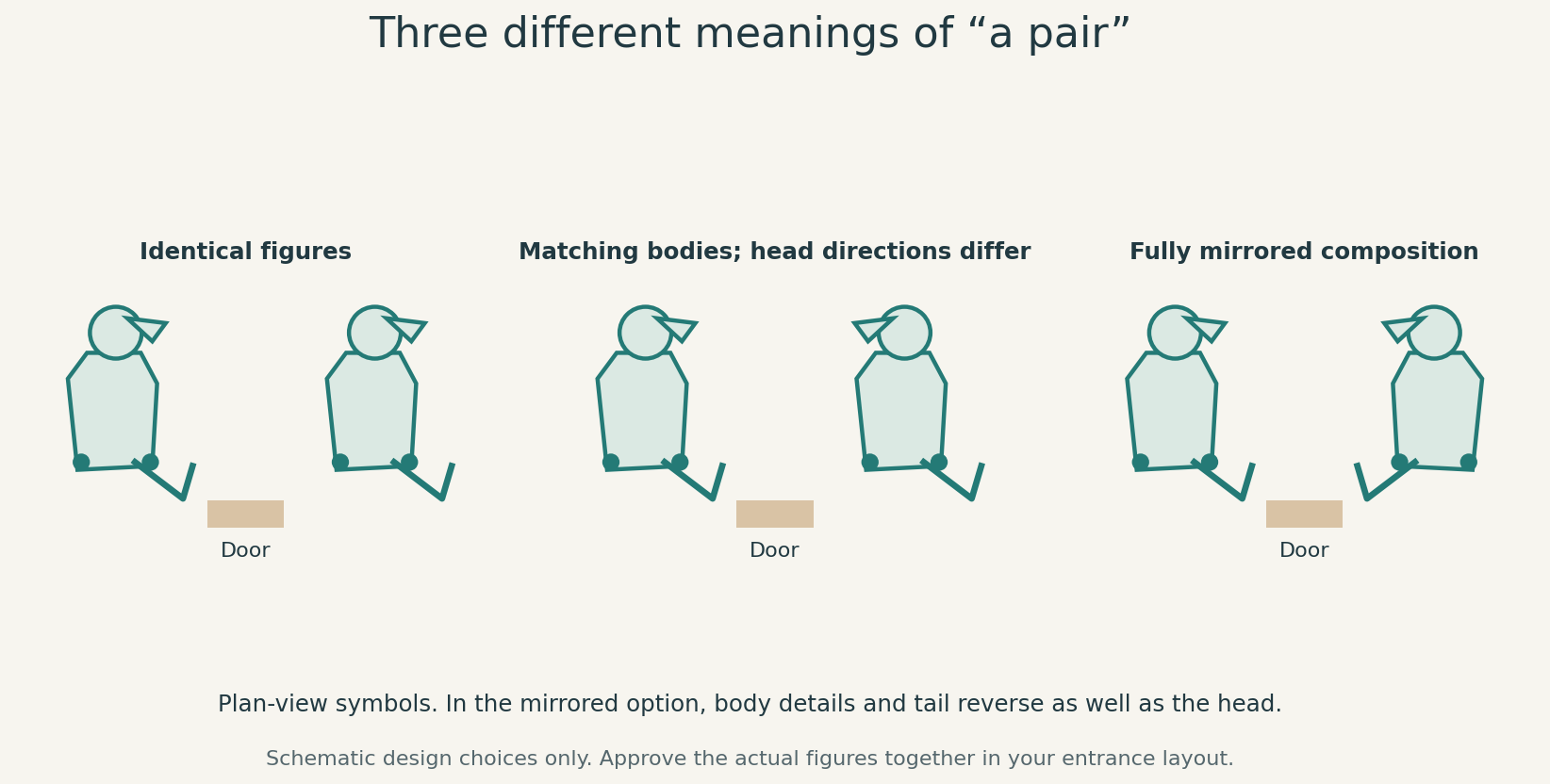
Review the pair together in one entrance view. Two separate close-ups cannot show their spacing or relationship to the doorway. Label them “left” and “right” from an agreed viewpoint, such as standing in the garden and looking toward the house.
Compare the distance of each figure from the doorway, their overall heights and the space around the bases. If the porch itself is uneven or asymmetrical, a visually balanced arrangement may use different offsets. Begin with the actual site rather than a demand for equal distances everywhere.
Make the figure readable against the house
The entrance forms the background of the sculpture. A dark dog against dark brick may have a quiet presence but less visible detail from the approach. A pale figure against planting may stand out more strongly. Neither effect is inherently better; choose the contrast that suits the role you want.
Examine the whole silhouette before selecting the amount of surface detail. A long neck, compact body or extended muzzle can remain recognizable at a distance. Individual hairs and small facial details are mainly appreciated closer to the piece.
For a large porch, explore the position before enlarging the dog. Moving a figure nearer the approach or giving it a carefully proportioned pedestal may change its visual presence. Increasing every dimension also changes the footprint, base and handling requirements.
Check the entrance in daylight and under its existing evening lighting. Include nearby windows and seating when evaluating reflective finishes. A simple scene mockup can help compare alternatives, provided its scale follows measured dimensions. Treat it as a composition study; the final design and finish need their own approval.
Compare the material and its finish as a complete choice
Color names can hide important differences. “Bronze finish” does not by itself identify cast metal, and a stone-colored dog is not automatically carved natural stone. Ask for the actual material, construction and finish of the piece being quoted.
| Option | What to confirm | Porch decision it affects |
|---|---|---|
| Cast bronze | Alloy specification, hollow or solid construction, finish reference and care | Appearance, weight, support and upkeep |
| Carved natural stone | Named stone, sample, carving design and base | Color variation, projecting details and handling |
| Cast stone or concrete | Exact manufactured material and supplier’s outdoor-care guidance | Product comparison and exposure suitability |
| Fabricated stainless steel | Grade, surface finish and fabrication details | Visual character, reflection and care in the stated environment |
Natural stone and cast stone should be compared as different materials. The Cast Stone Institute describes architectural cast stone as a manufactured concrete product made to resemble cut stone. Retail descriptions vary, so request the exact specification of the sculpture rather than infer it from “stone” in a title.
For bronze, choose the surface reference with the setting in mind. A dark patina and a lighter highlighted finish can make the same form read differently. Confirm which protective treatment accompanies the finish and follow the care instructions for that piece; our bronze sculpture maintenance guide covers the topic separately.
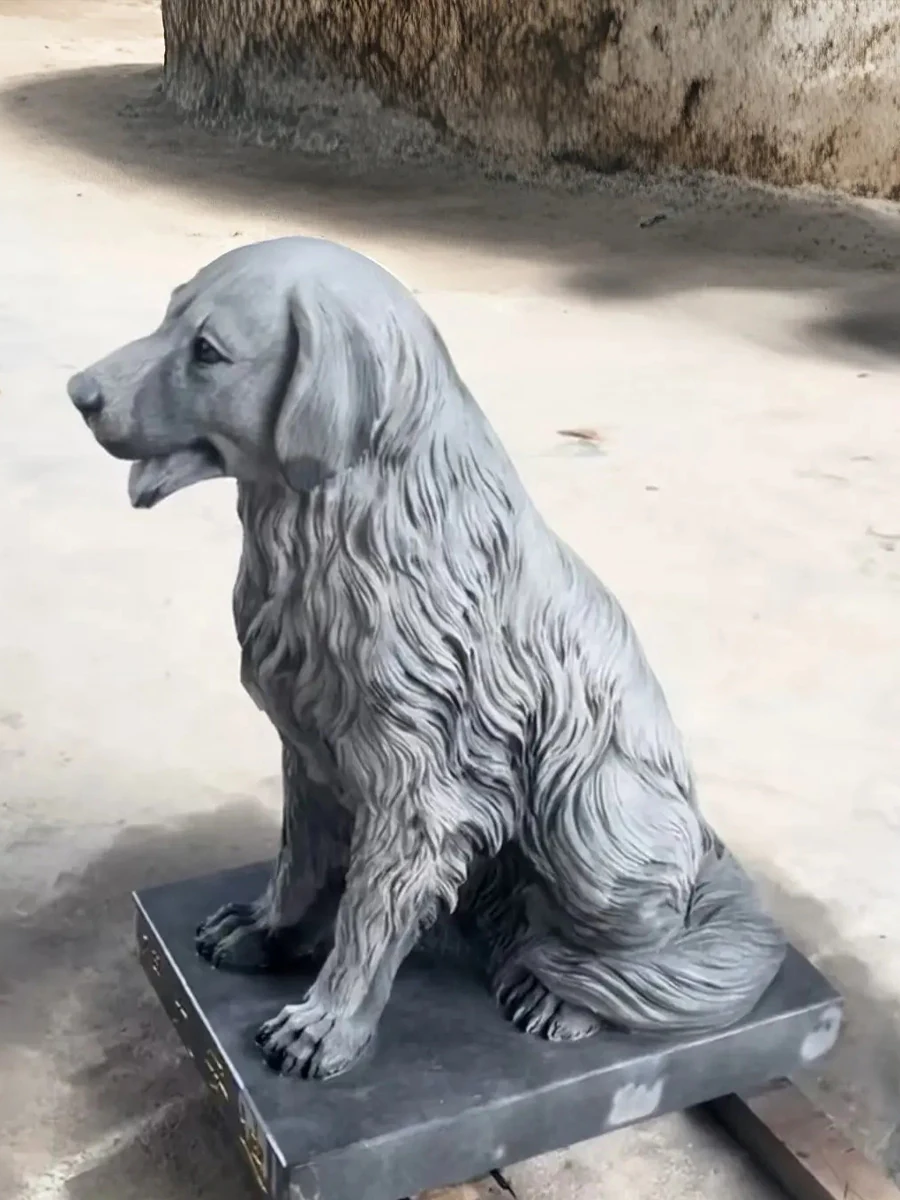
For natural stone, review a sample and agree on expectations for visible variation. Ask how slender projecting features and the base are handled in the selected carving. Avoid assuming that a drawing for one material can be transferred unchanged into another.
For stainless steel, the finish and exposure matter alongside the grade. The British Stainless Steel Association treats cleaning requirements in relation to environment, including coastal settings. A reflective appearance is not a substitute for a material and maintenance specification.
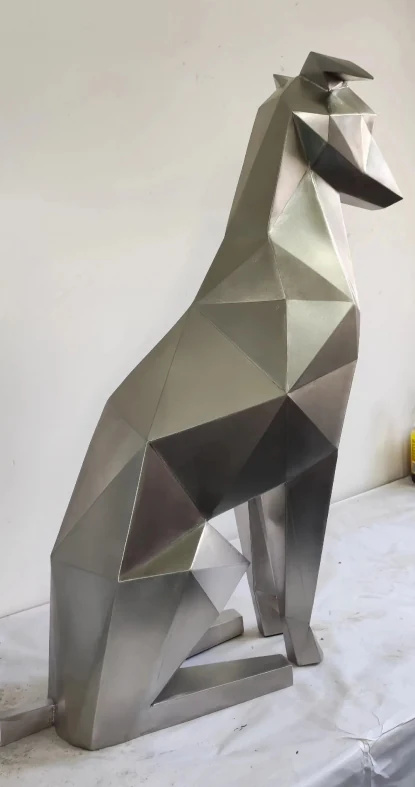
A faceted design offers a different visual language from a dog with carved or modelled coat detail. Compare the silhouette as well as the finish: the long muzzle, upright torso and angular hindquarters determine what you see from the approach. Check the outer edges in the selected view, including any elements near the feet. A change from a realistic model to a geometric design does not remove the need for complete dimensions and confirmed support details.
Describe the exposure at the actual position
An entrance beneath a roof may still receive wind-driven rain, sprinkler spray or water from nearby planting. Tell the supplier about freezing weather, coastal air and the position of irrigation.
The Canadian Conservation Institute’s outdoor-object guidance explains how trapped water, freezing and salts can affect outdoor objects. It recommends good site drainage, avoiding direct sprinkler exposure and keeping intentional drainage openings clear.
Use that information to ask about the proposed sculpture’s drainage and placement. Do not add holes or seal openings without the maker’s instructions. Plan access for checking and caring for the piece after it is positioned.
Plan the last part of delivery before approving a large piece
A statue that fits the porch may still be difficult to move through the gate or around a turn on the way there. Walk the delivery route from the likely unloading point to the final position.
Record narrow openings, steps, sharp turns, overhead obstructions and surfaces that handling equipment would cross. A doorway measurement alone is insufficient where the piece must turn immediately beyond it.
Keep sculpture weight and shipping weight separate
Ask for the net weight of the dog, the weight of a separate base, the total installed weight and the packed gross weight. Packed weight includes the crate and packing; it should not be used as the weight placed on the porch after unpacking.
During early design, some values will be estimates. Have them identified as such and confirm when final weights and crate dimensions become available. Your local handling team can then decide whether to move the crated piece along the route or unpack it at an appropriate staging point.
Weight also needs to be considered with the actual support arrangement. A piece standing on four contact points and one supported across a broader base present different information to an installer. Have the supporting surface assessed using the proposed design, weight and mounting details, especially on an elevated or suspended porch.
Separate delivery, unloading, positioning and fixing
A quotation should state where delivery ends and which services it includes. Unloading a crate, moving the sculpture up steps, placing it on a base and securing it are separate tasks.
For a Yun Sculpture commission, arrange local unloading and installation; these are not included in the sculpture supply. Confirm the delivery scope in your project quotation, and let the local team review the information needed for its work before shipment.
Heavy weight alone is not a fixing plan. Ask how the specific design is intended to be supported and secured. The installer should confirm compatibility with the porch surface and any separate pedestal. Mounting details must also preserve drainage and access where the design requires them.
Approve the design in a sequence that keeps decisions clear
Start with the choices that shape everything else: position, pose, material, complete size and whether the commission is one figure or a pair.
Once those are established, review the sculpture itself. For a pet portrait, use the personalized dog statue guide for the detailed reference requirements. Here, keep the porch-related checks alongside the likeness review: head direction, tail projection, base size and overall height.
The layout and the model solve different questions. A scene image helps you assess placement; views of the model help you assess form. Ask for the dimensions to accompany the design you are approving, so that an attractive revised pose is also checked against the measured site.
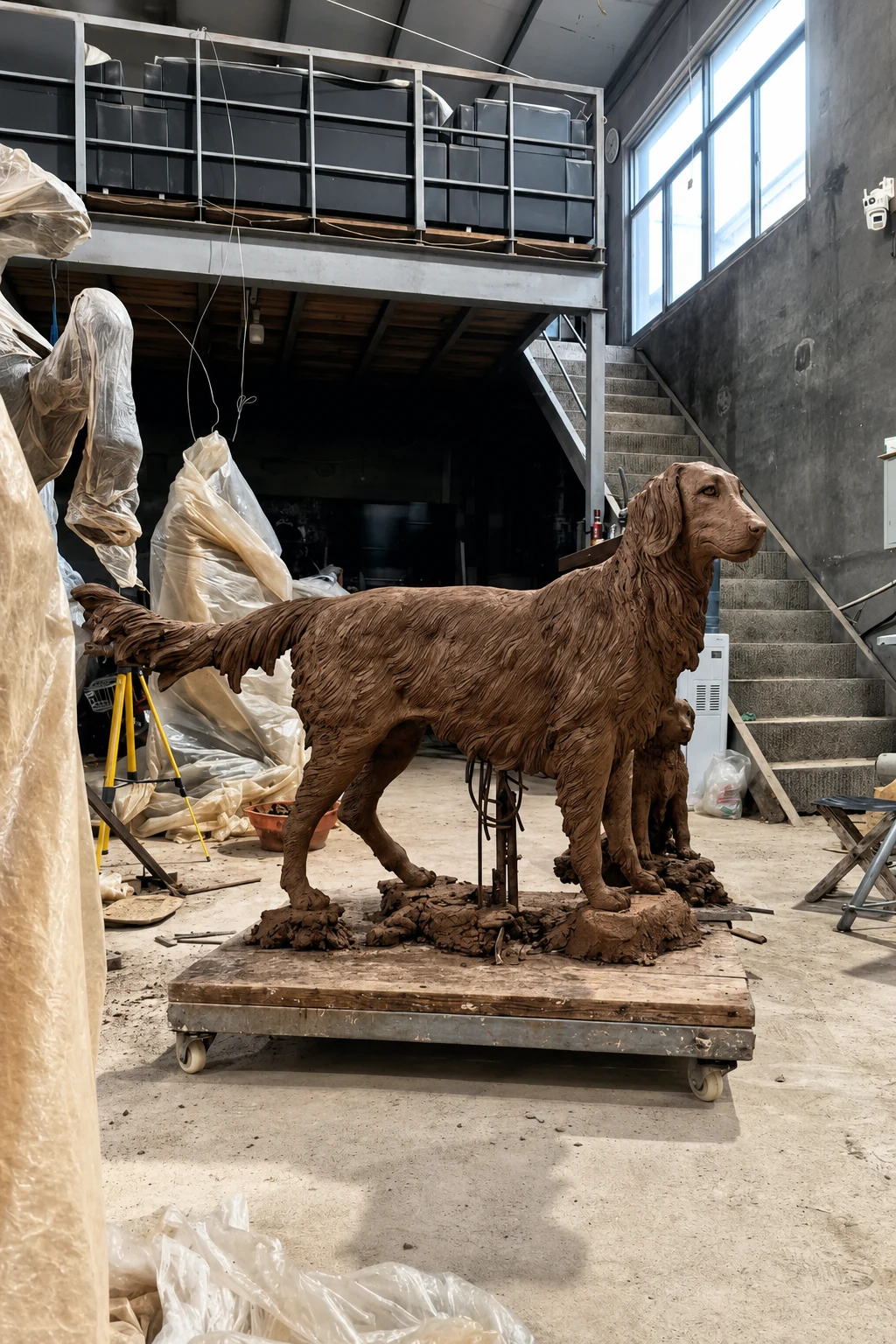
Modelling supports and workshop platforms visible in process photographs should not be used to infer the finished sculpture’s mounting arrangement. Review the completed design’s base and installation information separately. In a standing pose, examine the head direction and projecting tail at the model stage as well as the animal’s proportions.
For a cast-bronze commission, settle the agreed form at the model-approval stage before casting. Review the proposed finish separately from the uncolored model. If you are ordering a pair, approve both figures together as well as individually.
Keep a written summary with the approved views: which design, which measurements, which finish reference and which base. Include any important choices that changed during discussion. This gives the buyer, supplier and local team a common reference as the project moves forward.
Prepare one brief that others can review with you
You may love the sculpture before your family, designer or installer has enough information to agree. A concise shared brief helps each person assess the part relevant to them.
| Item to record | Your project information |
|---|---|
| Proposed position | Porch photograph with the position marked |
| Usable space | Width and depth after allowing for doors and daily circulation |
| Design | Breed or individual dog; seated, standing or reclining; one figure or pair |
| Direction | Body and head direction from a stated viewpoint |
| Complete size | Animal, base and assembled maximum dimensions |
| Material and appearance | Actual material specification and finish reference |
| Site exposure | Shelter, rain, irrigation, freezing or coastal conditions |
| Delivery and local work | Delivery endpoint, unloading, access, positioning and fixing |
| Approvals | Who confirms the design and who reviews the site arrangements |
This can begin as a short email rather than a completed technical packet. Record unresolved details as questions, instead of making assumptions to fill every box.
The same brief also improves quotation comparisons. Ask each supplier to price the same size, material, base and destination, with its included services stated. A lower headline price is difficult to evaluate when the designs or delivery scopes differ.
If you have a preferred arrival date, share it early. Allow separately for design decisions, model review, production, transport and local preparation. Confirm the project schedule with the supplier rather than applying a generic website timeline to your order.
Questions about dog statues for a front porch
What size dog statue looks right beside a front door?
Begin with the usable width and depth, then test height against the entrance. There is no single size that suits every porch. A tall, narrow seated figure and a lower, longer standing figure can occupy very different spaces. Compare complete dimensions and use a floor template plus a height marker before choosing.
Is one dog statue enough, or should I buy a pair?
One figure can give an entrance a clear focal point, especially when seating or a handrail occupies the other side. Consider a pair when both positions work independently and the combined arrangement improves the entrance. Two complementary poses are another option for unequal spaces.
Can the dog stand on the porch without a pedestal?
That depends on the sculpture’s design and support arrangement. Some figures have an integrated base; others need a separate base or defined mounting points. Confirm the finished piece’s support and fixing details with the supplier and local installer. A pedestal is also a visual choice that changes overall height and footprint.
Does “bronze finish” mean a bronze dog statue?
The wording alone does not establish the material. Request a specification distinguishing the body material from its color or coating. For a metal casting, also clarify hollow or solid construction and the finish supplied. Compare the stated specifications rather than the photograph’s color.
Can I place a portrait of my dog beside the front door?
Yes, that can be a meaningful setting. Choose a familiar pose that also fits the measured position, and review the likeness and porch layout together. For detailed photography and portrait preparation, follow the personalized guide linked above.
Can I change the head direction without changing the whole pose?
It can be discussed as a design request. Ask to see the revised form and dimensions, particularly the muzzle’s projection. For a pair, establish whether you want matching bodies, different head directions or a fully mirrored arrangement before approving the models.
Plan your front porch dog statue with Yun Sculpture
Explore the dog statue collection for realistic forms and custom commissions. To begin, send a porch photograph, the usable width and depth, a preferred dog or pose, and your delivery postcode.
We can use those details to discuss a figure or pair, its dimensions, base and finish. The aim is a sculpture that belongs at your entrance, with a clear plan for how it will reach its place there.