Get in touch with Yun-Sculpture company
Marble Statue of Poseidon: Water Feature, Garden & Commission Guide

In 1566, Giambologna completed a bronze Neptune for the Piazza del Nettuno in Bologna — a figure standing nearly four meters tall, positioned at the center of a monumental fountain, commanding the water that flowed beneath him. Twelve years later, Bartolomeo Ammannati’s Neptune took the same position at the center of the Piazza della Signoria in Florence. Neither sculptor placed Neptune beside water as decoration. They placed him at the center of water as authority. This distinction — the god commanding his domain rather than merely adjacent to it — is the single most important decision in commissioning a marble statue of Poseidon, and it is the decision that determines everything else: scale, pose, material, pedestal height, and orientation. This guide covers how to make it correctly.
The Space Poseidon Commands — Water as Setting, Not Backdrop
Poseidon is the only major Olympian whose domain is an environment rather than an abstract quality. Zeus governs authority; Apollo governs light; Athena governs wisdom. Poseidon governs water — a physical substance that is already present in the gardens, pools, courtyards, and coastal properties where his image is most often commissioned. This means placing a Poseidon statue correctly is not a question of finding an attractive location. It is a question of establishing the god’s relationship to the water that is already there.
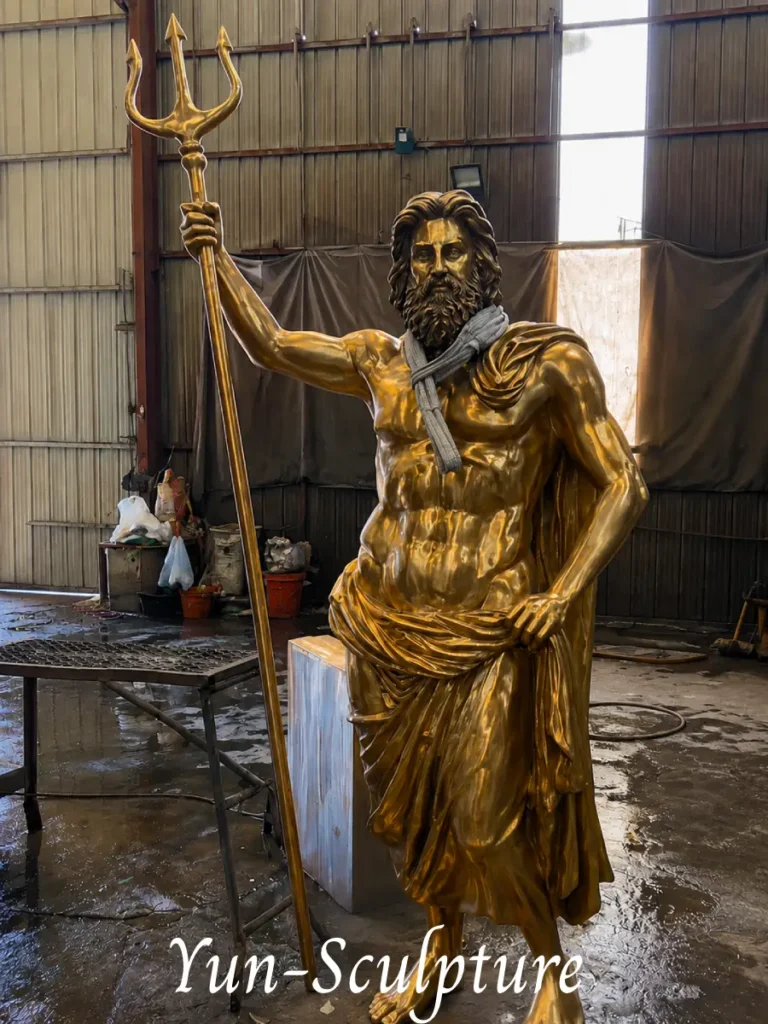
Three spatial relationships are possible. In the first, Poseidon commands from above — elevated on a pedestal at the pool edge or garden fountain rim, looking down across the water, trident raised. This is the Bologna and Florence model: the god as sovereign over his territory. It requires scale sufficient to establish authority from above — a figure that is too small relative to the water surface it overlooks reads as decoration rather than command. In the second relationship, Poseidon appears to emerge from the water — integrated into a fountain so that water flows around the base of the figure, creating the impression that the god is rising from the sea. This requires bronze rather than marble, and a specifically engineered base for the water installation. In the third relationship, Poseidon stands adjacent to water — at the edge of a garden pond, beside a pool, near a coastal garden boundary — as a figure who belongs to this environment without being integrated into the water feature itself. This is the most flexible placement and the most forgiving of scale errors.
The orientation of the figure matters in all three cases. A Poseidon facing inland — away from the water — has turned his back on his domain. A Poseidon facing the water, trident angled toward it, establishes the correct visual relationship: the god present in, aware of, and presiding over the element he rules. For pool installations, I position the figure so that a viewer approaching from the primary garden axis sees both Poseidon and the pool in the same line of sight — the statue and the water reading as a unified composition rather than as separate elements sharing the same space.
Most Commissioned
Standing with Trident
Sovereign posture — commands from a position of authority
Best setting
Pool surround, garden axis, estate entrance, coastal pedestal
Material
Marble body + bronze trident for outdoor; all marble for sheltered interior
Scale
150 cm minimum for pool surround; life-size to heroic for open settings
Fountain Integrated
Emerging from Waves
Water flows at the figure’s base — the god rising from the sea
Best setting
Fountain centerpiece, water feature with engineered base, pool island installation
Material
Bronze throughout — direct water contact and internal water flow require bronze’s durability
Scale
Determined by basin diameter — figure should occupy one-third to one-half of basin’s visual footprint
Contemplative
Seated / Enthroned
The god at rest — presiding rather than commanding
Best setting
Covered terrace, indoor pool atrium, sheltered courtyard niche
Material
White marble for sheltered settings; the seated pose reduces trident stress angles
Scale
Seated scale reads smaller — allow for this in size selection; 120–180 cm seated height
Paired Commission
Poseidon with Amphitrite
Sea god and sea queen — fountain centerpiece or formal garden pair
Best setting
Large fountain basin, formal garden axis, estate water feature centerpiece
Material
Matched materials essential — both marble or both bronze; mismatched materials destroy visual unity
Scale
Both figures must be produced simultaneously for proportion matching — see our paired commission guide
The Trident Problem — Why Material Choice Is More Complex for Poseidon
The trident is Poseidon’s defining attribute and the most structurally demanding element in any Poseidon commission. Three prongs extending from the staff, each angled slightly outward, each creating leverage stress at the point where it meets the adjacent form — this is the anatomy of a marble fracture waiting to happen, and it is why material choice for a Poseidon commission cannot be resolved by the same logic that applies to a draped figure like Athena or a simple standing figure like Apollo.
In natural white marble, a carved trident held at an angle from the body concentrates stress at three specific points: where each outer prong diverges from the central shaft, and where the shaft itself meets the figure’s hand. In a controlled interior environment with no vibration, no thermal cycling, and no wind load, an expert carver can produce this form with adequate structural reinforcement through internal stainless steel pins, invisible to the viewer. Outdoors, in any climate with temperature variation — which includes most of the United States and Europe — the freeze-thaw cycle that infiltrates marble’s microfractures will find these stress points first. The outer prongs of a marble trident are among the most statistically likely elements in classical outdoor sculpture to fail over a ten-to-twenty-year period.
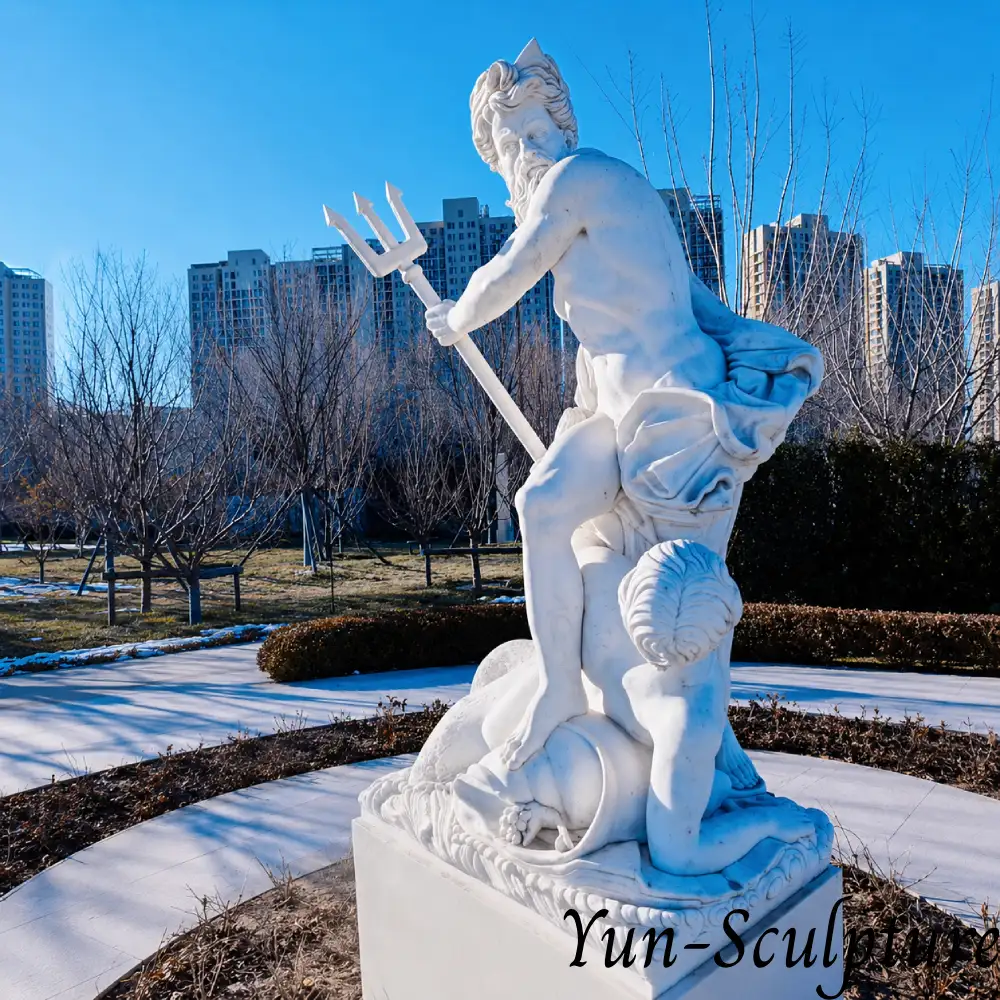
The correct technical solution for outdoor Poseidon commissions is the same hybrid approach that ancient chryselephantine sculpture used for its projecting elements: the figure in white marble, the trident cast in bronze and integrated at the hand. Bronze handles the geometry of the trident structurally — its tensile strength maintains thin projecting forms under load conditions that would fracture stone. The visual result, once the bronze trident is patinated to a warm brown that complements the marble, is unified. The structural result is a commission that will survive its outdoor environment for decades rather than years.
| Installation Environment | Recommended Material | Why |
|---|---|---|
| Pool surround — temperate climate | Marble body + Bronze trident | Constant pool-edge humidity; marble body handles outdoor exposure well; trident in bronze eliminates fracture risk at prong stress points |
| Fountain centerpiece — water contact | Bronze throughout | Direct water flow at base; internal water channels if integrated; bronze’s corrosion resistance and tensile strength are both required |
| Coastal garden — salt air exposure | Bronze throughout | Salt air accelerates marble surface deterioration over years; bronze develops a stable patina in coastal conditions that protects the alloy beneath |
| Indoor pool or atrium | White marble | Controlled environment with no freeze-thaw; marble’s translucency under interior pool lighting produces exceptional surface presence; humidity is stable |
| Garden without water — contextual placement | White marble or Bronze | Standard outdoor material considerations apply; marble for sheltered positions, bronze for fully exposed settings or freeze-thaw climates |
Scale — Matching the Figure to the Water Feature
Scale errors in Poseidon commissions almost always run in one direction: too small. A figure that seems substantial on its own diminishes against the horizontal expanse of a pool, a large garden fountain basin, or an open coastal garden. The water surface itself provides a visual scale reference — and a Poseidon figure that does not hold its own against that reference reads as a garden ornament rather than as the god of the sea.
For pool surrounds, the minimum useful scale for a standing Poseidon is approximately 150 centimeters excluding the pedestal. At this height, elevated on a 40 to 60 centimeter stone base, the figure’s face and trident read clearly from the far end of a standard residential pool. For a large estate pool or a commercial installation viewed from greater distances, life-size or heroic scale — 180 to 250 centimeters — is more appropriate.
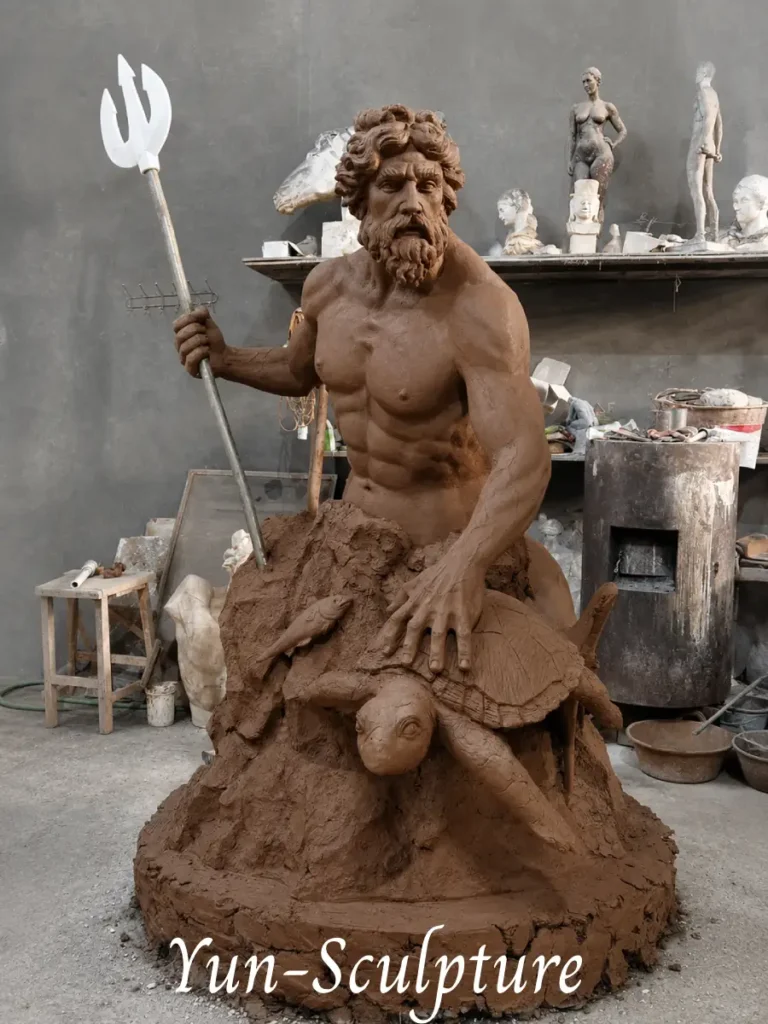
For fountain centerpiece installations, scale is determined by the basin diameter: the figure should occupy approximately one third to one half of the basin’s visual footprint when viewed from the primary approach. Giambologna’s Bologna Neptune, at nearly four meters, presides over a basin of corresponding scale. A figure that is too small relative to its basin looks as though it has been placed there temporarily rather than designed for it.
For coastal or open garden placements without a formal water feature, I recommend erring toward life-size or above. Open sky and open space are as scale-demanding as water, and a figure at garden level without the vertical context of a pool or fountain needs its own height to establish presence. A life-size Poseidon at 180 centimeters on a 60-centimeter pedestal, positioned at the edge of a coastal garden with the sea visible behind it, is one of the most architecturally correct placements for this subject in the entire classical vocabulary.
Frequently Asked Questions
What does the statue of Poseidon symbolize?
The Poseidon statue symbolizes dominion over water and the forces of nature — including earthquakes, which the Greeks attributed to Poseidon striking the earth with his trident. In a modern installation near a pool or coastal garden, it symbolizes command over that water environment: the god present in his domain, presiding over the element he governs. His image carries natural force rather than ordered authority — an energy that distinguishes it from Zeus’s sovereignty or Athena’s intelligence.
Are there any famous statues of Poseidon?
The most significant surviving ancient bronze is the Cape Artemision Bronze, recovered from the sea off Greece in 1926 and now in the National Archaeological Museum in Athens — a figure with arm raised to throw, considered one of the finest surviving examples of ancient Greek bronze casting. For Neptune, Giambologna’s Fountain of Neptune in Bologna (1566) and Ammannati’s Neptune in Florence’s Piazza della Signoria (1565) are the defining water feature statues in Western art and the direct precedents for contemporary pool and garden commissions.
What is the history of the Neptune fountain?
The tradition of Neptune fountain statues in public space dates from the Italian Renaissance, when civic commissions in Florence, Bologna, and other Italian cities placed bronze Neptunes at the center of monumental water features as symbols of civic power. Giambologna’s Bologna Neptune (1566) and Ammannati’s Florence Neptune (1565) established the visual language still used today: the god elevated above the water, commanding it, trident raised. Later examples at Schönbrunn and Versailles extended the tradition across Europe. This history is the direct precedent for contemporary estate and garden commissions placing Poseidon at pool surrounds and fountain centerpieces.
What are the symbols of Poseidon?
Poseidon’s primary symbol is the trident — the three-pronged staff with which he was said to strike the earth to cause earthquakes and stir the sea into storms. Secondary symbols are the horse (which he created by striking the earth), the dolphin (a divine messenger of his realm), and the bull. In a commission, the dolphin at the figure’s base adds iconographic completeness without the structural demands of the trident — a reliable secondary element for any Poseidon piece that enhances the figure’s identity while adding visual interest at the base.
What does Neptune mean spiritually?
Neptune — the Roman name for Poseidon — is associated spiritually with the depths and the forces that move beneath the surface. In classical Roman religion, Neptune presided over all water: fresh and salt, calm and turbulent. Placing a Neptune figure near a pool, fountain, or coastal garden has a history stretching two thousand years — the Romans placed Neptune images at baths and harbors for protection and blessing, a tradition that has continued unbroken in garden and architectural sculpture to the present day.
Factory Direct · Quyang, China
Commission a Poseidon for Your Water Feature
Standing with trident, emerging from waves, or enthroned — in white marble, bronze, or the correct hybrid for your environment. Every commission begins with the placement question: where does the god stand in relation to the water?