Get in touch with Yun-Sculpture company
Birth of Venus Statue: Botticelli’s Masterpiece in Marble & Bronze

A Birth of Venus statue is a sculptural interpretation of Sandro Botticelli’s 1485 painting of the same name — depicting Venus, the goddess of love and beauty, standing nude on a scallop shell as she arrives at shore, hair flowing, one hand modestly covering her body in the classical pudica pose. The painting itself, housed in the Uffizi Gallery in Florence, is tempera on canvas — it has never existed as a sculpture. Every Birth of Venus statue on the market today is a three-dimensional translation of a two-dimensional composition, made possible because the pose Botticelli painted was itself derived from ancient Greek sculpture. This guide explains that connection, what the statue actually depicts, and how to choose the right material and scale for a garden or interior commission.
Table of Contents
Table of Contents
Is the Birth of Venus a Painting or a Statue?
The Birth of Venus is a painting. Sandro Botticelli completed it around 1485 in tempera on canvas, and it has hung in Florence — first in Medici collections, now in the Uffizi Gallery — for over five centuries. No ancient or Renaissance sculpture by this name exists.
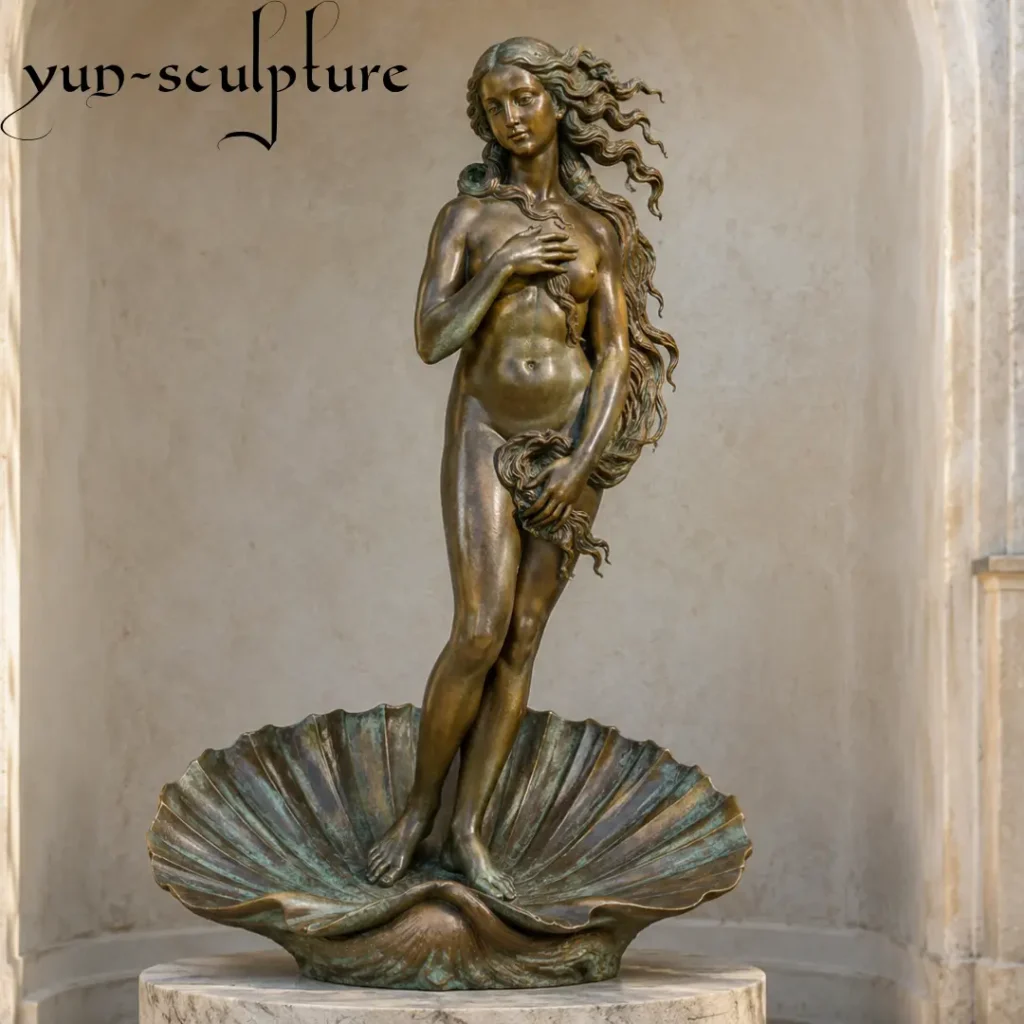
The confusion is understandable and, in a sense, historically appropriate. Botticelli did not invent Venus’s pose from nothing. He based it directly on a type of ancient Greek and Roman sculpture known as the Venus Pudica — “modest Venus” — most famously exemplified by the Capitoline Venus and the Medici Venus, Roman marble copies of an original attributed to Praxiteles. The standing pose, the weight on one leg, the hand drawn across the body in a gesture of modesty rather than concealment: this is sculptural vocabulary that Botticelli translated into paint.
So when a sculpture studio offers a “Birth of Venus statue,” what they are actually producing is a sculptural realization of Botticelli’s painted composition — Venus on her shell, in her pudica pose, with her particular gesture and flowing hair — built using the same three-dimensional logic that originally inspired the painting. The statue completes a circle: ancient sculpture inspired a Renaissance painting, and that painting now inspires new sculpture.
What Does the Birth of Venus Depict?
The painting shows the mythological moment of Venus’s birth and arrival at shore. According to the version of the myth Botticelli followed, Venus was born fully formed from sea foam and arrived on the island of Cyprus standing on a giant scallop shell, blown toward land by Zephyrus, the west wind, and his companion Aura. On the shore, a figure representing the Hora of Spring waits to wrap her in a floral cloak.
The composition is built around three figures: Venus at center, the embracing wind gods at left propelling her forward, and the welcoming spring figure at right. Roses — associated with Venus — drift on the wind around her. Orange trees in the background reference the Medici family, who commissioned the painting.
Venus herself stands in contrapposto, weight on one leg, body forming a gentle S-curve. Her right hand draws a strand of hair across her body; her left hand gestures toward — without fully covering — the opposite side. This is the pudica gesture: modest, not concealing, drawing attention to what it appears to hide.
For sculptural purposes, this single figure — Venus on her shell, in her characteristic pose — is what gets isolated and translated into three dimensions. The wind gods and the spring figure are part of the painting’s narrative composition but are rarely included in standalone garden or interior statues.
Why Is the Birth of Venus So Famous?
Several factors combine to make this one of the most recognized images in Western art, and by extension one of the most requested subjects for sculptural interpretation:
It was radical for its time. Painted in Florence in the 1480s, it was one of the first large-scale secular paintings on canvas depicting a nude female figure since antiquity — a deliberate revival of classical subject matter and classical form during the early Renaissance, made possible by the Medici family’s embrace of Neoplatonic philosophy, which read Venus as a symbol of divine beauty rather than mere sensuality.
The pose itself is exceptional. Botticelli’s Venus has an elongated neck and torso, proportions that prioritize grace and rhythm over strict anatomical accuracy. The result is a figure that feels weightless — appropriate for a goddess arriving on a sea breeze rather than standing under ordinary gravity.
It bridges two traditions. The painting connects ancient Greek sculptural form (the Venus Pudica pose) with Renaissance painting technique and Christian-inflected Neoplatonic symbolism, making it a touchstone for understanding how classical antiquity was revived and reinterpreted in fifteenth-century Florence.
It has remained continuously visible. Unlike many famous works with complicated ownership histories, the painting has been part of a public or quasi-public Florentine collection for most of its existence and has been a fixture of the Uffizi Gallery since 1815 — generating two centuries of reproduction, study, and cultural reference.
What Does the Shell Symbolize?
The scallop shell carries layered symbolic meaning. Most directly, it is the vessel of Venus’s birth and arrival — the literal setting of the mythological scene, in which she emerges from sea foam and is carried to shore.
Symbolically, the shell has long been associated with female fertility and birth, a connection scholars trace through ancient Mediterranean visual culture into Christian iconography, where the scallop shell also became associated with pilgrimage and spiritual rebirth. In the context of Botticelli’s painting, the shell reinforces the theme of divine birth and renewal — Venus emerging into the world as a fully formed embodiment of beauty.
For sculptural interpretations, the shell is also a practical compositional device: it gives the standing figure a base that is thematically integrated into the scene rather than a generic plinth, and it provides a natural visual frame that draws the eye toward the figure.
What Is the Venus Pudica Pose?
Pudica is Latin for “modest.” The pose — standing weight on one leg, one or both hands drawn toward the body in a gesture of modesty — originated in Greek sculpture with the Aphrodite of Knidos by Praxiteles around 350 BC, the first life-size female nude in Greek sculptural history. Roman copies, most notably the Capitoline Venus and the Medici Venus, preserved and popularized the pose through antiquity and into the Renaissance, when artists rediscovering classical sculpture used it as a foundational reference.
The gesture is deliberately ambiguous: the hand draws attention to the body even as it appears to shield it, creating a tension between modesty and display that scholars have analyzed for centuries. Botticelli’s Venus performs this exact gesture, confirming that his painted figure is, formally, a direct descendant of ancient sculptural Venus types — which is precisely why the painting translates so naturally back into sculpture today.
Bronze or Marble for a Birth of Venus Statue?
Marble is the material most aligned with the painting’s classical sources. Since the pose derives directly from ancient marble sculpture (the Venus Pudica tradition), a hand-carved white marble Birth of Venus statue connects most directly to that lineage. The surface translucency of natural marble — light entering the stone before reflecting back — suits a figure associated with luminous, divine beauty. For garden, courtyard, or interior installation where classical authenticity matters most, marble is the standard choice. See our marble replica buyer’s guide for a full breakdown of material grades, from resin to hand-carved natural stone.
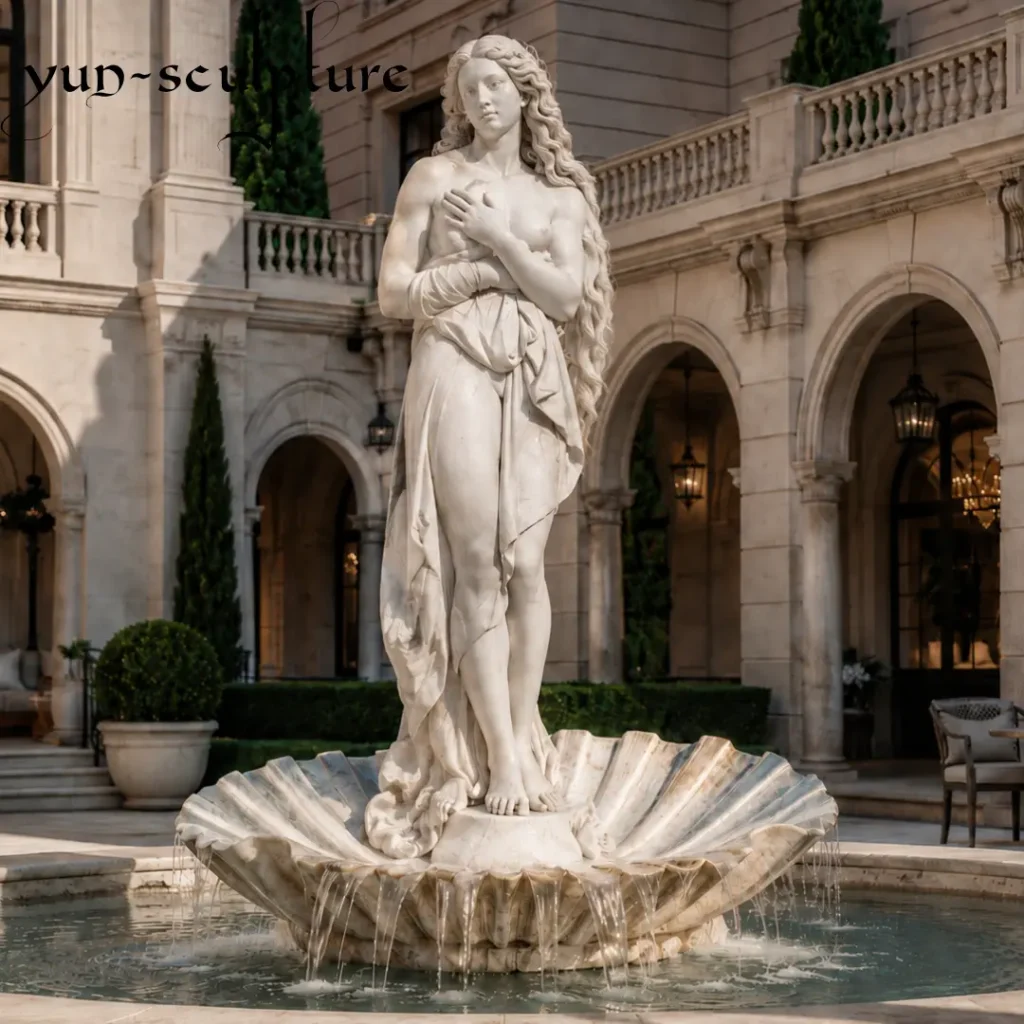
Bronze offers a different register — slightly more dramatic, with a darker patina that creates contrast against garden planting and water features. Bronze handles outdoor installation in all climates without the siting considerations marble requires in freeze-thaw conditions, and it is the more practical choice for a poolside or fountain-adjacent placement, where Venus’s maritime origin makes particularly strong thematic sense.
For a figure intended to echo the Greek goddess statues tradition most directly — particularly alongside an Aphrodite or Venus de Milo piece in the same setting — marble maintains material consistency across the collection.
What Scale and Placement Work Best?
Tabletop (40–60 cm) — Indoor display, mantelpiece, or console table. The pose and shell composition read clearly even at reduced scale; this is the most commonly ordered size for interior decorative placement.
Garden accent (80–120 cm) — Terrace, poolside, or garden niche. Sufficient scale to anchor a planting bed or water feature without overwhelming the space.
Life-size and above (150 cm+) — Garden focal point, estate centerpiece, or hotel courtyard installation. At this scale the figure carries genuine sculptural presence; the shell base typically requires an integrated plinth or water feature setting to support the visual weight of the composition.
For placement guidance specific to mythological figures in outdoor settings, our Greek god garden statues guide covers axis positioning, elevation, and pairing with water and planting — the same principles apply directly to a Birth of Venus installation.
Frequently Asked Questions
What is the meaning of The Birth of Venus statue?
A Birth of Venus statue depicts the goddess of love and beauty arriving at shore on a scallop shell, in the classical Venus Pudica pose — standing with weight on one leg, hand drawn modestly across the body. It represents divine beauty emerging fully formed, a theme of renewal and rebirth that traces back to ancient Greek sculpture and was popularized through Botticelli’s 1485 painting of the same composition.What statue is The Birth of Venus modeled after?
Botticelli’s painted Venus is modeled after the Venus Pudica (“modest Venus”) type of ancient Greek and Roman sculpture, most famously represented by the Capitoline Venus and the Medici Venus — Roman marble copies of an original attributed to the Greek sculptor Praxiteles around 350 BC. The standing pose, the weight shift, and the modest hand gesture all derive directly from this sculptural tradition, which Botticelli translated into paint over a thousand years later.Why is The Birth of Venus so famous?
The Birth of Venus is famous for being one of the first large-scale secular Renaissance paintings to depict a nude female figure since antiquity, for its exceptional and influential composition (Venus’s elongated proportions prioritize grace over strict anatomy), for bridging ancient Greek sculptural tradition with Renaissance Neoplatonic philosophy, and for its continuous public visibility — it has been part of Florentine collections for over five centuries and on display at the Uffizi Gallery since 1815.Where is the original Birth of Venus painting located?
The original Birth of Venus by Sandro Botticelli is housed in the Uffizi Gallery in Florence, Italy, displayed in the Botticelli Rooms (Rooms 10–14), typically positioned opposite his other major work, Primavera. It has been part of Florentine collections since its creation around 1485 and has been in the Uffizi specifically since 1815.Who is the woman in Birth of Venus?
The figure depicted is Venus, the Roman goddess of love and beauty (equivalent to the Greek Aphrodite). Art historians widely believe Botticelli’s model was inspired by Simonetta Vespucci, a celebrated Florentine beauty of the period who died young and was idealized in Florentine art and poetry after her death, though this attribution is based on stylistic tradition rather than documented certainty.What does the shell symbolize in Birth of Venus?
The scallop shell represents the vessel of Venus’s mythological birth from sea foam and her arrival at shore. Symbolically, shells have long been associated with female fertility and birth in Mediterranean visual culture, and the image carries connotations of renewal and divine emergence. For sculptural interpretations, the shell also serves as an integrated compositional base for the standing figure.What is The Birth of Venus pose called?
The pose is called Venus Pudica, Latin for “modest Venus.” It originated in Greek sculpture with the Aphrodite of Knidos by Praxiteles around 350 BC and was preserved through Roman marble copies including the Capitoline Venus and Medici Venus. The pose features the figure standing with weight on one leg and a hand drawn across the body in a gesture that suggests modesty while simultaneously drawing the eye to the form.What is the most famous Venus sculpture?
The Venus de Milo, housed in the Louvre in Paris, is the most famous three-dimensional Venus sculpture in the world. Among Venus Pudica-type sculptures specifically, the Capitoline Venus and Medici Venus are the most historically significant Roman examples. The Birth of Venus, by contrast, is a painting rather than an original sculpture — sculptural versions of it are modern interpretations of Botticelli’s composition rather than reproductions of an ancient sculptural original.Commission a Birth of Venus Statue from Quyang
Hand-carved marble or cast bronze, tabletop to life-size. Venus on her shell, in the classical pudica pose — factory direct from Quyang, 2-business-day quote turnaround.