Get in touch with Yun-Sculpture company
The familiar face, in a lasting material
Custom Golden Retriever Statues in Bronze
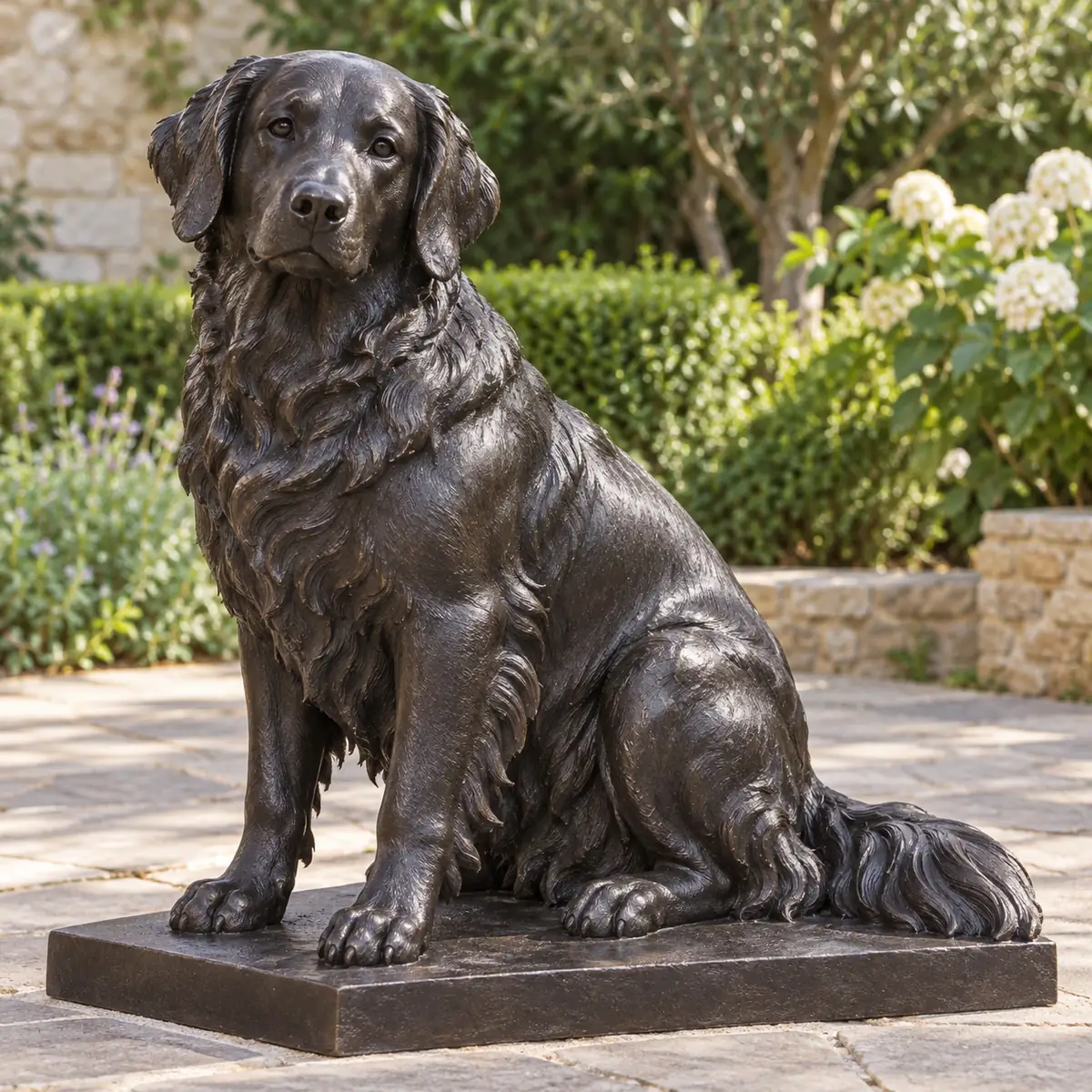
Choose a Golden Retriever statue that keeps the gentle face, dropped ears and flowing coat outline you love. Commission an individual portrait, a garden companion or a welcoming figure for your entrance.
Explore seated, standing and reclining designs, then decide how the coat, tail and expression should read in your space. Cast bronze is our main direction, with separately developed marble and simplified steel options.
Plan your Golden Retriever on WhatsApp ↗Send a favourite photograph, a design you like or a picture of the display position. We can help refine the brief from there.
Your dog or a general breed designCoat outline and expression reviewedYour own AI design can start the commission
Choose what feels like your dog
Golden Retriever sculpture design directions
A quiet seated dog, a fuller standing outline and a relaxed reclining companion give different impressions. Compare the posture first; the finish and any inscription can be agreed separately.
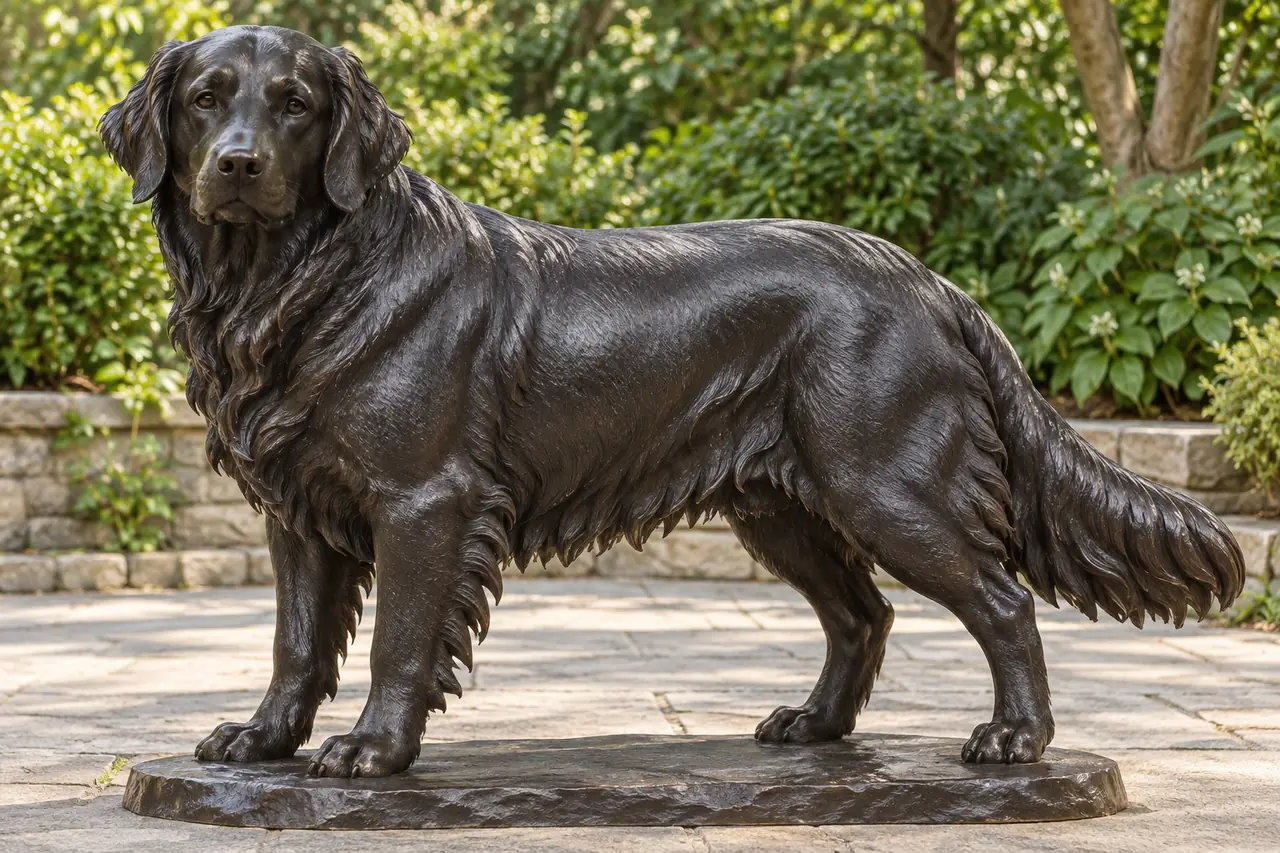
Standing in bronze
The full side outline brings the body, leg feathering and tail into the composition. Compare the complete footprint with your display space.
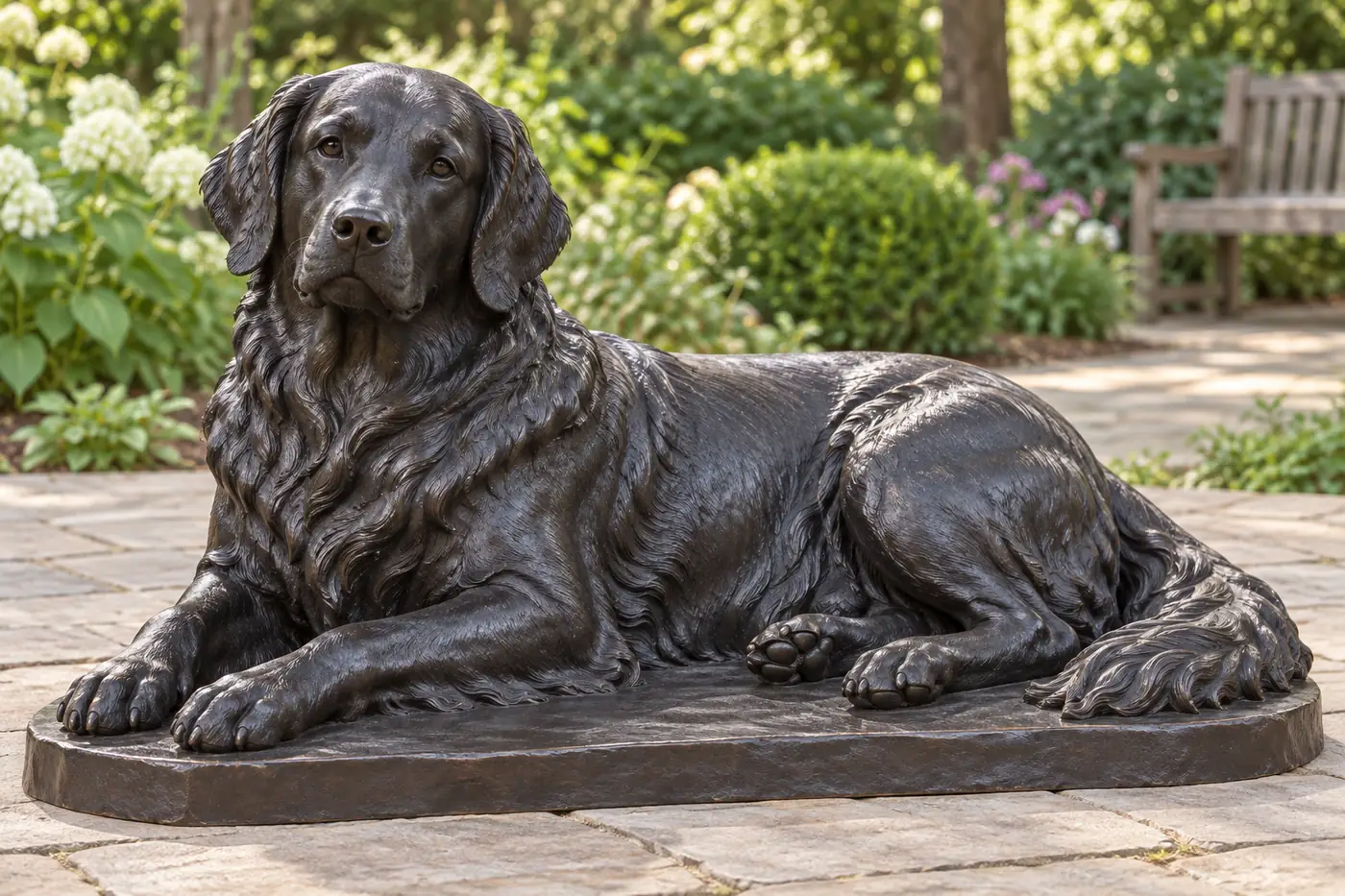
Relaxed reclining pose
A lower resting figure can feel like a companion beside a seat. Check how clearly the face can be seen from that position.
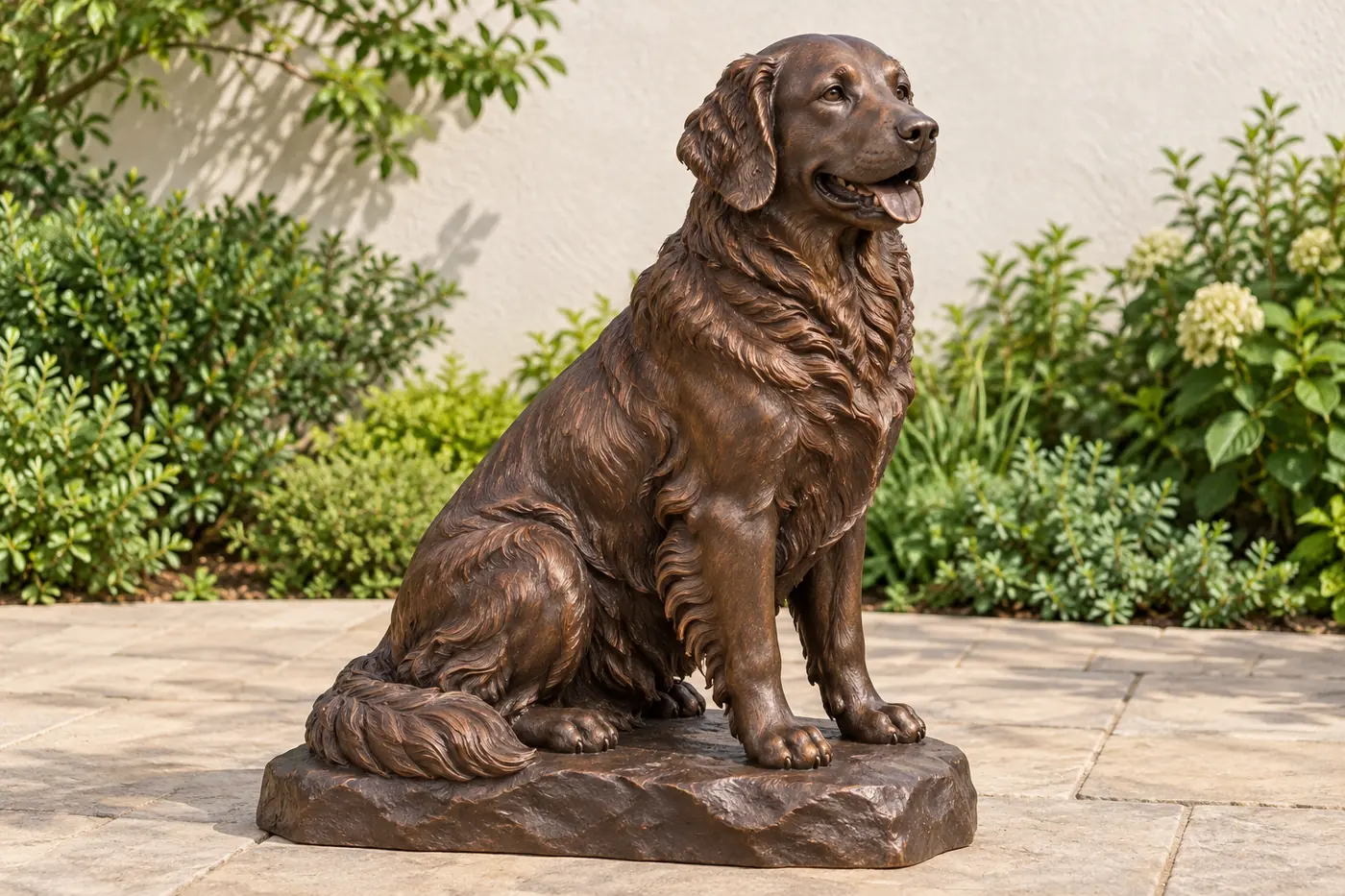
Warmer burnished bronze
The relaxed mouth and gentler warm highlights offer another expression. Agree the surface separately from the pose and likeness.
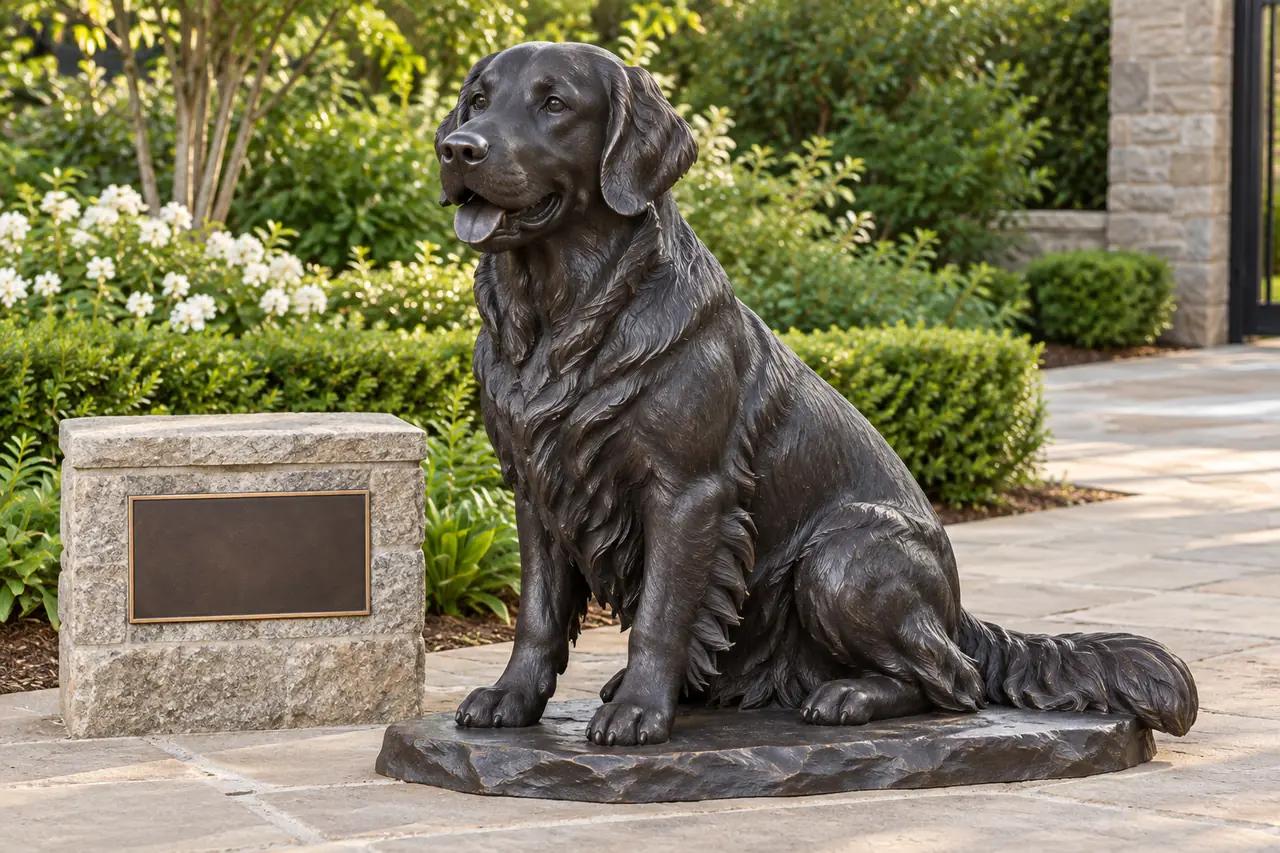
Welcome plaque layout
The plaque is a layout option beside the dog. Specify your wording, support and letter proof; the concept does not imply a supplied sign.
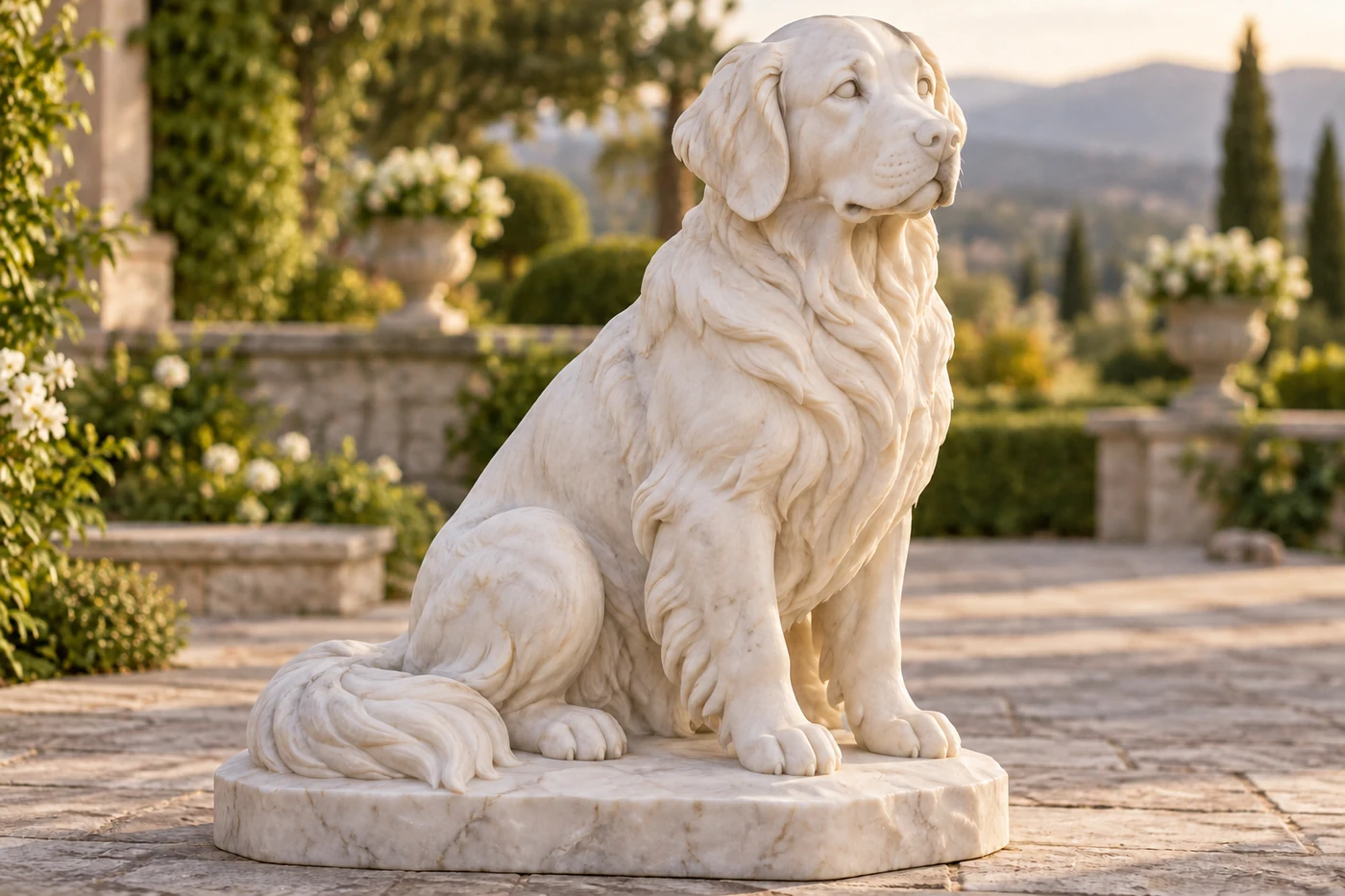
Carved white marble
Grouped coat relief and supported ear and tail transitions create a stone interpretation. Confirm the stone sample and carving approach for the project.
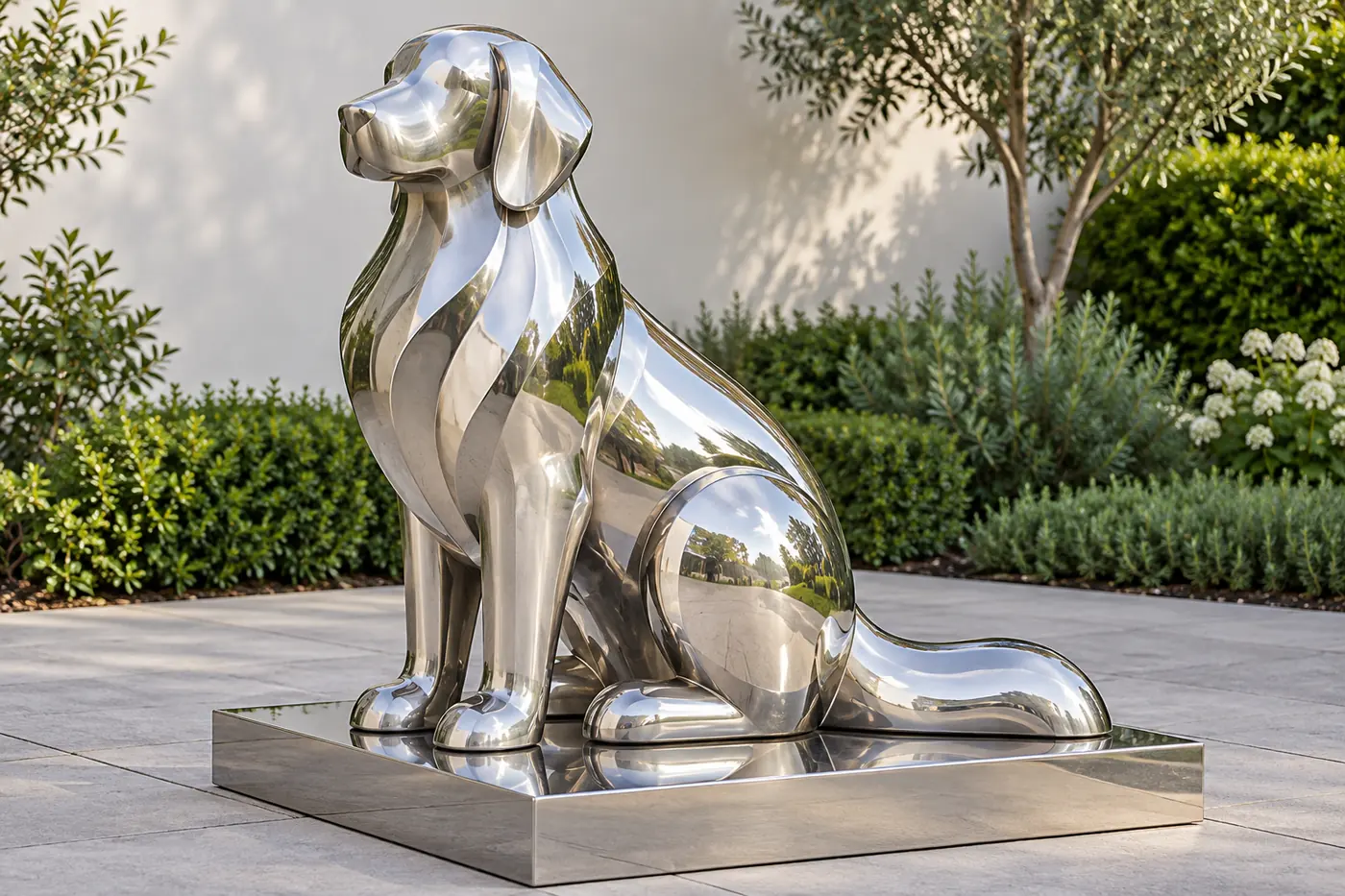
Simplified mirror steel
Broad curves and a clear seated outline replace realistic fur. This is a separately developed fabricated interpretation, with its grade and finish confirmed.
These are AI designs created by Yun Sculpture. You can also send an AI design you have made yourself. For suitable designs, our visual-reproduction target is above 90% against the agreed reference, with the pose, proportions and details confirmed during model review. The achievable interpretation is discussed for the chosen material.
A concept can explain the direction you want; photographs of your actual dog remain important for an individual portrait. Our personalized dog statue guide explains how references support the wider portrait process.
Recognition is more than a brown finish
Keep your Golden Retriever distinct from a Labrador
A Golden Retriever dog statue should be recognisable through its form, not simply through a warm surface colour. Goldens and Labradors can both have a friendly retriever expression, but a generic short-coated figure with a different patina may miss the dog you want.
| Area to compare | Golden Retriever direction | What to check in your chosen design |
|---|---|---|
| Overall coat | A coat outline with straight or wavy forms and areas of feathering. | Whether the sculpture distributes that fullness rather than adding identical texture everywhere. |
| Chest and legs | Fuller relief can describe the neck, chest and feathering behind the legs. | Whether the chest and paws remain readable beneath the coat. |
| Tail | A fuller feathered outline, particularly beneath the tail. | The tail shape in your own photographs and its position beside or behind the body. |
| Labrador comparison | A Labrador generally reads through its shorter dense coat and thicker, less feathered tail. | Whether a catalogue image is actually the coat type and individual outline you want. |
The AKC Golden Retriever standard and Labrador standard provide references for these coat differences. They are a starting point for recognising form; your pet’s photographs decide the individual portrait.
Match the face before adding more fur
Compare the width of the forehead, the muzzle length and the way the ears frame the cheeks. A dense neck ruff cannot correct a head that feels too narrow or a muzzle that is too short.
A straight-on reference helps explain the face. A side photograph explains the nose and forehead more clearly. If a close phone image makes the muzzle look unusually large, include a more distant view before asking the model to follow that effect.
Preserve your dog’s own appearance
Your Golden may have a lighter coat outline, a broader face, a thinner tail or a particular ear that folds differently. These individual traits belong in the brief even when they differ from a general breed image.
For an older companion, identify which period of its life should guide the portrait. A familiar resting face and a less full coat may be more meaningful than a youthful show-style appearance.
Use our outdoor dog breed guide for broader comparisons. This page concentrates on the Golden Retriever choices you need to turn into a practical commission.
The coat should explain the body
Review feathering at the ears, chest, legs and tail
For a Golden Retriever sculpture, the most useful coat detail is often its distribution. Decide where the outline becomes fuller, where the body should remain calm and which features need to stay visible from the final viewing position.
| Area | What to review | A specific instruction that helps |
|---|---|---|
| Ears and cheeks | Ear shape and the transition into the neck, without a wall of texture hiding the face. | “Keep the ears closer to the cheeks and reduce the fullness underneath.” |
| Front of the chest | The direction and depth of the grouped relief, with the chest outline still visible. | “Use broader, calmer groups here; the chest should not look sharply spiked.” |
| Back of the forelegs | Coat outline in the selected pose and the separation between the two paws. | “Keep this feathering behind the leg rather than covering the front paw.” |
| Hindquarters | The seated or standing body shape beneath the fuller coat. | “The rear outline is too bulky; compare it with this side photograph.” |
| Tail | The complete tail, its underside and where it meets the body or base. | “Retain the fuller underside, but place the tail against this side of the body.” |
Choose grouped forms instead of individual projecting hairs
The bronze concepts use flowing groups of relief. That approach can describe the coat without turning it into a mass of thin pointed strands. It also lets the muzzle, chest, paws and tail remain part of one coherent sculpture.
For a small display figure, simplify the relief enough that it can be read at close range. For a larger outdoor design, first confirm the major outline from the intended distance. Surface detail that looks striking in a close render may disappear when the sculpture is seen across planting.
Ask for the coat to be checked from more than the front
A front view can show a convincing face while hiding an oversized neck, a shortened body or a tail extending in an unexpected direction. Review a clear side view and an opposite three-quarter view before confirming the coat outline.
Send a reference that shows the area you want changed. You do not need specialist terms: point out the location, describe whether it should be fuller, flatter or shorter, and attach the photograph that explains it. The model stage is where those instructions become a form you can review.
Remember a moment, not just a breed
A seated, standing or reclining Golden Retriever?
Seated near an entrance
A seated Golden brings the face and chest forward. Decide whether the dog looks toward arriving visitors, along the path or toward a nearby seat. The tail beside the body still belongs in the footprint, even when the main impression is vertical.
Check the paws, ear height and head turn as a group. A perfectly symmetrical front view is not always the pose your dog used.
Standing in an open garden
A standing design makes the body length, legs and full tail part of the silhouette. It needs a position where the side outline is visible, rather than pressed into planting that hides the lower coat and paws.
Choose the stance from a useful reference. Agree whether the tail is held out, lowered or closer to the body; each changes the outer dimensions.
Reclining beside a quiet seat
A reclining Golden can preserve the feeling of a companion resting nearby. The face may be lower, while the front paws and body take more ground length.
Look at the figure from your seated position as well as from the path. A raised support and an enlarged dog are different ways of changing what you see.
Keep the expression and pose in the same brief
A closed mouth gives a different impression from a relaxed open mouth. If a tongue is part of the familiar expression, discuss how simply it should be modelled and how it sits within the muzzle. The concept should remain a sculpture rather than depend on painted or glass details to imitate a living face.
For a playful reference, identify whether the important part is the head angle, a lifted paw or an accessory. A ball, lead or other object adds its own modelling and support requirements. It should be explicitly included in the commission rather than assumed from a general description of a playful dog.
Let the greeting support the sculpture
Plan a Golden Retriever welcome statue
A welcoming Golden does not need to hold a sign to create a friendly entrance. Decide whether the dog’s posture is enough, whether a short word belongs on its base, or whether a separate plaque would make the entrance clearer.
| Direction | Why you might choose it | What to confirm |
|---|---|---|
| The dog without lettering | The face and posture carry the welcoming impression. | Head direction and placement relative to the approach. |
| Lettering on the base | The greeting remains part of one composition. | Exact wording, letter layout, base dimensions and how the text will be read. |
| A separate nearby plaque | The dog stays visually clear and the message can have its own position. | Plaque support, material, size, wording and the relationship to the dog. |
The welcome concept shows a plain plaque as a layout direction. It is not a stocked sign-bearing product, and no wording is implied. Send the exact text you want, including capitalisation, and approve a separate lettering proof.
Test the greeting from the real approach
A plaque that looks large in a close image can be difficult to read from the driveway. Photograph the proposed location from where visitors first approach and again from beside the entrance. Discuss which of those distances matters for the message.
Keep the greeting from competing with the face. Lettering on a support should not require a plinth so high or wide that the dog’s proportions disappear in the overall arrangement. Our front porch dog statue guide provides further entrance-planning advice.
Golden is the breed, not the metal specification
Bronze finish, white marble or abstract stainless steel
A bronze Golden Retriever with a dark patina
Our bronze direction uses lost-wax casting from an agreed model. A dark brown or blackened surface can keep attention on the head, coat relief and overall outline. The final construction and metal specification belong in the project quotation.
A bronze Golden Retriever statue does not have to be gold-coloured. A darker interpretation can still read clearly as the breed because the ears, face, body and feathering carry its identity.
The surface reference and the model reference answer different questions. Choose the likeness and posture first, then review the intended patina and protective treatment for the setting.
A warmer, gently burnished bronze surface
The warmer seated concept offers a different appearance without changing the sculpture into gold or brass. Raised forms can reflect more light, while deeper areas stay darker. Decide how much contrast you want around the face and coat.
Ask to compare the finish in ordinary daylight. A surface that looks balanced under soft lighting can feel very bright in strong sun. A smoother shoulder or cheek can be lightly reflective without making the whole piece mirror-polished.
If matching your dog’s coat colour is important, discuss that separately. A pale, red-toned or older Golden’s colour is not reproduced simply by selecting a metal with a similar name.
For a Golden Retriever outdoor statue, describe drainage, irrigation and any coastal exposure before choosing a surface treatment. Keep the design accessible for care; the bronze maintenance guide covers the longer maintenance discussion.
Measure the complete outline
Allow space for the tail, coat and base
Agree the sculpture’s size using the chosen pose and a selected dog or breed-scale reference. The height of a living dog at its shoulder does not give the complete dimensions of a seated sculpture, raised head or separate pedestal.
Include the outer coat and tail
The body beneath the coat is only part of a Golden Retriever’s display outline. Confirm maximum width at the fullest coat or tail area, maximum length to the furthest point and height to the highest part of the finished design.
If the tail extends beyond the main body, mark that space on the site photograph. If it is brought closer to the body, confirm the resulting outline in the model rather than simply removing a length from the original measurement.
Define each support separately
Specify the figure, its own base and any separate plinth. If a welcome plaque is nearby, it has its own dimensions too. Confirm the combined layout and overall installed height.
A larger integral base is not automatically a substitute for a suitable foundation. The support and fixing method need confirmation for the agreed sculpture and site.
Compare a close companion with a garden focal point
A sculpture beside a bench may be viewed mostly from nearby and at a low angle. One seen from a window across the lawn needs a clear silhouette against its background. Choose actual size, enlargement or support height around that experience.
Use a temporary footprint marker and a height marker at the intended position. View them when the planting is at a representative height, not only when the bed is empty. This helps judge visibility and available space; a support’s structural suitability is confirmed separately.
Share delivery access, steps, gate clearances and the proposed unloading point when requesting the quotation. Packaging, delivery to the address, unloading and installation are different parts of the scope. Agree responsibility for each instead of assuming the delivery price includes placing the dog in the garden.
Real workshop examples of the craft
Dog sculpture modelling and bronze work
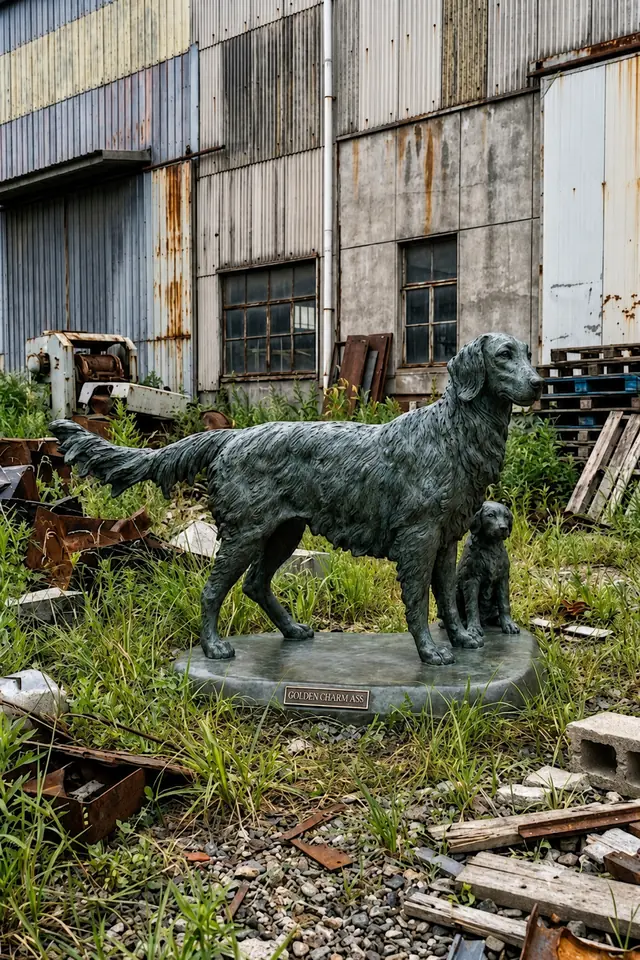
These are factory photographs supplied by Yun Sculpture. They show a dog-and-puppy composition in clay and bronze, plus a separate seated dog pair. They illustrate modelling, coat relief and surface treatment; they are not presented as verified portraits of the Golden Retriever concepts above.
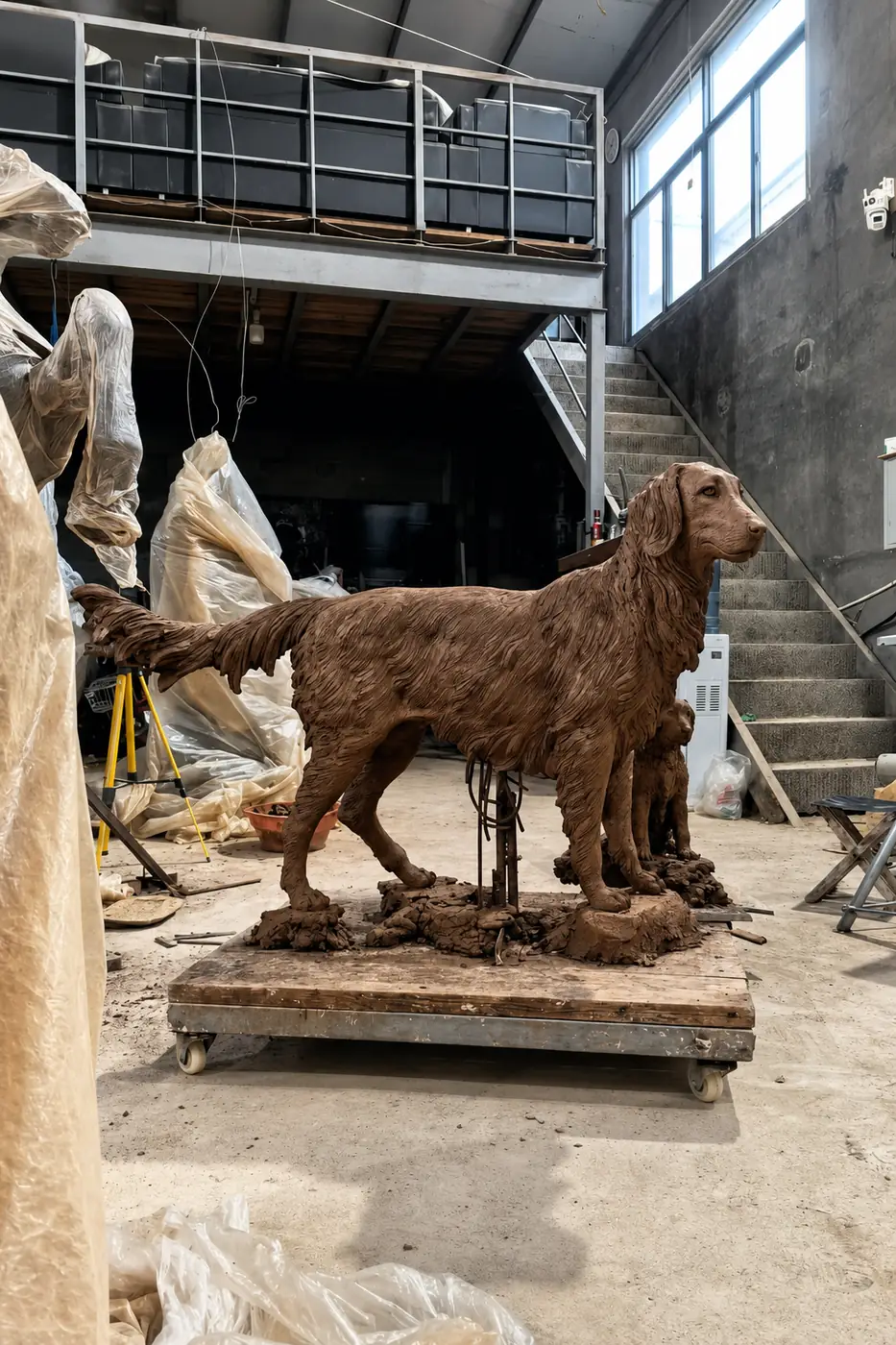
Clay modelling example
This dog-and-puppy composition shows physical modelling and coat relief. It is a workshop reference, not a Golden Retriever concept converted into a verified order.
Bronze and surface example
The bronze example shows another material stage and surface direction. A new Golden Retriever portrait uses its own model and finish agreement.
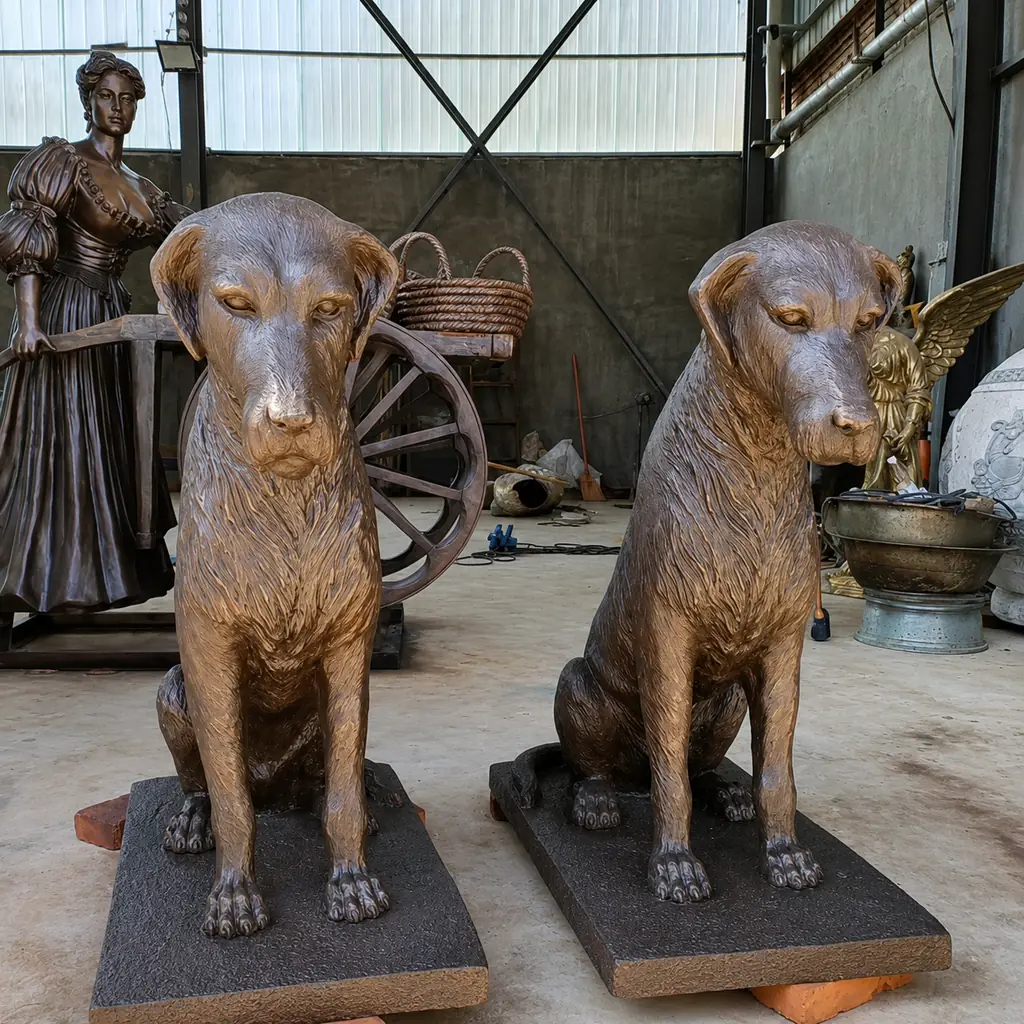
Seated pair workshop example
Compare the grouped coat treatment and warmer highlights as craft references. The individual breed and portrait for your commission are defined separately.
In your commission, the agreed review stage may use a digital model, a physical clay model or both. Confirm that stage in the quotation. Use it to review the Golden’s muzzle, ears, chest, leg feathering and tail before final material production.
The workshop examples do not establish a standard size, weight, inventory item or price. A new portrait or a welcome composition needs its own dimensions and scope.
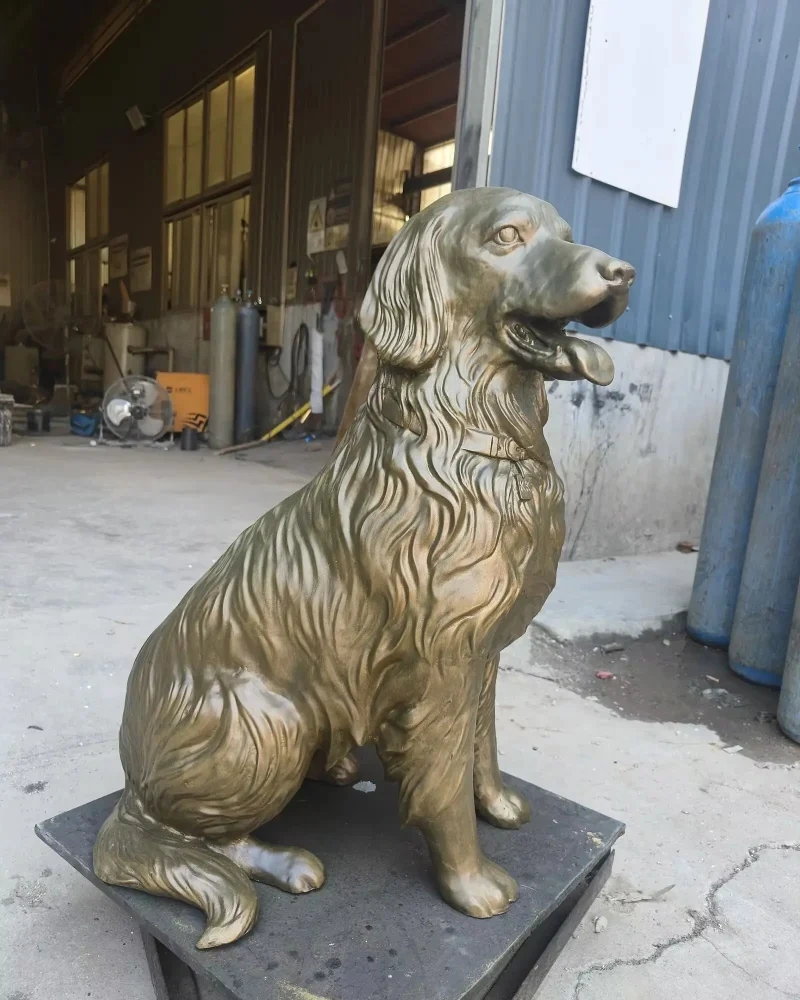
A finished long-coated workshop example
The long-coated seated dog shown here is another workshop design. Look at how the larger coat groups meet the face, chest and tail, and how the surface catches light. Those are useful questions for your Golden Retriever portrait, whose own ear, chest and tail feathering would be developed from the chosen references. This photograph does not establish a completed Golden Retriever commission.
Bring the design that starts the conversation
Turn your own AI design into a sculpture brief
You can send an AI-generated Golden Retriever image as a design reference. It can help explain a pose, coat treatment, material appearance or garden setting that is difficult to describe in words.
Identify what should be carried into the model
Mark the elements you want kept: head angle, relaxed mouth, standing body line, tail position or a particular base. If you want a portrait of your own dog, add real photographs and identify where the AI image differs from it.
One attractive image may not show the rear, underside or support connections. We develop those parts in the model and discuss material-specific adjustments. A bronze concept, carved stone figure and fabricated steel sculpture need different interpretations of projecting detail.
Review the form from consistent views
Compare the model with the agreed reference at a similar viewpoint. Check the head and ears, the coat silhouette, the body-to-leg proportions and the full tail. Then review the other views that the reference image does not reveal.
A visual-reproduction target is most useful when those features are defined. It does not replace your approval of a model, or the separate finish and inscription references.
Keep the finish and setting in their own review
An AI image may combine reflected greenery, dramatic lighting and metal colour. Tell us which surface appearance you want on the actual sculpture. The final garden and daylight will affect how the metal reads.
Confirm any changes needed to the base, ears, thin projections or plaque before approving the model. That gives the workshop a clear design to make and gives you a specific form to assess.
For a personal memorial, a name, dates or a short message can be developed with the base. An ashes compartment needs separate capacity, access and closure details. Our pet memorial statue guide covers those planning choices in more detail.
Questions before choosing
Golden Retriever statue questions
Can you sculpt my own Golden Retriever from photographs?
Yes. Identify the posture, expression and individual coat outline you want preserved. Photographs of the face, side and tail help us develop a model you can review before final production.
Can I send an AI design I have made myself?
Yes. Send the image and tell us which parts you want kept. We assess the selected material and develop the missing views and practical details in the model. Your own dog photographs remain useful if individual likeness is important.
Can you reproduce an AI design with over 90% similarity?
For suitable designs, that is our visual-reproduction target against an agreed reference. The achievable scope depends on the material and details. Confirm the pose, proportions, coat and base during model review, then approve the surface reference separately.
How do I avoid a Golden Retriever sculpture looking like a Labrador?
Review the coat distribution, dropped ears and full tail outline with your references. Adding a brown or golden finish to a generic short-coated figure does not establish the likeness. The head and individual body proportions matter too.
Can I choose standing, seated or lying down?
All three can be discussed. The selected pose changes the face height, body length and position of the coat and tail. Agree dimensions around that version instead of assuming a single breed-wide size.
Does a Golden Retriever welcome statue include a sign?
Only if agreed in the design. You can choose the dog alone, lettering on its base or a separately supported plaque. The welcome concept here shows a plain plaque direction, not a stocked sign with standard wording.
Is a golden-coloured sculpture made of gold or brass?
No material can be identified from colour alone. Golden Retriever is the breed name. The quotation confirms the actual bronze or other material, with the patina and surface treatment described separately.
Can the statue have a pale, reddish or darker appearance?
Send the surface reference you prefer. A metal patina and a living coat are different visual effects, so agree the intended finish separately from the likeness. Special colour treatments need project-specific confirmation.
Are the designs shown here in stock?
The gallery contains design concepts for custom discussion. The separate workshop photographs show examples of the craft. Neither establishes a stocked model, default size or current availability for your commission.
Can I commission a white marble or stainless steel Golden?
Yes, as a separately reviewed material direction. Marble requires an appropriate carving design and stone selection. Stainless steel uses a simplified abstract interpretation instead of detailed bronze hair texture.
What should I send for a quotation?
A preferred image or dog photographs, approximate size or display space and delivery country with postcode are a useful start. Add any plaque wording, material preference or target date when available. The model, finish, shipping and installation responsibilities are confirmed around the project.
Start with the Golden you want to see
Discuss your Golden Retriever statue
Send the design you like, your own AI idea or photographs of your Golden Retriever. A picture of the intended location will help us discuss the pose and scale.
You do not have to resolve every material and installation detail before making contact. Begin with the dog, image and place.
Details that help refine the proposal
- Individual portrait or general breed design.
- Pose, expression and coat reference.
- Material and preferred surface appearance.
- Available space, intended size and delivery location.
- Any welcome text, memorial inscription or target date.