Get in touch with Yun-Sculpture company
From German Shepherds to Beagles: A Breed-Specific Guide to Choosing the Perfect Outdoor Dog Statue

In serious landscape design, a dog statue is never a decorative afterthought. It is a quiet anchor within the spatial composition — a fixed point that shapes how visitors perceive the entrance, the pathway, and even the character of the estate itself.
Stone, bronze, and stainless steel hold presence differently from plants or furniture. A well-crafted canine sculpture becomes a psychological focal point. People slow down when they see it. They read intention into its posture. They feel watched, welcomed, or guarded depending on the breed depicted.
Cheap garden ornaments fail because they misunderstand this principle. Mass-produced resin dogs are caricatures. They do not carry weight — visually or structurally. A true outdoor sculpture must possess anatomical credibility, material integrity, and spatial authority.
Breed selection therefore becomes an architectural decision.
Different dogs embody different cultural archetypes:
- The German Shepherd represents discipline, vigilance, and protection.
- The Labrador suggests warmth and companionship.
- The Beagle evokes pastoral charm and curiosity.
- The Mastiff conveys power and territorial authority.
In high-end landscape projects, I choose the breed the same way an architect chooses stone. Form must reinforce function.
A guardian breed belongs at an entrance axis.
A companion breed belongs near seating gardens or pathways.
A hunting breed belongs in open lawns or countryside estates.
The sculpture is not only an image of a dog. It is a statement about the personality of the property.
Among all breeds used in monumental garden statuary, one stands above the rest when the goal is authority and vigilance.
The German Shepherd.
Table of Contents
Table of Contents
The German Shepherd: Capturing the Alert Sentinel in Stone and Bronze
Few dogs possess the architectural clarity of the German Shepherd. The breed was engineered for function — intelligence, discipline, and endurance. Those qualities translate beautifully into sculpture.
The silhouette alone communicates purpose.
A forward chest.
Strong shoulders.
Erect ears scanning the horizon.
In sculpture, these elements form a visual language of vigilance.
When executed correctly, the figure does not feel decorative. It feels stationed.

Why the German Shepherd garden decor is a favorite for estate entrances.
The German Shepherd carries a powerful cultural identity.
Originally developed in late 19th-century Germany for herding and protection, the breed quickly proved capable of far more demanding roles. Military patrol units adopted them. Police departments built entire K-9 programs around them. Search-and-rescue teams rely on their intelligence and discipline.
Generations of people now associate the breed with duty.
That symbolic weight matters in landscape architecture.
When a visitor approaches an estate gate and encounters a Life size shepherd statue, the subconscious message is immediate: this place is protected.
The sculpture becomes an Entrance guard.
Not aggressive.
Not theatrical.
Simply present.
A Large shepherd statue works particularly well in the following environments:
- Private estate entrances
- Security gatehouses
- Corporate campuses
- Luxury residential compounds
- Government or institutional buildings
In a Commercial landscape, the presence of a shepherd sculpture introduces order and vigilance without the harshness of fences or surveillance towers.
It communicates discipline while remaining elegant.
Spatial placement is critical.
For maximum psychological effect:
- Position the statue slightly offset from the entry axis, not directly blocking it.
- Elevate it on a low plinth (20–40 cm) to enhance visibility.
- Angle the head 5–10 degrees toward the approaching path.
This creates the impression of a dog monitoring arrivals.
The result is subtle but powerful.
The statue expresses Protective nature and loyal guardianship without appearing hostile.
A successful Guardian statue must always feel dignified rather than threatening.
Achieving anatomical accuracy in large-scale shepherd sculptures.
Many factories claim to produce German Shepherd statues.
Almost none understand the anatomy.
The breed belongs to what zoologists call a mesocephalic head structure — a balanced skull type positioned between the narrow dolichocephalic head of a greyhound and the broad brachycephalic skull of a bulldog.
This balance gives the shepherd its distinctive intelligence and alert expression.
If the skull proportions are wrong, the entire sculpture collapses visually.
Key anatomical requirements include:
Head Structure
- Moderate skull width
- Defined but not exaggerated stop
- Strong but tapered muzzle
Ear Geometry
- Strictly Erect ears
- Slight forward angle
- Triangular structure with thick cartilage
Eye Formation
- Almond-shaped eyes
- Slightly sloping upper eyelid
- Deep set within the brow ridge
These small details create the emotional signal of a Vigilant posture.
Without them, the dog looks sleepy or confused.
The body structure presents an even greater challenge.
A true shepherd has a characteristic topline slope, with powerful shoulders transitioning into a slightly lowered hindquarter. That structure supports explosive movement in working dogs.


To achieve 1:1 scale realism, the sculptor must understand the muscular architecture beneath the fur.
Critical muscle groups include:
- Deltoid shoulder mass
- Latissimus along the rib cage
- Quadriceps and hamstrings in the rear legs
- Defined scapula movement under the skin
Without this Anatomical precision, a statue becomes a cartoon.
You often see cheap imports where the legs resemble cylindrical sticks and the shoulders collapse inward. The animal loses its authority immediately.
Material engineering is equally important.
For permanent Outdoor sculpture, structural stability requires Solid casting techniques rather than thin shell production.
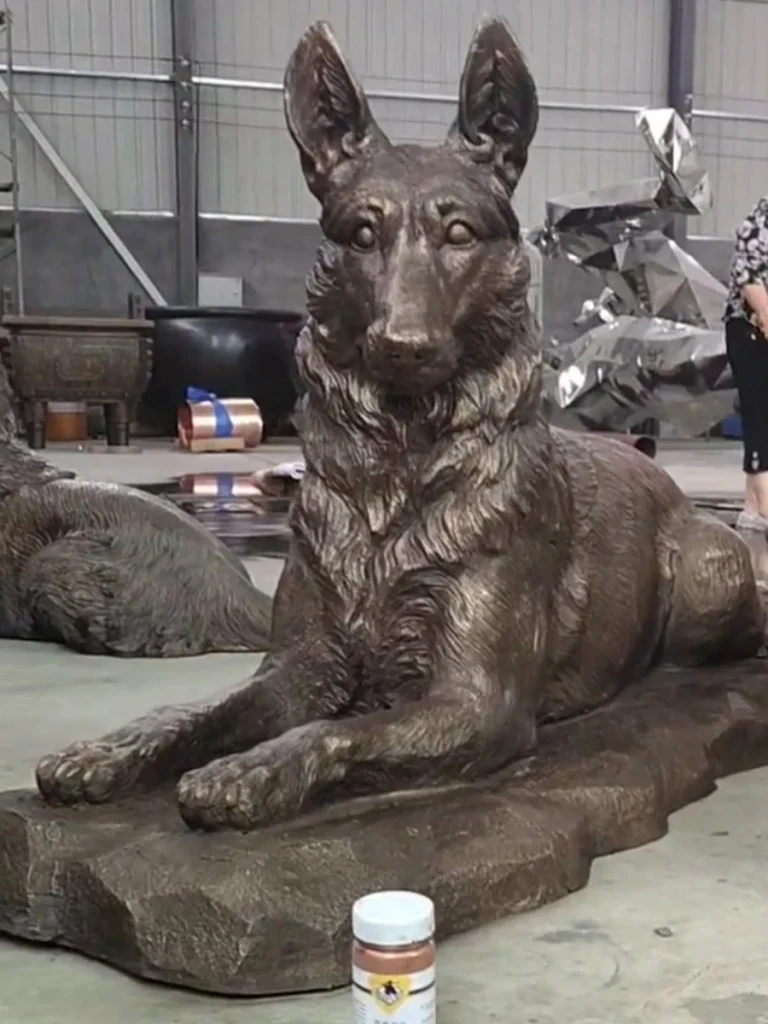
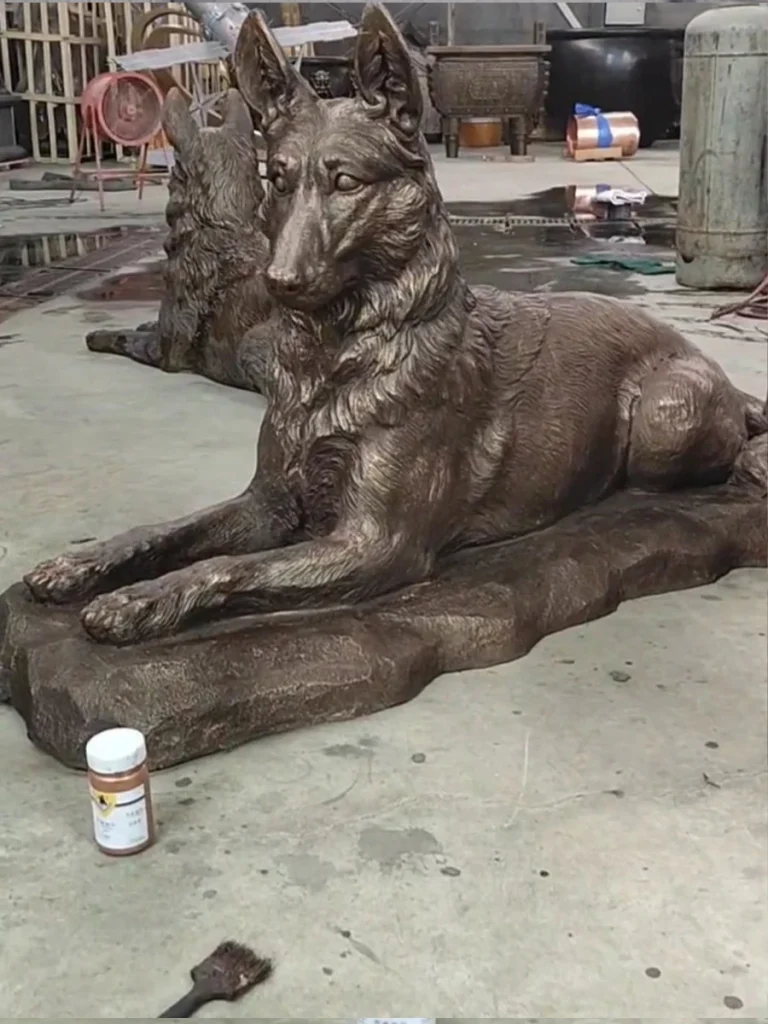

Professional installations typically use:
- Silicon bronze solid casting for museum-grade durability
- Thick stainless steel fabrication for contemporary landscapes
- Hand-carved granite or marble for classical estates
Technical specifications for a life-size shepherd statue often include:
- Height: 75–90 cm at shoulder
- Total length: 110–130 cm
- Weight (bronze): 180–350 kg
- Weight (stone): 400–900 kg
Mass matters.
A guardian statue must feel immovable.
Wind, accidental impact, or seasonal weather cannot compromise the structure.
The final detail — the posture.
A proper shepherd sculpture should never appear relaxed. The breed’s identity lies in readiness.
The ideal stance includes:
- Slight forward chest expansion
- Head raised just above the shoulder line
- Tail neutral, not curled
- Eyes focused forward
The result is an unmistakable Alert posture.
The sculpture does not bark.
It does not move.
Yet the moment someone approaches the gate, they feel watched.
That is the true power of a well-executed German Shepherd statue.
Small Breeds, Big Character: The Charm of Frenchie and Beagle Statues
Large guardian breeds command space. They anchor entrances and control visual authority.
Small breeds operate differently.
They create intimacy.
In refined landscape design, smaller dog sculptures serve as secondary focal points — subtle characters placed within pathways, courtyards, or garden rooms. Their role is not to guard territory but to animate the environment.
A properly chosen small-breed statue behaves like a living presence frozen in time.
Visitors discover it rather than confront it.
Among the most expressive breeds for this purpose are the French Bulldog and the Beagle. Each carries a completely different cultural identity.
One belongs to the city.
The other belongs to the countryside.
The rise of the French bulldog statue in modern pop-art decor.

Few dogs have achieved the cultural status of the French Bulldog.
In the last decade, the breed has transformed from companion animal into a symbol of urban lifestyle. Fashion houses feature them in campaigns. Designers sketch them in cafés. Penthouse owners treat them as mascots of metropolitan charm.
The Frenchie represents controlled indulgence.
Relaxed, humorous, but unmistakably stylish.
That personality translates naturally into sculpture. A Frenchie garden statue rarely appears formal. Instead, it radiates what I call sophisticated whimsy — a playful presence within disciplined modern design.
Anatomically, however, the breed is extremely difficult to sculpt correctly.
The French Bulldog belongs to the brachycephalic skull family, meaning the face is dramatically shortened compared to most dogs. This produces several critical structural features:
- Broad, rounded skull
- Short compressed muzzle
- Slightly undershot jaw
- Deep-set nose between facial folds
Most recognizable of all are the Bat ears.
These ears must stand vertically but flare outward slightly at the base. If they are too thin, they look fragile. If they are too wide, the dog appears cartoonish.
Achieving correct Proportional balance is therefore essential.
The breed’s body adds another layer of complexity. A Frenchie has a Compact frame, but it is muscular rather than delicate.
Correct sculptural proportions include:
- Broad chest relative to height
- Short but powerful forelegs
- Rounded rib cage
- Short tail integrated into the hind structure
When proportions fail, the statue resembles a toy rather than a dog.
The goal is solidity.
In contemporary design environments, the sculpture’s pose becomes part of the visual narrative. Popular poses include:
- A seated Frenchie with head tilted slightly upward
- A Playful pose with one paw raised
- A calm, meditative pose resembling a Zen guardian
Within modern landscapes, the statue acts as a Garden accent rather than a focal monument.
Placement strategies often include:
- Beside minimalist concrete benches
- Near reflecting pools
- At the corner of geometric gravel beds
- Along stepping-stone pathways
These compositions appear frequently in Curated gardens where every object is deliberately selected.
Material selection also differs from classical statuary.
While bronze and stone remain excellent choices, modern Frenchie sculptures frequently employ UV-resistant resin finished with metallic coatings.
This allows for contemporary finishes such as:
- Brushed chrome
- Matte black
- Champagne gold
- Mirror-polished metallics
Because French Bulldogs embody urban culture, these industrial finishes reinforce the aesthetic.
The result is playful, modern, and unmistakably sophisticated.
Capturing the “working scent” with a digging beagle garden statue.

If the French Bulldog belongs to the city, the Beagle belongs to open fields and quiet country roads.
The breed carries centuries of hunting heritage. Beagles were bred as scent hounds, working in packs to track rabbits and small game across rolling farmland.
Their posture reflects this purpose.
Head low.
Nose searching.
Tail signaling the pack.
That instinctive movement makes the Beagle uniquely suited for landscape storytelling.
A Beagle garden statue does not feel decorative. It feels like a moment from a living countryside scene.
The key anatomical feature is the famous “gay tail.”
In canine terminology, this means a tail carried upright with a gentle curve and a white tip. Hunters historically relied on that white tip to track their dogs through tall grass.
Without this detail, the sculpture loses authenticity.
Other important characteristics include:
- Long, soft ears that fall beside the muzzle
- Rounded skull with gentle brow
- Medium-length body balanced on sturdy legs
Unlike the upright discipline of a German Shepherd, the Beagle thrives in motion.
That is why the most compelling designs depict activity.
Three poses dominate successful installations:
• Digging beagle — front paws engaged with soil or gravel, nose forward in investigation
• Outdoor beagle statue standing alert with head lowered to scent the ground
• Sleeping beagle curled beside a garden path or under a bench
Among these, the Digging beagle creates the strongest interaction with the landscape.
Placed beside mossy pavers or garden edging, the statue appears to be uncovering hidden scents beneath the soil. The illusion adds life to otherwise static design elements.
These sculptures perform beautifully in environments such as:
- Cottage-style landscapes
- Rustic farmhouse gardens
- Herb gardens and vegetable beds
- Natural stone pathways
Within these settings, the sculpture functions as a charming Garden accent rather than a centerpiece.
Visitors often smile when they discover it.
Another reason Beagles appear frequently in sculpture commissions is emotional attachment. Many families associate the breed with childhood memories and loyal companionship.
For that reason, a Beagle statue for garden is often commissioned as a Pet memorial sculpture.
In such projects, accuracy becomes deeply personal.
Clients request precise details:
- Exact ear length
- Specific head tilt
- Unique markings carved into the coat texture
When executed properly, the sculpture becomes more than decoration.
It becomes remembrance.
A quiet presence within the garden — as if the dog simply stepped outside for a moment and chose to stay.
The Terrier Series: Celebrating Strength and Tenacity in Sculpture
Terriers bring a completely different energy to garden statuary.
Where shepherds represent vigilance and hounds evoke pastoral calm, terriers embody raw determination. Their compact bodies are built for work — digging, gripping, confronting prey many times their size.
In sculpture, this intensity becomes a powerful visual language.
Short legs.
Dense shoulders.
Forward stance.
Every line of the body communicates readiness.
A terrier statue does not merely decorate a garden. It radiates resolve. That character makes terrier sculptures particularly effective in contemporary residential landscapes and architectural courtyards where strength and personality must coexist.
Two breeds dominate this sculptural category:
The English Bull Terrier and the Staffordshire Bull Terrier.
Both share a Muscular build and fearless temperament, yet their anatomy and sculptural expression differ dramatically.
Choosing between an English bull terrier stone statue and a Staffordshire bull terrier bronze statue.
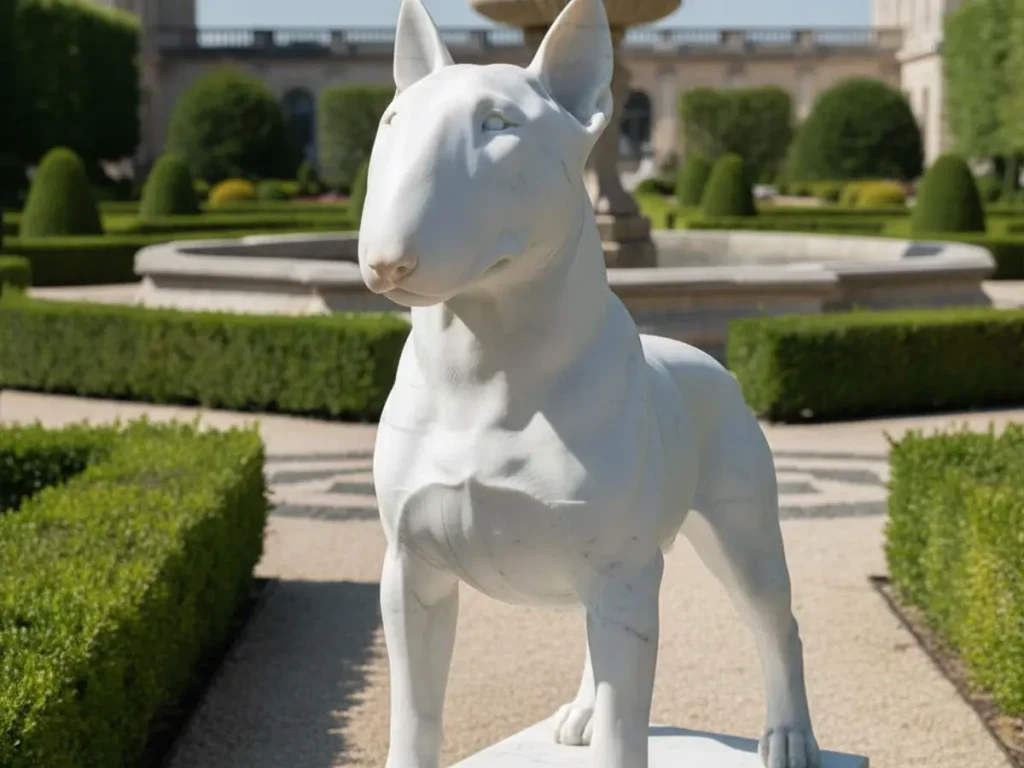
At first glance, these two breeds appear similar. Both belong to the bull-and-terrier lineage developed in 19th-century Britain.
Closer inspection reveals profound anatomical differences.
The English Bull Terrier is instantly recognizable by its extraordinary skull structure. The head forms a continuous convex curve from the top of the skull to the tip of the nose.
Breeders call this the “egg-shaped head.”
There is almost no visible stop between forehead and muzzle. The eyes sit deep within the skull, narrow and triangular, creating the breed’s distinctive focused expression.
Historically, the breed earned the nickname “The White Cavalier.”
This unusual head shape makes the English Bull Terrier one of the most difficult dogs to sculpt accurately. Even minor proportion errors disrupt the entire silhouette.
In contrast, the Staffordshire Bull Terrier possesses a broader, more traditional skull.
Key structural features include:
- Wide cheek muscles
- Short powerful muzzle
- Pronounced jaw structure
- Rounded skull with expressive eyes
When the dog relaxes, the mouth curves slightly upward. Enthusiasts call this the famous “Staffie smile.”
This difference in facial structure strongly influences material choice.
An English bull terrier stone statue often performs best when carved or cast in mineral-based materials. The smooth convex surfaces of the skull translate beautifully into Hand-cast stone, where subtle light reflections emphasize the purity of the shape.
High-quality production typically includes:
- Dense mineral aggregate casting
- Surface finishing to eliminate air pockets
- A Hand-dyed finish layered into the stone matrix
This technique creates natural color variations that resemble aged limestone or weathered marble.
The result feels classical and permanent.
A Staffordshire bull terrier bronze statue, however, benefits from a different sculptural approach. Bronze excels at capturing surface complexity.
The alloy records even the smallest sculptural detail — the tension in shoulder muscles, the subtle folds at the neck, the short fur lying across the rib cage.
This makes bronze ideal for expressing the Detailed musculature of the breed.
When executed properly, the casting preserves:
- Shoulder muscle separation
- Subtle rib contours
- Tight abdominal structure
- The compressed neck typical of terriers
Surface finishing techniques then enhance realism.
Bronze artists often chase the casting by hand to define Detailed fur texture, particularly around the chest and forelegs. Patina layers add tonal variation, bringing depth to the sculpture.
The visual effect is dynamic.
Light moves across the body, emphasizing strength beneath the skin.
The prestige of the large english bull terrier statue in curated gardens.

Despite their historical association with toughness, terriers possess a surprising emotional character.
Owners know them as deeply affectionate dogs — energetic, loyal, and intensely devoted to family life.
That combination of power and warmth gives terrier sculptures unique emotional gravity.
A large Bull terrier garden statue becomes an anchor within the landscape.
The breed’s Muscular build communicates strength, while its calm seated posture expresses confidence rather than aggression.
The symbolism resonates strongly in residential environments.
Visitors interpret the statue as a marker of stability — a guardian presence that feels dependable rather than intimidating.
The Tenacious spirit of terriers also aligns beautifully with architectural hardscape design.
Stone terraces, fire pits, and timber decks often require sculptural elements that can visually hold their own against strong materials like granite, concrete, and steel.
Terrier statues excel in this role.
Strategic placements include:
- Beside outdoor fire pits
- At the edge of stone patio steps
- Near built-in seating walls
- Adjacent to outdoor kitchen areas
In these environments, the sculpture achieves natural Hardscape integration.
The dense body mass visually balances heavy architectural materials.
The statue feels rooted to the ground rather than simply placed upon it.
A Staffordshire bull terrier garden statue performs particularly well in family-oriented spaces. Positioned near a deck entrance or garden pathway, it creates a welcoming yet grounded presence.
Children often treat the sculpture as if it were a real dog waiting patiently beside the house.
In more formal environments, a larger English bull terrier stone statue introduces quiet prestige. The purity of its silhouette contrasts beautifully with clipped hedges, geometric lawns, and structured planting beds typical of Curated gardens.
Unlike exaggerated decorative statues, the terrier maintains authenticity.
Its posture remains simple.
Solid stance.
Forward chest.
Calm gaze.
Nothing theatrical.
That restraint is precisely what gives the sculpture authority.
It stands there as a symbol of determination and loyalty — the kind of silent companion that belongs equally to a working yard or a sophisticated landscape estate.
Elegance in Motion: Greyhound and Spaniel Sculptures
Not every garden statue should feel heavy.
Some sculptures exist to introduce motion into still landscapes. They stretch the eye forward, creating visual flow along pathways and architectural axes.
This is where elegant breeds become invaluable.
Dogs such as Greyhounds and Spaniels bring refinement rather than power. Their anatomy emphasizes lines instead of mass. Their presence softens stone terraces, balancing rigid geometry with organic grace.
In sculpture, these breeds behave almost like calligraphy written in three dimensions.
Long curves.
Light frames.
Controlled movement.
When placed carefully, they guide the viewer’s gaze across the garden.
The aerodynamic beauty of the Greyhound garden statue.
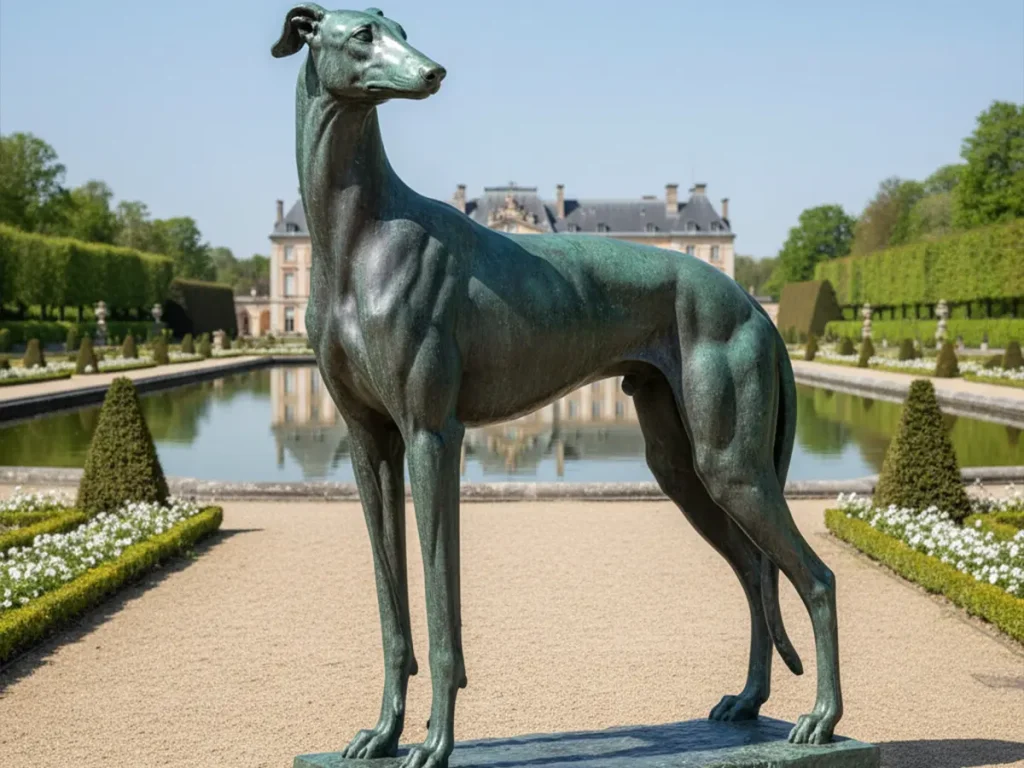
Among all canine forms, the Greyhound possesses perhaps the most sculpturally perfect anatomy.
It is also one of the oldest documented dog breeds in human history. Ancient Egyptian tomb carvings depict similar dogs hunting beside pharaohs over 4,000 years ago.
Centuries later, European aristocracy adopted the breed as a symbol of status and continuity. Greyhounds appear in medieval manuscripts, Tudor heraldry, and noble coats of arms.
The message was simple.
Speed.
Grace.
Nobility.
In modern design culture, that symbolism evolved again during the 1920s and 1930s. Art Deco designers admired the breed’s sweeping geometry. Its flowing body echoed the era’s fascination with streamlined trains, automobiles, and skyscrapers.
The result was a perfect union between canine anatomy and modern aesthetics.
From a sculptor’s perspective, the Greyhound belongs to the dolichocephalic skull family. This classification describes animals with long, narrow heads optimized for aerodynamic movement.
The anatomy includes several defining structures:
- Extended skull and narrow muzzle
- Deep thorax for massive lung capacity
- Extremely long limbs
- Flexible spine enabling explosive acceleration
Together these features create the unmistakable Slender silhouette of the breed.
Capturing that silhouette requires precision.
If the rib cage becomes too thick or the legs too short, the sculpture loses its elegance instantly. Every curve must follow the natural tension lines of a running athlete.
The most successful Greyhound garden statue designs emphasize posture rather than detail.
Popular sculptural poses include:
- A standing Greyhound gazing across a lawn
- A seated Greyhound with neck extended upward
- Two symmetrical hounds framing an entry axis
These compositions rely on the breed’s Aerodynamic lines.
The sculpture does not dominate the garden through weight. Instead, it directs the viewer’s gaze across space.
That quality makes a Greyhound outdoor sculpture ideal for:
- Long garden avenues
- Reflecting pools
- Architectural staircases
- Formal lawns and axial pathways
In such locations, the sculpture becomes a visual Focal point that anchors the geometry of the landscape.
Material choice reinforces this effect.
Many designers prefer bronze for Greyhound sculptures because the metal amplifies the breed’s flowing surfaces. A rich Bronze patina creates shifting highlights across the body as sunlight changes throughout the day.
When finished correctly, the patina becomes a Weather-resistant patina that deepens with age rather than deteriorating.
The result feels both classical and contemporary.
A Greyhound sculpture therefore operates as both aristocratic symbolism and Modern garden art.
Traditional elegance with Spaniel and Yorkshire terrier statues outdoor.
Not every elegant sculpture needs height or long limbs.
Some breeds express refinement through texture and intimacy rather than speed.
Spaniels and Yorkshire Terriers belong to this quieter tradition.
Historically, Spaniels were beloved companions of European nobility. Paintings from the Renaissance frequently depict them resting beside royal chairs or accompanying hunters in woodland scenes.
Their role was loyalty rather than aggression.
That gentle character appears clearly in sculpture.
A well-made Spaniel statue typically emphasizes relaxed posture. The dog may sit beside a doorway or lie calmly near a path, head slightly tilted as if listening to distant footsteps.
Yet sculpting a Spaniel presents a significant technical challenge.
Unlike short-coated breeds, Spaniels possess feathered fur around the ears, chest, and legs. Translating that texture into stone or bronze requires delicate modeling.
The sculptor must suggest soft hair without creating fragile projections that could break outdoors. Achieving this balance is essential for long-term Structural integrity.
Yorkshire Terriers introduce another layer of complexity.
The Yorkie is tiny, but its coat is famously long and silky. Reproducing that flowing hair at small scale requires extraordinary surface control.
That is why high-quality Yorkshire terrier garden statue designs avoid exaggerated detail. Instead, the sculptor uses gentle ridges and directional lines to imply the coat’s movement.
These statues are rarely monumental.

Instead, Yorkshire terrier statues outdoor function beautifully within intimate garden spaces such as:
- Courtyard herb gardens
- Balcony planters
- Window-adjacent flower beds
- Stone benches along narrow paths
Within these environments, the statue becomes refined Small garden decor.
Despite their modest scale, these sculptures often carry profound emotional meaning.
Many Yorkie owners view their dogs as family members. For that reason, a Yorkie sculpture is frequently commissioned as a Personalized pet figurine.
Clients may request exact coat patterns, ear angles, or facial expressions that mirror their real companion.
The result becomes something more permanent.
A Personalized memorial quietly placed within the garden where the dog once walked.
In these cases, sculpture moves beyond design.
It becomes memory.
Quietly, before concluding, I must address a matter of engineering discipline.
Outdoor sculptures survive decades only when owners respect material science.
Never use pressure washers on a Weather-resistant patina or Frost-proof concrete sculpture. High-pressure water forces moisture into microscopic pores. During winter freezing cycles, that trapped water expands and damages the surface.
Use only soft brushes and pH-neutral soap.
Rinse gently with a garden hose.
Preserving Structural integrity is not complicated, but neglect destroys even expensive artwork.
There is another mistake I encounter constantly when clients commission custom statues.
Smartphone cameras.
Wide-angle lenses distort proportions. They stretch the nose, enlarge the head, and compress the body — the classic “fish-eye” effect. When sculptors rely on such photos, the final statue inherits those distortions.
Always provide multiple photographs from different angles.
Front.
Side.
Rear.
Eye level.
Accurate references allow the sculptor to restore true anatomical proportions.
Remember this principle.
Physics and anatomy do not tolerate shortcuts.
Frequently Asked Questions About Outdoor Dog Statues
1. What is the difference between foundry bronze and cold cast bronze resin?
This is one of the most common technical confusions when buying a high-quality dog sculpture. Foundry bronze is real metal produced through traditional casting processes; it is extremely durable and can withstand wind, freezing temperatures, and decades of outdoor exposure. Over time it develops a natural patina, giving the sculpture the depth and character seen in museum pieces.
Cold cast bronze resin, by contrast, is a mixture of bronze powder and resin. It is lighter and more affordable, which makes it practical for decorative use. However, it does not match the structural durability of solid bronze and can be more sensitive to saltwater, chemicals, and harsh weather over long periods.
2. How much does a life-size custom dog sculpture cost, and how long does it take to make?
For a serious custom commission, both budget and timeline are important considerations. A high-end life-size bronze dog sculpture typically starts around $7,500 USD, though the price increases depending on size, complexity, and material selection.
The production process is also lengthy. From initial design and clay modeling to mold making, casting, finishing, and patination, the entire process may take up to 3–5 months. Much depends on the sculptor’s schedule and the complexity of the project.
3. How can I ensure the sculpture captures my dog’s personality, not just its appearance?
Accuracy comes from reference material. Provide the sculptor with multiple photos and short videos from different angles, including unusual viewpoints such as the underside of the jaw, the back of the paws, and the belly line. These details help the artist understand the dog’s skeletal structure and posture.
Equally important is the clay modeling stage. This is the final opportunity to adjust proportions and expression before casting begins. Once the sculpture enters the metal casting process, structural changes are extremely difficult or impossible to make.
4. Can a dog sculpture hold my pet’s ashes?
Yes, many custom sculptures can be designed to serve as a memorial. Traditional bronze sculptures are usually hollow cast, which reduces weight and prevents deformation during the casting process.
This hollow interior can accommodate all or part of a pet’s ashes if the artist designs a sealed compartment during fabrication. Resin sculptures can also include a dedicated chamber, but this must be discussed with the sculptor before production begins.
5. Where should a dog statue be placed in a garden?
Placement should never be random. In landscape design, sculptures are typically positioned at visual focal points.
Common locations include:
At the end of a pathway
In the center of a planting composition
Visible from a main window or terrace
Framing an entrance or garden gate
Scale also matters. A large German Shepherd statue works well as an entrance guardian, while smaller breeds such as French Bulldogs or Yorkshire Terriers are better suited to patios, courtyards, or intimate garden corners.
6. How should outdoor bronze or stone sculptures be maintained?
Outdoor sculptures require simple but consistent care. Every few months, gently clean the surface using mild soap and water with a soft brush.
For bronze pieces, many conservators recommend applying a specialized bronze wax once per year to protect the surface patina. Avoid aggressive cleaning methods.
Never use:
Pressure washers
Acidic cleaners
Harsh chemical solvents
These can damage stone surfaces or destroy the protective patina on metal sculptures.
7. How can I distinguish between a Bull Terrier, a Staffordshire Bull Terrier, and an American Staffordshire Terrier in sculpture?
These breeds are often confused because they share a similar heritage. However, their physical characteristics differ noticeably.
Bull Terrier – known for its distinctive egg-shaped head and Roman nose profile.
Staffordshire Bull Terrier (Staffy) – has a wider skull, pronounced cheek muscles, and the famous “Staffy smile.”
American Staffordshire Terrier (AmStaff) – generally taller and more athletic than the Staffy, with a broader chest and longer legs.
A skilled sculptor emphasizes these anatomical distinctions to maintain breedaccuracy.
8. Why are marble or stone sculptures more expensive than aluminum or resin versions?
The difference lies in both material value and craftsmanship. Natural stone and cast stone sculptures possess significant weight and permanence, allowing them to integrate naturally into outdoor landscapes as if they were part of the environment.
Materials like cast aluminum are corrosion-resistant and lighter, but they lack the grounded visual presence of stone. The higher cost of stone sculptures reflects both the raw material loss during carving and the extensive labor required by experienced artisans.
9. Does the weight of a sculpture affect shipping and installation?
Yes, weight plays a major role in logistics and installation planning.
For example:
A life-size bronze Labrador statue may require two strong adults to move safely.
A resin version of the same sculpture can usually be carried by one person.
Large solid stone statues weighing 80 kg (175 lbs) or more often require palletized freight shipping and may need cranes or professional installers for placement.
These considerations are important when integrating sculptures into hardscape environments.
10. How should outdoor lighting be designed for a dog statue?
Lighting dramatically enhances the presence of a sculpture at night. The most effective technique is soft uplighting, where low-intensity lights are placed at ground level and directed upward toward the sculpture.
This approach highlights surface textures such as bronze fur details or stone carving marks while creating gentle shadows that emphasize form. Avoid harsh spotlights or direct overhead lighting, as excessive brightness can flatten the sculpture’s natural depth and reduce its visual impact.