Get in touch with Yun-Sculpture company
A familiar hound. A considered silhouette.
Custom Greyhound Statues in Bronze
Bring a Greyhound’s long lines into your garden, entrance or home. Choose a seated figure, a standing profile or a resting companion, then develop the particular dog and proportions you want represented.
Our bronze concepts explore the slender head, folded ears and flowing body outline. An Italian Greyhound portrait begins with its own reference; marble and abstract stainless steel offer different interpretations of the form.
Share your idea on WhatsApp ↗Start with a favourite design or a photograph of your hound. Tell us whether the reference is a Greyhound, Italian Greyhound or another individual dog.
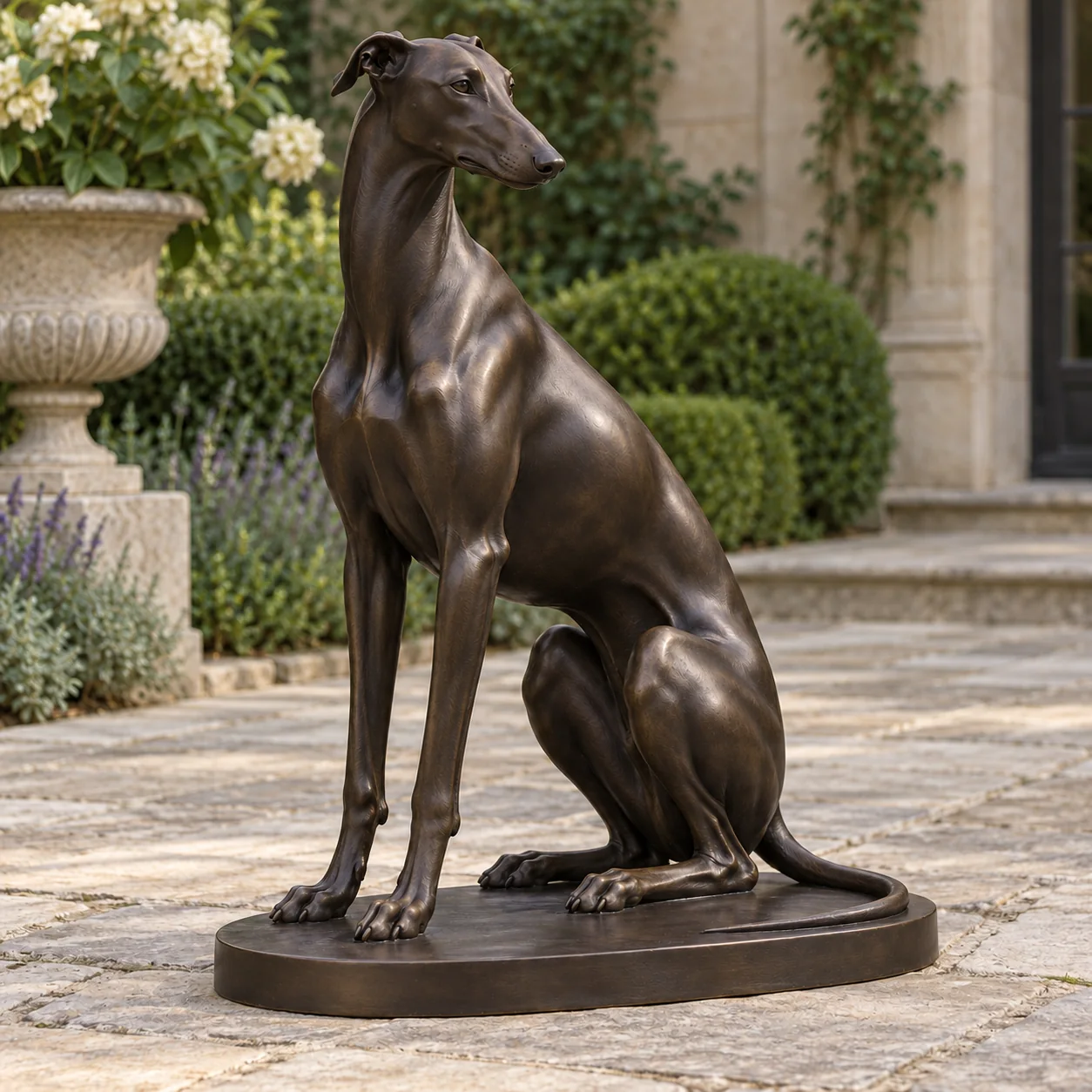
Distinct Greyhound and Italian Greyhound referencesLong lines reviewed from more than one angleNew commissions with an agreed surface
Find the line you want to keep
Greyhound sculpture design directions
The gallery includes a standing body profile, quieter resting forms and a finer-boned Italian Greyhound direction. Choose the composition that appeals to you before deciding its size and setting.
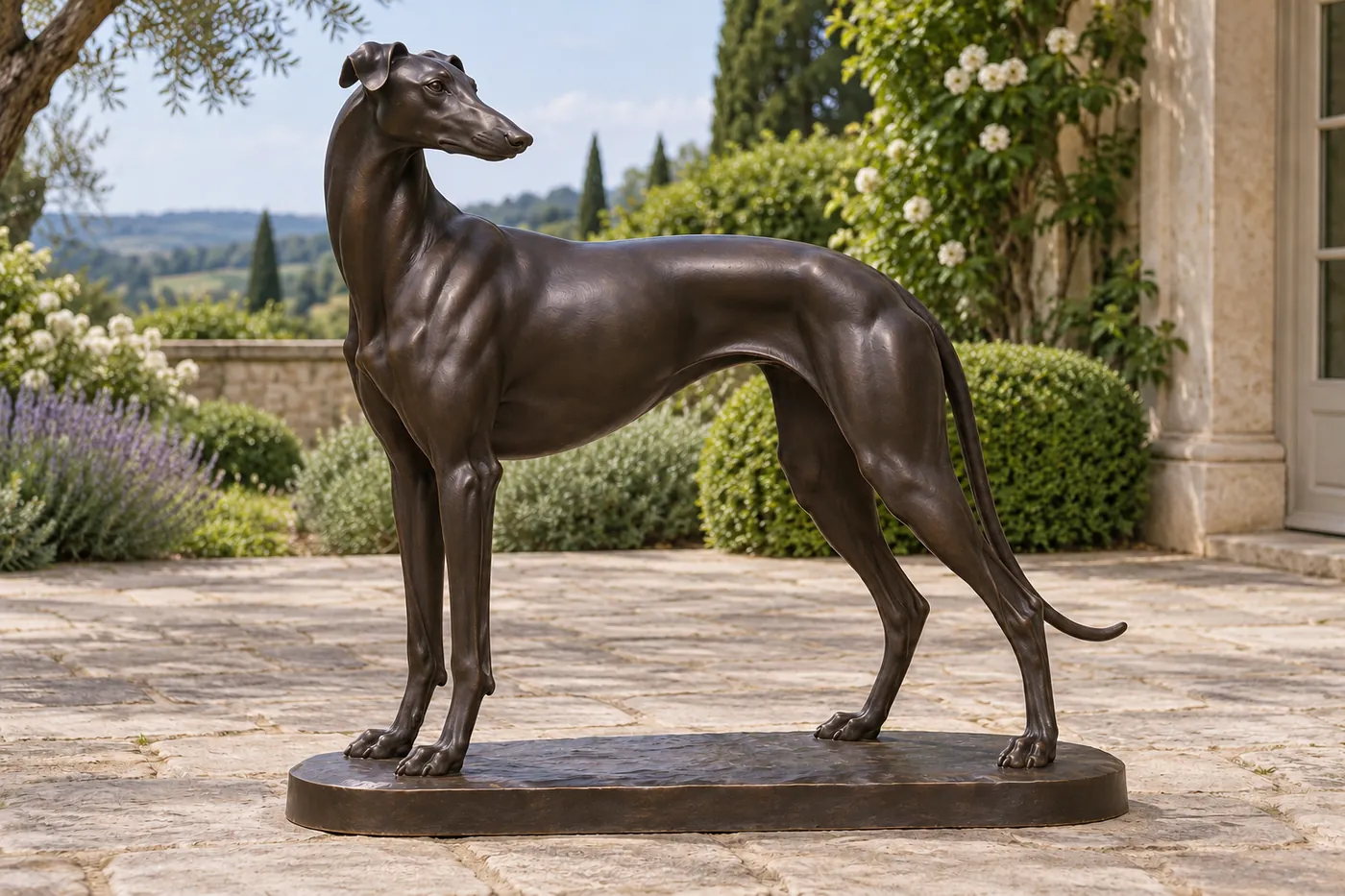
Standing bronze Greyhound
The side profile shows the underside and leg openings. Agree the head turn and the complete nose-to-tail boundary for the intended approach.
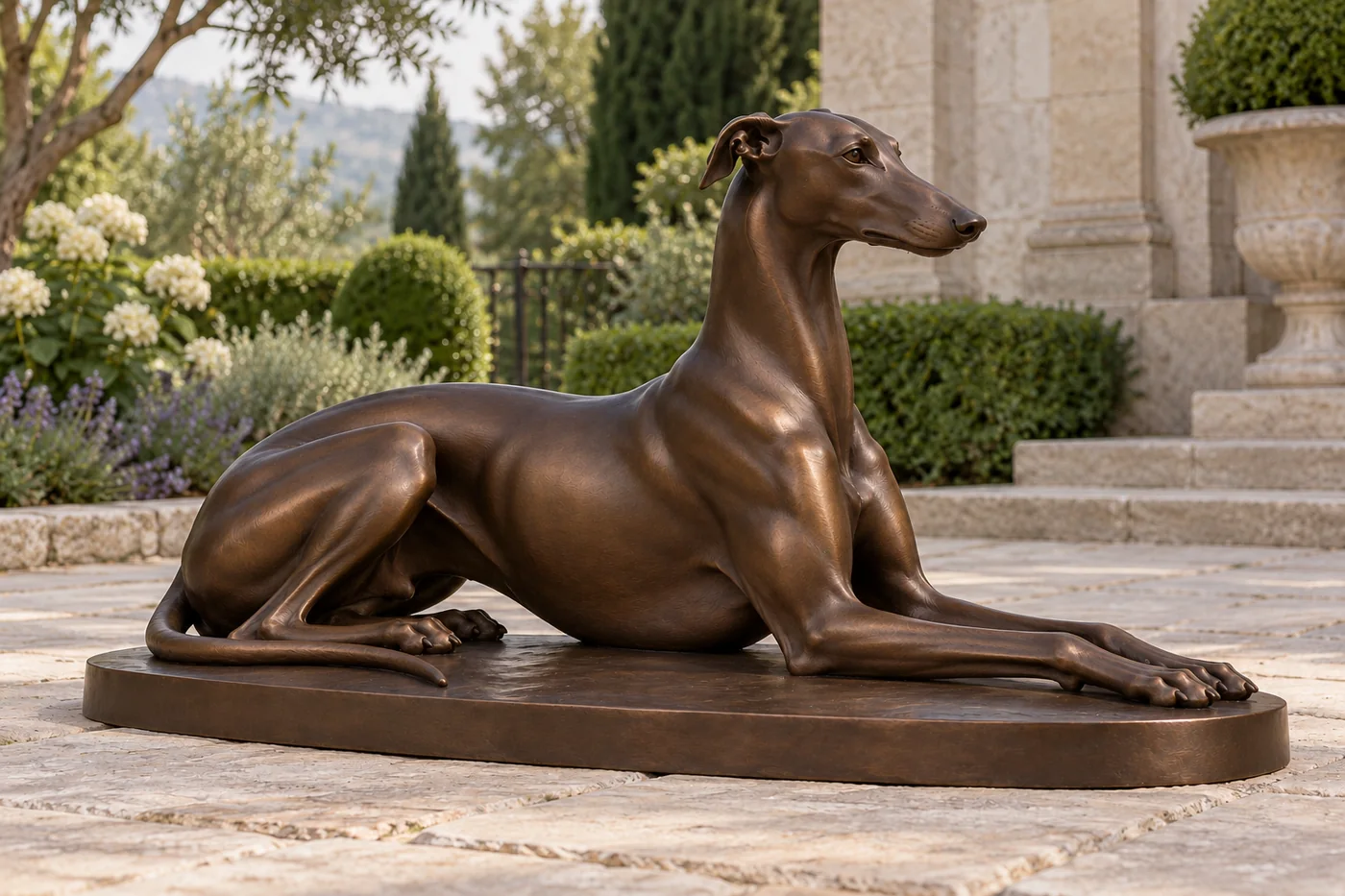
Resting bronze Greyhound
The lower composition focuses on the face above the paws. Its resting layout needs the full foreleg and tail allowance.
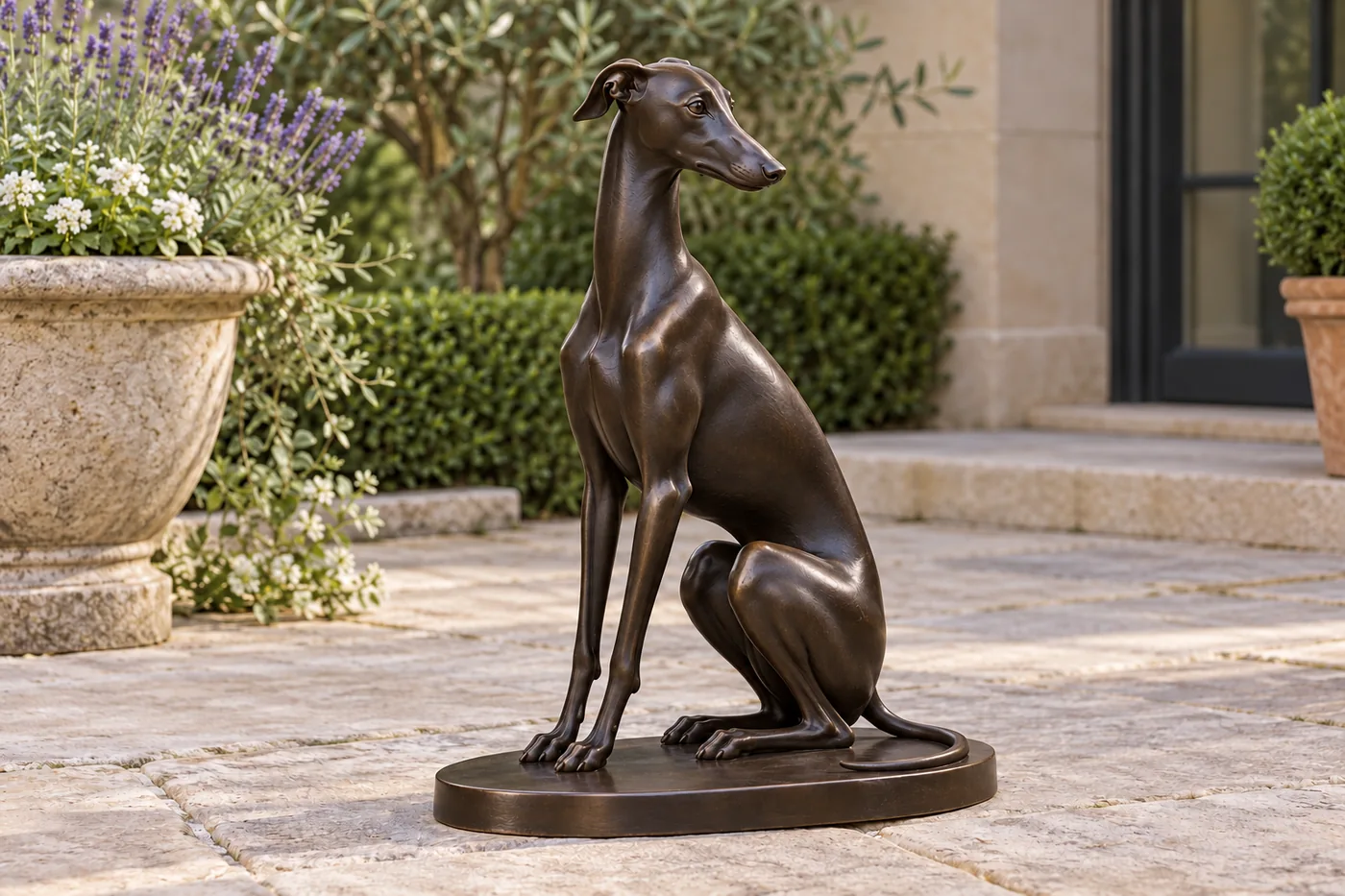
Italian Greyhound portrait
A separate finer-boned reference. Develop the individual proportions and its own dimensions rather than using the larger hound's life-size specification.
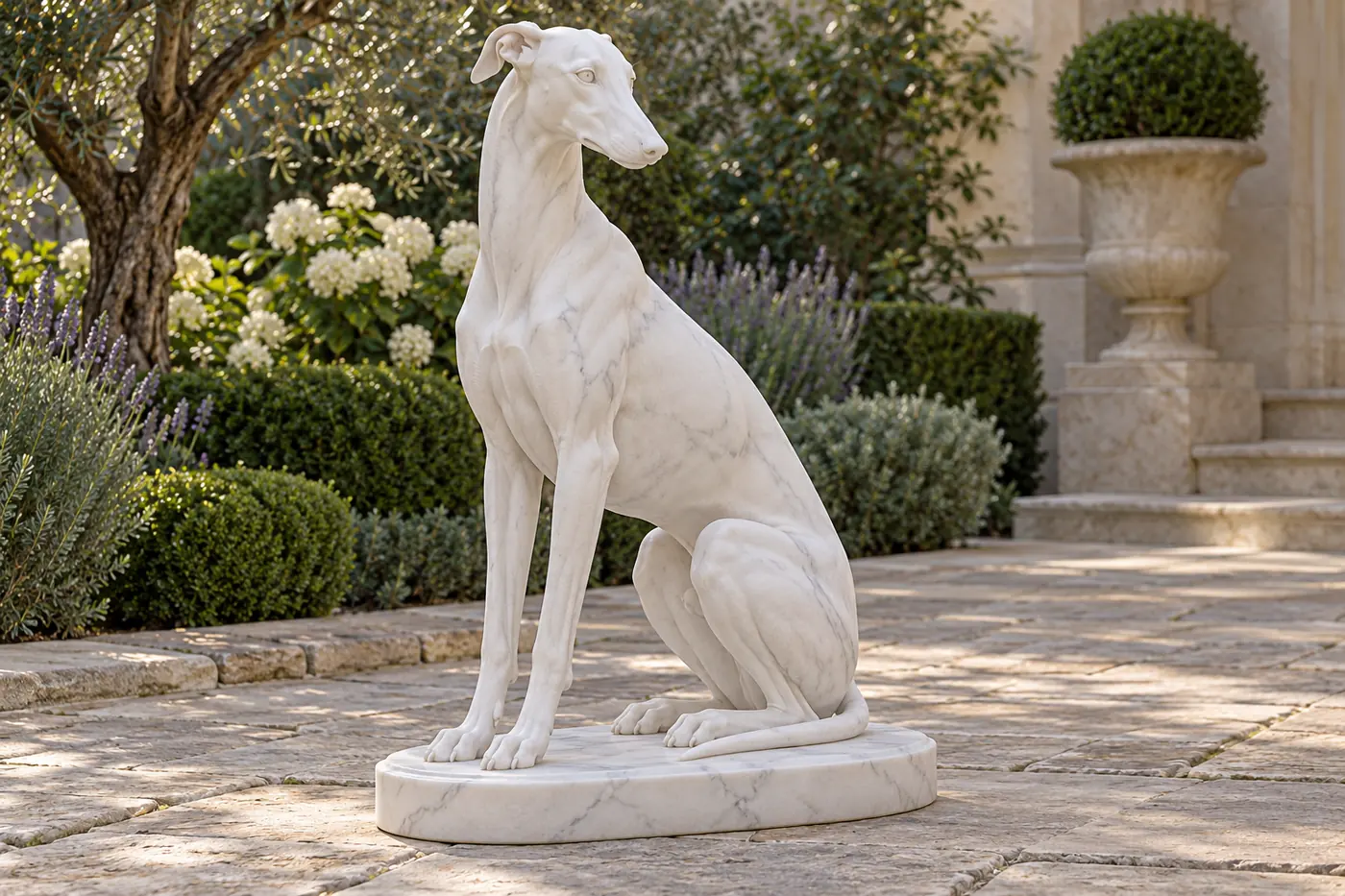
White marble Greyhound
A quiet carved interpretation with folded ears close to the head. Review the slender neck, long legs and supported tail for the selected stone.
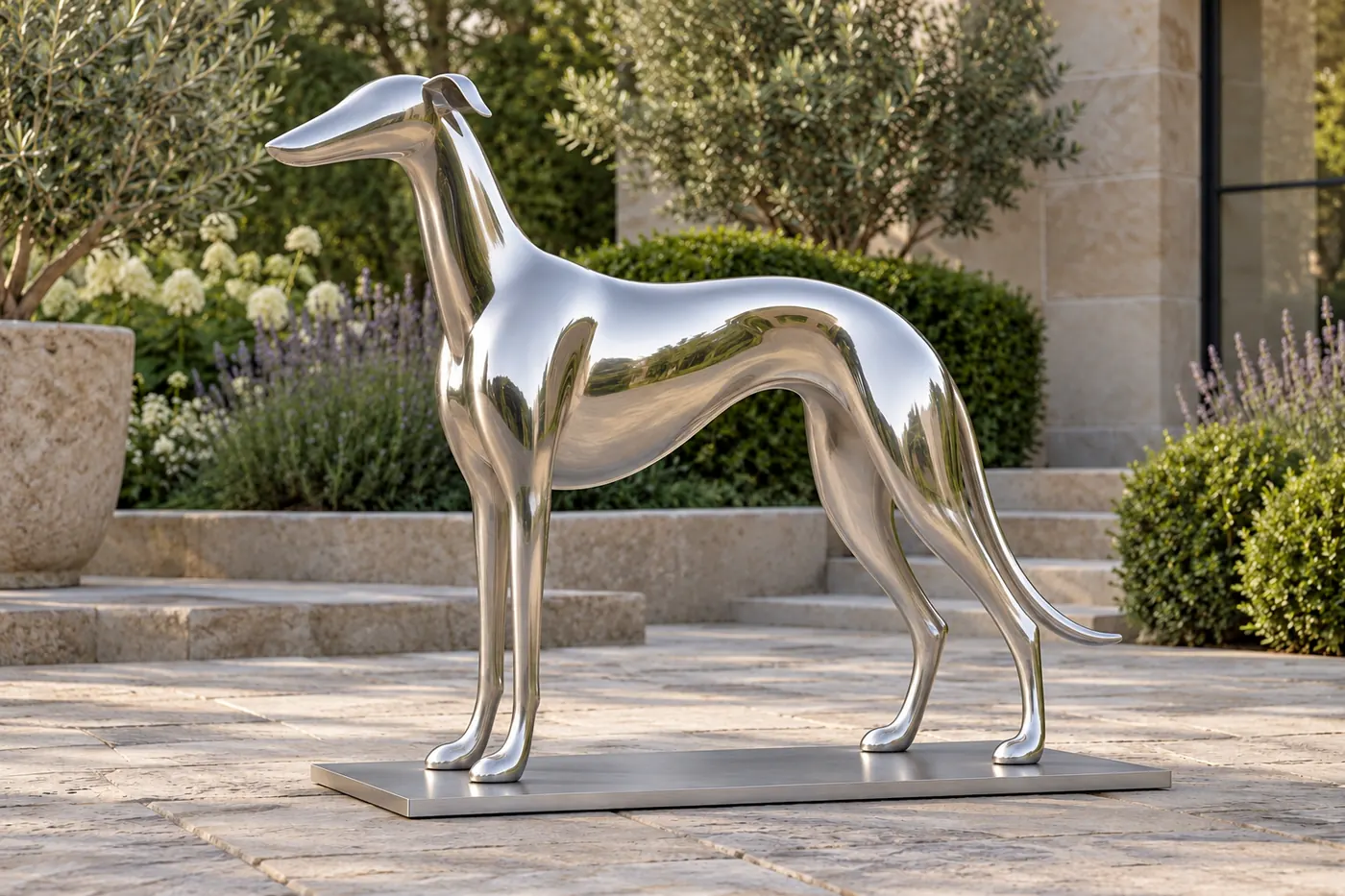
Abstract steel Greyhound
A broad-surface interpretation of the long body and tucked underside. Its simplified fabricated design has its own metal and finish specification.
AI designs by Yun Sculpture, available as starting points for a commission. You may send your own AI design. We aim for more than 90% visual reproduction on suitable references, subject to material adaptations and the model you approve.
For a portrait of your own dog, use these ideas alongside photographs rather than replacing the individual reference. Our personalized dog sculpture guide explains the wider portrait brief.
A similar outline is not the same reference
Greyhound or Italian Greyhound: establish the dog first
Both names appear in sculpture searches, sometimes beside images of other sighthounds. For a custom piece, identify the intended dog explicitly. A decorative figure described simply as a hound is a different brief from an individual Greyhound or Italian Greyhound portrait.
| Your intended sculpture | What to provide | What should be agreed first |
|---|---|---|
| Greyhound | A named breed reference, or photographs of the particular Greyhound. | The head, body and pose to model, including the stronger rear-body form you want retained. |
| Italian Greyhound | Italian Greyhound photographs and its own intended dimensions. | A separate fine-boned interpretation; its life-size reference is not the Greyhound’s. |
| Stylised or individual sighthound | Your own dog or an original design, with the important features identified. | Whether likeness or an expressive decorative outline is the priority, without silently assigning another breed name. |
Choose the reference before the height
The AKC Italian Greyhound standard describes a much smaller, more slender dog than the Greyhound. This is a useful starting distinction, but an individual portrait is guided by that dog’s photographs.
Resizing a generic model does not establish an individual Italian Greyhound likeness. Its head-to-body relationship, fine limbs and familiar posture still need their own review. Equally, enlarging a small decorative hound does not automatically produce a life-size Greyhound.
If your favourite reference has no reliable breed identification, send it as an appearance reference. Add a photograph of the actual dog or name the intended breed so the modeller knows what the image contributes and what should change.
A name can mean a breed, a style or a particular pet
Explain whether you want the familiar breed outline, an individual companion or a classical decorative hound. A more stylised design can intentionally simplify the body; a portrait should preserve the features that make your dog recognisable.
If your dog is a Whippet, a mixed sighthound or another breed, say so rather than accepting the closest catalogue label. We can discuss its own reference without presenting it as the Greyhound model on this page.
Look at the spaces as well as the surfaces
The long head, chest curve and open space beneath the body
The AKC Greyhound standard supports the long narrow head, folded ears, deep chest, raised abdominal line and tapering tail. For sculpture, those features need to work together in the whole outline rather than as separate decorative details.
Follow the head into the neck
Look for a continuous relationship between the muzzle, skull and curved neck. A head that is too broad can interrupt the slender impression; a nose made too pointed can lose the character of the particular dog.
The small folded ears belong to the expression. Compare how they sit from the side and how much they project in a front view. Adding tall upright ears because they look dramatic would create a different reference.
A turned head exposes one cheek and changes the visible length of the neck. Choose that turn for the portrait or composition, then check the adjoining forms. Do not approve a face close-up while leaving its connection to the neck unseen.
Read the chest and abdomen as a curve
In a standing profile, follow the underside from the chest toward the rear. The open space beneath it is an important part of the design. Filling that area visually with an oversized chest, heavy support or unrelated texture changes the impression.
The rear thighs contribute strength to a Greyhound’s otherwise slender outline. Avoid describing every slim hound as delicate in exactly the same way. Use your reference to decide how much muscle and fullness belongs to this dog.
Inspect the front legs, rear legs and the gaps between them from a three-quarter view. A convincing side silhouette can still look crowded when the legs overlap from the approach.
Surface detail should support the line
On a short-coated hound, a smooth shoulder and a restrained thigh transition can communicate more than many engraved hair marks. Describe the degree of modelling you like: quiet broad forms, subtle anatomical transitions or a more expressive interpretation.
If ribs or other individual contours matter to a portrait, identify them from photographs. Exaggerating every depression can change the dog into a different condition or a dramatic anatomical study that you never requested.
For wider comparisons among breeds, see our outdoor dog sculpture guide. This page keeps the selection centred on the long sighthound outline.
Posture changes which lines you see
Standing, sitting or reclining Greyhound statues
A standing hound presents the full chest-to-abdomen curve. A seated figure gathers the rear body and raises the neck. A reclining dog lowers the composition and brings the extended forelegs into view. Pick the moment that suits your connection to the dog and the intended viewing position.
| Direction | Useful view to check | Space that can be missed |
|---|---|---|
| Standing | Side and three-quarter views reveal the long body, leg separation and underside. | The head and tail extend beyond the main torso; a narrow front view hides the length. |
| Sitting | Front and angled views show the neck, chest and gathered rear quarters. | The rear body and tail still require room around the support. |
| Reclining | A lower three-quarter view shows the face above the paws and resting body. | Extended paws and the tail can make a low figure a long one. |
| A coordinated pair | A shared view of both complete figures shows whether their long axes fit the setting. | Two noses, tails and bases need their own boundaries; the gap between the figures is separate. |
A sitting Greyhound is not a standing model folded down
The rear joints, gathered thighs and chest position change when the dog sits. Review an actual seated reference instead of asking for the legs of a standing render simply to be shortened.
A graceful long neck can be the focus of this pose, but its curve should belong to the head angle you choose. Show the modeller whether your dog sits upright, leans slightly or holds a familiar asymmetrical posture.
For an Italian Greyhound sitting statue, the fine limbs and rear body need the same attention to the chosen individual. A pose label is useful for browsing; it is not a complete model specification.
A resting dog can still have a strong presence
A reclining design places less emphasis on the standing abdominal curve and more on the head, forelegs and gathered body. It may feel appropriate near a favourite seat or quiet part of a garden.
Choose whether the head is raised, lowered or turned from a useful reference. A raised head reads differently from a dog asleep with its muzzle near the paws. Do not rely on the word resting to make that choice.
A running or lifted-paw composition is another custom discussion. It changes the support arrangement and needs its own model and construction review; the calm four-foot concepts do not establish how that alternative would be made.
Keep the silhouette legible in its setting
Choose a background and approach for the slender form
A Greyhound can look very different when you move from its side to directly in front. The body becomes narrower, legs overlap and the chest-to-abdomen opening may disappear. Position the model in relation to the view that matters most, not only the wall it will stand beside.
Test the view from where people will actually look
Take a photograph from the entrance, window, bench or path where the sculpture will usually be seen. Add another from closer to the intended position. These explain whether the composition needs to work as a distant silhouette or a close companion.
If the side outline is the attraction, keep enough angle to see it. If the face matters most, a seated or gently turned head may suit that view better. There is no single orientation that preserves every detail from every position.
For a pair, check whether the long profiles disappear when both noses point straight toward the approach. A shared angled view may explain the figures better. For fuller site planning, use the front-porch guide’s paired-placement checks.
The gaps around the legs are part of the composition
Dense plants, railings or patterned paving can compete with the thin legs and the open area beneath the body. Compare that background with a quieter one before increasing the figure’s size or exaggerating its anatomy.
A dark bronze hound against deep shade may read mostly as its outside edge. Against lighter paving, the lower outline and leg spaces can become clearer. A reflective steel interpretation changes with what appears in its surface, so review it separately.
The sculpture’s support also contributes to the scene. A taller or wider pedestal may help the display, but it changes the relationship to the viewer and planting. Consider the figure and support together.
Preserve the route beside the sculpture
Trace the complete nose-to-tail boundary at the intended orientation. The body may sit comfortably along a wall while a curved tail or turned muzzle extends into the route beside it.
For porch planning, use our front-porch dog statue guide. The site check should include the support, door or gate movement and the actual route people use, rather than only the apparent width of the slim dog.
Scale the selected dog, not the catalogue label
Define life size and review a reduced Greyhound model
A life size Greyhound statue needs a named reference and an agreed pose. An Italian Greyhound uses its own reference. A decorative hound can instead be made to a selected overall size without claiming that it matches a live dog’s dimensions.
| Part of the brief | Record this | What it resolves |
|---|---|---|
| Dog or design reference | Greyhound, Italian Greyhound or the individual portrait, with the selected posture. | What life size refers to and which proportions are being preserved. |
| Complete figure | Maximum height, nose-to-tail length and outside width from the actual model. | Whether the muzzle, paws or curved tail extend beyond the apparent body outline. |
| Integral support | Base length, width and height, including any projection around the feet. | The separate footprint of the support rather than just the dog. |
| Display support | A separate plinth’s dimensions and the combined installed height. | The final viewing level and arrangement at the chosen position. |
| A reduced version | Its new overall dimensions and any proposed changes to fine features. | Which details remain readable and which require a different modelling or support approach. |
Do not carry standing measurements into another pose
The shoulder height of a live standing hound is not the top of a seated sculpture’s head. Likewise, a body-length measurement does not include a stretched front paw or the furthest point of a tail.
Use an outline drawing or labelled model view for the version you are considering. If the posture changes, update those dimensions rather than retaining the earlier measurements because the breed name is unchanged.
Where two pieces are planned, list the dimensions of each figure and base. The full arrangement is a separate site decision, especially if the two hounds have different head turns or resting positions.
Reducing the whole model can change the reading of fine details
A long slim muzzle, a folded ear and a fine tail become smaller together when a model is reduced. Ask to review the actual smaller version, including any revised thickness or connection that suits the material.
Keeping the outline familiar does not require keeping every small groove at exactly the same relative scale. Decide which features carry the likeness and which can simplify. A miniature-looking render alone cannot confirm the finished object’s fine detail or support.
If a small Italian Greyhound sculpture is intended for close viewing, say so. If a larger decorative version will be seen across a courtyard, that is a different display brief. Neither needs to be described as the other’s life-size model.
Carry the silhouette into the chosen material
Bronze, marble or a simplified steel interpretation
Cast bronze
Develop the individual form for lost-wax casting, then agree the metal specification and patina. A restrained surface suits the long head and short coat. Bronze and brass names need an actual alloy agreement; brown colour alone is not that specification.
For fuller care guidance, use our bronze sculpture maintenance page.
Natural marble
Review the slender neck, long legs and tail as a carving. Their connections and the support require a stone-appropriate model. Our concept has white carved eyes and nose, with folded ears close to the head.
Confirm the selected stone and visible veining around the face before production.
Abstract stainless steel
The steel concept translates the profile into broad smooth curves and plain feet. It follows a separate fabricated design instead of reproducing every bronze detail.
Specify the metal and reflective finish through our stainless steel sculpture options.
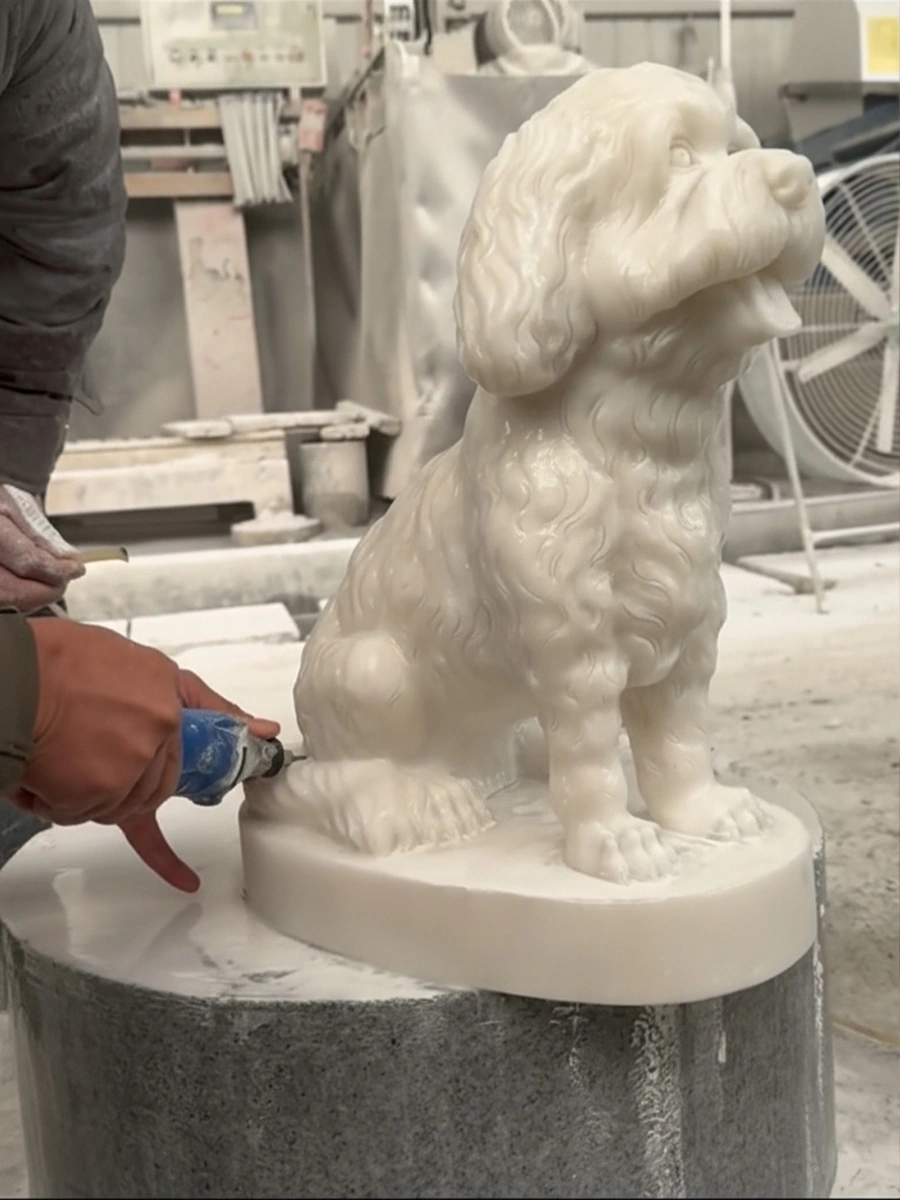
Stone carving shown during tool work
Hands, a tool and the stone surface are visible in this photograph of a separate dog carving. It adds real processing evidence to the marble discussion. A Greyhound has different slender limbs, ears and tail relationships; the carving and support for that outline would be reviewed on its own model.
A surface choice, with a clear description
An antique finish is different from an antique Greyhound sculpture
Our concepts are new design directions for custom production. A dark antique-style patina describes the intended surface; it does not establish age, historical origin or provenance.
Use a finish image to describe the effect
Identify whether you like a deep brown surface, warmer high points or a smoother sheen. A dark recess and a softly lit raised plane can bring out a long neck without covering it in strong streaks.
If an older sculpture is your style reference, explain what appeals to you: its pose, degree of simplification, base shape or colour. That does not turn the new commission into an antique or give it the history of the reference.
Keep historical claims out of a new commission brief
A maker’s signature, edition, date or ownership history belongs to the documented object carrying it. We do not add another artist’s marks or sell a newly made hound with an invented origin.
If your interest is an existing collectible, its age and attribution need separate evidence from the seller. This page offers a new sculpture with an agreed appearance, not antique authentication, restoration or an investment forecast.
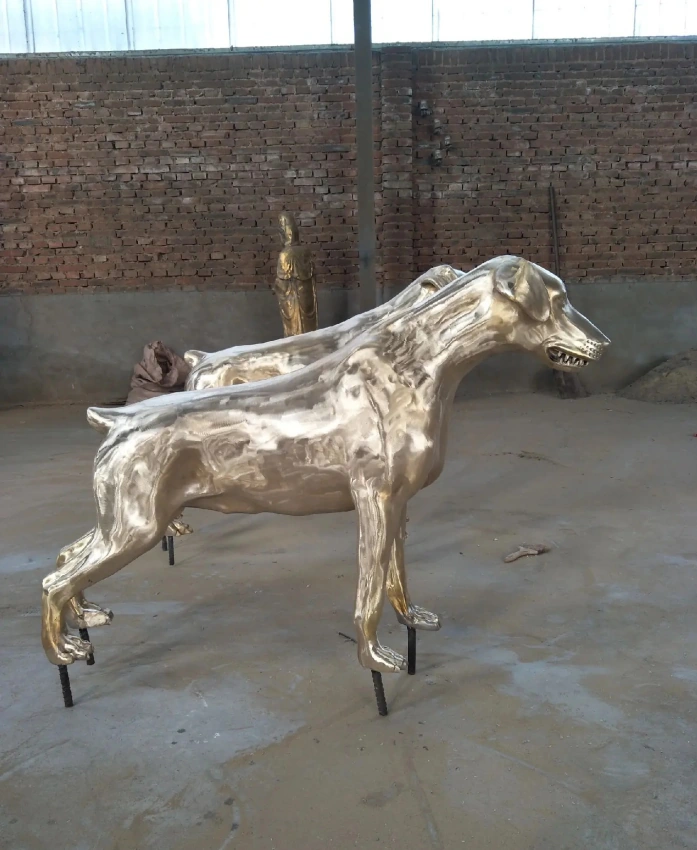
A reflective metal surface in the workshop
The side view makes a reflective metal surface visible on another standing dog design. Use it to describe the amount of reflection you like while keeping the Greyhound outline as a separate model decision. The warm appearance does not by itself identify an alloy or patina, and it does not establish an antique object.
Review the model as the dog you know
Build a Greyhound portrait around the reference and chosen view
For an individual companion, include a complete side photograph, the face from more than one angle and the posture you want represented. A close face image cannot establish the length of the back, the gathered rear legs or the full tail.
Choose a consistent moment in the dog’s life
A fit racing-period photograph and a later relaxed portrait may show different body fullness and posture. Identify the period you want remembered rather than combining the leanest body in one image with a face from another without explanation.
For a retired companion, the familiar resting pose may be more important than a generic athletic stance. Name that priority. If a feature varies between photographs, identify the one you want preserved instead of asking the modeller to average the images.
Give each review image one job
Use the side view to judge the head-to-neck line, chest curve and tail. Use the front or rear to assess the narrow body and leg spacing. Use the intended approach view to decide whether those features remain legible in the display.
When a change affects the loin, thigh or leg position, review the neighbouring area as well. A correction that looks right in a cropped detail may alter the whole profile or conceal a gap between the legs.
An original AI design can explain the desired composition, including one you created. Add the actual dog reference if likeness matters. Details outside the image’s view must be developed and checked rather than assumed to be known.
Agree what the delivery proposal covers
The chosen pose, size and material determine the manufacturing and shipping proposal. Share the destination and access restrictions before it is final. Confirm unloading, local placement and mounting responsibilities along with the packaging plan.
No single weight, wall thickness or production schedule belongs to every slender hound. Those figures are confirmed for the actual commission. The visual concept helps start the specification; it is not a substitute for it.
Clarify the hound and the composition
Greyhound statue questions
Can I commission an Italian Greyhound statue?
Yes. Begin with an Italian Greyhound reference and its own intended dimensions. We review its finer proportions independently rather than assigning the Greyhound model a smaller height.
Can a Whippet photograph be used as a Greyhound reference?
It can explain a pose or style, but it does not establish a Greyhound portrait. Identify the actual breed or individual dog and say which part of each image should guide the model.
What gives a standing Greyhound sculpture its distinctive outline?
The relationship between the long narrow head, curved neck, deep chest, tucked underside and rear body matters. Review those forms together in side and angled views.
Is a sitting Greyhound statue always suitable for a narrow space?
No. The rear quarters, muzzle, tail and support still occupy space. Use the complete model’s dimensions at the chosen orientation to check the position.
Can a reclining design show my dog with its head lowered?
Yes. Provide the resting posture you want remembered. Head position and front-paw layout are part of the design, so they should be reviewed rather than inferred from the word reclining.
Does life size mean the same size for both breeds?
No. It refers to the agreed Greyhound, Italian Greyhound or individual dog. Confirm the finished pose and separate dimensions of the figure and support.
Can I have two hounds without making them identical?
Yes. Identify the reference, posture and important view for each. Review their combined arrangement as well as the individual figures, including the complete tail and base boundaries.
Does antique bronze mean the sculpture is old?
On this page it describes a requested surface direction for a new commission. Age and provenance are separate claims about a documented existing object.
Are the gallery images photographs of finished Greyhound orders?
No. They are labelled AI designs for discussing a commission. The individual model, dimensions, material and finish are agreed before manufacture.
What information helps you price my Greyhound sculpture?
Send the breed or dog reference, preferred posture, approximate size, material direction and destination country with postcode. A photograph of the display position helps us discuss the main viewing angle.
Begin with your hound
Discuss a Greyhound sculpture for your space
Show us the dog or design you would like to bring into sculpture. A preferred pose and a photograph of the setting are enough to begin comparing directions; the complete specification can follow.
If you are choosing between a breed design and an individual portrait, tell us which matters most to you.
A useful first reference
- Greyhound, Italian Greyhound or your named individual dog.
- Standing, seated or a particular resting posture.
- The view you want to enjoy at the display position.
- Your approximate size and preferred material.
- Delivery country and postcode.