Get in touch with Yun-Sculpture company
Rearing Horse Statue Meaning: Power, Victory & What This Pose Symbolizes

A rearing horse is not a neutral pose. Every other equestrian posture — standing, galloping, walking, trotting — places the horse in a functional relationship with the world. It is going somewhere, or it has arrived, or it is waiting. A rearing horse is doing none of these things. It is making a statement. The forelegs leave the ground, the entire weight of the animal concentrates on two rear legs, and what is produced is not a moment of movement but a moment of pure declaration: power announcing itself without needing to prove itself through action. This is why the rearing horse has been the pose of rulers, generals, and conquerors in Western sculpture for two thousand years. Marcus Aurelius on the Capitoline Hill. The equestrian statue of Louis XIV at Versailles. The Monument to Peter the Great in St. Petersburg. Wellington at Hyde Park Corner. Napoleon at multiple sites across France. The pose was not chosen for realism — horses rarely rear for sustained periods — but for what it communicates: the authority that needs no further demonstration.
Table of Contents
Table of Contents
What the Rearing Pose Communicates
The rearing horse communicates three things simultaneously, and it is worth understanding all three before commissioning this pose. The first is dominance. A rearing horse is physically larger in its raised form than in any other posture. The forelegs, elevated above the ground, visually extend the figure upward. A viewer standing before a life-size rearing horse in bronze is looking up at the animal, which reverses the ordinary relationship between human viewer and horse figure. This upward visual dynamic communicates authority in the same way that elevated throne rooms, raised platforms, and high ceilings have always communicated it: the figure above is the figure in command. The second is contained energy. A horse in this posture has not expended its power — it is holding it. The muscular effort required to maintain a rear is enormous, and a correctly rendered bronze captures this: the hindquarter muscles under load, the neck arched with the effort of balance, the body in maximum tension. This is not the discharge of force but its accumulation. The message is not “I have already acted” but “I have the capacity to act, and I have chosen, for this moment, to hold.” The third is victory. In Western equestrian tradition, the rearing horse became associated specifically with the moment of triumph — the general at the moment of decisive victory, the champion at the point of achievement. This association goes back to ancient accounts of Alexander the Great’s horse Bucephalus and has been reinforced by two thousand years of commission decisions by the most powerful people in Western civilization.
Dominance · Contained Power · Victory
Rearing
Front legs elevated, weight on rear legs
Core meaning
Power announcing itself — not yet applied, but undeniable in its presence
Historical use
Rulers, generals, conquerors; the pose of decisive victory in Western equestrian tradition
Feng shui
Highest Yang energy; rising ambition; best for south sector, estate entrances, career advancement
Best setting
Estate entrance, corporate headquarters, landmark threshold; needs 10–20m approach distance
Momentum · Progress · Arrival
Galloping
Full forward motion, all legs in flight
Core meaning
Forward momentum — the force of ambition in motion, directed toward a destination
Historical use
Estate driveways, landscape corridors; the energy of arrival and of forward progress
Feng shui
Draws energy inward; associated with wealth arrival and career progress when facing inward
Best setting
Long driveway approach, garden corridor, commercial entrance with linear axis
Authority · Permanence · Legacy
Standing
All four legs on ground, alert or at rest
Core meaning
The authority of what has already been established — presence without need for declaration
Historical use
Historic estates, museums, institutions; the settled authority of tradition and continuity
Feng shui
Stability and wealth preservation; the energy of what has been accumulated and is maintained
Best setting
Formal garden focal point, institutional space, any setting where settled permanence is the message
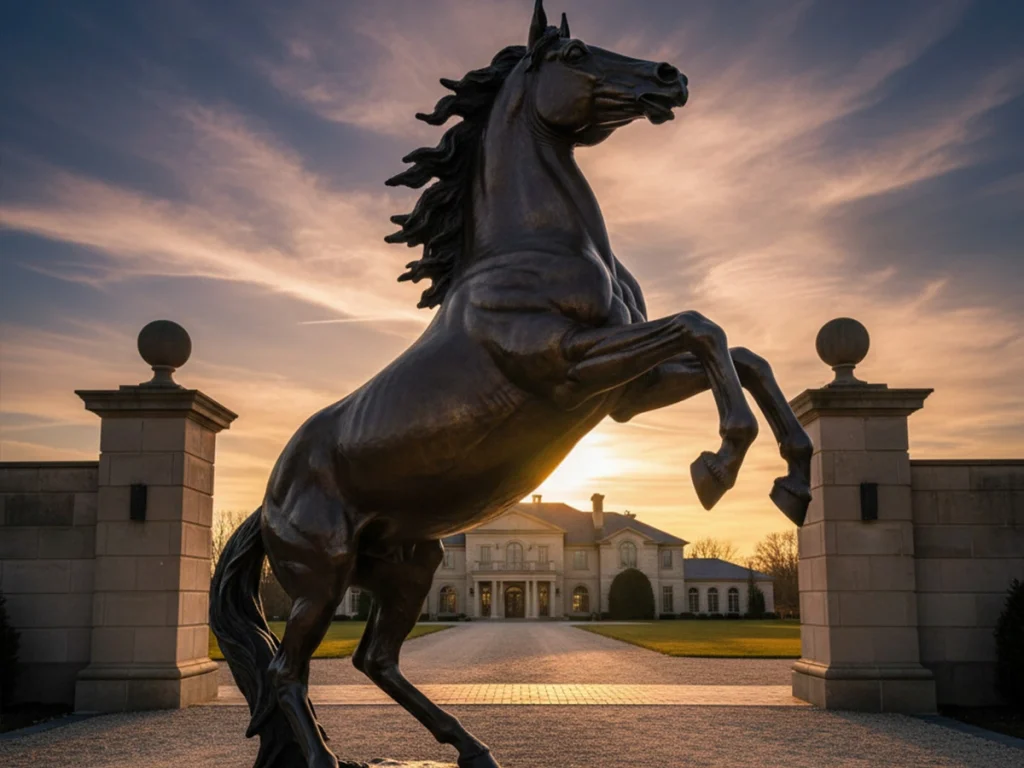
Caption: A properly scaled bronze horse statue aligned with the architectural axis of a private estate.
The Historical Tradition — Two Thousand Years of the Rearing Pose
The rearing horse in Western equestrian sculpture enters the historical record with a specific problem and a specific solution that still governs how the pose is engineered today. The problem is structural. A rearing horse in bronze or stone has its full weight on two rear contact points. The entire figure — which at life-size might weigh 800 to 1,200 kilograms in bronze — is balanced on a base area that is a fraction of the figure’s total footprint. Ancient sculptors solved this with a third contact point: the tail touching the ground, or an enemy figure fallen beneath the rear legs creating an additional support. The equestrian statue of Marcus Aurelius — the one surviving ancient bronze equestrian figure of the first rank — places the horse in a walking posture specifically because the rearing posture’s structural requirements were beyond what Roman bronze engineering could reliably achieve in a free-standing figure. Renaissance and later Baroque sculptors found the solution in both engineering and material selection. Giambologna’s Equestrian statue of Cosimo I in Florence (1595) places the horse in a walking posture. But the equestrian statue of Philip III in Madrid (1616) achieves a partial rear through careful mass distribution. Peter the Great on the Bronze Horseman (1782) achieves the full rear by designing the entire sculpture’s weight distribution so that the two rear hooves and the serpent under the tail together provide three load paths to the ground. Modern foundry engineering with 304 stainless steel internal skeletons — welded load paths from the hindquarters to the base, engineered for specific wind loads at the installation site — has made the rearing pose structurally reliable in a way that earlier centuries could not achieve. The sculptural solution that was reserved for the most ambitious commissions of the greatest foundries in the world is now available to any buyer who works with a foundry that specifies the internal engineering correctly.
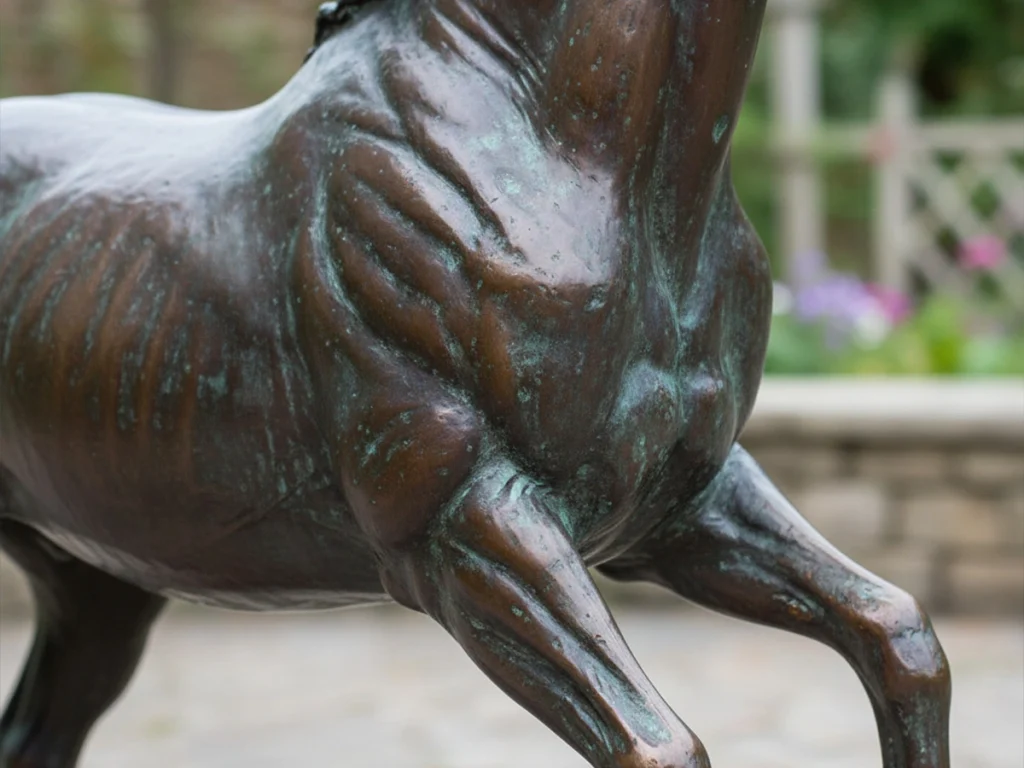
Caption: Muscle tension preserved through lost wax casting—not mold duplication.
Rearing Horse Meaning in Feng Shui and Cultural Tradition
In feng shui and East Asian cultural tradition, the rearing horse carries associations that partially overlap with the Western tradition and partially diverge from it in illuminating ways. In classical feng shui, the horse is associated with the south sector — the direction of fame and recognition — and with Yang energy: active, ascending, achievement-oriented. A galloping horse draws energy inward (toward the home or office) and symbolizes the arrival of opportunity and wealth. A standing horse communicates stability and the preservation of what has been accumulated. The rearing horse, in feng shui, is the most Yang of the three postures — the highest energy, the most active declaration. It is considered auspicious for spaces oriented around public achievement, career advancement, and the claiming of recognition. The upward thrust of the figure is understood as the embodiment of rising ambition: not ambition as striving, but ambition as natural expression of capacity. It belongs in spaces that face outward: estate entrances, corporate headquarters, the threshold between a private property and the world it addresses. Placement guidance in the feng shui tradition is specific about one aspect of rearing horse figures: they should face inward, toward the primary occupied space, rather than outward away from it. The energy of the figure is understood as directed — it moves in the direction the horse faces — and a rearing horse facing outward is understood as driving energy away from rather than toward the property.
| Placement | Facing Direction | Feng Shui Benefit |
|---|---|---|
| Estate entrance | Face inward toward property | Power and protection entering the property; arriving visitors experience the figure’s authority |
| Home office or study | Face toward the main working position | Rising career energy directed toward the person at work; south sector placement amplifies fame and recognition |
| Living room | Face inward, toward the room’s center | Yang energy contained within the home; wealth and achievement energy directed toward the household |
| Corporate entrance | Face inward, toward arriving visitors | Institutional authority declared at the threshold; visitors receive the figure’s energy as they enter |
| Avoid: bedroom | — | Yang energy too active for rest; the rearing pose’s charged energy conflicts with the bedroom’s need for Yin calm |
| Avoid: facing outward at entrance | — | Energy directed away from property; symbolically drives achievement and wealth out rather than in |
Where the Rearing Pose Belongs — Setting Guide
The rearing pose communicates best at entrances and thresholds. This is where its specific claim — dominance, contained power, the announcement of authority — is most legible and most purposeful. At an estate entrance, a rearing horse positioned so that arriving visitors approach it from the front, looking up at the raised forelegs, makes the maximum use of the pose’s visual dynamic. The viewer is positioned as the figure addresses them. The property’s claim on authority is made before a word is spoken, before the house itself is seen. This is the oldest use of the rearing horse pose in Western architecture, and it works because the visual language is still immediately legible. At a corporate headquarters, the rearing horse at the main entrance communicates the organization’s relationship to ambition and achievement in a way that the standing horse does not. The standing horse says permanence. The rearing horse says ascent. Both are legitimate institutional statements; they are different statements. In a garden, the rearing horse is the focal point that commands rather than invites. Placed at the end of a garden axis, elevated on a substantial pedestal, with clear approach from the primary viewpoint, a rearing horse terminates the axis with a figure that does not merely occupy the space but dominates it. The pose is not suited to intimate or enclosed settings. A rearing horse in a small courtyard or a room is visually overwhelming — the figure’s scale reads as intrusion rather than presence. The rearing pose needs space: the 10 to 20 meter approach distance that allows the viewer to take in the full vertical statement of the figure before they are directly beneath it.
The Structural Reality — What This Pose Requires
A correctly engineered rearing bronze horse at life-size (approximately 200 to 280 centimeters to the highest point of the raised forelegs) requires a 304 stainless steel internal skeleton with welded load paths specifically designed for the rearing pose’s weight distribution. The typical life-size rearing horse weighs 800 to 1,200 kilograms. More than 70% of this weight is concentrated on the two rear hooves and their contact points with the base plate. The base plate — the steel plate embedded in or bolted to the concrete foundation — must be engineered for this specific load concentration, with anchor bolts sized and positioned to the foundry’s structural drawings. The concrete foundation must be specified for the actual weight and wind load of the specific figure, not a generic “outdoor statue” specification. These engineering requirements are not optional. A rearing horse without the correct internal structure and foundation system will experience progressive stress at the rear ankle joints — the point where the load concentration is highest and the casting cross-section is smallest — and will eventually develop cracks or structural failure at these points. The timeline for this failure depends on the original wall thickness and internal structure: a correctly engineered figure will not fail in this way; an under-specified figure will begin showing stress within five to fifteen years depending on wind exposure. Our foundry provides structural drawings with every rearing horse commission, specifying anchor bolt positions, depths, and diameters for the specific figure’s weight and center of gravity. These drawings must reach the installation contractor before the concrete foundation is poured.
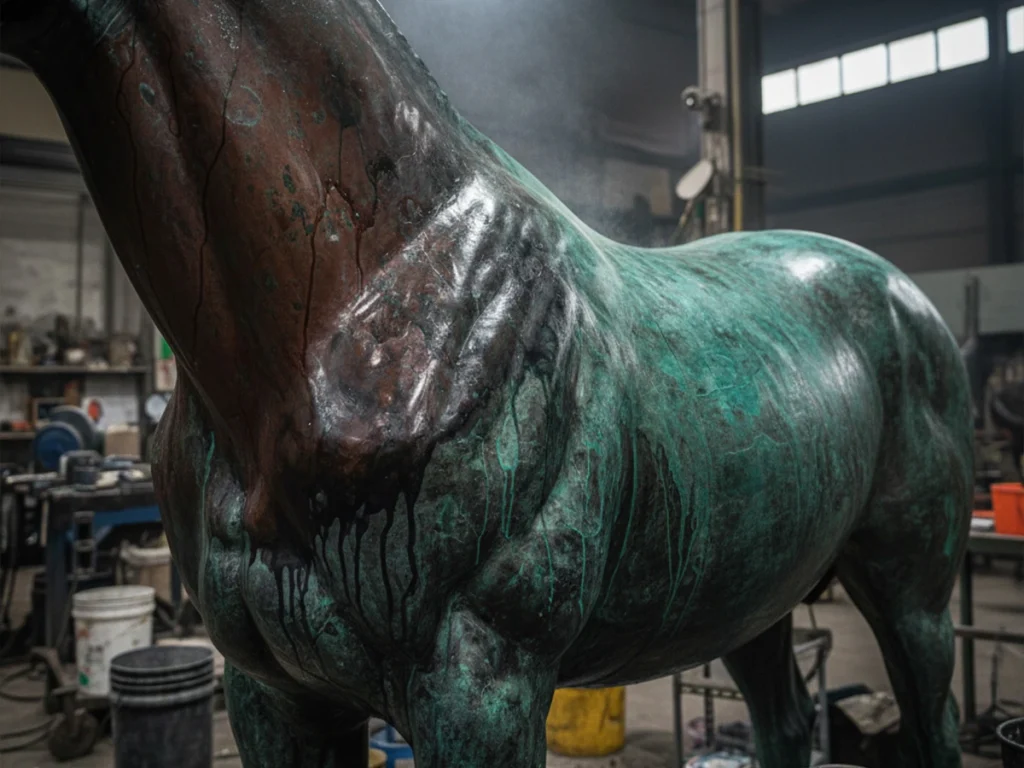
Caption: Chemical patina reacts with the bronze surface—color that ages naturally.
Frequently Asked Questions
What does a rearing horse statue symbolize?
A rearing horse symbolizes dominance, contained power, and victory. In Western equestrian sculpture, the pose has been used for 2,000 years to represent rulers and generals at the moment of decisive triumph — power announcing itself without need for demonstration. In feng shui tradition, the rearing horse represents the highest Yang energy, associated with rising ambition, career advancement, and public recognition.
Is a rearing horse statue good luck?
In feng shui, a rearing horse is auspicious when correctly placed — specifically when facing inward toward the primary living or working space. This placement directs the figure’s Yang energy toward the household rather than away from it. South sector placement is particularly beneficial for fame and recognition. Avoid bedroom placement, where the rearing pose’s high Yang energy conflicts with the calm required for rest.
What is the difference between rearing, galloping, and standing horse statues?
Rearing communicates dominance, contained power, and victory — the pose of declaration. Galloping communicates forward momentum and ambition in motion — the pose of progress. Standing communicates settled authority and permanence — the pose of legacy. In feng shui: rearing is highest Yang (rising career, recognition); galloping draws wealth inward; standing preserves accumulated wealth.
How is a rearing horse statue engineered to stay upright?
A life-size rearing bronze horse (200–280 cm) weighs 800–1,200 kg, with over 70% concentrated on two rear hooves. Correct engineering requires a 304 stainless steel internal skeleton with welded load paths from hindquarters through rear legs to the base plate, plus concrete foundation anchor bolts sized to structural drawings specific to the figure. Rearing horses without this engineering develop stress cracking at the rear ankle joints within 5–15 years.
Where should a rearing horse statue be placed?
The rearing pose communicates best at entrances and thresholds — estate gates, corporate headquarters, garden axis terminations — where its dominance and contained power are most purposeful. Face the figure inward toward the primary occupied space. Viewers should approach from 10–20 meters to take in the full vertical statement before arriving beneath the figure. Not suited to intimate or enclosed settings.
Factory Direct · Quyang, China
Commission a Rearing Horse Statue in Bronze
5–8mm silicon bronze. 304 stainless steel internal skeleton engineered for the rearing pose’s specific load distribution. Structural drawings and installation specifications included with every commission.