Get in touch with Yun-Sculpture company
Immaculate Heart of Mary Statue: The Complete Guide to Iconography, Marble, and Bronze

An immaculate heart of mary statue is one of the most symbolically layered commissions in Marian art — a figure whose entire spiritual meaning is communicated through a single visible element: her heart, exposed on her chest, pierced and aflame. Getting the iconography right matters. Getting the material right matters more. This guide covers both, from the theological meaning of every symbol to why the sword that pierces her heart is the most structurally vulnerable element in the entire sculpture.
Table of Contents
Table of Contents
What Does the Immaculate Heart of Mary Symbolize?
The Immaculate Heart is not simply a devotional image of Mary being kind. It is a theological statement about the nature of love that suffers without retreating.
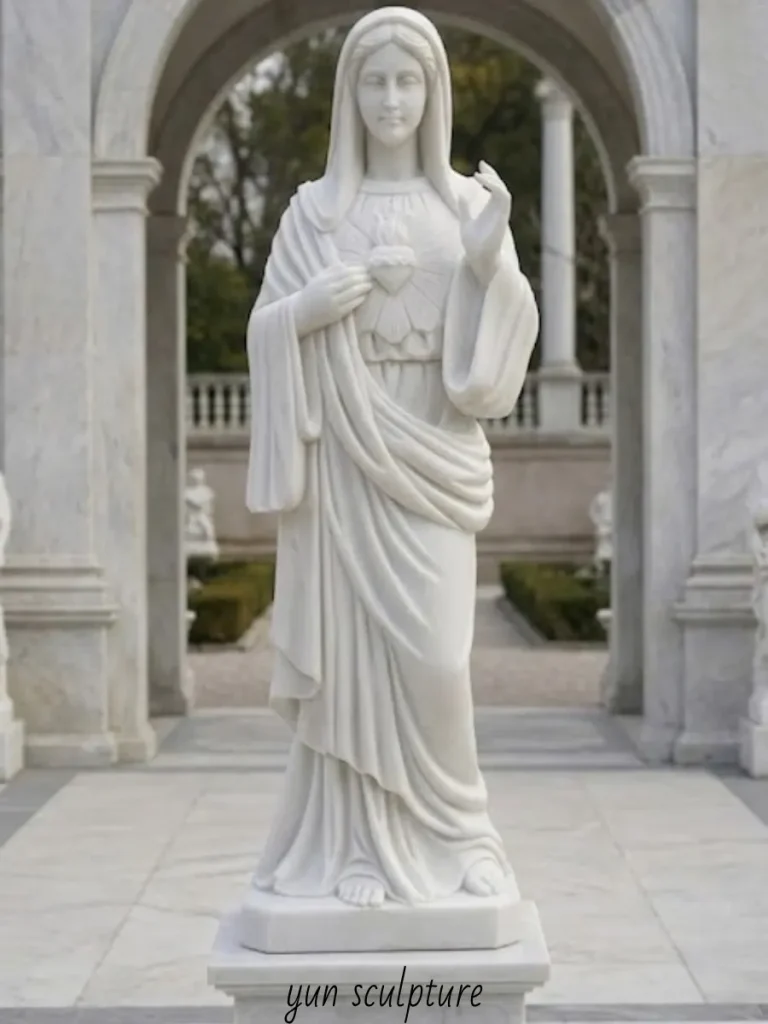
The heart itself represents Mary’s interior life — her profound love for God, her maternal care for humanity, and her complete, unguarded self-giving. Where the Sacred Heart of Jesus reveals love that pours outward actively and redemptively, the Immaculate Heart reveals love that receives, consents, and endures. The distinction matters theologically, and it matters visually: the two hearts speak a dialogue, not a monologue, which is why they are so often commissioned together.
The imagery finds its biblical anchor in Luke 2:35 — Simeon’s prophecy to Mary: “a sword will pierce your own soul too.” This is not metaphor. It is the theological foundation of the entire image. Mary’s heart is not serene because nothing touches it. It is serene because it has been pierced and remains open.
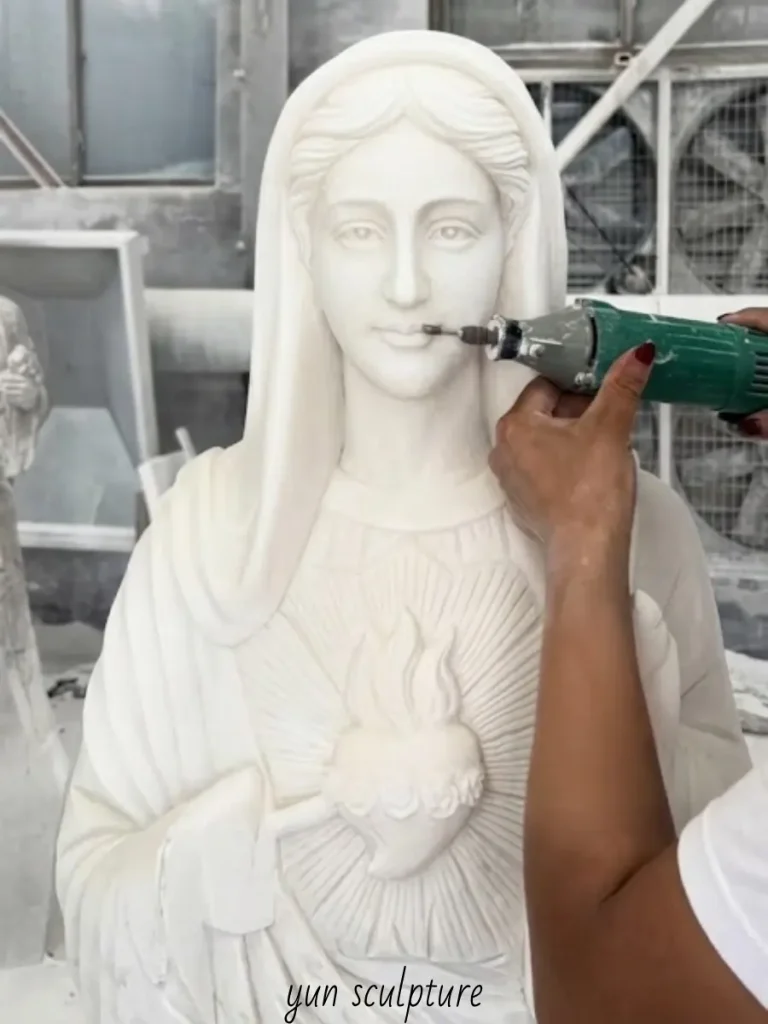
This quality of wounded peace is the hardest thing to capture in stone or bronze — and the reason why the expression of the face is the most critical element in any serious commission. The statue must communicate sorrow and serenity simultaneously, without collapsing into either grief or detachment.
What Is the Story Behind the Immaculate Heart of Mary?
The devotion has a precise historical arc, and understanding it helps explain why this particular statue is commissioned with such intention.
The theological roots go back to the 17th century, when St. John Eudes articulated the Hearts of Jesus and Mary as inseparable — two expressions of one divine love, one active and redemptive, the other receptive and participatory. This vision slowly matured in Catholic devotion over the following centuries.
The decisive moment came in 1917 at Fatima, where Mary appeared to three shepherd children and explicitly requested devotion to her Immaculate Heart as a path to peace and conversion. The Fatima connection transformed what had been a growing devotion into a global movement. Churches, shrines, and religious communities across the world began commissioning statues specifically to honor this request.
The institutional response came in 1944, when Pope Pius XII formally established the Feast of the Immaculate Heart of Mary for the universal Church — giving the devotion a permanent place in the liturgical calendar.
What this history means for a commission: the Immaculate Heart statue is not simply a decorative Marian image. It carries the weight of a specific theological request, one that the Church has formally recognized. Institutions that commission it are not merely decorating a space — they are responding to that request in visible, permanent form.
For the full history of the Fatima apparitions and their connection to this devotion, our Fatima Immaculate Heart of Mary statue guide covers the Pilgrim Virgin tradition and shrine installation in detail.
What Are the Symbols on an Immaculate Heart of Mary Statue?
Every element is deliberate. Nothing is ornamental without theological purpose.
The heart itself — exposed on Mary’s chest, not hidden — represents total self-giving, love without concealment. Its visibility is the point. A heart tucked behind robes would defeat the entire iconographic intention.
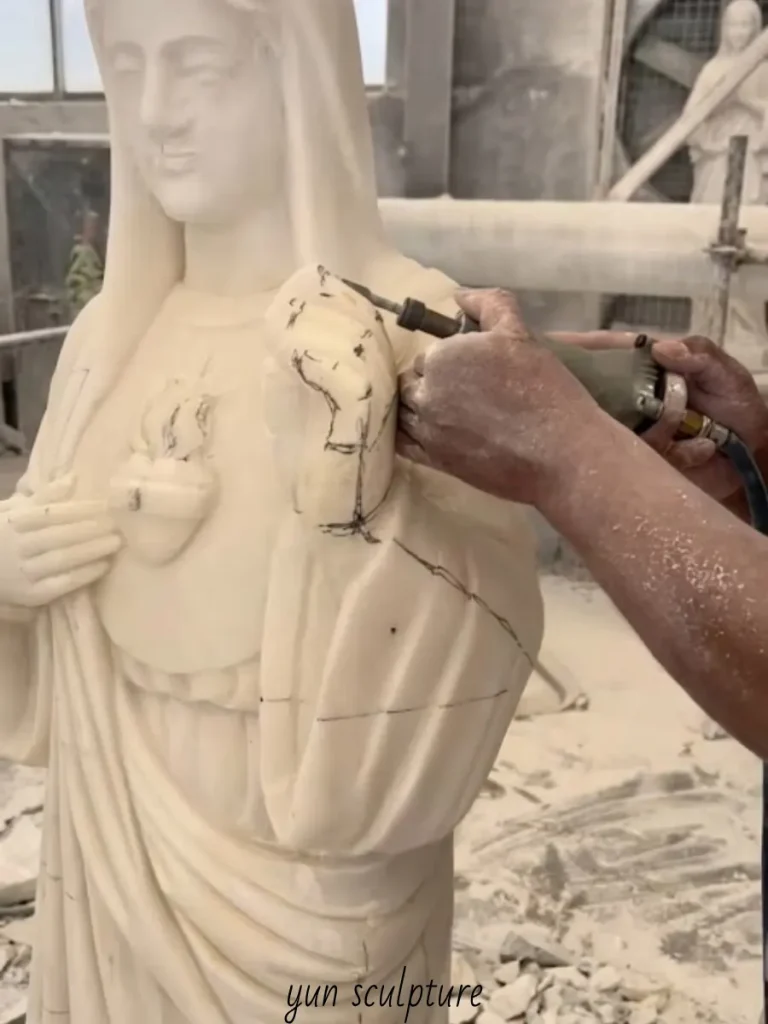
The sword piercing the heart represents the Seven Sorrows of Mary — the accumulated grief of her earthly life, from Simeon’s prophecy through the Crucifixion. In sculpture, this is the most structurally demanding element. Donghui Zhang notes that in marble, a sword projecting from the heart creates a linear stress point that must be internally reinforced or subtly thickened to prevent fracture over years. Any marble commission without attention to this structural detail will eventually fail at the sword junction — we have seen it in statues made by less experienced carvers.
The roses or ring of roses encircling the heart represent both the Rosary and beauty sustained through suffering. In marble they require careful undercutting to achieve petal depth; in bronze, the lost-wax process allows for more expressive, three-dimensional blooms.
The flames rising above the heart represent burning love for God and humanity. In bronze casting, thin upward-tapering flame forms are technically challenging — proper gating and cooling calculations are essential to prevent warping or air pockets within the flame structure. In marble, flame tips must be carved with precision; fragility increases as the forms narrow and lengthen upward.
The crown of thorns (present in some versions) represents complete unity with Christ’s suffering — a visual declaration that Mary’s sorrow is not separate from the Passion but joined to it entirely.
The expression is not a symbol in the conventional sense, but it functions as one. A face that reads as grief alone misses the theology. A face that reads as serenity alone misses the sword. The correct expression is a specific, difficult combination: peaceful attention that has already passed through sorrow.

What Material Is Best for an Immaculate Heart of Mary Statue?
The answer depends on where the statue will live — and what the heart and sword need to do structurally.
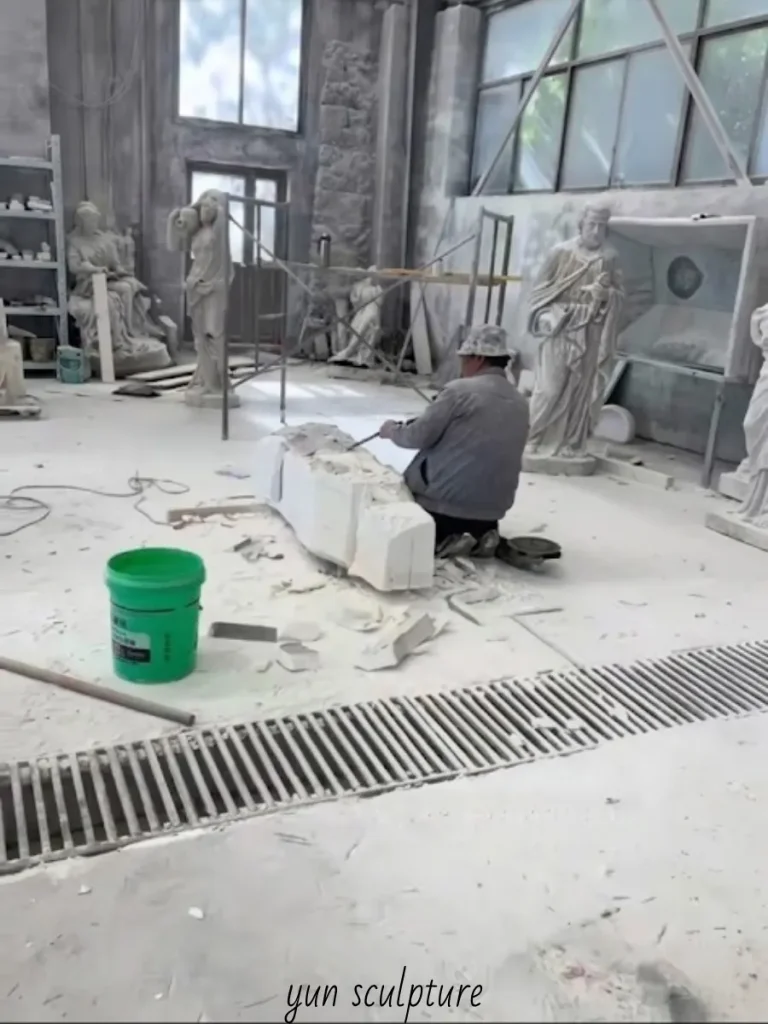
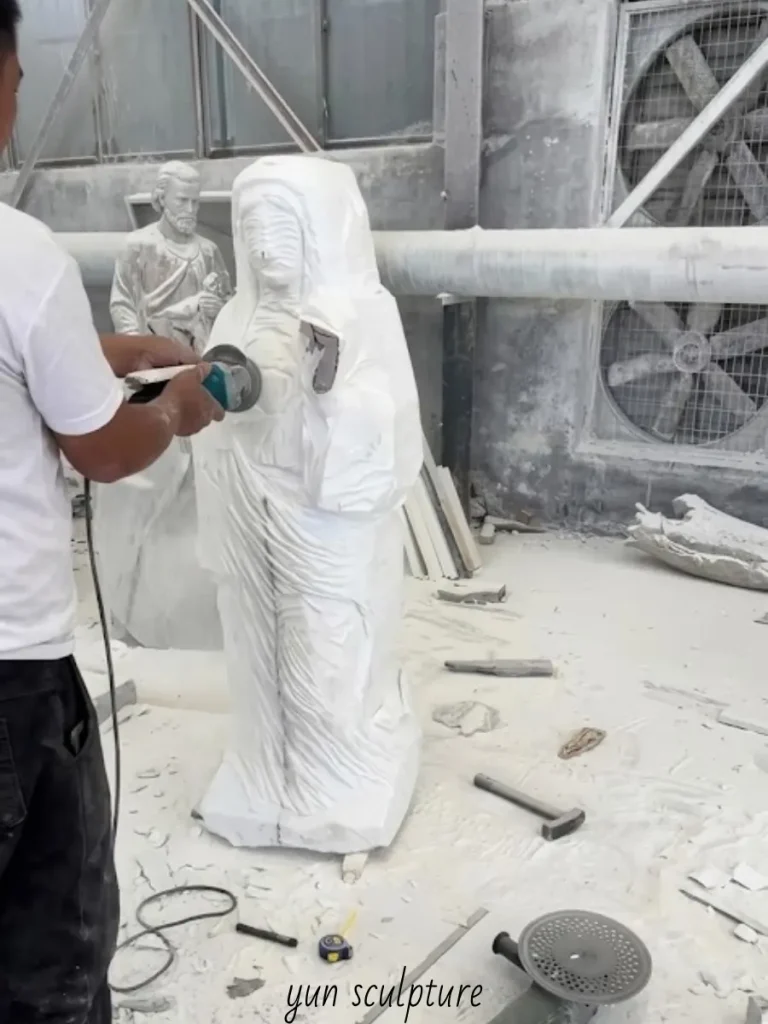
Natural white marble is the material most closely aligned with the spiritual atmosphere of this image. White marble holds interior light in a way no other material matches — robes develop depth and translucency, the carved heart takes on a luminous quality, and the overall presence of the figure radiates the quiet spiritual authority that Marian devotion calls for. For chapel interiors, covered cloisters, indoor shrines, and sheltered garden settings, marble is the first choice.
The structural caveat is the sword. In marble, any element that projects at an angle from the main figure creates leverage stress — the sword is the clearest example. Donghui builds internal reinforcement into every marble commission at this junction, and recommends that outdoor marble installations be placed where they are protected from direct rain and freeze-thaw cycling, both of which accelerate stress fracture at vulnerable projection points.
Cast bronze is the correct choice for exposed outdoor installations — church courtyards, public gardens, memorial spaces, any setting where the statue will face weather directly. The lost-wax process captures the sword, roses, flames, and facial expression with extraordinary precision, and bronze resists corrosion indefinitely. The natural patina that develops over years deepens the surface and actually enhances the statue’s presence rather than diminishing it.
One material I see too often in parish gardens: painted resin. The heart detail flattens at any meaningful scale, the sword loses its edge definition within a few seasons of UV exposure, and the flames read as decorative shapes rather than living fire. For a devotion as iconographically precise as the Immaculate Heart, a material that cannot hold fine detail is not an appropriate vessel.
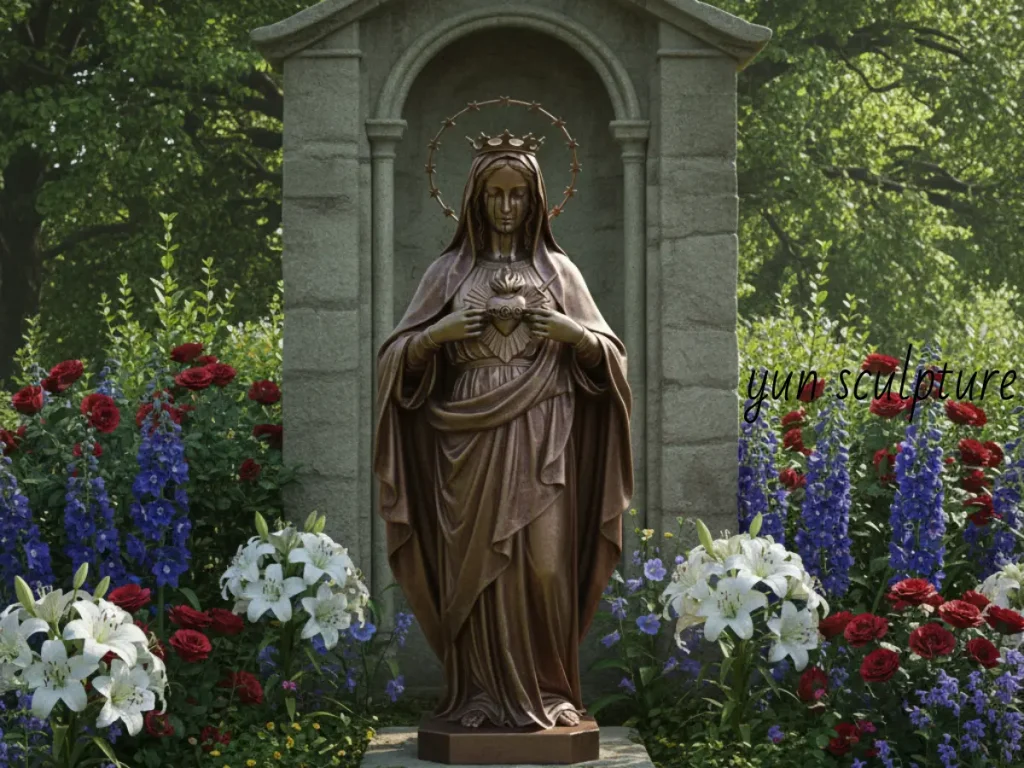
Unsure whether marble or bronze fits your installation setting? Tell us your climate and placement — we will recommend the right option.
How Big Should an Immaculate Heart of Mary Statue Be?
Scale determines whether the iconography communicates or disappears.
The heart, sword, roses, and flames must be large enough to read clearly from the intended viewing distance. At smaller scales, the roses flatten into surface texture, the sword loses its piercing direction, and the flames become indistinct shapes. The theological meaning of the image depends on its symbols being legible — which means scale is not a secondary consideration.
Donghui’s practical thresholds from two decades of commissions:
| Size | Best Setting | What Reads Clearly |
|---|---|---|
| 18–24 inches | Home altar, personal devotion, tabletop | General form and expression; fine symbol detail simplified |
| 30–36 inches | Home garden, small chapel niche | Heart, sword direction, rose ring clearly legible |
| Life-size (5–6 ft) | Church interior, institutional courtyard | Full iconographic detail at normal viewing distance |
| 8 ft and above | Outdoor shrine, public memorial | Visible and legible from 20+ meters; requires anchored foundation |
A life-size Immaculate Heart of Mary in white marble takes approximately 35–45 working days from approved clay maquette to shipping. The equivalent in bronze runs 40–50 days. Both timelines assume the design brief is clear before production begins — expression direction, sword placement, whether a crown of thorns is included, and the treatment of the roses.
For paired installations with the Sacred Heart of Jesus, both statues must be produced together to guarantee matched scale and finish. We cover the specific design principles for paired commissions in our Sacred Heart of Jesus and Immaculate Heart of Mary paired installation guide.
FAQ
What is the meaning of the Immaculate Heart of Mary statue?
The Immaculate Heart represents Mary’s interior life — her love for God, her maternal compassion, and her perfect participation in Christ’s suffering through her own sorrow. We cover the full theological meaning, including the distinction between the Immaculate Heart and the Sacred Heart of Jesus, in the first section above.
Why is there a sword through the Immaculate Heart of Mary?
The sword represents the Seven Sorrows of Mary, fulfilling Simeon’s prophecy in Luke 2:35 that a sword would pierce her soul. We explain this symbol and its structural implications for marble and bronze carving in detail in the iconography section above.
What are the five sins against the Immaculate Heart of Mary?
The five offenses against the Immaculate Heart come from a 1925 Fatima apparition in which Mary asked for the Five First Saturdays devotion as reparation. The five offenses are: blasphemies against her Immaculate Conception; blasphemies against her perpetual virginity; blasphemies against her divine maternity and refusal to recognize her as the Mother of God; the efforts of those who seek to implant in children’s hearts indifference, contempt, or hatred toward her; and the direct insults to her sacred images. The devotion of Five First Saturdays — receiving Communion on five consecutive first Saturdays while meditating on the Rosary mysteries — was specifically requested as reparation for these offenses.
What are the flowers on the Immaculate Heart of Mary?
The flowers encircling Mary’s heart are roses, representing both the Rosary and the beauty of holiness sustained through suffering. The rose’s association with Mary is ancient — she is called “Rosa Mystica” and “Rose of Sharon” in Catholic tradition, with the red rose symbolizing love and the white rose symbolizing purity. In sacred art, roses appear on the Immaculate Heart specifically because the Rosary is the primary devotional practice associated with Marian intercession, and because the image of beauty persisting alongside the piercing sword communicates the core theological paradox: love that suffers without losing its nature.
Why are there 12 stars around Mary’s head?
The crown of twelve stars comes from Revelation 12:1 — the vision of a woman clothed with the sun, standing on the moon, crowned with twelve stars. Catholic tradition interprets this woman as Mary in her role as Queen of Heaven. The number twelve represents both the twelve tribes of Israel and the twelve apostles — the full span of salvation history from the Old Covenant to the New. In Marian iconography, the twelve stars appear most prominently on the Miraculous Medal and in Our Lady of Guadalupe imagery, though they also appear in some Immaculate Heart compositions, particularly those with a more regal iconographic program.
What fruit is associated with Mary?
The strawberry is the primary fruit associated with Mary in Catholic art and tradition, representing her as the “Fruitful Virgin.” In medieval iconography, the strawberry was unique among fruits because it blooms and fruits simultaneously — a visual symbol for Mary’s simultaneous virginity and motherhood. Its white blossom represents purity; its red fruit represents love. The pomegranate also appears in Madonna and Child imagery, held by Jesus rather than Mary, symbolizing the fullness of the Passion and the seeds of the Church. Grapes are blessed on the Feast of the Assumption, connecting Mary to the Eucharistic harvest.
Why do Catholics have statues when the Bible says not to?
The biblical prohibition in Exodus 20:4-5 forbids making images for the purpose of worship — treating a created object as a god. Catholic teaching draws a clear line between latria (worship, reserved for God alone) and dulia (veneration, the honor given to saints). Statues in Catholic practice are not worshipped; they are visual focal points for prayer and meditation on the holy lives they represent, functioning similarly to a family photograph. The same God who prohibited idol worship also commanded the construction of the cherubim on the Ark of the Covenant — the prohibition is against worshipping images, not against creating them. The Incarnation, in which God took physical human form in Christ, further grounds the Catholic understanding that divine reality can be expressed in visible, material form.
What does it mean if a Mary statue cries?
Reports of weeping Marian statues appear across Catholic history, with documented cases in Japan, Italy, Mexico, and the United States. Scientific investigations typically identify condensation, porous material absorbing and releasing liquid, or in some cases deliberate manipulation. The Church approaches these reports with caution, requiring extensive investigation before any official recognition. From a material standpoint, solid marble and cast bronze statues do not have the porous structure through which liquid could migrate — which is one reason serious commissions use these materials. We cover the weeping statue phenomenon and its relationship to the Philippines devotional tradition in detail in our fabric vestment and Philippine Marian statue guide.
Commission Your Immaculate Heart of Mary Statue
Her heart is exposed. The material you choose to hold it should be worthy of what it carries.
Factory Direct · Quyang, China
Get an Exact Quote for Your Mary Statue
Tell us the size, pose, and any custom requirements — we respond within 24 hours with a detailed price breakdown, no obligations.