Get in touch with Yun-Sculpture company
Fatima Immaculate Heart of Mary Statue: The Pilgrim Virgin Tradition & Shrine Commission Guide

If you are commissioning a fatima immaculate heart of mary statue, the first question is not what size or what material. It is how the statue will be used. A statue built for permanent outdoor shrine installation has completely different structural requirements from one built for parish processions or home visitation programs. Get this wrong and you will have a beautiful piece that fails its purpose within years. This guide covers the history, the engineering, and the commission decisions that follow from both.
Table of Contents
Table of Contents
What Is the Pilgrim Virgin Statue?
The Pilgrim Virgin Statue is not a devotional style. It is a specific mission.
The original International Pilgrim Virgin Statue was sculpted in 1947 by José Thedim, based on precise instructions from Sister Lucia — one of the three shepherd children who witnessed the 1917 Fatima apparitions. Lucia’s requirement was specific: the image must represent Our Lady’s position when she revealed herself as the Immaculate Heart. This was not an artistic brief. It was a theological specification.
Two twin statues were commissioned. The first, blessed on May 13, 1947, traveled east. The second, blessed by the Bishop of Fatima on October 13, 1947, traveled west — entering the United States on December 8, 1947, the Feast of the Immaculate Conception, in Buffalo, New York. Within the first two years, nearly 200,000 people lined the streets of Buffalo alone to welcome it. In St. Louis Cathedral, 310,000 people attended in a single week.
The purpose was precise: to bring the graces of Fatima to those who could never travel to Portugal. The statue was not a representation of a place. It was a continuation of the mission that began at the Cova da Iria in 1917.
This history defines what a Pilgrim Virgin statue must do structurally. It travels. It is handled repeatedly. It is installed temporarily in different environments — churches, homes, outdoor spaces — without permanent anchoring. It must survive this without degradation.
I have seen resin Fatima statues that looked acceptable for a single parish display and were visibly deteriorating by their fifth installation. The polychrome surface flakes under repeated handling. The base cracks from repeated uneven placement on different surfaces. A statue with a traveling mission needs internal reinforcement, a stable center of gravity, and surface treatment that tolerates contact and transport.
Who Sculpted the Original Our Lady of Fatima Statue?
The original statue at the Fatima shrine — the one housed in the Chapel of the Apparitions — was carved in 1920 by Portuguese sculptor José Ferreira Thedim, from cedar wood, 1.04 meters tall, based on a picture of Our Lady of Lapa and descriptions of the 1917 apparitions. Thedim worked on the commission for years, and the finished statue was placed in the Chapel of the Apparitions on June 13, 1920.
The same Thedim sculpted the 1947 International Pilgrim Virgin Statue under direct guidance from Sister Lucia. Lucia reviewed his work and provided corrections based on her memory of the apparitions. The result is the image that has since traveled to over 100 countries and become the most recognized visual representation of Our Lady of Fatima worldwide.
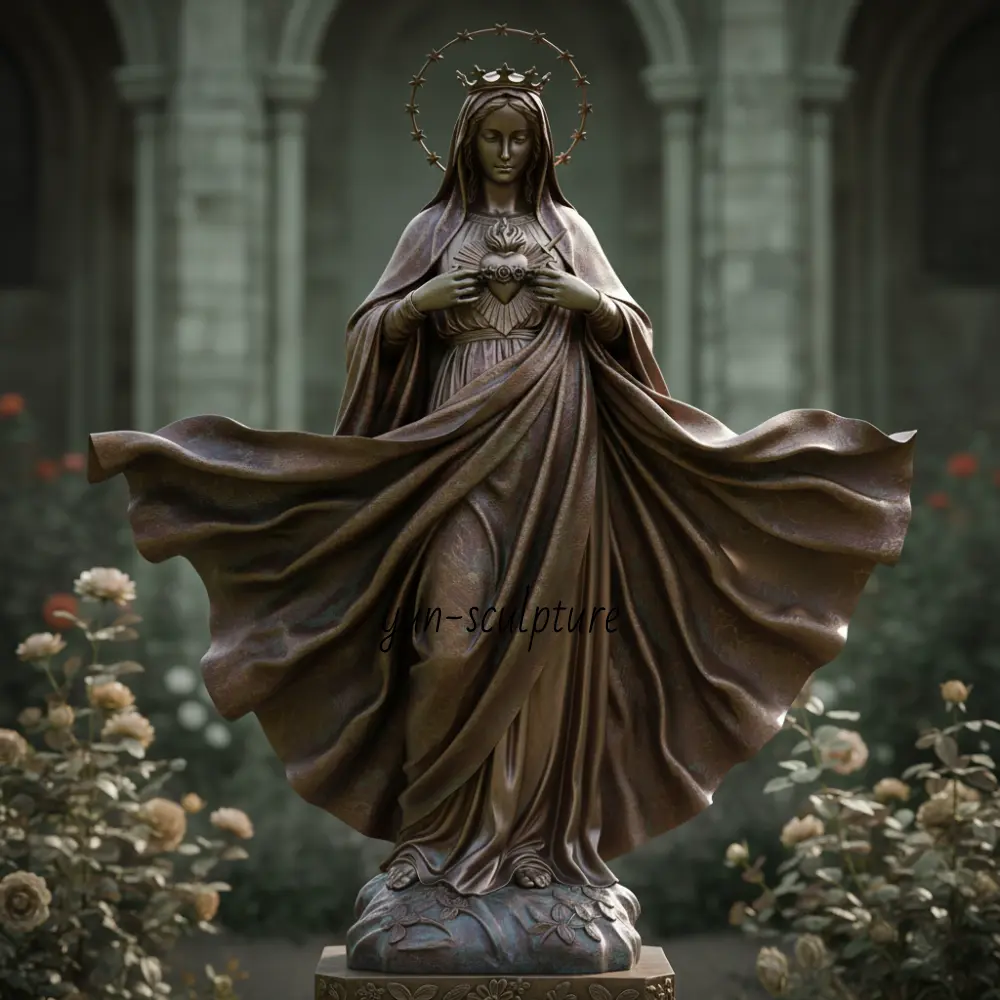
What this means practically for a commission: any serious Fatima Immaculate Heart statue produced today is working from a well-established visual tradition. The iconography is not open to interpretation in the way that, say, a generic Marian statue might be. The crown, the rosary, the blue mantle, the white dress, the position of the hands, the posture of the figure — these are defined by Thedim’s 1947 image and Lucia’s direct testimony about what she saw.
When a parish or shrine commissions a Fatima statue from us, we always provide reference photographs of the Thedim original and ask the client to confirm which iconographic details they want preserved exactly and which they are open to adapting. Most want precision. The devotion to this specific image is strong enough that departures from the established form create problems in devotional reception.
What Is the Significance of the Our Lady of Fatima Statue?
The AI Overview answer to this question says: the statue represents “a peace plan from Heaven.” That is accurate but incomplete. It tells you the message. It does not tell you why the physical object matters.
A statue is not just a sign pointing at a message. It is the material presence of that message in a specific place. When the International Pilgrim Virgin entered Red Square in Moscow in October 1992 — carried by six bishops — the statue was doing something a pamphlet or a broadcast could not do. It was physically present in a space that had been closed to that message for decades. The material object made the act concrete and visible in a way that no other medium could.
This is why institutions commission permanent Fatima statues rather than simply posting reproductions. A bronze or marble statue installed in a church courtyard, a seminary garden, or a hospital healing space is not illustrating the Fatima message. It is enacting the response that message requested — the establishment of devotion to the Immaculate Heart in a specific place, permanently.
The significance is therefore both theological and architectural. The statue transforms the space it occupies. It creates a place for prayer where none existed before. It becomes a focal point for consecrations, rosary devotions, and May and October Marian observances. Communities organize themselves around it.
For this to function over decades, the material must hold. A resin statue that fades and cracks within ten years does not sustain this function. Bronze or marble does. The material choice is not a luxury decision — it is a commitment to the permanence the devotion requires.
Planning a permanent Fatima shrine installation? Send me your space dimensions and I will specify the right scale, base, and anchoring system for your environment.
How Is the Our Lady of Fatima Statue Used in Religious Practices?
There are three distinct use contexts, and each requires a different structural approach.
Fixed outdoor shrine installation is the most structurally demanding. The statue faces full weather exposure year-round. Bronze is the correct material. For installations in North America or Northern Europe, freeze-thaw cycling is the primary structural threat — water infiltrates micro-fractures, expands on freezing, and widens cracks progressively. Solid cast bronze has no micro-fractures to exploit. A properly cast bronze Fatima statue with a sealed concrete base and steel rod anchoring will survive this without maintenance intervention for decades.
Marble can be used for outdoor Fatima shrines in mild climates — Mediterranean regions, protected Southern European settings, sheltered gardens in warmer North American zones. I do not recommend marble for exposed outdoor installations in Canada, the northern United States, or Northern Europe. The surface detail loss over repeated freeze-thaw cycles is real and irreversible.
Procession use requires light weight and balanced load distribution. A life-size bronze statue weighing 180–220 kg cannot be carried. For processional Fatima statues — common in the Philippines, Mexico, and throughout Latin America — I build in hollow sections where possible, use lighter alloys, and position the center of gravity low in the figure. A standard processional commission from us runs 35–60 kg depending on size, with four carrying handles integrated into the base design. Polychrome painted finishes are standard for processional pieces; they read expressively at close range and can be refreshed without full refinishing.
Home visitation programs — where a statue rotates through parish households — require the most attention to structural resilience under repeated handling. The base edges are the first things to chip. Carrying points need to be obvious and load-bearing. I reinforce the base perimeter on all visitation-program statues and add rubber protective pads to the base underside. The surface treatment needs to tolerate fingerprints and cleaning without deteriorating.
For more on how our Lady of Guadalupe outdoor statue commissions handle similar climate and use requirements, the design principles in our Our Lady of Guadalupe outdoor statue guide apply directly.
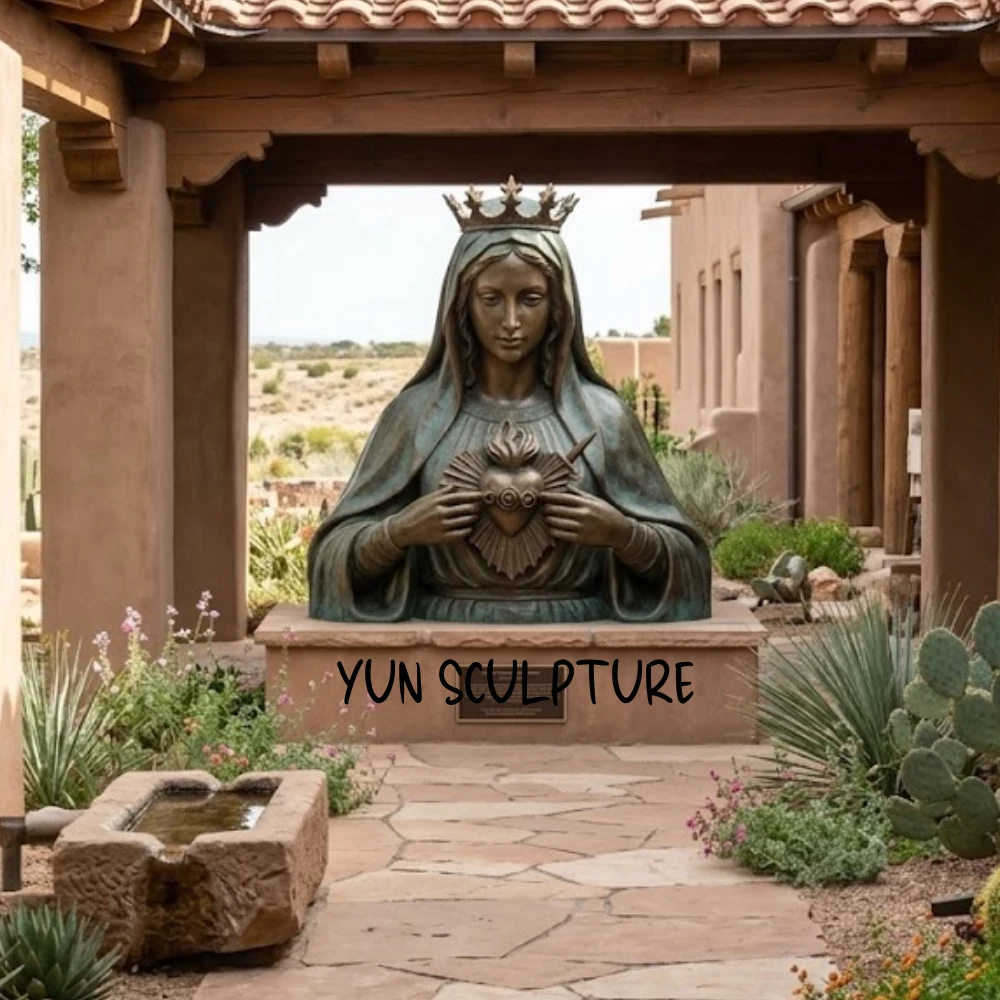
We completed a Fatima shrine commission two years ago for a Carmelite monastery in the American Southwest — a life-size bronze, fixed installation in a covered outdoor cloister, with a low water feature and flagstone path approaching the figure. The sisters wanted the statue to face the path so that anyone walking toward it would encounter her eyes directly before reaching the shrine space. That gaze direction — which seems like a simple detail — required three maquette adjustments before we got the angle right. It determines the entire devotional experience of approach. I do not rush that stage.
FAQ
What is the miracle of Our Lady of Fatima?
The central miracle at Fatima is the Miracle of the Sun on October 13, 1917 — witnessed by an estimated 70,000 people gathered in the Cova da Iria despite heavy rain. Observers reported the sun spinning, changing colors, and appearing to plunge toward the earth before returning to its normal position. The event had been foretold by Mary in earlier apparitions as a sign to confirm her messages. Scientifically, no natural explanation has been established for a phenomenon witnessed simultaneously by tens of thousands of people across a wide geographic area. The Catholic Church has not required belief in this specific event as a matter of faith, but the Church did formally declare the Fatima apparitions worthy of belief in 1930.
What are the miracles associated with the Our Lady of Fatima statue?
The International Pilgrim Virgin Statue has been associated with documented reports of weeping on fifteen occasions, with one of the most investigated incidents occurring in New Orleans on July 17, 1972, where the liquid was authenticated as human tears by medical examination. Physical cures — including documented cases of cancer, paralysis, and infertility — have been reported at locations visited by the statue during its global tours. The World Apostolate of Fatima maintains records of these reports. The Church approaches each case individually, requiring careful investigation before any formal recognition. What is consistent across reports is the pattern of intense spiritual conversion and renewal accompanying the statue’s visits regardless of whether specific physical phenomena are involved.
Where is the Our Lady of Fatima statue located?
The original 1920 Thedim statue is enshrined in the Chapel of the Apparitions at the Fatima Sanctuary in Portugal, at the site of the 1917 apparitions. The International Pilgrim Virgin Statue — the 1947 Thedim commission based on Sister Lucia’s descriptions — is not permanently located anywhere; it travels continuously under the custody of the World Apostolate of Fatima, visiting parishes, dioceses, and countries on a scheduled rotation. A schedule of upcoming visits is maintained at fatimapeace.com. Replica statues based on the Thedim iconography are installed in thousands of churches, shrines, and homes worldwide.
Who were the three children who saw Mary?
The three shepherd children were Lúcia dos Santos (age 10 in 1917), and her cousins Francisco Marto (age 9) and Jacinta Marto (age 7). All three reported apparitions of an angel in 1916 before the Marian apparitions began in May 1917. Francisco and Jacinta both died young — Francisco in 1919 and Jacinta in 1920, from the influenza pandemic — and both were canonized by Pope Francis in 2017 at Fatima. Lúcia survived, entered the Carmelite convent in Coimbra, Portugal, and lived until 2005. She was instrumental in supervising the creation of the 1947 Pilgrim Virgin Statue and remained the primary living witness to the Fatima apparitions for decades. Her cause for canonization is currently under review.
What happened on October 13th in Fatima?
October 13, 1917 was the date Mary had promised a miracle to confirm her messages. An estimated 70,000 people gathered in rain and mud at the Cova da Iria. At approximately noon, witnesses reported the rain stopping, the clouds parting, and the sun performing a series of rotations and color changes before appearing to fall toward the earth. Many who were present reported their rain-soaked clothing was suddenly completely dry. The event was reported by secular newspapers, including the Lisboa O Século, whose correspondent was present. October 13 remains the most significant date in the Fatima devotional calendar and is observed annually with Mass and procession at the Fatima Sanctuary.
What was the final warning of Fatima?
The Fatima message contained three “secrets” communicated to the children in July 1917. The first showed a vision of hell. The second predicted the end of World War I and warned that a worse war would follow if humanity did not convert — a warning that included a reference to Russia spreading errors throughout the world. The third secret, kept sealed by the Vatican until 2000, described a vision of a pope and other Church figures being killed — interpreted by the Vatican as prophetically referring to the 1981 assassination attempt on Pope John Paul II. Some theologians and Fatima scholars believe the third secret has not been fully disclosed. The consistent theme across all three secrets is the call to prayer, penance, and consecration to the Immaculate Heart as the path to peace.
What are the three predictions of Our Lady of Fatima?
Mary’s three predictions at Fatima were: first, that World War I would end but that a worse war would begin during the reign of Pope Pius XI if Russia was not consecrated to her Immaculate Heart — World War II began in 1939; second, that Russia would spread its errors throughout the world, causing wars and persecutions of the Church, but that in the end her Immaculate Heart would triumph and a period of peace would be granted to the world; and third, the vision of the suffering Church and the martyred bishop in white, disclosed in 2000. The consecration of Russia to the Immaculate Heart, requested at Fatima and performed by successive popes, remains a subject of theological discussion regarding whether it has been carried out as Mary specified.
What is the history of the Our Lady of Fatima statue?
The original shrine statue was carved in 1920 by José Thedim from cedar wood, installed in the Chapel of the Apparitions at Fatima. The International Pilgrim Virgin Statue, also by Thedim, was completed in 1947 under Sister Lucia’s direct supervision and has since visited over 100 countries. We cover the full history — including the 1947 blessing, the Buffalo arrival, and the Red Square visit — in detail in the sections above.
Commission Your Fatima Shrine or Processional Statue
Tell me the use: fixed outdoor shrine, processional, or home visitation program. The structural requirements are different. The commission starts with that answer.
Factory Direct · Quyang, China
Get an Exact Quote for Your Mary Statue
Tell us the size, pose, and any custom requirements — we respond within 24 hours with a detailed price breakdown, no obligations.