Get in touch with Yun-Sculpture company
Immaculate Heart of Mary Statue: The Philippines Tradition, Fabric Vestments & Weeping Statues

There is a version of the immaculate heart of mary statue philippines tradition that no catalog page describes: the statue that is not displayed but carried, not fixed but dressed, not viewed from a distance but touched and adorned by the hands of the faithful year after year. This guide covers that version — the fabric vestment statue, the processional commission, and the weeping statue phenomenon — along with what each requires structurally and why the design principles differ so completely from a standard fixed installation.
Table of Contents
Table of Contents
What Does It Mean If a Mary Statue Cries?
Reports of weeping Marian statues appear across Catholic history with striking consistency — in Japan, Italy, Mexico, the United States, and most frequently in the Philippines, where Marian devotion is practiced with an intensity that shapes the entire cultural calendar.
The theological interpretation is one the Church approaches with deliberate caution. Reported weeping is not immediately recognized as miraculous — each case requires formal investigation, and the Church rarely issues definitive rulings. What the reports reveal consistently, regardless of their ultimate explanation, is the depth of the relational bond between the faithful and the sacred image. When believers describe a statue as weeping, they are describing an encounter — a moment in which the boundary between representation and presence seemed to dissolve.
The scientific explanations are real and should be understood honestly. Porous materials — certain composites, plasters, and resins — can absorb liquid from humid environments and release it slowly through surface micro-fractures. Temperature changes cause differential expansion between a statue’s surface and interior, which can draw moisture outward. In some documented cases, liquid was introduced deliberately. Skeptics and investigators have demonstrated all of these mechanisms.
What Donghui Zhang points out from a material standpoint is significant: solid cast bronze and carved marble do not have the porous internal structure through which liquid could migrate. A solid marble statue does not weep from condensation because there is no network of internal channels for moisture to travel through. A properly cast bronze statue has no surface porosity. This is not a theological claim — it is a material reality. When institutions ask us which material is most appropriate for a devotional image that will receive intense veneration over decades, the structural integrity of solid natural materials is part of the answer.
The most documented weeping case involving a Pilgrim Virgin statue — the International Pilgrim Virgin Statue’s reported weeping in New Orleans in 1972 — was photographed and the liquid subjected to analysis. The case remains one of the most investigated in modern Catholic history. Whatever conclusion one draws from that specific incident, it demonstrates how seriously the faithful and the institutional Church both take the phenomenon.
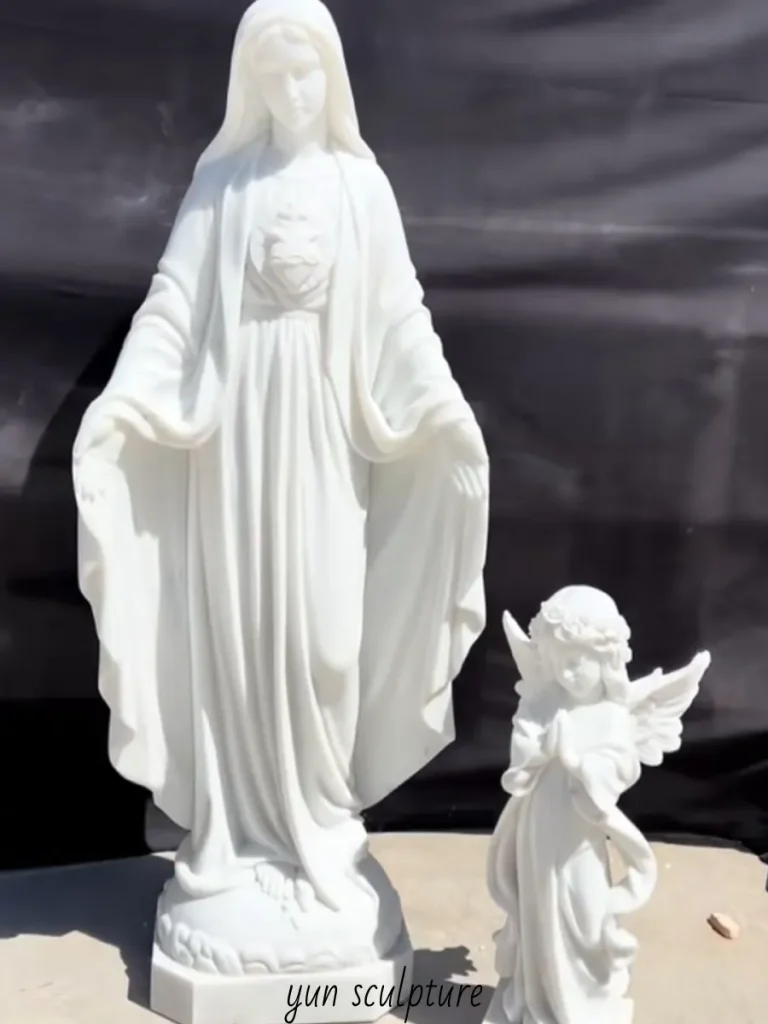

What Do Filipinos Call the Virgin Mary?
Filipinos call her Mama Mary.
Not “Our Lady.” Not “the Virgin.” Mama Mary — the same form of address a child uses for a mother, intimate and immediate. When I first encountered this in conversations with Filipino clients, it struck me as the most precise possible description of how Marian devotion functions in the Philippines: not distant veneration of a theological figure, but a living relationship with a maternal presence woven into daily life.
This relational quality shapes everything about how Filipino parishes commission and use Marian statues. The statue is not installed and observed. It is present in the community — carried in processions through neighborhoods, brought into homes for week-long visits, dressed in garments sewn and maintained by parishioners. The statue participates in the life of the community rather than presiding over it from a fixed position.
The Philippines has the largest Catholic population in Asia, and Marian devotion is inseparable from national identity. May 1 — the Feast of St. Joseph the Worker — coincides with Labor Day and is marked with public religious events. The month of May is devoted to Mary with daily flores de mayo celebrations and processions. October brings the Rosary month observances. In this context, the physical presence of a Marian statue in community life is not occasional but continuous.
The largest Marian statue in the world by total height is in the Philippines — the Mother of All Asia, Tower of Peace, at Montemaria International Pilgrimage Center in Batangas City, standing 98.15 meters including its plinth. That scale communicates something about the place Mama Mary holds in Filipino Catholic consciousness. It is not peripheral. It is central, monumental, and public.
How Is a Fabric Vestment Immaculate Heart of Mary Statue Designed Differently?
A fabric vestment statue requires a fundamentally different sculptural approach from the beginning — not a modification of a standard fully carved figure, but a purpose-built design that redistributes artistic intensity.
The body beneath the vestments is intentionally simplified. Deep drapery folds, carved fabric details, and elaborate robe treatments are unnecessary because they will be concealed. Carving them wastes both production time and structural material that could compromise the figure’s proportions once layers of real fabric are added. What I have seen from less experienced workshops is fully carved figures adapted for vestments by simply laying fabric over existing sculpture — the result is a lumpy, disproportionate figure whose garment lines conflict with the real cloth draped over them. A vestment statue must be built with vestments in mind from the first day of production.
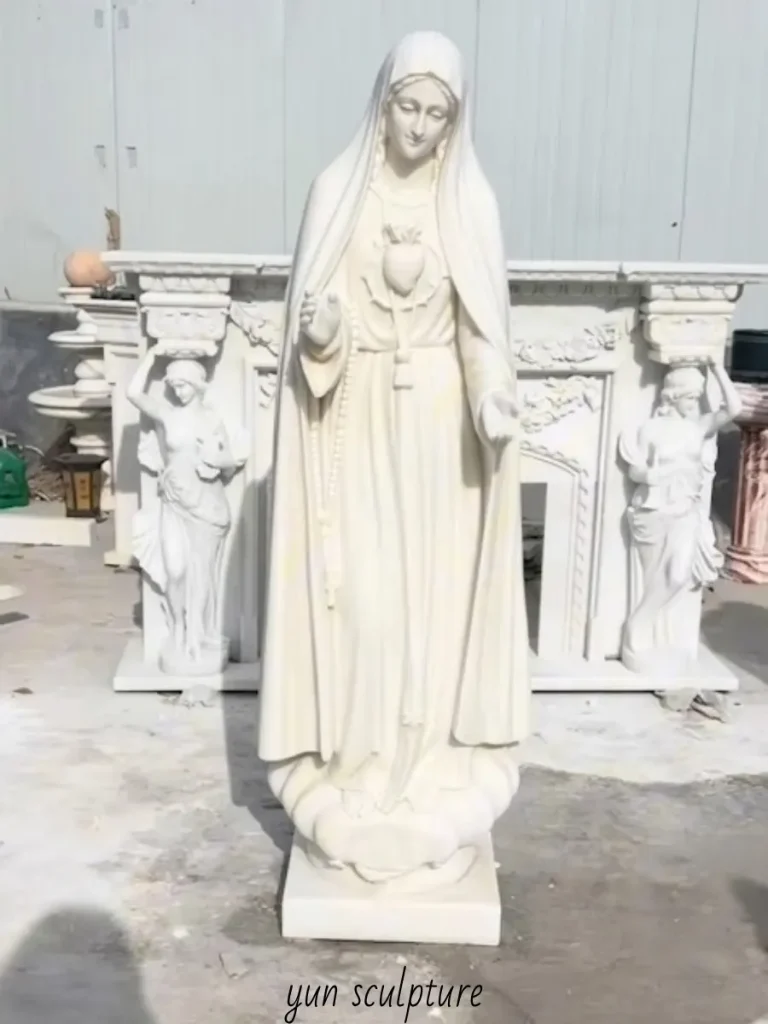
All artistic intensity concentrates in what remains visible: the face, the hands, and the heart.
The face carries the entire devotional weight of the piece. Commissioners in the Philippines frequently tell me that the expression of Mama Mary’s face is the most important single element in the commission — more important than size, more important than material. The face must hold serenity and maternal sorrow simultaneously, with sufficient depth and precision to read clearly from the close distances at which processional statues are venerated. Soft, naturalistic features that photograph beautifully in a studio can appear flat or generic in the warm, angled light of a candlelit procession. I adjust the depth of carving and the angle of the brow, eyes, and lips specifically for processional lighting conditions.
The hands must be anatomically precise and capable of conveying their gesture — typically presenting the Immaculate Heart — even when partially obscured by vestment sleeves. If the hands are too small relative to the figure, or positioned too close to the body, they disappear under fabric and lose their expressive function.
The heart projection is the critical structural calibration. It must extend sufficiently beyond the garment line that vestment layers do not obscure it — the heart’s visibility is the entire point of the Immaculate Heart devotion, and a heart buried under silk loses its theological function. Donghui specifies the projection depth on every vestment commission based on the expected number of fabric layers and the weight of materials the parish typically uses.
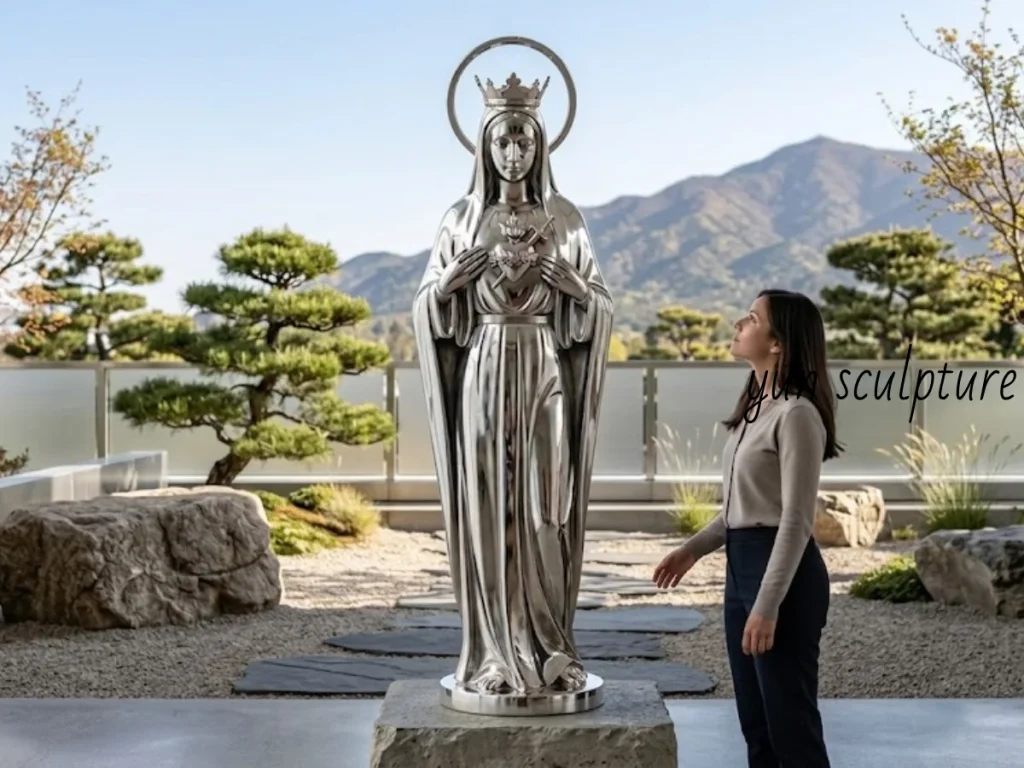
What Makes a Philippine Processional Commission Different From a Fixed Installation?
Weight is the variable that changes everything else.
A life-size bronze statue for a fixed outdoor shrine installation might weigh 180–220 kilograms. That weight is irrelevant for a poured concrete base in a church courtyard. It is completely incompatible with a statue being carried through city streets by eight parishioners.
Philippine processional statues typically range from 18 to 36 inches — large enough to be visually commanding in a crowd, small enough to be manageable. At 24–28 inches, a well-balanced statue can be carried comfortably by four bearers on a decorated platform. At 36 inches, six bearers are standard. Anything larger requires a wheeled processional float rather than direct carrying.
The material calculus shifts accordingly. For processional commissions, I work with lighter-weight casting alloys and hollow construction where the iconography allows it. The goal is to bring the total weight — statue plus carrying platform — within safe handling range for the volunteers who participate in these processions, who are often not trained in load-bearing and who carry the statue for distances measured in kilometers.
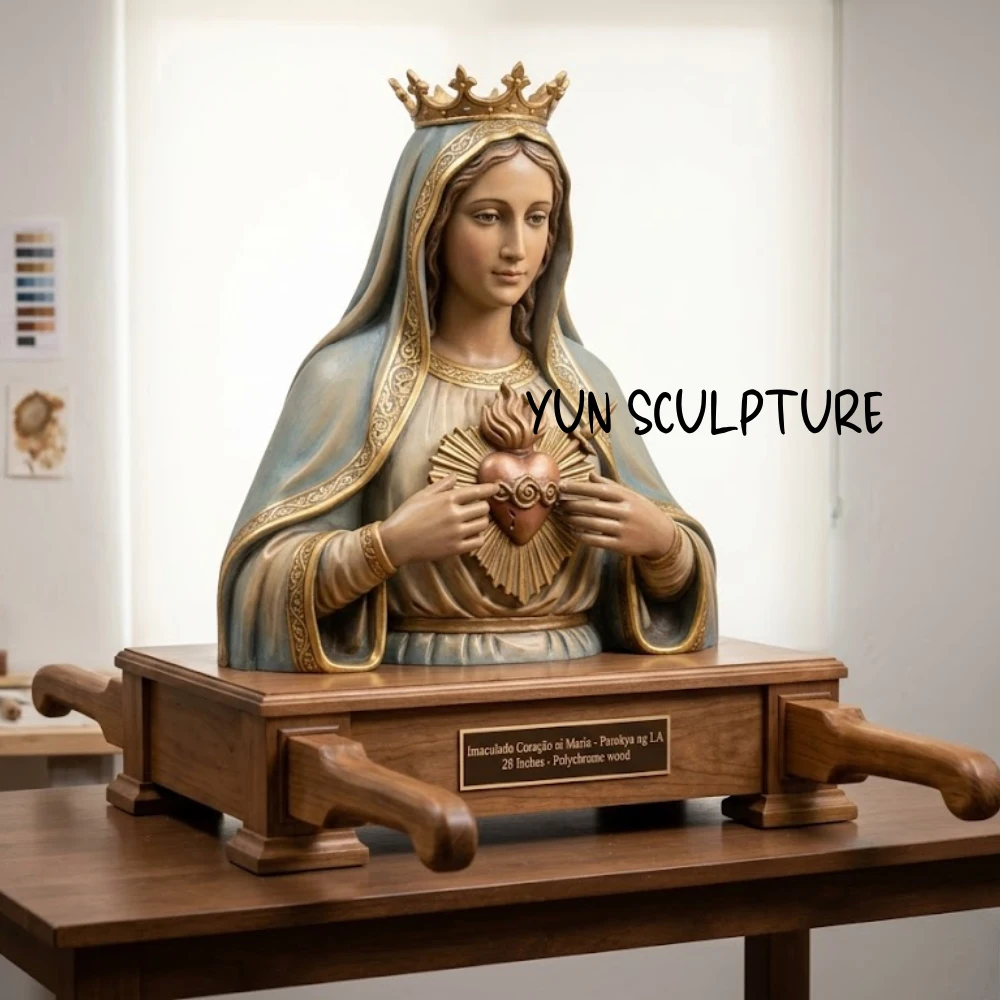
Four carrying handles integrated into the base design are standard on every processional commission. They are not aesthetic additions — they are safety infrastructure. I position them at the natural grip points for the expected number of bearers and test the weight distribution before the statue leaves the workshop. An off-center statue will torque in the hands of its bearers, creating instability that becomes dangerous in a crowd.
Surface treatment for processional pieces prioritizes durability under repeated handling over fine texture detail. Polychrome painted finishes — the warm skin tones, vivid mantle blues, and gold accents characteristic of Filipino Marian iconography — must be able to tolerate fingerprints, incense exposure, the occasional rain shower, and the physical contact of devotional touching without flaking or fading within a few seasons. I apply a protective clear coat formulated for outdoor use that maintains surface vibrancy through repeated processions without giving the figure an artificial gloss.
The base underside gets rubber protective pads on every processional commission — a small detail that dramatically extends the life of the painted base and prevents the statue from slipping on the varied surfaces where it will be temporarily placed during processions.
Commissioning a processional statue for a Philippine parish or Filipino Catholic community? Tell me your expected procession distance and bearer count — I will calculate the right size and weight specification.
For related material and climate considerations in outdoor Marian installations, our Our Lady of Guadalupe outdoor statue guide and our Our Lady of Lourdes grotto guide cover comparable design decisions.
We completed a processional Immaculate Heart commission last year for a Filipino parish community in Los Angeles — a 28-inch figure in polychrome finish, four integrated carrying handles, 42 kilograms total with platform. The parish coordinator told us the previous statue had been a mass-produced resin piece that had cracked at the base after three processions. The finish on the new piece was chosen specifically to match the coloring the community had associated with their previous statue for twenty years — the transition needed to feel continuous, not like a replacement. That kind of brief takes time to get right. We spent two weeks on color matching before production began.
FAQ
What are the crying statues of Mary?
Weeping Marian statues have been reported across the Catholic world, with documented cases in Akita, Japan; New Orleans; Colima, Mexico; and multiple locations in Italy and the Philippines. We cover the phenomenon in detail — including the material science explanation and why solid marble and bronze are structurally different from porous composites — in the first section above.
Where is the biggest Mama Mary statue in the Philippines?
The world’s tallest statue of the Virgin Mary is the Mother of All Asia — Tower of Peace, located at Montemaria International Pilgrimage and Conference Center in Sitio Montemaria, Barangay Pagkilatan, Batangas City, Philippines. Standing 98.15 meters including its plinth, it holds the record for the tallest Marian statue globally. The pilgrimage center covers eight hectares and draws visitors from across Asia. The scale of the statue reflects the central place of Marian devotion in Filipino Catholic identity — Mama Mary is not a peripheral figure in Philippine spirituality but a constant, living presence in community and family life.
What is the oldest image of Mary in the Philippines?
The oldest extant Marian statue in the Philippines is the wooden Black Madonna enshrined at the Ermita Church in Manila, venerated locally as Our Lady of Guidance and recognized as the patroness of navigators and travelers. The statue predates Spanish colonial religious art in the Philippines and represents a tradition of Marian devotion that extends to the earliest period of Christianity in the archipelago. A separate claim to historical significance belongs to the Santo Niño de Cebú — the image of the Holy Child Jesus — brought to the Philippines by Ferdinand Magellan in 1521 and the oldest Christian relic in the country, now enshrined at the Basilica del Santo Niño in Cebu City.
What is the most famous Mother Mary statue?
Michelangelo’s Pietà (1499), housed in St. Peter’s Basilica in Vatican City, is widely considered the most famous sculpture of the Virgin Mary — a Carrara marble masterpiece showing Mary holding the body of Christ after the Crucifixion, created when Michelangelo was 24 years old. Among devotional statues specifically — images created for veneration rather than artistic contemplation — Our Lady of Fatima, Our Lady of Guadalupe, and Our Lady of Lourdes are the most widely reproduced and recognized globally. In the Philippines specifically, the International Pilgrim Virgin Statue of Fatima holds particular prominence, and local patronesses such as Our Lady of Peñafrancia in Bicol draw enormous annual processions.
What happens if you break a Mary statue?
A damaged or broken Marian statue is treated with the same reverence as any sacred object in Catholic tradition. It should not be thrown in ordinary trash — damaged sacred images are typically buried in consecrated ground, burned with the ashes buried, or taken to a parish for proper disposal. Small cracks or chips in stone or bronze statues can often be repaired professionally without compromising the piece’s integrity or devotional function. For marble statues, a skilled conservator can fill hairline cracks with color-matched stone compound. For bronze, welding repairs are standard for structural breaks. The appropriate response to accidental damage is repair where possible, respectful disposal where not — and in neither case is the devotional value of the image believed to be affected by the physical damage.
What do Filipinos call the Virgin Mary?
Filipinos call her Mama Mary — an expression of intimate, maternal relationship rather than formal theological distance. We explain what this relational quality means for how Filipino parishes commission, use, and interact with Marian statues in the second section above.
Factory Direct · Quyang, China
Get an Exact Quote for Your Mary Statue
Tell us the size, pose, and any custom requirements — we respond within 24 hours with a detailed price breakdown, no obligations.