Get in touch with Yun-Sculpture company
St. Joseph the Worker Statue for Churches, Schools, and Labor Organizations

A large st joseph statue commissioned for a church courtyard, a school entrance, or a union hall is a different purchase entirely from a garden statue ordered online. The scale is different, the material requirements are different, the installation engineering is different — and most importantly, the institutional message is different. This guide covers what serious buyers need to know before commissioning, including why Canadian winters demand bronze and why Philippine parishes require something else entirely.
Table of Contents
Table of Contents
Who Is the Patron Saint of Labor Day — and Why Does It Matter for Institutions?
St. Joseph the Worker is the patron saint of workers, and his feast day falls on May 1 — the same date as International Workers’ Day, by deliberate design.
Pope Pius XII placed the feast there in 1955 as a theological counterstatement to communist labor ideology: the true model of the worker is not a revolutionary class figure, but the silent craftsman of Nazareth who provided for his family through skilled daily labor. We cover the full Cold War history behind this decision in our Feast of St. Joseph the Worker guide.
What this history means practically for institutions: a St. Joseph the Worker statue is not merely devotional decoration. It is a public declaration. When a Catholic trade union installs a life-size bronze Joseph in its headquarters courtyard, or a vocational school places him at the workshop entrance, the sculpture makes a visible statement about the organization’s values — that labor is sacred, that workers have dignity, that craftsmanship is a form of vocation.
This is why institutions do not buy these statues from catalog pages. They commission them. The difference matters enormously. A catalog piece is manufactured to a standard size and finish, then shipped. A commission begins with a conversation about what the institution wants to say, where the sculpture will stand, and what material can carry that message for the next fifty years.
Which Institutions Commission Large St. Joseph Statues — and Why?
Five institutional types return to this commission more than any others, and each has a distinct reason.
Catholic trade unions and labor federations are the most historically aligned buyers. Many hold May 1st worker blessing ceremonies, and a permanent bronze outdoor statue becomes the focal point — the place where workers gather annually to affirm that their labor is spiritually meaningful, not merely economic. For these organizations, bronze is almost always the right material: it communicates permanence, authority, and public commitment.
Catholic vocational schools and trade programs commission St. Joseph as a symbolic mentor. A life-size figure standing at the entrance to a welding workshop or carpentry training center communicates to students every morning that what they are learning to do with their hands has always been considered holy. Donghui Zhang completed a commission for a Catholic trades school in the American Midwest two years ago — life-size bronze, dynamic pose with a chisel — and the principal told us that parents ask about the statue during every campus visit. It had become part of the school’s identity within the first semester.
Construction companies and Catholic real estate developers use Joseph as a professional patron and a public integrity statement. Dedication ceremonies at project groundbreakings often include a blessing of the statue and a prayer for the safety of workers. The sculpture communicates to clients and employees alike that the organization holds itself to a standard beyond the merely commercial.
Catholic universities — particularly those bearing Joseph’s name — commission large statues as campus anchors. The 1967 bronze St. Joseph at Saint Joseph’s University in Philadelphia remains one of the most referenced examples: a sculpture that has become inseparable from the institution’s identity over nearly sixty years.
Catholic hospitals and healthcare systems choose Joseph for healing gardens and patient courtyards. Healthcare is labor, and the people who perform it — nurses, doctors, aides working double shifts — benefit from a figure who embodies quiet strength and steadfast protection. Marble statues work particularly well in these sheltered environments, where the reflective surface quality of stone suits the contemplative purpose of a healing garden.

Planning a dedication ceremony for your institution’s statue? Tell us your timeline and setting — we can work backward from your May 1st or feast day deadline.
Canada and the Philippines: Two Markets, One Devotion, Very Different Requirements
Geography and culture shape commissioning decisions in ways that material specifications alone cannot capture.
Canada has one of the deepest St. Joseph devotions in the world. Quebec was officially consecrated to St. Joseph in 1624, and Saint Joseph’s Oratory of Mount Royal in Montreal — built through the lifelong devotion of Brother André Bessette — is the largest shrine dedicated to Joseph anywhere on earth. Canadian churches, schools, and religious communities have been commissioning St. Joseph statues for centuries.
What Canadian winters demand is bronze. Snow accumulation, freeze-thaw cycling, and temperature swings between -30°C and +35°C will destroy marble surface detail over decades, particularly fine carved elements like tool textures and facial features. A white marble statue belongs inside a Canadian institution — in a chapel, a cloister, or a covered entrance hall. For any exposed outdoor installation in Canada, cast bronze is the only material with the structural resilience to handle those conditions without maintenance intervention year after year.
I have had Canadian parish administrators tell me they learned this the hard way — a beautiful marble figure that looked magnificent at installation, degrading noticeably after its third winter. Bronze does not have this problem. It weathers into a deeper, richer surface with each passing season.
The Philippines presents an entirely different set of requirements. St. Joseph the Worker is celebrated on May 1st as both a religious feast and a national labor holiday — one of the few countries where the two calendars align completely. Parish celebrations involve processions: statues carried through neighborhoods, through streets, through communities gathering to mark the day together.
A statue built for procession cannot be engineered like a statue built for a fixed courtyard. Weight becomes critical — a life-size bronze that works perfectly in a Canadian church garden is physically impossible to carry in a Filipino street procession. Philippine commissions typically favor lighter construction, polychrome painted finishes that read expressively at close range during processions, and structural balance optimized for being carried rather than anchored.
The colors matter too. Gold accents signal holiness. Warm skin tones make faces readable in natural outdoor light. The devotional aesthetic is warmer and more intimate than the patinated bronze preferred in North American institutional settings — and that difference is not a matter of quality but of cultural context and devotional function.
For related multi-figure commissions that serve similar institutional and community devotional purposes, our Holy Family statue guide and our St. Joseph and Jesus workshop scene guide cover comparable design and material decisions in detail.
What Does a Large-Scale Institutional Commission Actually Involve?
Most institutions approaching this kind of commission have never done it before. The process has four stages, and understanding them prevents the most common mistakes.
Stage one: brief and site assessment. The commission begins with dimensions — not of the statue, but of the space. A sculpture that reads powerfully in a small chapel garden can disappear against a large stone facade. Donghui reviews site photographs and architectural drawings before recommending scale, because the relationship between the figure and its environment determines whether the final installation feels monumental or merely present.
Stage two: clay maquette approval. Before a single chisel touches marble or a wax model goes into the investment casting process, a scale clay maquette is produced and approved. This is the stage where tool selection, pose, facial expression, and gaze direction are locked in. Changes at this stage cost time but not material; changes after casting or carving cost both. Institutions that skip or rush maquette approval almost always regret it.
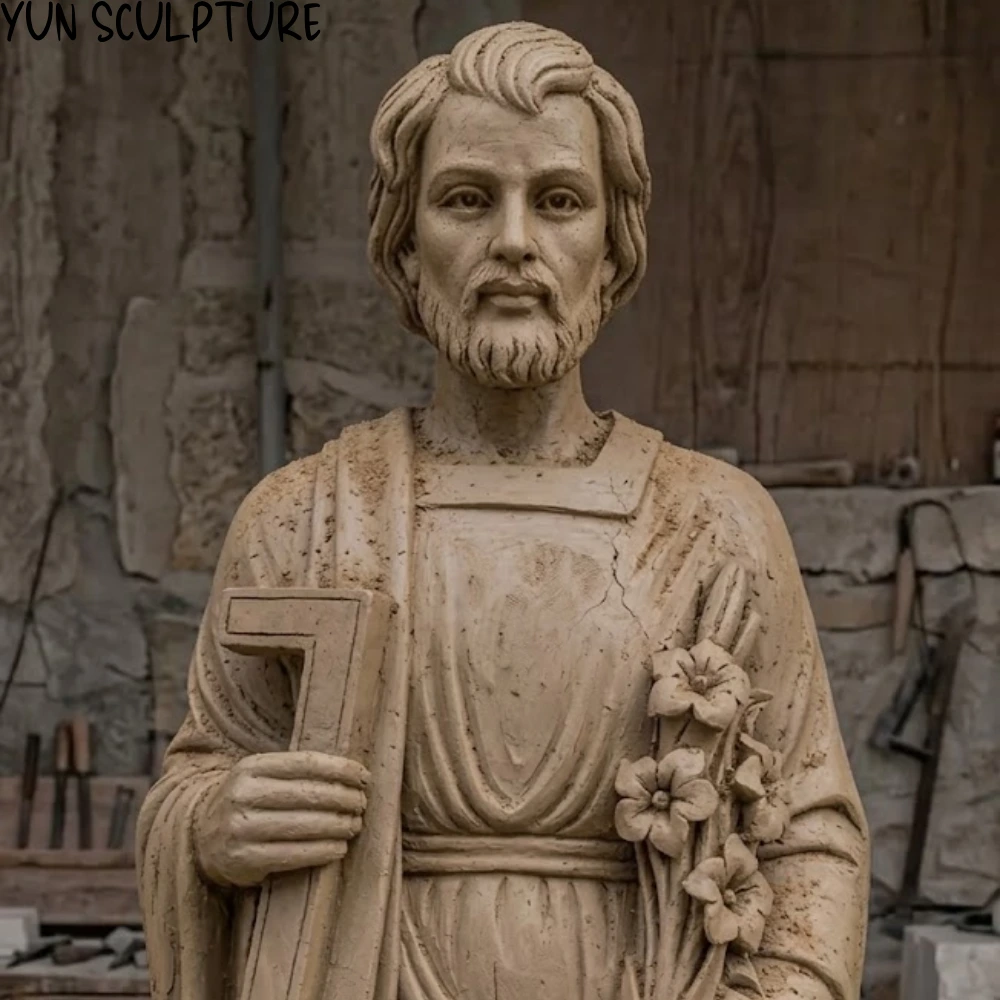
Stage three: production. A life-size St. Joseph the Worker in bronze runs 40–50 working days from maquette approval to shipping. The equivalent in marble takes 35–45 days. For institutions with a specific dedication date — a May 1st ceremony, a school year opening, a building consecration — production scheduling needs to account for international shipping time: 15–25 days to US or European ports, longer to Canada’s western provinces or the Philippines.
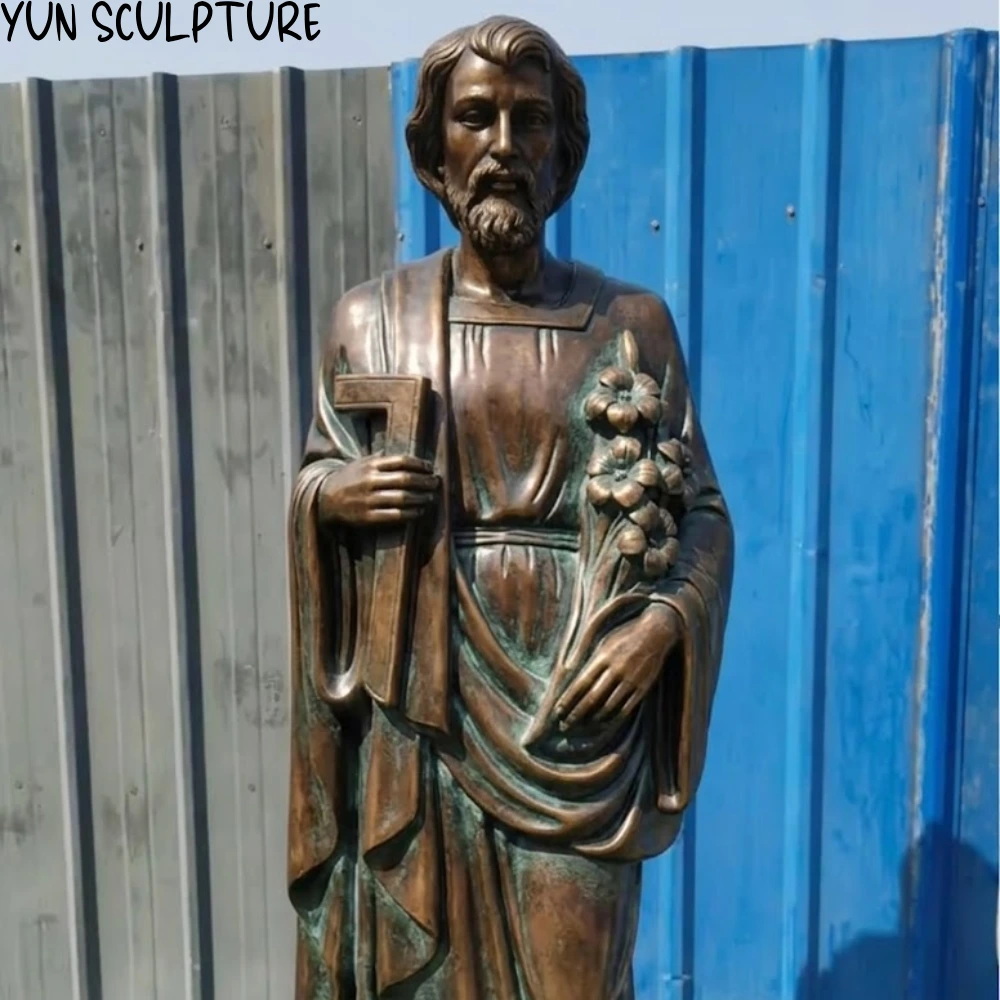
Stage four: installation. Life-size bronze outdoor statues require an 18–24 inch concrete base with anchoring hardware. Statues above 8 feet require engineering-grade wind load calculations and steel rod foundation systems. These are not optional for institutional outdoor installations — they are safety requirements. We provide installation specifications with every commission, and we recommend clients engage a local contractor for the foundation work before the statue arrives.
FAQ
Who is the patron saint of Labor Day?
St. Joseph the Worker is the Catholic patron saint of workers and the figure most closely associated with May 1st labor observances. His feast was established on May 1, 1955 by Pope Pius XII specifically to offer a theological response to communist International Workers’ Day — presenting the Nazareth craftsman as the true model of labor dignity rather than a revolutionary class ideology. In countries where Catholic and civic calendars overlap on May 1st — particularly the Philippines — St. Joseph’s role as patron of workers and patron of Labor Day are treated as inseparable.
What is St. Joseph’s Miracle?
The miracle most associated with St. Joseph in popular Catholic devotion is the miraculous blooming of his staff — the sign used, according to tradition, to identify him as the chosen spouse of Mary. Among candidates for Mary’s hand, Joseph’s dry wooden staff alone flowered with white lilies, indicating divine favor. This event is the origin of the lily as Joseph’s symbol in sacred art. In modern devotional life, Joseph is widely associated with answered prayers for employment, housing, family protection, and a peaceful death — not through dramatic supernatural events, but through the steady, providential intercession of a saint whose entire earthly life was defined by faithful response to God’s will.
How do I ask Saint Joseph for a job?
Catholic tradition addresses St. Joseph for employment through direct prayer, often a novena — nine consecutive days of prayer — asking for his intercession in finding work suited to one’s abilities and responsibilities. The prayer most commonly used invokes Joseph’s own experience as a provider: a craftsman who fed and housed the Holy Family through skilled daily labor. For institutions commissioning a St. Joseph the Worker statue specifically to honor their workforce, the statue itself becomes a focal point for this kind of prayer — workers passing it each morning, May 1st blessing ceremonies gathering around it. The physical presence of the sculpture gives the devotion a place to land.
Who is the most famous saint in the Philippines?
The Santo Niño — the Holy Child Jesus — is arguably the most deeply venerated religious figure in the Philippines, with the Basilica del Santo Niño in Cebu housing the oldest Christian relic in the country. Among the saints properly, the most widely celebrated include St. Lorenzo Ruiz, the first Filipino martyr and canonized saint, and Our Lady of Peñafrancia, patroness of the Bicol region. St. Joseph occupies a significant place in Filipino Catholic identity specifically through the May 1st feast, where the alignment of his feast day with national Labor Day gives his image particular prominence in parish processions and worker devotions throughout the country.
How to place a St. Joseph statue in your yard?
For a garden or yard installation, placement depends on the statue’s purpose. A St. Joseph the Worker statue placed as an institutional or devotional focal point belongs at the entrance or in a central garden position where it can be seen on approach — not tucked in a corner. For outdoor bronze installations, the base should sit on level ground with concrete anchoring; for marble in garden settings, a sheltered position away from direct rain exposure and freeze-thaw conditions will preserve surface detail over years. Facing the statue toward the primary viewing direction — the path people walk as they enter — ensures the figure’s expression and tools read clearly. The statue should feel like it is greeting the space, not observing it from the margins.
Commission a Statue That Speaks for Your Institution
A life-size St. Joseph the Worker in bronze or marble will still be standing in your courtyard in fifty years. The ceremony will be a memory by then. The statue will not.