Get in touch with Yun-Sculpture company
Your small companion, given a lasting form
Custom Chihuahua Statues in Bronze
Commission a Chihuahua statue around the face, ears and posture you want to recognise. Choose a bronze portrait at your dog’s actual size, or an enlarged garden figure that holds its place among the plants.
The design starts with your Chihuahua and its future setting. Smooth or long coat, seated or standing, dark patina or warmer highlights: each choice is agreed for your sculpture.
Discuss your Chihuahua on WhatsApp ↗A few dog photographs and a picture of the display space are enough to start. You can decide the remaining details with us.
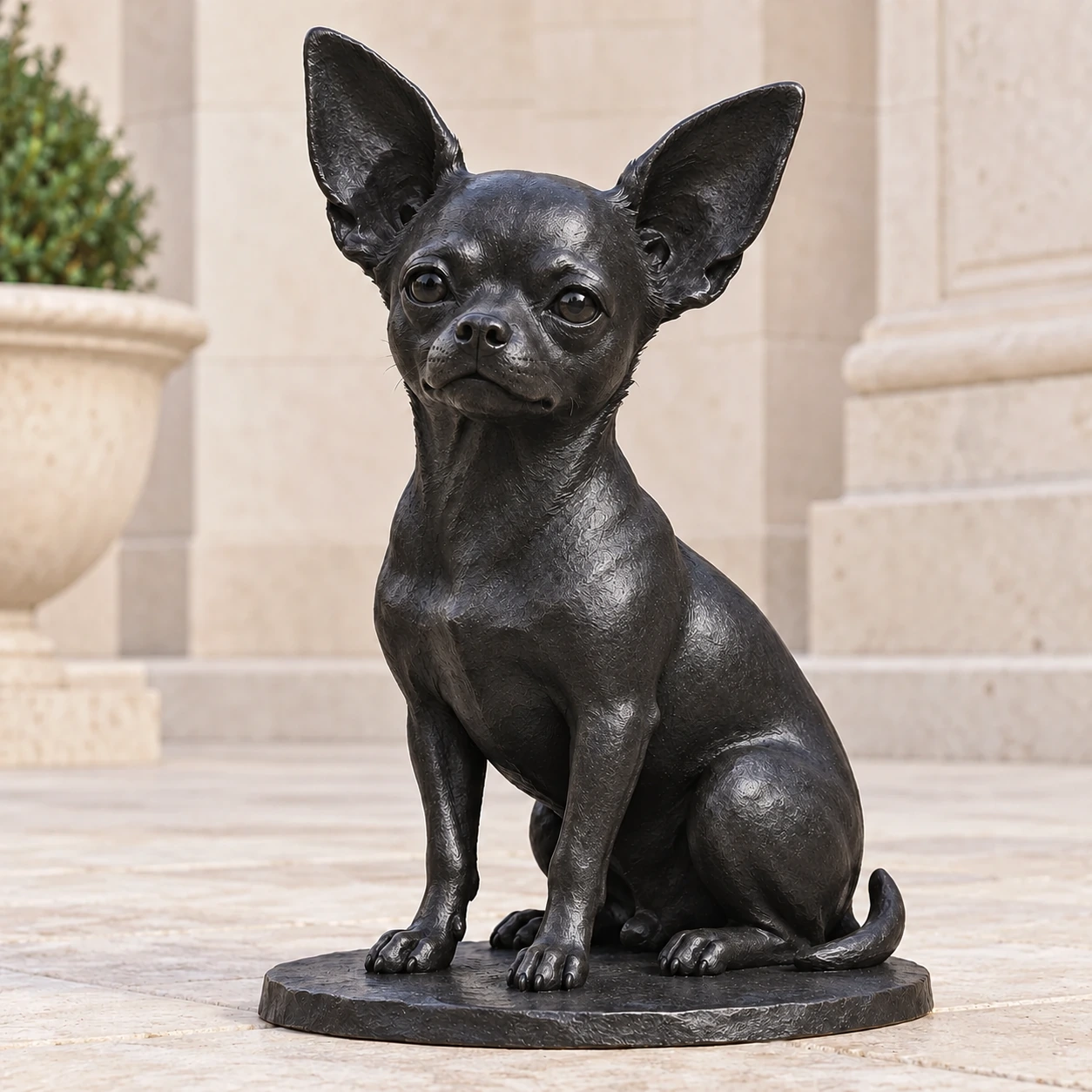
Individual portraits from photographsActual size or enlarged designsPose, coat and finish reviewed together
Choose a direction, then make it personal
Chihuahua sculpture design ideas
These concepts help compare outlines, display settings and material directions. A breed figure can begin with an idea you like; a portrait of your own dog should be adjusted to its individual proportions and familiar expression.
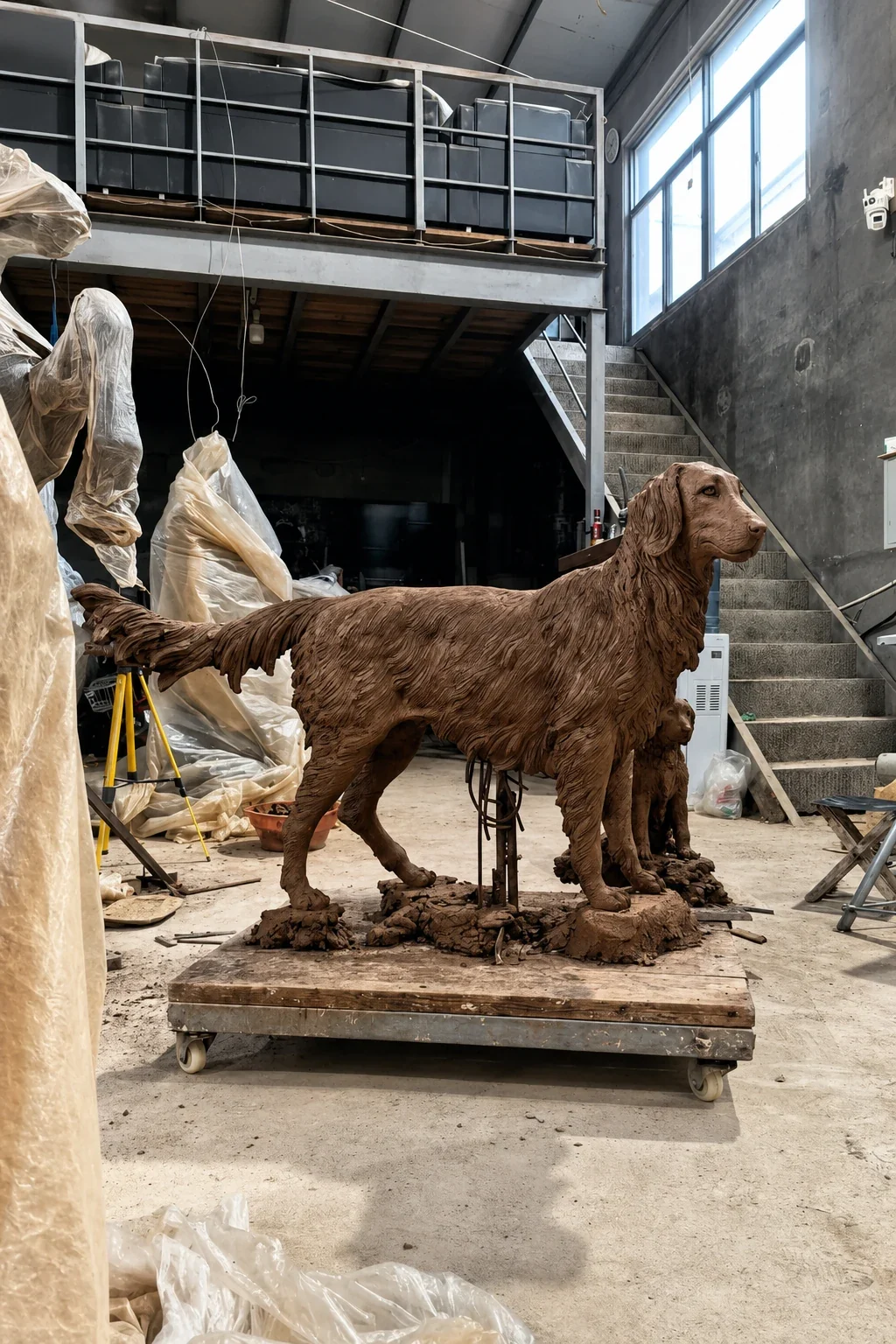
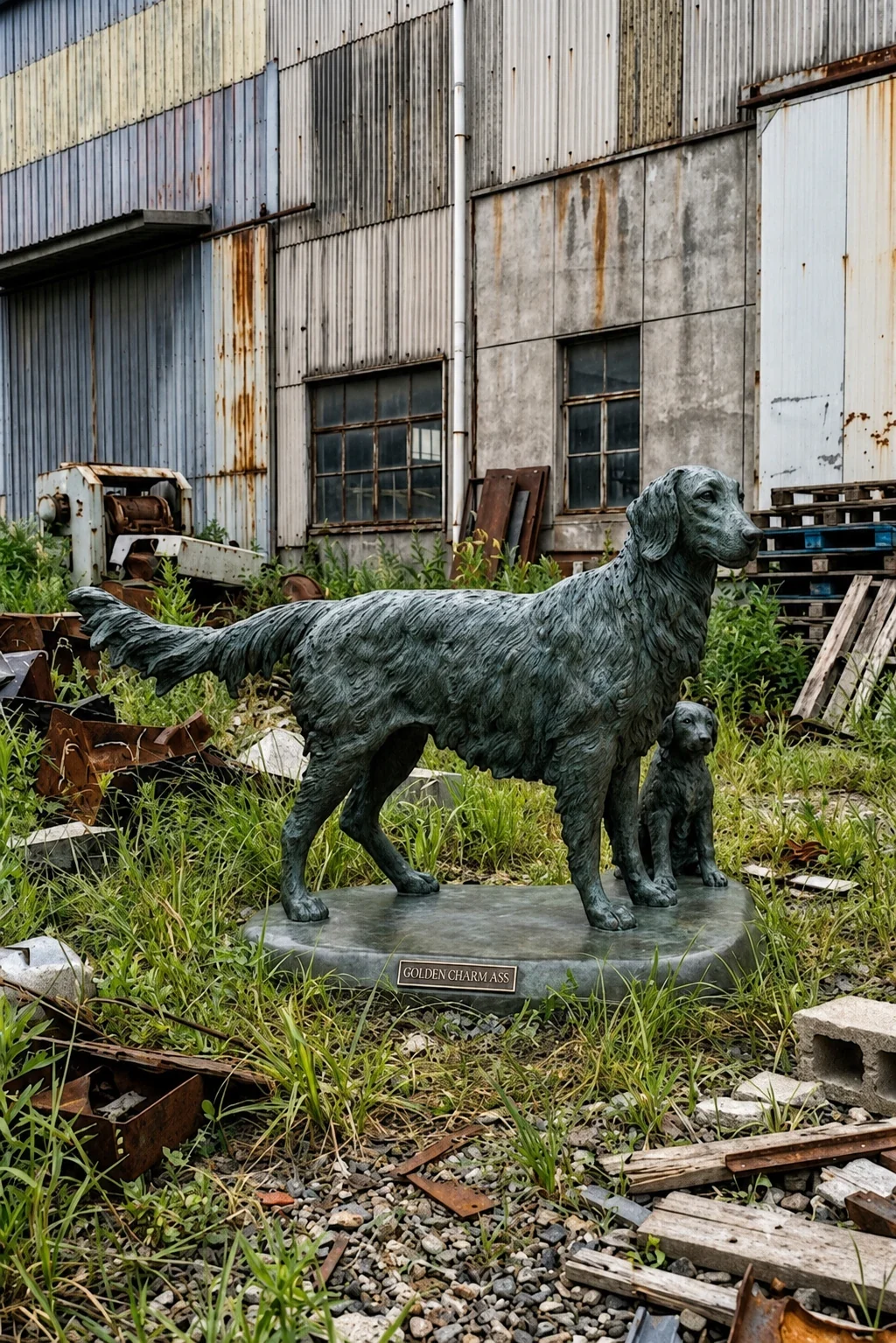
All Chihuahua images on this page are AI design concepts, not photographs of completed commissions or stock products. The two workshop photographs below show a separate dog-and-puppy project.
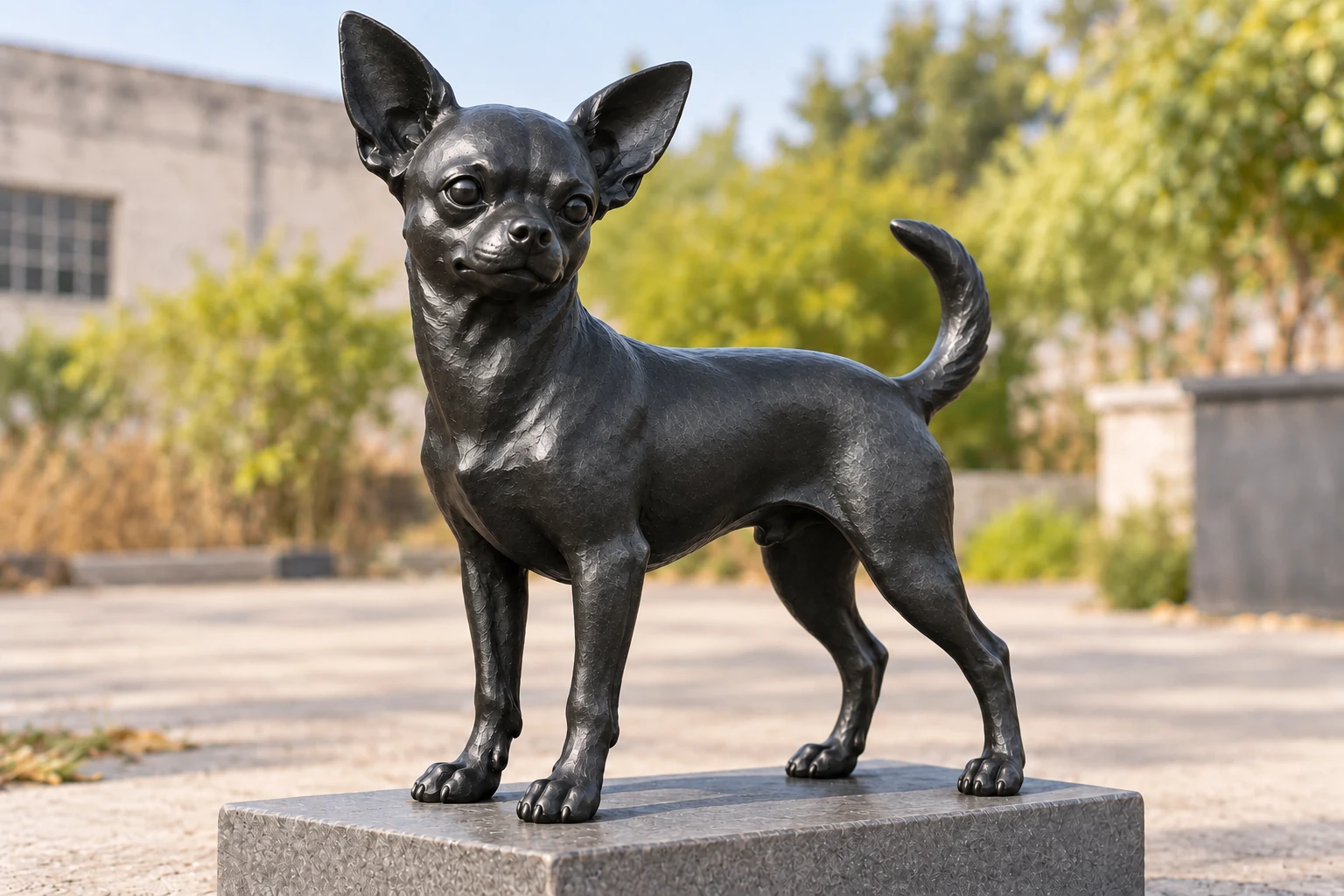
Standing smooth coat
Compare the body line, stance and tail. A standing pose needs more space from nose to tail than a compact seated composition.
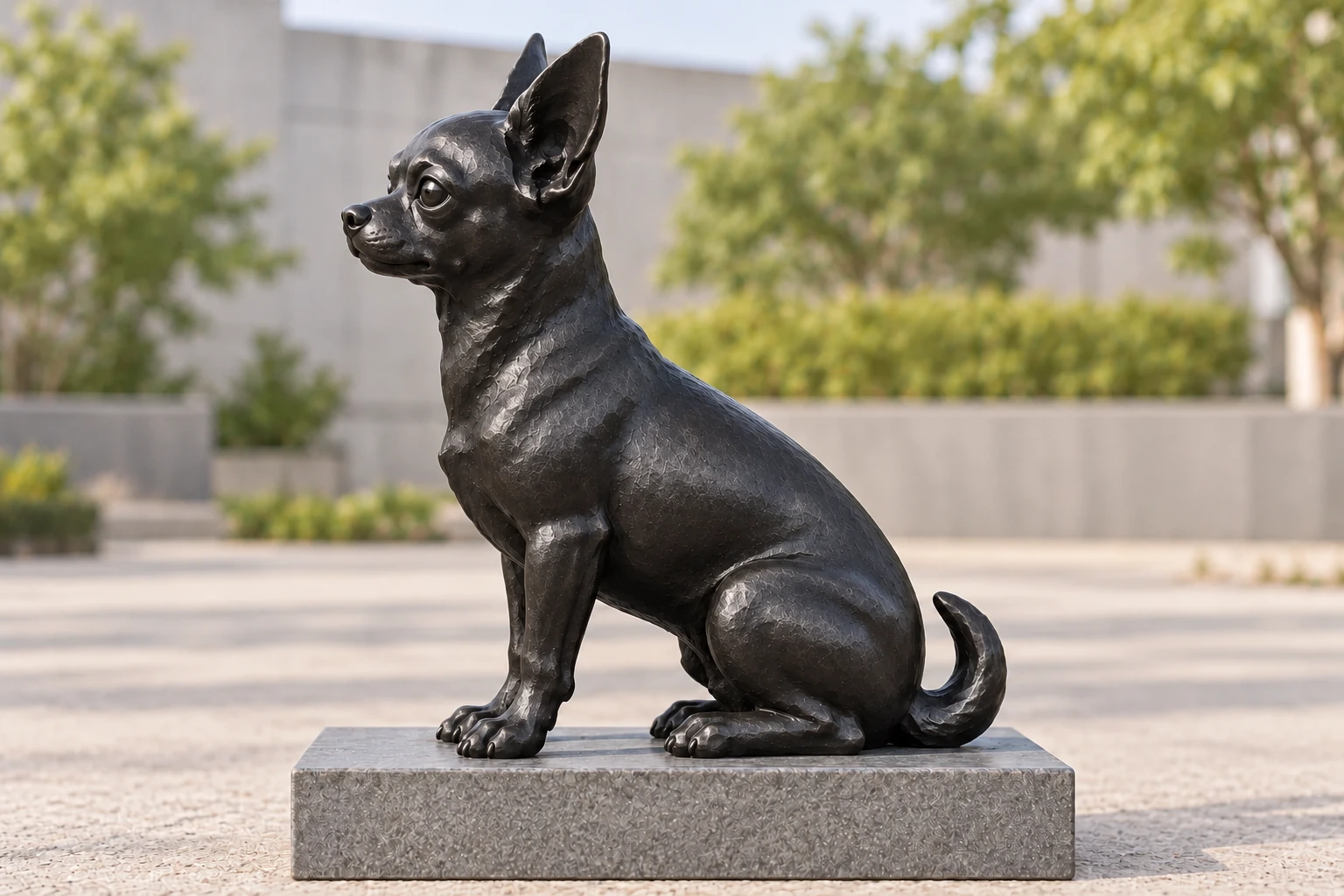
Seated side profile
Use the side outline to discuss muzzle length, head direction and body proportions. Choose the head angle with the final display position in mind.
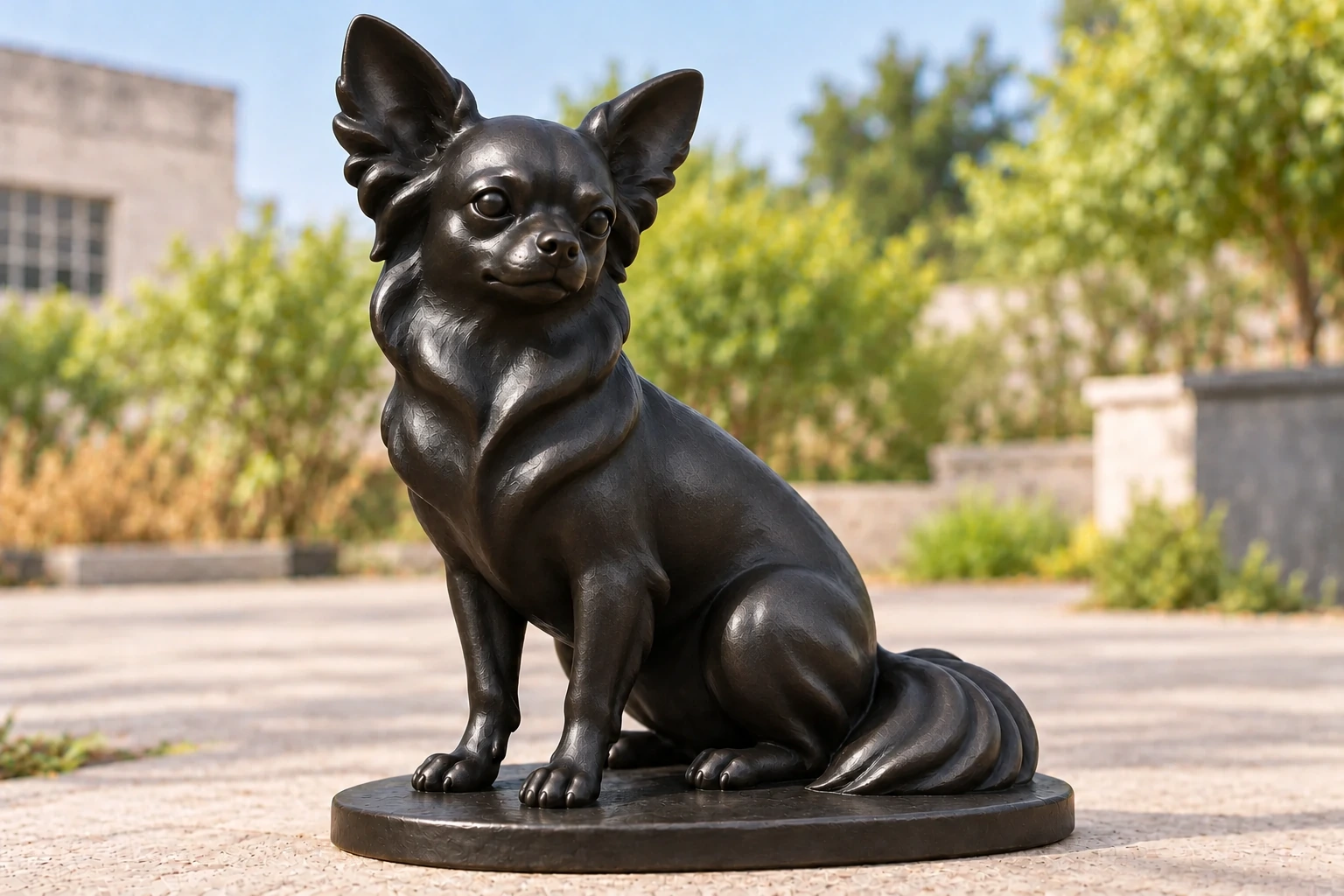
Long coat, grouped detail
The neck ruff and fuller tail use broad sculpted forms. Compare your dog’s coat outline before choosing how much texture belongs in the portrait.
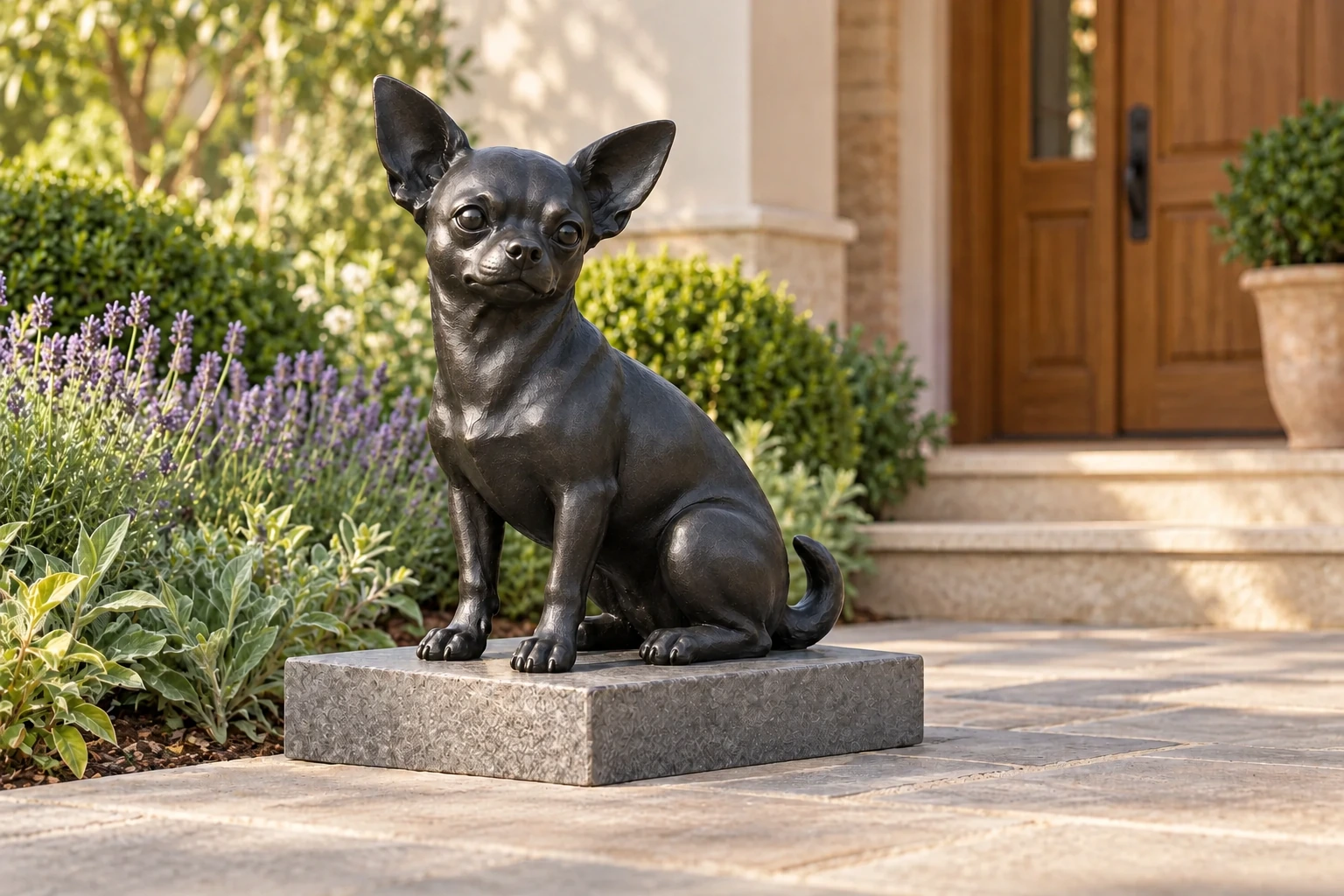
Porch garden placement
Compare the figure with the planting and the main viewing position. The pictured setting does not establish the sculpture’s dimensions or fixing requirements.
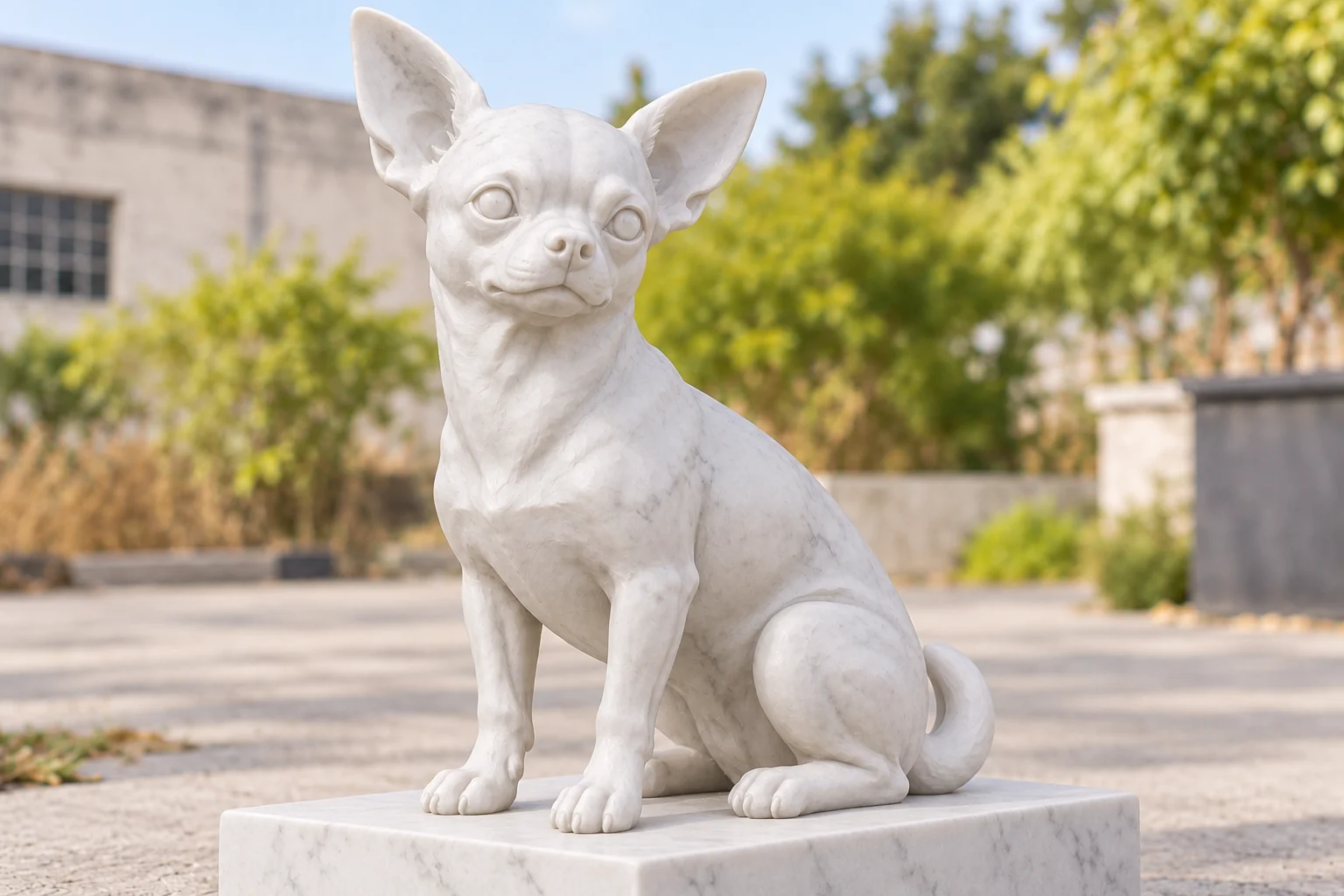
White marble interpretation
A quiet stone surface puts more emphasis on the silhouette. The ears, leg gaps and support need a carving design agreed for the selected stone.
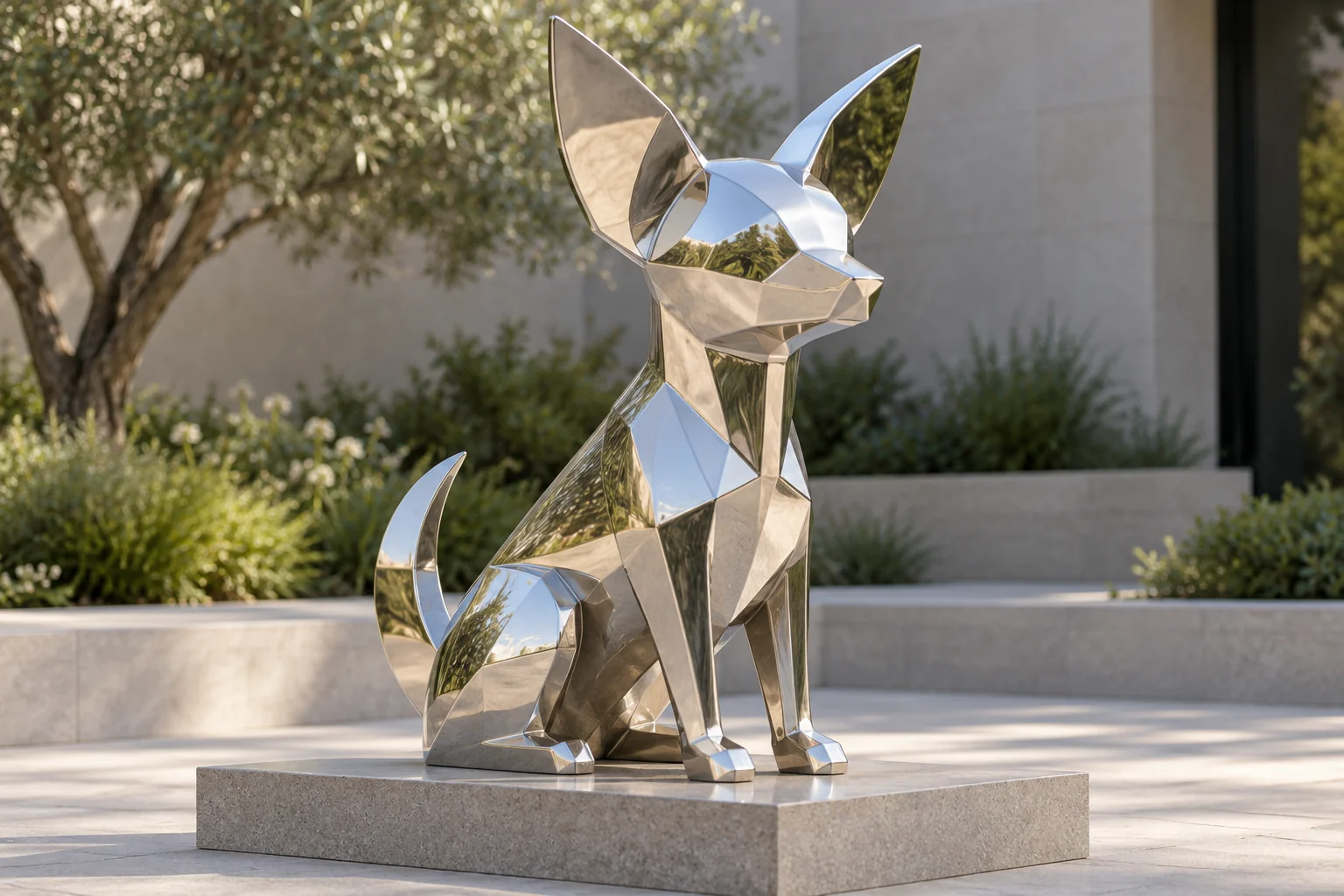
Abstract mirror steel
Broad planes and a simple ear-and-body outline carry the breed. Choose this as an abstract interpretation rather than a detailed bronze portrait in another metal.
Prefer a different head angle, a relaxed mouth or a familiar ear that folds? Send the photograph that explains it. Our personalized dog statue guide explains the wider portrait process; the choices below focus on what matters for a Chihuahua.
Recognition begins with the silhouette
Keep your Chihuahua’s head, ears and expression
A small dog can lose its identity when the sculpted head becomes too heavy, the muzzle too broad or the ears too upright and symmetrical. Decide which details make the portrait feel like your companion before deciding how much surface texture to add.
A general breed figure or an individual portrait?
A general Chihuahua figure offers a recognisable design without reproducing one particular dog. An individual portrait uses your photographs to preserve the features you remember: a longer muzzle, a narrower face, an uneven ear, a full neck ruff or the angle of the head when looking up at you.
People often describe head shapes as “apple head” or “deer head.” Those words help start a conversation, but they are not enough to define a portrait. Two dogs given the same label may have very different profiles. Send a front view and a side view, and point out the appearance you want preserved.
Your pet does not need to match a show description. An older dog, a mixed-breed companion or a Chihuahua with one folded ear can be represented according to its own appearance. Avoid correcting a familiar feature into a generic catalogue face.
Five features to check together
- Head and muzzle: compare the forehead, nose length and jaw in front and profile views.
- Ears: review their shape, spacing and natural direction; one ear may sit differently.
- Eyes and mouth: choose the expression through sculpted form, rather than relying on shine or painted details.
- Neck and chest: keep the relationship between the small head, body and coat outline believable.
- Tail: check its direction, fullness and where it rests or joins the composition.
A favourite face photograph is useful, but close phone-camera views can exaggerate the nose. Add a more distant photograph when available.
The AKC Chihuahua standard provides a reference for the rounded skull, prominent ears and smooth or long coats. We use breed references to understand form; your dog’s photographs guide an individual portrait.
Smooth coat and long coat need different treatment
For a smooth-coated Chihuahua, broad facial and body surfaces carry much of the character. Gentle modelling around the shoulders, chest and muzzle can be more useful than covering the figure with small fur marks. In a dark finish, the edges of those forms need enough light to remain readable.
For a long-coated Chihuahua, first identify the outline around the ears, neck, chest and tail. Grouped, shallow coat forms can retain that outline without turning every hair into a separate sharp projection. The goal is your dog’s coat distribution, not a uniformly fluffy body that could belong to another small breed.
Check the coat from the intended viewing distance. Detail that looks impressive in a close image may disappear across a garden. Conversely, deep ridges intended to read from a distance can feel excessive on a small sculpture displayed beside a chair.
Small dog, deliberate scale
Actual size or an enlarged Chihuahua garden statue?
A life-size Chihuahua statue has no single catalogue height. The individual dog, chosen pose, head direction, ears and base all affect its dimensions. A seated figure may be taller at the ears while occupying less length than a standing figure of the same dog.
Start with the experience you want. Is the sculpture a quiet companion seen close up, or a focal point noticed from a window or across a planting bed? Enlarging the dog and raising its support are different decisions: one changes the figure itself; the other changes its position.
| Display situation | Useful starting direction | Check before agreeing dimensions |
|---|---|---|
| Beside a chair, bench or nearby path | An actual-size portrait can keep the intimate relationship with a small companion. | Whether the face is visible from your usual seated or standing position. |
| Among flowers or taller planting | Consider an enlarged figure, a clearer foreground position or a suitable raised support. | The mature planting height and the outline behind the head and ears. |
| Seen across a lawn or from a window | Compare an enlarged design with the garden’s other focal points. | The real viewing distance, overall silhouette and surrounding visual clutter. |
| On a shelf, console or indoor pedestal | Choose dimensions around the display surface and how closely the face will be viewed. | Support capacity, base footprint, overhead clearance and all viewing sides. |
| A personal memorial position | Choose actual size or enlargement according to the place and the posture you remember. | Space for any separate name plaque, flowers and access for care. |
Keep the dog’s scale separate from the base
Write down the dog’s body length and, where appropriate, shoulder height. Then confirm the sculpture’s highest point, maximum length and maximum width in the chosen pose. The width may include a tail beside the body; height may be measured to an ear tip.
Specify the integral sculpture base and any separate stone plinth independently. “A 50 cm sculpture” is ambiguous if one person means the dog and another includes the support. A dimensioned model or drawing should identify the reference points clearly.
Enlarge the whole composition
An enlarged Chihuahua should remain a Chihuahua. Keep the head, body, legs, ears and tail in the agreed relationship; increasing only the ears or forehead can change the character into a caricature.
Enlargement can also affect supports and the expression of small details. Review the model at the intended overall scale, then confirm base dimensions and fixing requirements for that version. A smaller concept image does not establish the weight or construction of a larger piece.
A simple placement test before ordering
Mark the proposed base footprint with cardboard or tape. Use a temporary upright marker to represent the highest point, and view it from the path, window or seat where you expect to see the sculpture. Photograph that test from the main viewpoint and send it with your enquiry.
This checks visible height and available space; it does not test the strength of a shelf, plinth or foundation. For a planted setting, consider how foliage changes through the year. Avoid choosing the figure’s size from an empty winter bed if the face will be hidden by summer growth.
For a Chihuahua statue for a garden entrance, keep the walking route clear and decide how visitors approach the face. Our front porch dog statue guide covers the broader entrance layout and measurement process.
Choose the moment you remember
Seated, standing or looking up?
A seated Chihuahua often places the face and ears at the centre of a compact composition. A standing design gives more attention to the body line, stance and tail. Neither is automatically the more accurate portrait: the familiar posture and display position should decide.
Seated and attentive
This direction can suit a near-view garden position or an indoor display where you want the face to be prominent. Check the front paw spacing, back shape and how the tail sits beside the body. Avoid forcing a perfectly symmetrical posture if your dog usually sat differently.
Standing and alert
A standing figure needs room from the nose to the furthest tail point. Review the silhouette from the main side view as well as the face. The legs, paws and base form a single design problem; their proportions should be agreed before the surface finish becomes the focus.
Head turned or looking up
A small change in head direction can make the sculpture feel more familiar. Specify what the dog is looking toward in its final location. A portrait planned for a low position may need a different head angle from one displayed at eye level.
For a relaxed or sleeping memorial, send the posture you remember rather than adapting an alert catalogue idea by description alone. If photographs show different ages or grooming styles, identify which period should guide the portrait. Other images can still help explain the body or tail.
Request front, side and rear model views. A convincing front view can conceal an incorrect body length or tail attachment. If the sculpture will be visible from all sides, the back and underside relationship to the base also deserve attention.
Choose the material and the interpretation together
Bronze Chihuahua statues, natural marble and abstract steel
Cast bronze for an expressive portrait
A bronze Chihuahua statue can combine recognisable anatomy with restrained hand-modelled texture. We use the lost-wax casting route for bronze work; the modelling approach and construction are confirmed around the agreed sculpture.
Choose how the face, coat and surface should read together. A short-coat figure can use calmer planes. A longer coat can use broader grouped forms around the ruff and tail. Eyes and nose can be sculpted in the same bronze rather than depending on glass inserts or painted animal features.
For a Chihuahua bronze portrait, distinguish the metal specification from the patina and protective surface finish. A warm gold-toned highlight is an appearance direction, not evidence that the sculpture is brass. Confirm the actual material in the quotation.
Dark satin or warmer highlights?
A deep brown finish can give a quiet, cohesive outline. Warmer raised areas can make selected forms easier to see, while a smoother polished treatment gives stronger reflections. Ask which effect you prefer under ordinary daylight, not only under a dramatic studio light.
A dog’s coat colour and bronze patina are different visual systems. For a black, cream or marked Chihuahua, decide whether you want the portrait carried primarily by its shape, by restrained surface tones or by a separately discussed colour treatment.
The colour reference should be reviewed independently from the model. Approving the ears and body proportions does not automatically approve the finish; a surface reference does not prove the likeness.
Outdoor care starts with the location
For a Chihuahua garden statue, consider irrigation, soil contact, drainage, coastal exposure and access for cleaning. An easily overlooked small figure can be vulnerable to gardening equipment, so give it a deliberate position and a suitable support.
The Canadian Conservation Institute’s outdoor-object guidance treats the sculpture, its support, site and maintenance as parts of the same planning decision. Agree care for your selected finish; our bronze maintenance guide provides further reading.
Approve the form before the final material
What to review in your Chihuahua model
Your photographs and brief guide a model that can be reviewed before the final sculpture is made. The agreed review stage may use a digital model, a physical clay model or both, depending on the commission. Confirm the review format with the quotation.
| Review view | Compare with your references | A useful way to request a change |
|---|---|---|
| Front and three-quarter face | Ear spacing, cheek width, eyes, jaw and the relationship of head to neck. | “The left ear should lean farther outward, as in this photograph.” |
| Clear side profile | Forehead-to-muzzle transition, nose length, body length and head direction. | “Please retain the longer muzzle visible in this side view.” |
| Rear and tail side | Coat outline, hindquarters and where the tail sits beside or above the body. | “The tail should rest against the right side rather than extend behind.” |
| Full figure with dimensions | Highest point, maximum length and width, base and any separate plinth. | “The stated height should exclude the separate stone support.” |
Specific observations make a revision clearer than “it does not look like my dog.” You do not need technical anatomy terms: identify the area, describe what feels different and attach the photograph that shows the intended feature.
If you have only older photographs, start with those. We can identify which views provide useful information and which details need interpretation. An AI concept helps discuss a direction; it cannot supply missing evidence of your individual dog’s appearance.
Understand what you are commissioning
What belongs in your Chihuahua statue quotation?
The scope changes with the size, pose, individual modelling, coat treatment, material, finish and base. A new portrait is different from a general breed design; an enlarged long-coat sculpture is different from a small smooth-coated figure even when both depict a Chihuahua.
Ask the quotation to identify the sculpture dimensions, material and finish, model review, base or inscription, protective packing, shipping destination and delivery terms. Confirm who handles unloading and installation, including any separate support. A delivery quote does not automatically include setting the sculpture in its final position.
For a memorial, specify whether the name and dates belong on the integral base or a separate plaque. An ashes compartment requires its own design agreement. Share any intended ceremony date early so production, review and transport can be considered separately; the schedule should be confirmed for your project.
You can begin with the dog photographs and intended location, then compare suitable options before fixing every detail. A budget range is useful if you have one, but you do not need to solve the casting, finish and installation specifications before making contact.
Before choosing your design
Chihuahua statue questions
Can you make a statue of my own Chihuahua from photographs?
Yes. Send your preferred photographs and describe the pose and individual features you want preserved. The model review is where you check the likeness against those references. Missing views should be discussed before the form is approved.
Can you represent a longer muzzle or one folded ear?
Those individual features can be part of the portrait. Use clear photographs to explain them, rather than relying only on a head-type label. Your Chihuahua does not need to be remodelled to match a show description.
What is the height of a life-size Chihuahua statue?
It depends on your dog and the chosen pose. Shoulder height, height to the ear tips and total height including a base are different measurements. Agree the reference points on a dimensioned model instead of assuming one breed-wide size.
Can you make an enlarged Chihuahua for a garden?
Yes, an enlarged version can be discussed for the intended location. Send a site photograph and approximate display space. The whole figure should retain the agreed proportions, with construction, support and fixing reviewed for the larger scale.
Can I choose a long-haired Chihuahua sculpture?
A long-coat direction can be modelled with attention to the ruff, ear fringes and fuller tail. The individual coat outline and achievable surface detail are reviewed together. The long-coat image here is an AI concept, not a completed commission.
Are these Chihuahua statues in stock?
This page presents custom design directions. The concept images do not confirm inventory, an existing mould or a fixed standard size. Send the image you like so we can confirm the design scope and current production arrangements.
Can I order a small Chihuahua statuette for a shelf?
Send the required dimensions and material for review. Small statuettes are not presented here as a stocked retail range. At a reduced scale, fine details, support and the feasible modelling approach need confirmation before a quotation.
Can the bronze finish match my dog’s coat colour?
Discuss a colour reference separately from the sculpted likeness. Bronze patina, reflected light and a living dog’s coat behave differently. Agree the desired surface treatment rather than assuming a dark or golden concept image is an exact colour match.
Can a Chihuahua statue be made in marble or stainless steel?
Both can be raised as material enquiries. Marble requires a suitable carved interpretation and stone selection. Stainless steel uses our simplified abstract direction, with broad surfaces rather than detailed bronze fur. Each needs its own design confirmation.
Can you include a memorial name, dates or ashes compartment?
A name, dates or plaque can be discussed with the base design. An ashes compartment needs separately confirmed capacity, access and closure details. Our pet memorial statue guide covers the wider planning questions.
What affects the price and delivery time?
The modelling, size, material, coat treatment, finish, base and delivery destination affect the quotation. Model revisions and transport also affect the schedule. We confirm the scope and timing for your commission rather than assigning a fixed price or delivery promise to a concept image.
Start with your Chihuahua
Tell us which face and pose you want to remember
Send a few dog photographs, the concept you like and a picture of the intended position. If you are unsure about the size or material, describe what you want the sculpture to look like in that space.
The images are starting points for discussion. The form, dimensions, material and finish are confirmed for your commission.
Helpful details, when you have them
- Your dog’s photographs and preferred posture.
- Actual-size or enlarged direction, or the available display space.
- Material and finish reference.
- Delivery country and postcode.
- Any name, dates or target event date.