Get in touch with Yun-Sculpture company
The outline you know. The presence you want.
Custom Doberman Statues in Bronze
Choose a Doberman statue around your dog’s familiar head, ears, tail and posture. A composed seated companion and a full standing profile bring different kinds of presence to a garden or entrance.
Explore bronze design ideas with upright or natural dropped ears, then define the complete outline and surface. White marble and simplified mirror steel provide separately developed alternatives.
Discuss your Doberman on WhatsApp ↗Send the design you like or a photograph of your dog. We can develop the ear and tail reference, pose and size from there.
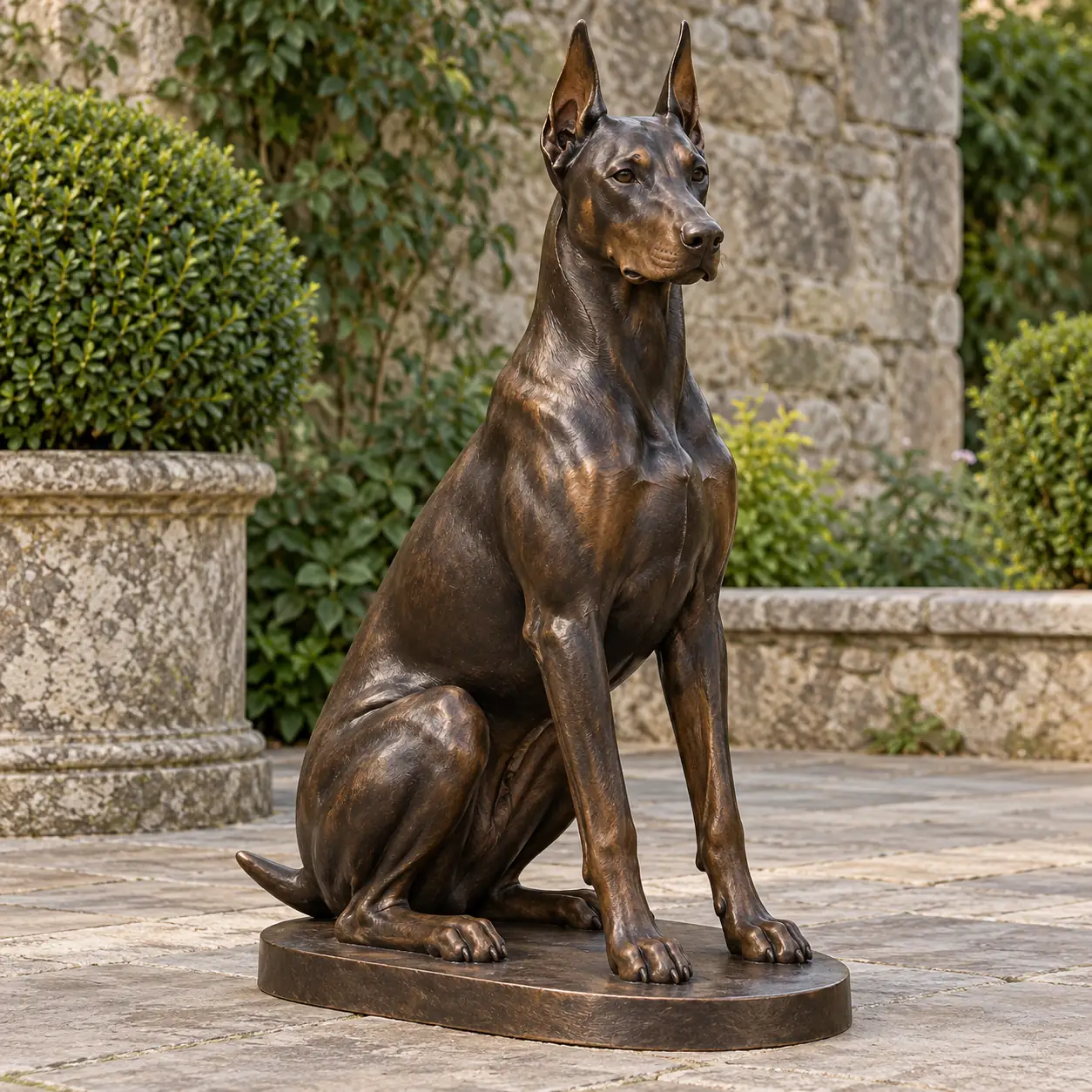
Ears and tail follow your referenceStanding, seated or resting directionsMetal and surface specified separately
Compare the form before the finish
Doberman sculpture design ideas
The gallery offers upright-ear and natural-ear directions in several poses. Treat each as a starting point: you can keep the expression you like while developing a different tail, body position or material.
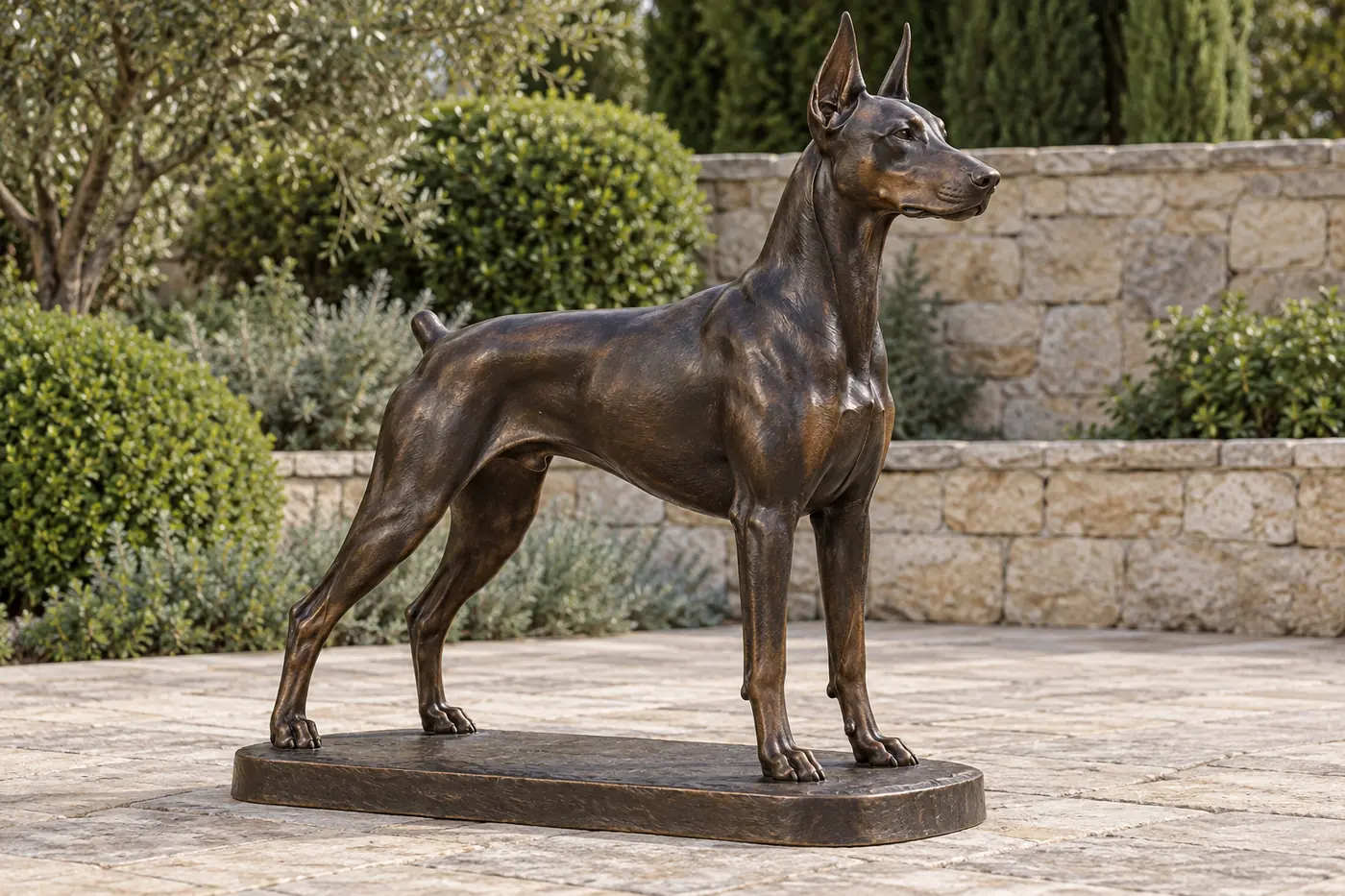
Upright-ear standing bronze
The compact standing silhouette brings the chest and underside into view. Agree the ear angles and the outer dimensions of the complete figure.
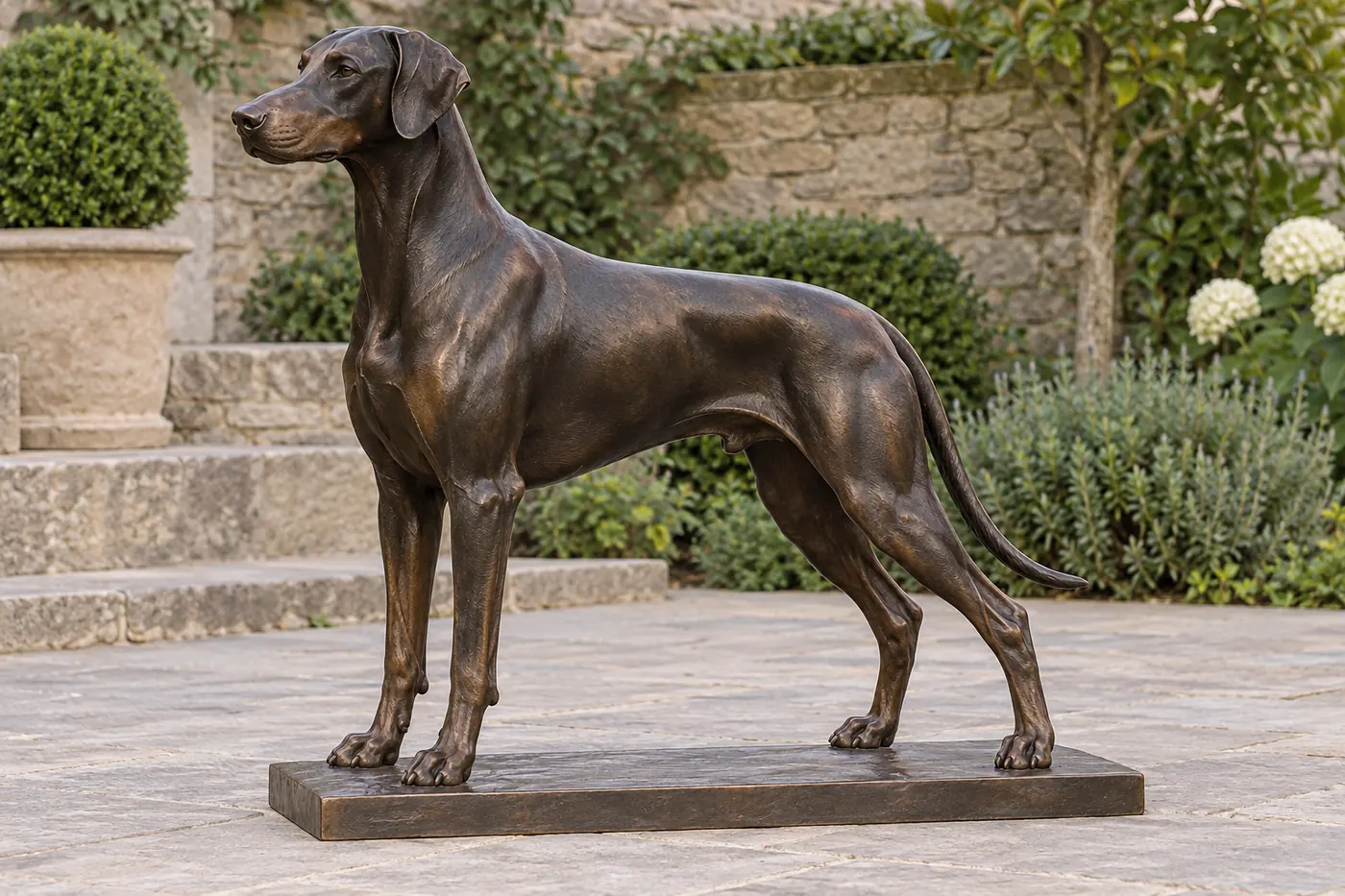
Natural ears and long tail
Dropped ears soften the upper outline while the long tail extends the footprint. Review the full tail curve and endpoint alongside the chosen stance.
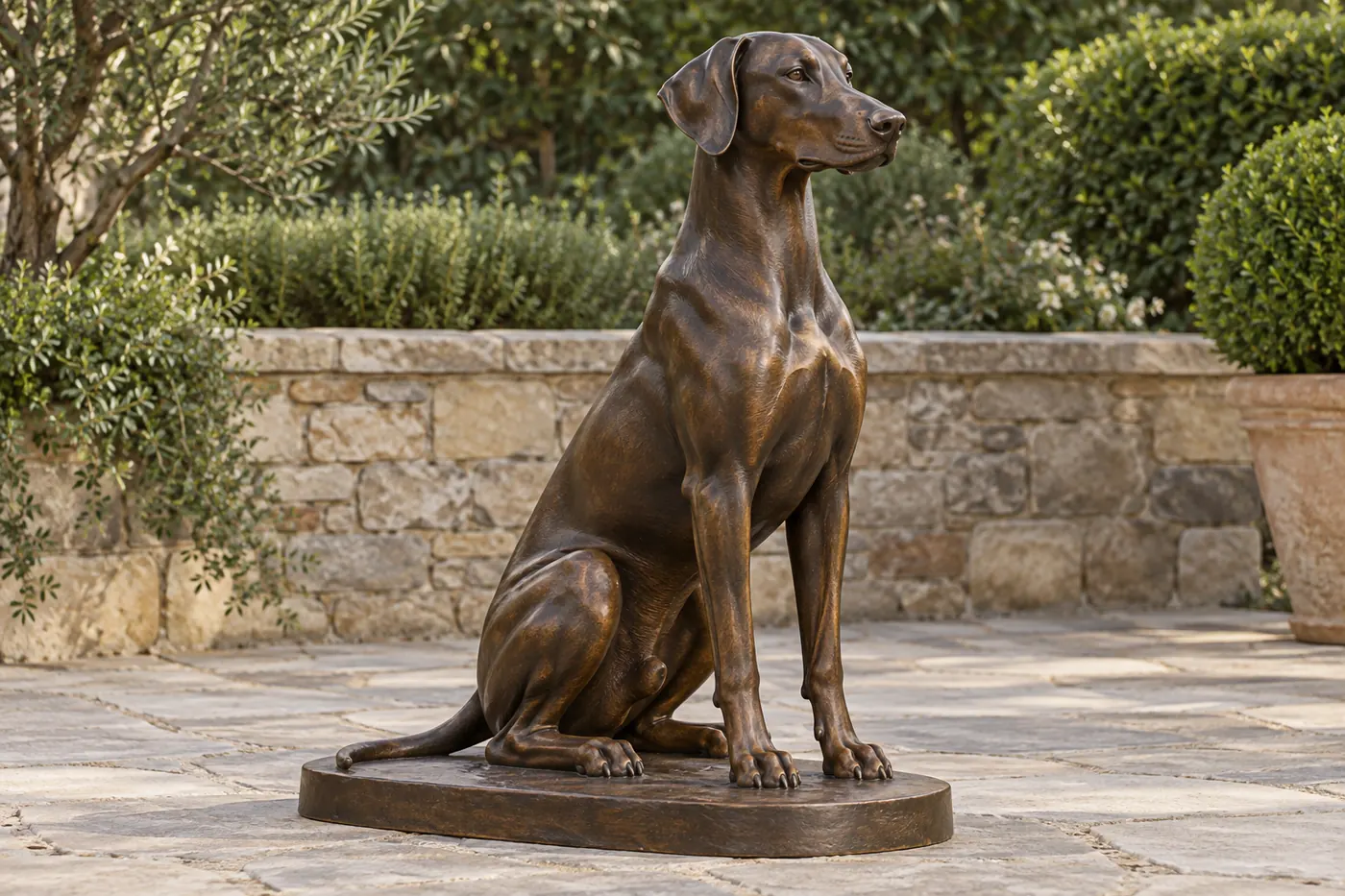
Natural-ear seated bronze
A seated direction with a gentle head turn and warmer raised planes. The long tail remains close to the base; shape and surface can be specified separately.
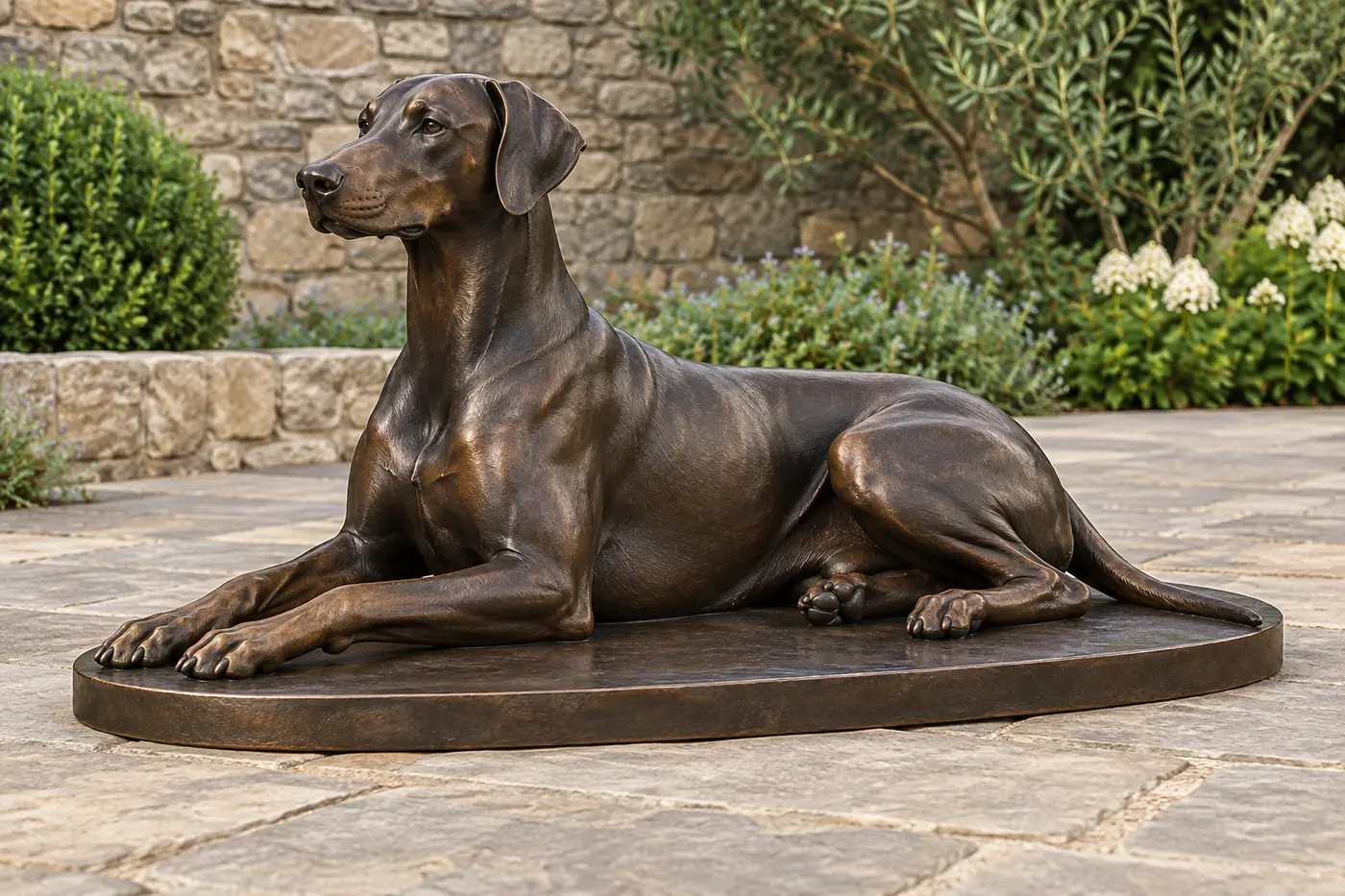
Resting bronze companion
A quieter pose for a closer view beside a seat or garden path. Include the front paws and tail when measuring the complete layout.
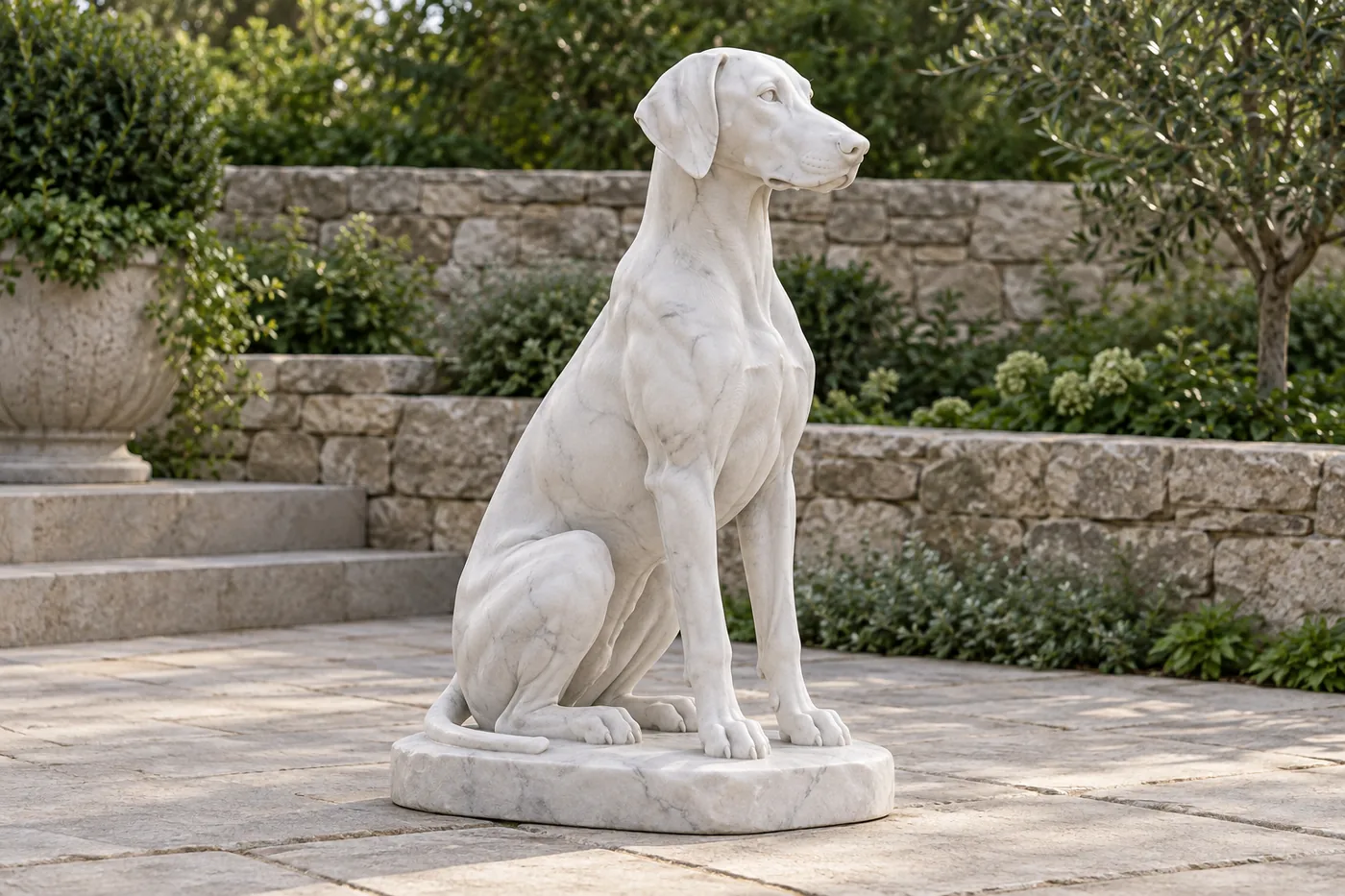
White marble with natural ears
A carved direction with the ears close to the cheeks and the tail resting along the support. Confirm the stone and supported transitions before modelling.
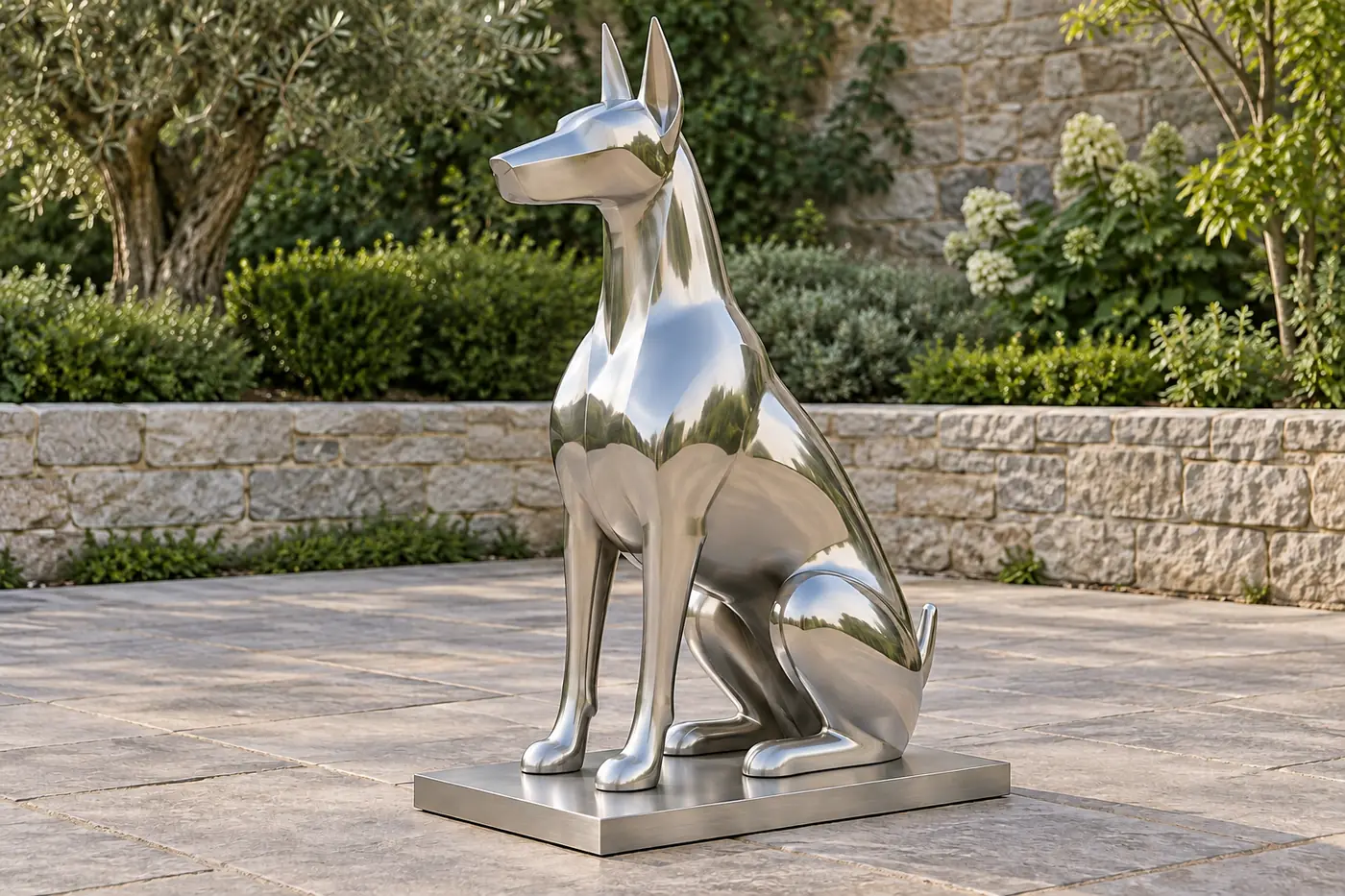
Abstract mirror steel
Broad curves and an upright-ear silhouette provide a separate fabricated interpretation. The cool reflective appearance should be specified with the actual metal.
AI designs by Yun Sculpture. Your own AI image can also become a sculpture brief. For suitable references, our visual-reproduction target exceeds 90%, with material adaptations and model details agreed before approval.
A design can explain the direction; photographs establish the individual dog. See our personalized dog statue guide for the wider portrait process.
Two choices that define the silhouette
Confirm your Doberman’s ears and tail independently
A catalogue image may show upright ears and a short tail. Your own dog may have dropped ears, a long tail or another familiar outline. Specify each feature separately so that choosing a pose does not silently choose the rest of the appearance.
| Feature | Reference that helps | What the model should establish |
|---|---|---|
| Upright-ear appearance | A clear front view and a side view showing the ear height and angle you prefer. | Length, separation, thickness and relationship to the head at the chosen turn. |
| Natural dropped ears | Photographs showing where the folded ears sit against the cheeks. | The folds and visible outer shape without widening the head unexpectedly. |
| Short-tail appearance | A side or rear photograph that shows the complete visible tail. | Its length, direction and connection to the rear of the body. |
| Long tail | A view of the whole tail in the posture you want represented. | The curve, furthest point and whether it remains close to the body or base. |
A head turn changes how the ears are seen
When the head turns, one ear can become more prominent while the other partly overlaps the skull or cheek. Ask for the model at the intended angle, not only facing directly forward. What looks balanced from one view may need adjustment from the usual approach.
For a natural-ear portrait, identify an ear that folds differently or sits farther outward. For an upright-ear reference, mark any variation in angle or height that belongs to the individual. Those differences can matter more to recognition than increasing surface detail.
Show the tail rather than asking the modeller to guess
A front photograph can explain the face but reveal almost nothing about the tail. Add a side or rear reference, and indicate whether the chosen sculpture should preserve a relaxed, lowered or more lifted position.
For a long tail, review the full curve and endpoint in the complete model. Moving it closer to the body changes the sculpture’s outer dimensions and appearance. In stone or a simplified metal interpretation, the tail also needs a material-appropriate connection.
These choices describe the artwork’s appearance. A portrait follows the references you want preserved; a general breed design uses the ear and tail combination you agree. Neither requires adopting every feature of the gallery’s first image.
Recognition comes from the whole form
Review the wedge-shaped head, chest and body outline
The AKC Doberman standard describes a compact, muscular form, a blunt wedge-shaped head, close-fitting lips and a short smooth coat. These help identify the breed; your own dog’s photographs guide a portrait, including features that differ from a general reference.
Keep the muzzle connected to the head
Check how the face broadens from muzzle to skull in front and side views. An overly pointed nose can give a different expression, while a heavy, hanging lip shape can move the impression toward another breed.
Compare the cheek, brow and mouth together. If the face feels unfamiliar, identify whether the concern is its width, muzzle length or expression. Asking for more detail around the eyes alone may not resolve an incorrect overall head shape.
A clear profile photograph helps establish the forehead-to-muzzle transition. Include a more distant image if your favourite close-up makes the nose look much larger than the rest of the face.
Balance the deep chest and tucked abdomen
The transition from the chest into the underside helps describe the athletic figure. Review it with the back, shoulder and hindquarters; exaggerating one area can make the body look too slight or too bulky.
For a portrait, use photographs taken around the same period of your dog’s life. An older companion, a younger athletic dog and a particular resting posture can have different outlines worth preserving.
The front and rear legs should belong to the same pose. Check their placement and the visible space beneath the body before approving the relief or final surface.
A short coat can be expressed through calm surfaces
The bronze designs use broad planes and restrained modelling rather than many individual hair marks. This allows the chest, muzzle and legs to read through their form. A rougher surface does not automatically communicate a more accurate dog.
Ask to compare the model in ordinary lighting as well as a strongly lit render. Deep shadows can make the cheek or shoulder seem sharper; bright highlights can hide a transition you want to review.
Our outdoor dog breed guide covers wider comparisons. Here the review centres on the compact Doberman outline and the specific features of your selected reference.
Choose the moment and the viewing angle
A standing profile, seated companion or resting Doberman
Standing: the body in one clear outline
A standing Doberman reveals the relationship between chest, abdomen and rear legs. It suits a position where the side or three-quarter silhouette can be seen, rather than only the narrow front of the figure.
Agree a calm four-paw stance or another posture from a useful reference. The head angle and tail remain separate choices, with their projections included in the footprint.
Seated: a face that meets the approach
A seated dog brings attention toward the face and chest. An upright-ear appearance can add to its highest point; dropped ears change the upper silhouette without changing the body size.
Look at the gathered hindquarters and tail as well as the front legs. A seated model may occupy more depth or width than its straight-on image suggests.
Reclining: a quieter familiar presence
A resting Doberman can preserve the feeling of a companion nearby. The head is lower, and the front paws become part of the extended layout.
Choose this pose around a closer viewing position, such as beside a seat. Review the face from that height and the full length of the body and tail.
Attentive does not have to mean an aggressive expression
A closed mouth, a gentle head turn or the direction of the gaze can communicate attention without an open jaw or exposed teeth. Identify the expression you recognise instead of relying on the word “guardian” to define the model.
If a relaxed open mouth belongs to the reference, agree its degree of opening and how simply the interior should be modelled. A mouth adjustment can change the entire face, so review it before approving the finished surface.
Keep the important view clear
Photograph the position from where you will usually see the sculpture. A strong side profile can disappear when the dog is turned directly toward that viewpoint. The pose and orientation should work together.
For an entrance pair, consider whether repeating the same direction suits both sides. Agree any differences in head turns and tails, and review the combined arrangement. The individual Doberman brief still needs its own ear, expression and body references.
Three questions behind a surface image
Dark bronze, warm highlights or a silver Doberman statue?
Specify the metal, the surface treatment and the amount of reflection separately. A dark Doberman image can represent bronze with a patina; a silver-coloured one can suggest a different metal or surface. Colour alone does not establish either specification.
| Appearance you like | What it can communicate | What the proposal must confirm |
|---|---|---|
| Near-black or dark brown | A quieter surface that emphasises the head and body outline. | The bronze or other material, patina or coating, and protective treatment. |
| Warm bronze high points | Gentle contrast on raised planes, with darker surrounding areas. | Where highlights appear and how reflective they should be. |
| Silver appearance | A cool metallic visual direction; it does not prove pure silver. | The actual metal and whether the effect comes from polishing, a coating or another agreed process. |
| Mirror reflection | A highly reflective surface that changes with its surroundings. | The metal grade, fabrication approach and mirror finish; reflected scenery is not part of the metal’s colour. |
Choose the contrast on the face deliberately
On a smooth Doberman head, a bright cheek or brow can become a focal point. Decide whether you prefer a largely dark surface or more visible warm high points. A close render may amplify that contrast more than ordinary daylight does.
Use a finish reference to show the effect, then ask which areas of your model receive it. The same patina direction can read differently on a broad shoulder and a smaller face. Confirm the surface after the model’s planes are established.
Coat markings and bronze highlights are different choices
If you want your dog’s markings represented, provide colour photographs and identify what should be retained. Warm highlights on raised bronze are not an automatic reproduction of markings above the eyes, on the muzzle or across the chest.
You may prefer a monochrome sculpture that preserves the face through shape, or a separately reviewed surface interpretation. Ask for the intended treatment rather than expecting the material name to establish the dog’s coat colour.
For silver, ask what the object is actually made from
The mirror-steel concept on this page is an abstract stainless steel direction. It is not a silver-metal product or evidence that an existing bronze model can be given that effect without another design review.
If your reference instead suggests a silver-coloured coating or plated surface, we can assess the requested appearance as part of the material proposal. The process, suitability and any project-specific care need confirmation. No particular coating is implied by the word silver.
Compare a reflective sculpture against its planned background. Trees, paving and nearby buildings will appear in the mirror surface. If you want a calm, even appearance, explain that preference alongside the colour reference.
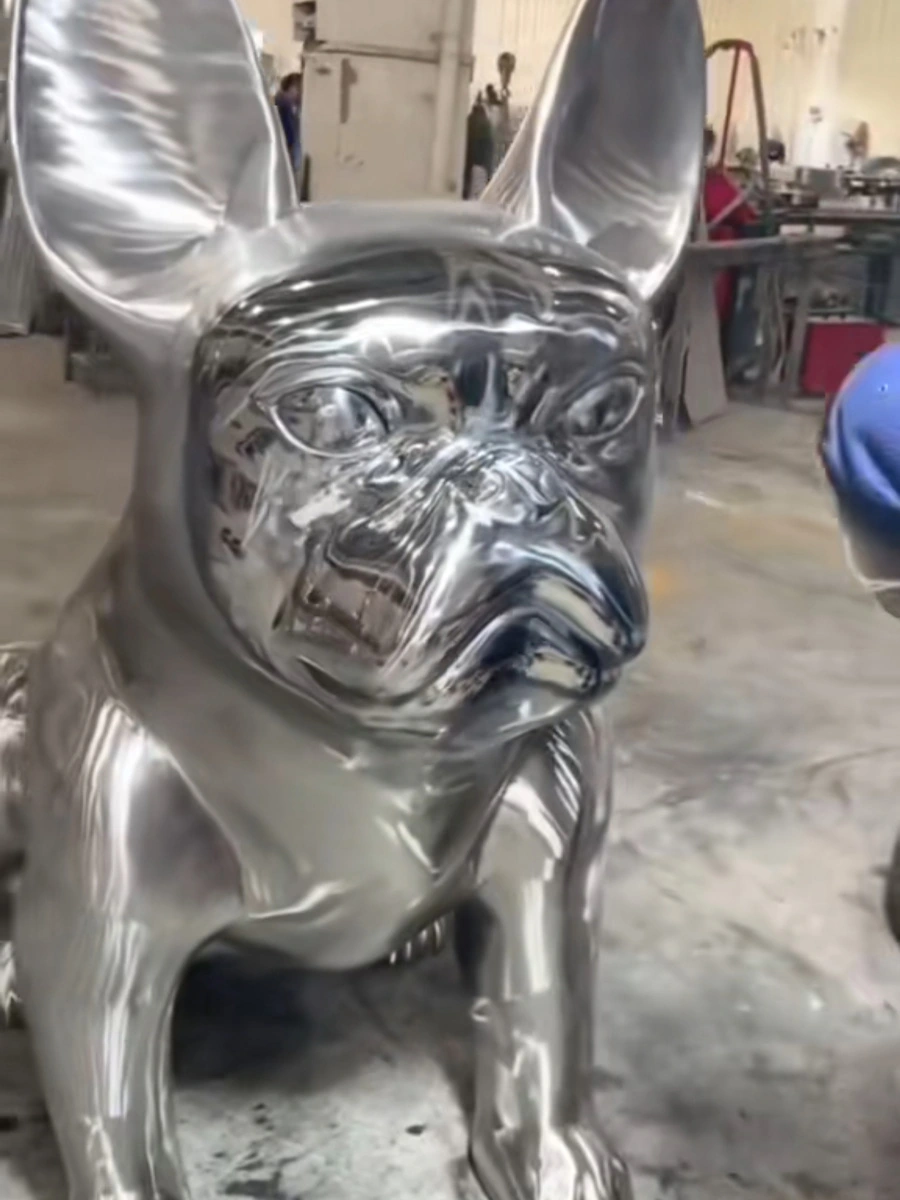
Mirror steel shown on an actual sculpture
This head detail shows mirror-polished stainless steel on a separate dog project. Its reflections help explain the appearance of a steel option when discussing a silver-looking Doberman. Choose that effect alongside the material and level of modelling you want; the photographed detailed face is not the simplified Doberman steel design.
Measure the selected version
Define a life size Doberman statue around your reference
Life size can refer to your own dog or an agreed general breed model. Establish that reference first, then confirm maximum height, length and width in the selected pose. The shoulder height of a standing live dog does not give the overall height of a seated sculpture, ears or pedestal.
| Design decision | Dimension to review | What can change |
|---|---|---|
| Upright or dropped ears | Height to the highest point in the complete model. | The ear tips may become the upper limit rather than the skull. |
| Head turned toward a path | Outside width and the nose’s position relative to the base. | The muzzle can extend toward a walking route even when the paws remain inside the support. |
| Short or long tail | The full length and width to its furthest point. | A lowered, curved or side-resting tail creates a different outer boundary. |
| Seated or reclining posture | Complete depth and paw-to-rear layout. | Gathered hindquarters or extended front paws change the space occupied. |
| Integral base and separate plinth | Each support’s dimensions and the combined installed height. | The arrangement can be wider or taller than the figure alone. |
Give the outside dimensions, not only the body’s length
A torso measurement leaves out the muzzle, paws and tail. Ask for labelled outer dimensions of the actual model and make clear whether the base is included. The view used for those labels should show the figure’s intended orientation.
When a long tail is revised, return to the footprint check. Keeping it closer to the body can change the width; placing it behind can change the depth. Choose that position for the composition, not merely to make an earlier dimension appear to fit.
Keep enlargement and support height separate
An enlarged figure should preserve the proportions you approve. Adding a taller plinth is another way to raise the face, but it gives a different relationship to the entrance and viewer.
For a close companion, consider the view from a nearby seat or doorway. For a figure seen across a garden, check whether the outline reads clearly against planting. Define the intended experience before deciding that a larger dog is necessary.
Different materials need different interpretations
Bronze, natural marble and abstract stainless steel
Cast bronze for individual modelling
Our bronze direction uses lost-wax casting from the approved form. Specify the individual head, ears and tail before the surface; the quotation records the metal and construction for the commission.
Use the bronze maintenance guide for fuller care advice.
Marble with supported details
The seated marble design keeps the dropped ears close to the head and the tail alongside the body. Leg, ear and tail transitions need a carving approach suited to the chosen stone.
Confirm the block and visible veining around the wedge-shaped face. The concept uses carved stone eyes and nose.
Steel with a simplified outline
The seated mirror-steel idea uses broad curves, simple legs and an upright-ear outline, with little facial detail. It is a fabricated abstract interpretation with its own material agreement.
Explore our stainless steel sculpture options for the wider direction.
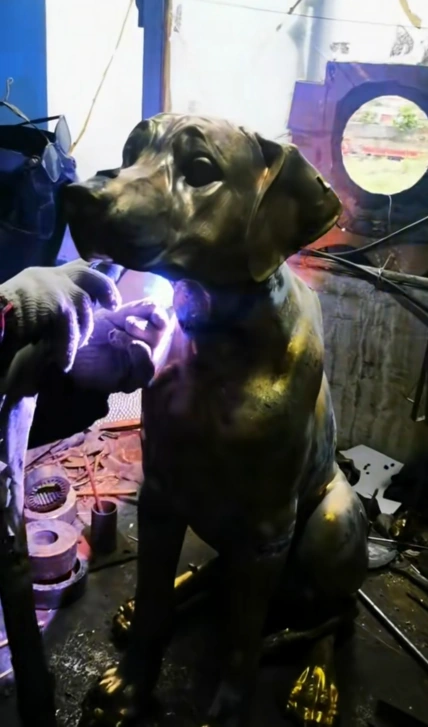
A real metal-joining stage
The tool and active work area are visible in this photograph of another metal dog. It illustrates a processing stage before the agreed finished surface. Your Doberman model still determines the ear-and-tail reference, wedge-shaped head and full outline; the joining arrangement and final treatment are specified for that commission.
Make room for the entire silhouette
Place an outdoor Doberman where the head and tail stay clear
Mark the proposed figure and support together at the display position. The face may appear clear in a photo while its nose, tail or base extends into the approach. Test the full outer outline with the door or gate in its normal opening position.
Near an entrance or narrow border
Show the orientation of the dog along the wall or path. A standing body turned sideways can occupy more frontage; a head looking toward visitors can project across the base’s edge.
For a long-tail design, identify its endpoint on the model and site sketch. Keep the intended route clear without simply removing the feature that makes the portrait familiar. The front porch dog statue guide provides the wider entrance-planning method.
Against planting or a reflective background
A dark bronze surface can merge with deep shade, while a mirror finish picks up nearby scenery. Compare the chosen position from the normal viewing direction and discuss the intended surface effect.
A reclining Doberman can be hidden by planting that leaves a seated figure’s head visible. Check the scene at a representative planting height and keep access for cleaning and local site work.
Before the quotation is final, share the delivery postcode and any narrow gates, steps or restricted access. Packaging and shipment figures are confirmed for the selected size and construction. Unloading, moving the sculpture to its position and mounting it require a clearly agreed scope.
Give changes a clear reference
Approve the Doberman’s form before its final surface
Ask for the view that shows the feature you are judging. The profile reveals muzzle shape and body outline; the front shows ear spacing and chest width; the rear explains the tail connection and hindquarters.
Separate a shape correction from a finish correction
If the head looks too wide, specify the part and attach the reference that explains it. If the model is right but the surface looks too bright, discuss the finish instead. Adding darker shading in a render should not replace changing an incorrect form.
Likewise, a familiar black-and-rust photograph can suggest colour as well as anatomy. Identify whether you want the eye-area shape, the marking pattern or both carried into the brief. Review the agreed form and surface in separate references.
Recheck the connected areas after a change
Reducing the ear height changes the upper outline. Turning the head affects its relationship to the neck and approach. Revising the tail changes the rear view and footprint. Confirm the updated whole figure, not only a close-up of the corrected part.
An AI image can start this discussion, including one you created. Tell us which features must stay. Views and supporting details not shown in that image are developed in the model and reviewed for the chosen material.
Keep the final brief specific to your dog
A useful instruction might be: “Keep the standing body, use these natural ears, bring the long tail closer to this side, and retain this relaxed mouth.” It is clearer than combining several unrelated catalogue images without saying what each contributes.
If a name, dates or a collar belong to the commission, include them explicitly. Agree the text and its base or plaque position separately so those additions do not change the face or the outline unintentionally.
Questions for your Doberman design
Doberman statue questions
Can the sculpture have natural ears and a long tail?
Yes. Provide the complete ear and tail references you want represented. Their shape and position are reviewed with the selected pose and material.
Do the ear and tail choices have to match one gallery image?
No. Identify the posture you like and specify the ear and tail appearance separately. We develop that combination as its own model rather than assuming every gallery feature belongs in the commission.
Can I choose a calm expression instead of a guard-dog pose?
Yes. A relaxed mouth, gentler head angle or reclining posture can guide the design. Use photographs that show the familiar expression you want kept.
Does silver Doberman statue mean a sculpture made of silver?
No. It describes an appearance unless an actual metal specification says otherwise. Our mirror example is a stainless steel design; any other silver-coloured treatment needs separate confirmation.
Can bronze highlights reproduce my dog’s rust markings?
Not automatically. Highlights follow the chosen surface treatment and model planes. If particular markings matter, provide colour references and discuss how they should be represented before approving the finish.
How is a life-size seated Doberman measured?
Use the agreed dog or model reference, then specify the seated figure’s maximum height, length and width. Include ear tips, tail and paw positions, with the base and any separate plinth listed separately.
Can a long tail change the space the sculpture needs?
Yes. Its furthest point can affect length or width even when the torso is unchanged. Review the complete model after revising the curve or bringing it closer to the body.
Are the designs shown here completed bronze commissions?
They are AI designs identified in their captions and offered for custom discussion. They do not establish completed Doberman orders, inventory or fixed product dimensions.
Can I request a small Doberman Pinscher figurine?
A smaller custom interpretation can be assessed from its intended size and material. This page does not list ready-made low-priced figurines; the model detail and support need to suit the agreed scale.
What should I send to begin a quotation?
Send a preferred design or your dog photographs, the ear and tail references, approximate size or display area, and delivery country with postcode. We can refine the material and surface choices with you.
Start with the features you want to keep
Discuss your Doberman sculpture
Send your favourite direction, an AI design you have made or photographs of your Doberman. Tell us the ear and tail appearance you want, and share the display position if you are deciding between poses.
Begin with the dog and the image. The remaining specification can develop from that conversation.
Details that shape this proposal
- Individual portrait or general Doberman design.
- Ear outline, tail length and expression.
- Standing, seated or reclining posture.
- Preferred material, surface and approximate size.
- Display location and delivery country with postcode.