Get in touch with Yun-Sculpture company
Jesus Bust Statue: The Collector’s Guide to Iconography, Face Traditions & the Art of Sacred Portraiture

A Jesus bust statue or Jesus head statue is more than mere representation—it is the concentrated embodiment of spiritual presence. When crafted with skill and reverence, such a statue channels the full essence of Christ into a single, sacred visage. This guide is for those who seek to understand the deeper significance of these icons, which have long been revered for their ability to capture the profound mystery of the divine. In the following sections, we will explore the rich history behind the five face traditions of Christ, the legacy of the Ecce Homo portrait, the material choices that affect both form and feel, and the process of commissioning a custom Jesus statue for home.
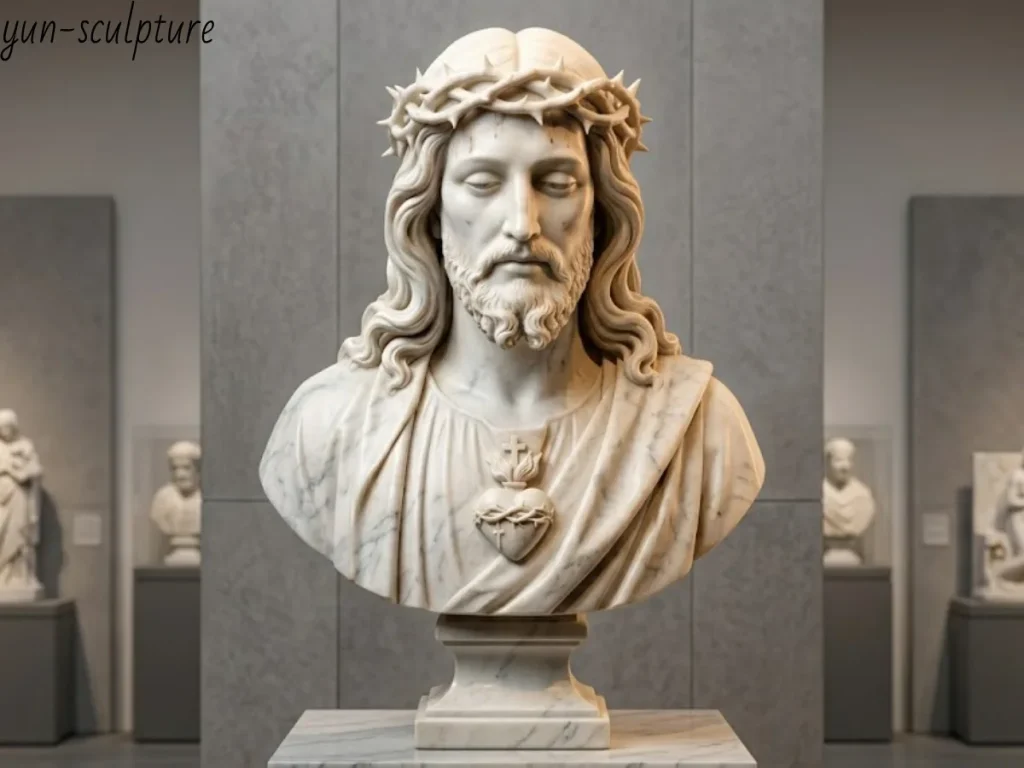
Table of Contents
Table of Contents
Why a Bust, Not a Full Statue? The Aesthetic Logic of Sacred Portraiture
The Logic
The visual power of a Jesus bust statue lies in its ability to concentrate all energy and focus upon the face. Unlike a full statue, which disperses visual attention across the body, posture, and drapery, a bust directs the observer’s gaze entirely to the countenance of Christ. The face becomes the narrative. This artistic decision is not mere preference; it is a deliberate choice to elevate the soul of the figure. A Jesus head statue allows the artist to delve deeper into the expression of Christ’s humanity and divinity, encapsulating the complex interplay of suffering, compassion, serenity, and grace within the confines of the face.
In sacred portraiture, the face becomes the most significant vessel for conveying the spiritual message. The soul of the subject, as believed by many in religious art traditions, resides in the eyes and the expression—elements that are emphasized when the figure is framed in a bust. A bust, free from the distraction of robes or gestures, allows the face to communicate the deepest emotions of Christ’s mission on Earth: His sacrifice, His love, and His divine wisdom.
Art History: The Imago Clipeata Tradition
The bust as an artistic form is rooted in the traditions of ancient Rome, particularly in the imago clipeata, a type of portrait developed for the elite. Roman emperors and important figures were often immortalized in this form, capturing their faces in marble or bronze and presenting them in circular or oval frames, often adorned with laurel wreaths. The imago clipeata was a statement of power, legacy, and eternity, serving as a visual declaration of the subject’s importance.
Early Christians adopted this tradition and infused it with new meaning. In Christian iconography, the imago clipeata transformed into sacred portraiture, a way to capture Christ’s divine nature and His role as the eternal King. Rather than focusing on the power of an emperor, the Jesus bust statue became a powerful symbol of Christ’s dominion over all creation. The face alone became a powerful witness to Christ’s significance, providing a direct, personal connection between the viewer and the divine. The focus on Christ’s visage in the bust form was not only an artistic choice but also a spiritual necessity—allowing the faithful to behold Christ in His most intimate and human form.
Spatial Advantage
In the modern world, a Jesus statue for home is often best represented as a bust. Unlike the full-length statues which typically require large pedestals or dedicated spaces, the bust offers a more intimate and accessible form. Its compact nature makes it ideal for placement in private studies, libraries, or home altars—areas where personal reflection and prayer can take place. A Jesus head statue doesn’t demand grandiose settings; instead, it integrates seamlessly into the home, inviting close, meditative gazing.

The spiritual advantage of a bust lies in its proximity to the viewer. Where a full statue might seem distant, a bust allows for a more direct connection. Whether placed on a mantle, desk, or atop a bookshelf, the bust invites the individual to pause and reflect, creating a sacred space for contemplation. It is not merely art for decoration; it is a tool for meditation, helping to foster a deeper connection with the divine.
For those looking to cultivate a space of personal worship or devotion, a custom Jesus bust statue is an ideal choice. Its compact size makes it a versatile and deeply moving addition to any home, providing both spiritual and aesthetic enrichment.
The focus on Christ’s face in these sacred busts transforms an object of art into something transcendent—an encounter with the divine, framed in marble, bronze, or other materials that reflect Christ’s eternal nature.
The Face of Christ: Five Artistic Traditions No Competitor Will Tell You About
Since no historical portrait of Jesus exists, each Jesus face statue is an artistic and theological statement—a personal interpretation of the divine through the lens of cultural and doctrinal lenses. The challenge of rendering Christ’s face is not merely about artistic technique; it is about conveying the mystery of His identity and His nature. Throughout the centuries, artists have approached this task in distinct ways, informed by their respective religious, cultural, and historical contexts. In this section, we explore five major artistic traditions that have shaped Christ’s face in sculpture and painting. Understanding these will guide you in commissioning a Jesus face statue that resonates with your spiritual and aesthetic preferences.
1. The Byzantine Tradition — The Pantocrator Face
One of the oldest and most revered representations of Christ’s face in sacred art is the Pantocrator, a term that means “Almighty” or “Ruler of All.” In the Byzantine tradition, this iconic image became the hallmark of Christian religious portraiture. The Pantocrator face is rendered with frontality, an essential characteristic of Byzantine art. Christ’s face gazes directly at the viewer, offering a sense of omnipresence and divine authority. The symmetrical features, almond-shaped eyes, and forked beard all contribute to the majesty of the figure, creating an image of Christ as the cosmic judge and divine ruler of the universe.

The Pantocrator was often depicted in mosaics or icons, with the most famous example being found in the Hagia Sophia in Constantinople. Here, the grandeur of the figure is meant to convey Christ’s sovereignty, His eternal reign, and His unchanging nature. The strict frontality of the bust, with Christ’s face perfectly aligned to the vertical axis, reinforces His transcendence over the temporal world. For those commissioning a Jesus face statue in the Byzantine tradition, expect a piece that evokes a sense of divine awe and cosmic authority—perfect for spaces where you seek to emphasize Christ’s role as both judge and savior.
2. The Renaissance Tradition — The Florentine Warmth
In contrast to the more abstracted, otherworldly depictions of Christ in earlier traditions, the Renaissance reintroduced a focus on human beauty and naturalism. Artists such as Donatello, Verrocchio, and even Michelangelo, in works like the Michelangelo Risen Christ statue, brought a new warmth and humanity to Christ’s face. Unlike the Pantocrator, which emphasizes Christ’s divine majesty, the Renaissance tradition sought to capture Christ’s incarnation—His humanity made manifest in flesh.
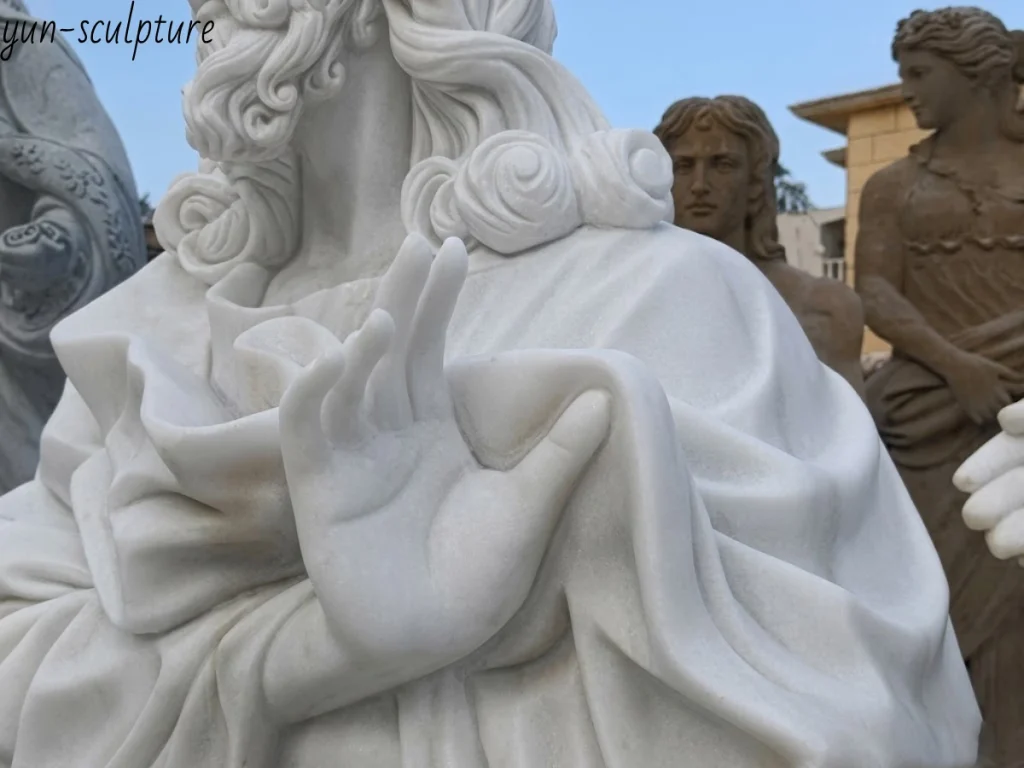

A hallmark of the Florentine style is the 3/4 profile, where Christ’s face is often shown in a slightly turned position, suggesting a more intimate and approachable figure. The eyes are often depicted with lowered lids, evoking a sense of compassion or introspection, while the hair is shown in natural curls, softening the face and inviting the viewer to contemplate Christ’s earthly life. In sculptures like Donatello’s early works, the human aspect of Christ is emphasized, making Him approachable, relatable, and real.

The Renaissance Jesus face statue is perfect for spaces like libraries, studies, or even private chapels—places where the viewer can reflect on Christ’s perfect union of the divine and human. The emphasis on Christ’s humanity in this tradition speaks to the Incarnation, inviting a sense of reverence grounded in the beauty and warmth of His earthly nature.
3. The Baroque Tradition — The Ecce Homo
The Baroque period, particularly through artists like Guido Reni, brought a dramatic and emotional intensity to religious art. The Ecce Homo tradition, in particular, focuses on the suffering of Christ, often showing Him crowned with thorns, with wounds on His brow and face, as He is presented to the people by Pilate (“Ecce Homo” means “Behold the Man”). This portrayal emphasizes Christ’s passion, His humanity, and His suffering on the Cross.
Baroque depictions of Christ’s face are often characterized by an upward gaze, drawing the viewer’s eye to the divine rather than the earthly, suggesting Christ’s ultimate submission to the will of God, even in His suffering. The facial expression is one of sorrow and compassion, evoking deep empathy from the viewer. The Jesus face statue in this tradition is meant to evoke a powerful emotional response, calling the viewer to contemplate the depth of Christ’s sacrifice for humanity.
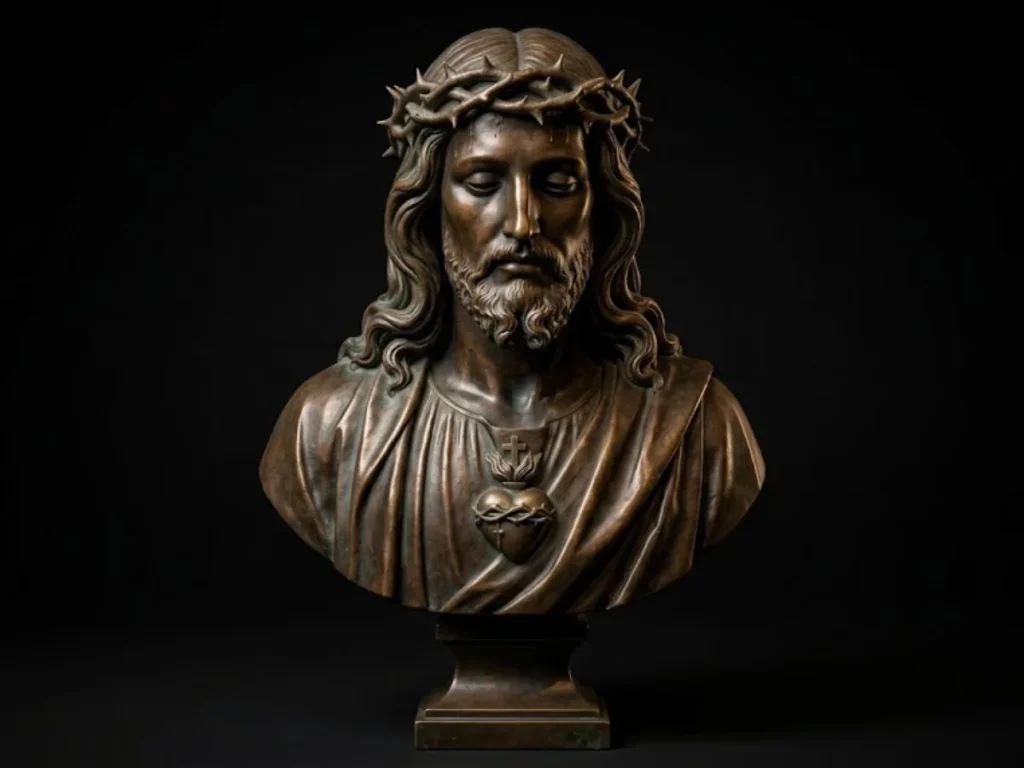
An Ecce Homo bust works well in places of prayer and reflection, such as confessionals or hospitals, where individuals may be confronting their own struggles and suffering. This tradition is for those who wish to emphasize the shared human experience of pain and redemption, and is ideal for creating spaces of intense spiritual reflection.
4. The Northern European Tradition — Raw Humanity
In Northern Europe, particularly through the work of sculptors like Veit Stoss, the depiction of Christ’s face took on a raw, emotional realism. Unlike the idealized forms of the Renaissance or the divine authority of the Byzantine, Northern European art focused on asymmetry, capturing Christ in a more worn, tired state. His face often carries the weight of suffering—exhaustion, anguish, and emotional intensity are conveyed in the deep lines and intense expressions.
This portrayal of Christ’s face is stark, emphasizing the physical and emotional toll of His passion. The figures are not polished; they are deeply human, reflecting the reality of Christ’s suffering in a world that often disregards human pain. For instance, the Veit Stoss woodcarvings depict Christ’s face in a raw, visceral manner, emphasizing His pain and humanity.
For collectors who are drawn to the Northern European tradition, a Jesus face statue in this style will convey an unvarnished view of Christ’s earthly suffering—perfect for spaces where raw emotion and reflection on social injustice or personal suffering are central themes. The face in these sculptures is not just a symbol of divine majesty but of Christ’s empathy with the human condition.
5. The Semitic Accuracy Movement — Historical Reconstruction
The Semitic Accuracy Movement is a more modern trend in sacred art that seeks to reconstruct Christ’s face based on historical and anthropological studies. Drawing from the research of archaeologists and anthropologists, artists have begun to explore what Jesus may have looked like as a first-century Jew from the region of Palestine. This movement portrays Christ with darker skin, curly short hair, and a broad nose, reflecting a more accurate representation of His Semitic heritage.

For collectors who desire a Jesus face statue grounded in historical accuracy, this movement offers a representation of Christ that aligns more closely with the physical appearance of people from His time and place. It is a departure from the more idealized or spiritualized forms of Christ found in earlier traditions. This style is not about theological interpretation but about presenting a more realistic image of the historical Jesus—making it ideal for those seeking a historical portrait without theological judgment.
This approach does not focus on any particular religious tradition but instead emphasizes historical context, making it a compelling option for those interested in understanding Christ within the full scope of His earthly reality.
The Ecce Homo: Why the Crown of Thorns Bust Dominates the Market
The Art Historical Origin of Ecce Homo Busts
The Ecce Homo tradition, meaning “Behold the Man,” focuses on a pivotal moment in the Passion of Christ—His presentation to the people by Pilate, crowned with thorns and marked by suffering. This moment was immortalized in art during the 15th century by Flemish painters such as Hugo van der Goes and Jan van Eyck, who isolated the scene into a pure facial close-up. In removing the broader narrative context, they allowed the viewer to meditate intensely on Christ’s suffering without distraction. This focus on Christ’s face, often shown in an expression of pain and humility, set the stage for the modern Ecce Homo bust, where the emotional intensity is heightened through the singularity of the facial portrayal.
By focusing entirely on the face of Christ, these early painters gave rise to a form of sacred portraiture that would be echoed by sculptors and artists for centuries. The Jesus Christ crowned with thorns portrait continues to resonate deeply, as it encapsulates Christ’s suffering in its most direct and visceral form. Over time, the Ecce Homo motif became central to the Baroque period’s emotional approach to religious art. The Ecce Homo bust dominates the market because it speaks to both the profound spiritual reflection and the emotional power of the passion narrative, making it a deeply evocative piece for those drawn to Christ’s suffering for humanity.
The Spiritual Mechanics of the Crown of Thorns
Creating a picture or sculpture of Jesus Christ crowned with thorns is one of the most challenging and intricate forms of religious craftsmanship. Unlike other facial representations, the crown of thorns requires careful attention to anatomical detail, blood flow, and the interaction of the thorns with Christ’s skin and hair. In a bust, each thorn must be individually hand-crafted, with a precise understanding of the geometry of the skull and the delicate nature of the wound. The negative space between the thorns and the hair must be calculated with great care, ensuring the piece feels lifelike yet reverent.
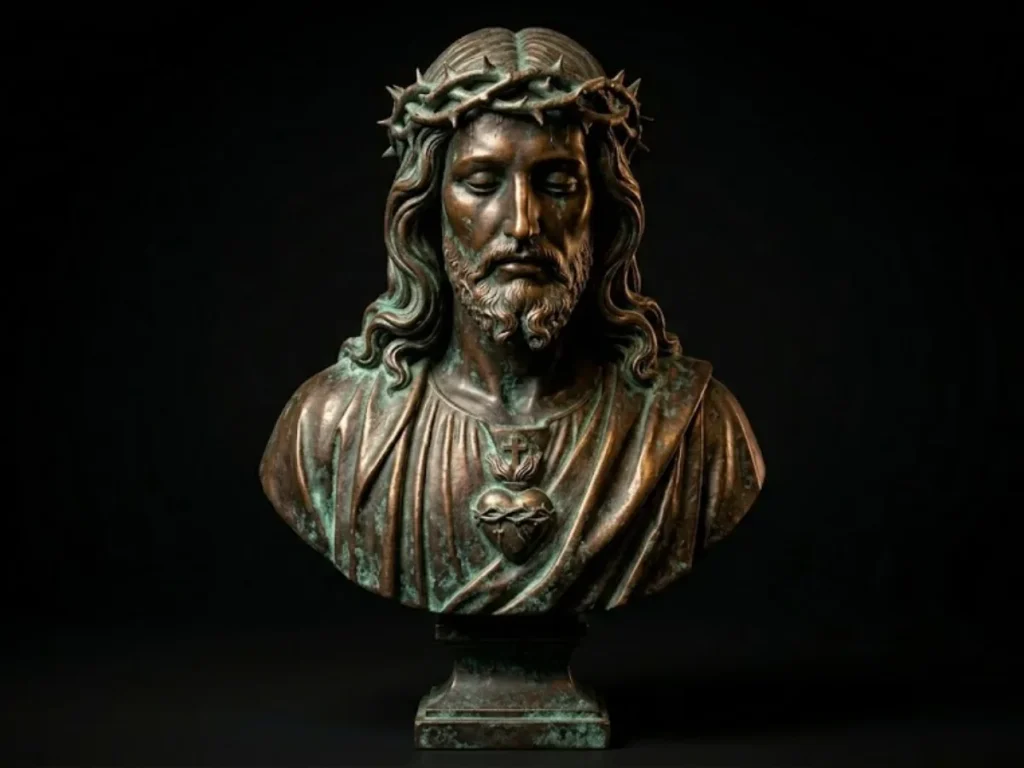
In sculpting a crown of thorns, artisans must also consider the gravity of the blood flow—an element that brings emotional depth to the piece. The blood is not merely a visual element but a theological one. It represents the ultimate sacrifice Christ made for humanity, and this understanding must permeate every detail. The Jesus face statue crowned with thorns is not just an artistic creation; it is an act of reverence, where every thorn, every curve of the face, and every drop of blood tells the story of Christ’s passion and His willingness to suffer for mankind.
This sculptural challenge requires a blend of precision, technical skill, and deep spiritual insight. Only a select few artisans are capable of capturing such complexity in a Jesus face statue, and those who do have mastered the delicate balance between craftsmanship and devotion.
Ecce Homo vs. Resurrected Christ — Choosing Your Theology
When commissioning a Jesus bust statue, one must consider which aspect of Christ’s story they wish to emphasize. The Ecce Homo bust, with its crown of thorns and upward gaze, emphasizes Christ’s suffering—His obedience to God’s will, His sacrifice, and His humanity. It is a poignant reminder of His passion, and those who choose this style are likely seeking to meditate on Christ’s suffering and His love for humanity. It is a piece that speaks to the Christian who desires to connect deeply with Christ’s humility and ultimate sacrifice.
In contrast, a Resurrected Jesus statue, such as the iconic depictions by Michelangelo in his Risen Christ, emphasizes triumph over death, resurrection, and divine victory. Here, Christ is shown in glory, often in a posture of victory or resurrection, radiating life, light, and hope. It is a celebration of Christ’s victory over sin and death—a symbol of eternal life and divine power.
When deciding between these two iconic representations, the buyer is effectively choosing which aspect of Christ’s life they wish to contemplate. Do you wish to reflect on His suffering for you, focusing on the Ecce Homo and His love for mankind in the face of pain? Or do you desire a focus on the triumphant joy of the Resurrected Jesus statue, celebrating His victory and the hope He brings to the world? Both representations carry immense theological weight, but they serve different devotional purposes.
The Idolatry Question: An Honest Theological Answer
What the Bible Actually Says — The Second Commandment in Context
One of the most common questions surrounding Jesus statues is whether having such a statue constitutes idolatry. Is having a statue of Jesus idolatry? Are Jesus statues idols? These are valid concerns, particularly for those who want to reconcile their faith with their artistic choices. The key to understanding this issue lies in the context of the Second Commandment.
Exodus 20:4 does indeed forbid the worship of idols: “You shall not make for yourselves a carved image.” However, this prohibition refers to the worship of false gods and the creation of images used for the purpose of idolatry—bowing down before them as gods. The commandment is not a blanket prohibition against creating representations of the divine. This is evident in the Bronze Serpent of Numbers 21:8, where God commands Moses to craft a serpent in bronze as a means of healing. Similarly, in Exodus 25:18, God instructs the Israelites to make two golden cherubim to be placed on the Ark of the Covenant. These are not condemned as idolatry because they are not objects of worship but serve as symbols of God’s presence.
So, what does the Bible say about statues of Jesus? The act of creating a Jesus face statue or a Jesus bust is not inherently idolatrous. It is a symbolic representation that serves as a focus for worship or reflection, not an object of worship itself.
The Catholic/Orthodox vs. Protestant Distinction
The Catholic and Orthodox traditions have long maintained that images and statues are educational tools that help focus the worshipper’s mind and heart on God. The difference between worshiping and venerating is crucial here. Latria is the worship reserved for God alone, while dulia is the veneration of saints, and hyperdulia is the special veneration given to the Virgin Mary. A Jesus statue is venerated, not worshiped. Is worshipping a statue of Jesus a sin? Yes, if one were to worship the statue itself. But venerating what it represents—Christ—without attributing any divine power to the object itself is not sinful.
In contrast, some Protestant denominations reject the use of religious images altogether, believing that even veneration of a statue might lead to idolatry. They emphasize the sola scriptura principle and the belief that direct worship should only be of God.
The Collector’s Secular Frame
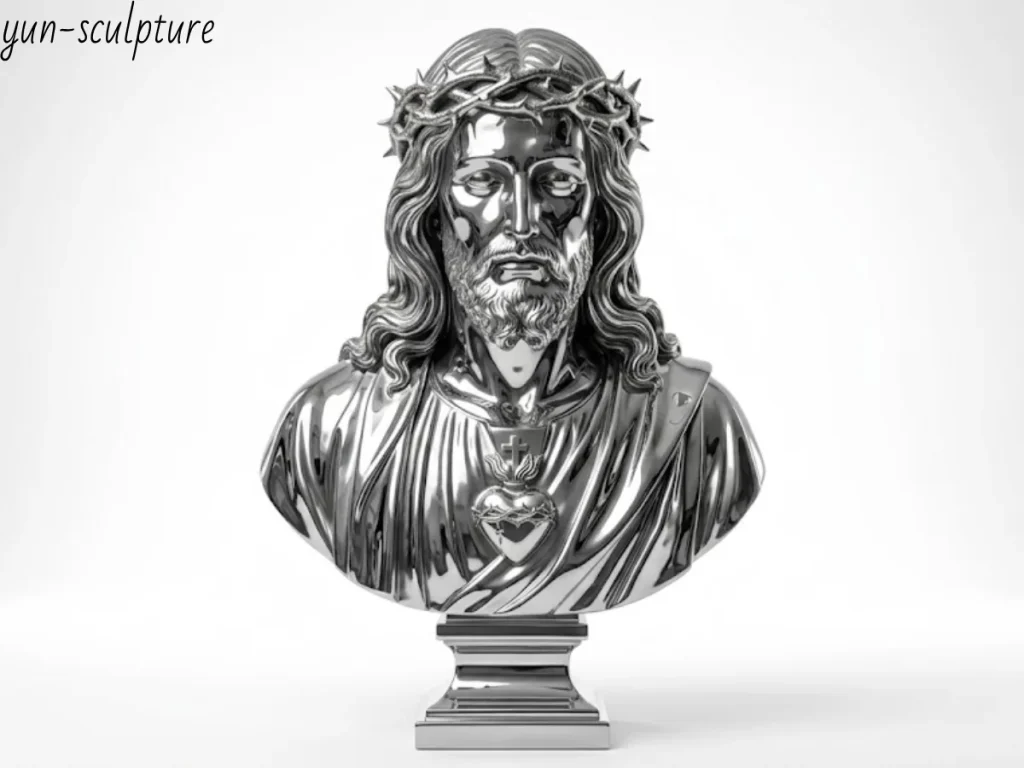
For non-religious buyers, the value of a Jesus bust statue extends beyond the spiritual or theological realm. Jesus statues are foundational to Western art history, representing centuries of artistic development, craftsmanship, and cultural significance. A Jesus face statue can be viewed as a historical artifact, akin to acquiring works from the Renaissance or Baroque periods. Auction houses value such pieces not only for their religious connotations but for their artistic merit—their place in the grand narrative of Western art and sculpture.
For collectors who do not seek a religious connection but appreciate sacred art for its cultural and aesthetic value, the Jesus bust statue remains a cornerstone of historical expression. Whether placed in a gallery or private collection, these sculptures are highly sought after for their intricate craftsmanship and their position within the broader tradition of religious portraiture.
Material Intelligence: How Each Medium Changes the Face
The material chosen for a Jesus bust statue plays a significant role in the way Christ is portrayed, not just visually, but spiritually and emotionally. Each medium has its own characteristics, and these subtle nuances of texture, color, and finish contribute to the theological and artistic message the statue conveys. In this section, we explore the five primary materials used for creating Jesus statues—marble, bronze, wood, vintage/antique finishes, and concrete—each contributing a unique dimension to the sacred portrait.
White Marble — The Skin of Divinity
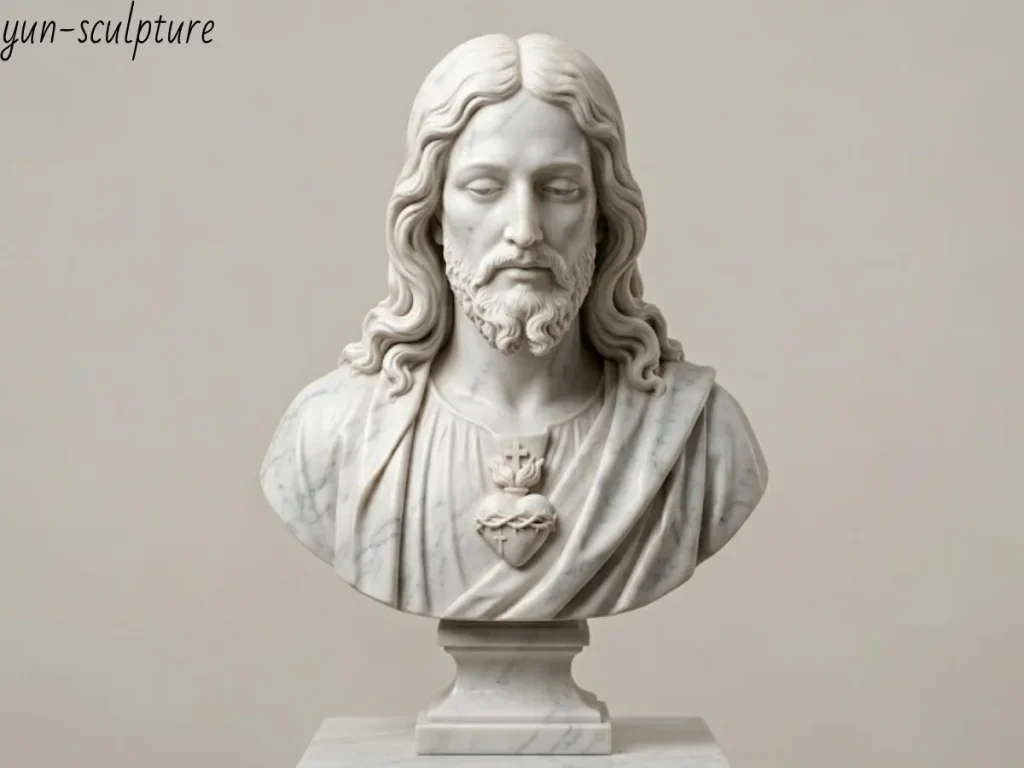
The marble Jesus statue stands as one of the most revered and enduring forms of religious art. Marble, especially white marble, is known for its extraordinary ability to replicate the qualities of human skin—a phenomenon called morbidezza. The inherent translucency of marble allows light to pass through the surface, creating a soft, glowing effect that mimics the way light interacts with human flesh. This quality of marble lends an ethereal, almost divine quality to the figure of Christ, as if His flesh is not of this world.
The process of polishing marble to achieve different gradients is also a meticulous art. For a Jesus face statue, the artist typically polishes the high-gloss face to capture the light and bring out the depth in Christ’s expression. This polished surface enhances the facial features, from the eyes to the lips, making them appear alive with emotion. In contrast, areas such as the thorns of the crown of thorns and the hair are often left in a matte finish. This contrast between polished and matte surfaces adds a sense of realism and texture, drawing attention to the sacred and somber aspects of Christ’s sacrifice while preserving the luminous quality of His divine nature.
Marble’s timelessness, coupled with its ability to express both divinity and humanity, makes it the preferred choice for those seeking a connection to both the ancient and the eternal. A marble Jesus statue represents the enduring beauty of Christ’s nature and His eternal relevance.
Bronze — Patina as Theology

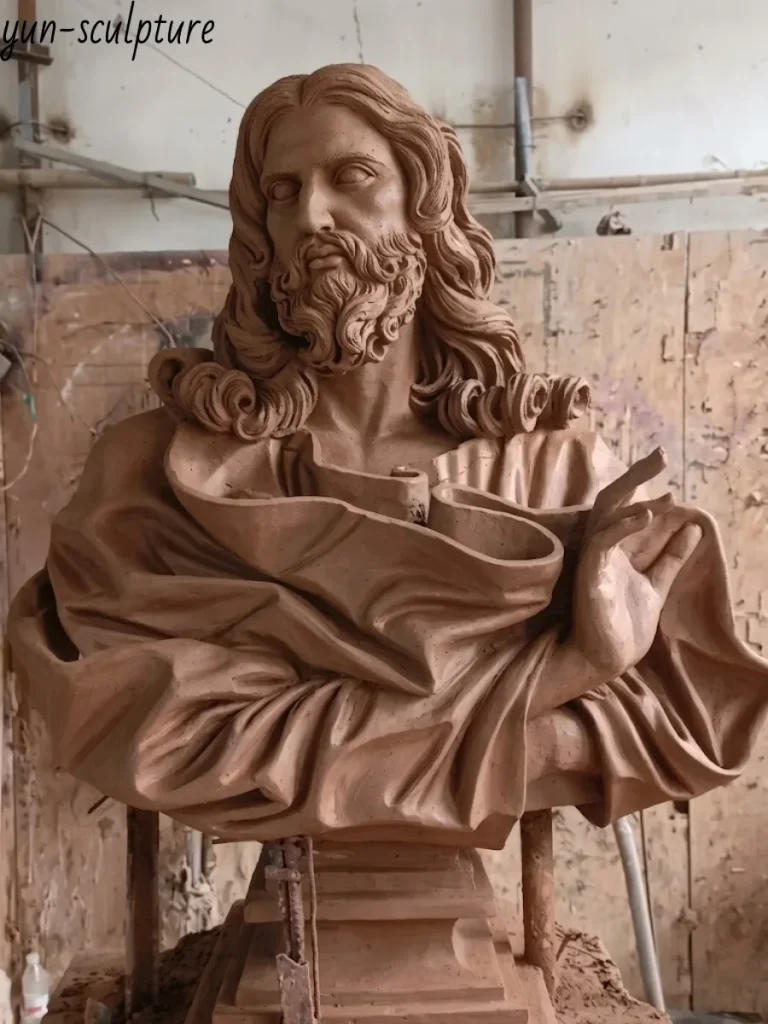

The bronze Jesus statue offers a different yet equally profound way to represent Christ. Bronze, with its rich, metallic sheen, has been a favored material for religious sculptures throughout history. One of the most distinctive characteristics of bronze is its ability to develop a natural patina over time. The patina, a greenish or reddish-brown film that forms as the metal reacts with the environment, gives the bronze Jesus statue a sense of age, character, and deep spiritual resonance. It is a living testimony to time, making each piece unique. The patina evolves over the years, mirroring the ongoing relationship between the sculpture and its viewer—a process that can be seen as symbolic of the Christian life: one of gradual transformation, of suffering and renewal.
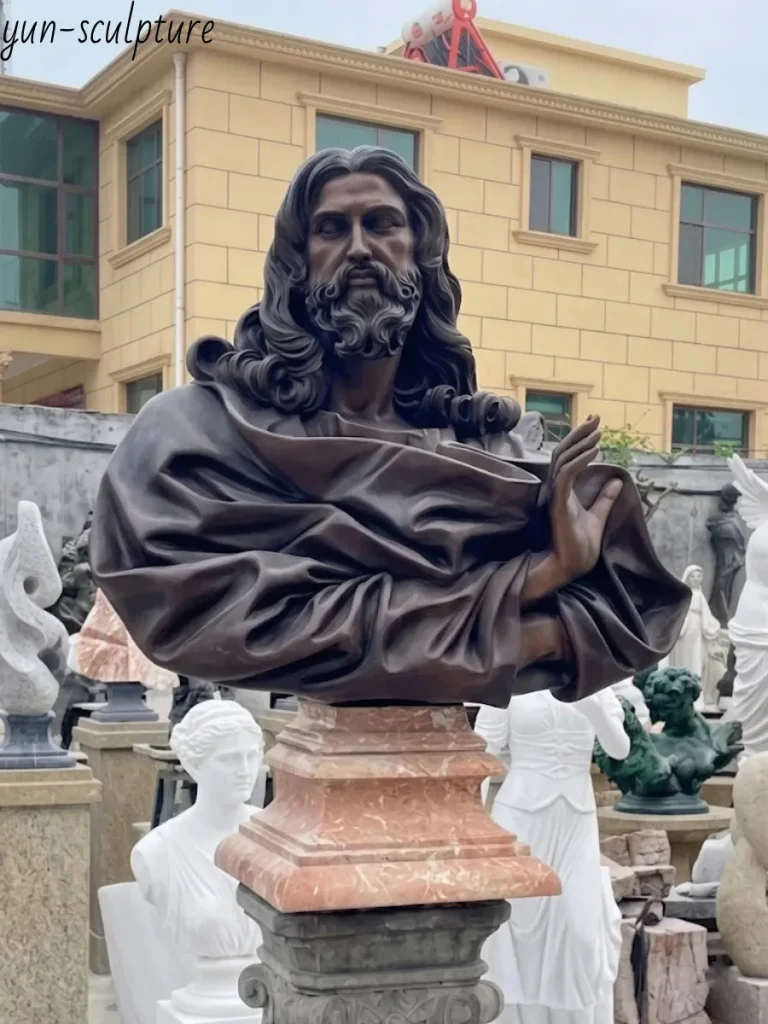

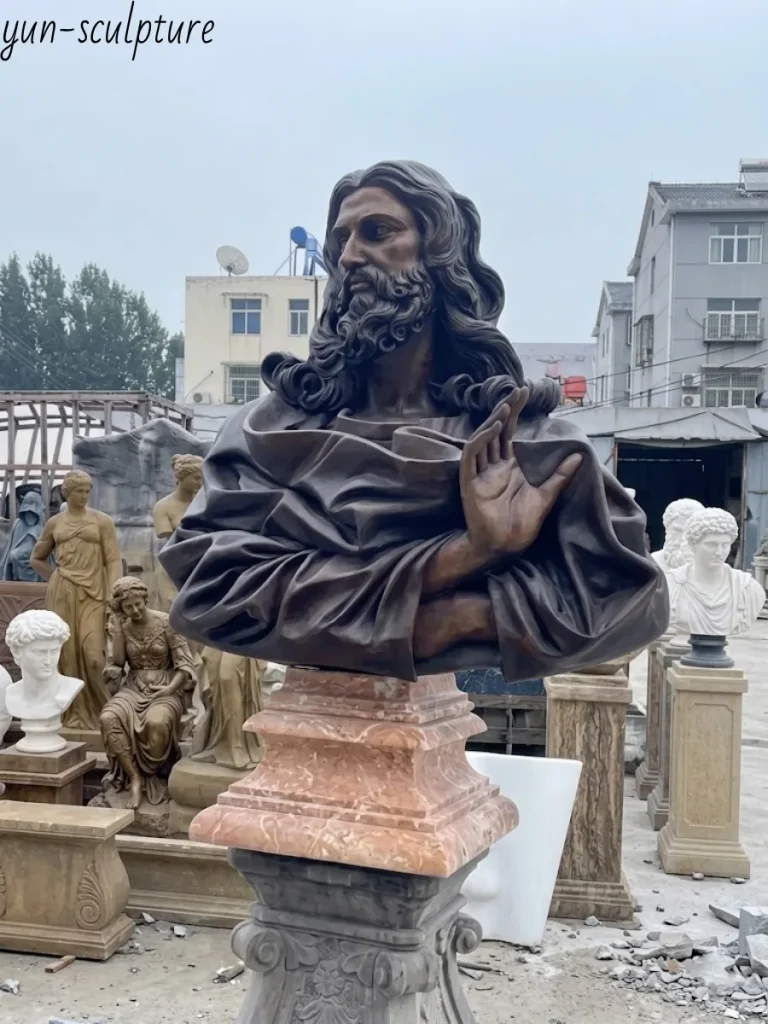
The lost-wax casting technique, used in creating a bronze Jesus statue, is particularly important for capturing intricate details like the wrinkles around the eyes or the curves of the lips—subtle features that cannot be replicated in stone or wood. The precision of this technique ensures that each line of the face, every contour, and every detail is rendered with a lifelike quality that gives the statue an almost breath-like presence. This is a significant departure from the more static forms found in marble or wood, allowing the bronze Jesus face statue to possess a dynamic, ever-evolving character as it ages.
For collectors who appreciate a piece that bears witness to the passage of time, the bronze Jesus statue becomes a metaphor for Christ’s enduring impact on the world, with each change in the patina reflecting the deepening of faith through experience.
Olive Wood — The Most Theologically Resonant Material
A wooden Jesus statue, particularly one made from olive wood, carries with it a profound theological resonance. Olive trees have long been associated with sacred places and moments in Christian tradition. Most notably, olive trees were present in Gethsemane, where Christ prayed before His Passion. The ancient lifespan of an olive tree—often hundreds or even thousands of years—adds an element of historical continuity, connecting the viewer with the land where Jesus walked and the experiences He shared with His disciples.
Every wooden Jesus statue made from olive wood is unique due to the grain of the wood, which is never identical in any two pieces. The grains and textures give each statue its own life, much like how Christ’s individual relationship with each believer is unique. Olive wood’s natural patterns imbue the sculpture with a warmth and authenticity that few other materials can replicate. The wood itself seems to “breathe,” inviting a tactile, personal connection with the sacred.
From a theological perspective, olive wood embodies the connection between Christ and the Earth—His earthly nature, the place of His sacrifice, and His role in the natural world. It is a material that speaks of deep rootedness in both spiritual and physical realms. A wooden Jesus statue made from olive wood is not merely a representation; it is a direct link to the land that witnessed Christ’s life and death.
Vintage & Antique Finishes — Authentic Aging vs. Artificial Aging
The market for vintage Jesus statues and antique Jesus statues is rich with history and significance, appealing to collectors who seek pieces that are steeped in age and authenticity. These statues often carry the patina of time—scratches, worn edges, and the faint traces of previous owners and environments. However, the difference between a truly antique Jesus statue and one with artificially aged finishes is crucial for discerning buyers.
True antiques show natural wear that occurs over time. The wear is most visible on protruding parts of the sculpture, such as the nose, forehead, or hands, where the most frequent contact would have occurred. In contrast, artificial aging often involves techniques like spray painting or using flat, even washes that create an unrealistic, uniform aging effect. Buyers should be aware of the artificial patina produced through such methods, which lacks the depth and character of authentic aging.
In our workshop, we take care to age pieces with techniques that mimic the natural process. This involves acid washing, hand-rubbing, and the application of layered waxing to ensure that the statue ages naturally while retaining its historical and aesthetic integrity. Whether you are buying a vintage Jesus statue or commissioning a new piece with an antique finish, our approach ensures that the statue holds the right amount of historical gravitas.
Concrete & Alternative Materials — The Studio Art Perspective
For those seeking a more contemporary or industrial aesthetic, a concrete Jesus statue is an ideal choice. Concrete, as a material, offers flexibility, durability, and a strikingly modern look. This makes it a favorite for post-modern or architectural spaces where the traditional materials of marble, wood, or bronze may feel out of place.
In studio art, concrete is often used to create pieces that are not bound by historical traditions but speak to current aesthetic and philosophical concerns. A concrete Jesus statue may not carry the same theological resonance as an olive wood or marble statue, but it serves as an artistic expression of the sacred in modernity—a reimagining of Christ in an ever-evolving world. Its utilitarian appearance can convey strength, resilience, and the idea of Christ as a figure who transcends time and adapts to the modern condition.
For industrial spaces or urban churches, a concrete Jesus statue offers an option that is bold, durable, and deeply rooted in contemporary visual culture. It allows for a reinterpretation of the sacred that aligns with the aesthetics of the present age.
The Collector’s Logic: Pairing, Sequencing & Display Architecture
The placement and display of a Jesus bust statue go beyond mere aesthetics; they are an integral part of the spiritual atmosphere and the experience of devotion. How you pair, position, and sequence these pieces within a space influences both the emotional tone and theological resonance of the room. Thoughtful spatial design brings depth to the sacred experience, transforming a simple object of art into a spiritual focal point. Below, we explore key principles for creating a sacred display that is both architecturally compelling and spiritually enriching.
The Sacred Pair — Jesus and Mary Bust as a Matched Set
A powerful and evocative display often comes from pairing a Jesus bust statue with a Virgin Mary bust statue or Madonna and Child bust statue. The pairing of these two figures is a natural and profound representation of the Christian faith—Christ as the Savior and Mary as the intercessor, bringing together both the divine and the maternal.

When creating a matched set, it is important to adhere to a few key guidelines. First, both busts should share the same artistic tradition to maintain visual and thematic harmony. For example, a Jesus bust in the Byzantine tradition, with its frontal, symmetrical gaze, would pair well with a Virgin Mary bust statue crafted in the same style, emphasizing divine majesty. Second, material consistency is crucial: a marble Jesus statue should not be paired with a bronze Madonna statue; both must align in their texture and finish to ensure cohesion. Lastly, the scale of the figures should be in balance. A large Jesus Christ statue should be matched with a similarly scaled Mary bust to maintain symmetry and proportion.
The aesthetic and spiritual impact of such a pairing can transform a space into an intimate sanctuary, where the sacred relationship between mother and son is physically embodied, allowing the faithful to meditate on the complementary roles of the two figures in the salvation story.
The Meditation Sequence — Building a Sacred Corner
When designing a sacred corner in your home or chapel, think of it as a multi-dimensional space that facilitates both personal reflection and meditative worship. The ideal meditation corner consists of a three-tier space: the bust as the focal point, a cross or painting as the background, and candles or a rosary to provide functional elements that bring the space to life.
The bust serves as the centerpiece, where Christ’s face, whether in suffering or meditative repose (such as a Jesus meditating statue), calls the viewer to contemplate His sacrifice, His wisdom, or His divine love. For an intimate setting, place the bust at eye level so that the viewer can easily engage with Christ’s face.

Behind the bust, a cross or painting enhances the theological message, providing a context for the face. A cross reminds the viewer of Christ’s Passion and ultimate sacrifice, while a painting depicting a serene scene, such as Christ in the Garden of Gethsemane, can offer a peaceful atmosphere for prayer. Finally, surrounding the space with candles or a rosary helps create a functional and spiritual aura. The flickering candlelight offers a sense of the divine presence, and a rosary encourages the viewer to reflect upon Christ’s life through prayer.
This three-tiered design encourages a flow of contemplation—from Christ’s physical form to His divine mission and to personal prayer—creating a complete spiritual experience.
The Study & Library Placement — Christ as Intellectual Companion
The study or library has long been a space for intellectual growth and reflection, making it a perfect setting for a Jesus Christ statue for home. Historically, during the Renaissance, scholars would place representations of Christ alongside classical philosophers. These intellectual spaces were designed to encourage a union of the spiritual and rational, showing that the pursuit of knowledge is not separate from faith but deeply intertwined with it.
In the modern home, placing a Jesus bust in a study or library continues this tradition. Christ’s face in these settings is not just for devotional worship; it becomes a symbol of the search for truth. Whether meditating on the Incarnation or reflecting on the wisdom of Christ, the statue becomes an intellectual companion, reminding the viewer of the divine in all knowledge and inquiry. Such a placement is especially fitting for those who wish to combine academic pursuits with spiritual growth, inviting both dialogue and silence, thought and prayer.
A Jesus Christ statue for home placed in this way invites both the scholar and the seeker to integrate their intellectual pursuits with their faith, making the space a true sanctuary of both mind and soul.
The Pedestal Principle — Height Determines Theology
In the placement of a Jesus bust statue, the height at which it is displayed plays a pivotal role in the theological message conveyed. The position of Christ’s face in relation to the viewer can either elevate His divine majesty or create a sense of intimate connection with His suffering. The Pedestal Principle dictates that height can be a direct indicator of the relationship between the observer and the object of devotion.
- Above Eye Level: Placing Christ above eye level signifies divine majesty and spiritual authority. This positioning evokes the grandeur of the Pantocrator and the Cosmic Judge, emphasizing Christ’s eternal reign and His transcendence over earthly concerns.
- Eye Level: Positioning the bust at eye level creates an intimate relationship. The viewer can look directly into Christ’s face, establishing a personal connection and emphasizing His humanity. This level invites contemplation of Christ’s earthly ministry, compassion, and sacrifice.
- Below Eye Level: Placing the bust below eye level causes the viewer to look down at Christ, emphasizing His humility and suffering. This positioning is ideal for focusing on Christ’s Passion and can evoke a deep sense of reverence and penitence. It is particularly effective when paired with an Ecce Homo bust, where the viewer physically lowers themselves to reflect on Christ’s ultimate sacrifice.
Each height configuration brings a different theological focus, and the decision should align with the mood and message the collector wishes to convey through the Jesus bust statue.
Lighting Design: The Secret to Bringing a Jesus Bust to Life
The lighting around a Jesus bust statue is an essential element of its display, transforming the piece from a static object into a dynamic expression of light and shadow. The proper lighting not only enhances the aesthetic qualities of the sculpture but also reinforces its theological and emotional significance. Below, we explore three primary lighting philosophies that will elevate your display.
The Three Lighting Philosophies
| Lighting Type | Description | Best For |
|---|---|---|
| Raking Light (Side) | Highlights wrinkles and depth, creating dramatic shadows. Best for intense, Baroque-style expressions. | Bronze, Dark Stone |
| Diffused Frontal Light | Softens the face, reducing shadows and creating a serene, heavenly glow. Best for Byzantine-style faces. | White Marble |
| Uplighting (Bottom) | Creates dramatic shadows, accentuating deep eye sockets and cheekbones. Enhances supernatural or resurrection themes. | Bronze |
Natural Light vs. Artificial Light — Time of Day Matters
The time of day can profoundly affect how a Jesus bust statue is illuminated. For a white marble statue, the “golden 15 minutes” at dusk—just before sunset—brings out the translucency of the marble, allowing the face to glow with a soft, divine radiance.
For bronze sculptures, 3000K warm LED lights work best, bringing out the warm, earthy tones of the metal while enhancing the patina. On the other hand, 4000K cool white LED is recommended for marble statues, as it helps to maintain clarity and a serene aesthetic.
Shadow as Iconography

Shadows cast by the Jesus bust statue on the wall can become a secondary form of artwork. The interplay between light and shadow creates iconography of its own. Shadows can represent the divine presence or the human condition, depending on the angle and intensity of the light. It’s important to test the placement of the statue with a flashlight before the final decision to ensure that the shadows align with the intended message. For large-scale sculptures, such as those inspired by the Jesus Christ the Redeemer statue, shadows can dramatically enhance the grandeur of the piece, adding an almost monumental feel to the space.
The right lighting transforms your Jesus bust statue from a mere object into a living, breathing witness to the divine.
The Custom Commission: From Historical Reference to Your Personal Jesus Bust
Creating a custom Jesus bust statue is a deeply personal journey that merges artistic craftsmanship with theological intent. At Yun Sculpture, we guide each client through a meticulous process to ensure the final sculpture reflects not only aesthetic desires but also spiritual significance. Below, we detail the step-by-step workflow for commissioning your own bespoke bust.
Choosing Your Reference Tradition
The first step in the commissioning process is selecting the face tradition that best aligns with your spiritual and artistic vision. There are several established traditions, including Byzantine, Renaissance, and Baroque, each with its distinct characteristics and theological undertones.
We ask our clients to provide 1-3 historical artworks as references. This helps us understand the specific nuances of the face they envision, whether it is the majesty and frontality of a Byzantine Christ, the human warmth of the Renaissance, or the suffering and intensity found in Baroque representations like the Ecce Homo. The tradition you choose will serve as the foundation for the spiritual identity of your statue, influencing everything from facial expression to posture.
Once we have a clear understanding of the chosen tradition, we move forward with careful research to ensure the final piece is historically accurate and artistically faithful to the tradition.
The Portrait Fusion Commission — Combining Traditions
One of the unique features of our custom commission process is the ability to fuse multiple artistic traditions to create a Jesus bust statue that feels entirely unique while remaining grounded in tradition. For example, we may combine the symmetry and majesty of a Byzantine face with the textured skin and natural curls of a Renaissance Christ, and the passion-filled crown of thorns from the Baroque Ecce Homo style.
This customization process is done at the clay model phase, which is where the magic happens. It is essential that every subtle change in form is meticulously crafted. A change of even 0.5mm in the curvature of the lips can drastically alter the theological narrative embedded in the piece. The face of Christ is not just an aesthetic representation; it carries profound theological weight, and each minute adjustment can shift the way the viewer relates to the subject.
As we work through the portrait fusion, we constantly collaborate with our clients, ensuring that each decision aligns with both their artistic desires and spiritual objectives.
Size Calibration for the Home
When it comes to choosing the size of your Jesus bust statue, it’s essential to consider the space where the sculpture will be displayed. The scale of the bust plays a key role in its visual impact and how it interacts with its surroundings. We offer a range of sizes to fit different environments, from small desk-sized busts to grand floor pedestal pieces.

Here are the typical size options:
| Size Range | Ideal Placement | Recommended Height |
|---|---|---|
| Desk (8-12 inches) | Small personal spaces or offices | Eye level |
| Bookshelf (12-18 inches) | Library, small altars, home studies | Focal point |
| Mantelpiece (18-24 inches) | Living room, above the fireplace | Needs volume |
| Floor Pedestal (24-36 inches) | Large spaces, hallways, churches | Life-size impact |
For smaller spaces like desks or bookshelves, an 8-12 inch bust placed at eye level will create an intimate connection with the viewer. For larger settings, such as mantels or floor pedestals, a 18-24 inch or 24-36 inch bust is more appropriate, offering a presence that anchors the space and commands attention.
FAQ
As you consider commissioning a Jesus bust statue, there are several frequently asked questions that arise. We aim to address these inquiries honestly, providing clarity on both artistic and theological matters. Below, we cover some of the most common questions our clients ask.
What is the difference between a Jesus bust and a Jesus statue?
A Jesus bust is a focused representation of Christ’s face, isolating the spiritual energy into a singular, intimate point of connection. Unlike a full statue, which disperses narrative across Christ’s gestures, robes, and body, a bust centers all the emotional and theological energy on His facial expression. This makes it ideal for intimate, close-up meditation, allowing the viewer to engage deeply with Christ’s divine and human nature.
In contrast, a full Jesus statue—whether it’s a traditional crucifix or a Resurrected Christ statue—includes the full body, providing a broader narrative and symbolic presence that often calls for more physical space and ceremonial context.
What are the main types of Jesus bust statue expressions?
There are five main face traditions in the creation of a Jesus bust statue, each representing a different theological and emotional focus:
Byzantine: Emphasizes majesty and divine judgment, with a symmetrical, frontal gaze and a dignified expression.
Renaissance: Focuses on human warmth and beauty, often with a 3/4 profile, soft features, and natural curls.
Baroque/Ecce Homo: Highlights suffering and passion, showing Christ crowned with thorns, often with an upward or intense gaze.
Northern European: Depicts raw realism, with asymmetry and a deep emotional expression, representing Christ’s earthly humanity and social suffering.
Semitic Accuracy: Offers a historically accurate portrayal based on anthropology, with darker skin, curly hair, and facial features reflecting the actual appearance of a man from first-century Palestine.
Each of these traditions carries its own theological message, allowing you to choose the expression that aligns with your own spiritual focus.
What is an “Ecce Homo” Jesus bust?
“Ecce Homo” translates to “Behold the Man,” a moment captured in art where Jesus, crowned with thorns and marked by suffering, is presented before the crowd. This style isolates the Passion into a pure facial close-up, emphasizing Christ’s humanity and sacrifice. The Ecce Homo Jesus bust typically focuses on pain, vulnerability, and the weight of Christ’s love for mankind. It is ideal for meditative reflection, encouraging viewers to deeply contemplate Christ’s suffering and the price He paid for salvation.
Where can I buy a quality Jesus bust statue?
When searching for a Jesus statue for sale, it’s essential to avoid mass-produced resin or bonded marble pieces, which lack the spiritual depth and historical accuracy of a true work of art. For a quality Jesus bust statue, we recommend commissioning directly from a professional foundry like Yun Sculpture, where each piece is meticulously handcrafted from solid natural materials such as marble, bronze, or olive wood. These materials not only enhance the spiritual and theological resonance of the piece but also ensure its lasting beauty and authenticity.
If you’re wondering what is the statue of Jesus called, a Jesus bust statue typically refers to a focused, head-and-shoulders representation, often in the Ecce Homo or Pantocrator style, emphasizing Christ’s face over the full body. Commissioning directly from a trusted artisan ensures a high-quality piece that will endure for generations.
What is the best material for a Jesus bust for home display?
The best material for your Jesus bust statue depends on the atmosphere and theological message you want to convey within your space.
White marble is ideal for capturing the soft, ethereal quality of human skin. The material’s translucent effect is particularly powerful in rooms with natural light, giving the statue an almost glowing, divine radiance.
Foundry bronze, on the other hand, is perfect for capturing sharp details like the intricacy of the crown of thorns or the natural curves of Christ’s face. Over time, the metal develops a rich, historic patina, giving each piece its own unique character and depth.
For those seeking a more theologically resonant material, olive wood is unmatched. The deep connection to Gethsemane and its age-old symbolism connects the viewer directly to the land where Christ walked. Every piece of olive wood is unique, offering a deeply personal, natural presence.
Each material has its own profound theological impact and aesthetic appeal, so choose according to what resonates most with your personal faith and space.
How do I display a Jesus bust statue at home?
Displaying a Jesus bust statue is as much about the placement as it is about the lighting. The goal is to create an intimate, reflective atmosphere that invites meditation and reverence.
Eye level placement creates an intimate, personal connection with the figure of Christ. It allows for direct engagement with His face, encouraging contemplation and prayer.
For reverence and majesty, place the bust slightly above eye level. This positioning evokes a sense of divine authority and spiritual transcendence.
To highlight the statue’s features, use side lighting—specifically raking light—which emphasizes the depth of the carving, accentuating details like the wrinkles, expression, and texture of hair and thorns. For added dimension, place the bust next to a cross or candles to create a complete sacred corner.
With the right placement and lighting, your Jesus bust statue will not only be an art piece, but a daily encounter with the sacred.
What is the “vintage” style Jesus bust statue?
The vintage style of a Jesus bust statue refers to pieces that either genuinely are antiques or have undergone artificial aging to create the appearance of age. This gives the statue a timeworn, historical aura.
True vintage pieces have naturally developed wear over decades—scratches, patina, and slight fading that only time can create. These pieces come with an undeniable authenticity.
Artificially aged busts use techniques like acid washing and layered waxing to simulate the appearance of 50-100 years of natural patina. Unlike cheaper methods that use flat, spray paint, high-quality aging preserves the depth and subtlety of a statue’s history, giving it a sense of timelessness while maintaining the integrity of the original craftsmanship.Whether you are drawn to genuine antiques or prefer the look of historical aging, vintage-style busts bring a richness and character that connects the modern viewer with centuries of faith and tradition.
Can I commission a Jesus bust based on a specific artistic tradition?
Yes, you can absolutely commission a Jesus bust statue based on a specific artistic tradition. We specialize in “Portrait Fusion” commissions, where we blend multiple influences to create a truly unique and personalized work of art.
You can provide us with historical references, whether it’s a Renaissance painting, a Byzantine mosaic, or a Baroque sculpture, and our master sculptors will model the face of Christ in clay to capture the exact theological emotion of the artwork. We ensure that every detail—down to the curvature of His lips or the depth of His gaze—is crafted to convey the intended meaning.
Once we have the clay model ready, we invite your feedback and approval before any final work begins, ensuring that every aspect of the commission aligns with your vision and spiritual connection.
Commission a Jesus Bust That Becomes a Daily Encounter
Now that you’ve explored the profound artistry and theological significance behind the Jesus bust statue, it’s time to bring that vision into your home. Whether you are seeking to capture the divine majesty of Christ, meditate on His suffering, or add a personal, custom piece to your sacred space, we are here to make your vision a reality.
- Path A (Style Customization): “Which face of Christ speaks to you — the Byzantine Pantocrator, the Renaissance warmth, or the Baroque Ecce Homo? Tell us your tradition, and we’ll model it in clay for your approval before a single chisel touches the stone.”
- Path B (Paired Collection): “Commissioning a matched Jesus and Mary bust pair? We specialize in proportionally harmonized sets — same material, same scale, same artistic tradition — designed to dialogue across your mantelpiece.”
- Path C (Standard Custom): “Ready to commission your Jesus bust statue? Share your preferred style, size, and material — receive a free quote and concept sketch within 24 hours.”
Let your Jesus bust statue be more than an object. Let it be a daily encounter with the divine, a living testament to faith, artistry, and spiritual devotion.
– Elena Zhang, Religious Art Historian & Donghui Zhang, Yun Sculpture