Get in touch with Yun-Sculpture company
Mary Undoer of Knots Statue: Marble vs Bronze, Ribbon Engineering & Commission Guide

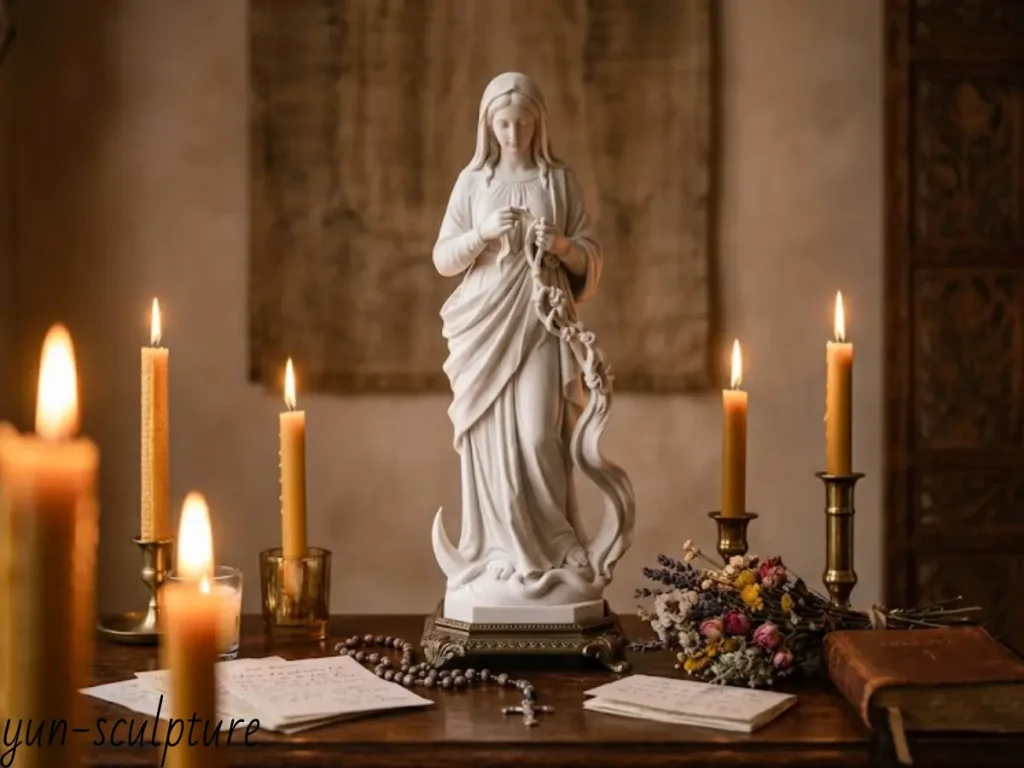
A mary undoer of knots statue is unlike any other Marian commission. Every other statue of Mary is defined by a figure, a posture, a gesture. This one is defined by a ribbon — a single continuous form that must move from tension to release, from knotted to smooth, in stone or bronze that weighs hundreds of kilograms and will stand in one place for a century. Getting the ribbon right is the entire commission. This guide covers what that actually requires, and why most of what you will find on Amazon and EWTN will not get you there.
Table of Contents
Table of Contents
What Does the Mary Undoer of Knots Statue Represent?
The statue represents intercession — Mary’s active participation in resolving what human effort alone cannot untangle.
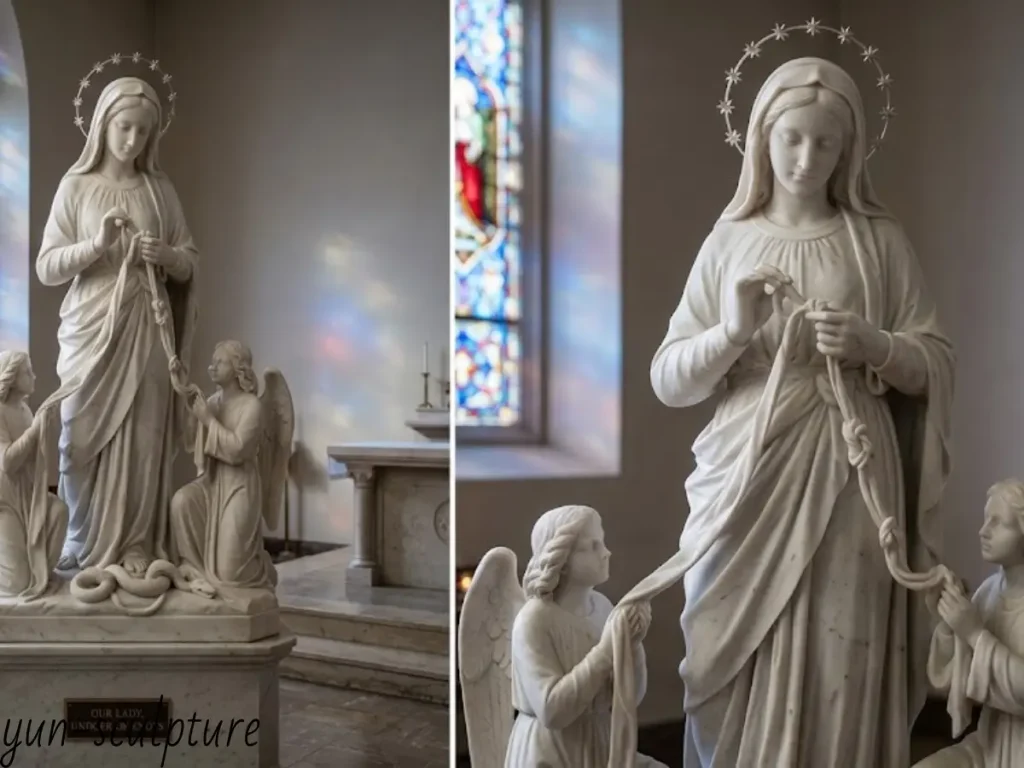
The image originates from a 1700 Augsburg painting by Johann Georg Schmidtner, commissioned to commemorate a marriage saved from collapse through Marian prayer. In the painting, Mary stands between heaven and earth, her hands working a ribbon marked by knots. One angel presents the tangled length; another receives it, smooth and restored. The theology embedded in that image is precise: grace does not destroy the ribbon of human life — it restores it. The knots are loosened, not cut.
Each knot on the ribbon represents a different category of human struggle — marital discord, addiction, family estrangement, illness, grief, spiritual paralysis. The devotion spread from Germany to Argentina through Cardinal Jorge Mario Bergoglio, who later became Pope Francis, and from Argentina to the world after his election in 2013. The Brazilian sanctuary in Campinas now receives approximately 600,000 pilgrims annually, making it the largest Mary Undoer of Knots site on earth.
For a sculpture commission, this theological precision has direct consequences. The ribbon is not decoration. It is the theological center of the piece. Every decision — material, scale, number of knots, surface treatment — flows from that fact.
What Problems Does Mary Undoer of Knots Solve?
The devotion is unusual in Catholic tradition for its breadth. Most Marian titles carry a specific protection or intercession — Our Lady of Guadalupe for the Americas, Our Lady of Lourdes for healing. Mary Undoer of Knots is explicitly universal.
The original 1615 event involved a marriage. But the image that emerged from it — knots representing human entanglement, Mary’s hands loosening them one by one — speaks to any situation that feels intractable. The devotion is invoked for troubled marriages and for addiction recovery. For estranged family relationships and for career paralysis. For spiritual dryness and for grief that will not lift.
This universality is what drove the extraordinary spread of the devotion through Latin America, where the struggles of ordinary family life — poverty, migration, broken relationships, uncertainty — found an immediate resonance with the image of a mother patiently working through the knots of her children’s lives.
For institutions commissioning a statue — a parish in Buenos Aires, a retreat center in São Paulo, a Catholic family services organization in the American Southwest — this breadth is the point. The statue does not speak to one specific crisis. It speaks to the experience of being entangled, which is universal.
Planning a commission for a parish, retreat center, or institution? Tell us your space dimensions and devotional context — we will suggest the right scale and composition.
Why Can’t Resin Capture the Ribbon and Knots?
Every resin Mary Undoer of Knots statue on the market has the same problem, and it is not a matter of quality or price point. It is geometry.
Resin statues are produced through molds. A mold must release the finished object without damage — which means the design cannot include deep undercuts, areas where one form passes fully under another and back again. A genuine knot requires exactly these undercuts. Each strand must have thickness, must press against another strand, must create real compression and shadow between the layers. That three-dimensional interlocking is what makes a knot visually legible and theologically present.
In a mold, these forms must be flattened. The strands merge into surface texture rather than fully rounded volumes. The result looks like knots from three meters away and reveals itself as shallow relief up close — which is precisely the distance at which devotional statues are most often encountered.
Donghui Zhang, who has spent over 20 years producing religious sculpture, is direct about this: a resin knot is a visual imitation of a knot, not a structural one. The difference matters because the knot is the theology. A flattened knot communicates the idea of struggle the way a postcard communicates the idea of a place — recognizable, but absent of the thing itself.
In hand-carved marble, each strand is sculpted in full three dimensions. In lost-wax bronze casting, the wax model captures every overlap and undercut before casting. Both methods preserve the structural reality of the knot. Neither can be replicated through molding.
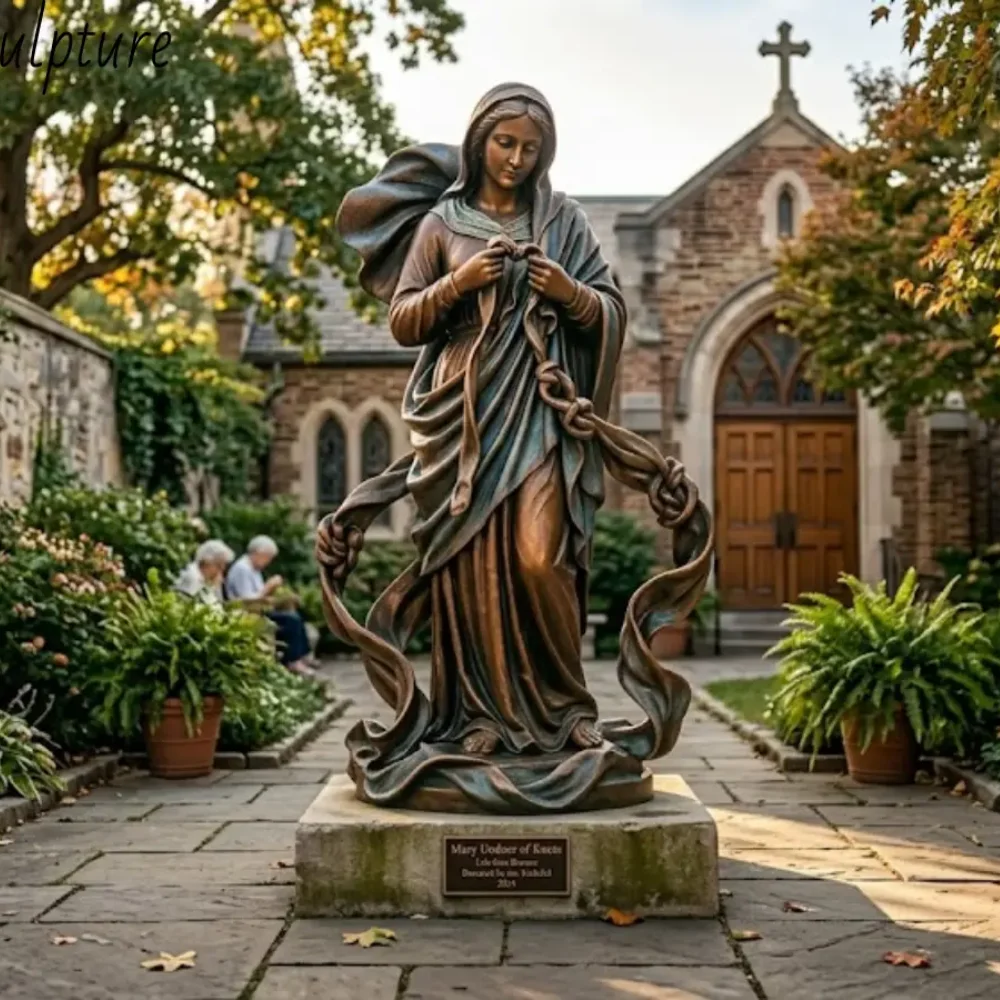
What Material Is Best — Marble or Bronze?
The answer depends on where the statue will live, and what the ribbon needs to do structurally in that environment.
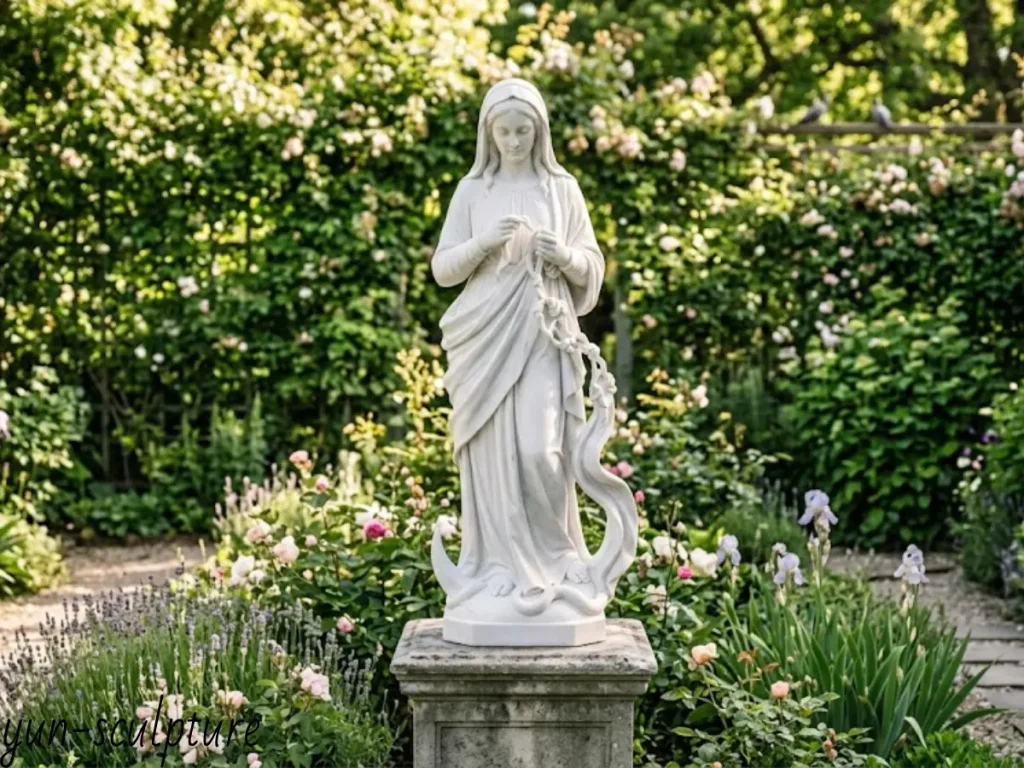
White marble is the material I reach for first when a client describes an indoor chapel, a covered cloister, or a sheltered garden shrine. Marble has a translucency that no other material replicates — light penetrates the surface slightly before reflecting back, giving the ribbon an almost luminous softness. A well-carved marble ribbon appears to yield, to bend, to carry weight differently than stone should be able to. This quality is theologically resonant for a subject about grace transforming tension into release.
The structural challenge in marble is the ribbon’s thin sections and overlapping forms. Any element that projects at an angle from the main figure creates leverage stress — the thinner the ribbon edge, the higher the fracture risk over time. Donghui reinforces every marble commission at these stress points with internal stainless steel pins, invisible to the viewer but essential to the sculpture’s survival over decades. For outdoor marble installations in climates with freeze-thaw cycles, he does not recommend it — moisture infiltrates micro-fractures, expands, and widens them progressively. The ribbon’s thinnest sections are the first to fail.
Cast bronze is the correct choice for outdoor installations and large-scale institutional commissions. The lost-wax process allows the sculptor to capture every overlap, every undercut, every twist of the ribbon in wax before casting — and bronze preserves this complexity with precision. Thin ribbon sections retain strength because of the material’s tensile properties. The natural patina that develops over years darkens the recesses between knot strands, enhancing the perception of depth and making the three-dimensional structure of the ribbon more visible rather than less.
For the Brazilian and Argentine parish market — where commissions are often processional or installed in humid outdoor environments — bronze is almost always the right answer. For North American indoor chapel installations, marble offers the spiritual refinement that suits contemplative devotion.
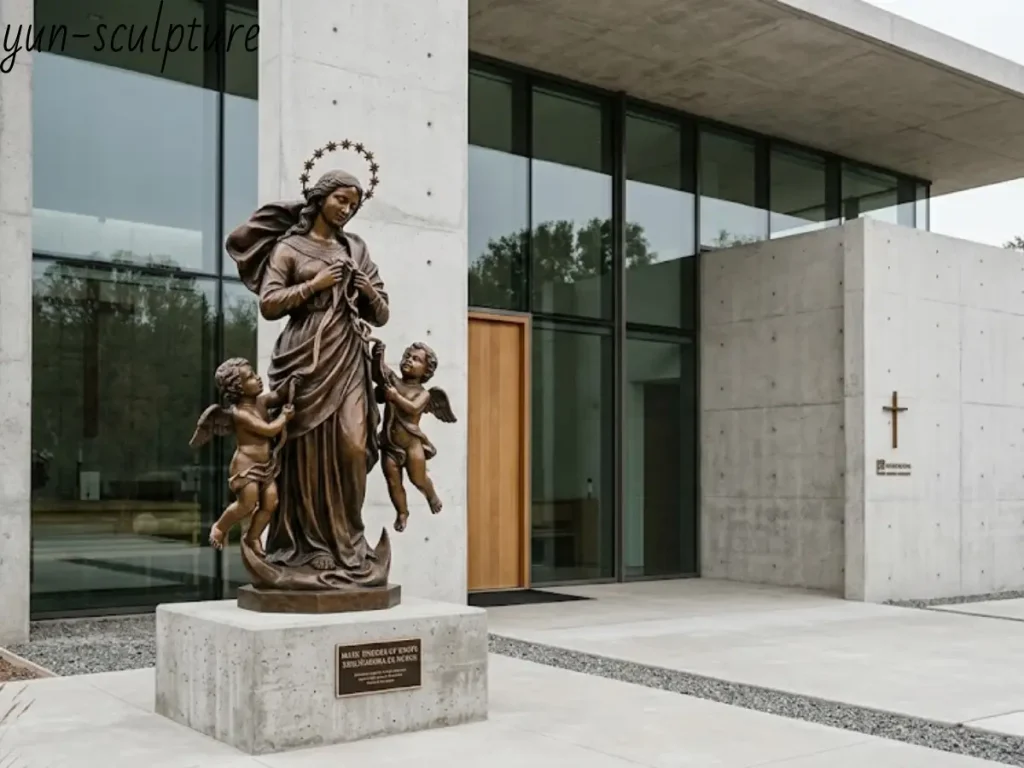
How Big Should a Mary Undoer of Knots Statue Be?
Scale determines whether the ribbon communicates or disappears — and the ribbon is everything.
At 12 inches, the knots flatten into surface suggestion. The distinction between the knotted and smooth sections of the ribbon becomes a color difference rather than a structural one. At 18–24 inches, the knots become readable but simplified — you understand that they are knots, but you cannot follow the strand through the crossing.
True iconographic legibility begins at 30–36 inches. At this scale, each knot can be carved or cast in full round, with clear over-and-under relationships visible from multiple angles. The transition from knotted to smooth becomes a journey the eye can follow. The snake beneath Mary’s feet, the angels, the twelve stars — all secondary elements become fully present rather than suggested.
Donghui’s scale framework for this subject:
| Size | Setting | What the Ribbon Does |
|---|---|---|
| 12–18 inches | Home altar, personal devotion | Symbolizes knots; cannot show structure |
| 24–30 inches | Home shrine, small chapel | Knots readable; some detail simplified |
| 36–48 inches | Parish chapel niche, retreat space | Full knot structure visible; all elements present |
| Life-size (5–6 ft) | Church nave, institutional courtyard | Complete iconographic program; ribbon fully engineered |
| 8 ft and above | Outdoor shrine, pilgrimage site | Requires structural integration of ribbon into robes; engineering-grade base |
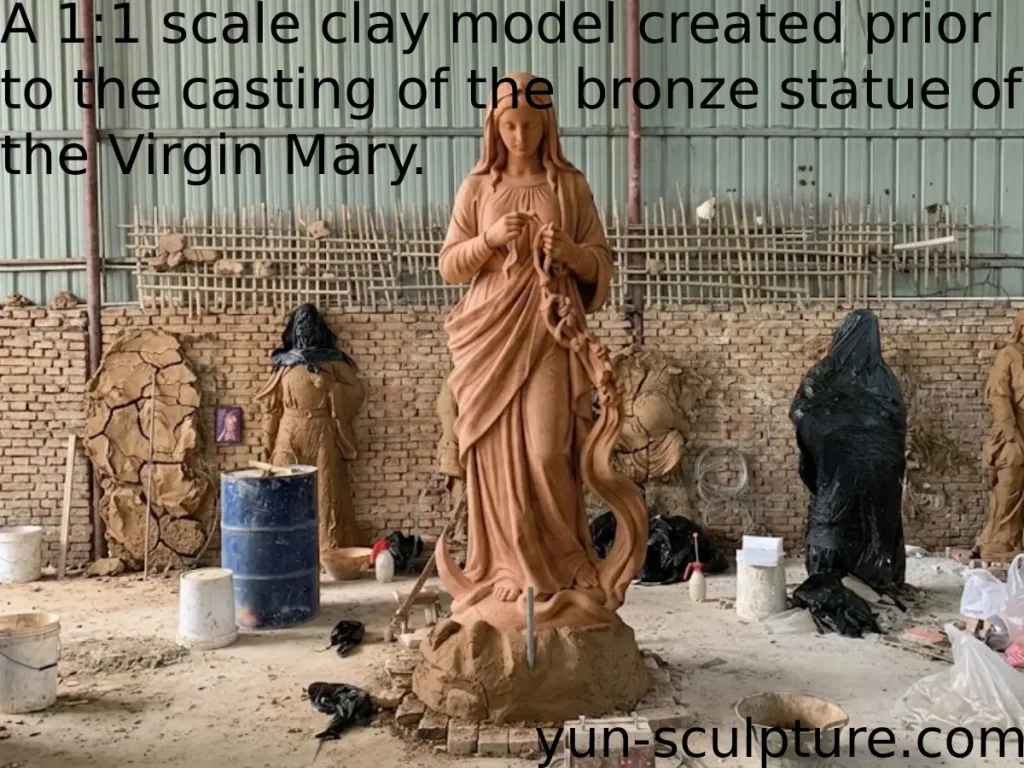
A life-size Mary Undoer of Knots in white marble takes approximately 40–50 working days from approved clay maquette to shipping. The equivalent in bronze runs 45–55 days — slightly longer because the wax ribbon model requires more refinement time than the marble roughing stage. These are real production timelines from recent commissions, not estimates.
One practical note on the clay maquette stage for this specific subject: we will not proceed to marble carving or bronze casting without full maquette approval. The ribbon’s three-dimensional flow — whether it moves naturally from tension to release, whether the knots read from multiple viewing angles, whether the transition to smooth feels continuous — cannot be evaluated from a drawing. It must be confirmed in three dimensions before any material is committed.
For related Marian outdoor commissions where similar material and climate decisions apply, our Our Lady of Lourdes grotto guide and Our Lady of Guadalupe outdoor statue guide cover comparable engineering considerations.
FAQ
Where is the original image/painting of Mary Undoer of Knots?
The original 1700 painting by Johann Georg Schmidtner is housed in the Church of St. Peter am Perlach in Augsburg, Bavaria, Germany. It was commissioned by Hieronymus Ambrosius Langenmantel to commemorate an event in his family history — the saving of his grandparents’ marriage through Marian intercession. The painting remains in its original location and can be visited today. A second significant site is the National Sanctuary of Mary Undoer of Knots in Campinas, São Paulo, Brazil, which has become the largest center of this devotion in the world, receiving approximately 600,000 pilgrims annually. The first chapel specifically dedicated to Mary Untier of Knots was completed in 1989 in Styria, Austria, created in connection with the memory of the Chernobyl disaster.
Is there a feast day for Mary Undoer of Knots?
Yes. The feast of Our Lady Undoer of Knots is celebrated on September 28 in the Catholic calendar. The feast is not universal — it is observed primarily in dioceses and communities where the devotion has been formally adopted, particularly in Argentina, Brazil, and increasingly in the United States and Europe following Pope Francis’s global promotion of the devotion. In Argentina, the devotion is also associated with the Church of San José del Talar in Buenos Aires, where it took root in 1996 and spread rapidly through urban parish communities.
Is Mary Undoer of Knots powerful as an intercessor?
Catholic tradition holds Mary Undoer of Knots as a particularly efficacious intercessor precisely because the devotion is rooted in a documented historical event — the saving of an actual marriage in 1615 through Marian prayer — rather than in apparition or private revelation alone. The extraordinary spread of the devotion through Latin America, and its global acceleration after Pope Francis’s election in 2013, reflects the consistent experience of the faithful that this form of Marian intercession meets real needs. The theological grounding goes back to Saint Irenaeus in the second century: “The knot of Eve’s disobedience was loosed by the obedience of Mary.” The intercession is understood as Mary’s ongoing cooperation with divine grace, not independent power.
Who is the saint of untying knots?
Mary — the Virgin Mary — is the figure specifically associated with untying or undoing knots in Catholic tradition. She holds no formal title as “saint” in the conventional sense, as she occupies a unique position in Catholic theology above the saints. The title “Undoer of Knots” or “Untier of Knots” is a specific Marian title drawn from the 1700 Augsburg painting and the second-century theology of Saint Irenaeus. No canonized saint carries this specific patronage. When Catholics invoke help for situations described as “knotted” — intractable problems, broken relationships, spiritual entanglement — they address Mary directly under this title.
What does the Mary Undoer of Knots statue represent?
The statue represents Mary’s active intercession in transforming human struggle — the ribbon moving from knotted to smooth is the entire theology in visual form. We cover the full meaning, the devotion’s origins, and what this requires in a sculpture commission in the first section above.
What problems does Mary Undoer of Knots solve?
The devotion is explicitly universal — invoked for troubled marriages, addiction, family estrangement, grief, spiritual dryness, and any situation that feels impossible to resolve through human effort alone. We explain why this universality shaped the devotion’s extraordinary spread through Latin America and what it means for institutional commissions in the second section above.
Commission Your Mary Undoer of Knots Statue
The ribbon is simple in meaning and unforgiving in execution. Tell us your setting — indoor chapel, outdoor shrine, parish courtyard — and we will start from the clay maquette, not the catalog.
Factory Direct · Quyang, China
Get an Exact Quote for Your Mary Statue
Tell us the size, pose, and any custom requirements — we respond within 24 hours with a detailed price breakdown, no obligations.