Get in touch with Yun-Sculpture company
Faith in Three Figures: The Ultimate Guide to Custom Holy Family Statues in Marble and Bronze

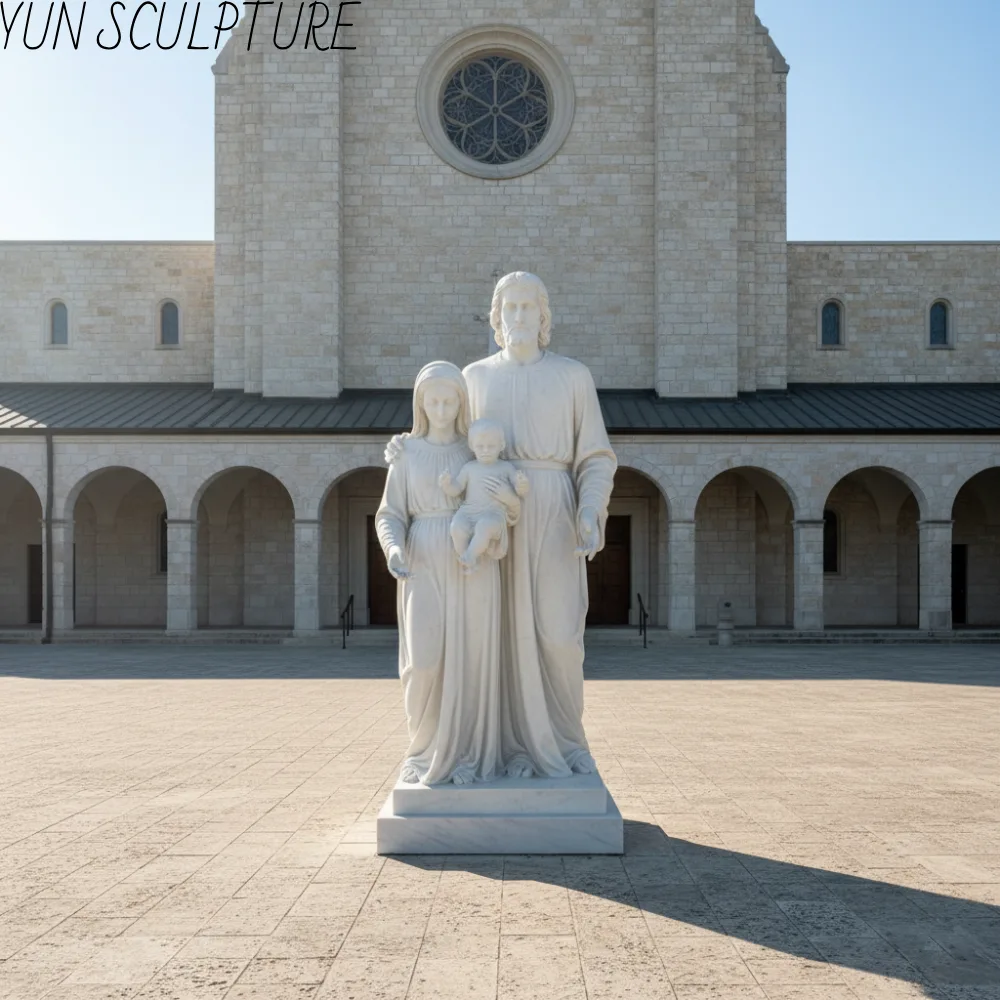
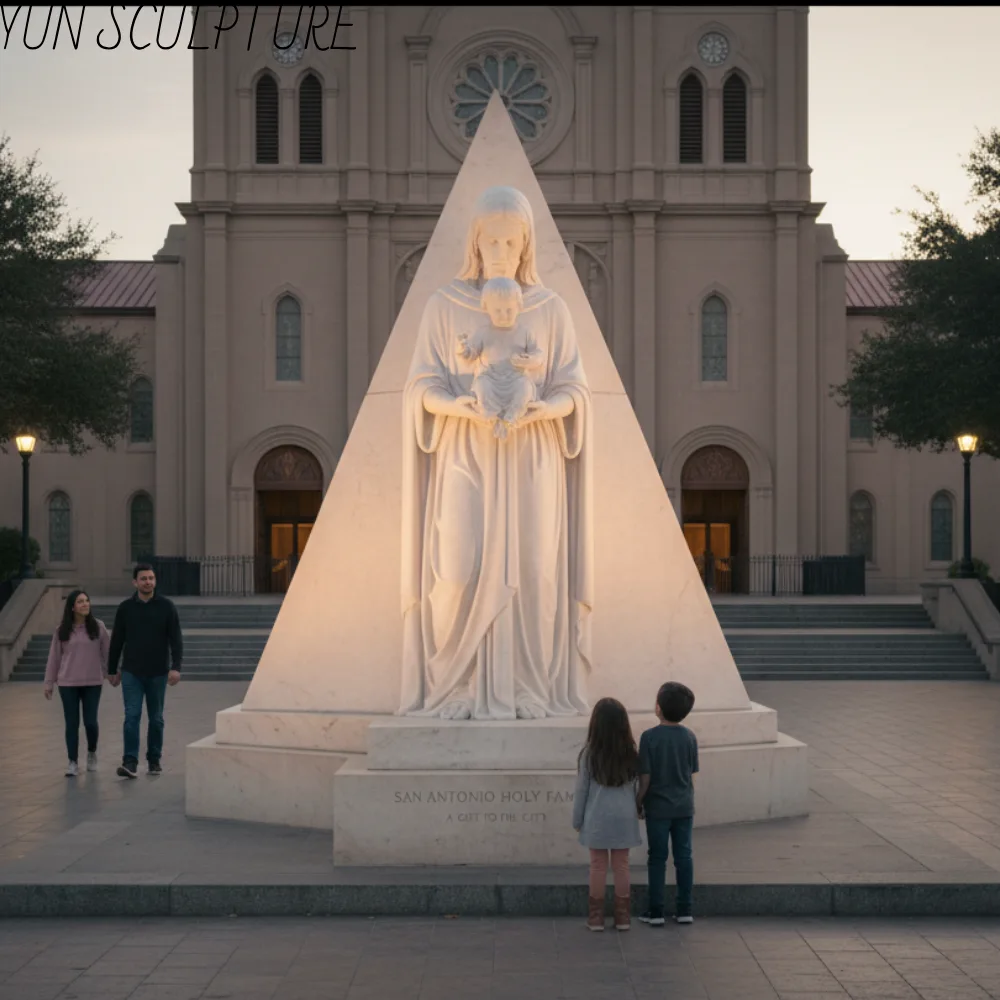
In the spring of 2022, a building committee from a parish in San Antonio, Texas, sent us a photograph of their church entrance — a broad stone plaza, fifteen meters wide, with a granite pedestal already poured at its center. The pedestal had been waiting three years for a statue.
The committee’s brief was unusual in its precision. They did not want a single figure. They did not want a crucifix or a Risen Christ. They wanted three people — a man, a woman, and a child — standing together in a way that every family entering the church would recognize as their own.
They wanted a jesus mary and joseph statue. And they wanted it in marble.
The first question we asked was not about size or budget. It was about geometry.
Three figures standing together do not automatically become a composition. They become a composition only when the spatial relationship between them — the distances, the angles, the directions of their gazes, the positions of their hands — is resolved into a visual logic that the eye reads as inevitable. A jesus mary joseph statue that fails this test does not look like a family. It looks like three strangers standing in proximity.
This article is about how that problem is solved. It is about the material — marble, specifically, and why white stone speaks the language of domestic life and sacred family in ways that bronze cannot fully replicate. And it is about the three figures themselves: who they are, what they mean, and what it costs in craft and engineering to make them stand together as one.
Table of Contents
Table of Contents
The Theology of the Holy Family — Three Persons, One Vocation
The Holy Family is, in Catholic theological tradition, the earthly family of Jesus Christ: the child himself, his mother Mary, and his foster father Joseph. Three people of radically different theological status — God incarnate, the Immaculate Mother, a Galilean carpenter — living together in an ordinary house in Nazareth for approximately thirty years, performing the ordinary acts of domestic life.
This is the theological paradox that gives the jesus and mary statues tradition its peculiar devotional power. The God who created the universe learned to walk in that house. He was taught to read by his mother. He learned a trade from Joseph. The Holy Family is not merely a devotional image. It is a theological argument: that ordinary family life — its dailiness, its labor, its love, its friction — is the context God chose for the Incarnation, and therefore sacred in itself.
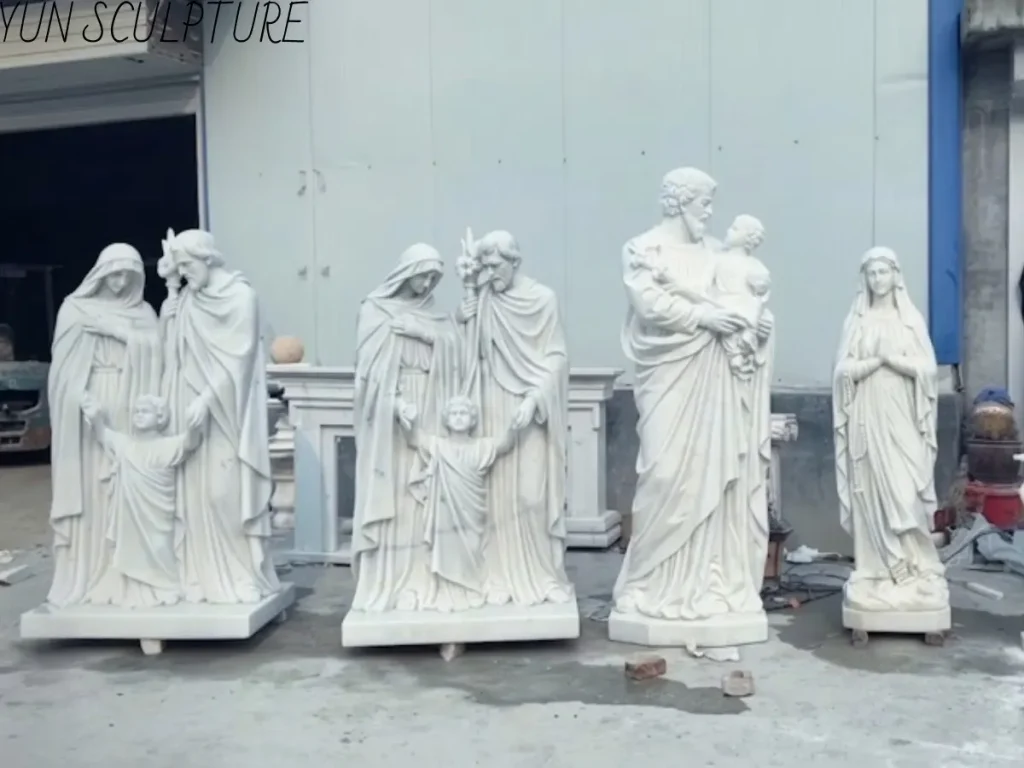
Pope Leo XIII formally established the Feast of the Holy Family in 1892, designating the Holy Family as the patron and model of all Christian families. The feast is celebrated on the Sunday after Christmas in the Roman Catholic calendar — the liturgical logic being that the joy of Christmas immediately raises the question of how the child will be raised, and by whom, and in what kind of home.
The catholic jesus statue tradition for Holy Family representations draws on this theological foundation: these three figures are not primarily a devotional group for individual prayer. They are a declaration about the nature of family life — that it is vocation, not merely biology; that a father’s protection and a mother’s tenderness and a child’s vulnerability together constitute a complete image of what human love, at its fullest, looks like.
Three Iconographic Traditions — Which Moment Do You Commission?
The Holy Family does not appear at a single moment in the Gospel narrative. The sacred art tradition has developed three distinct iconographic forms, each depicting a different phase of the family’s life together, each demanding a different compositional solution.
The Holy Family of Nazareth depicts the domestic life of the family during the hidden years — the three decades between the Nativity and the beginning of Christ’s public ministry that the Gospels largely pass over in silence. Joseph is typically shown at his carpenter’s work, Mary engaged in domestic tasks, the child Jesus nearby — learning, watching, growing. This tradition emphasizes the sanctity of ordinary labor and ordinary family life. It is the form most frequently commissioned for parish entrance installations and school campuses, because its theological message — that everyday life is holy — speaks directly to the communities that use these spaces.
The Nativity depicts the night of Christ’s birth: the infant in the manger, Mary kneeling or seated beside him, Joseph standing in protective attendance. This is the most universally recognized iconographic form of the Holy Family, the form associated with Christmas and with the birth of jesus statue tradition. It introduces compositional complexities that the Nazareth format does not present — the figures are at radically different heights, the infant on the ground while the adults stand or kneel, and the spatial relationship between the three must be resolved vertically as well as horizontally.
The Flight into Egypt depicts the family’s journey into Egypt to escape Herod’s persecution — Mary holding the infant Christ, typically seated on a donkey, Joseph walking ahead or beside, leading the animal through the desert. This tradition is less frequently commissioned for permanent installations but carries particular resonance for immigrant and diaspora Catholic communities, for whom a family fleeing danger in the night is not a distant scriptural narrative but a lived experience.
Each of these three traditions demands a different answer to the fundamental compositional question: how do three figures of different heights, different postures, and different theological roles become a single visual statement?
The Role of Joseph — The Figure Most Often Misunderstood
Of the three figures in a joseph mary jesus statue commission, Joseph is the one most frequently handled incorrectly — not because he is theologically unimportant, but because his role in the composition is the most difficult to define.
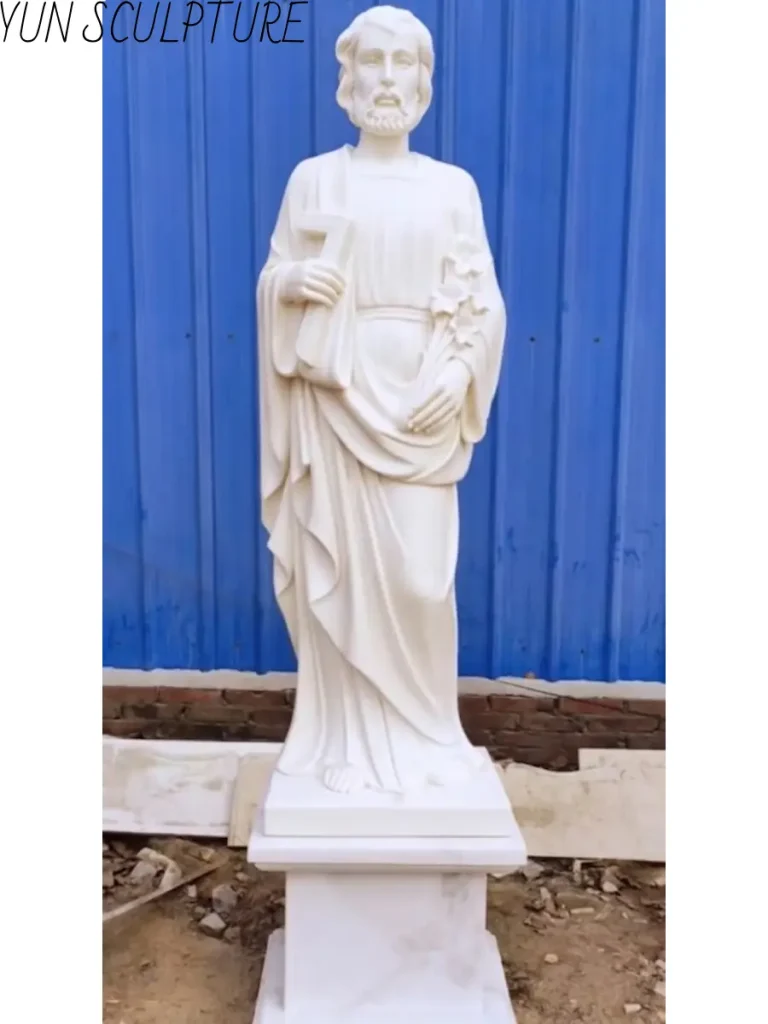
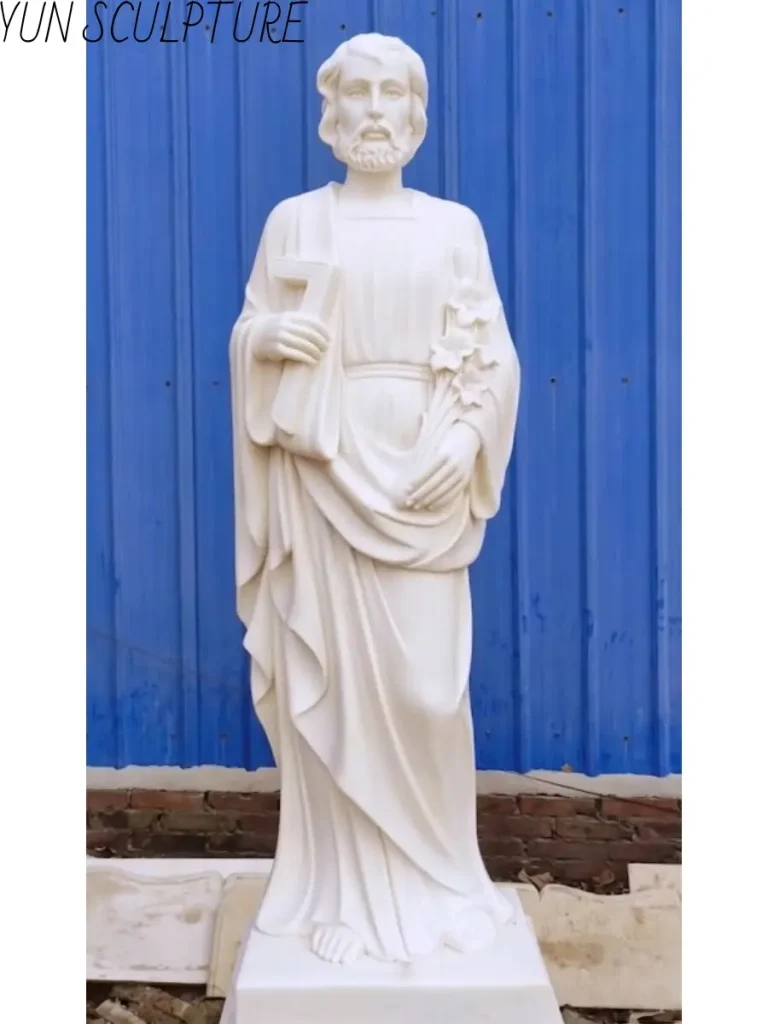
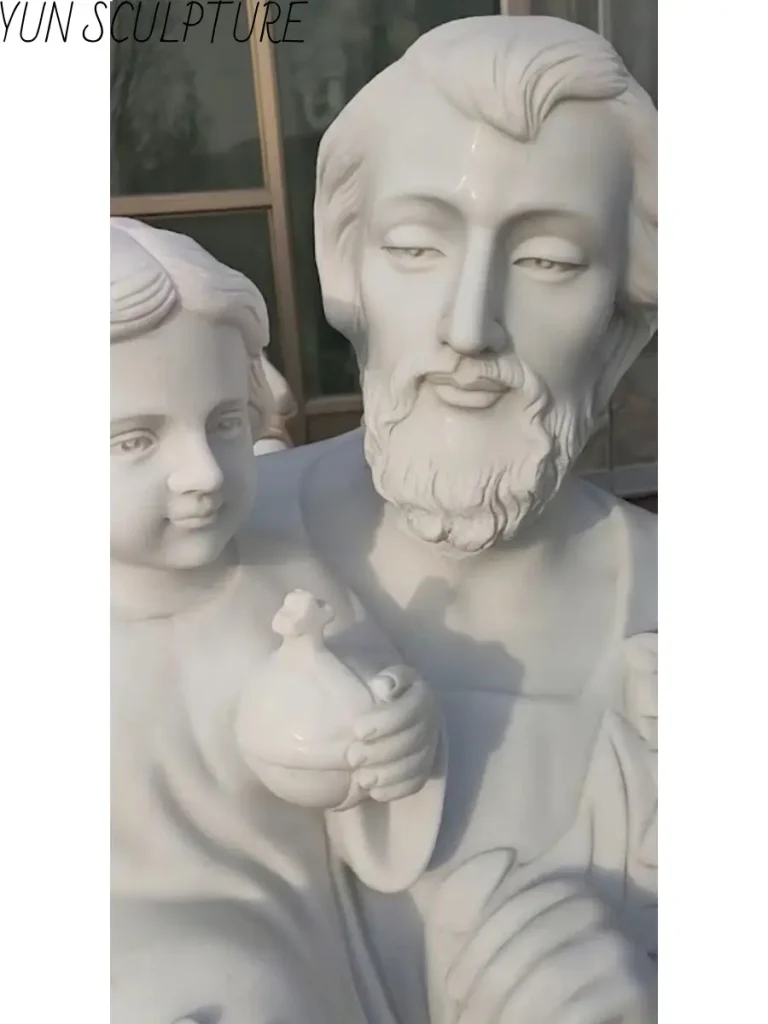
Mary’s position is clear: she is the Mother of God, the theological center of the image, the figure toward whom devotional attention naturally flows. The infant Christ is the theological subject of the entire commission — the reason the other two figures exist in the composition. Joseph’s role is structural rather than focal: he defines the outer edge of the family, the protective perimeter, the presence that makes the group a family rather than a mother and child.
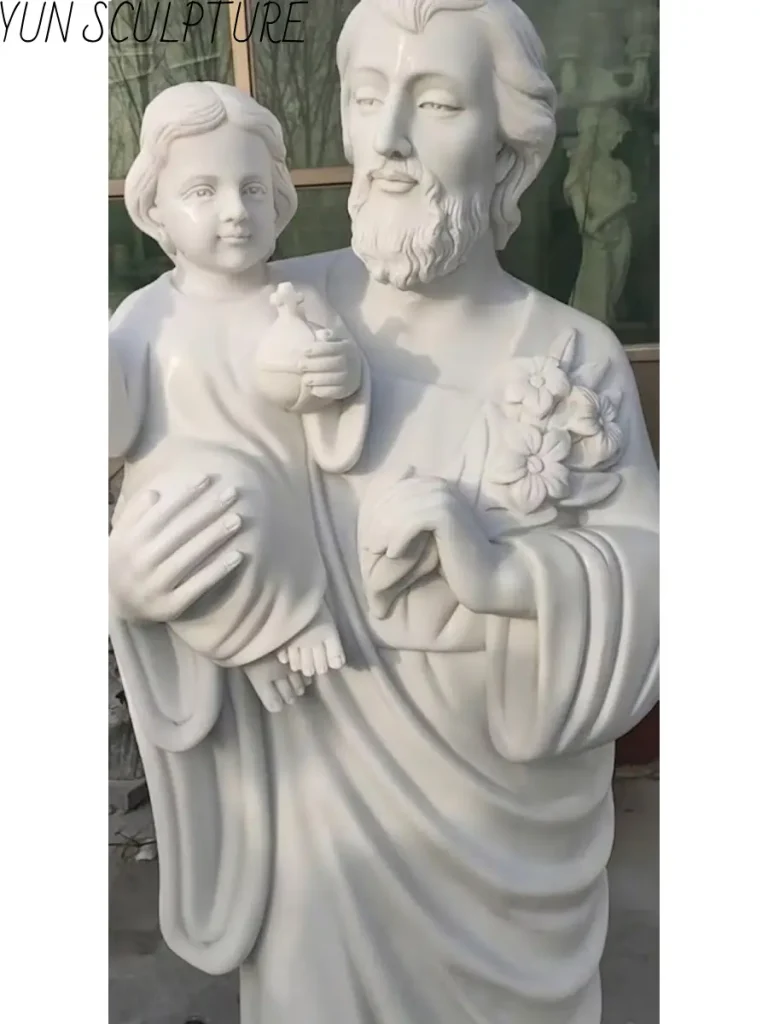
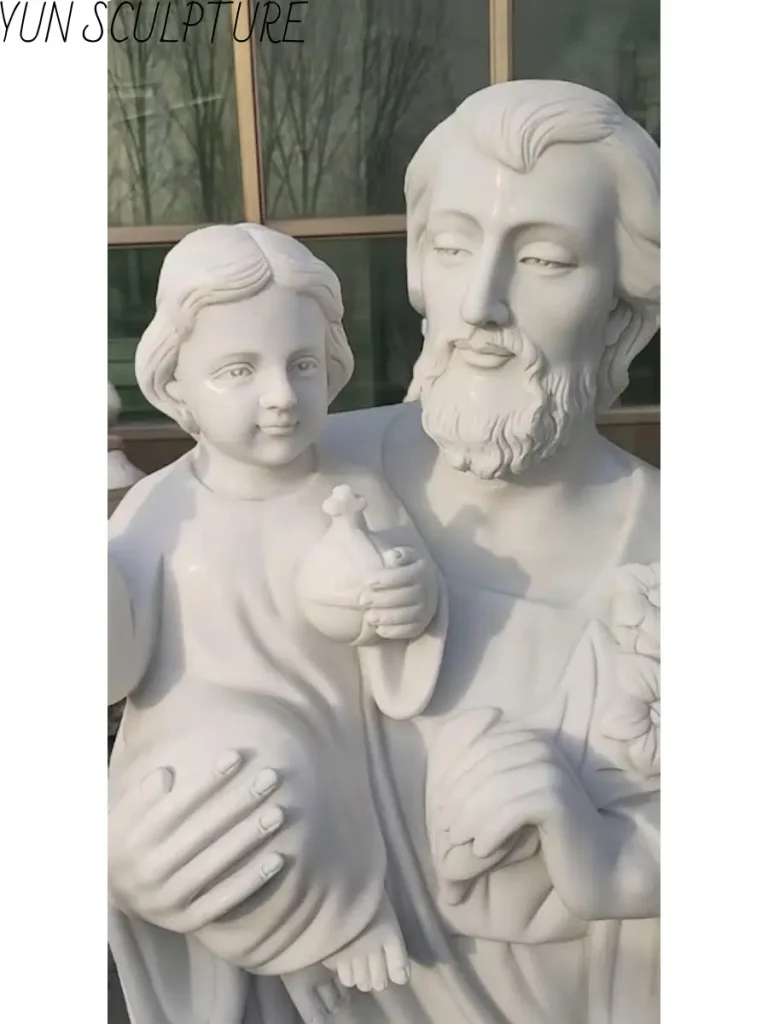
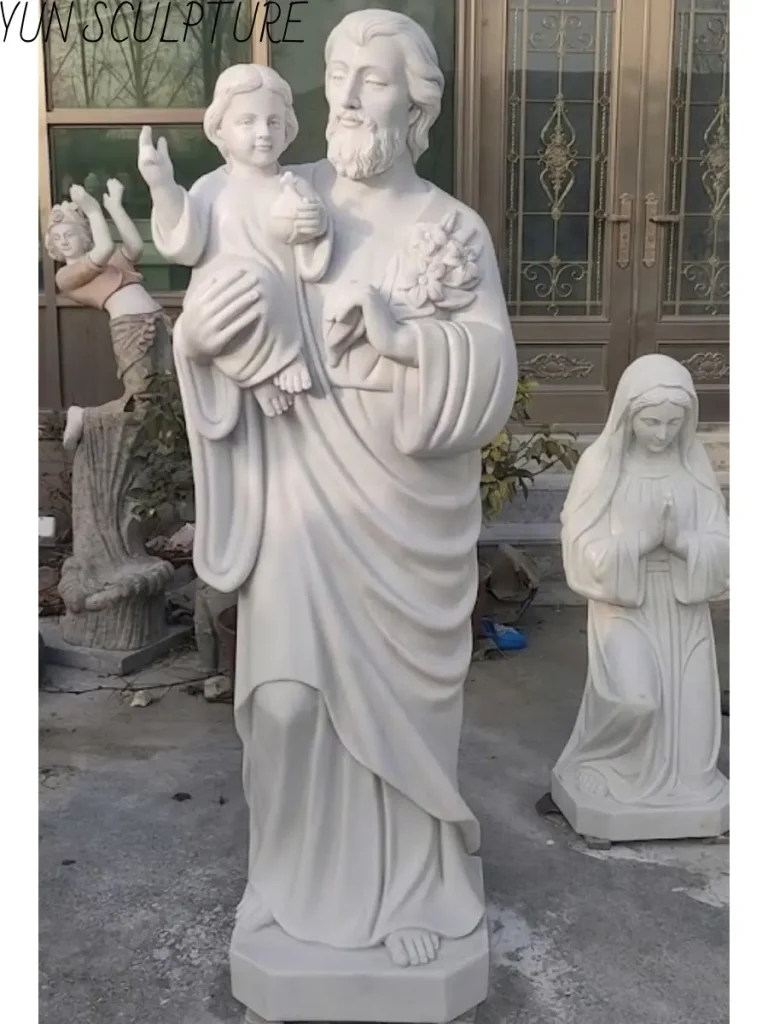
In our studio’s terminology, Joseph functions as the compositional anchor — the figure whose position establishes the spatial boundaries of the group and whose gaze and gesture direct the viewer’s attention toward the theological center without claiming that center for himself.
This requires a specific kind of sculptural intelligence. A Joseph who is too prominent — too large, too forward, gaze directed outward at the viewer — pulls attention away from Mary and the child and disrupts the theological hierarchy of the composition. A Joseph who is too recessive — too small, too far back, inadequately modeled — weakens the group and produces a composition that reads as a Madonna and Child with an unnecessary third figure appended.
The correct Joseph occupies the compositional edge with authority and without ego. He is present. He is necessary. He is not the subject.
In marble commissions, this balance is achieved primarily through the relative mass and surface treatment of the three figures: Joseph’s robes occupy more vertical space than Mary’s, giving him height and presence; but the finest surface modeling — the faces, the hands, the infant’s body — concentrates around Mary and the child, directing the eye through the quality of the carving rather than through compositional position alone.
The Sculptor’s Hardest Problem — Three Figures, One Composition
Every compositional challenge in figurative sculpture increases in complexity non-linearly with the number of figures. A single figure has one center of gravity, one emotional axis, one structural logic. Two figures in relationship — as in the Madonna and Child — introduce the problem of contact: how two bodies occupy shared space, and how that sharing communicates a relationship.
Three figures introduce something categorically different: the problem of compositional geometry. Three points in space define a triangle. That triangle — its shape, its proportions, its orientation — determines whether the group reads as a unified composition or as three separate objects that happen to share a base.
The Triangle Principle — Geometry as Theology
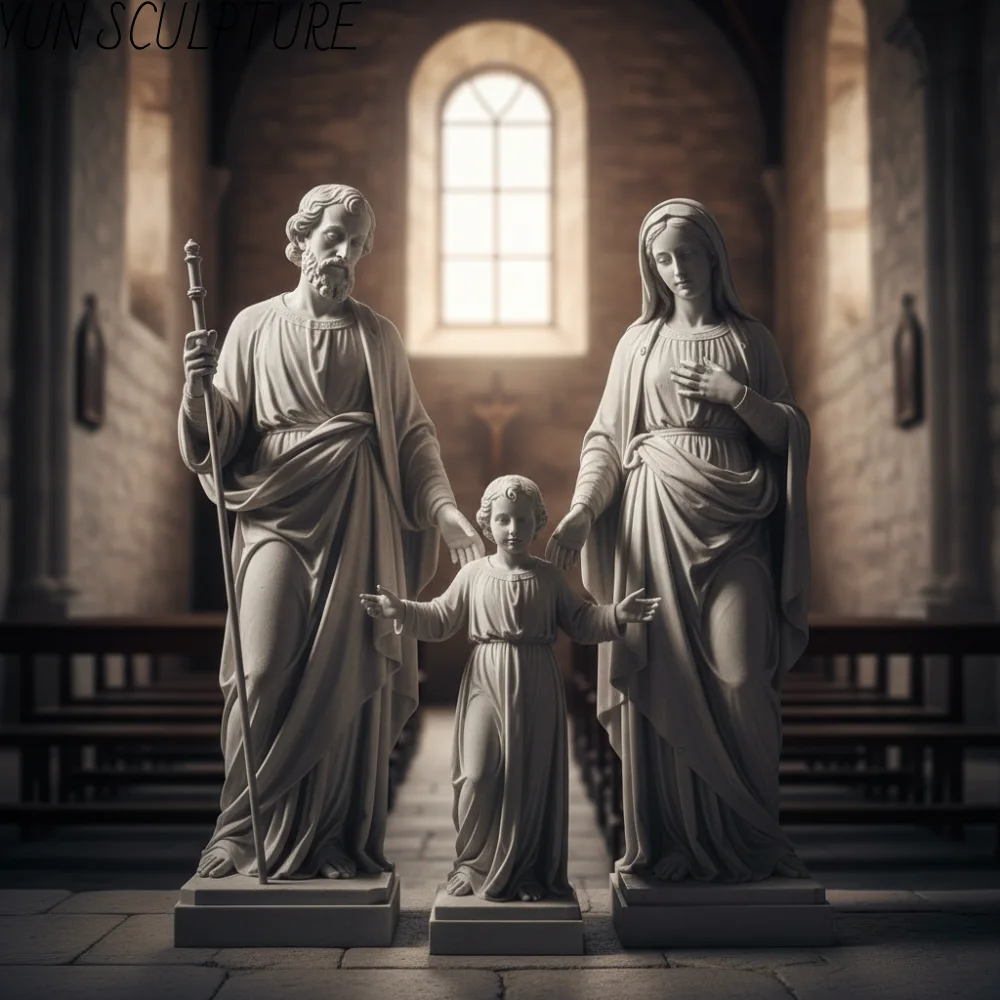
In a standing Holy Family group, the compositional triangle is defined by three key points: the highest point of Joseph’s head, the highest point of Mary’s head, and the position of the infant Christ. In a well-composed mary joseph jesus statue, these three points form a triangle that is visually stable — neither too equilateral, which reads as static and rigid, nor too asymmetrical, which reads as unbalanced.
The standard proportion we use as a starting point is a triangle with Joseph at the apex, Mary at the secondary high point approximately 85 percent of Joseph’s height, and the infant at a position that falls within the lower third of the triangle’s area. This proportion places the theological subject — the child — at the visual center of mass of the composition, while establishing the protective hierarchy of the adults above and around him.
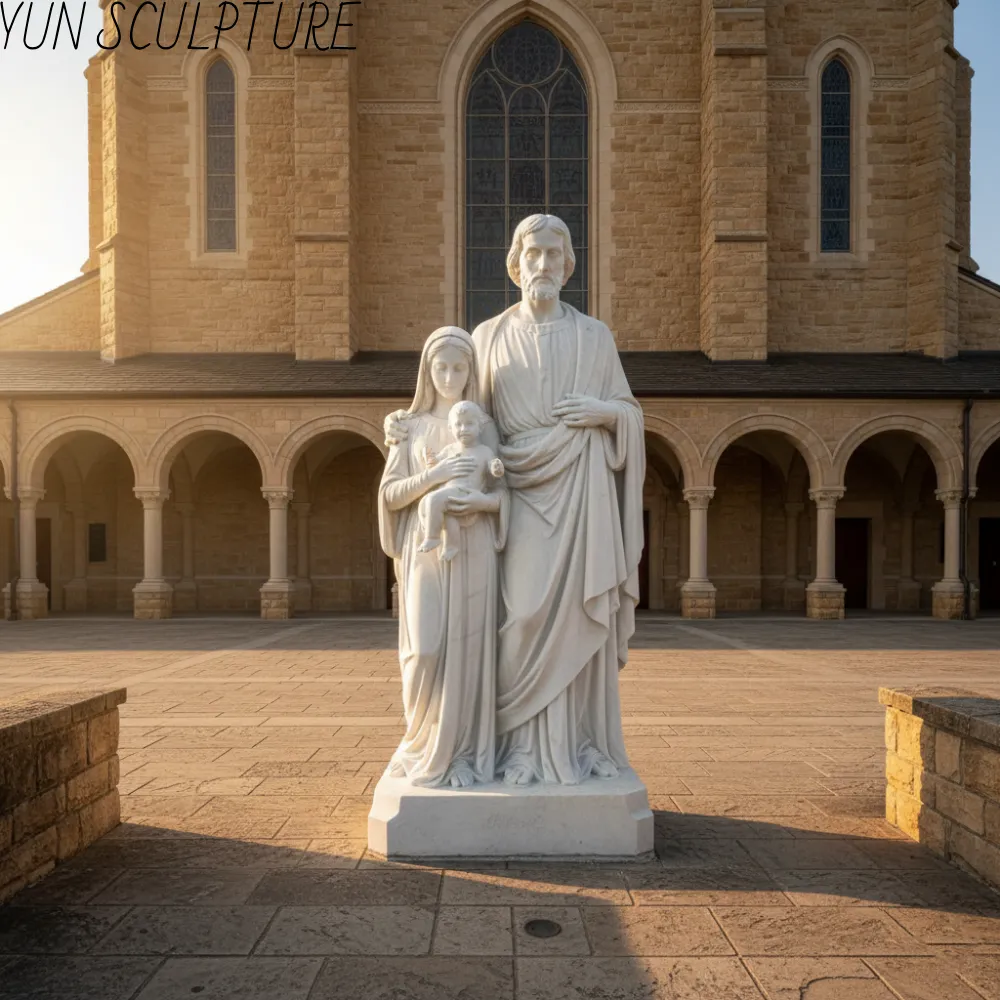
But the triangle is not merely a matter of heights. It is a matter of mass distribution in three dimensions. A Holy Family group viewed from the front must resolve into the correct triangular composition. Viewed from the side, it must present a different but equally coherent profile. Viewed from above, the three figures must occupy a spatial arrangement that establishes clear relationships of proximity and direction — Joseph and Mary oriented toward the child, their bodies inclined toward the center of the group.
We produce a top-view plan drawing for every Holy Family commission before the clay models begin, mapping the three figures’ positions and orientations in the horizontal plane. This drawing is reviewed and approved by the client before any sculpting commences, because changes to the fundamental spatial arrangement are impossible once the clay work is underway.
The Line-of-Sight System — Closing the Emotional Circuit
The three figures in a joseph mary jesus statue must look at each other — or at the viewer — in a way that establishes a coherent emotional narrative. We call this the line-of-sight system, and it is the element of Holy Family composition that most directly determines the devotional experience of the completed work.
There are two primary line-of-sight configurations, each producing a fundamentally different devotional character.
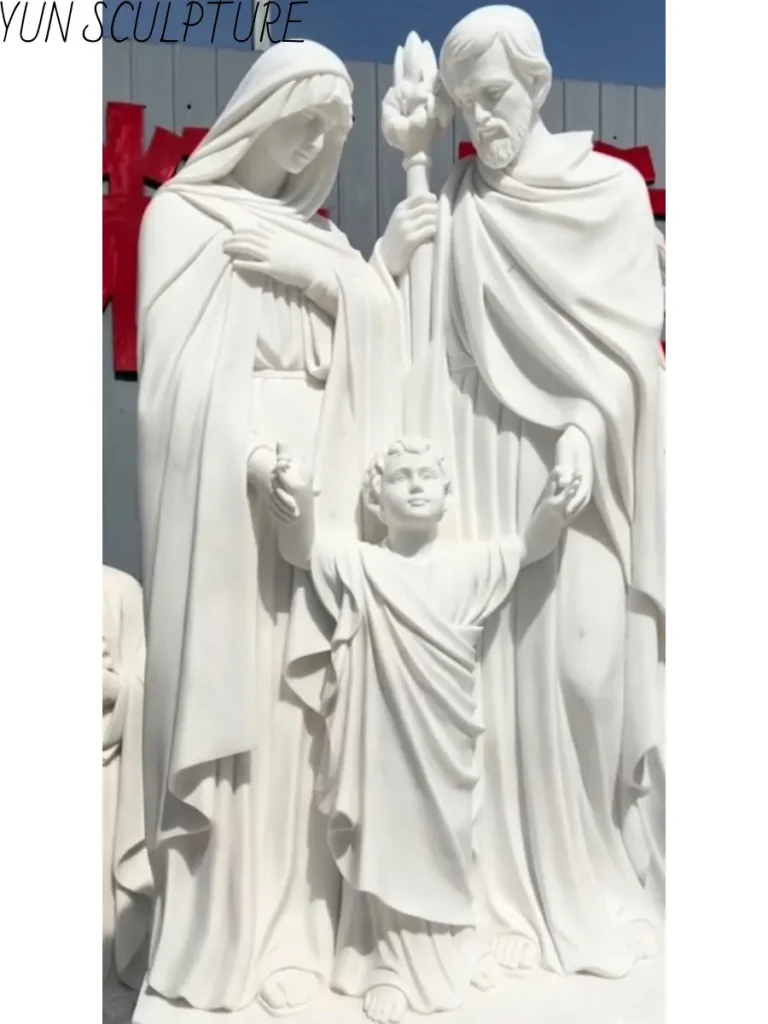
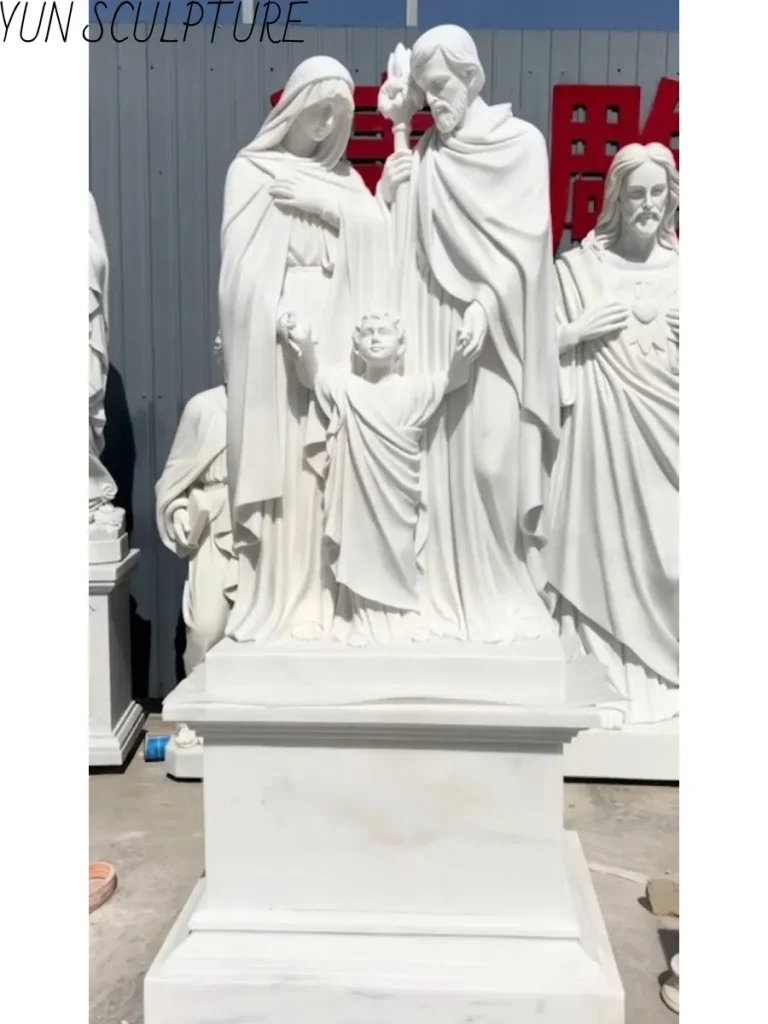
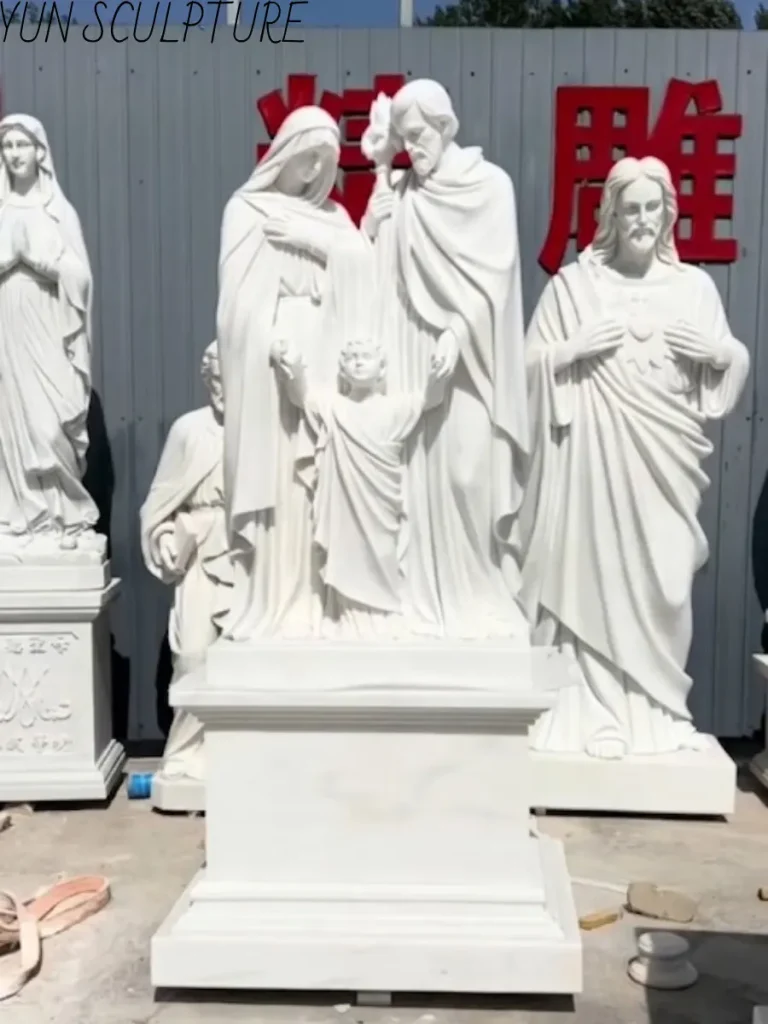
The closed circuit configuration directs all three figures’ attention inward — Mary looking at the infant, Joseph looking at Mary and the infant, the infant either sleeping or returning Mary’s gaze. This configuration produces a composition that is intimate and self-contained. The viewer observes the family from outside, as if through a window. The emotional experience is one of witnessing — of being present at a moment of private tenderness that the viewer has no part in. This configuration is most appropriate for interior chapel installations, where the viewer approaches the statue in personal prayer and the intimacy of the family’s relationship creates a devotional enclosure.
The open circuit configuration directs one figure’s gaze — typically the infant Christ’s — outward toward the viewer, while the adult figures maintain their inward orientation. This configuration produces a composition that invites rather than merely displays. The child looks at you. The family is not closed to the world. This configuration is most appropriate for exterior entrance installations, where the statue must establish a relationship with every person passing through the space, and where the theological message — that this family exists for the world, not only for itself — needs to be spatially legible.
For the San Antonio commission, we specified the open circuit: the infant’s gaze directed toward the plaza entrance, meeting every family that arrives. The adults frame and protect. The child welcomes.
Contact Points — The Architecture of Tenderness
The points at which the three figures make physical contact with each other are the sites of greatest emotional density in the entire composition. They are also among the most technically demanding elements of the commission.
In marble, contact between figures must be resolved at the design stage, before a chisel touches stone, because the contact point in a marble group is not merely an aesthetic detail — it is a structural element. Two marble figures that touch at a single small area — a hand on a shoulder, fingers meeting — create a stress concentration at that contact point that must be assessed against the bending and impact loads the installation will experience over its service life.
For a marble Holy Family in the Nazareth standing format, we typically specify three contact points: Joseph’s right hand on Mary’s left shoulder, Mary’s hands supporting the infant, and the infant’s hand or foot in contact with Mary’s arms. Each of these contacts is designed in the clay model to maximize the contact area — not a fingertip touching a shoulder, but the full palm; not a hand barely supporting the infant, but arms that envelope — in order to distribute the structural load across the maximum possible surface area at each connection.
The emotional content of these contact points is inseparable from their structural logic. A broad, confident hand on a shoulder communicates protection. Encircling arms communicate security. The specific geometry of how Joseph’s hand rests on Mary’s shoulder — the angle of the wrist, the slight curve of the fingers, the degree of pressure implied by the modeling — communicates the entire relationship between these two people in a few square centimeters of carved stone.
This is the area of the commission where our sculptors spend the most time in the clay review stage. Not the faces — though the faces are critical. The contact points. Because the faces tell you what the figures feel. The contact points show you what they do about it.
Marble for the Holy Family — Why White Stone Speaks This Subject’s Language
Of all the sacred image commissions we undertake, the Holy Family is the one for which marble makes the strongest argument on purely theological grounds.
The Holy Family of Nazareth is a domestic subject. Its theology is not the theology of triumph or sacrifice or supernatural intervention. It is the theology of ordinary life made holy — a carpenter’s house, a mother’s daily work, a child growing up in a family. The material appropriate to this theology is not the heroic weight of patinated bronze. It is the domestic warmth of white stone: luminous, approachable, capable of the softness that renders an infant’s cheek and a mother’s hand with the quality of living skin.
Carrara and Hanbaiyu — Choosing the Stone
Italian Carrara marble from the quarries of the Apuan Alps in Tuscany has been the canonical material for Western figurative sculpture since the ancient Greeks identified its specific optical properties as uniquely suited to the representation of the human figure. The crystal structure of Carrara marble — fine-grained, low in iron content, high in calcite purity — produces the sub-surface light scattering that gives white marble its characteristic warmth. Light penetrates 2 to 4 millimeters into the polished surface and returns scattered, creating the effect of internal luminosity that no opaque surface can replicate.
For a Holy Family commission, this property is most critical at the infant’s face and skin surfaces — the areas where the theological content of the image is most concentrated. A marble infant face that receives diffused light correctly appears not carved but inhabited. The cheeks carry warmth. The closed eyelids have the quality of sleep rather than inertia. This is not an illusion. It is physics — the specific interaction of visible light with a crystal structure that happens to share the optical properties of human skin.
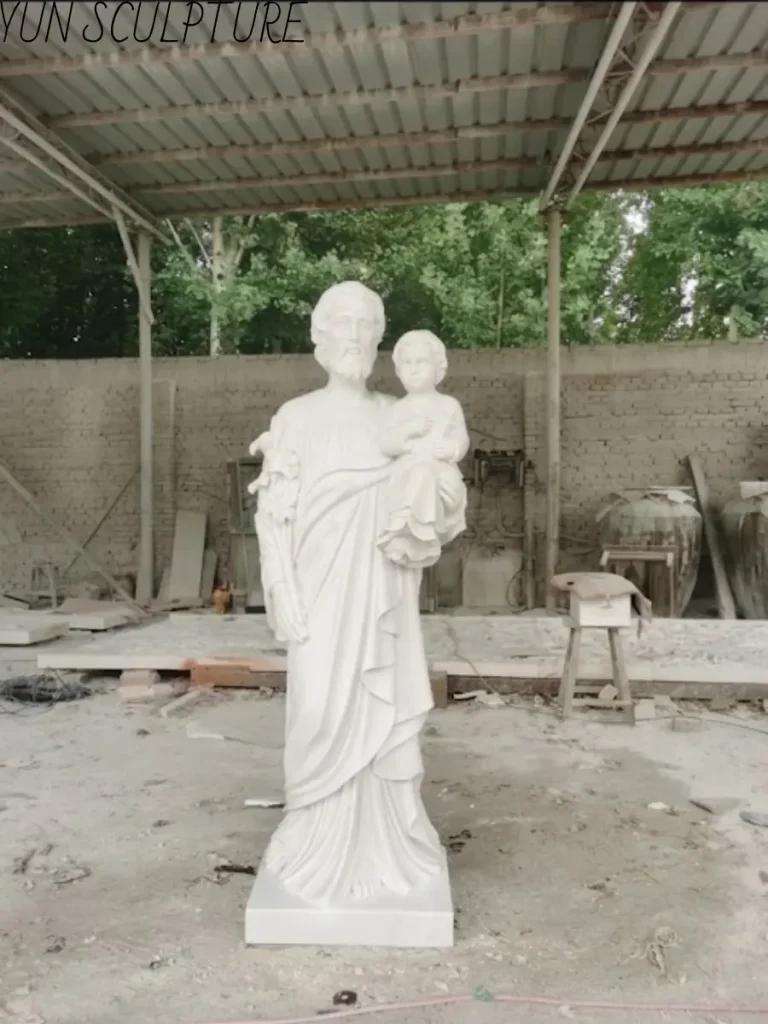
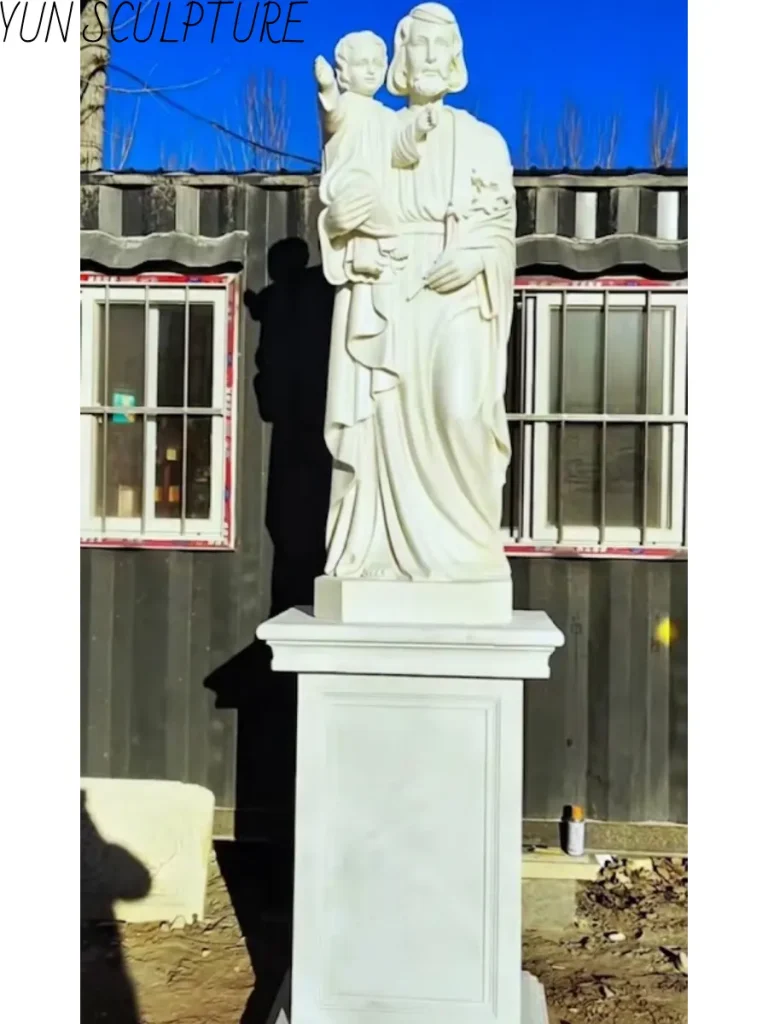
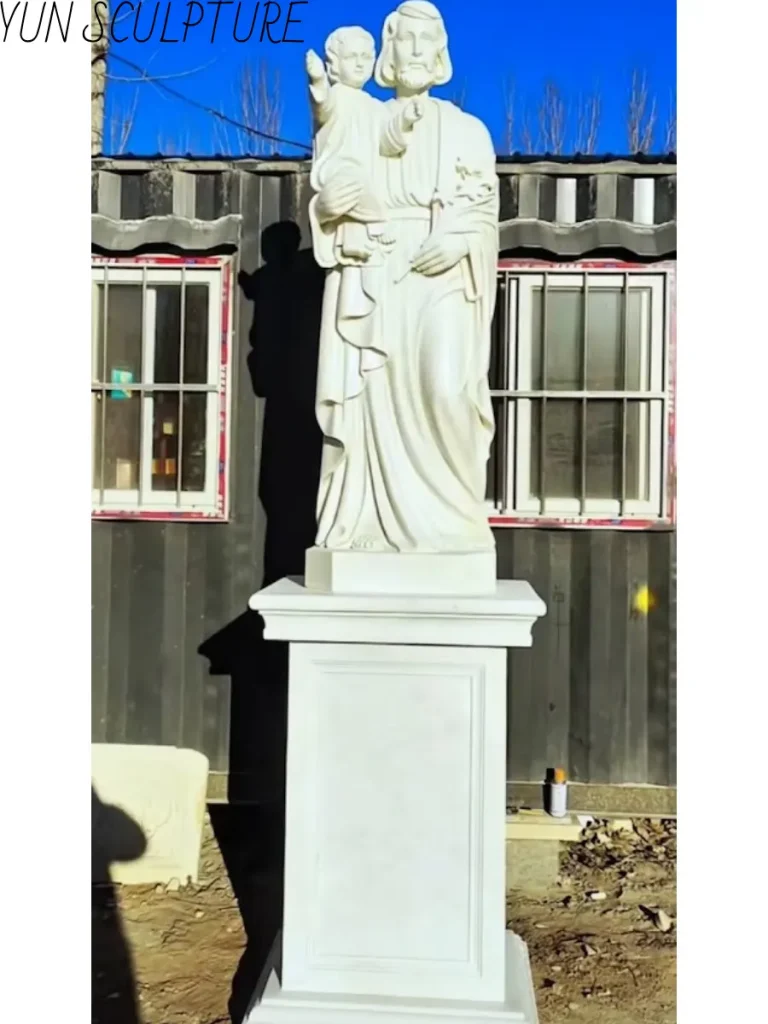
Chinese Hanbaiyu white marble, quarried in Baoding, Hebei Province, offers a related but distinct optical character. Its crystal grain is slightly coarser than fine Carrara, and its surface tone carries a marginally warmer baseline — slightly cream rather than pure white in certain quarry cuts. For Holy Family commissions where the client has specified a warmer, more intimate visual character — commissions for family chapels rather than institutional spaces, or for communities with a strong preference for the warmer Mediterranean-influenced iconographic tradition — Hanbaiyu can be the more appropriate choice.
We maintain current stock documentation for both materials: crystal structure analysis, compression strength testing, and representative carved sample blocks that clients can examine before material selection is finalized. No commission begins until the client has approved the specific stone.
The Marble Holy Family — Three Figures, One Block or Three?
The fundamental material decision for a marble Holy Family group is whether to carve the three figures from a single block of stone or to carve them separately and join them at the installation stage.
A single-block carving — the method Michelangelo employed for his Pietà and his David — produces a compositional unity that separate figures cannot replicate. The stone is continuous. The space between the figures is not empty space between separate objects but negative space carved from within a single mass. The figures emerge from the same material history, the same geological formation, the same block that was once undifferentiated stone.
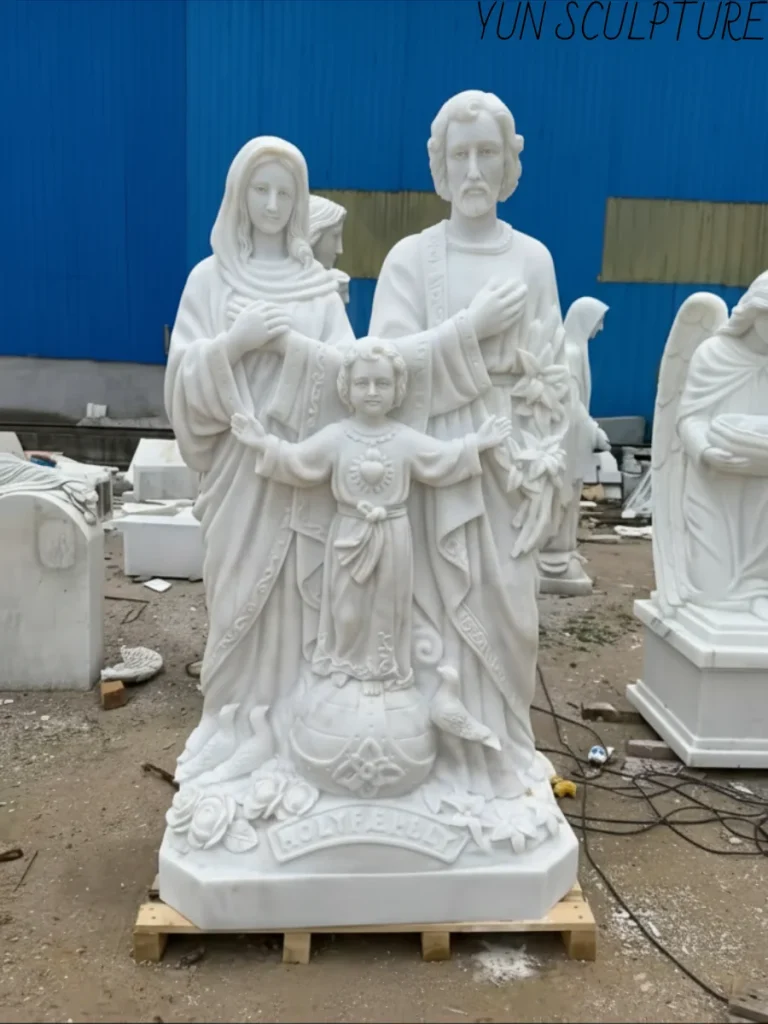
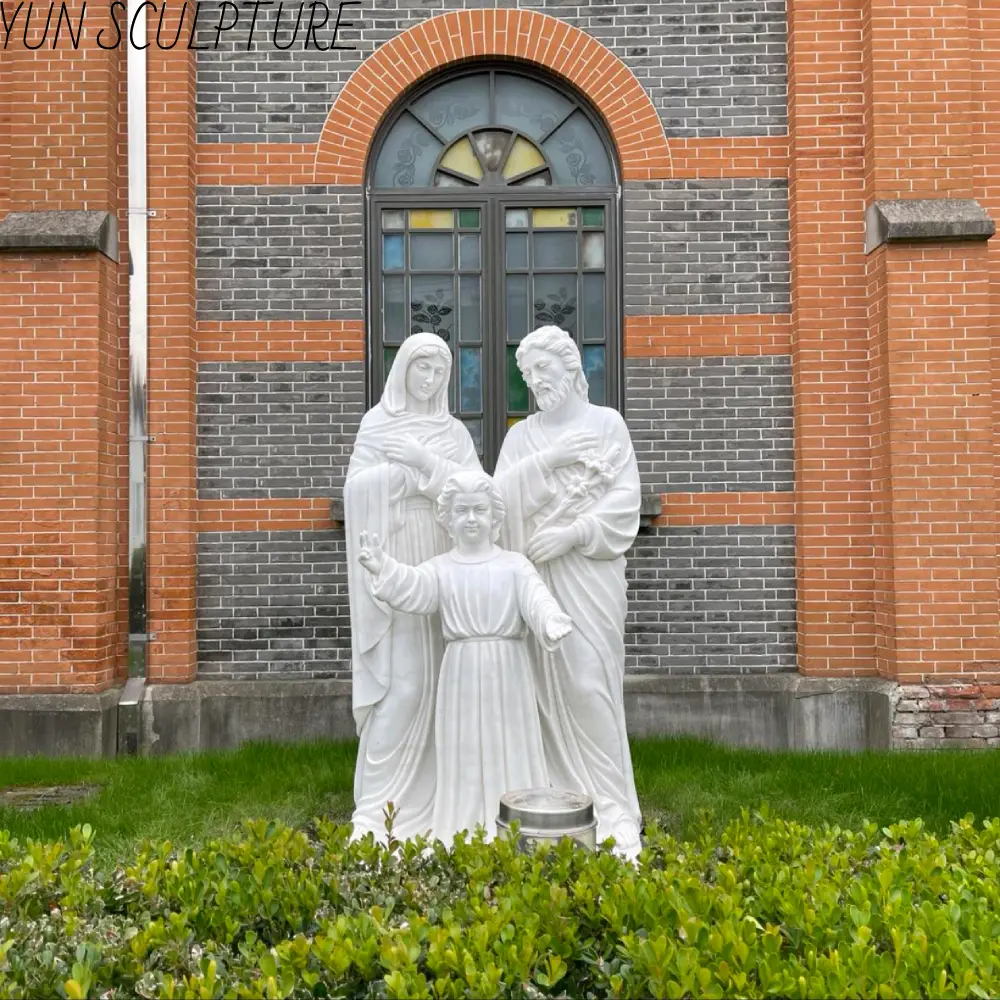
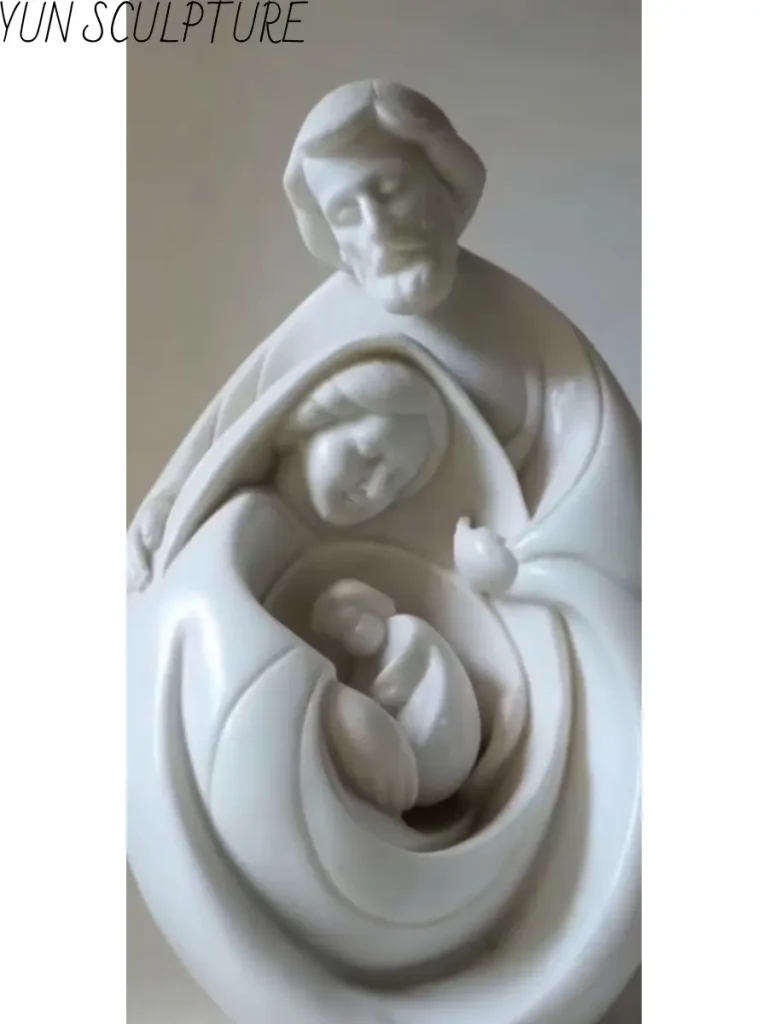
For a mary joseph jesus statue at chapel scale — figures up to 90 centimeters — single-block carving is our preferred method where the quarry can supply a block of sufficient dimensions and quality. The structural advantages are significant: there are no joining surfaces to manage, no stress concentrations at connection points, no risk of differential movement between separately carved elements over decades of thermal cycling.
For life-size and above — figures at 150 centimeters and taller — single-block carving becomes impractical. The required block dimensions exceed the commercially available supply of flawless high-grade Carrara or Hanbaiyu at the necessary scale. Separately carved figures, joined by concealed stainless steel dowels set in epoxy adhesive at the contact points, are the standard approach. The joining technique we use produces a connection that is invisible in normal viewing conditions and structurally rated to carry the loads and movements of a permanent indoor installation.
Polishing Gradients — The Surface That Tells the Story
A marble Holy Family commission is not finished at the point of carving. The surface treatment of the stone — the specific degree of polishing applied to different areas of the composition — is a design decision with direct emotional consequences.
We use a three-zone polishing system for marble Holy Family groups:
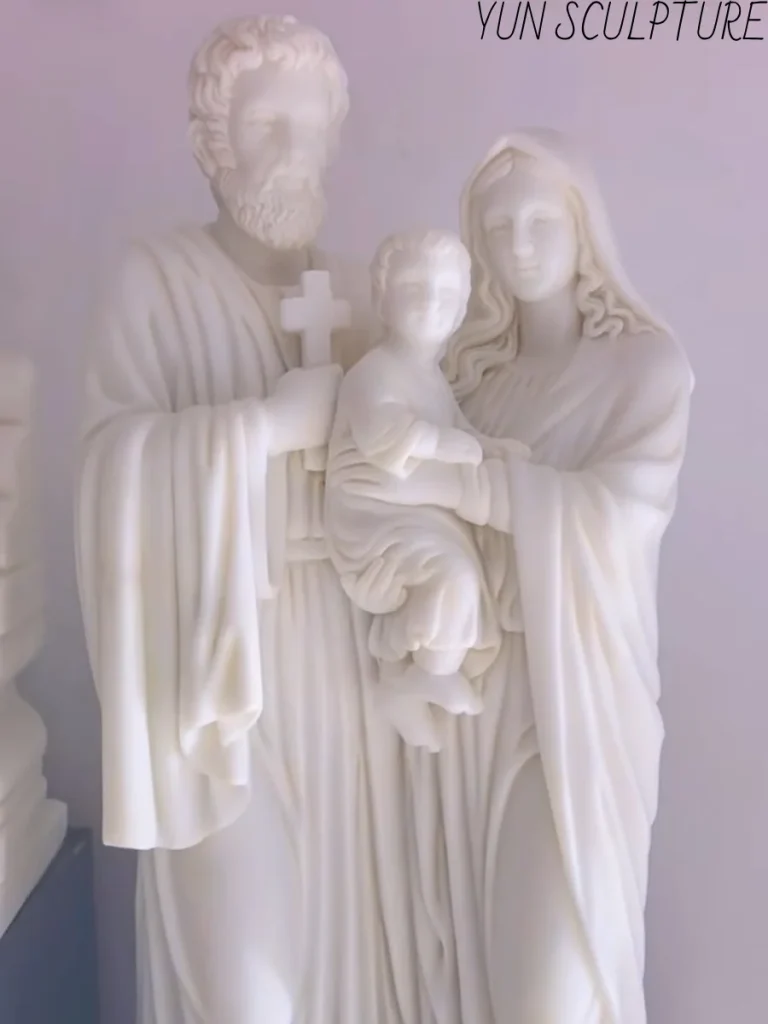
The infant’s skin receives the highest polish — a full mirror finish that maximizes the sub-surface light scattering and produces the warmest, most luminous surface reading. At any scale, the infant’s face and hands are the areas where the viewer’s eye naturally concentrates, and the surface treatment reinforces this concentration by giving these areas the most visually active surface in the composition.
The adult figures’ faces and hands receive a high polish, slightly less reflective than the infant’s surfaces — warm and present, but not competing with the child’s visual priority.
The drapery and robes receive a graduated treatment: high polish on the raised fold edges, progressively less polished into the recessed areas, with the deepest recesses left in a honed matte finish that holds shadow and creates the depth and weight of fabric. This gradient is what makes carved marble drapery read as cloth rather than stone — not the shape of the folds, but the way the surface interacts with light across the full range of polish from brilliant to matte.
The transition between polishing zones is resolved by hand, using progressively finer abrasives — from 100-grit through 3000-grit to felt buff — across the surface of the completed carving. This process requires between 15 and 25 hours of skilled labor on a life-size group commission, and it is the stage where the final visual character of the work is established.
Marble Installation — The Indoor Engineering Standard
A marble Holy Family group requires an installation engineering approach that differs significantly from bronze outdoor commissions. The priorities are different: not wind resistance and environmental durability, but seismic stability, visitor safety, and the prevention of differential settlement that could stress the stone figures over decades.
For a single-block marble Holy Family at chapel scale, the installation consists of a leveled stone or granite base, a concealed stainless steel anchor plate bonded to the underside of the marble group with structural epoxy, and a mechanical connection to a prepared chase in the base. The connection is designed to prevent overturning from incidental contact — a visitor stumbling against the base, a cleaning crew bumping the pedestal — while allowing for the controlled removal of the group for conservation treatment at multi-decade intervals.
For separately carved figures on a shared base, each figure receives its own independent anchor system, and the base is designed with a drainage void beneath the stone surface to prevent moisture accumulation at the figure bases. The anchor bolt positions are laid out in consultation with the polishing plan — anchor points are located in areas of maximum drapery relief, where their presence can be concealed within the carved surface geometry.
We provide a complete installation package for every marble commission: base preparation drawings, anchor bolt specifications, adhesive product data sheets, and a 25-year maintenance schedule covering cleaning protocol, wax treatment, and anchor inspection intervals.
Bronze as a Secondary Voice — When Marble Is Not an Option
The primary argument for bronze in a Holy Family commission is environmental: when the installation is outdoors, marble cannot be specified, and bronze is the correct material. The secondary argument is scale: at civic monument scale, above 250 centimeters per figure, the economics and logistics of marble carving at the required quality level favor bronze casting.
For outdoor Holy Family commissions — parish entrance plazas, cemetery gardens, pilgrimage landscapes — our bronze approach for this specific subject differs from the single-figure commissions detailed in our companion guides. The multi-figure nature of the commission introduces considerations that do not exist for single figures.
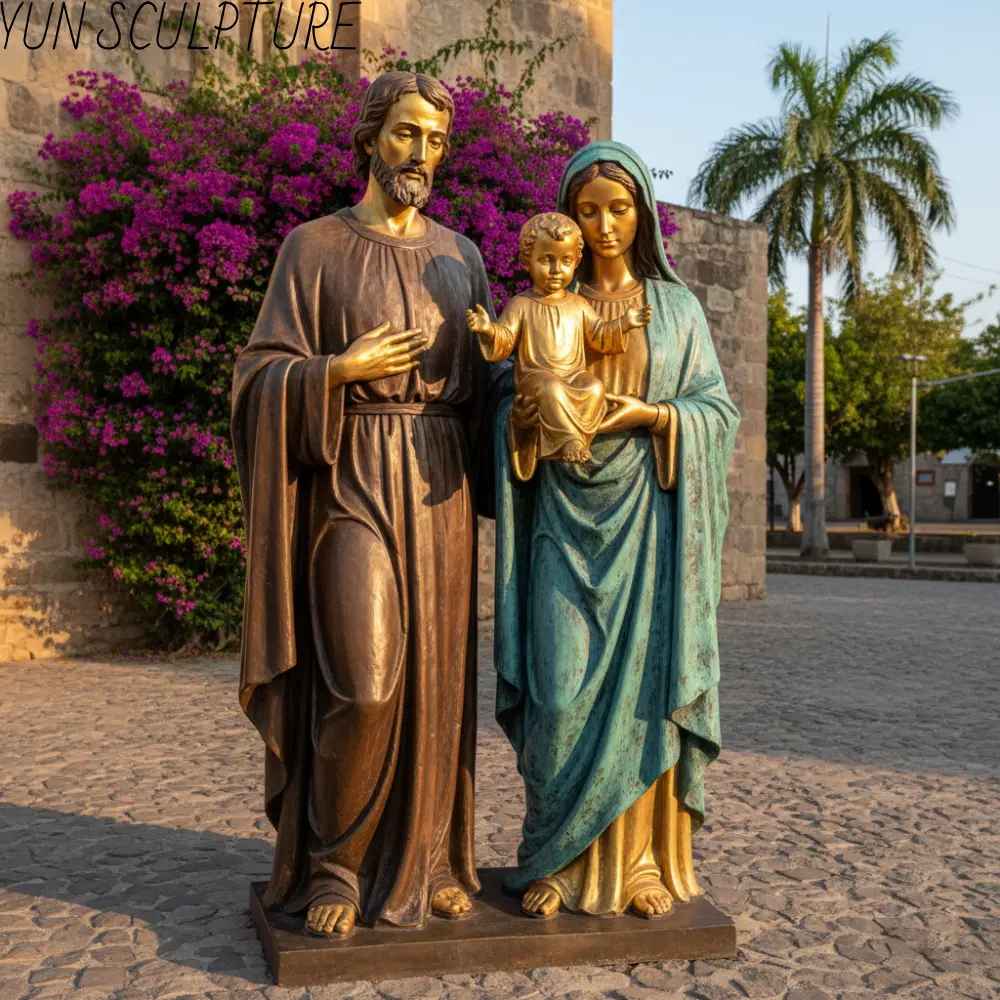
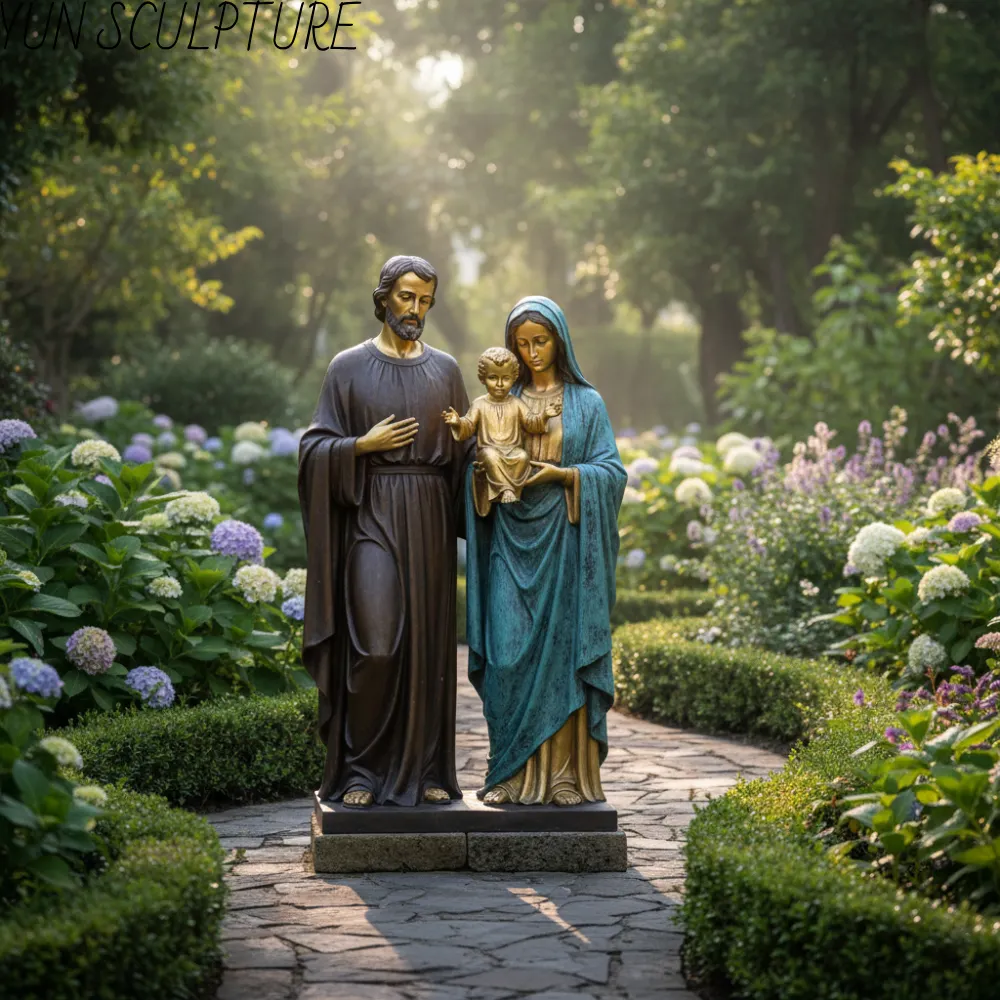
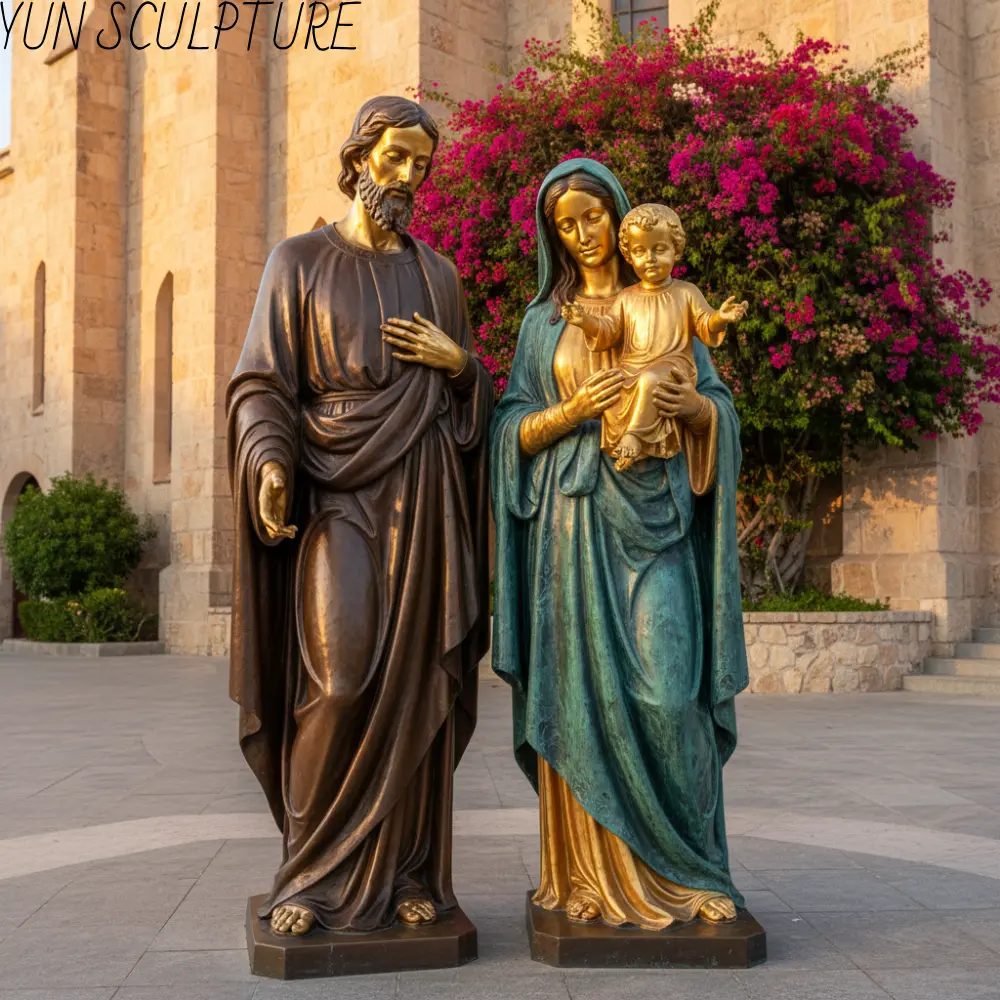
The zone patination system for a bronze Holy Family uses a four-color strategy rather than the three-color system used for single figures. Joseph’s outer robes receive a deep, warm statuary brown — the color of worn leather, of a craftsman’s work clothes, of material that has been used. Mary’s mantle receives the verde antique treatment traditionally associated with the Madonna. The infant’s exposed skin receives the warmest, highest-contrast gold patina in the composition — the visual focal point reinforced by the color hierarchy of the metal. Mary’s and Joseph’s faces and hands receive a mid-tone warm brown, clearly differentiated from the surrounding robes but unified in tone with the domestic character of the subject.
The structural engineering of a jesus garden statue or outdoor outdoor jesus statue Holy Family group follows the multi-figure anchor system described in our compositional section above, with individual anchor calculations for each figure and a shared base engineering assessment for the combined wind load of the group.
For clients who ask about bronze versus marble for an indoor Holy Family commission, our answer is consistent: where the installation context permits marble, marble is the more theologically appropriate choice for this specific subject. Bronze speaks the language of permanence and heroism. Marble speaks the language of domestic life and human warmth. The Holy Family of Nazareth is a domestic subject. The material should honor that.
Sizing Guide — Three Figures at Every Scale
The sizing of a Holy Family group must account for both the individual figure heights and the total compositional footprint — the width and depth of the group as a whole. A three-figure group at life-size occupies a significantly different spatial envelope than any single figure at equivalent height.
| Installation Context | Figure Height (Joseph) | Group Width | Group Depth | Material |
|---|---|---|---|---|
| Home prayer desk | 20 – 35 cm | 30 – 50 cm | 15 – 20 cm | Marble or Bronze |
| Family garden | 60 – 90 cm | 100 – 150 cm | 50 – 70 cm | Bronze |
| Small chapel altar | 90 – 120 cm | 150 – 200 cm | 70 – 90 cm | Marble or Bronze |
| Parish church interior | 150 – 180 cm | 250 – 320 cm | 100 – 130 cm | Marble |
| Parish entrance plaza | 180 – 220 cm | 300 – 400 cm | 120 – 160 cm | Bronze |
| Outdoor landmark | 250 cm + | 400 cm + | 160 cm + | Bronze + Steel |
The group depth — the front-to-back dimension of the composition — is a frequently overlooked specification that directly affects the installation space requirements. A Holy Family group with a compositional depth of 130 centimeters requires a pedestal and viewing clearance that must be planned into the space design. We provide a three-dimensional footprint drawing for every commission before pedestal design begins.
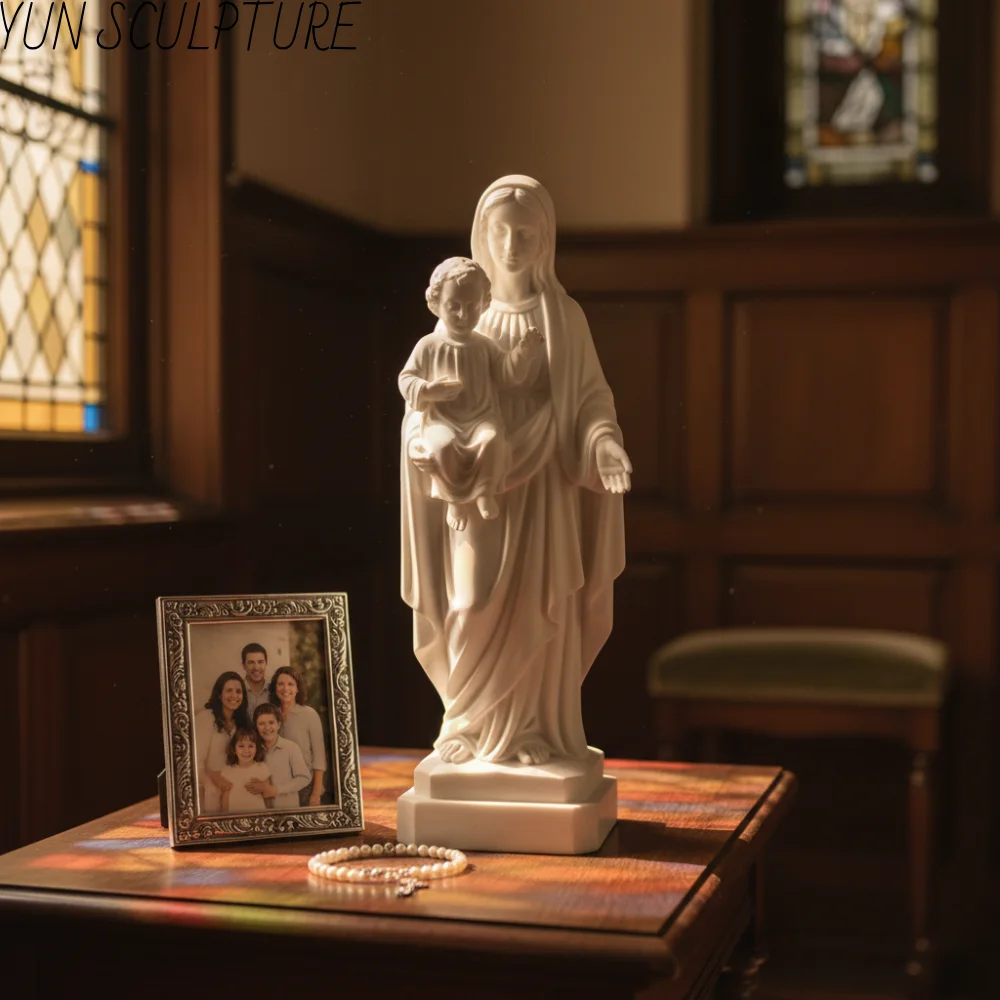
The mary and baby jesus statue element within the group — Mary with the infant Christ — is typically designed so that it reads as a visually complete sub-composition independent of Joseph. This allows the group to be read at multiple scales: as a complete Holy Family from a distance, and as a Madonna and Child with Joseph in attendance from closer proximity.
For the life size jesus statue standard — figures at 180 centimeters — a marble Holy Family group weighs approximately 800 to 1,200 kilograms depending on the depth and complexity of the composition. Floor loading must be verified for any interior installation at this scale before the commission is confirmed.
Who Commissions a Holy Family Statue?
The commissioning profile for a Holy Family statue is broader and more culturally diverse than any other sacred image in our range. The theological subject — family life as vocation, the ordinary home as sacred space — crosses cultural, ethnic, and class boundaries in ways that the more specifically Passion-focused images do not.
Catholic Parishes and Dioceses commission Holy Family groups primarily for two contexts: the parish entrance, where the image establishes the identity of the community as a family of families; and the family life center or parish hall, where the image anchors a space dedicated to family ministry and community gathering. Diocese art and architecture offices frequently specify the Nazareth format for these locations, because its emphasis on domestic life and ordinary labor speaks most directly to the communities that use these spaces.
Catholic Schools and Universities represent a commissioning market that is, in our experience, distinctively oriented toward the Holy Family image above all other sacred subjects. The theological message — that family life is the school of virtue, that Joseph’s workshop and Mary’s household are the original classroom — speaks directly to educational institutions. Campus Holy Family installations frequently specify a format in which the child Jesus is depicted in the act of learning or working — watching Joseph, listening to Mary — rather than in the Nativity posture of passive infancy.
Heritage and Cultural Communities bring some of the most specific and carefully considered briefs we receive. Italian-American communities frequently request a Holy Family that reflects the visual tradition of the presepe — the Neapolitan nativity tradition with its specific iconographic character. Mexican-American communities may request facial features and skin tones that reflect their own heritage. Filipino Catholic communities, whose devotion to the Holy Family is among the most fervent in global Catholicism, frequently request the family in a format that emphasizes Joseph’s role as protector and provider — a reflection of the strong paternal values of Filipino family culture.
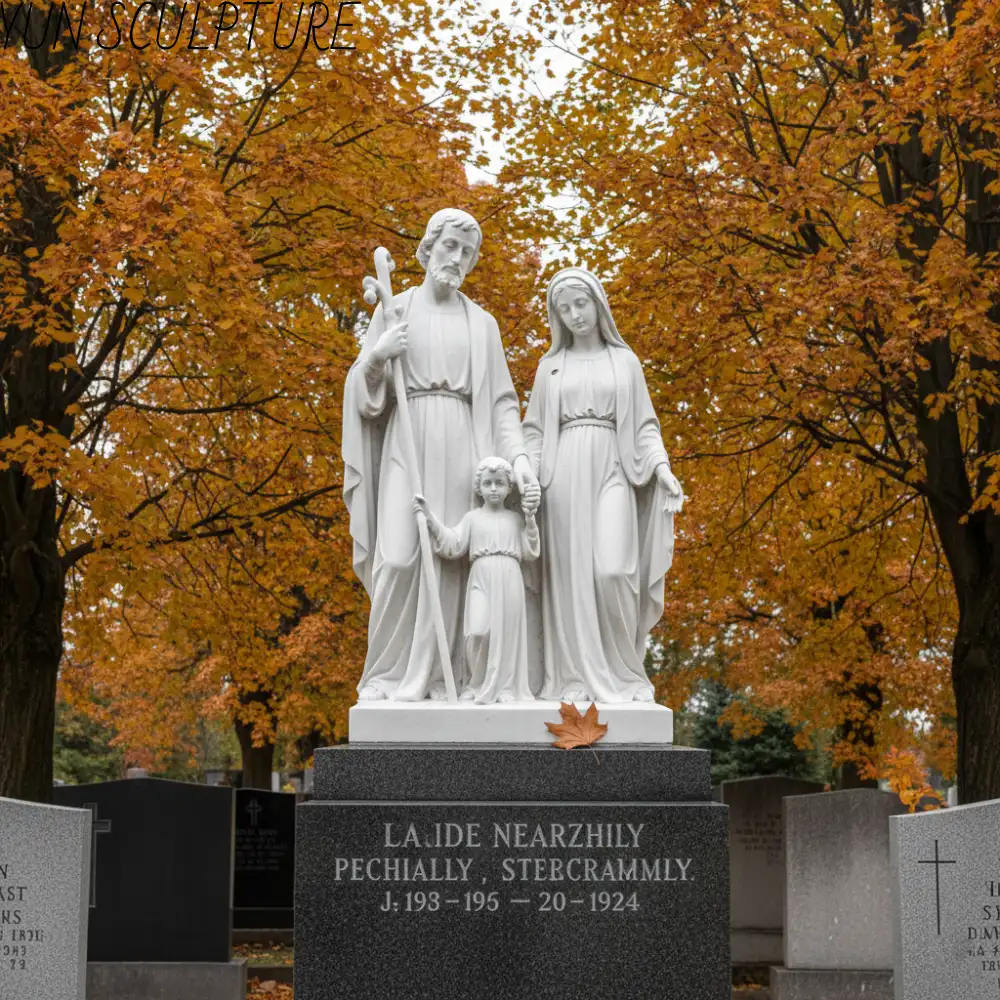
Cemetery and Memorial Garden clients commission Holy Family groups with a specific theological purpose: the family as the fundamental unit of the resurrection promise. A Holy Family installation in a Catholic cemetery grounds the grief of loss in the theological affirmation that families are not merely biological units but vocational ones — bound by more than blood, promised a reunion that death interrupts but does not end.
Private Estate and Family Chapel clients bring the most personally invested briefs of any category. These commissions — a Holy Family for a private chapel, a garden installation at a family estate, a piece commissioned to mark a significant family anniversary — are often the most emotionally complex to execute, because the client is not commissioning a generic sacred image but a representation of their own family’s vocation. They may request specific details: a Joseph whose hands show the marks of labor, as their own grandfather’s did; a Mary whose posture reflects the specific tenderness of a particular cultural tradition; an infant whose face they have asked us to model from a photograph of their own child.
We receive these requests as the most serious of our commission work. A family that asks us to translate their private devotion into permanent stone is placing something irreplaceable in our hands. We treat it accordingly.
The Commission Process — Three Figures, One Brief
A Holy Family commission follows the same foundational workflow as all our sacred group work, with two stages that are specific to multi-figure compositions and that do not exist in single-figure commissions.
Compositional Brief. Before iconographic form or material is selected, we conduct a compositional consultation: which of the three narrative traditions is most appropriate for the installation context? What line-of-sight system — closed or open circuit — best serves the devotional purpose? What contact points between the figures are theologically and structurally appropriate? This consultation produces a written compositional brief that governs every subsequent decision.
Individual Figure Modeling. Each of the three figures is modeled in clay independently, at 1:1 scale, following the approved compositional brief. The figures are worked simultaneously rather than sequentially, because each figure’s proportions affect the others’. A Joseph who is completed before Mary’s posture is established cannot be adjusted to match her without remodeling.
Group Assembly Review. This is the stage unique to multi-figure commissions. When the three individual clay figures are complete, they are physically assembled on a mock-up of the approved base and photographed from every angle — front, sides, rear, above — before the client review. The group assembly review frequently produces requests for minor adjustments that were not visible in the individual figure reviews: a slight change in Joseph’s gaze angle, a shift in Mary’s weight distribution, a repositioning of the infant that better centers the focal point of the composition. These adjustments are made before molds are taken. They cannot be made after.
Material Execution. For marble commissions, the approved clay model serves as the reference for the stone carvers, who work from the model’s proportions and surface resolution. For bronze commissions, the standard lost-wax process follows from this point — described in full in our companion guides, which we recommend for clients who wish to understand the complete casting workflow.
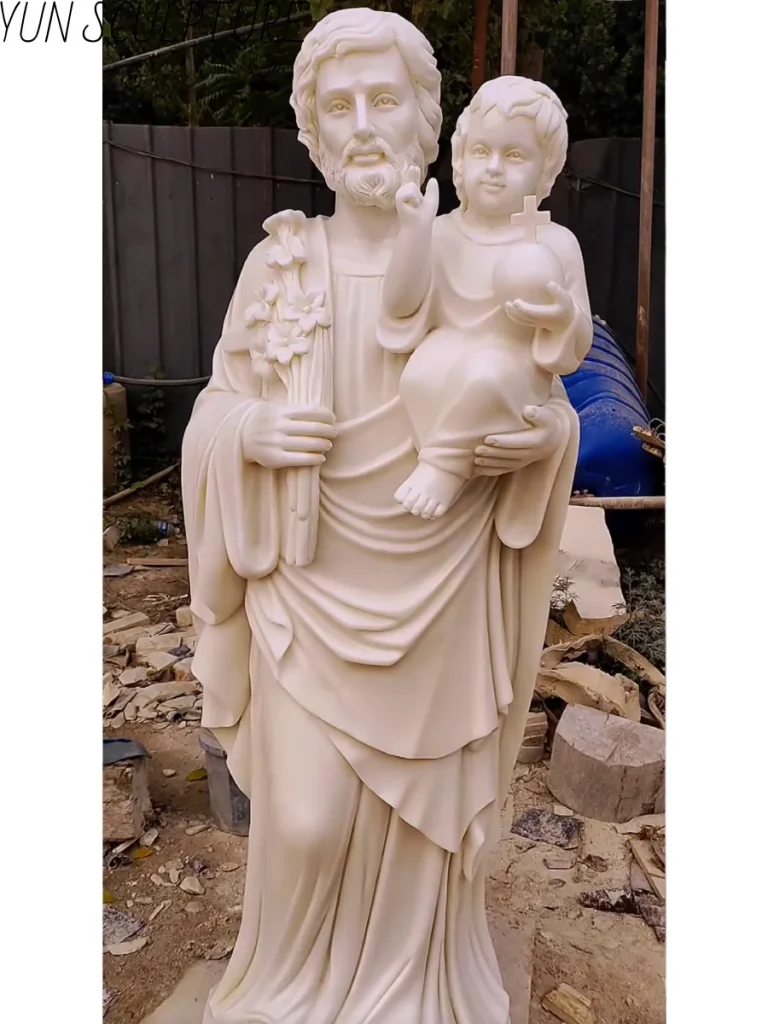
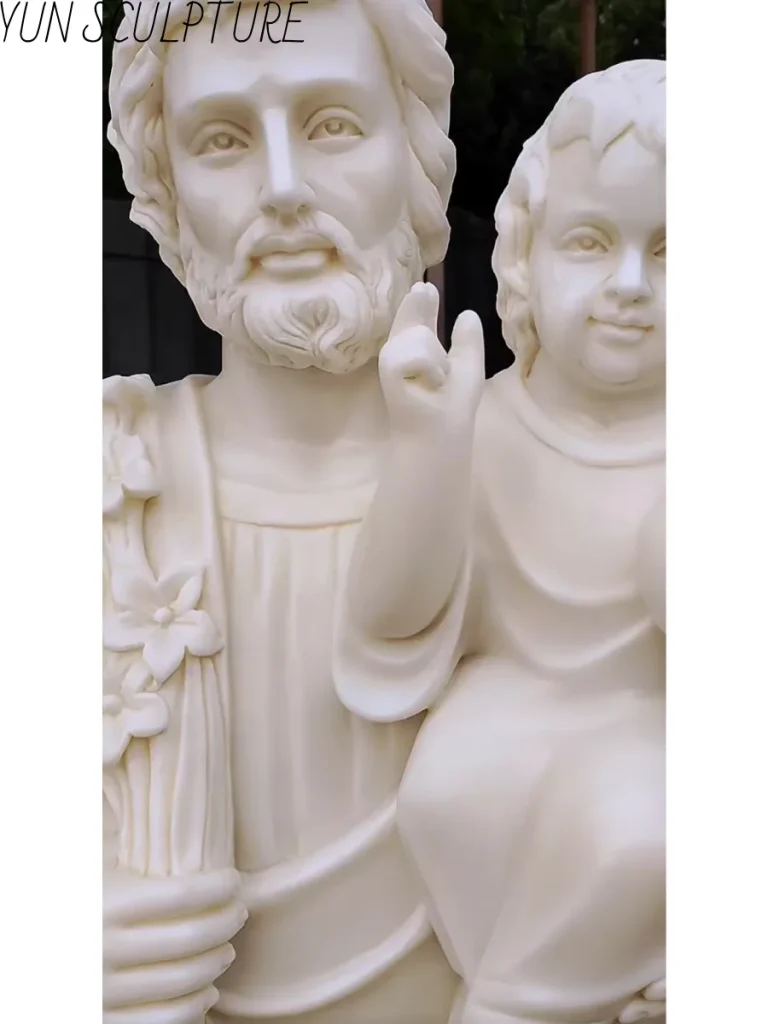
For our complete process documentation — lost-wax casting, patination, and foundation engineering — see our companion guides to the Risen Christ, Jesus on Cross, Divine Mercy, and Mary and Child statue series.
FAQ — 12 Core Questions Answered
What is a Holy Family statue?
A Holy Family statue is a sacred sculpture depicting the three members of the earthly family of Jesus Christ: Jesus himself, his mother Mary, and his foster father Joseph. The image draws on the Gospel accounts of Christ’s birth, childhood, and domestic life in Nazareth. In Catholic devotional tradition, the Holy Family is venerated as the model and patron of all Christian families, and the jesus mary and joseph statue is among the most widely commissioned multi-figure sacred works in contemporary religious art.
Who are the three figures in a Holy Family statue?
The three figures are Jesus Christ — depicted as an infant or young child in most compositions — his mother Mary, the Blessed Virgin, and Joseph, the husband of Mary and foster father of Jesus. Joseph was a carpenter in Nazareth and is venerated in Catholic tradition as the patron of fathers, workers, and the universal Church. He is one of the most significant figures in Christian iconography and, in our experience, the most frequently misunderstood compositionally.
What is the difference between a Nativity scene and a Holy Family statue?
A Holy Family statue typically depicts the three figures in a self-contained group composition — standing, seated, or in domestic activity — without the supporting cast of the Nativity narrative. A Nativity scene, by contrast, is an expanded composition that includes the Holy Family as its center but adds shepherds, angels, the Magi, and animals, producing a full narrative landscape. A Holy Family statue is a permanent devotional object; a Nativity scene is typically — though not always — a seasonal installation. A birth of jesus statue commission may refer to either format, and we clarify this distinction with every client at the initial consultation.
What is the correct arrangement of the Holy Family?
There is no single liturgically mandated arrangement, but the compositional principle that governs most serious commissions is the triangle: Joseph at the highest point, Mary at a secondary height approximately 85 percent of Joseph’s, and the infant Christ positioned at the visual center of mass of the group — typically in Mary’s arms or at waist height, within the lower third of the compositional triangle. This arrangement reflects the theological hierarchy of the group: Joseph as the protector who frames the space, Mary as the primary caregiver who occupies the emotional center, and Christ as the theological subject toward whom the entire composition directs the viewer’s attention.
How is Joseph typically shown in a Holy Family statue?
Joseph’s position and gesture in a joseph holding baby jesus statue or standing group commission varies by iconographic tradition and commissioning brief. The three most common configurations are: the guardian posture, in which Joseph stands slightly behind and to one side of Mary, his gaze on the infant, his body language establishing protective enclosure; the participant posture, in which Joseph stands beside Mary at approximately equal compositional weight, his gaze shared between Mary and the infant; and the leader posture, in which Joseph stands slightly forward of Mary, one hand extended as if indicating the path ahead — the configuration most associated with the Flight into Egypt tradition. Our studio discusses these options in the compositional brief and recommends based on the specific installation context.
How much does a life-size marble Holy Family statue cost?
A custom life-size marble Holy Family group — Joseph at approximately 170 centimeters, Mary at 150 centimeters, infant at natural infant scale — carved from Carrara or Hanbaiyu white marble generally ranges from $35,000 to $65,000, depending on the complexity of the compositional arrangement, the degree of contact between figures, the surface polish gradient specification, and the installation engineering requirements. Single-block commissions at chapel scale — figures to 90 centimeters — range from $18,000 to $32,000. Bronze commissions for outdoor installations at life-size scale generally range from $22,000 to $42,000 for the complete group. All commissions are quoted individually following the compositional brief consultation.
What material is best for an outdoor Holy Family statue?
For outdoor installation in any climate — sun, rain, frost, salt air, or typhoon exposure — bronze is the only material we specify. White marble, despite its extraordinary quality for interior sacred work, is not suitable for outdoor installation: its surface porosity makes it vulnerable to biological growth, water infiltration, and freeze-thaw damage that will compromise surface detail and structural integrity within a decade in most outdoor environments. An outdoor jesus garden statue or parish entrance Holy Family group must be bronze. This is not a preference. It is a material science constraint, and we decline marble commissions for outdoor installation regardless of client preference.
Can we commission a Holy Family statue with ethnic facial features?
Yes, and we welcome these commissions. The Holy Family was a Galilean Jewish family of the first century, but the Catholic iconographic tradition has depicted the Holy Family in the visual language of every culture that venerates them — Byzantine, Gothic, Renaissance, Baroque, and the indigenous Catholic traditions of the Americas, Africa, and Asia. A Filipino Holy Family, a Mexican Holy Family, a West African Holy Family — each is theologically orthodox and iconographically legitimate. Ethnic facial feature requests are addressed during the clay modeling stage, with client photographic review at the draft modeling phase before final resolution.
What is the ideal size for a parish entrance Holy Family?
For a parish entrance plaza with a primary viewing distance of 10 to 20 meters, we recommend figures with Joseph at 180 to 200 centimeters, producing a total group width of approximately 300 to 360 centimeters. At this scale, the group is legible as a three-figure composition from the full viewing distance, the individual figures are distinguishable from each other, and the infant’s face — at approximately 15 centimeters in a life-size infant — is resolvable at moderate approach distance. A group significantly smaller than this reads as a single undifferentiated mass at the primary viewing distance of a plaza entrance.
Can you add figures to create a full Nativity scene?
Yes. Our standard approach for clients interested in a full Nativity scene is a phased commission: the Holy Family core group in the first phase, followed by additional figures — shepherds, angels, Magi, animals — in subsequent phases over one to three years. This approach allows the client to distribute the investment over time, to assess the compositional success of the core group before expanding it, and to ensure that all figures in the final Nativity scene share a consistent sculptural character. All figures in a phased commission are designed from the initial brief to function as a coherent whole, with consistent scale, patina specification, and surface treatment across all phases.
How long does a custom marble Holy Family take?
A single-block marble Holy Family at chapel scale — figures to 90 centimeters — requires between 90 and 120 days from approved clay model to completed stone. A separately carved life-size group in marble requires between 140 and 180 days, owing to the extended stone carving time for three full-scale figures, the joining and installation engineering preparation, and the graduated polishing process across the full group surface. Bronze Holy Family commissions at life-size outdoor scale require between 100 and 130 days. These timelines include the group assembly review stage, which adds approximately two weeks to a single-figure commission timeline but is non-negotiable for multi-figure work.
Where do you buy a high-quality Holy Family statue?
The markers of quality in a Holy Family commission are more stringent than for single-figure work, because the compositional failures of a poorly resolved group are more visible and more permanent than the failures of a single figure. A serious studio will conduct a compositional brief before any design work begins — asking about the line-of-sight system, the contact points, the base geometry — because these decisions cannot be revised after the clay work starts. They will produce a group assembly review with the three clay figures physically assembled before molds are taken. And they will be honest about the material constraints: a studio that offers you a marble Holy Family for an outdoor installation, or a bronze Holy Family for an interior altar without discussing the material’s specific limitations in that context, is not giving you the consultation your commission deserves.
Three Figures, Standing Together
The San Antonio commission was installed in October 2022.
Joseph stands at 195 centimeters at the apex of the composition, his right hand on Mary’s shoulder — broad palm, four fingers, the specific weight of a carpenter’s hand. Mary stands at 168 centimeters, the infant held against her left side, his face turned outward toward the plaza entrance. Joseph’s gaze is on them both.
The three figures are in Carrara white marble. They stand in the open air of the Texas sun — under a covered arcade, protected from direct precipitation, the architect having designed the entrance canopy specifically to allow marble at this scale. The surface polish on the infant’s face catches the morning light and returns it warmer than it received it.
Every family that enters that church passes within three meters of those three figures. Every child who looks up sees the infant looking back.
This is what a jesus mary and joseph statue is, at its truest: not a religious accessory, not a decorative element, not a symbol placed for institutional purposes. It is three people standing together — a man, a woman, and a child — in the material that best honors what they represent. Carved from stone that formed over millions of years, shaped by hands that understood both the theology and the engineering, placed in a position where they will stand for centuries after every person involved in their making is gone.
Three figures. One composition. One vocation.
We are ready to build yours.
— Elena Zhang & Donghui Zhang, Yun Sculpture