Get in touch with Yun-Sculpture company
The Thinker Statue for Sale: Bronze Replica Buyer’s Guide — Size, Material & Casting Quality

The thinker statue for sale market has a problem nobody discusses openly: most pieces described as bronze are not bronze. They are resin with bronze powder in the surface coating. They weigh only 3 kilograms, whereas genuine lost-wax castings weigh over 100 kilograms. They look identical in a product photograph and do not look identical after two winters outdoors. This guide covers the three decisions that determine whether you buy something worth keeping for fifty years — size, material, and casting accuracy — and what each of those decisions actually costs.
Table of Contents
Table of Contents
The Three Sizes of The Thinker — Which One You’re Actually Buying
Most buyers assume The Thinker is one sculpture in one size. It is not. The work exists in three distinct canonical sizes, and the commercial market compounds this by selling reductions at every scale in between. Understanding which size you are looking at changes the purchase entirely.
Rodin modeled the original figure between 1880 and 1882 as part of the Gates of Hell commission — a monumental doorway based on Dante’s Divine Comedy. In that context, The Thinker sat at the top of the composition, approximately 71.5 centimeters tall, originally representing Dante surveying the souls below. This study size is the first canonical scale: historically significant, compact enough for interior installation, and the version that appeared publicly at the Copenhagen exhibition in 1888.
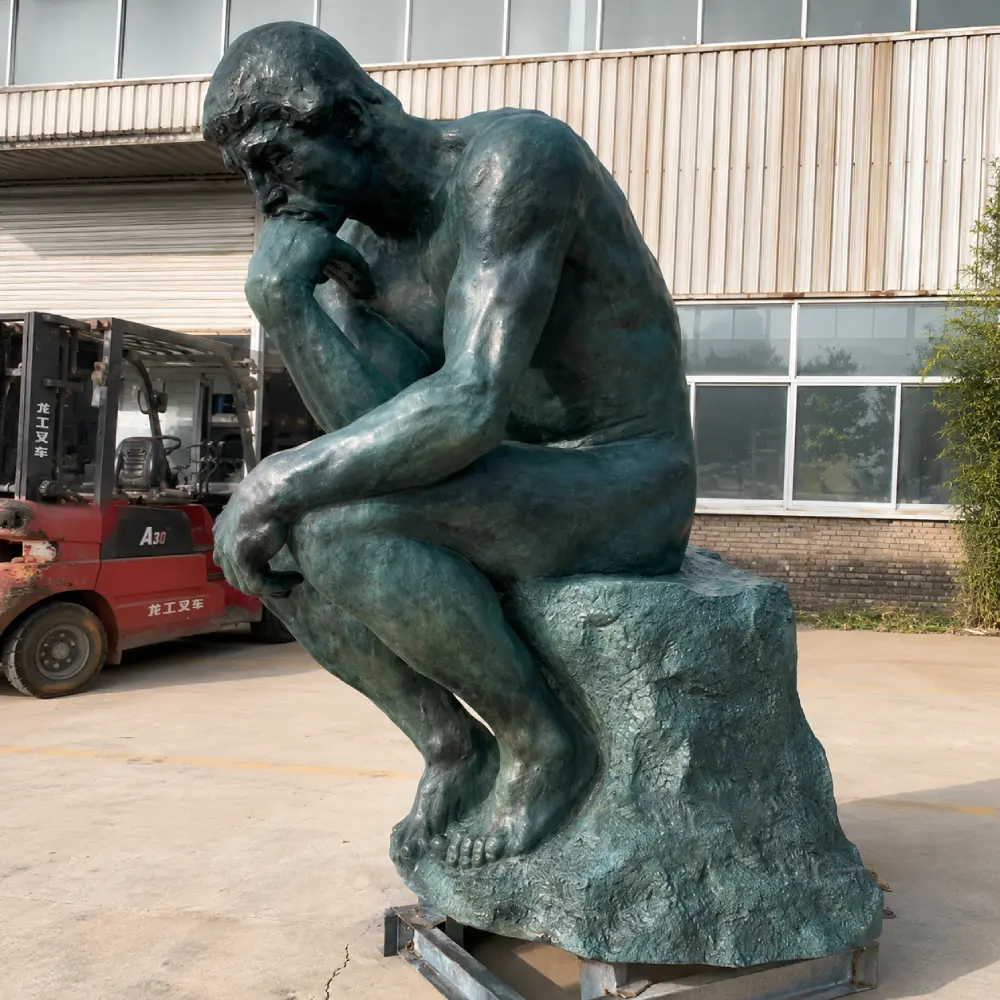
In 1902, Rodin authorized an enlargement to approximately 182 centimeters — roughly life-size for a large male figure. This heroic-scale version was exhibited at the 1904 Salon de la Société Nationale des Beaux-Arts and became the dominant cultural image. When most people picture The Thinker, they picture this scale: physically imposing, designed for an outdoor institutional setting, the version installed in front of the Musée Rodin, at Stanford University, and at the Cleveland Museum of Art. This is the sculpture that established The Thinker as a monument rather than simply a figure.
The commercial market produces reductions at every point between 20 centimeters and the heroic scale. Most of what is sold online falls in the 20 to 80 centimeter range. These are neither the study original nor the heroic enlargement — they are arbitrary reductions made for retail convenience, and they compress the sculpture’s anatomy in ways that affect how the pose reads. A buyer who wants the study original at 71.5 centimeters should specify that scale explicitly; most vendors selling at “70 cm” are producing a generic reduction rather than the historically documented size.
Heroic Scale · 1902
~182 cm
The Iconic Version
- Rodin’s authorized enlargement
- The image most people picture
- Designed for outdoor institutional settings
- Installed at Musée Rodin, Stanford, Cleveland
- Correct scale for garden, courtyard, or plaza
Study Size · 1880–1882
71.5 cm
The Original Model
- Rodin’s original Gates of Hell figure
- First exhibited Copenhagen 1888
- Compact; suited to interior installation
- Historically documented scale
- The correct size for library or study pedestal
Commercial Reductions
20–60 cm
Retail Convenience Sizes
- No historical canonical basis
- Anatomy compressed at smaller scales
- Mostly cold cast resin at this range
- Desk and shelf display only
- Verify material before purchase
What “Bronze” Actually Means in This Market
A lost-wax bronze casting and a cold cast bronze piece are both listed as “bronze” on nearly every retail site that sells Thinker replicas. They are not the same material and they do not behave the same way outdoors or at close range.
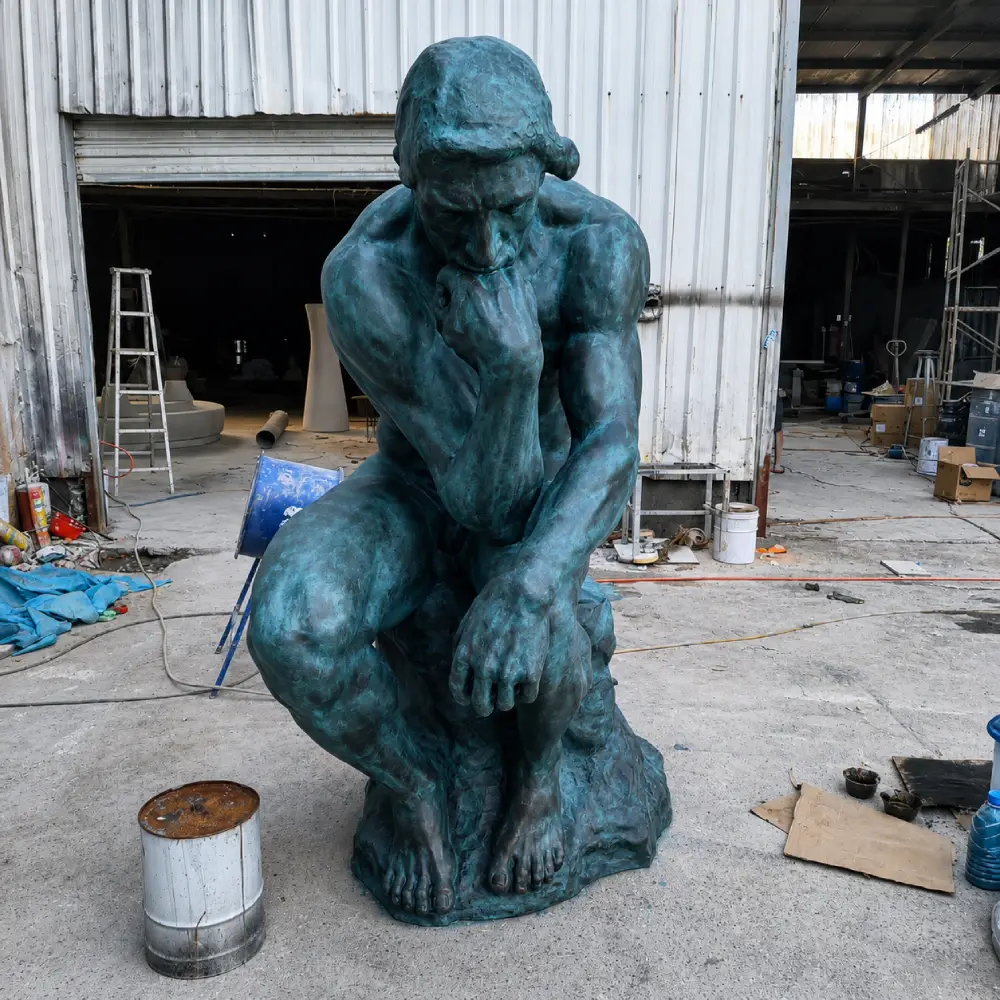
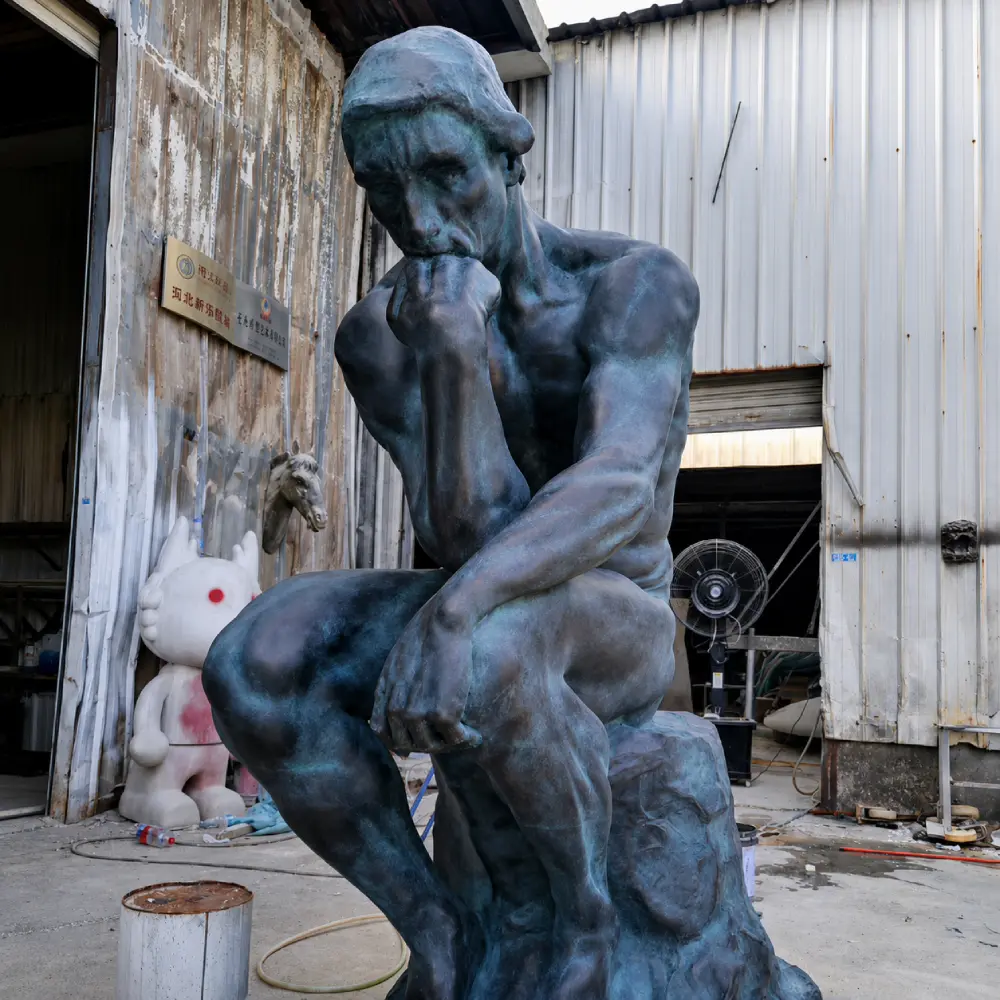
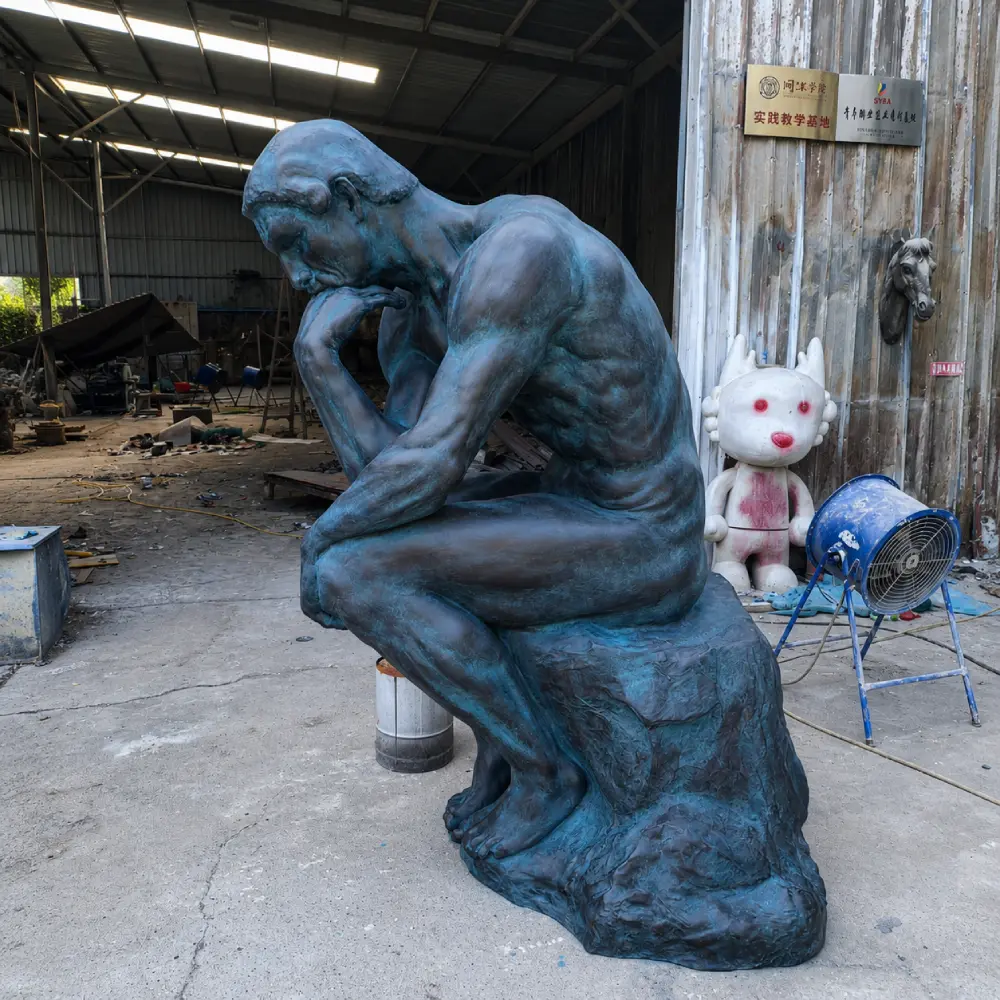
Lost-wax bronze is the result of a casting process standard in fine metalwork for over four thousand years. Molten bronze alloy — copper content above 85 percent — is poured into a ceramic shell mold produced from a wax model. The result is a structural metal casting with a wall thickness of 5 to 8 millimeters in our foundry’s standard production. A life-size Thinker cast by this method weighs approximately 150 kilograms. No single person can move it without equipment.
Cold cast bronze is a resin composite. Bronze powder is mixed into polyester or epoxy resin and cast in a mold. The result can have a convincing bronze-colored surface but the structural material underneath is polymer. Cold cast pieces at 24 centimeters typically weigh 1 to 2 kilograms. Left outdoors, the resin degrades under UV exposure and surface coatings begin separating within a few years. Cold cast has a legitimate place — interior display, small-scale decorative use, low price points — but it is not bronze in any structural or metallurgical sense, and a vendor describing it only as “bronze” without qualification is being imprecise in ways that cost buyers money.
Three tests require no specialist equipment. First, weight: a genuine bronze casting is substantially heavier than a cold cast piece at the same stated dimensions — the difference is immediately apparent when handled. Second, a magnet: bronze is non-ferrous and non-magnetic; if a magnet adheres to any part of the piece, the base material is not bronze. Third, surface variation: genuine chemical patination applied to heated bronze produces depth — darker in recessed areas, lighter on high points and edges. Cold cast surfaces tend toward uniform color with no genuine variation between depths.
What a Correct Casting of The Thinker Gets Right
The pose of The Thinker looks straightforward. It is not, and most commercial castings demonstrate this by getting the central anatomical detail wrong.
The right elbow does not rest on the right knee. It rests on the left thigh — a crossed position that forces the entire torso into torsion. The right shoulder drops. The left shoulder rises. The spine curves and twists simultaneously. This is what creates the muscular tension visible across the back and shoulders: the figure is not at rest, it is held in sustained physical effort. Rodin described his intent as rendering thought as physical condition rather than passive repose. The crossed elbow is the structural mechanism that makes this legible in bronze.
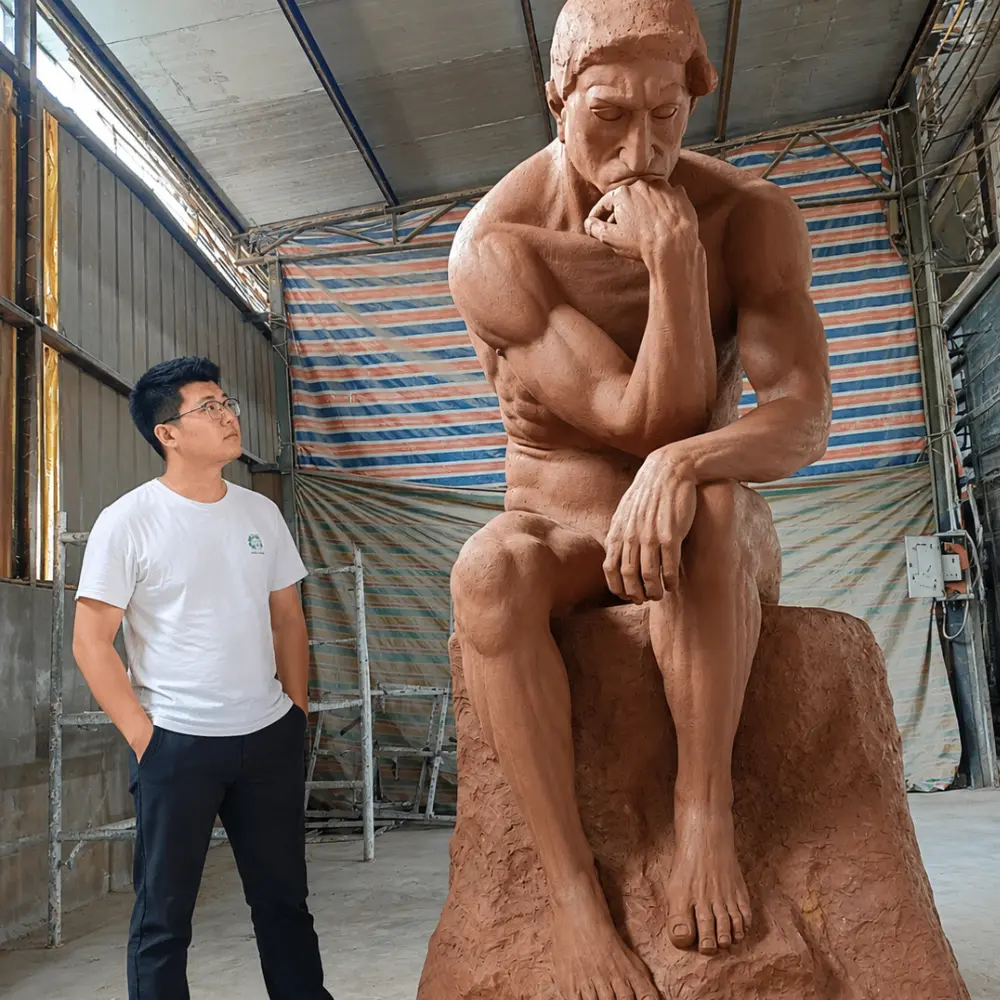
In a casting that misunderstands this position — or simplifies it to a man sitting with hand on chin — the torsion disappears. The back muscles flatten. The figure reads as a seated man rather than a man held in concentrated mental effort. I examine this detail in every Thinker casting that comes through our workshop. It is the first thing I check and the detail that most clearly separates a technically accurate reproduction from a simplified commercial figure.
The secondary detail is the feet. Both feet grip the rock surface, the left foot drawn back slightly. This tension completes the postural logic of the figure — energy runs from the feet through the spine to the supporting hand. A Thinker with relaxed feet has broken the physical continuity of the pose, regardless of how well the upper body is handled.
Where to Place a Thinker Statue
The placement history of the heroic-scale Thinker defines where this sculpture belongs. Every major installation has been institutional: museum entrance, university courtyard, library facade, corporate headquarters plaza. The heroic scale was designed for these contexts — a figure that holds its own against architecture, that reads from thirty meters as clearly as from three. For any outdoor institutional commission, 182 centimeters is the correct scale to start from. Smaller figures lose presence against a building facade or a large open courtyard.
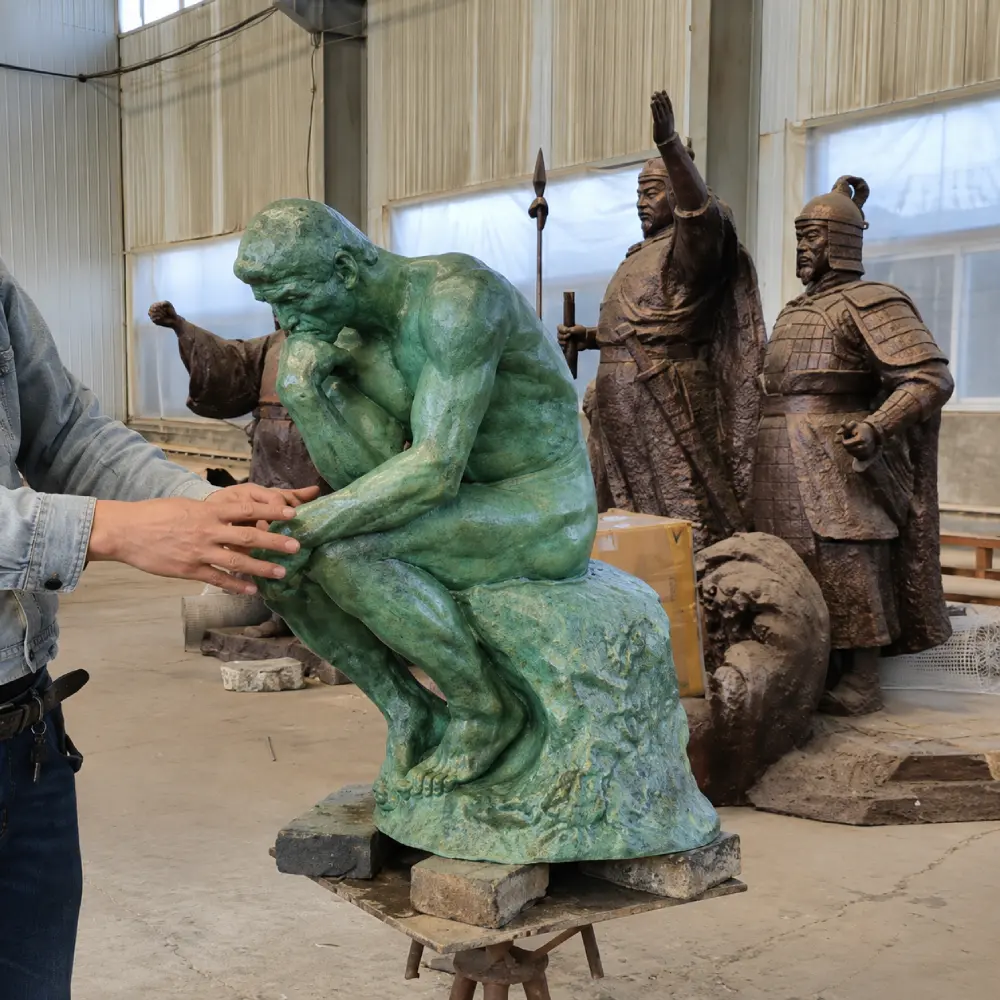
For private estate gardens, the same logic applies at reduced scale. A Thinker at 80 to 120 centimeters works well positioned at a garden axis point, elevated on a stone or concrete pedestal. The figure belongs facing inward toward the garden rather than toward the entrance — this is a piece that rewards approach rather than one that greets arrivals. It sits differently from a Hercules or Zeus, which gains from a confrontational frontal position. The Thinker is a figure you discover rather than one that announces itself.
Interior placements — library, study, executive office — historically favored the study size and its commercial equivalents in the 60 to 80 centimeter range. At this scale, the figure works as part of a collected environment. A Thinker on a low pedestal in the corner of a paneled library, set against books and accumulated working material, is one of the most architecturally natural placements in interior sculpture.
| Size | Material | Price Range (USD) | Production Time |
|---|---|---|---|
| 20–60 cm | Cold cast bronze Resin | $80 – $600 | In stock / 1–2 weeks |
| 71.5 cm (Study) | Lost-wax bronze True Bronze | $3,000 – $4,500 | 30–45 working days |
| 80–120 cm | Lost-wax bronze True Bronze | $4,000 – $8,000 | 35–50 working days |
| ~182 cm (Heroic) | Lost-wax bronze True Bronze | $7,000 – $40,000 | 35–50 working days |
| 250–500 cm | Lost-wax bronze True Bronze | $30,000 – $100,000+ | 60–80 working days |
Frequently Asked Questions
Why is The Thinker statue so famous?
The Thinker became famous for two reasons that reinforced each other. First, the pose is immediately legible as a universal symbol: a body held in concentrated physical effort communicates thought as something difficult, not passive. Rodin’s stated intent was to show thought as muscular — the crossed arm position, the curved spine, the gripping feet all create a figure under tension. Second, the sculpture’s public history placed it at institutional entrances — museums, universities, government buildings — where it accumulated cultural weight through repeated association with serious intellectual life.
How many Thinker statues are there in the world?
The Musée Rodin has documented approximately 28 authorized bronze casts of the heroic-scale Thinker held by major institutions worldwide, including the Musée Rodin itself, the Cleveland Museum of Art, Stanford University, and Columbia University. Rodin’s works entered the public domain decades ago, meaning any foundry can legally produce replicas. The total number of commercial replicas at all scales and in all materials is uncountable — thousands of suppliers operate globally.
Where is the original Thinker statue located now?
The primary installation of the heroic-scale Thinker is in the garden of the Musée Rodin in Paris, on the Boulevard des Invalides — the version most closely associated with Rodin’s intentions for the enlarged figure. The original study-size figure (71.5 cm) from which the heroic enlargement was made is also in the Musée Rodin’s collection. Other significant institutional castings are at the Cleveland Museum of Art, Stanford University’s Cantor Arts Center, and Columbia University, among approximately 28 documented authorized casts.
How much does a bronze Thinker replica cost?
Cold cast bronze resin pieces at 20–60 cm typically range from $80 to $600. Genuine lost-wax bronze castings start at approximately $3,000 for the study size (71.5 cm) and range to $7,000 or more for the heroic scale (~182 cm). Monumental commissions at 250–500 cm can reach $30,000 or above. The material difference between cold cast resin and true lost-wax bronze is not visible in a product photograph but is immediately apparent in weight, surface quality, and outdoor durability over time.
How do you spot a fake bronze statue?
Three tests require no specialist equipment. First, weight: genuine lost-wax bronze is substantially heavier than cold cast resin at the same stated dimensions — a life-size bronze figure weighs approximately 150 kg. Second, a magnet: bronze is non-ferrous and non-magnetic; if a magnet adheres to any surface, the base material is not bronze. Third, surface variation: genuine chemical patination on heated bronze shows natural depth — darker in recessed areas, lighter on high points. Cold cast and spray-applied finishes trend toward uniform color with no authentic variation between surface levels.
Factory Direct · Quyang, China
Commission a Lost-Wax Bronze Thinker
Study size, heroic scale, or custom dimensions. Correct arm position, accurate surface anatomy, chemical patination. Quoted individually from 71.5 cm to 5 meters.