Get in touch with Yun-Sculpture company
Famous Sculpture Replicas: How to Buy Museum-Quality Copies in Bronze & Marble

Famous sculpture replicas are full or reduced-scale reproductions of historically significant works — from Michelangelo’s David to Rodin’s Thinker — produced in bronze, marble, plaster, resin, or composite stone. Museum-quality replicas are hand-carved or cast from the original’s precise measurements and produced in genuine material; decorative copies are molded from photographs and finished in surface coatings. The difference is visible at close range and permanent over time. This guide covers which sculptures are most commonly replicated, what material and quality tiers exist, what each tier costs, and how to commission a replica that will hold its value and presence for decades.
Table of Contents
Table of Contents
The Most Commonly Replicated Famous Sculptures
Certain works appear in replica form far more often than others — not only because they are famous but because their subject matter, scale, and formal qualities translate well across materials and settings.
Michelangelo’s David — The most replicated Renaissance sculpture in the world. The figure’s scale (5.17 meters original), its psychological intensity, and its formal clarity make it equally effective at 80 centimeters on a library shelf and at full height in an estate garden. Our Michelangelo David replica guide covers material and scale decisions in detail.
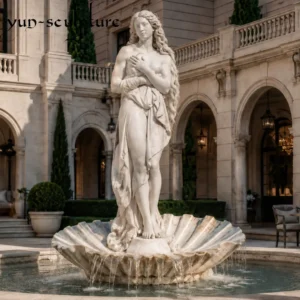
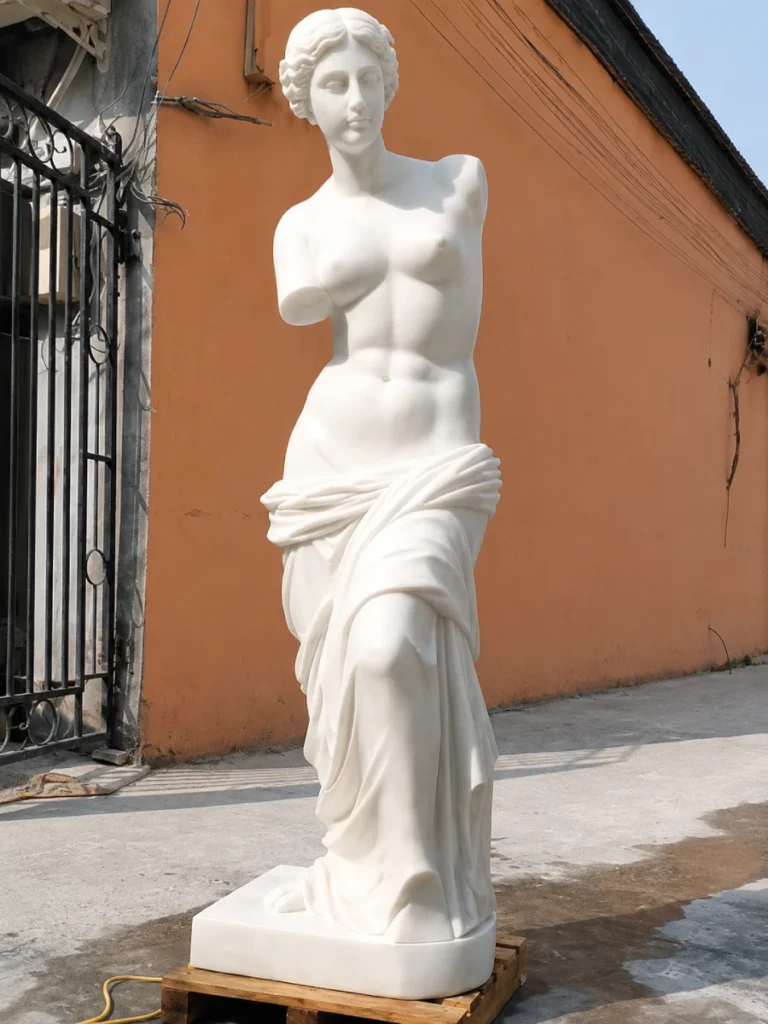
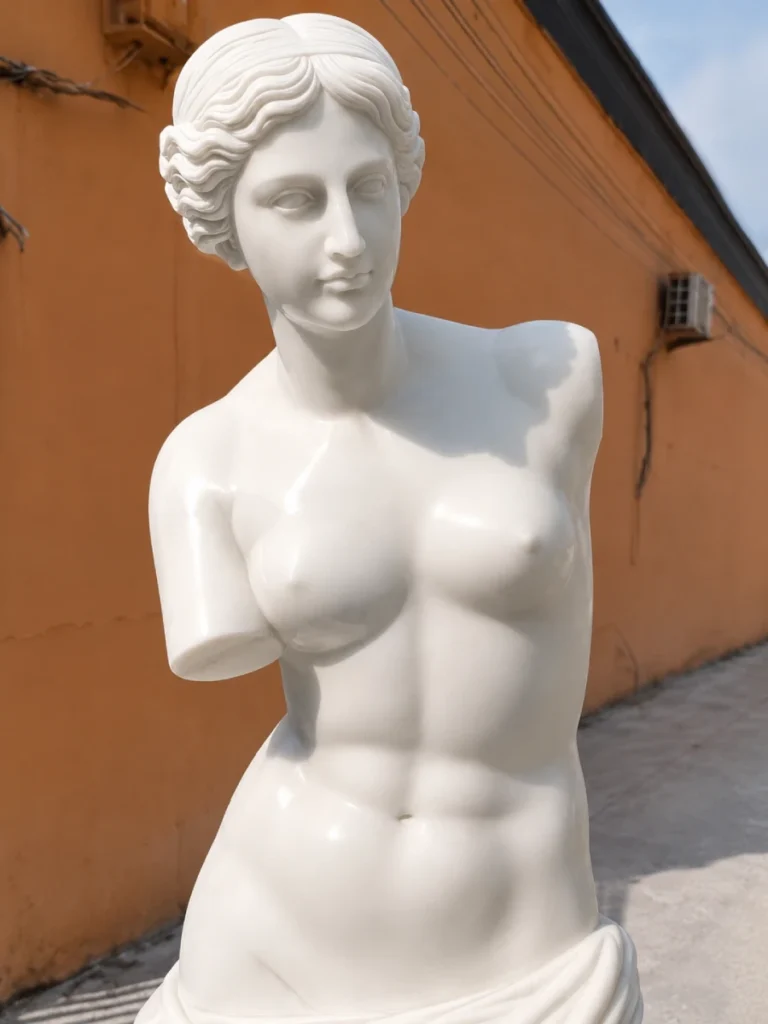
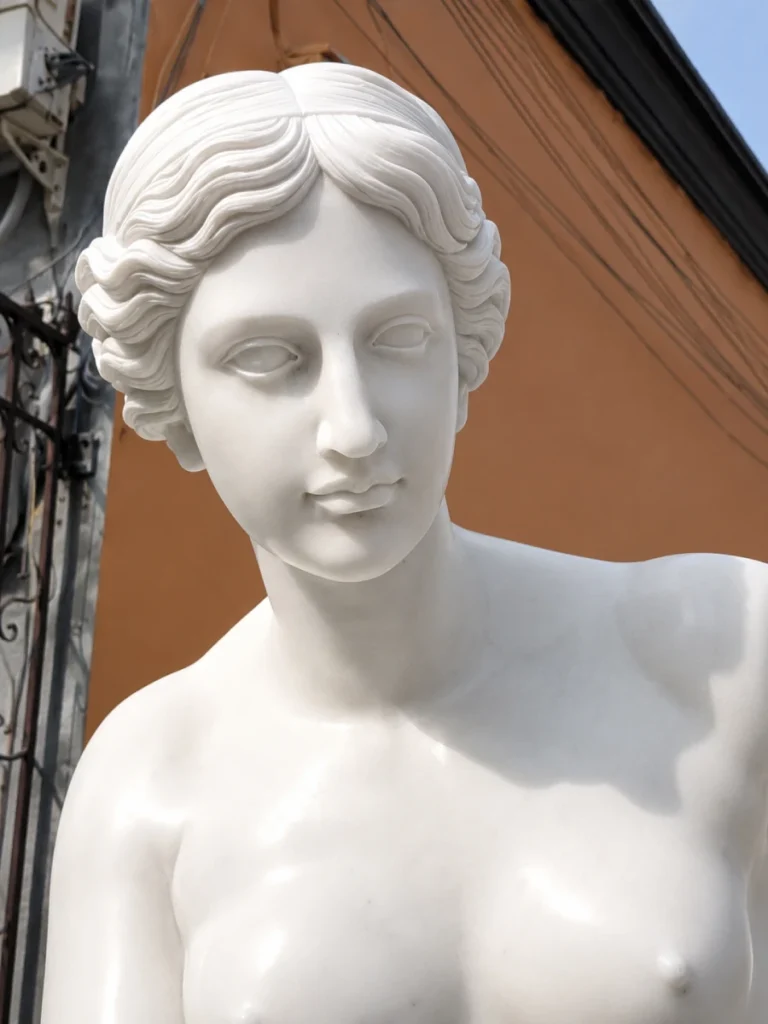
Venus de Milo — The most replicated ancient Greek sculpture. The armless composition is formally complete without restoration, which makes it unusually easy to reproduce faithfully. White marble is the correct material; the original is Parian marble. See our Venus de Milo guide for the full history and placement considerations.
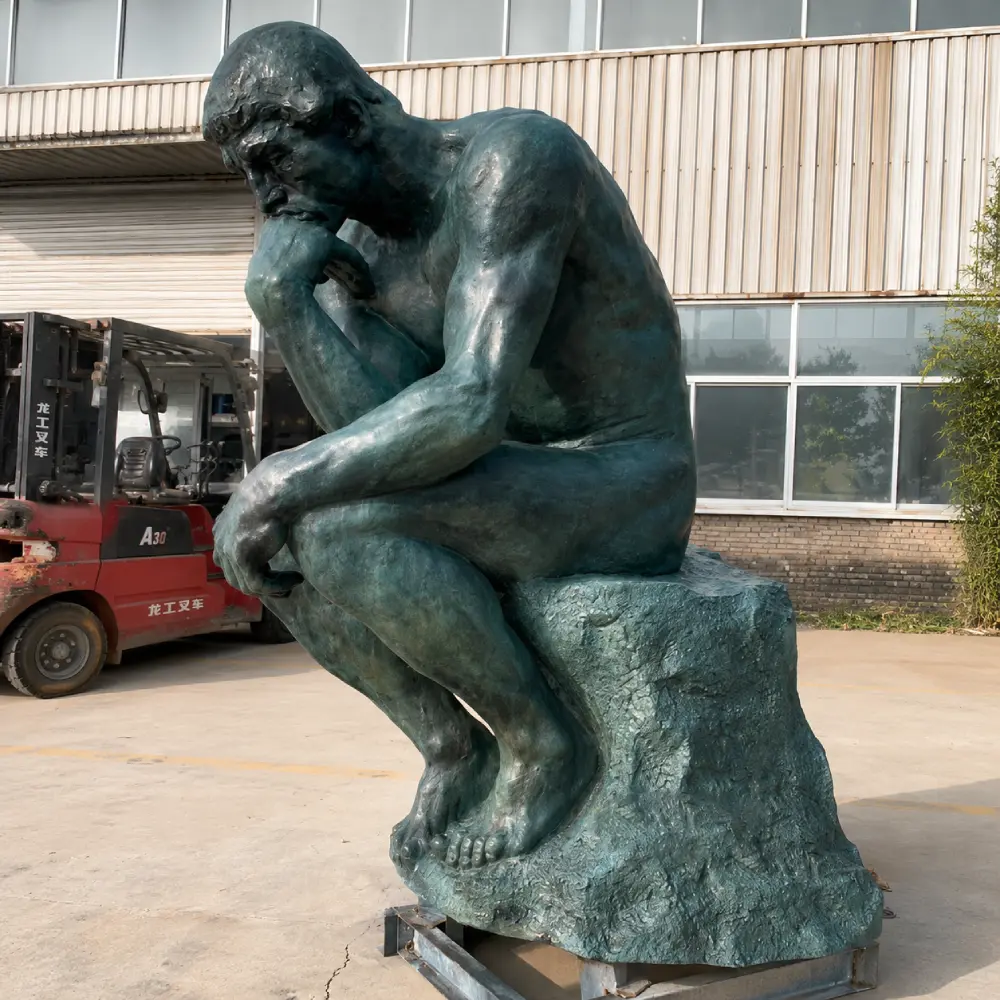
Rodin’s Thinker — The most replicated modern sculpture. Rodin himself authorized multiple casts during his lifetime; there are over 28 full-size authorized bronze casts worldwide. Replicas in bronze and resin are produced at every scale.
Winged Victory of Samothrace — Increasingly popular for entrance halls, staircases, and garden installations where the headless, armless figure creates dramatic presence. Effective in marble and bronze.
Discobolus (Discus Thrower) — The Greek athletic ideal in its most resolved form. Popular for sports facilities, residential gyms, and garden installations. Bronze is the standard material for outdoor use.
Laocoön and His Sons — A complex multi-figure group requiring advanced casting or carving skill. Best at life-size or above; compressed at small scale. Bronze handles the group composition better than marble at reduced sizes.
Apollo Belvedere — The Roman ideal of masculine beauty. Works in both marble and bronze, at any scale from 60 centimeters upward.
What “Museum Quality” Actually Means
The phrase appears on product listings across every price tier from $40 to $40,000. It means nothing on its own. What separates a genuine museum-quality replica from a decorative copy comes down to three verifiable factors:
Source of measurements. A museum-quality replica is dimensioned from the original — either from published academic measurement data, 3D scan data, or direct workshop reference. A decorative copy is dimensioned from a photograph, which introduces perspective distortion into every surface and proportion.
Material. Genuine bronze (minimum 85% copper, lost-wax cast) and hand-carved natural marble are the materials the originals were made from or that institutions use for authorized full-size copies. Resin, bonded marble, composite stone, and cold-cast bronze are surface approximations — visually similar at distance, immediately apparent at close range.
Surface refinement. A hand-cast or hand-carved piece is refined by a sculptor after the initial cast or rough carve — tool marks resolved, surface planes finished, detail clarified. A molded piece comes out of the mold as its final form, with no subsequent hand work.
At Yun Sculpture, every replica — bronze or marble — is produced from verified dimensional reference, cast using the lost-wax method or carved from quarried stone, and hand-finished in our Quyang foundry. For a full breakdown of material grades from resin to natural stone, our marble replica buyer’s guide covers the complete spectrum.
Material Tiers: What You Are Actually Buying
| Material | Process | Surface Quality | Outdoor Durability | Price Range |
|---|---|---|---|---|
| Natural marble | Hand-carved from quarried stone | Translucent, unique per piece | Excellent (protected siting in freeze-thaw) | $1,500–$50,000+ |
| Lost-wax bronze | Hand-cast, hand-finished | Rich patina development, fine detail | Excellent, permanent | $1,200–$40,000+ |
| Bonded marble | Molded from marble powder + resin | Opaque, consistent from mold | Indoor / sheltered only | $200–$3,000 |
| Cold-cast bronze | Resin + bronze powder, molded | Surface metallic appearance | Indoor only | $100–$1,500 |
| Resin with stone finish | Polymer base, surface coating | Coating degrades outdoors in 2–5 years | Not suitable outdoors | $30–$500 |
| Plaster | Molded, hand-finished patina | Detailed surface, fragile | Indoor only | $50–$2,000 |
For permanent installation — garden, entrance hall, lobby, estate — natural marble or lost-wax bronze are the only appropriate choices. Every other material is a time-limited solution.
What Are the Most Famous Statues in the World?
The five most recognized sculptures globally, based on cultural reach and institutional significance:
- Michelangelo’s David — Galleria dell’Accademia, Florence. The defining work of Renaissance sculpture.
- Venus de Milo — Louvre, Paris. The defining work of Hellenistic sculpture and the most recognized female figure in Western art.
- Rodin’s Thinker — Multiple locations; original plaster at Musée Rodin, Paris. The defining work of modern figurative sculpture.
- Winged Victory of Samothrace — Louvre, Paris. The defining work of Hellenistic dynamic composition.
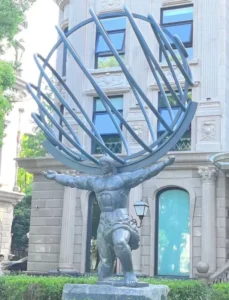
- The Statue of Liberty — New York Harbor. The most recognized monument sculpture in the world.
Of these, the first four are regularly produced as private replicas. The Statue of Liberty is reproduced primarily as decorative miniatures rather than serious sculptural commissions.
How Much Does a Famous Sculpture Replica Cost?
Price depends on material, scale, and the complexity of the original composition.
Resin / cold-cast / bonded marble: $30–$3,000 depending on size. Available immediately from stock. Surface quality visible at close range.
Hand-carved natural marble: $1,500 for simple figures at 80 cm; $4,000–$12,000 for life-size single figures; $15,000–$50,000+ for complex groups or monumental scale. Production 30–60 days.
Lost-wax bronze: $1,200 for small single figures; $3,500–$15,000 for life-size; $20,000–$40,000+ for complex groups or monumental scale. Production 35–60 days.
6-foot (180 cm) bronze statue: Typically $4,000–$10,000 factory direct for a standard single figure in genuine lost-wax bronze. Gallery pricing for the same piece runs 40–80% higher.
Factory-direct pricing from Yun Sculpture eliminates gallery and import markups. All pieces are quoted individually; contact us with your figure, scale, and material preference for an accurate price.
Can You Get a Custom Famous Sculpture Replica Made?
Yes. Any of the works listed in this guide — and most other significant sculptures in the public domain — can be commissioned as a custom replica at your specified scale, in your choice of bronze or marble.
At Yun Sculpture, the commission process for a famous sculpture replica involves:
Step 1 — Specify the work, scale, and material. Tell us which sculpture, the height you need, and whether you want bronze or marble. If you have a specific patina or marble color preference, include that.
Step 2 — Receive a quote. We respond within 2 business days with a factory-direct price and production timeline.
Step 3 — Approve and produce. Production runs 35–60 days depending on scale and material. We send progress photographs at key stages.
Step 4 — Ship. Crated and insured freight from Quyang. We handle all export documentation.
For life-size sculpture commissions, include your installation space dimensions and viewing distance at inquiry — this affects scale recommendations for compositions like the David where proportional distortion is a factor.
Frequently Asked Questions
What are the top 5 most famous statues in the world?
The five most recognized sculptures globally are Michelangelo’s David (Galleria dell’Accademia, Florence), the Venus de Milo (Louvre, Paris), Rodin’s Thinker (multiple locations), the Winged Victory of Samothrace (Louvre, Paris), and the Statue of Liberty (New York Harbor). Of these, the first four are regularly produced as private commissions in bronze and marble.What is considered the greatest sculpture of all time?
By scholarly consensus, Michelangelo’s David is most frequently cited as the greatest sculpture ever produced — for its technical mastery, psychological intensity, and the conditions under which it was made (from a block two previous sculptors had abandoned). The Venus de Milo and the Winged Victory of Samothrace are the strongest contenders from the ancient world. Rodin’s Thinker holds the equivalent position in modern sculpture.What is the most beautiful statue in the world?
Beauty in sculpture is subjective, but the Venus de Milo consistently ranks highest in surveys of the most beautiful sculptural works — for the Hellenistic ideal of feminine form it represents and the open, unresolved quality created by the missing arms. Michelangelo’s David and the Apollo Belvedere are the strongest counterparts representing the male ideal. All three are among the most replicated sculptures in history.How much does a custom life-size statue cost?
A custom life-size statue in genuine lost-wax bronze typically costs $3,500–$15,000 factory direct, depending on the complexity of the figure and the level of surface detail. Natural marble life-size statues run $4,000–$12,000 for standard figures. Gallery pricing for equivalent pieces runs 40–80% higher. Production time is 35–60 days. Price is quoted individually based on the specific figure, scale, and material.How much does a 6-foot bronze statue cost?
A 6-foot (180 cm) bronze statue in genuine lost-wax bronze costs approximately $4,000–$10,000 factory direct for a standard single figure. Complex compositions or figures with fine surface detail run toward the higher end. Cold-cast bronze pieces at the same scale cost $500–$2,000 but are resin-based — the bronze content is a surface coating, not the structural material.What is the most expensive material for statues?
Natural marble and genuine lost-wax bronze are the most expensive statue materials, and both are justified by longevity and surface quality that no composite replicates. Among marbles, rare colored varieties — verde antico, nero marquina, Egyptian beige — command higher prices than standard white marble. Among bronzes, complexity of composition and level of hand-finishing drive cost more than the metal content itself.Can you get custom statues made?
Yes. Any sculpture in the public domain — which includes all works created before 1928 and most classical and Renaissance works — can be commissioned as a custom replica. At Yun Sculpture, we produce custom famous sculpture replicas in bronze and marble at any scale from 50 cm to monumental, with a 2-business-day quote turnaround and 35–60 day production timeline from our foundry in Quyang, China.Commission a Famous Sculpture Replica from Quyang
Bronze or marble, any scale from 50 cm to monumental. David, Venus de Milo, Thinker, Winged Victory — or any public domain work. Factory direct, 2-business-day quote, 35–60 day production.