Get in touch with Yun-Sculpture company
Venus Goddess Statue: Garden, Pool & Interior Placement Guide

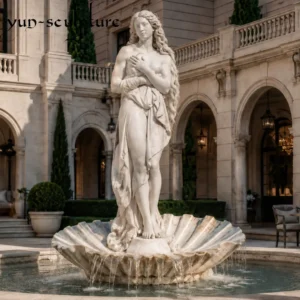
Aphrodite’s name in Greek means sea foam. She was born from it — rising from the waves where Uranus’s blood fell into the sea, carried to shore on a scallop shell, the wind filling her hair. Every venus goddess statue placed near a pool, a fountain, or a coastal garden is not a decorative choice. It is a mythologically correct one: the goddess returned to the environment of her own origin. This is why Venus near water has a quality of rightness that other figures placed in the same position do not quite achieve — they are beautiful there, but she belongs there. This guide covers the four major Venus types, the placement logic that follows from her mythology, and what each setting requires in material and scale.
Table of Contents
Table of Contents
Venus and Water — The Mythological Logic Behind Every Pool Placement
The Botticelli painting that most buyers picture when they search for a Birth of Venus garden statue is a fifteenth-century Renaissance interpretation of a much older myth. The original story — told by Hesiod in the Theogony — has no shell, no wind gods, no attendants. It has only the sea and the goddess rising from it, fully formed, beautiful, and entirely at home in the water. Botticelli’s painting, completed around 1484 and now in the Uffizi in Florence, gave that myth its definitive visual form for Western culture: the goddess on the shell, the sea behind her, arriving.
What the painting established — and what every pool and garden commission works within whether the buyer knows it or not — is the grammar of Venus’s relationship to water. She arrives from it. She does not live beside it as a neighbor; she comes from it as a native. This has specific implications for placement. A Venus figure positioned so that she appears to be arriving toward the viewer — facing landward from the water’s edge, or rising from the center of a fountain basin — is working with the mythology. A Venus figure positioned with her back to the water, or placed in open lawn without any directional logic, is working against it.
The practical rule that follows from this mythology is one that the best garden designers apply instinctively: Venus should always have a direction of arrival. She should face toward the primary viewing point of the garden, appear to have come from somewhere, and be positioned so the viewer understands themselves to be the destination of her approach. The pool, the fountain, the coastal view: these should be behind her or beneath her, not to her side or in front of her. When this logic is correctly applied, even a modest commission carries the full weight of the myth.
Fountain & Pool · Most Mythologically Correct
Venus Anadyomene
“Venus Rising from the Sea” — arms raised wringing hair, body in emergence posture
Best setting
Fountain centerpiece, pool island, water feature where figure integrates with flowing water
Material
Bronze throughout for water-contact installations; marble for elevated pool-edge positions
Note
The Birth of Venus (Botticelli) draws on this type; most “Birth of Venus” garden statues are loose interpretations of the Anadyomene pose
Most Commissioned · Garden Universal
Venus Pudica
“Modest Venus” — standing, one hand at breast, one at hip; the Capitoline Venus type
Best setting
Garden focal point with evergreen backdrop, pool surround, covered loggia, interior alcove
Material
White marble preferred — no projecting elements; arms close to body; structurally ideal in stone
Note
The Capitoline Venus (193 cm) is the canonical reference; life-size Venus Pudica in marble is among the most successful classical garden commissions
Most Recognized · Spiral Composition
Venus de Milo
Armless, spiral torso — the Louvre’s most visited figure
Best setting
Garden with clear viewing axis on multiple sides; interior entrance hall; formal courtyard
Material
Natural white marble — hand-carved; the armless composition has no projecting structural vulnerabilities
Note
The spiral composition requires sufficient scale (120 cm minimum) to read fully; see our dedicated Venus de Milo guide for the complete commission brief
Intimate Scale · Private Garden
Venus Crouching / at Rest
Seated or crouching — the goddess in a private, unobserved moment
Best setting
Private walled garden, bath, spa, bedroom alcove — spaces of personal retreat
Material
White marble for interior; bronze for sheltered garden positions where patina suits the intimate scale
Note
Reads beautifully at smaller scales (60–100 cm); the intimacy of the crouching pose is appropriate only in settings where the viewer approaches at close range
Garden Placement — Where Venus Reads Correctly
The backdrop requirement comes from the figure’s visual character. Most Venus types are smooth-surfaced, curved, with no strong vertical attribute — no helmet crest, no raised spear, no wings — to anchor the eye. In open lawn, this smoothness disappears against the sky. Against dark evergreen planting — yew, box, clipped hornbeam — white marble Venus figures become luminous. The contrast between the stone’s warmth and the dark foliage sharpens every surface detail. A clipped hedge alcove, a niche cut into an evergreen wall, a position where dark planting behind creates a framing effect: these are where Venus performs best.
The direction requirement comes from the mythology. Position Venus so she is facing toward the primary approach path or viewing axis of the garden — she is arriving, and the viewer is her destination. Elevate her on a pedestal 40 to 60 centimeters above grade so she appears to be stepping down toward the garden rather than standing at its level. For pool installations, place her at the end of the pool with the water behind her and the primary seating area in front, so she is always facing those who are reclining by the pool she has just emerged from.
A Venus figure placed in open lawn, without backdrop or directional logic, is not badly positioned — it is simply incompletely positioned. The figure is present but the myth is absent. Adding the hedge backdrop and establishing the arrival direction costs nothing in a commission but changes entirely what the figure communicates.
| Setting | Best Venus Type | Material | Scale |
|---|---|---|---|
| Garden focal point with backdrop | Venus Pudica or Venus de Milo | White marble — dark foliage backdrop essential | 120–200 cm; pedestal 40–60 cm above grade |
| Pool surround — edge placement | Venus Pudica facing landward | Marble for temperate/protected; bronze for freeze-thaw or exposed | 150–185 cm; elevated above pool deck |
| Fountain centerpiece — water integrated | Venus Anadyomene | Bronze throughout — direct water contact requires bronze | Determined by basin: figure = 1/3 to 1/2 of basin visual footprint |
| Coastal garden | Venus Pudica or Anadyomene | Bronze throughout — salt air deteriorates marble over years | Life-size or above; open sky requires scale authority |
| Covered loggia or garden room | Venus Pudica | White marble — controlled conditions; marble translucency fully realized | 80–150 cm; close-range viewing rewards detail quality |
| Interior — bedroom, bath, spa | Venus Crouching or Venus Pudica | White marble — indoor marble at its absolute best | 60–120 cm for intimate spaces; life-size for dedicated rooms |
Pool and Water Feature Integration — The Anadyomene Choice
For buyers who want to integrate a Venus figure directly into a water feature rather than positioning her at its edge, the correct iconographic type is the Venus Anadyomene — literally “Venus rising from the sea.” In this pose, the figure stands in a posture of emergence: one or both arms raised to wring water from her hair, the body slightly turned, water flowing from or around her. The Capitoline Museums in Rome holds a celebrated ancient version; the type has been reproduced continuously in European fountain sculpture from the Renaissance to the present.
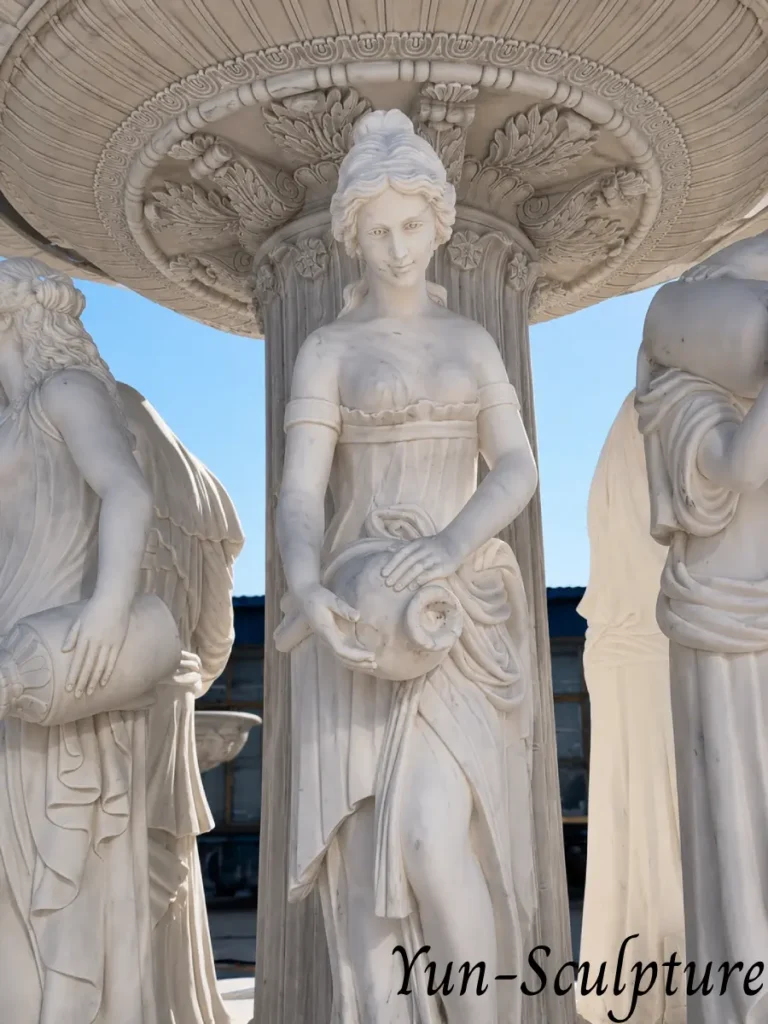
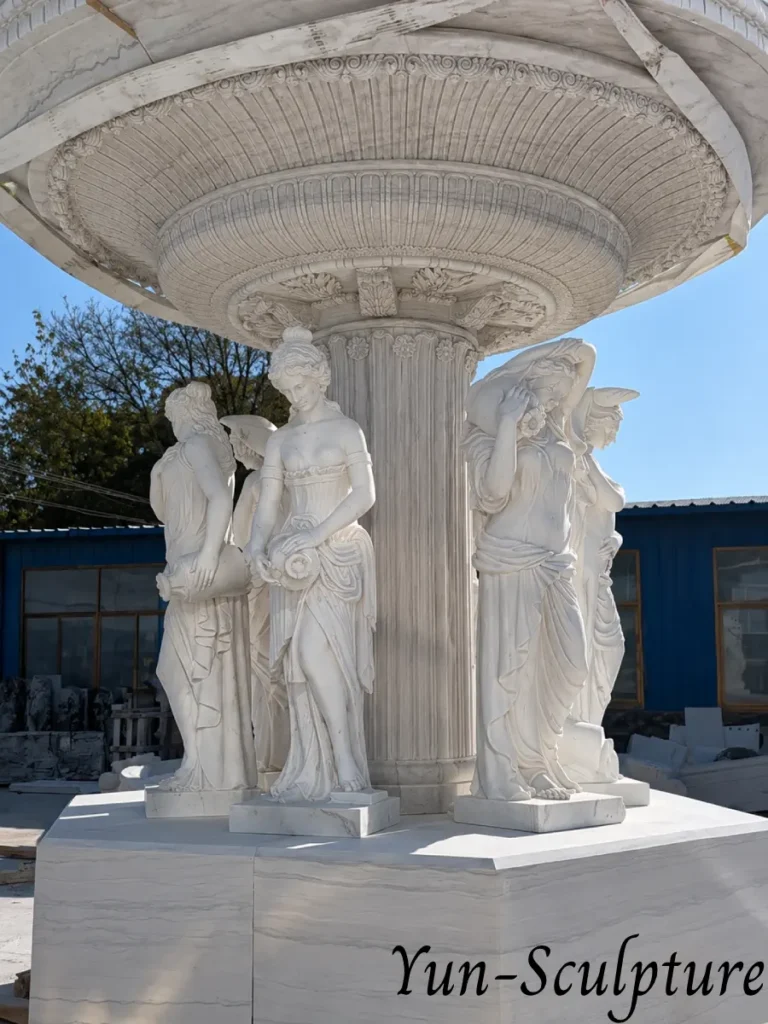
For a fountain centerpiece installation where water flows at the figure’s base, the structural requirements are the same as for any fountain figure: bronze throughout, an internal plumbing channel if the water is to emerge from the figure itself, a base engineered for permanent water contact. Natural white marble is not appropriate for a figure in direct continuous water contact — the constant moisture and mineral deposit cycles will mark and eventually deteriorate the stone surface in ways that bronze, which weathers into a stable patina, does not. Our Poseidon water feature guide covers the engineering requirements for fountain-integrated commissions in detail; the same specifications apply to a Venus Anadyomene centerpiece.
For Venus figures positioned at the pool edge — adjacent to water rather than integrated into it — the material choice follows the same logic as any outdoor commission near water. In climates with genuine freeze-thaw cycling, bronze handles the humidity and temperature variation more reliably than marble. In temperate climates or protected settings, natural white marble at the pool edge is a beautiful choice, particularly when the figure is elevated on a pedestal above the pool deck rather than sitting at grade level in direct splash range.
Interior Venus — The Two-Thousand-Year Tradition
The indoor Venus has as long a history as the garden Venus, and a different aesthetic logic. The Capitoline Venus — the most celebrated ancient Venus Pudica type and one of the most copied sculptures in Western art — was displayed indoors from antiquity. The tradition of placing Venus in private interior spaces, particularly bedrooms, bath chambers, and spaces of personal retreat, is continuous from Roman villa culture to the present.
Indoors, the material calculus changes entirely in Venus’s favor. Natural white marble in a controlled interior environment — consistent temperature, diffuse natural or artificial light, no moisture cycling — performs at its absolute best. The slight translucency that gives marble its warmth, the way chapel or gallery lighting catches the surface and seems to come from within it, the refinement of hand-carved detail at close range over years of daily familiarity: these qualities are fully available in interior marble and only partially available outdoors.
For interior placement, the Venus Pudica type — standing, one hand covering the breast, one at the hip, the pose modest and self-contained — is the most versatile. It requires no projecting attributes and has no structural vulnerabilities in marble. At 80 to 120 centimeters, it is the correct scale for a bedroom or bathroom alcove, a covered loggia, a dressing room, or the private garden room of a serious collector. The Capitoline Venus herself stands 193 centimeters — the scale of a real woman — and in the right interior space, a life-size Venus Pudica commission carries exactly that quality: not a statue, but a presence.
Frequently Asked Questions
What does the Venus statue represent?
The Venus statue represents beauty, love, and desire — more specifically, the quality of presence that makes beauty felt rather than merely seen. Venus doesn’t announce herself the way Zeus announces authority; she invites, draws the eye, makes the space she occupies feel worth being in. In garden and interior commissions, a Venus figure represents the dedication of the space to beauty and pleasure as serious values — the ancient understanding that a beautiful environment is a precondition for a well-lived life.
Is there a Birth of Venus statue?
The Birth of Venus is a painting — Botticelli completed it around 1484, and it hangs in the Uffizi in Florence. There is no single original Birth of Venus statue. However, the iconographic type Botticelli drew on — Venus Anadyomene, the goddess rising from the sea — has a long sculptural history, with celebrated ancient examples and continuous reproduction in fountain and garden sculpture from the Renaissance to the present. Most “Birth of Venus” garden statues are interpretations of the Anadyomene pose rather than reproductions of Botticelli’s two-dimensional painting.
What is the most famous Venus statue?
The most famous Venus statue is the Venus de Milo — marble, approximately 100 BCE, discovered on Melos in 1820 and now in the Louvre. The second most influential type in sculptural tradition is the Venus Pudica, represented by the Capitoline Venus in Rome and the Venus de’ Medici in Florence — the standing modest figure reproduced continuously in garden and interior sculpture for two thousand years. For garden commissions, the Venus Pudica is more commonly commissioned than the Venus de Milo because its upright pose reads more powerfully in outdoor settings.
What does the shell represent in Birth of Venus?
The scallop shell is Venus’s vessel of arrival — the platform on which she crosses from sea to land. In Greek mythology, the shell specifically carried Aphrodite to shore after her birth from sea foam, connecting her to both the sea and the cycle of life and fertility. In the Botticelli painting, it also carries a Neoplatonic meaning: the shell as a symbol of generation and the emergence of divine beauty into the material world. In a commission context, the shell as a base element — worked into the pedestal or the figure’s pose — is the most mythologically specific way to acknowledge Venus’s origin.
What does Venus mean spiritually?
Venus represents the principle that beauty is the sensory form of truth and goodness — the way divine qualities become perceptible to human beings. In classical theology, Aphrodite governed the force that draws things toward each other: love in all its forms, the attraction between persons, the bond that makes community and family possible. Placing a Venus figure in a home or garden is understood as an invocation of that quality — a request that the space be one where beauty is present and the things that make life worth living are given their proper place.
Factory Direct · Quyang, China
Commission a Venus for Your Garden, Pool or Interior
Venus Anadyomene for water features. Venus Pudica for garden and interior. Venus de Milo for spiral composition. Every type in natural marble or bronze, at any scale from 60 cm to monumental.