Get in touch with Yun-Sculpture company
Athena Statue for Sale: Which Goddess, Which Material & Where She Belongs

Athena is the only Olympian who was never young. She emerged from Zeus’s head fully formed — helmet on, aegis fastened, spear already in hand. She arrived into mythology as she appears in every statue: complete, composed, and armed. This completeness is what makes an athena statue for sale a different commission from almost any other figure in the Greek pantheon. Every attribute she carries — the spear, the shield, the owl, the Gorgon’s face on her aegis — is not something she is holding. It is part of what she is. Choosing which of those attributes your commission will include, and what material each one requires, is where this buying decision actually begins.
Table of Contents
Table of Contents
Which Athena — The Three Major Iconographic Types
There is no single image of Athena. There are three distinct iconographic types, each representing a different aspect of the goddess, and each making a different statement in a commission. Most buyers searching for an Athena statue are picturing one of these three without necessarily knowing its name or its history. Identifying which type you are drawn to — and why — is the most important decision in the commission process.
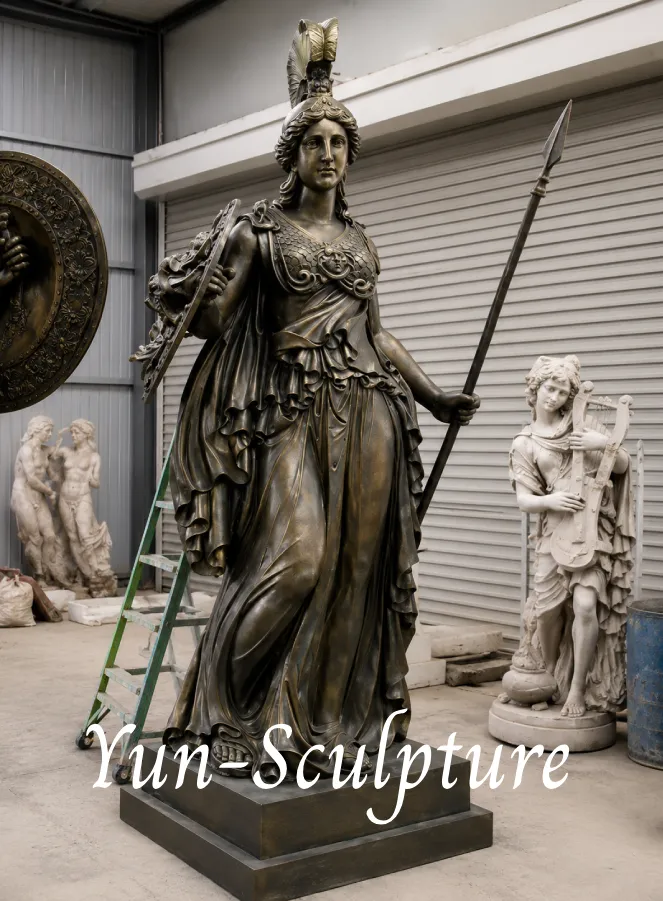
The Athena Parthenos is the type most people picture. Created by Phidias for the interior of the Parthenon in 438 BCE, the original stood twelve meters tall in gold and ivory — the most expensive cult statue in the ancient world. She stands fully armed: spear in one hand, a figure of Nike (winged victory) in the other, shield at her side, helmet crested and formal. The Gorgoneion marks her aegis. An owl sits near her feet. This is Athena as sovereign presence — goddess of the city, patron of civilization, protector of those who deserve protection. The Parthenos type is correct for institutional settings: the entrance to a law firm, a university building, an estate that needs to declare itself as a serious place.
The Athena Promachos — literally “Athena who fights in the front line” — is Athena as warrior. Also by Phidias, and also once standing on the Acropolis, this version shows the goddess with spear raised, shield forward, advancing or defending. The original bronze figure was reportedly visible to sailors approaching Athens from the sea, the tip of her spear catching the light. This is a more dynamic composition than the Parthenos — the figure in motion rather than the figure enthroned — and it is the correct choice for outdoor settings where the statue needs to hold its own against open space or strong architecture.
The Athena Lemnia is the one ancient writers described as the most beautiful work Phidias ever made. She stands with her helmet held in one hand rather than worn, her spear lowered or absent, her face turned slightly as if in thought rather than command. Ancient sources used the word “gentle” to describe her expression — extraordinary praise for a war goddess. The Lemnia is Athena at rest, Athena thinking, Athena at the moment between battles when wisdom reasserts itself over force. This is the correct Athena for a private library, a personal study, a space where the qualities of mind rather than the capacities of war are what the room is meant to honor.
Phidias · 438 BCE · Parthenon
Athena Parthenos
Fully armed sovereign — spear, Nike, shield, crested helmet
Attributes
Spear, Nike in right hand, shield at side, crested helmet, Gorgoneion aegis, owl
Meaning
Sovereign presence, civic authority, civilization’s patron
Best setting
Law firm entrance, university, institutional building, estate hall
Material
Marble body + bronze weapons for outdoor; all marble for sheltered interior
Phidias · c.450 BCE · Acropolis
Athena Promachos
Warrior advancing — spear raised, shield forward
Attributes
Raised spear, forward shield, helmet on — figure in forward motion
Meaning
Active defense, force applied with intelligence, the city protecting itself
Best setting
Outdoor garden focal point, large courtyard, strong architectural approach
Material
Cast bronze throughout for outdoor; projecting spear requires bronze structurally
Phidias · c.450 BCE · Acropolis
Athena Lemnia
Goddess at rest — helmet held, expression gentle
Attributes
Helmet held rather than worn, no raised spear, face described by ancients as uniquely gentle
Meaning
Wisdom over force, thought before action, the intellectual aspect of the goddess
Best setting
Private library, personal study, academic office, reading room
Material
White marble for interior; no structurally demanding projecting elements
The Material Question Athena Specifically Raises
Athena presents a material problem that most other classical figures do not: she is simultaneously the goddess of wisdom, whose flowing draped robes are among the most beautiful forms in classical sculpture, and a warrior goddess, whose spear, shield, and helmet are among the most structurally demanding attributes to reproduce in permanent material. A commission that handles both well requires understanding why those two sets of requirements point toward different materials — and how to resolve the conflict.
The draped peplos and himation that define Athena’s robed body are marble’s finest subject. Light enters the surface of well-quarried white marble before reflecting back, giving carved fabric the appearance of actual weight and movement — the drapery seems to fall rather than to be carved. The planes of the goddess’s body visible through the cloth, the deep shadow in the gathered folds, the way the fabric resolves at the hem: in white marble, these are extraordinary. In bronze, the equivalent forms are competent at best. The body of an Athena figure belongs in marble when the setting allows it.
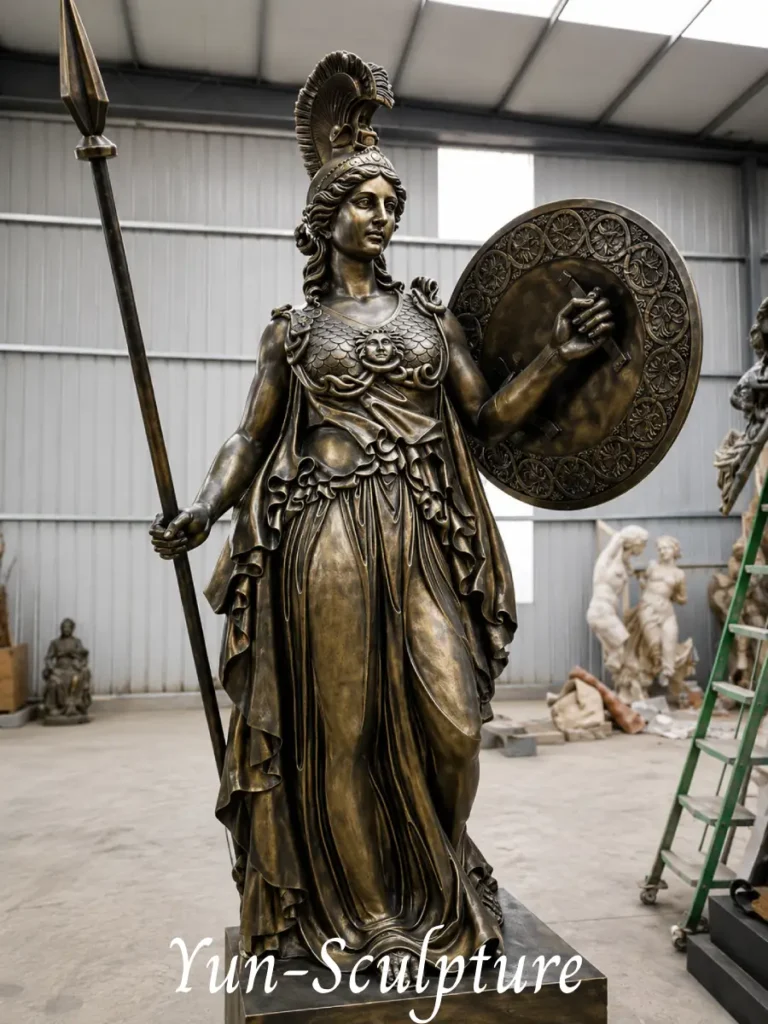
The spear is a different problem entirely. A marble spear extending from the figure’s hand at an angle creates a lever: the weight of the stone at the far end exerts continuous force on the thinnest point of the form, which is always the join between the spear shaft and the hand. In a controlled interior environment with no vibration or thermal cycling, a skilled carver can produce this form and it will survive. Outdoors, in any climate with temperature variation, it will not. The same physics apply to a shield held away from the body and to the crest of a formal helmet. For any outdoor Athena commission, the weapon attributes must be cast in bronze regardless of what material the figure’s body is worked in.
The solution — marble body, bronze weapons — is not a compromise. It is the historically correct answer. The original Athena Parthenos was herself a mixed-material figure: ivory for the flesh, gold for the drapery and armor, bronze or gold for the smaller attributes. The separation of material by function was Phidias’s own method. For an outdoor Athena commission in our workshop, we work the robed figure in natural white marble and produce the spear, shield, and helmet crest in cast bronze, then integrate them at the final stage. The visual result is unified. The structural result is durable.
Where an Athena Statue Belongs
Athena does not belong everywhere. She is a goddess of specific qualities — wisdom, strategy, the disciplined application of intelligence to difficult problems — and those qualities correspond to specific spaces. A commission placed without regard to this correspondence produces a statue that looks correct and means nothing. A commission placed with this correspondence in mind produces a figure that changes the character of the room it enters.
The private library is Athena’s most natural interior home. Surrounded by books, working materials, and the accumulated evidence of serious thought, an Athena figure — particularly the Lemnia type, whose expression is contemplative rather than commanding — presides over a space whose function matches her domain exactly. The correct scale for this setting is 80 to 120 centimeters: large enough to be a genuine presence rather than a decorative object, small enough to share the space with books and furniture without overwhelming them. White marble in this context, under controlled indoor light, will reward daily familiarity over years.
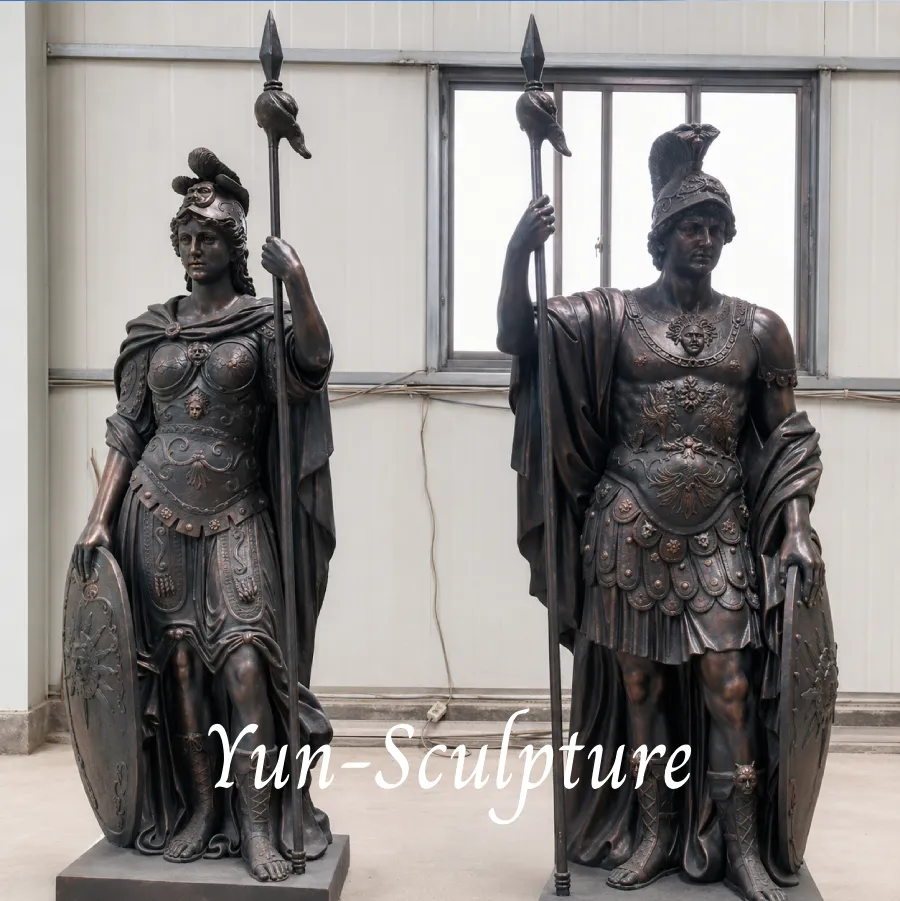
The institutional entrance — law firm, private school, university building, serious corporate headquarters — calls for the Parthenos type at a larger scale. Here the figure needs to announce something to arrivals: that the institution values what Athena represents. A life-size or slightly over-life-size Athena in the entry hall or on the approach to the building communicates intellectual seriousness more precisely than any other figure in the classical vocabulary. For this setting, the mixed-material commission — marble robes, bronze weapons — is appropriate even indoors, because the scale and the institutional context require the complete iconographic program.
Garden placements demand the Promachos type and bronze as the primary material. An Athena Promachos in cast bronze, positioned on an elevated stone pedestal at a garden axis point, elevated enough that the raised spear reads against the sky rather than against planting: this works. The same figure in white marble, positioned outdoors in any northern climate, faces structural risk at every projecting element. For garden Athena commissions in temperate or cold climates, I recommend bronze for the entire figure rather than the mixed-material approach — the patina that develops over years integrates the figure into its outdoor environment in ways that marble cannot match.
| Height | Form | Best Setting | Recommended Type |
|---|---|---|---|
| 40–60 cm | Bust or partial figure | Desk, mantelpiece, bookshelf | Any type; bust captures the helmet and face without requiring weapon attributes |
| 80–120 cm | Full standing figure | Private library, study alcove, side table | Athena Lemnia — the contemplative type at intimate scale |
| 130–160 cm | Full standing figure | Home entrance hall, covered loggia, reading room | Parthenos or Lemnia; complete iconographic program readable at this scale |
| 160–200 cm (life-size) | Full standing figure | Institutional entrance, library, law firm, university | Athena Parthenos — full program, mixed material, commanding presence |
| 200 cm+ | Heroic scale | Outdoor courtyard, garden focal point, plaza | Athena Promachos in bronze — the warrior type at monumental scale |
Frequently Asked Questions
What does the Athena statue symbolize?
The Athena statue symbolizes wisdom applied to action — not passive intelligence, but strategic thought directed toward specific ends. She is the goddess of wisdom, warfare conducted with intelligence rather than force, craftsmanship, and justice. Her image in a space communicates that those qualities govern what happens there: careful decisions, skilled execution, seriousness of purpose. Historically patron of Athens itself, her statue in a private or institutional setting carries the same declaration that once presided over the city’s entire intellectual and civic life.
What is the statue of Athena holding?
In the Athena Parthenos type, she holds a small figure of Nike (winged victory) in her right hand and a spear in her left, with a shield at her side. In the Promachos type, the spear is raised in defense or attack. In the Lemnia type, she holds her helmet rather than wearing it. The specific attributes matter for material decisions: spear and shield are projecting elements that require bronze for structural stability outdoors, while the draped body is most beautifully realized in carved marble.
What is Athena wearing in the statue?
Athena is depicted in the peplos — a long draped garment belted at the waist — over which she wears the aegis, a divine protective garment often decorated with the Gorgoneion (Medusa’s face). She wears a formal crested helmet, typically the Attic style with cheek guards and a high crest. In carved marble, the draped peplos with its deep fold shadows is among the most demanding and rewarding forms in classical sculpture — the material that best captures the weight and movement of the cloth.
What does Athena mean spiritually?
Athena represents the integration of wisdom and capability — intelligence without the discipline to act on it is incomplete, and action without wisdom is destructive. She helps heroes not by fighting for them but by giving them clarity to fight well. Her presence in a space invites those qualities into the work done there: careful thought, skilled execution, just judgment. She is also associated with practical crafts — weaving, pottery, shipbuilding — which grounds her wisdom in the physical world rather than abstraction alone.
What is Athena’s most famous symbol?
Athena’s most recognized symbol is the owl — the little owl (Athena noctua) that appeared on Athenian coins for centuries, representing wisdom and the capacity to see clearly in darkness. Her other primary symbols are the olive tree, the aegis bearing the Gorgoneion, and the spear and shield. In a statue commission, the owl is often placed at the figure’s feet or on an extended arm — a detail that identifies the figure unmistakably as Athena even in simplified compositions, and one that adds considerable iconographic completeness to a life-size or larger commission.
Factory Direct · Quyang, China
Commission Your Athena in Marble or Bronze
Parthenos, Promachos, or Lemnia — each type available in natural white marble, cast bronze, or the mixed-material commission. Every detail resolved before carving begins.