Get in touch with Yun-Sculpture company
Greek Goddess Statues: A Buyer’s Guide to Venus, Athena, Artemis & More

The male and female gods of Olympus do different things to a space. Zeus at an entrance announces authority. Poseidon beside water commands it. But Aphrodite in a garden corner doesn’t announce or command — she invites. Artemis at the woodland edge doesn’t declare — she unsettles, in the precise way that wilderness unsettles: a reminder that not everything beautiful is domesticated. Persephone at a garden threshold asks something that no male god asks: what season is this, and what is ending, and what will come back? The quality of presence each greek goddess statue brings is the first question in any commission, and it is the question most buyers skip entirely. This guide covers six goddesses, the emotional register each carries, and what those differences mean for material, placement, and scale.
Table of Contents
Table of Contents
Six Goddesses, Six Emotional Registers
The distinction between the goddesses is not simply a matter of different domains — wisdom versus beauty versus victory. It is a distinction in how each figure relates to the viewer and to the space it inhabits. Understanding this difference before selecting a goddess is what separates a commission that gives a space a specific quality of meaning from one that simply places a classical female figure in it.
Aphrodite — Venus in Roman tradition — does not preside. She is present in the way that beauty is present: it doesn’t demand acknowledgment, it simply makes acknowledgment inevitable. Her image in a private garden, at a fountain, in a covered loggia, has a quality of intimate presence that none of the other goddesses quite replicates. She is the right choice for spaces that are meant to be enjoyed rather than impressed by — where the quality of pleasure matters more than the declaration of seriousness.
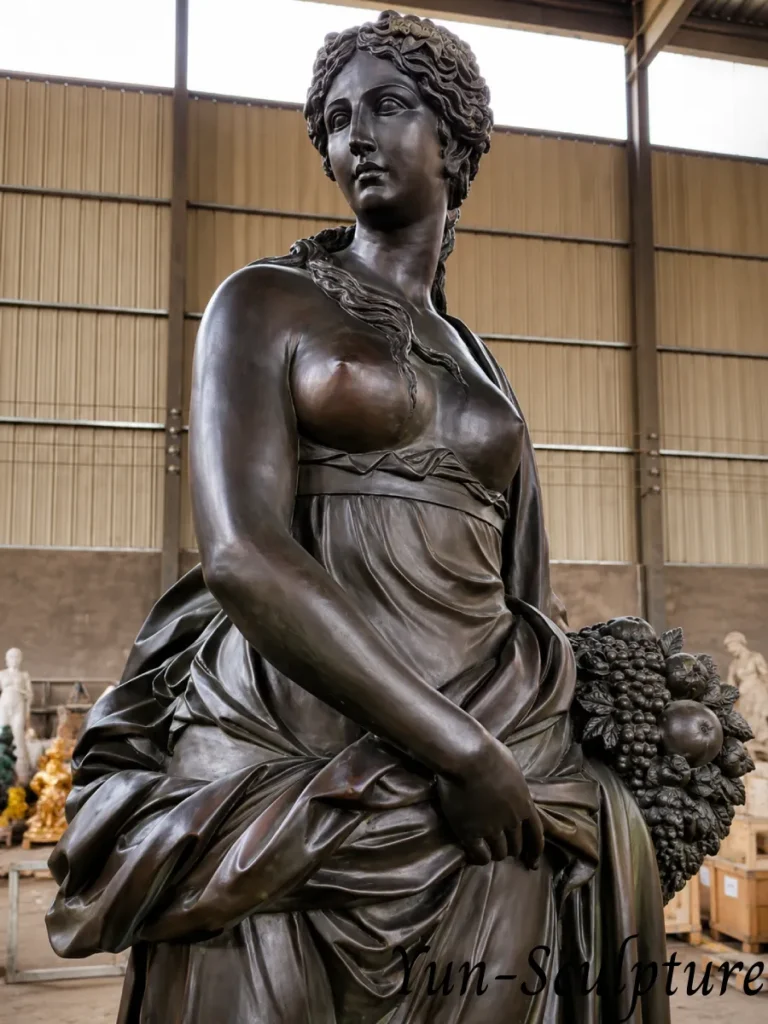
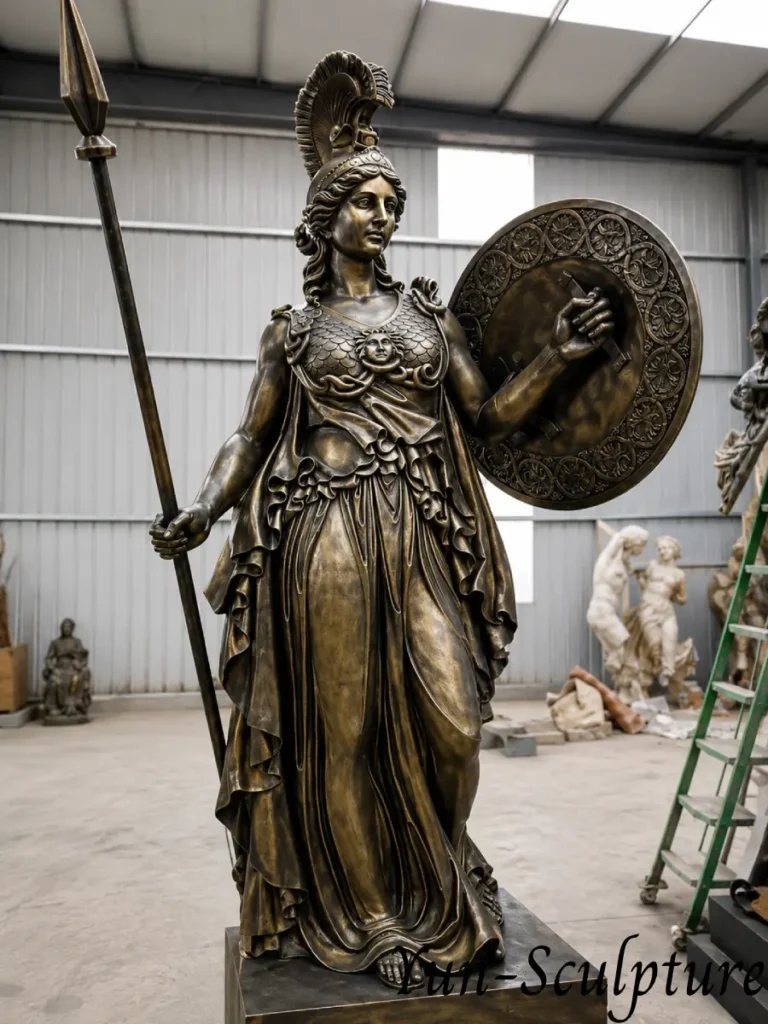
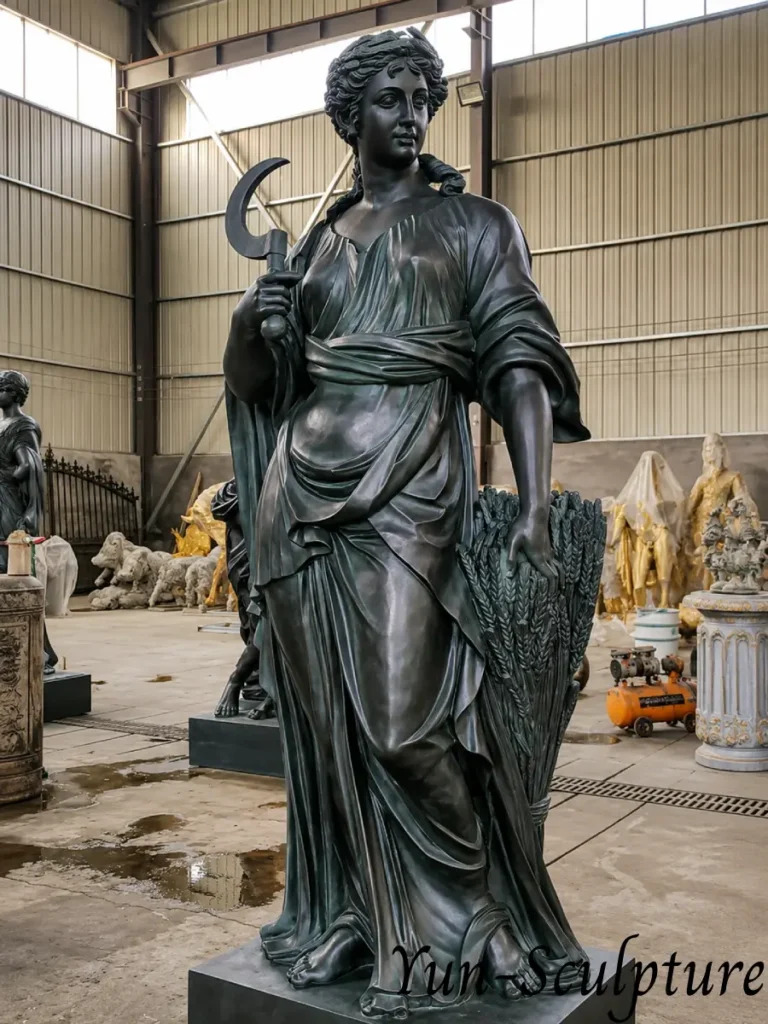
Athena presides. She is the only goddess whose presence changes a space’s intellectual register rather than its emotional one — she makes the space serious in the way a library is serious, a law firm is serious, a place where difficult things are thought through carefully. I covered her three iconographic types and the specific material requirements of her commission in the dedicated Athena guide; she appears here as one of the six because her emotional register is part of the complete picture of what the female Olympians offer.
Artemis unsettles in the best possible way. She is the goddess of wilderness, of the hunt, of the moon and its cold light — and her image in a garden doesn’t domesticate these qualities, it concentrates them. An Artemis at the far end of a garden, at the edge of a wooded area, where the planted meets the wild, is one of the most architecturally honest placements in classical garden sculpture: the goddess belongs exactly at the threshold between order and nature, which is where gardens end.
Nike — the goddess of victory — is underused in private garden commissions and overused in institutional ones, where she has become so familiar (on trophies, on institutional facades, on the entrance to every courthouse and university built between 1880 and 1940) that her power has become invisible through repetition. In the right private setting — a sports estate, a private gymnasium, a garden that belongs to someone for whom achievement is the defining personal value — she recovers her full force. The Winged Victory of Samothrace is among the most powerful sculptures in the Western tradition, and her descendant in a well-placed garden commission carries a fraction of that power that is still significant.
Persephone is the goddess of seasons and of the underworld’s boundary — the figure who descends each autumn and returns each spring, whose movement is the mythological explanation for why the earth goes dormant and renews. Her image in a garden has a specific resonance that no other goddess quite replicates: she belongs at entrances and thresholds, at the point where the cultivated garden meets something beyond it, in autumn plantings, and in spaces that are meant to hold both beauty and melancholy simultaneously.
Hera — the queen of the gods — brings formal dignity rather than warmth, authority without approachability. She is Zeus’s counterpart in the female register: not commanding like Athena, not inviting like Aphrodite, but presiding with the particular gravity of someone who has earned their position and intends to hold it. Her image suits formal gardens, covered garden rooms, and institutional settings where the values of tradition, continuity, and institutional order are what the space is meant to communicate.
Beauty · Love · Desire
Aphrodite / Venus
The goddess who invites rather than commands
Emotional register
Intimate presence; makes enjoyment inevitable rather than demanding acknowledgment
Best setting
Private walled garden, fountain surround, covered loggia, spa, bedroom alcove
Material
White marble — the goddess of beauty in white stone is the natural commission in classical sculpture
Wisdom · Strategy · Crafts
Athena
The goddess who makes a space serious
Emotional register
Intellectual authority; changes the space’s register rather than its warmth
Best setting
Private library, law firm, academic institution, executive office, study
Material
Marble body + bronze spear and shield — see the dedicated Athena guide for full detail
Hunt · Wilderness · Moon
Artemis
The goddess who belongs at the edge of things
Emotional register
Productive unsettlement; the reminder that not everything beautiful is domesticated
Best setting
Woodland garden edge, hunting estate, wild garden corner, moonlit terrace
Material
Bronze for outdoor with bow and quiver; marble for sheltered positions with bow held loosely
Victory · Achievement · Forward motion
Nike
The goddess who lifts what she touches
Emotional register
Uplift and forward momentum; the impulse that has placed her at the entrance of institutions worldwide
Best setting
Sports estate, private gymnasium, institutional entrance, achievement-oriented setting
Material
Bronze throughout for outdoor — wings are projecting forms requiring bronze’s tensile strength
Seasons · Threshold · Return
Persephone
The goddess who holds beauty and melancholy together
Emotional register
Seasonal resonance; the mythological figure of ending and renewal simultaneously
Best setting
Garden entrance or threshold, autumn plantings, spaces meant to hold both beauty and passing time
Material
White marble — draped figure with no projecting weapon elements; suits protected garden positions
Marriage · Queenship · Continuity
Hera
The goddess of formal dignity
Emotional register
Presiding gravity; the authority of tradition and institutional continuity
Best setting
Formal garden, covered garden room, institutional settings valuing tradition and order
Material
White marble — fully robed figure; the formal drapery of queenship is marble’s finest subject
The Draped or Unveiled Question — A Decision Unique to Goddess Commissions
The question of whether a goddess statue is depicted draped or nude — or partially of each — does not arise in the same way for male god commissions. Zeus is armored. Hermes is athletic. Poseidon is active. But Aphrodite, Persephone, Nike, and Hera can each be depicted in multiple degrees of drapery, and the choice carries both aesthetic and contextual implications that the buyer needs to resolve before the commission begins.
A fully draped goddess — robed in the flowing himation or peplos, with the fabric’s weight and fall defining the figure’s visual character — is the correct choice for any setting where the statue will be encountered by a wide or unpredictable range of viewers: a public garden, an institutional entrance, a commercial property, any space where the owner has no control over who will see the piece. The draped figure carries all the visual authority of classical goddess sculpture without raising questions about appropriateness. In marble, fully draped figures are also among the most technically accomplished objects in the medium — the challenge of carved fabric rewards prolonged attention in ways that a smooth surface does not.
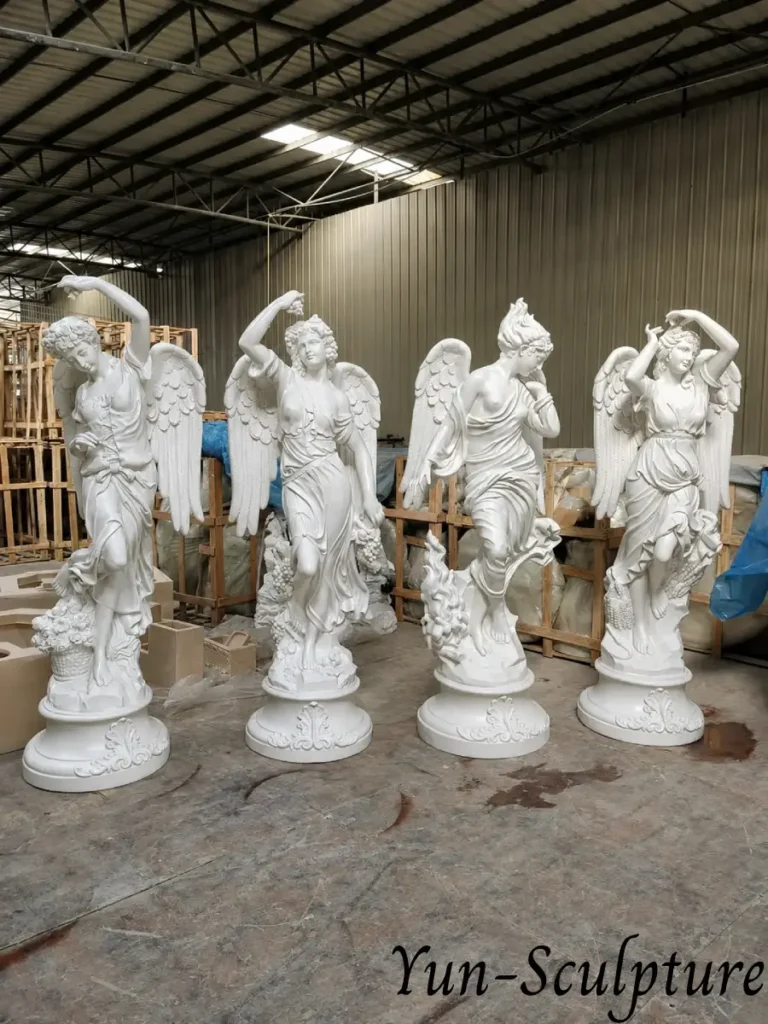
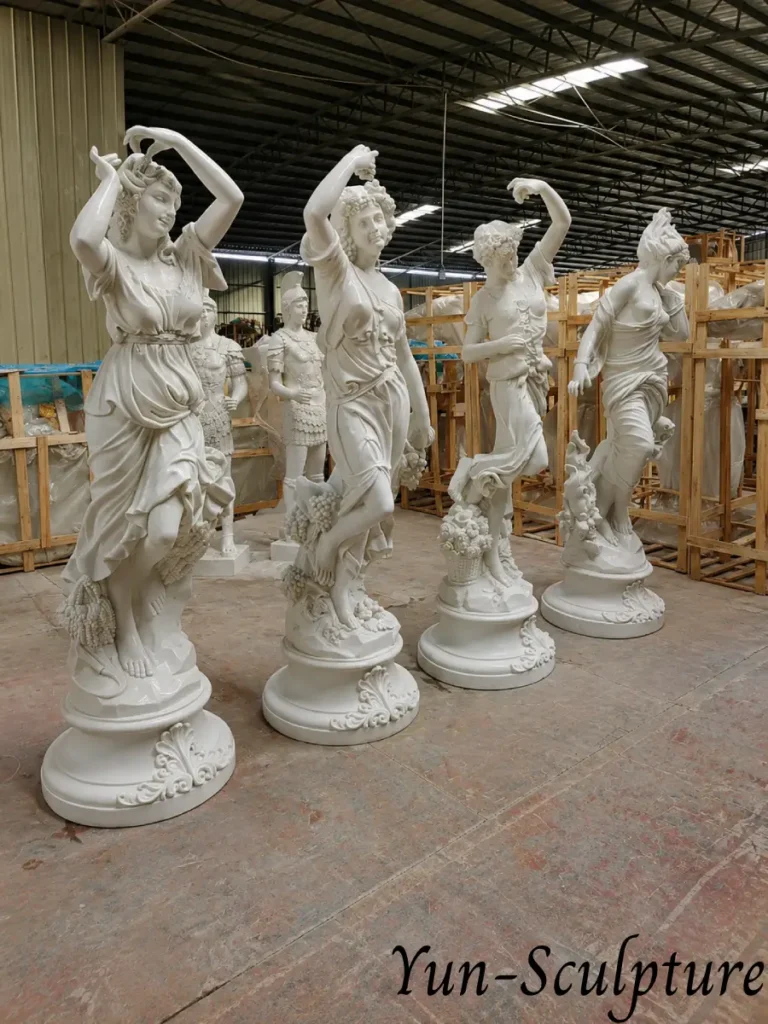
A partially draped or nude figure is correct for private settings where the owner controls the viewing context: a walled private garden, a covered loggia visible only from the main residence, an interior courtyard, a private swimming pool surround. These settings have been the appropriate context for nude or semi-nude goddess sculpture since antiquity — the Aphrodite of Knidos by Praxiteles, the first fully nude female figure in the Western sculptural tradition, was displayed in a private sanctuary that visitors approached specifically to view her. The tradition of the nude goddess in a private garden or bath setting is continuous from the 4th century BCE to the present.
The hybrid — one shoulder bared, drapery slipping from the figure, the pose caught at a moment of transition — is the most historically common and the most visually dynamic option. It appears in the Venus de Milo, in the Capitoline Venus, in dozens of the most celebrated goddess figures in museum collections worldwide. It suits almost any setting where a fully nude figure might be questioned but a fully robed figure might seem to miss something of what the goddess is.
For Any Setting
Fully Draped
- Correct for public gardens, institutional entrances, commercial properties
- No questions about viewer appropriateness
- Most technically demanding for the carver — carved fabric rewards prolonged attention
- Works for Aphrodite, Hera, Persephone, Athena, Demeter
- The choice when the setting’s audience is unpredictable
Private Settings Only
Partially Draped or Nude
- Correct for walled private gardens, covered loggias, private pool surrounds, interior spaces
- The Venus de Milo, the Capitoline Venus: partially draped is historically dominant
- Owner controls who sees the piece
- Works for Aphrodite, Artemis at bath, Nike in motion
- The choice when the setting’s intimacy is guaranteed
Material and Scale — What Each Goddess Requires
The material logic for goddess commissions follows the same framework that governs all Greek figure work: projecting elements require bronze, draped figures prefer marble. Among the six goddesses covered here, two have specific structural requirements that differ from the others.
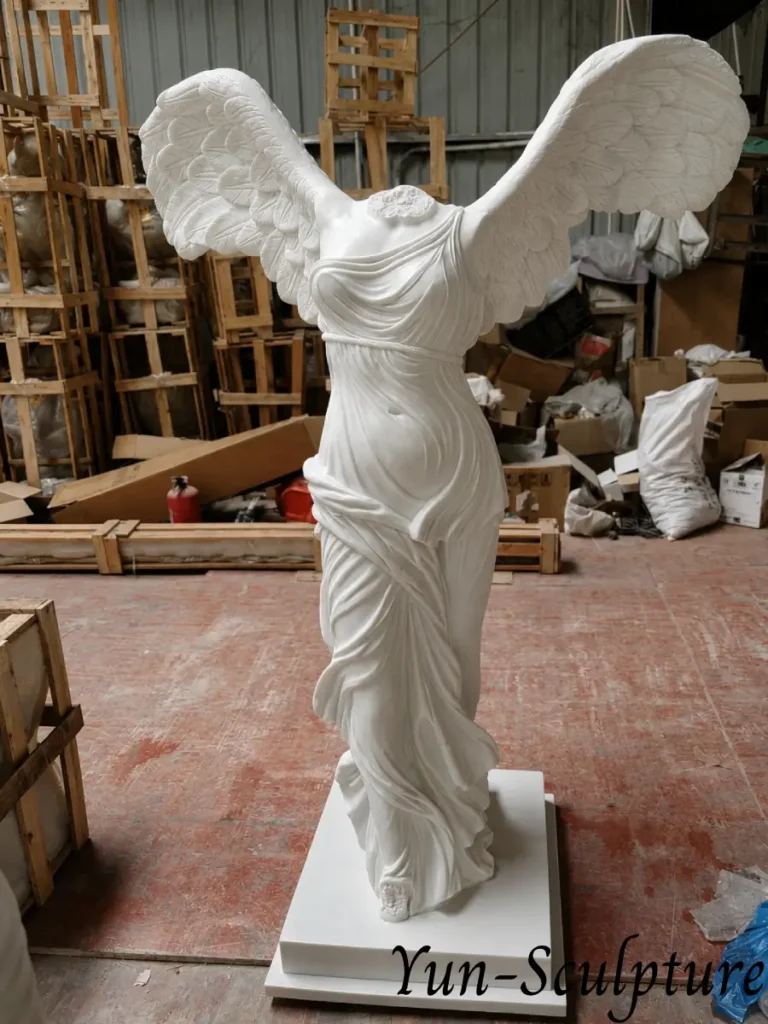
Nike’s wings are the defining element of her commission and its most structurally complex. A pair of large wings extending from the figure’s back — feathered, angled, catching imaginary wind — are projecting forms of considerable surface area. In marble, wings of the scale typical for a life-size Nike (roughly 80 to 120 centimeters from tip to body at each side) create substantial leverage stress at the attachment points. For outdoor Nike commissions, I recommend bronze throughout, or at minimum bronze wings on a marble body — the same hybrid logic that applies to Athena’s spear and Poseidon’s trident. The Winged Victory of Samothrace herself was bronze originally, the marble version we know being a Roman reproduction made for interior display.
Artemis with bow and quiver presents the same issue as Apollo: the drawn bow is a projecting form in tension, and the quiver with its arrows is a projecting form on the figure’s back. For outdoor Artemis commissions in exposed positions, bronze handles these elements structurally in a way marble cannot maintain over decades. For sheltered interior or covered outdoor positions, a marble Artemis with the bow held loosely — not drawn — reduces the structural risk considerably by eliminating the tension geometry.
The remaining four goddesses — Aphrodite, Athena, Persephone, Hera — present no exceptional structural requirements beyond what the general material framework covers. Draped figures in protected positions in white marble. Outdoor figures, or any figure with projecting attributes, in bronze or hybrid. Our individual Athena guide covers her specific commission requirements in the depth this overview cannot.
Scale for goddess commissions follows a slightly different logic than for male gods. The female Olympians — with the exception of Athena in institutional settings and Nike in monumental commissions — traditionally read at intimate to medium scale: powerful at 80 to 150 centimeters in the right enclosed or sheltered setting, without requiring the heroic scale that Zeus or Poseidon need to establish authority in open space. An Aphrodite at 120 centimeters in a walled garden, an Artemis at 100 centimeters at a woodland edge, a Persephone at 90 centimeters in a garden entrance niche: these are correct proportions, not compromises. The goddesses whose domain is private experience belong at the scale of private experience.
Frequently Asked Questions
What do Aphrodite statues symbolize?
Aphrodite statues symbolize beauty, love, and desire in their most generous form — the quality that makes enjoyment inevitable rather than demanding acknowledgment. In a garden or interior setting, an Aphrodite figure declares that the space is devoted to pleasure and beauty: not achievement, not authority, not wisdom, but the experience of being present in a beautiful place. Her image has been placed in gardens, baths, and private sanctuaries since the 4th century BCE, when Praxiteles created the Aphrodite of Knidos for a private sanctuary that visitors sought out specifically to see her.
What does the goddess Artemis symbolize?
Artemis symbolizes wilderness, the hunt, the moon, and the independence of those who belong to no domesticated order. Her image in a garden unsettles productively — it places the reminder of the wild at the edge of the cultivated, which is architecturally honest about what gardens are: a negotiation between human order and natural force. In a commission context, she is the correct goddess for woodland gardens, hunting estates, and spaces whose owner identifies with independence, self-direction, and the aesthetic of the untamed.
What does a goddess statue symbolize?
A goddess statue symbolizes that the space where she stands is governed by her values. An Aphrodite declares this is a space for beauty and pleasure. An Athena declares this is a space for serious thought. An Artemis declares wildness is honored here. A Nike declares achievement is the central value. The choice of goddess is not a decorative decision — it is a declaration about what the space is for and what qualities the owner wants it to embody.
What is a Greek female statue called?
In classical art, a standing draped female figure is called a kore (plural: korai) — literally ‘maiden.’ The kore was a standard Archaic-period type (700–480 BCE), characterized by a frontal pose, drapery, and the Archaic smile. The male equivalent is a kouros. Named deity figures — Aphrodite, Athena, Artemis — are identified by their specific attributes rather than a general typological name. Today, ‘goddess statue’ covers any female divine figure from the Greek or Roman pantheon, while ‘kore’ is used specifically for the Archaic type in art historical contexts.
Which Greek goddesses protect the home?
Hestia is the goddess specifically associated with the home — she presided over the hearth, the sacred fire at every household’s center, and by extension over the home’s stability and continuity. Unlike the other Olympians, she has no dramatic mythology and rarely appears in narrative art, but she was the most consistently present deity in Greek domestic religious life. Hera protects marriage and family continuity. For a home commission, Hestia is the historically specific choice for domestic protection; Hera suits formal spaces expressing the values of family and tradition.
Factory Direct · Quyang, China
Commission a Greek Goddess in Marble or Bronze
Aphrodite, Artemis, Nike, Persephone, Hera, or Athena — draped or unveiled, in the material and scale your space requires. Every commission begins with which goddess belongs here, and why.