Get in touch with Yun-Sculpture company
A familiar presence. Room to welcome.
Custom Great Dane Statues for Entrances and Gardens
Commission a Great Dane statue with the tall stance, distinctive head and quiet presence you want to see every day. Choose one companion or develop a coordinated pair for an entrance.
Explore bronze design directions, then agree the ears, head turn and complete dimensions. Marble and simplified stainless steel offer separate interpretations of the same breed.
Plan your Great Dane on WhatsApp ↗A preferred image and a photograph of the entrance are enough to begin. We can help refine the pose and size around your space.
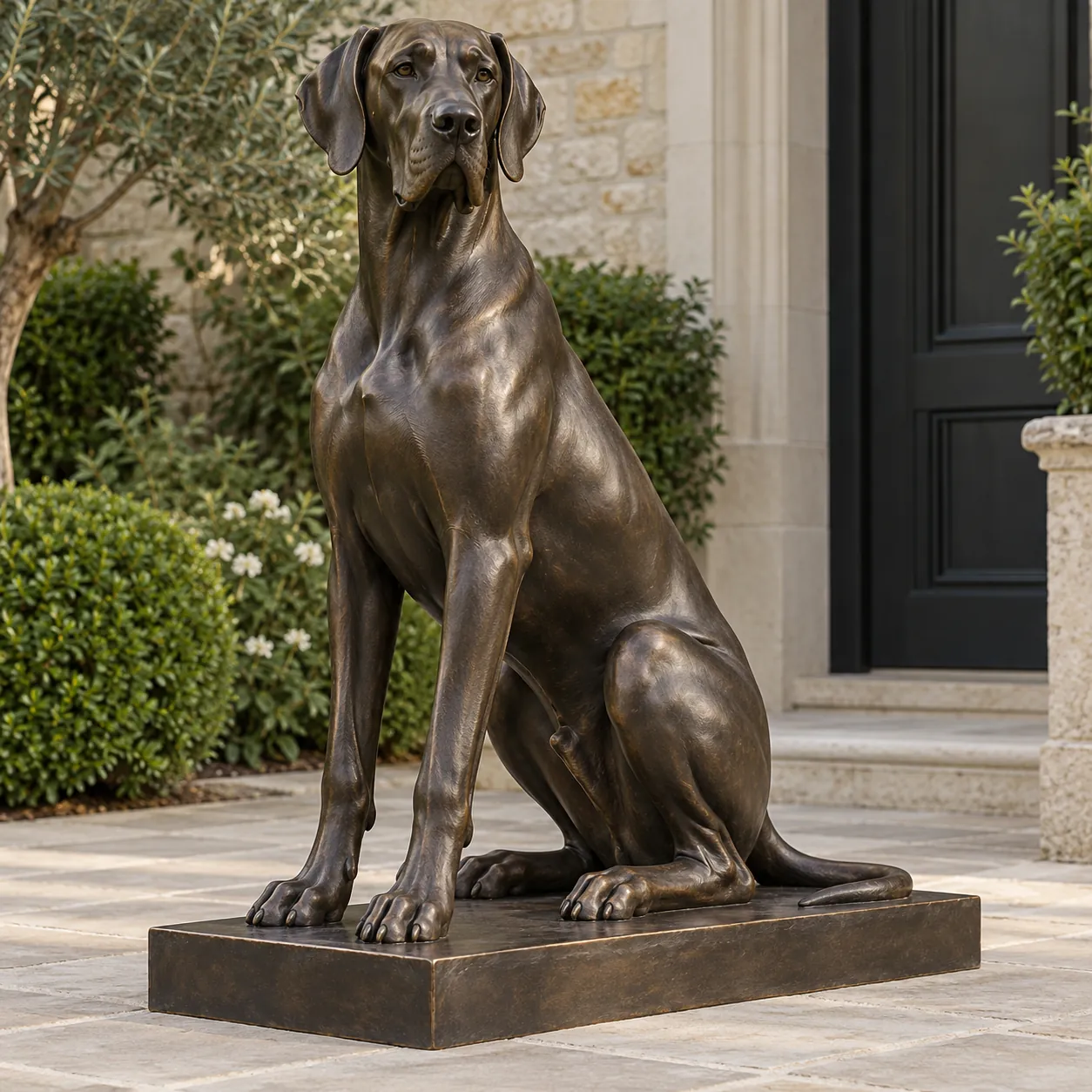
Single portrait or coordinated pairEar reference and head direction agreedFigure, support and delivery dimensions separated
Choose the presence that suits your place
Great Dane sculpture design directions
Natural dropped ears, an upright-ear reference, a standing profile and a two-dog entrance composition create different impressions. Start with the outline and expression; the final material and surface follow that choice.
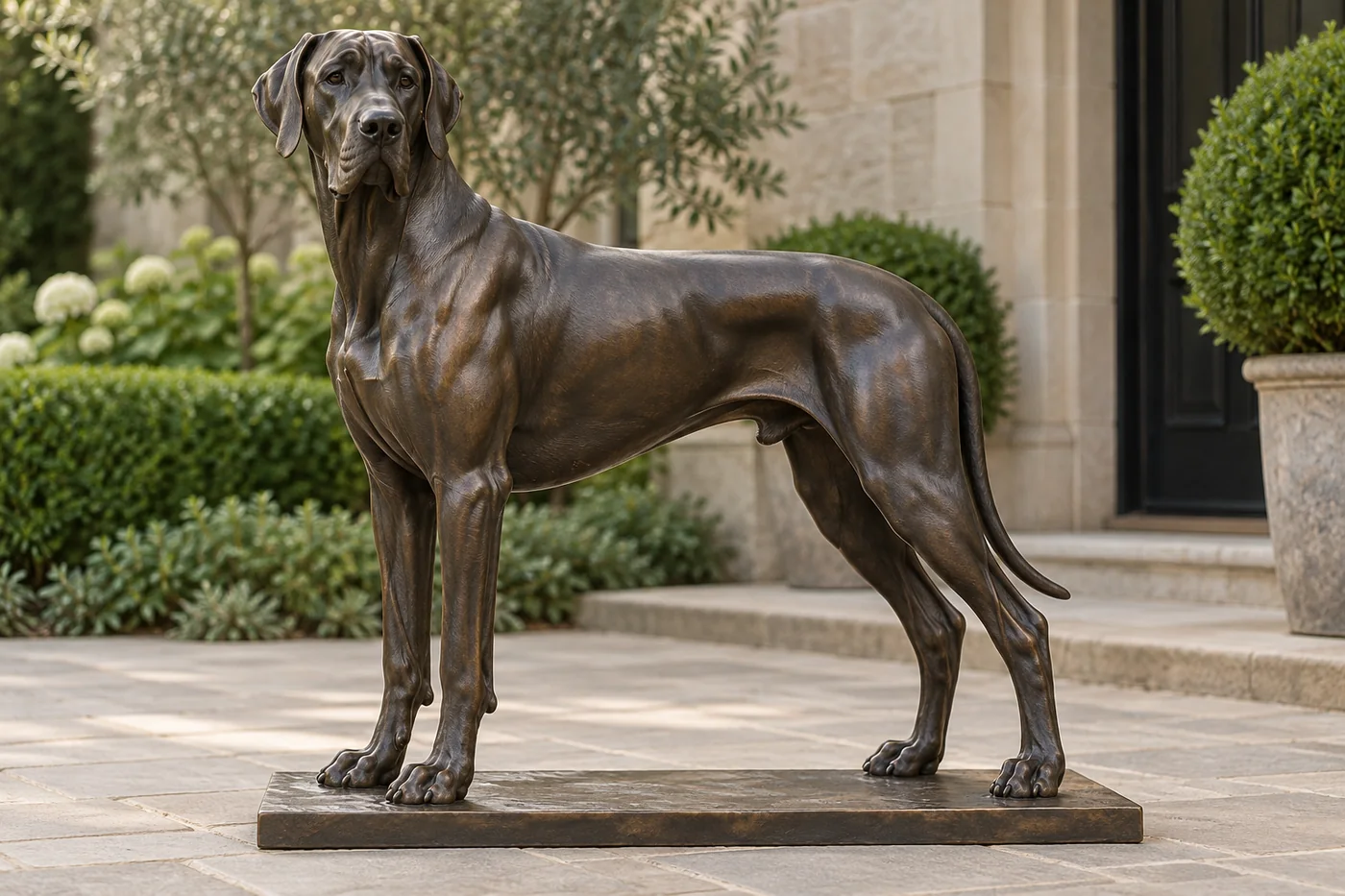
Standing with natural ears
The full body profile needs its own nose-to-tail allowance. Review the direction of the long axis against the entrance or garden path.
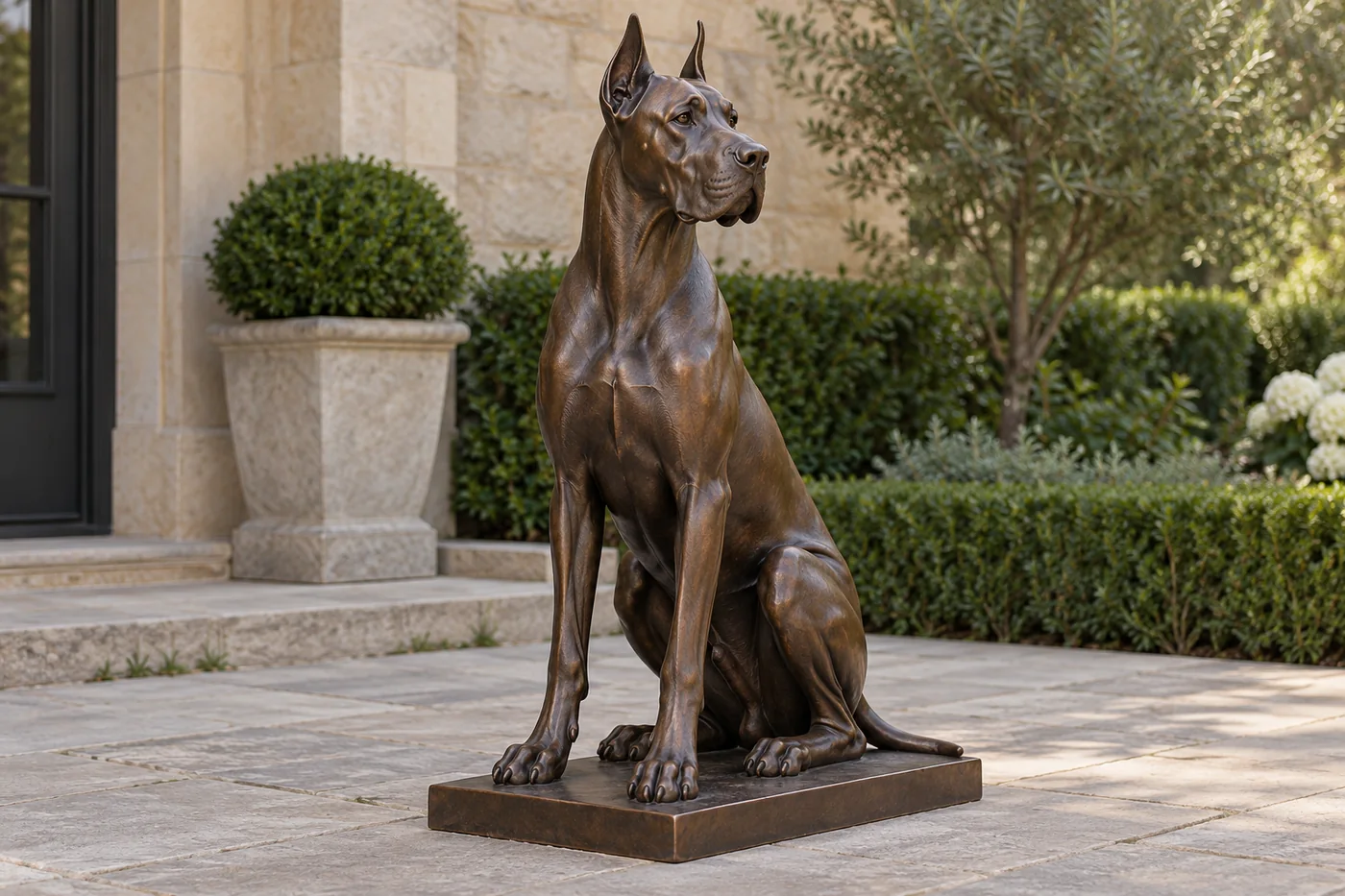
Upright-ear seated reference
An alternative ear appearance changes the upper outline. Choose it from your preferred reference and confirm the highest point in the model.
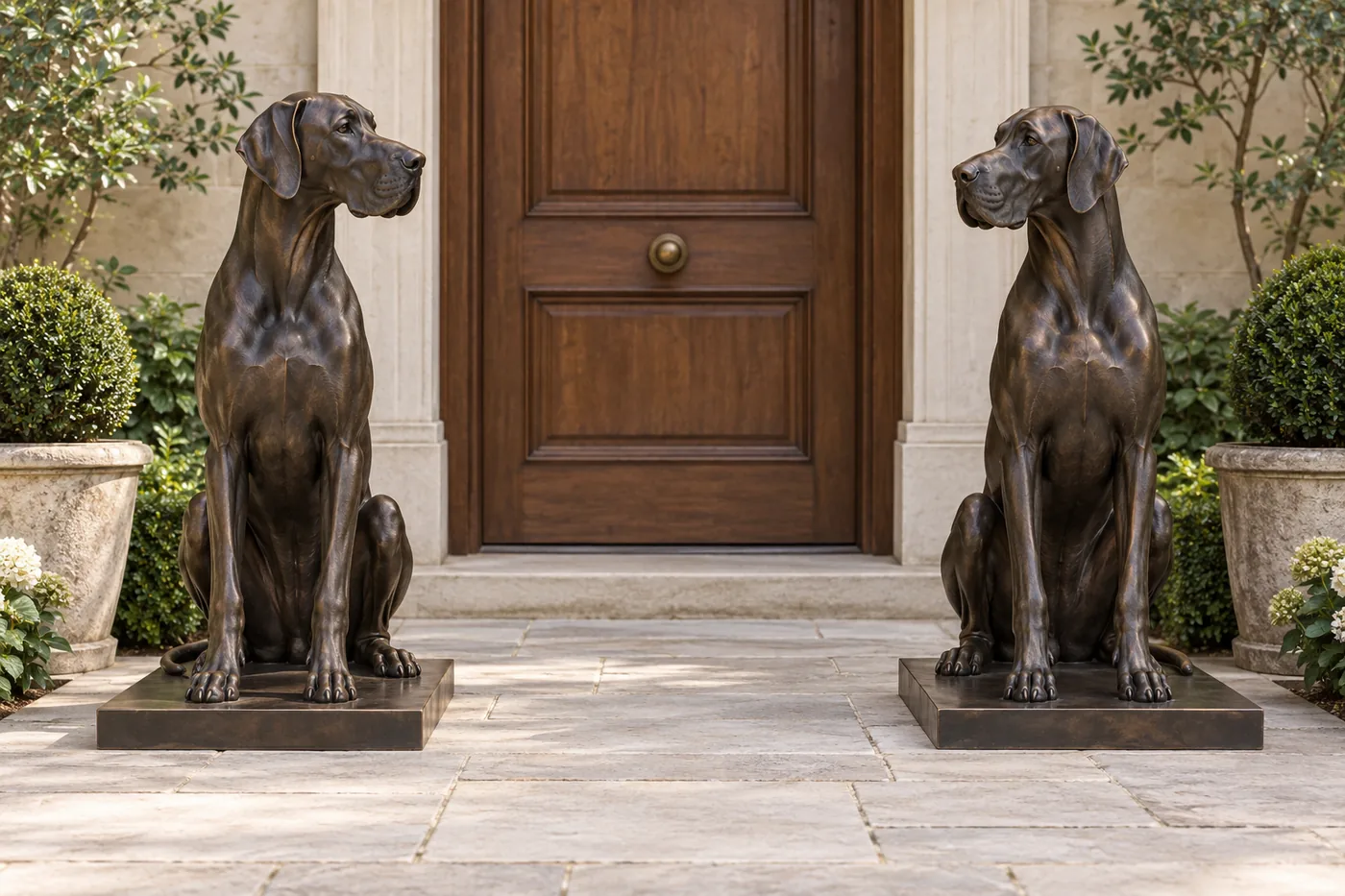
Coordinated entrance pair
Two separate figures frame the approach. Agree the bodies and head turns for each side; this image is a composition idea, not a measured installation plan.
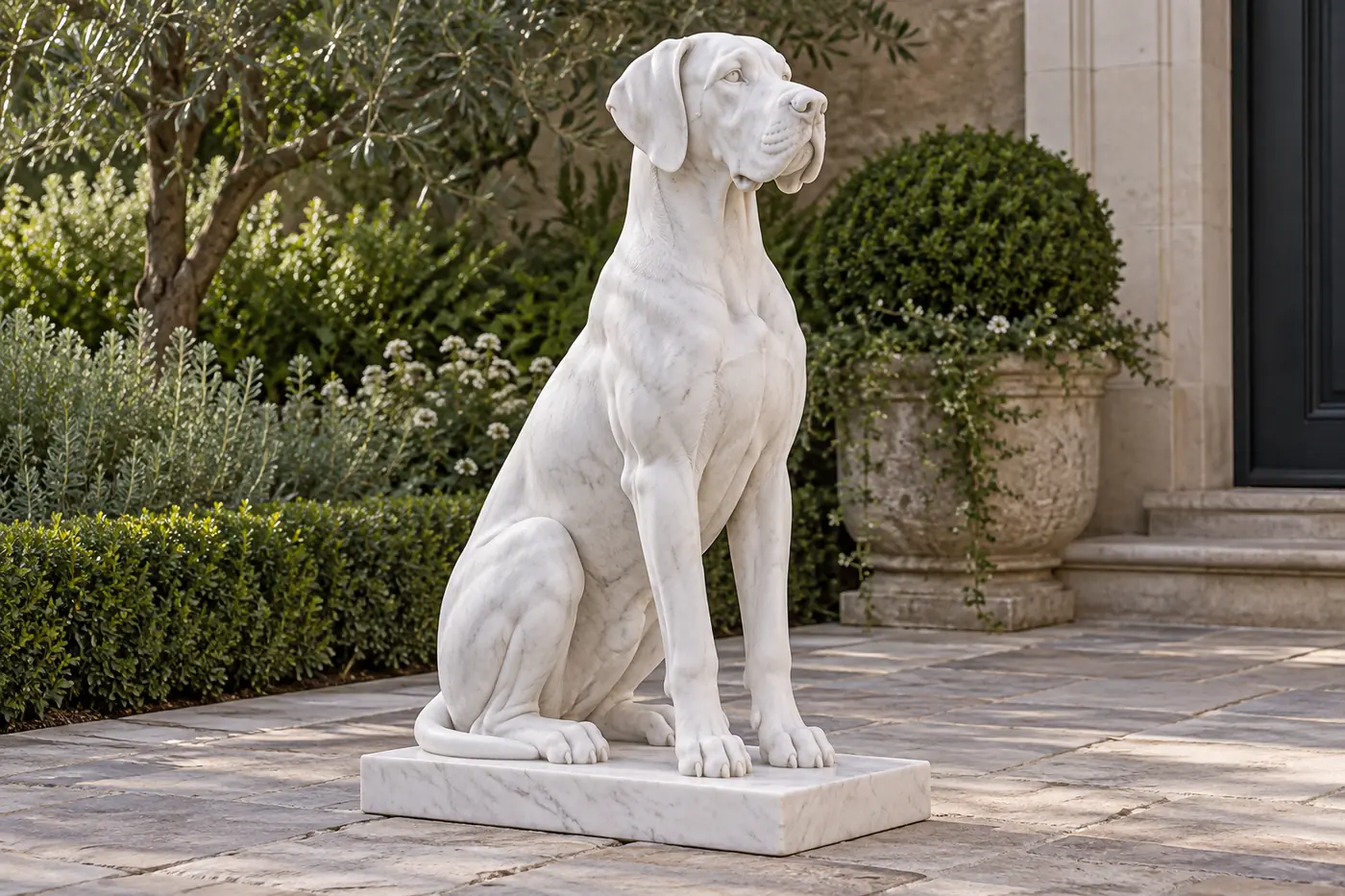
Seated white marble
A carved interpretation with ears close to the cheeks and a supported tail. Develop its leg transitions and base for the selected stone.
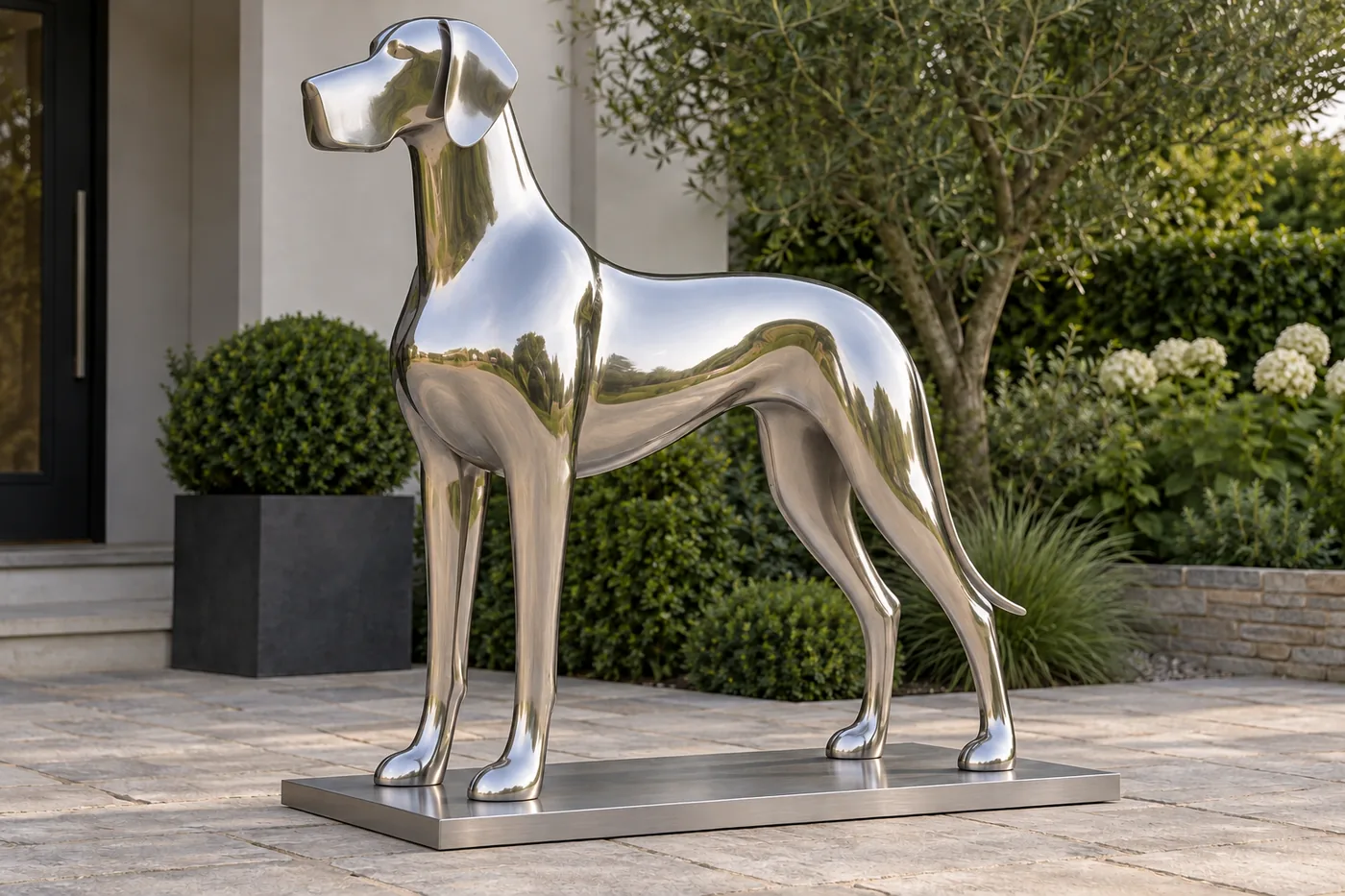
Abstract mirror steel
Tall broad curves and a simple head carry the breed outline. Minimal details support a separate fabricated design rather than a detailed bronze likeness.
Yun Sculpture created these designs with AI. You can send your own AI image for sculpture development. For feasible designs, we aim for over 90% visual reproduction of the agreed reference, with material adjustments and the complete model approved before production.
For a portrait, show us your Great Dane as well as the design you prefer. The personalized dog statue guide explains how photographs support an individual commission.
Recognition starts above the shoulders
Keep the Great Dane’s head, ears and expression
A Great Dane dog statue should feel like a Dane before the finish is added. Its large scale alone will not establish the likeness. Look at how the head, neck and chest connect, then compare those forms with the dog or breed reference you want represented.
Review the long, rectangular head
The AKC Great Dane standard describes a long rectangular head, a deep muzzle and a strongly defined transition between forehead and nose. These are useful breed cues; your own dog’s photographs decide its individual proportions and expression.
Check a side view for the forehead-to-muzzle relationship, then a front or three-quarter view for the width and jaw. A head can look substantial in one image yet feel too narrow when seen from the entrance approach.
Point out whether the mouth should be relaxed and closed, slightly open or interpreted more simply. A large lip fold can change the expression, so confirm its shape with the muzzle rather than adding it at the end.
Choose the ear appearance deliberately
Natural dropped ears and an upright-ear reference give the upper silhouette different shapes. Identify which appearance belongs to the sculpture you want. If it is a portrait, use photographs of your dog instead of assuming the gallery ear shape applies.
Review the ears from the front and side. When the head turns, one ear may overlap the cheek while the other becomes more visible. Agree the outline at the chosen head angle, not only in a straight-on model image.
If the two ears sit differently on your own dog, mark that distinction. In a paired entrance design, specify whether both dogs share an ear direction or represent two different individuals.
Keep strength and elegance in the same figure
A model that makes the body bulky to look imposing can lose the impression of a tall, smoothly formed dog. A model made too narrow can lose the depth of the chest. Judge the outline as a whole, including the neck and long legs.
For a general breed tribute, agree the reference that should guide these proportions. For your own Dane, identify the age or period you want remembered. Our outdoor dog breed guide covers wider breed comparisons; this page focuses on the practical Great Dane decisions.
Two dogs need one clear composition
One Great Dane statue or a pair at the entrance?
A single figure can give an entrance a familiar point of welcome without demanding symmetry. A pair can frame the approach, but its scale, orientation and relationship to the doorway need to be designed together.
| Composition | What you are choosing | What to confirm |
|---|---|---|
| One individual figure | A portrait or breed sculpture placed on the side that best suits the approach. | Head direction, visible side and relationship to the doorway or nearby planting. |
| Two matching figures | Two pieces sharing the same model and facing direction. | Whether repeating that direction works on both sides; identical does not mean mirror-imaged. |
| A coordinated left-and-right pair | Figures with agreed head turns or stance changes that work together. | The exact differences, scale, base layout and which piece occupies each side. |
| A fully mirrored pair | A deliberately reflected composition, including relevant asymmetrical details. | Both complete models and the treatment of tails, paws, bases and accessories. |
| Two individual portraits | Two different dogs presented as a related group. | Each dog’s likeness and natural scale, plus the balance of the combined scene. |
Name the viewing side before saying left and right
Mark the site photograph “viewed from outside toward the entrance.” Then label the proposed left figure and right figure on that same image. Looking outward from inside reverses those names and can lead to a different interpretation of the brief.
Use the same reference viewpoint in model labels and installation notes. If the approach curves, include the view from the path as well as a straight-on photograph of the doorway. You may spend more time seeing the dogs from that angle.
Separate the body’s direction from the head turn
Two bodies can face arriving visitors while the heads turn inward. Alternatively, the figures can look along the approach or toward each other. State both choices; “facing inward” can otherwise mean rotating the whole dog or only changing its head.
Compare the pair in a combined model view before confirming individual details. A strong head turn can make the nose project toward the central passage. A side-facing body can consume more of the entrance frontage than its front view suggests.
A matching pair does not require identical personalities
For two real pets, one might have a broader head, a softer mouth or a different ear position. Preserve those distinctions while discussing the overall balance. Enlarging one dog merely to match the other’s height should be an explicit choice.
For a formal breed composition, define which dimensions and surface qualities should match. The base tops can align even when the figures have different head angles. Approve the relationship that matters to you instead of using “matching” as a substitute for a complete brief.
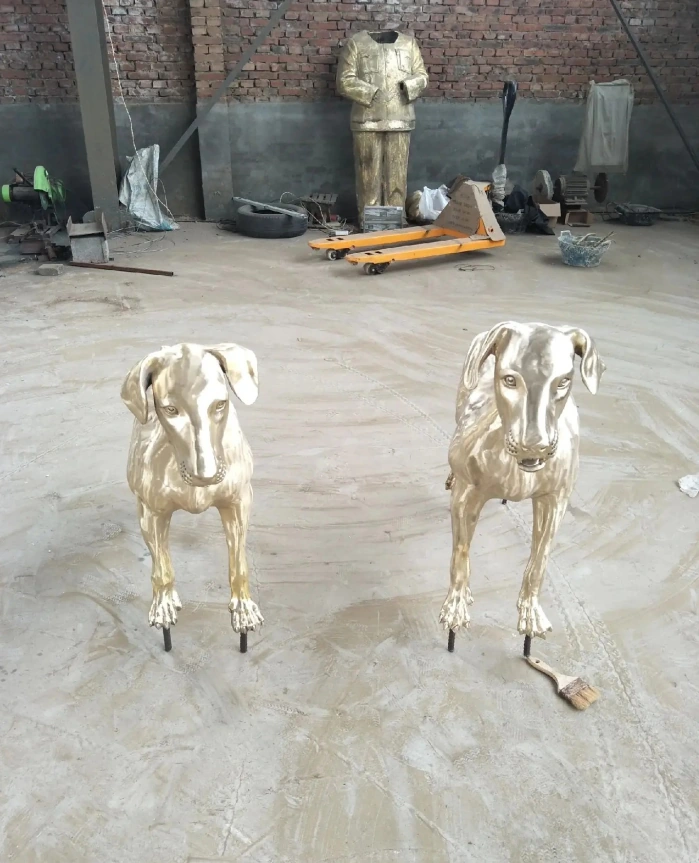
A workshop reference for a paired arrangement
Two standing metal dogs make the shared arrangement visible in this workshop photograph. Use it to discuss how a pair relates in pose and appearance, then develop your Great Danes from the selected references. The material, finish and fixing details belong to the actual proposal; the photographed floor arrangement is not a dimensioned entrance layout.
A tall face or a full standing profile
Standing and seated Great Danes occupy space differently
Standing: show the chest, legs and body line
A standing Great Dane needs room for the full nose-to-tail outline. From the side, the long legs and body proportions are clear. Seen directly from the front, much of that length is hidden, although the sculpture still occupies it.
Choose a calm stance or a more active posture from the reference you like. Confirm each paw position and the tail as part of the model. A lifted paw or extended tail changes the composition and its support design.
At an entrance, decide whether the long axis runs along the wall, along the path or across the approach. That orientation belongs in the dimensional review.
Seated: consider the head height and rear outline
A seated Dane can bring the face into a more vertical composition. The long front legs remain important to the impression, while the gathered hindquarters and tail determine how far it extends behind and beside the chest.
A tall-looking seated image does not establish a smaller footprint. Review the complete rear shape and base, particularly when the piece sits between a wall and a walking route.
View the sculpture from the doorway as well as from outside. An elevated support can change the head’s relationship to the architecture even when the dog itself remains the same size.
Choose the posture before solving the size
If the space is shallow, test the chosen pose and orientation first. Reducing a standing dog enough to fit may produce less presence than a different seated composition. A larger image in the gallery is not automatically the better answer for the site.
For a companion remembered at rest, you can also discuss a reclining design. It should be developed from a useful posture reference and given its own footprint, rather than treated as the seated model lowered onto the ground.
Define what life size includes
Specify a life size Great Dane statue clearly
Choose the individual dog or general reference that defines the scale. A living Dane’s shoulder height is different from the height of a sculpture with its head raised, and neither includes a separate plinth. “Life size” should lead to labelled dimensions of the chosen pose.
| Dimension | What should be shown | Why it matters here |
|---|---|---|
| Figure height | Ground-contact level to the highest point of the chosen figure. | Head angle and ear appearance can change the highest point. |
| Figure length and width | Maximum outside dimensions including the nose, paws and tail. | A side-facing body or inward head turn can project beyond the visible feet. |
| Integral base | Its own length, width and height, with the figure’s placement on it. | The support may extend beyond the dog and use more entrance space. |
| Separate plinth | Its dimensions and the resulting overall installed height. | It affects the face’s relationship to the door, wall and viewer. |
| Combined pair | Both placements, their outer limits and the intended space between them. | Two pieces that fit separately may create an unsuitable central layout. |
Confirm units and measuring axes
Use one unit throughout the proposal or show a clearly identified conversion. On a side-facing dog, label the long nose-to-tail dimension rather than relying on the words width and depth without a reference drawing.
For a pair, obtain the dimensions of each complete placement zone. The two dogs may share a height while their head turns or tails create different outer limits. Keep the model labels consistent with the entrance photograph.
Agree deliberate enlargement as a design choice
An enlarged Great Dane can have a stronger architectural presence, but it also changes the full footprint and handling requirements. State whether the aim is a portrait at your dog’s scale or a larger breed tribute.
Do not enlarge only the legs to gain height. Review the head, body and stance together in the model. If you prefer the original scale, a changed position or support may give the intended presence without changing the dog.
Before approving the size, view temporary height and footprint markers from the normal approach. Include nearby planters, steps and the real door position. The test helps you judge composition; the mounting surface is reviewed separately for the selected piece.
Keep the approach working
Check the doorway, opening arc and passage between the dogs
A frontal image can show two beautifully balanced figures while hiding a conflict with the door, gate or route through them. Mark the complete outline of each dog and support at the actual position before approving the composition.
Measure the opening and the surrounding frontage separately
The width between architectural walls or posts is not always the clear door or gate opening. A sculpture may be placed beside that opening yet project into it when its head or tail turns. Record both the opening and the display area alongside it.
As an illustrative layout calculation, a 300 cm display frontage with two 70 cm placement zones leaves 160 cm between those zones. The placement-zone widths must include the figures’ relevant projections and supports. These numbers are not a recommended clearance, product size or statement that the doorway will work.
Check that remaining space against the actual route and door movement. A doorway offset to one side can create a conflict even when the arithmetic looks generous. The exact placement should be confirmed on the site photograph or plan.
Check the full opening motion
Show whether the door or gate opens inward, outward or along a sliding route. Photograph or mark its moving edge through the opening motion. Include handles and other projecting parts where they affect the proposed sculpture zone.
For a seated dog, the head may be clear while the base conflicts with the moving door at ground level. For a standing one, the tail can extend into an area that looks empty in the front view. Test the complete composition rather than only the centre of each base.
Use the normal approach, not only the formal front view
Walk toward the entrance from the path you actually use. Check which dog’s face you see first and whether its muzzle reads clearly against the background. A visually balanced straight-on pair may need different head turns for an angled approach.
Retain access to the threshold, planting and other entrance features. Include service access where relevant to the property. If the intended pair consumes the useful display area, discuss one well-placed figure or a different pose before changing the scale.
Our front porch dog statue guide covers the broader measurement process. Here the emphasis is on the Great Dane’s tall head, extended profile and two-piece arrangement.
Let the material support the chosen form
Bronze Great Danes, carved marble and simplified steel
Bronze: calm planes and a clear head
Lost-wax cast bronze is our main direction. On a short-coated Dane, broad body planes and restrained surface modelling can describe the chest and legs without covering them in fur marks.
Choose deep dark bronze or gentler warm highlights. For a pair, agree the shared finish reference and compare both pieces together. The metal specification and construction are recorded for the actual project.
Marble: develop a supported carving
The marble concept is a separately designed seated interpretation. Ears close to the cheeks and a tail beside the body can become supported carved forms.
A standing Dane’s longer leg arrangement needs its own stone and support review. Do not assume every bronze pose can be cut unchanged from one block. Select the stone sample with the facial and base treatment.
Stainless steel: a broad, abstract silhouette
The mirror-steel direction retains tall legs, a deep chest and a rectangular head through simplified curves and ear forms. It uses minimal facial detail and plain feet.
Choose it as an abstract breed interpretation. Its fabrication design, grade and finish are confirmed separately. See our stainless steel sculpture options.
Describe the outdoor setting when choosing the surface. Keep access for care, and use our bronze maintenance guide for the fuller care discussion. The German Shepherd page also includes factory photographs for a separate example of our bronze dog work.
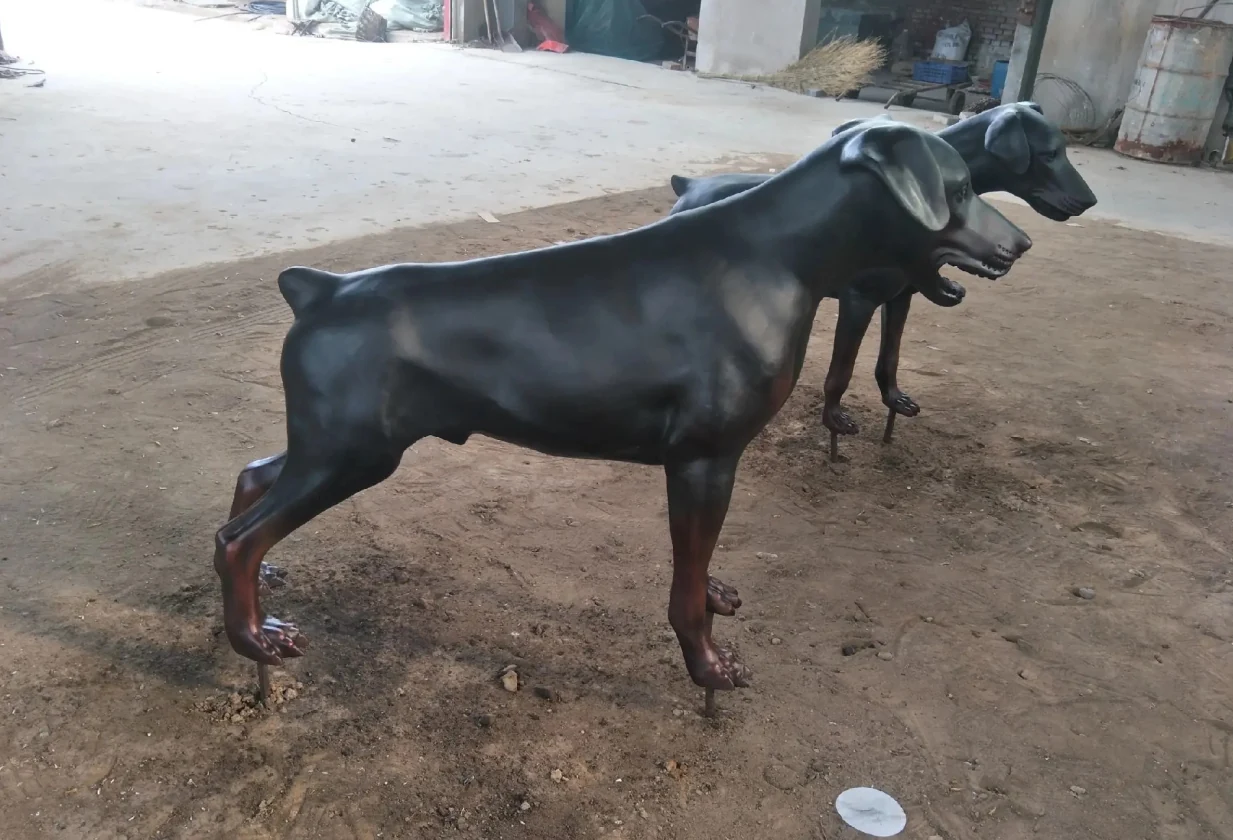
A real dark-surface example
This side view of another dog design shows how a dark surface can let the head, body and leg outline read as a whole. It is useful as an appearance reference while the Great Dane proportions are developed separately. A photograph of the colour does not establish the alloy, treatment or maintenance specification for your commission.
Approve the individual figures and the whole entrance
What to review in a Great Dane model
For a single portrait, review the head and stance against your dog’s references. For a pair, review each figure and then the two-piece arrangement. A correct individual model can still occupy the wrong side or look away from the intended approach.
Check the Dane from useful views
A side view explains the rectangular head, neck and chest-to-leg relationship. A front or three-quarter view helps judge the face width, ear appearance and front paws. Include the rear outline and full tail before confirming the outer dimensions.
If a render makes the legs appear shorter, compare a similar camera viewpoint or request a labelled dimension. Perspective can alter the impression of a tall figure, especially when the camera looks downward.
Check the pair with consistent labels
Use the agreed exterior viewpoint and label each model by placement. Confirm the body direction, head turn and tail of both figures. Review them at the same scale in the combined view.
Keep a record of which differences are intentional. If the brief calls for two portraits, individual features can differ; if it calls for a mirrored composition, the complete reflected relationship needs approval.
Review changes that affect the site layout again
Turning the head farther inward can improve the expression while moving the nose toward the central route. Revising the tail or base can alter the outer footprint. After such a change, confirm the updated dimensions and arrangement rather than retaining an older site sketch.
For an AI reference, identify the pose and ear outline you want kept, then develop the rear and support details that the image does not show. The model and finish reference answer different questions; reflected greenery in a render is not the colour of the bronze.
If a name or inscription belongs on either base, approve the exact wording and placement. For two different dogs, label the text with the corresponding figure so names are not exchanged when the pair is arranged.
Plan for the size that actually arrives
Confirm the sculpture and crate information before delivery
A large Great Dane sculpture can have a suitable display position but a difficult route from the unloading point. Plan both. The bare dog’s dimensions and the packed shipment’s dimensions are different sets of information.
| Item | What to confirm | Who needs it |
|---|---|---|
| Each sculpture | Approved overall dimensions and the confirmed or current estimated net weight, clearly identified. | Your installer or handling team, when planning the piece itself. |
| Each support | Whether the base or plinth arrives attached or separately, with its dimensions and weight. | The team planning assembly and the route to the position. |
| Each shipping crate | Crate count, outside length, width and height, and packed gross weight when available. | The carrier and the team arranging unloading. |
| The property route | Unloading point, surface, narrow gates, overhead limits, steps and turns. | The local team choosing a workable handling approach. |
| Installation scope | Mounting surface, fixing arrangement and who supplies and completes local site work. | You, the workshop and your installer before commitments are final. |
Check turning space as well as the narrowest opening
A crate can pass through a gate yet be difficult to turn in a narrow passage beyond it. Show both the opening and the route after it. For a standing Dane, the shipment’s long dimension may be especially relevant to that change of direction.
Explain whether the local team plans to move the packed crate or handle the sculpture after unpacking. Those approaches use different dimensions and equipment. The plan should be based on the agreed piece and confirmed shipment information.
For a pair, keep the handling records separate
Identify the left and right figure on the packing information using the same labels as the approved composition. If the bases or plinths are separate, identify the corresponding components.
Request shipment figures when they are available; a pre-production weight estimate is not a final packing weight. Delivery to an address does not by itself include unloading, placing the figure or completing its foundations and fixing. Agree those responsibilities in the quotation and local plan.
Questions for a Great Dane commission
Great Dane statue questions
Does a pair mean two identical or two mirrored sculptures?
Specify which arrangement you want. Two matching castings can share the same direction. A coordinated pair uses agreed differences, while a fully mirrored pair requires both reflected models to be reviewed.
How should I describe the left and right dog?
Label one site photograph with the viewpoint, such as outside looking toward the entrance. Use those labels for model approval, packing and placement. Looking outward from indoors reverses the sides.
Can I choose natural dropped ears instead of an upright-ear reference?
Yes. Send the ear appearance and head angle you want represented. For a portrait, your own dog’s photographs guide the shape and any difference between the two ears.
Is a life-size Great Dane sculpture measured at the shoulder?
The reference may use your dog’s scale, but the finished sculpture needs its own maximum height, length and width. A raised head, upright ears and separate support change the overall installed height.
Will a seated dog necessarily use less ground space?
No. Its hindquarters, tail and base still form a complete footprint. Compare the approved outer dimensions with the standing direction at the intended orientation.
Can the heads turn inward while the bodies face visitors?
Yes, that is a design choice to review. State the body direction and head turn separately, then check the combined view and whether the noses project toward the central route.
Can you make portraits of two different Great Danes?
Yes. Provide references for each dog and decide whether to retain their natural difference in scale. Each model’s likeness and the pair’s overall arrangement are reviewed separately.
Can a marble Great Dane use the same standing pose as bronze?
It needs a separate carving assessment. The long legs, ears, tail, selected stone and supporting base must work together. The seated stone concept does not establish that every bronze pose can be copied unchanged.
Do you make a smaller Great Dane figurine?
A smaller custom interpretation can be discussed with its intended size and material. The figurine search term does not mean this gallery contains low-priced shelf items in stock.
What should I check before the large sculpture is delivered?
Confirm the approved figure and support dimensions, current weight information, crate details when available, unloading point and route to the display position. Agree unloading and local installation responsibilities separately.
Start with the entrance and the dog
Discuss your Great Dane sculpture
Send the design you prefer, your own AI idea or photographs of your Dane. Include an entrance photograph if you are choosing a pair; we can work through the pose, orientation and size with you.
You can begin with one image. The remaining measurements can be refined as the proposal develops.
Useful details for this commission
- One figure, coordinated pair or two individual portraits.
- Ear reference, posture, body direction and head turn.
- Approximate figure size and available display area.
- Material, support and any inscription preference.
- Delivery country and postcode, with known access restrictions.