Get in touch with Yun-Sculpture company
Do Pergolas Provide Shade? Plan Around Your Seat & Sun

Garden design · Shade where you actually sit
Yes, pergolas can provide shade. Open bars create a changing pattern; the covering determines how much direct overhead light gets through.
Choose the seat and the hours first. A shady floor or an attractive roof does not tell you whether your face or table will be shaded.
Trace the unwanted light. Light through the top calls for a different response from low sunlight entering an open side.
Do pergolas provide shade where you need it? Picture the chair you use for morning coffee, or the table where you want to eat later in the day. A useful design starts with those positions and times, then works back to the frame and covering.
For ornamental garden architecture, explore Yun Sculpture’s iron gazebo collection and related pergola design references. Use the appearance references alongside the light checks below; a pergola proposal needs its own factory supply assessment.
In this guide
Start with a shade target, not a roof percentage
Write down one activity, its usual hours and the part of the seating area that matters most. You may want the table shaded while keeping a bright edge for planting, or you may care most about direct light reaching your eyes when you lean back. Those are different targets.
Before adding anything, look at the site at the times you plan to use it. Keep the chair in the same place and note what the house, trees and boundary already shade. Photograph from the seat as well as from across the patio. Repeat near the beginning and end of your intended sitting period; one picture can miss the moment when sunlight reaches the chair.
| Visit | Record at the same seat | Useful design question |
|---|---|---|
| Morning use | Date, local time, chair position and side of incoming sunlight. | Is breakfast in direct sun, or already shaded by the house? |
| Middle of the day | Light on the table and your upper body, not only on the paving. | Are overhead gaps the main source of unwanted light? |
| Later use | Where the bright edge reaches the seat as the sitting period continues. | Would an exposed side need attention even with a covered top? |
Earlier · low from one side
The marked target can receive direct sun below the cover edge.
Higher sun · same seat
The cover intercepts the direct ray to the same target.
Later · low from the other side
A different open side can become the path for direct sun.
If the project is for a different season, record that season in the brief. NOAA’s solar glossary distinguishes the sun’s compass direction from its height above the horizon, and explains that both depend on time and location. A roof’s orientation and the season therefore belong in a shade study, alongside the surrounding obstructions.
For a new structure, a site-specific sun study can compare proposed coverage at those chosen times. For an existing one, the observation sheet helps identify whether to test a roof setting, move furniture or investigate an added shade element.
How does a pergola provide shade—and why can the chair still be sunny?
Each opaque member intercepts direct sunlight along the rays that meet it. Gaps between members leave other paths open. Wider or deeper members, different spacing and a rotated layout can change those paths. Looking straight up at the gaps shows only one view of that relationship.
An overhead covering also casts its shadow away from the roof’s vertical outline when sunlight comes in at an angle. The following deliberately uses a continuous opaque cover so the moving shadow is easy to follow. An open-beam pergola would add gaps within that shadow.
60° sun · target shaded
The shadow at target height runs from 0.92 to 3.92 m.
30° sun · target exposed
The shadow at target height runs from 2.77 to 5.77 m.
In this hypothetical section, the target is 1.50 m from the left roof edge and 1.60 m below the cover. With the sun at 60° above the horizon, the near shadow edge shifts about 0.92 m, so the target lies inside it. At 30°, the shift is about 2.77 m and the same target is exposed, even though it has not moved outside the roof outline.
The calculation is horizontal shift = vertical gap ÷ tan(sun elevation): 1.60 ÷ tan(60°) ≈ 0.92 m, and 1.60 ÷ tan(30°) ≈ 2.77 m. It compares direct rays in this section only; it is not a daily coverage percentage or a prediction for the concept image.
What to do with that result: ask for the proposed shadow at the height and position that matter to you. A plan showing the roof perimeter is useful for layout; a timed view or section through the seat answers the light question. If rays pass beneath an edge, simply adding more material to the top may leave the problem untouched.
Should the slats run north–south or east–west?
Neither direction is an automatic winner. Specify the actual location, date range and use times, then compare the proposed member geometry in both directions. Ask the drawing to distinguish the main beams from the smaller shade members: “turn the slats” is ambiguous if several layers cross one another.
When a product advertises a shade percentage, ask what was measured: a material’s light transmission, a geometric roof ratio, or shade on a particular plane at a particular time. Keep the test conditions with the figure. None of those labels alone establishes how long your chosen seat stays out of direct sun.
Choose the change that intercepts the unwanted light
Open members
Keep the sky visible; accept the gaps between shadows.
An opaque overhead layer
Intercept top light across the covered area.
A screen at the exposed side
Address rays entering below the roof edge.
| Approach | Why consider it? | Trade-off to compare |
|---|---|---|
| Open beams or closer fixed shade members | Preserve the overhead rhythm and a view of the sky. | Direct light can pass through gaps; compare the proposed pattern at your sitting times. |
| Fabric canopy or shade cloth | Change the light across an overhead area without choosing a solid opaque roof. | Filtering varies by fabric. Compare replacement, cleaning, tensioning and the permitted weather conditions. |
| Adjustable louvers or a retracting covering | Change the overhead opening as your use changes. | Review both open and covered states, controls and maintenance; they are different mechanisms. |
| Opaque fixed covering | Intercept direct rays through its covered area. | Give up some open sky and light. Low rays may still enter at the sides. |
| Screen, curtain or planted edge | Target a side through which low sunlight reaches the seat. | Compare the view, airflow, access and the actual extent of the shade element. |
| A planted canopy | Make foliage part of the overhead garden experience. | Coverage develops and changes with the plant and season; allow for care and mature growth. |
These are market approaches to compare, not a list of confirmed Yun accessories. A fabric layer, louver system or curtain needs to suit the proposed frame. For the larger choice between open architecture and a roofed gathering place, read Gazebo vs Pavilion vs Pergola.
Keep shade, rain shelter and UV protection separate
A clear cover can keep some overhead rain out while admitting plenty of light. A fabric sold for shade may allow water through; a rain-sheltering design also needs the intended covering, edges and drainage. Decide whether both jobs are required before choosing the system.
Visible shade is not a UV-protection rating. The CDC notes that UV can reflect from surrounding surfaces and recommends other sun protection even in shade. For a fabric or glazing claim, ask for the relevant product information rather than converting a roof opening ratio into a health-protection percentage. This guide does not predict a temperature reduction.
Two hypothetical briefs: similar patio, different decisions
Morning coffee: keep some light
The owner uses one chair for a short period and likes seeing the sky through the framework. The first test is whether a small furniture adjustment uses shade already cast by the house. If direct light still reaches the seat through the top, compare the open frame with one proposed filtering layer at that time.
The goal is selective relief while preserving the bright garden character. A permanently opaque roof could meet the light target while changing more of the atmosphere than the owner wants.
Late-afternoon dining: protect the seated view
The owner wants to leave a table in place for a longer meal. Site photographs show low light entering from one side. Compare the table’s current position with a practical alternative, then test a screen on the incoming-light side while keeping the roof unchanged.
Ask how the screen changes the view from each chair and the route around the table. If the arrangement also needs a covered top, evaluate that addition for its own purpose. Treating every problem as “more roof” can produce an elaborate covering while leaving the diners facing the sun.
Neither brief specifies an accessory or installation size. They establish what should stay the same during comparison: the activity, the relevant seat and the required hours. Change one variable, review the result, then decide whether another intervention is necessary.
Relate the shade idea to the actual frame


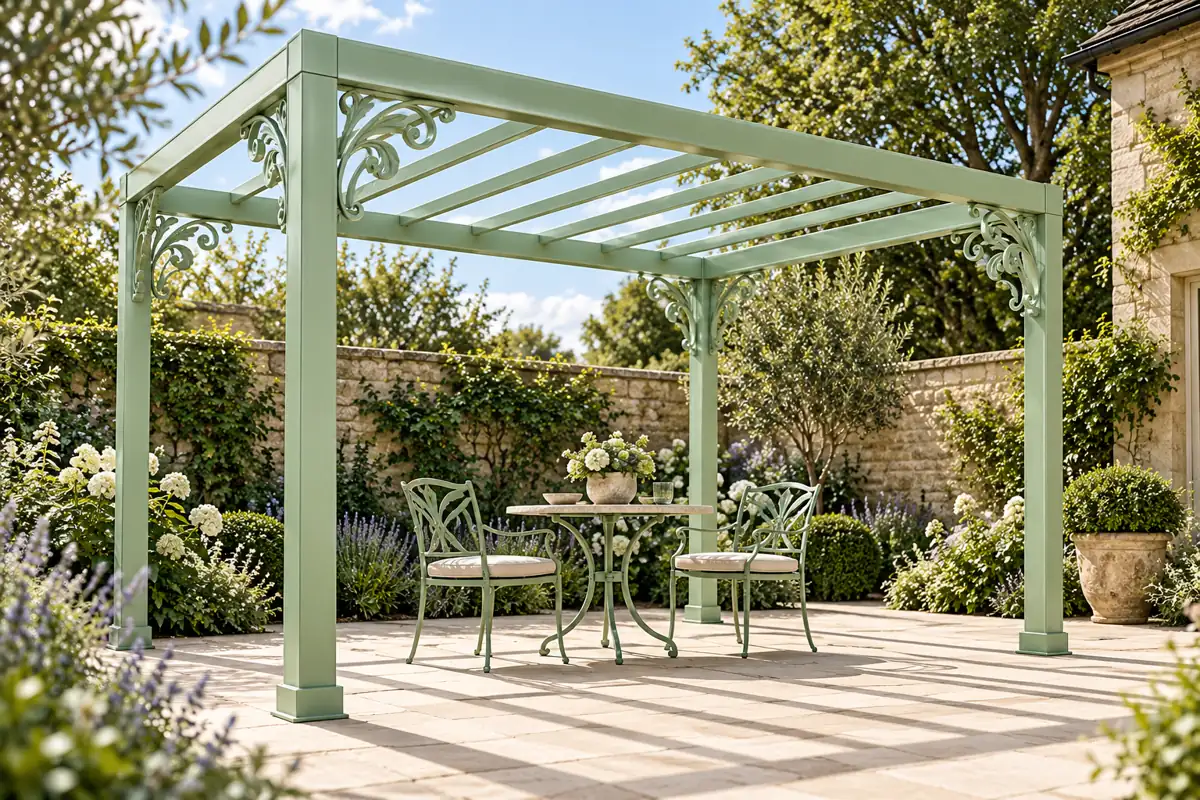
In the full workshop frame, repeated bays and roof members organize the whole structure. In the green detail, broad curved members, smaller scrolls and metal leaf ornament do different visual jobs. These photographs show actual metalwork; they are separate fabrication references, not stages of the pergola concept.
When describing a canopy or screen, mark where it is intended to meet the frame. A decorative curl is a visible motif, not an automatically approved tie point. The proposed connections, support members and supplied components should be identified together, so the covering is not left to be improvised around finished ornament.
Planting adds a different long-term relationship. Decide where it will start, which areas it may cover and how someone will reach it for training and pruning. Keep growth clear of moving roof parts and serviceable drainage. A separate support may be worth comparing when you want greenery beside the seating without training it onto the roof.
The local project team and supplier resolve the actual frame, wind and weather-use conditions, anchoring and any electrical work. The existing installation overview introduces the site-planning topic; its general examples do not replace the design for a modified or newly covered frame.
Questions about pergola shade
How much shade does a pergola actually provide?
There is no single percentage for every pergola and every seat. Compare the covering, member geometry, sun direction and height, and the target position at your use times. The fixed-seat example shows why a roof outline is not enough.
How can I provide more shade on a pergola?
Locate the incoming light first. Test the available roof settings or furniture position, then compare a compatible overhead layer for light through the top or a screen for side light. Use the coverage comparison.
What is the cheapest way to cover a pergola for shade?
There is no verified cheapest option for every site. First see whether moving furniture or using an existing adjustment solves the problem. For an added cover, compare the installed scope, including support, fixing, weather operation and replacement, rather than fabric price alone. The garden-architecture cost overview is a separate budget discussion, not a quote for a shade accessory.
Will closing a pergola roof shade the seat all day?
It changes overhead coverage, but low sun may still enter through open sides. Compare the proposed covering at the beginning and end of your sitting period and in the season that matters. Start with the observation sheet.