Get in touch with Yun-Sculpture company
How to Decorate a Gazebo for a Wedding: Flowers & Draping

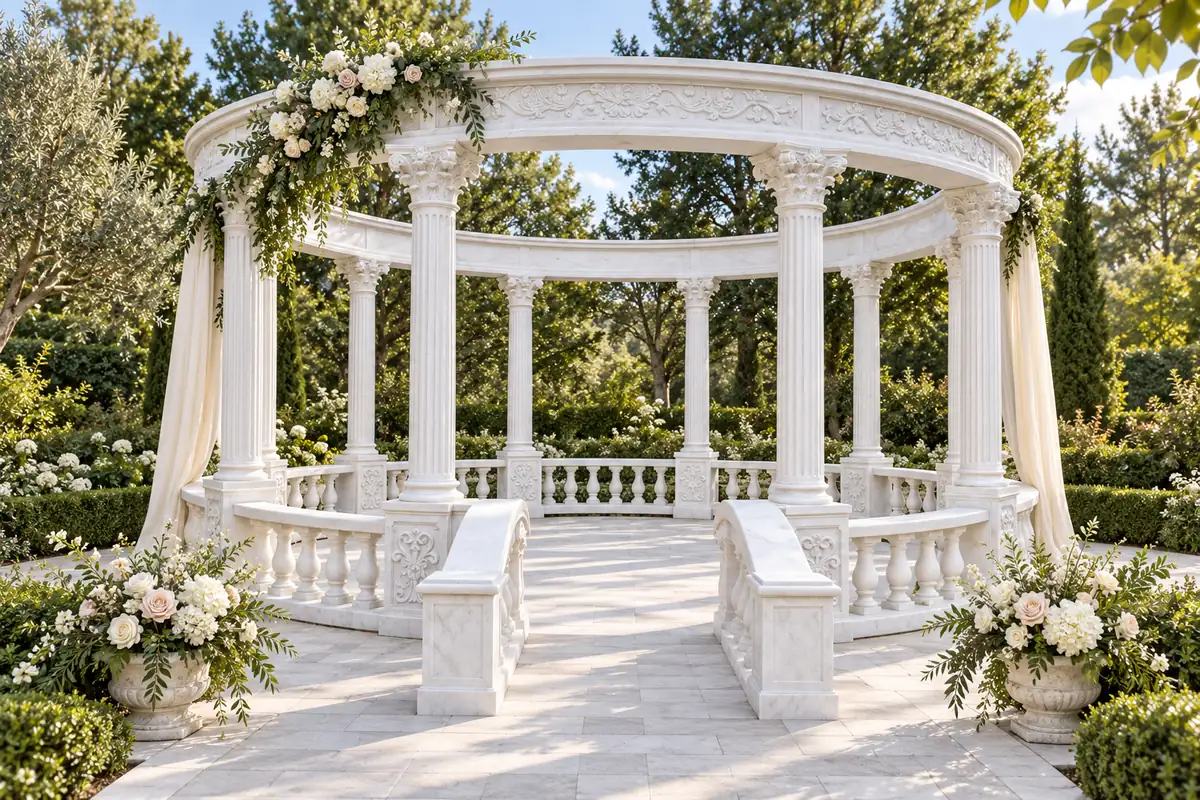
Wedding design · Frame the people, reveal the architecture
Place the people first. Mark the couple, officiant and entrance, then check the view from the center and outer guest seats.
Choose one leading treatment. Let flowers, fabric or the gazebo’s own carving carry the composition; the other elements can stay quieter.
Separate the design from its installation. Agree the decoration positions, surface protection and responsibilities with the venue and the relevant suppliers.
Knowing how to decorate a gazebo for a wedding starts with the scene around the couple. Focus on where flowers and fabric will draw attention, what guests will still see, and how the wedding party will arrive.
Yun Sculpture’s marble and stone gazebos and ornamental iron gazebo designs provide different architectural starting points. This guide deals with temporary ceremony styling around the selected structure; flowers, drapery and lighting are separate items to identify in the event brief.
In this guide
Plan the ceremony before choosing the flowers
Mark where the couple will stand, where the officiant will be and which opening will serve as the entrance. Add any signing table, chairs or other objects required by the ceremony. Keep those positions in the sketch while comparing decoration, so an attractive new arrangement does not quietly displace the people it was meant to frame.
Check the view from a center seat, an outer seat and a seat farther back. Ask two people to stand at the proposed positions while someone looks from those places. A tall floral arrangement can look beautifully balanced from the aisle while hiding one person from a side row. A broad curtain behind the couple may clean up the background but also conceal carving you wanted in the photograph.
A · The selected view is crossed
The flower group sits on the dashed viewing line.
B · The selected view is opened
The same flower group moves; people, seats and outline stay fixed.
In the hypothetical plan, the people, seats and gazebo outline stay fixed. A moves a floral mass onto the side guest’s line toward the couple. B moves that same mass out of the marked viewing line. This does not prove that B works from every seat: it shows how to test a position before increasing the amount of decoration.
Carry that check through the entrance. Walk the approach with the people and items that will use it, including a dress or train, attendants and any mobility aids. Put floor arrangements and gathered fabric on the sketch at their actual extent. A low display can still interrupt the route even when it does not hide anyone’s face.
Give the photographer room to discuss the intended angles as well. A photographer may be able to move around a floral cluster; a seated guest may have no comparable choice. Treat the guest view and the photograph as related checks rather than assuming a good center photograph settles both.
Three ways to decorate the same gazebo
Start with one architectural elevation and compare a few decoration placements on it. The following studies keep the frame, viewpoint, people and palette the same. Only the floral and fabric treatment changes. They are appearance studies: the drawings do not detail fastenings or approve hanging positions.
A · Low flowers
Keep the upper band and the center visible.
B · One floral accent
Concentrate detail at one upper corner.
C · Gathered side fabric
Change the edge of the scene; keep the center open.
| Treatment | What it emphasizes | What to compare next |
|---|---|---|
| Low flowers, visible architecture | The couple, the columns and the open center remain the main picture. | Check that containers stay outside the approach and remain visible from the guest rows. Low placement does not automatically make an arrangement unobtrusive. |
| One asymmetric floral accent | A stronger focal point at one part of the frame, with a quieter opposite edge. | Compare the accent from both side rows. A cluster that looks small on a wide photograph may feel close to a face in the tighter ceremony view. |
| Gathered side fabric with restrained flowers | A softer boundary around the ceremony while leaving the middle open. | Decide which columns should stay visible, where the fabric ends and how its movement will be managed. |
If the gazebo already has figure columns or deep relief, begin with the first treatment. It gives the carving room to be seen. For a quieter frame, a concentrated floral accent may become the detail people notice. Fabric is useful when you want a different edge or background, but compare what it hides as carefully as what it adds. These are design starting points, not rules for every venue.
Choose flowers, draping and light for different jobs
Flowers: compare placement before quantity
Choose the area that needs emphasis: the entrance, one upper corner, the standing area or the approach. Then look at the proposed display as a whole, including its container, support and any trailing greenery. A sketch that shows only the flower heads can underestimate both the visual mass and the space taken at floor level.
Ask the florist to distinguish fresh flowers, foliage, artificial elements and their supporting containers. For a suspended proposal, include the weight of the completed arrangement and any water supply, not just a list of stems. The information supports a project review; it does not establish that the proposed point on the gazebo is suitable.
Compare the palette against the actual structure. Ivory fabric and white flowers may merge into pale stone; a little foliage or a different flower tone can define the edge without covering more of the carving. Dark metal can make a pale floral group stand out strongly, so compare its shape before adding further clusters.
When working within a decoration budget, compare where the display is seen. One carefully placed group may serve the main ceremony view better than small groups on every column. Ask what setup, containers, transport and removal are included before comparing flower prices alone. Moving a ceremony display to the reception is a separate handling job to agree, not an automatic saving.
Fabric: choose the view it changes
A rear panel changes the background behind the couple. Side panels change the edge of the frame. A swag across the front changes the shape and apparent height of the opening. Sketch those effects separately rather than choosing a fabric by color and then wrapping every available member.
Look at a sample against the gazebo in the intended light. A translucent fabric may reveal the trees, guests or architecture behind it; a denser fabric can create a more continuous field. Decide which effect you want. The name “tulle,” “voile” or “organza” alone does not tell you exactly how a particular product will look or behave outdoors.
Measure the intended draping route, drop and gathered positions rather than buying fabric from the gazebo’s nominal outside width. Mark where each end will finish. For this ceremony, a neat end outside the arrival route may be more useful than a long pool of cloth on the paving.
Lighting: decide whether you want to see faces, flowers or the frame
These are different lighting goals. A string that outlines the roof may make the architecture legible without giving the couple suitable light. Ask the photographer and event lighting supplier to compare the actual ceremony positions at the intended time, especially when the background is much brighter than the people.
Keep fixture selection, cable routes, power and installation in the lighting supplier’s brief. Do not assume the florist’s supports also accept lights, or that a decorative lantern includes a suitable light source. If a candle effect is wanted, a flameless version is one option to discuss with the venue; any open-flame proposal needs the venue’s specific permission and controls. Detailed electrical layout belongs to the separate lighting plan.
Let the real workmanship help you choose what to leave visible
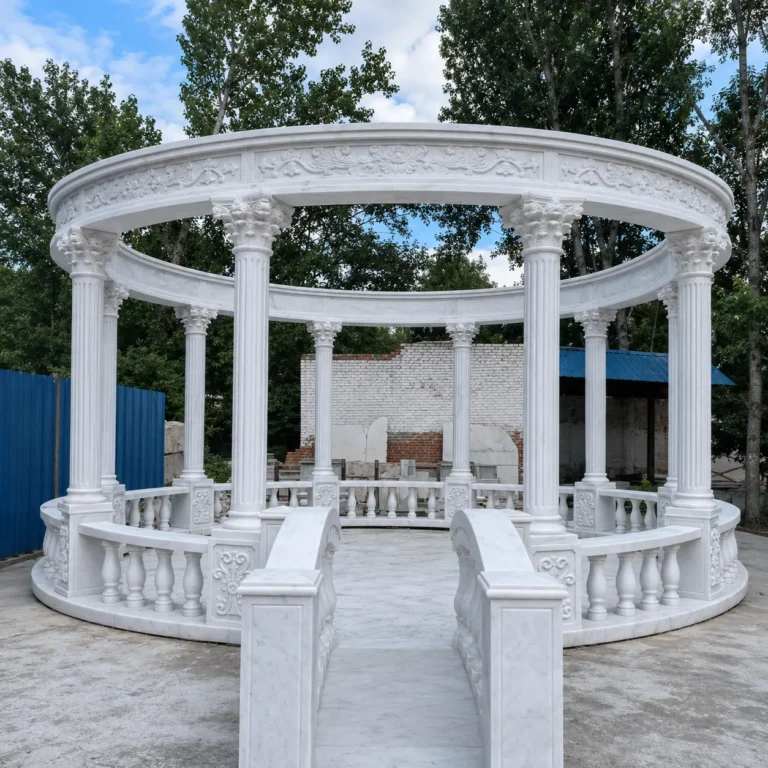
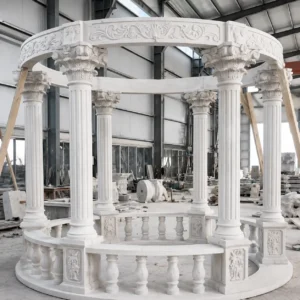
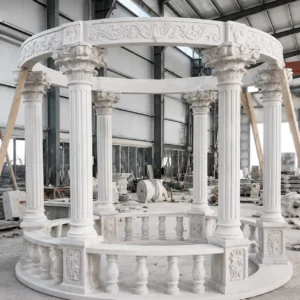
The factory photograph shows a clear approach between low stone railings, opening into the circular interior. The entrance already has a visual frame. Placing additional flowers on both edges is one choice, but the containers must be drawn beside the approach rather than assumed to fit within it.
Look upward as well: the carved band and capitals provide detail before any wedding flowers are added. You could keep that band visible and concentrate color lower down, or choose one floral accent that follows part of the curve. The opening concept applies those choices to a similar broad entrance and carved ring.
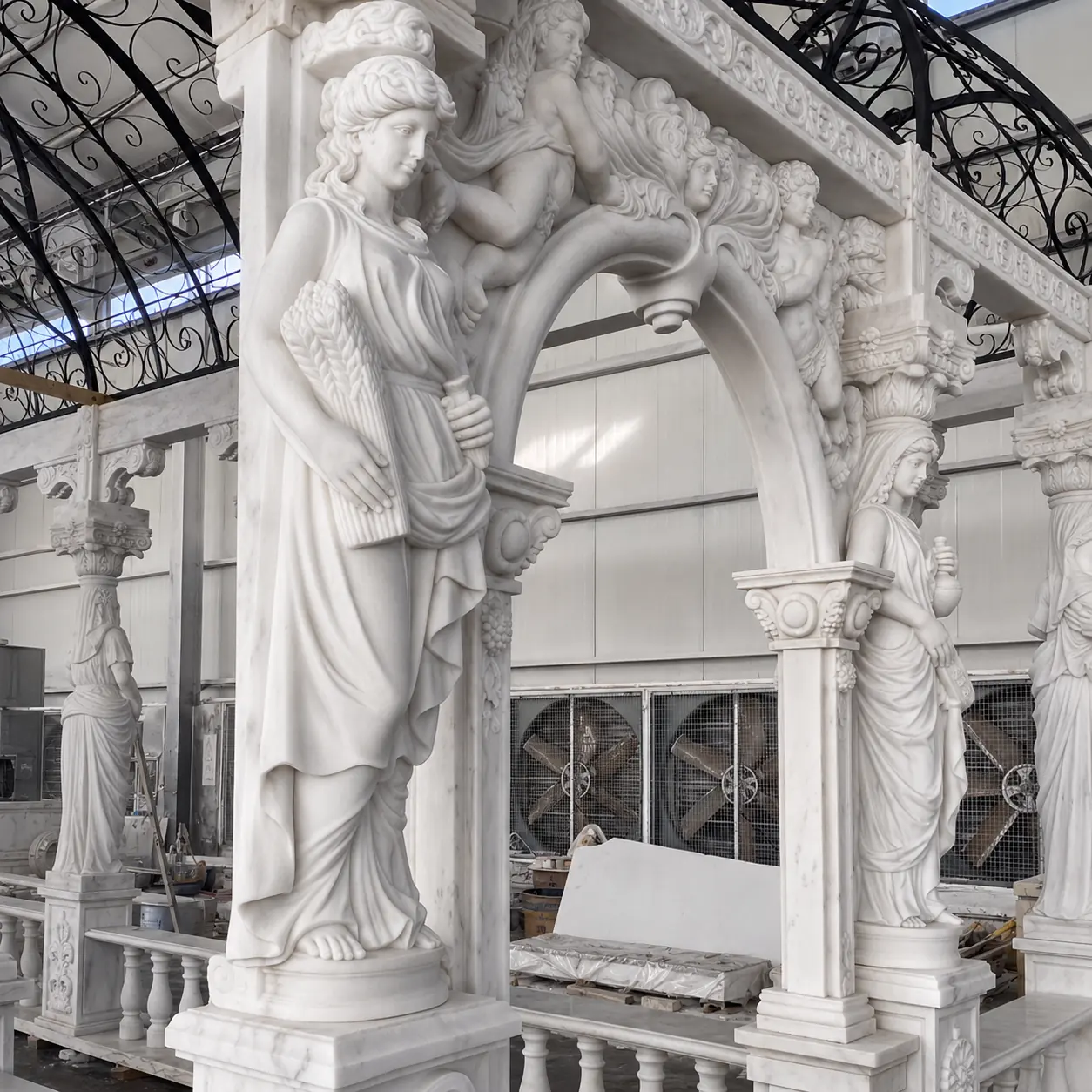
In the separate stone-carving reference, figures, leaves, relief panels and the arch edge already form a dense composition. Compare a small floral group beside that detail with fabric covering the whole figure. The first approach lets the sculpted face and hands remain subjects in their own right; the second makes a different, more continuous backdrop.
The two stone photographs document different reference assemblies. Together they show how ordinary columns and carved figures create different places for decoration; their project identities remain separate.

The green workshop panel shows broad curved members, smaller scrolls and leaf ornament at different depths. That distinction matters in a decoration brief. Mark which part a proposed fixing would touch instead of describing the whole area as “the ironwork.” A small decorative leaf and a main frame member are not interchangeable locations to assume for a support.
The close view helps you name the intended contact precisely. Use the selected design’s drawings and finish information to take that observation into a fixing discussion; color alone does not identify the metal grade or coating.
How to hang curtains on a metal gazebo: start with the fixing brief
First identify whether the selected gazebo has an intended curtain track, designated fixing points or another arrangement approved for the proposed use. If it does, obtain the instructions and limits for that exact system. If it does not, describe the desired fabric position to the venue, structure supplier and decorator before choosing hardware.
Ask for these details together
- The complete item: fabric or flowers, containers and supporting parts.
- The proposed area: front view, exact member and a close-up.
- The surface: actual material, finish and agreed contact protection.
- The event use: outdoor conditions, operating plan and responsible installer.
- The removal: who takes it down, when, and how the finish is left clean.
The sketch highlights information to exchange, not an installation detail. State the fabric or floral item, its proposed location, the part it would contact and the intended period of use. The responsible suppliers then assess the support, contact protection, outdoor conditions and removal method together.
- On stone: identify the stone and finish, projecting carving, joints and the area a container or fixing might touch. Agree how wet floral materials, metal containers and residue will be kept from marking the surface.
- On coated metal: identify the actual member, finish and proposed contact. Describe whether a fixing could rub, pinch or require a hole; do not assume a soft-looking tie or a “removable” adhesive is suitable for that finish.
- On a separate decoration frame: include the complete support and its floor position in the ceremony plan. It still needs the appropriate stability and venue review, and must not quietly occupy the entrance.
The Natural Stone Institute’s care guidance notes that stone care depends on the material and that organic matter and metals can cause staining. For a wedding setup, that is a reason to agree protection and cleanup in advance, rather than improvising stain removal after the event.
Have the venue and decoration team agree the outdoor operating and change-of-plan decisions for fabric and suspended displays. An open top, floral arrangement or drape is not a rain shelter. If weather cover is required, compare an appropriate covered structure or separate event provision; the gazebo, pavilion and pergola comparison explains the architectural distinction. Permanent supports, foundation and site installation are separate from temporary wedding styling; see the gazebo installation overview for that part of the project.
Give the factory, florist and venue one shared decoration plan
A reference image becomes useful when everyone can see what is permanent, what is temporary and who supplies each part. Mark decoration groups on a front view and show floor objects on the ceremony plan. Add a close-up wherever a proposed contact needs discussion.
| Part of the plan | Information to record | Who needs to agree it? |
|---|---|---|
| Permanent gazebo | Selected design, dimensions, opening, finish and any expressly included decoration provisions. | Buyer, gazebo supplier and local project team. |
| Flowers and fabric | Positions, complete items and supports, water-containing elements, fabric ends and visual samples. | Florist or decorator, buyer and venue; structure supplier for proposed frame contact. |
| People and routes | Standing positions, guest views, approach and any separate display frames. | Couple or planner, venue and photographer. |
| Lighting | Lighting goal, equipment, installation, power and cable route. | Event lighting supplier and venue, coordinated with the photographer and decorator. |
| Event changes and removal | Who checks conditions, changes or removes displays, protects surfaces and completes cleanup. | Named venue and decoration contacts, with relevant supplier instructions. |
The garden-architecture cost overview is a separate discussion of project scope. For this event, list structure, delivery and site work separately from flowers, fabric, lighting and their setup or removal. Write the supplier beside each pictured element so the scope stays clear.
For an existing venue gazebo, begin with its owner’s information and decoration permissions. For a new Yun gazebo, bring the proposed wedding styling into the design discussion early so that its requirements can be reviewed alongside the architecture. Neither route needs an assumed universal hanging capacity or a standard clamp recommendation.
Questions about wedding gazebo decoration
What are some good decorations for a gazebo at a wedding?
Compare low flowers, a concentrated floral accent and gathered side fabric against the same ceremony view. Choose what frames the couple while leaving the entrance and intended views clear. See the three-treatment comparison.
How can I decorate a gazebo for a wedding ceremony without hiding the carving?
Begin with the visible architecture and choose the detail you want to retain. Keep flowers or fabric to selected areas rather than covering every column. The factory photographs show why the capitals, figures and relief deserve their own space.
How do I hang gazebo curtains if there is no existing track?
Describe the intended location to the structure supplier, venue and decorator. They need to assess the actual members, finish, fabric, support and operating conditions before selecting a system. Use the fixing brief; the decorative scrolls are not assumed hanging points.
Can the same gazebo decoration work for the ceremony and reception?
It may, but the arrangement must serve both uses. Recheck furniture, arrival routes, light and who will move or maintain the displays. Keep any transfer and removal work in the shared event plan rather than assuming it is included.