Get in touch with Yun-Sculpture company
Rays of Mercy in Bronze and Marble: The Ultimate Guide to Custom Divine Mercy Statues

Father Emmanuel Reyes had buried eleven members of his congregation after Typhoon Hainan passed through Leyte in November 2013. When the rebuilding began, the first object his parish committee voted to replace was the Divine Mercy statue that had stood at the entrance of their chapel — a painted resin figure, imported from a Manila wholesale supplier, that the storm had reduced to fragments of colored plastic across the flooded courtyard.
The committee’s second vote was more deliberate. They would not replace it with another resin piece.
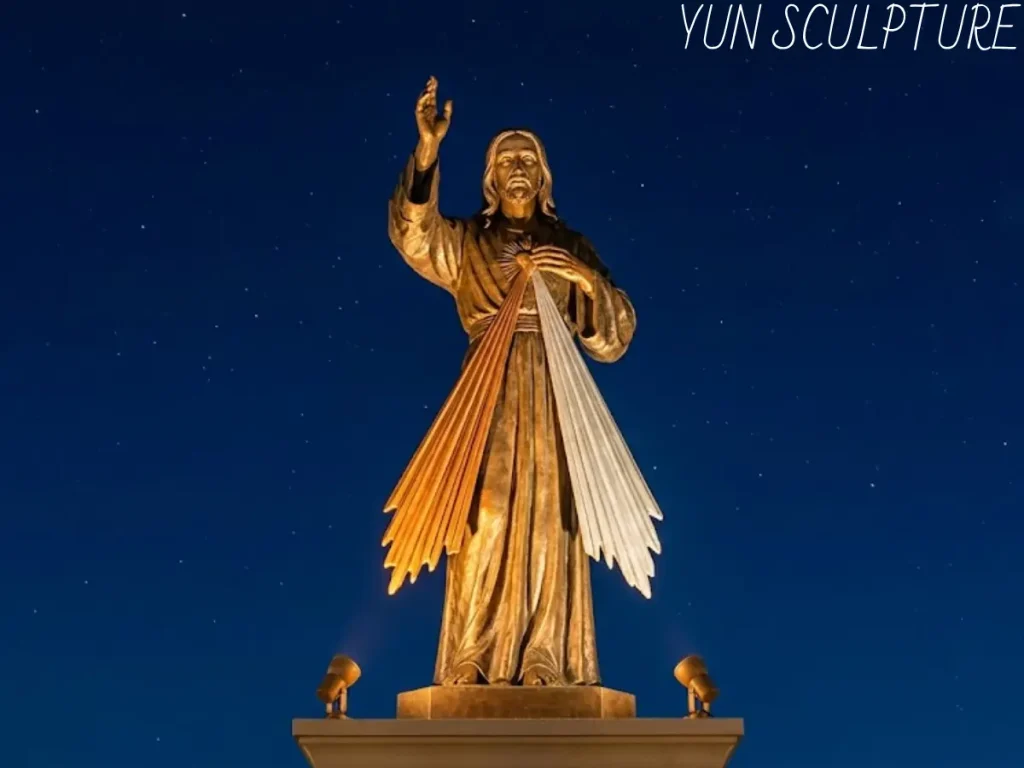
What they commissioned instead took six months to produce and arrived in a timber crate weighing 340 kilograms. It was cast in Grade A Foundry Bronze, the rays emerging from the chest rendered in permanent chemical patination — deep oxide red on the left, pale silver-gold on the right. It was installed on a reinforced concrete foundation engineered for wind loads exceeding 250 kilometers per hour.

Three typhoons have passed through that province since the installation. The statue has not moved.
This is the calculation that brings serious clients to a professional foundry. A divine mercy jesus statue placed at the entrance of a parish, a pilgrimage chapel, or a memorial garden is not a devotional accessory. It is a permanent architectural commitment — one that must survive the climate, the decades, and the accumulated prayers of every generation that will stand before it.
The statue of divine mercy is, after the crucifix, the most widely commissioned sacred image in the contemporary Catholic world. It appears in parishes from Manila to São Paulo, from Lagos to Chicago. Yet the overwhelming majority of these installations are produced in resin, fiberglass, or painted concrete — materials that carry the image but cannot carry the weight of permanence that the image itself demands.
A jesus divine mercy statue built in bronze or marble is a different category of object entirely. It is built to the standard the vision itself requires.
Table of Contents
Table of Contents
The Vision of St. Faustina — The Iconographic Blueprint
Every commission for a divine mercy statue begins with the same source document: the diary of Saint Maria Faustina Kowalska, a Polish nun of the Congregation of the Sisters of Our Lady of Mercy, who recorded a series of mystical visions in the 1930s that would ultimately transform the devotional landscape of global Catholicism.
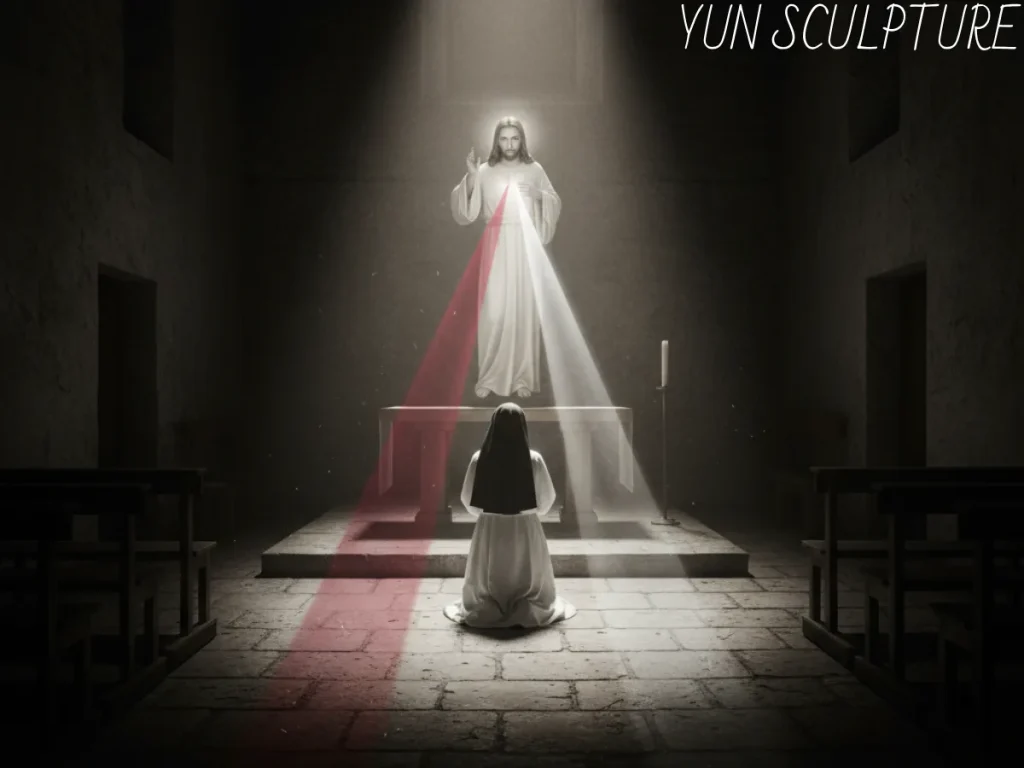
The specific vision that gave rise to the image occurred on February 22, 1931, in the convent at Płock, Poland. Sister Faustina described Christ appearing to her in white garments, his right hand raised in blessing, his left hand drawing back the garment at the chest. From the area of the heart, two rays of light emanated — one red, one white — extending outward toward the viewer.
The theological content of the rays was not left to interpretation. Christ himself, in Faustina’s account, provided the precise meaning: the red ray represents the blood of Christ — the souls of humanity, the living stream of redemption. The white ray represents the water that flowed from his pierced side at the lance of Longinus — the waters of Baptism, the grace that justifies and sanctifies. The image is not allegory. It is a precise theological diagram rendered in the language of vision.
The instruction Faustina recorded was equally precise: “I want this image to be venerated throughout the world.” And below the image, in whatever language the faithful speak: Jezu, ufam Tobie. Jesus, I trust in You.
The Iconographic Standard — What Every Commission Must Honor
The first painted realization of the vision was executed in 1934 by the artist Eugeniusz Kazimirowski, working under Faustina’s direct supervision and the theological direction of her confessor, Blessed Michał Sopoćko, in Vilnius, Lithuania. This painting — now preserved in the Church of the Holy Spirit in Vilnius — is the primary iconographic reference for all subsequent representations, including sculpture.
Several elements of this original are non-negotiable in faithful reproductions:
The right hand. Raised in the gesture of blessing — two fingers extended, the remaining fingers gathered — at approximately chest height. Not raised above the head in triumph, not extended outward in the manner of the Risen Christ. The gesture is sacerdotal: the blessing of a priest over a congregation.
The left hand. Drawing back the white garment at the chest, directing the viewer’s attention to the source of the rays. The gesture is intimate and deliberate — an act of self-disclosure, not display.
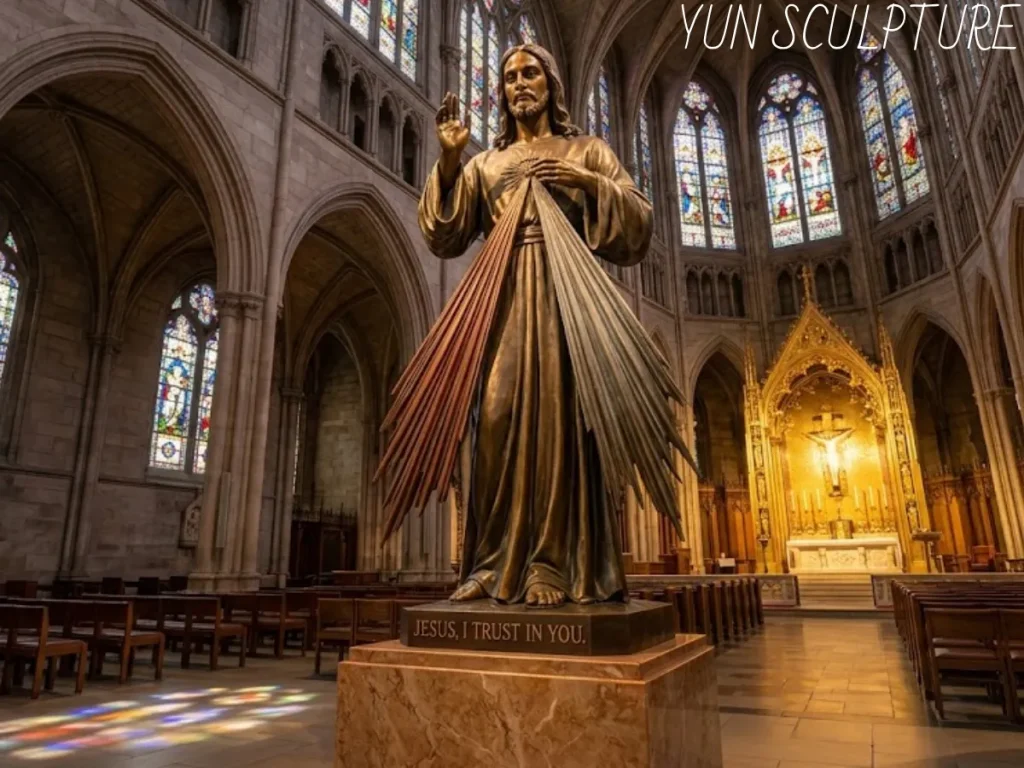
The rays. Originating from the area of the heart, they do not radiate in all directions. They extend forward, toward the viewer — directional, intentional, specific. In sculpture, the translation of this two-dimensional directional light into three-dimensional form is among the most significant artistic and engineering challenges the commission presents.
The inscription. Jesus, I Trust in You appears below the figure in the primary language of the commissioning community. Filipino parishes frequently request the Tagalog: Hesus, nagtitiwala ako sa Iyo. Polish communities specify the original. American commissions almost universally request English. We have produced the inscription in fourteen languages to date. The letterform, scale, and placement relative to the figure base follow a proportional standard we have refined across many commissions.
The posture. The figure stands in a slight forward inclination — not the sovereign erectness of the Risen Christ, not the bowed weight of the crucified corpus. Christ in the Divine Mercy image leans, almost imperceptibly, toward the one who stands before it. The posture is approach. It is the posture of mercy extended rather than mercy enthroned.
A st faustina divine mercy statue that honors these specifications is not simply an attractive religious object. It is a theologically precise instrument — one that carries the full weight of the vision that produced it, and that directs the prayer of every person who stands before it toward the exact reality the vision intended to convey.
Every detail we model in clay, we model against this standard. Every detail we cast in bronze, we cast against this standard.
The vision was specific. The sculpture must be equally so.
Global Landmarks of Divine Mercy: A Study in Scale and Material
To understand where the divine mercy statue stands in the history of sacred art, you must first understand the geography of its proliferation. In less than a century, a vision recorded by a Polish nun in a provincial convent has produced one of the most widely replicated sacred images in the history of Christianity. The landmarks that anchor this devotional geography tell us something essential — about faith, about scale, and about the consequences of material choice.
Płock and Vilnius — The Origin Points
The city of Płock, in central Poland, is where the vision occurred in 1931. The convent chapel where Sister Faustina knelt on the night of February 22nd still stands. It is not a grand pilgrimage basilica — it is a modest institutional chapel, and the intimacy of the space is itself instructive. The image that would eventually be reproduced on every continent began in a room that holds perhaps forty people.
Vilnius, Lithuania, is where the image first became visible to the world. The Kazimirowski painting, completed in 1934 under Faustina’s direct supervision, hung initially in the Gate of Dawn chapel. It now resides in the Church of the Holy Spirit on Aušros Vartų Street — a painting of modest dimensions that has functioned, for ninety years, as the master reference document for every sculptor, painter, and craftsman who has attempted to render the vision in permanent form.
Both origin sites are pilgrimage destinations. Neither is defined by monumental outdoor sculpture. They are defined by intimacy, by proximity to the original vision. This matters for understanding what the larger landmark commissions are attempting to do: they are taking an image born in private mystical encounter and translating it into the language of public civic declaration.
The Philippines — Where Devotion Becomes Infrastructure
No country on earth has embraced the divine mercy statue with the intensity of the Philippines. The reasons are theological, historical, and cultural simultaneously: a deeply Catholic population, a Marian and Christocentric devotional tradition, and a geographic exposure to typhoons that has made the question of permanent sacred structures an existential one rather than an aesthetic preference.
The outdoor divine mercy statue philippines installations that have proliferated across the archipelago — in Cebu, in Davao, in the provinces of Leyte and Samar that bear the most direct exposure to Pacific typhoon tracks — represent the full spectrum of material choices and their consequences. Painted concrete figures installed in the 1990s show the characteristic surface cracking and color loss of that material in tropical humidity. Fiberglass pieces from the early 2000s have fared marginally better in terms of surface integrity but suffer from UV degradation that strips color within a decade. The bronze installations, where they exist, show none of these failure modes.
The Philippine market has arrived, through decades of costly experience, at the same conclusion our engineering department reaches through calculation: for a divine mercy outdoor statue in a tropical typhoon-exposure environment, bronze is not the premium option. It is the only rational option.
The Pattern These Landmarks Reveal
The installations built in stone and bronze do not share this trajectory. They do not require color restoration because their surface treatment is not applied color — it is the metal itself, or the stone itself, altered by chemistry and time into forms of beauty that deepen rather than diminish with age.
Our clients who commission divine mercy statues for sale as permanent outdoor installations are not paying a premium for aesthetics. They are paying the actual cost of permanence — and avoiding the compounding cost of a material that cannot deliver what it promises.
Casting the Rays: Bronze Patination vs. Marble Carving
The most technically distinctive feature of the jesus divine mercy statue — the element that separates it from every other sacred image in the Catholic devotional canon — is the rays.
Two beams of directional light, one red and one white, emanating from the chest of the standing figure. In a painting, the solution is immediate: pigment on canvas, applied in two colors, rendered with whatever technique the painter commands. In a three-dimensional bronze or marble sculpture, the problem is entirely different, and the solution requires a different kind of expertise.
This is the question every serious foundry must answer before the first gram of clay is touched: How do you cast light?
The Bronze Solution — Chemical Patination as Permanent Color
Bronze is, in its natural state, a single color — the warm gold of the copper-tin alloy before oxidation begins. The risen christ bronze statue and the bronze crucifix statue we have discussed in our companion guides both use patination primarily as a tonal treatment: darker in recesses, warmer on raised surfaces, unified in color family across the entire figure.
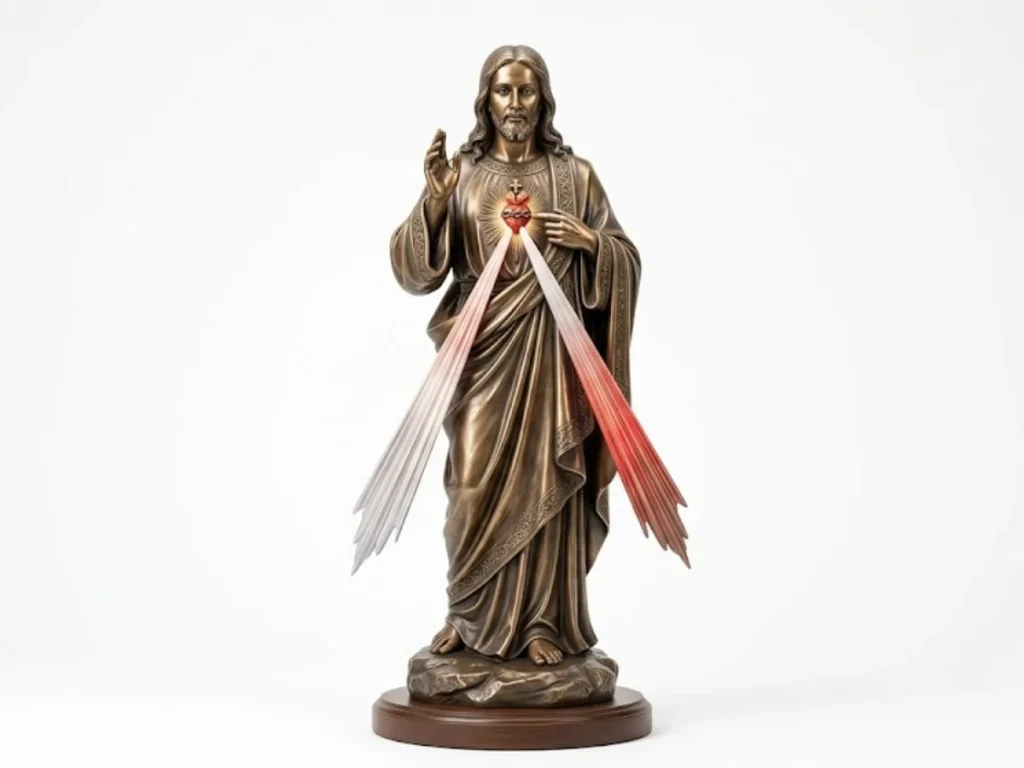
The divine mercy statue presents a categorically different requirement. The rays must be distinguishable from each other and from the surrounding figure. Red and white — or more precisely, the bronze equivalents of red and white — must be achieved through the chemistry of the metal surface itself, not through applied paint that will peel, fade, or require periodic reapplication.
Our patination process for Divine Mercy commissions uses a multi-compound chemical sequence:
For the red ray: Ferric nitrate solution, applied in controlled heat cycles to the prepared bronze surface of the ray elements. Ferric nitrate reacts with the copper in the bronze alloy to produce a stable reddish-brown oxide layer — warm, deep, and permanent. Multiple application cycles build the color to the required depth. The final tone reads as a rich, dark red-brown in full daylight and as deep amber in candlelight — a chromatic quality that no applied paint can replicate.
For the white ray: A combination of tin-based patination compounds produces a pale, silvered surface on the bronze — cooler in tone, lighter in value, visually distinct from both the red ray and the surrounding statuary brown of the figure and robes. In certain lighting conditions, particularly direct sunlight, this surface carries a quality of luminosity that reinforces the theological content of the ray: the white ray as water, as light, as the grace that purifies.
For the figure: The standard statuary brown to deep verde antique patina treatment used across our full range of sacred commissions — warm and grounded, providing the visual contrast against which both rays read with maximum clarity.
The three-patina system requires precise masking during application — each zone treated independently, the boundaries between zones resolved by hand using detail brushes and fine chasing tools. A Divine Mercy commission in bronze requires approximately 40 percent more patination labor than a comparable figure without the ray color requirement. This is reflected in our commission timeline and pricing.
The result is a surface treatment that requires no color maintenance across the life of the installation. The patina is not on the bronze. It is the bronze, chemically altered. It will not peel. It will not fade. It will, over decades, continue to develop in depth and complexity — each passing year adding a layer of visual history to the surface of the figure.
The Marble Solution — Carved Light and Natural Translucency
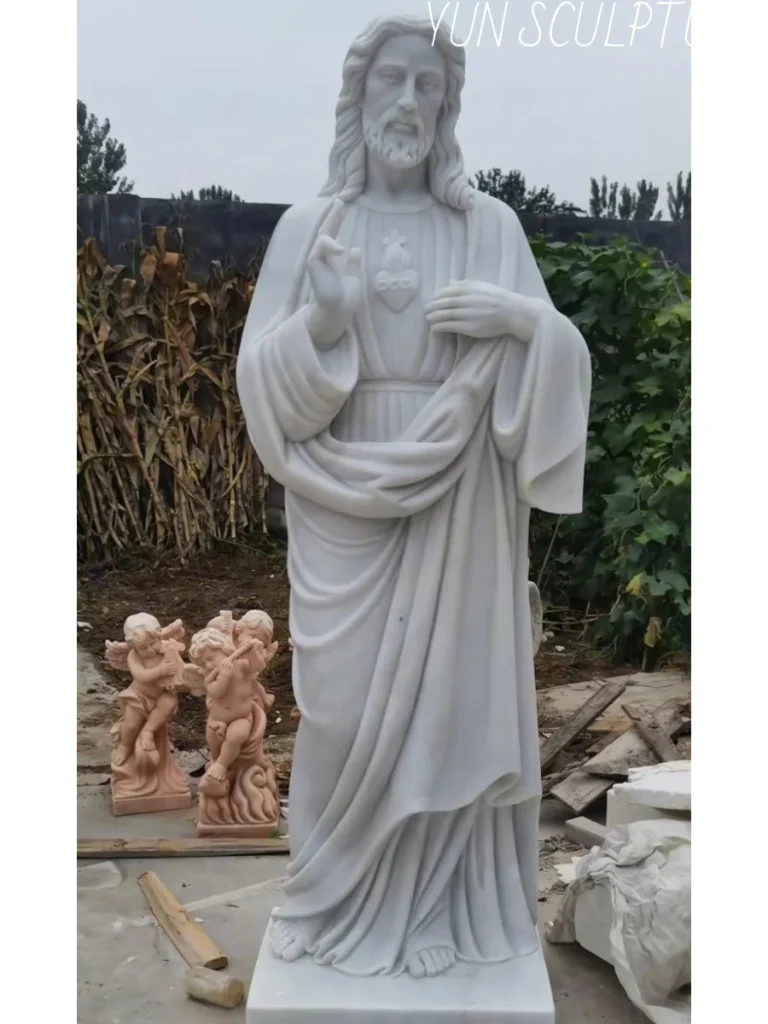
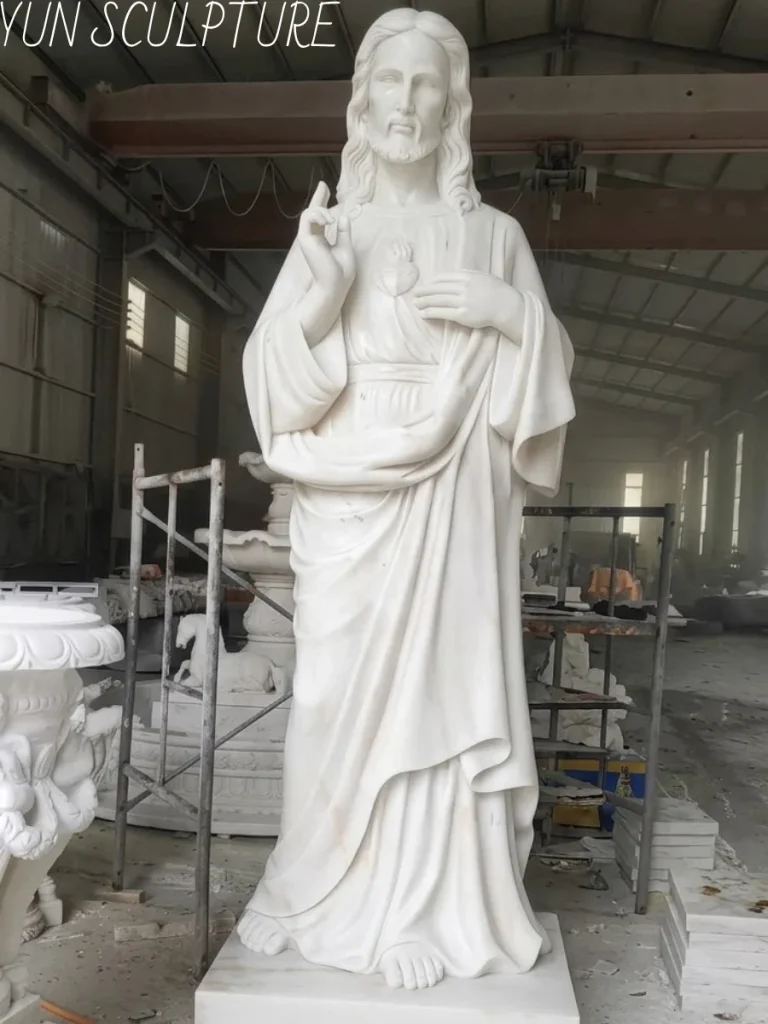
A marble jesus statue of the Divine Mercy image presents the ray problem differently. Marble does not accept chemical color treatment the way bronze does — it is a stone, not a metal, and its surface responds to carving and polishing rather than chemistry.
The marble solution relies on two properties inherent to the stone itself.
Translucency. High-quality white marble — Carrara from Tuscany, or Hanbaiyu from Hebei province — has a natural light transmission quality that no opaque material can replicate. When carved to the correct thickness and polished to a high sheen, white marble transmits diffused light through its surface in a way that reads, in the right conditions, as self-luminous. A ray element carved in white marble and placed where it receives natural or directed artificial light carries a quality of radiance that is not an effect — it is a property of the stone.
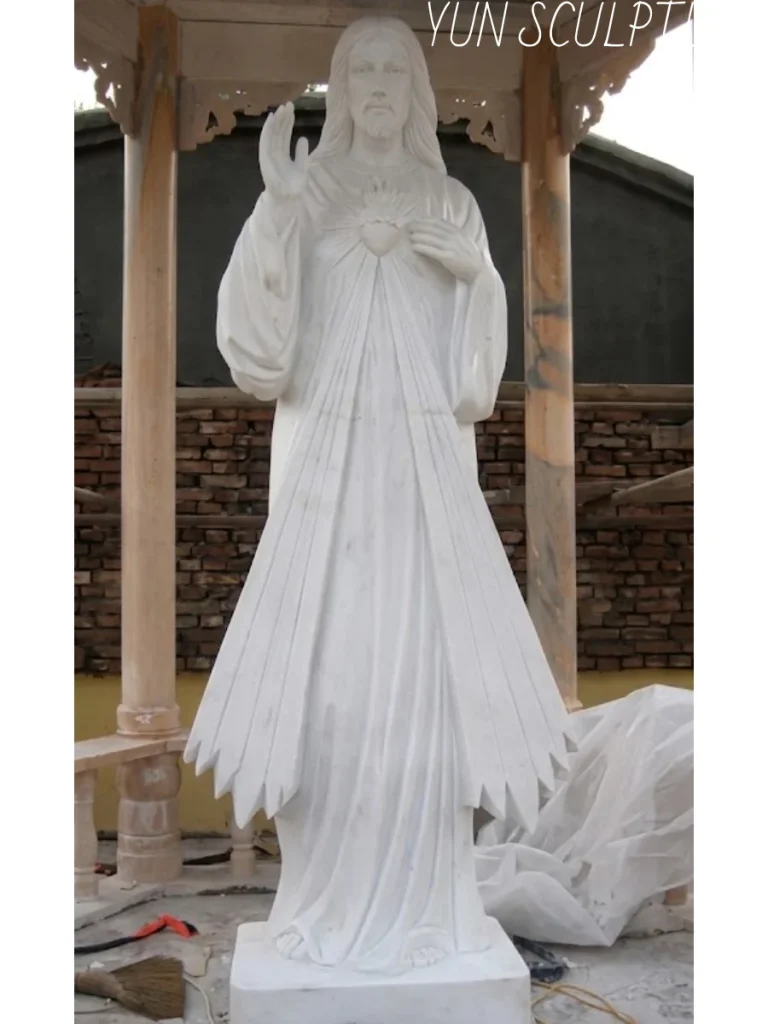
Relief and shadow. The two rays in a marble Divine Mercy commission are differentiated not primarily by color but by surface treatment. The white ray is carved in higher relief and polished to maximum luminosity. The red ray — which cannot be red in the literal sense on white marble — is carved in slightly lower relief and finished to a more matte surface, then treated with a tinted stone sealant in the warm amber-red range that penetrates the stone surface without obscuring its natural grain. The visual distinction between the rays is achieved through the interaction of carving depth, surface finish, and controlled tinting.
The constraint. A jesus marble statue of the Divine Mercy image is specified exclusively for interior installation. The tinted sealant treatment of the red ray, while durable in controlled interior environments, is not rated for the UV exposure and moisture cycling of exterior placement. White Carrara marble’s micro-porosity also makes it vulnerable to biological surface growth in humid outdoor conditions. Every marble Divine Mercy commission we produce carries a formal specification in the delivery documentation: interior installation only.
For outdoor installations — whether in a Philippine typhoon zone, a coastal American parish garden, or a European pilgrimage sanctuary — bronze is the only material that can deliver both the ray differentiation and the environmental durability the commission requires.
The divine mercy garden statue placed in an outdoor sacred space, visible across a courtyard, exposed to decades of weather, must be bronze. The divine mercy statue placed above an interior altar, where its translucency will be revealed by candlelight and morning sun through stained glass, may be marble. Both are extraordinary. The choice depends entirely on where the statue will spend the next hundred years.
Engineering the Rays — Structural Considerations
The rays in a three-dimensional bronze Divine Mercy figure are not flat surfaces. They are volumetric elements — cast bronze forms that project from the chest of the figure and extend downward toward the base. At life-size scale, these elements may extend 60 to 90 centimeters from the figure’s body. At monumental scale, proportionally further.
This projection introduces a structural consideration that does not exist in flat painted representations. The ray elements, cast in bronze, carry their own weight. That weight is cantilevered from the attachment point at the chest — a bending moment that must be calculated and resolved in the internal armature design of the figure.
For a life-size divine mercy outdoor statue, this calculation is straightforward: the ray elements at 1:1 scale are manageable within standard armature design. For a large divine mercy statue for sale at 3 meters or above, the ray elements become significant structural loads, and their internal connection to the primary figure armature must be engineered as deliberately as the foundation anchor system below.
We have encountered ray elements on inadequately engineered large-format figures — imported from foundries that treated the rays as decorative attachments rather than structural elements — that have cracked at the chest attachment point under their own weight within five years of installation. The failure is not visible from a distance until it is catastrophic. We design against this failure mode from the first structural calculation.
The rays of mercy, in bronze, must be built to last as long as the mercy they represent.
Sizing and Specification Guide for Divine Mercy Installations
The divine mercy statue presents a sizing challenge that differs from every other sacred image in our commission range. The Risen Christ figure is defined by vertical presence — height above the viewer, arms raised toward heaven. The crucifix corpus is defined by horizontal span — the outstretched arms establishing the lateral dimension of the composition. The Divine Mercy figure is defined by something more subtle and more demanding: the relationship between the standing figure, the projected rays, and the viewer who must stand close enough to read the inscription at the base.
This three-part spatial relationship — figure, rays, inscription — must be resolved correctly at every scale from a 60-centimeter interior devotional piece to a 6-meter outdoor landmark. Get it wrong, and the inscription becomes illegible, the rays lose their directional quality, or the figure loses the quality of intimate approach that is the devotional core of the image.
We resolve it through proportion calculation before any other design decision is made.
The Proportion Framework
The classical proportion for a divine mercy statue commission holds that the ray elements should extend to approximately 65 to 75 percent of the corpus height, measured from the chest attachment point to the lower terminus of the rays. This ratio ensures that the rays are visually dominant — present, directional, legible — without overwhelming the figure that generates them.
The inscription panel at the base — Jesus, I Trust in You — should be sized so that the letter height equals approximately 3 percent of the total installation height, including pedestal. At a 180-centimeter corpus with a 60-centimeter pedestal, this yields a letter height of approximately 7 centimeters — legible at a viewing distance of 4 to 6 meters, which is the typical approach distance for an interior altar installation.
At outdoor landmark scale, these calculations change. Viewing distance increases. Letter height must scale accordingly. A large divine mercy statue for sale at 4 meters corpus height, on a 1.5-meter pedestal, requires a letter height of approximately 16 centimeters for legibility at 15 meters viewing distance. We calculate this for every commission before the clay model is finalized.
Interior Installations — Altar and Chapel Scale
A life size jesus statue at 180 centimeters — six feet of corpus height — is the canonical scale for interior Divine Mercy installations. At this height, the figure meets the standing adult worshipper at chest level. The gaze of the figure, directed slightly downward and forward in the posture of merciful approach, meets the eyes of a kneeling adult at precisely the angle the devotional posture requires.
The jesus statue 180cm tall for sale represents our most frequently commissioned Divine Mercy scale for parish altar placement. It is the scale at which the ray patination reads with maximum clarity — the color distinction between red and white rays fully legible at the typical nave viewing distance of 8 to 15 meters. Below this scale, the ray differentiation becomes increasingly difficult to resolve with sufficient visual weight.
| Installation Context | Corpus Height | Ray Extension | Pedestal Height | Material |
|---|---|---|---|---|
| Home Prayer Room | 45 – 60 cm | 30 – 40 cm | 20 – 30 cm | Bronze or Marble |
| Hospital Chapel | 90 – 120 cm | 60 – 80 cm | 30 – 40 cm | Bronze |
| Small Parish Chapel | 120 – 150 cm | 80 – 100 cm | 40 – 50 cm | Bronze |
| Parish Altar | 180 cm | 115 – 135 cm | 60 – 80 cm | Bronze |
| Cathedral Installation | 200 – 280 cm | 130 – 200 cm | 80 – 120 cm | Bronze + Armature |
| Outdoor Courtyard | 250 – 350 cm | 160 – 250 cm | 100 – 150 cm | Bronze + Steel |
| Landmark Monument | 400 cm + | 260 cm + | 150 cm + | Bronze + Engineered Steel |
For interior installations above 200 centimeters, the ceiling height of the installation space becomes the primary constraint. The total installation height — corpus plus pedestal plus ray extension above the figure’s head, where the blessing hand reaches — must clear the ceiling by a minimum of 40 centimeters to avoid visual compression. We request architectural drawings for all cathedral-scale interior commissions before finalizing proportions.
Outdoor Landmark Commissions — Engineering at Scale
An outdoor jesus statue in the Divine Mercy posture presents a wind engineering challenge distinct from any other figure in our commission range. The combination of the standing corpus, the projected ray elements, and the raised blessing hand creates a complex windage profile with three separate load-generating surfaces at different heights and angles.
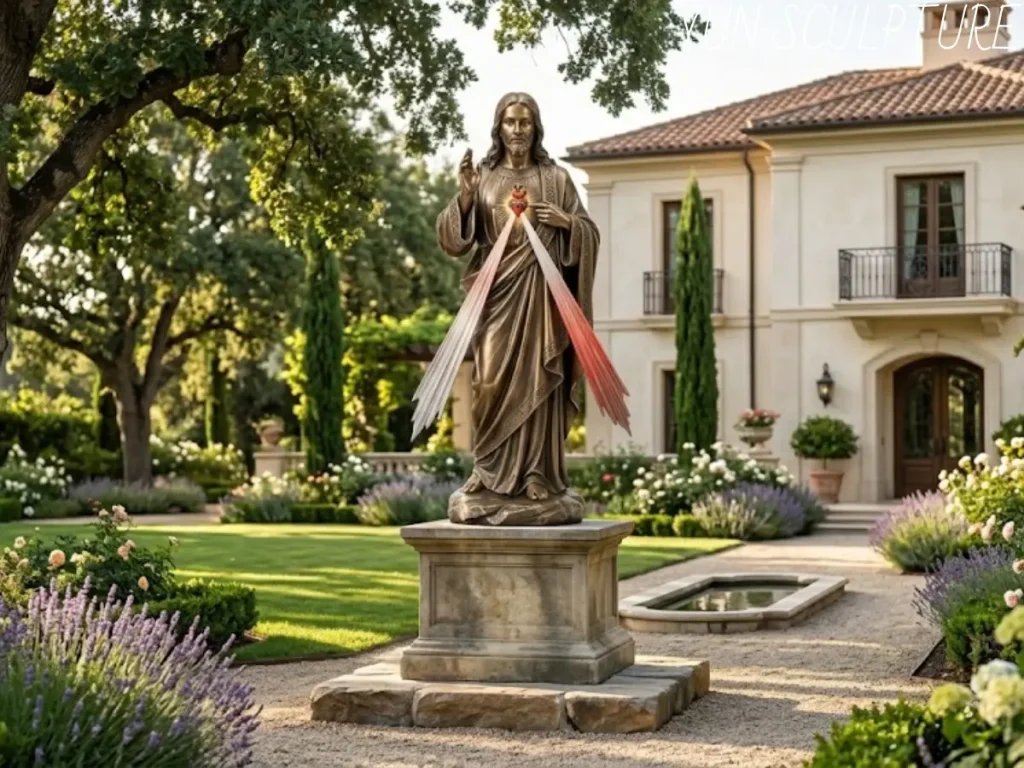
For a divine mercy outdoor statue at 3 meters corpus height, our structural calculation proceeds as follows:
The primary corpus presents a frontal windage area of approximately 2.8 square meters. The ray elements, projecting forward from the chest at an angle, add a combined windage area of approximately 0.9 square meters — but at a height and forward offset that introduces a significant overturning moment at the pedestal connection. The raised right hand, at the highest point of the figure, is the most exposed element and the one most vulnerable to harmonic vibration in sustained wind conditions.
We calculate wind load using the maximum recorded wind speed at the installation site — not the average, not the design standard, but the recorded historical maximum. We then engineer to a safety factor of 3.0 above that figure. For a divine mercy garden statue installed in a coastal Philippine province, this means engineering for wind loads that would destroy most structures in the surrounding landscape. The statue must survive what the buildings around it cannot.
The internal engineering solution for large outdoor commissions incorporates three elements:
Primary armature. A welded stainless steel skeleton, engineered to carry the static load of the bronze shell and resist the lateral and overturning forces of maximum wind load. For figures above 3 meters corpus height, this armature is a structural engineering object in its own right — designed by our structural team using site-specific load calculations before the sculpture studio begins clay work.
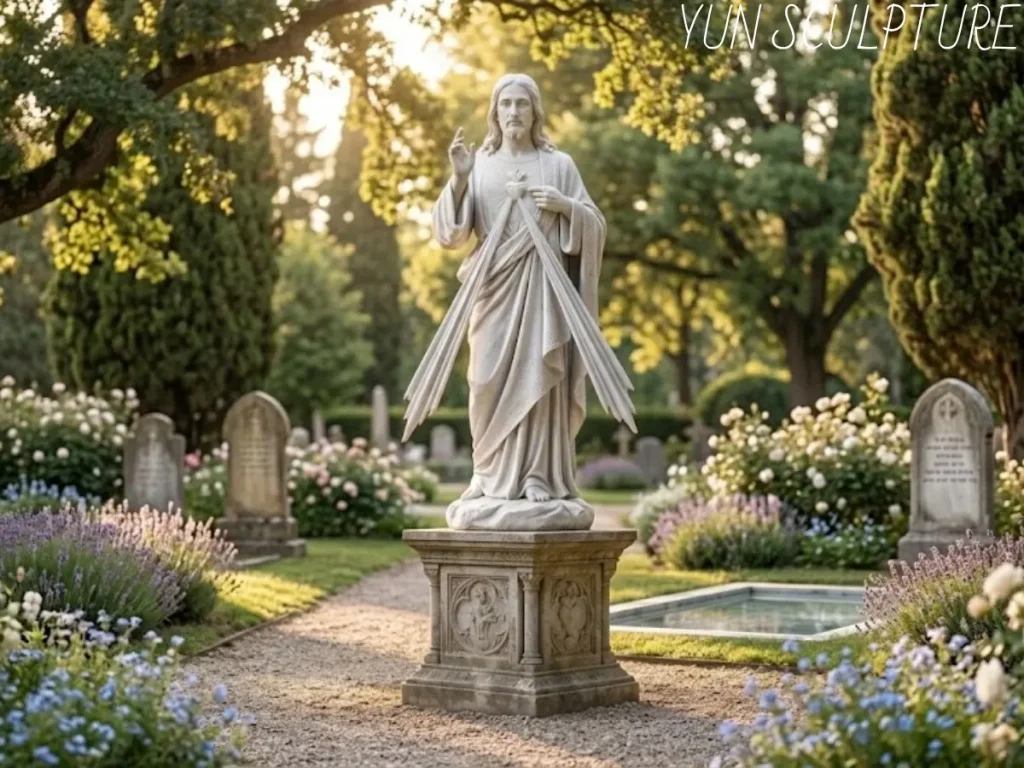
Ray armature connection. The ray elements connect to the primary armature through dedicated structural nodes at the chest — not welded to the bronze skin, but bolted to the internal steel frame through engineered connection plates. Each node is rated for the combined static and dynamic load of the ray element it carries. This is the connection point that fails on inadequately engineered imported figures. We have seen the failure mode. We design against it from the first calculation.
Foundation system. A reinforced concrete foundation with depth equal to not less than 1.5 times the total above-grade installation height, with 316-grade stainless steel anchor bolts set in high-strength epoxy grout. For typhoon-exposure sites, we specify a minimum concrete strength of 35 MPa and a rebar cage designed to resist the full overturning moment of the installation under maximum wind load. We provide stamped structural drawings for foundation construction, formatted for submission to local building authorities and diocese engineering review committees.
The Largest Divine Mercy Statues — Engineering at Civic Scale
The question of the largest divine mercy statue in the world is one our clients raise frequently, usually in the context of planning a landmark commission that will define a pilgrimage site or diocesan campus for generations.
At civic scale — corpus heights above 6 meters — the Divine Mercy figure transitions from a sculptural commission to an infrastructure project. The engineering considerations at this scale include not only structural load and wind resistance but also maintenance access systems, lightning protection, foundation drainage, and in most jurisdictions, formal building permits and third-party structural review.
Bronze remains the material of choice at civic scale, but the casting and assembly process shifts from our standard segmented approach to a panel-based construction system — curved bronze panels, engineered to precise thickness for both structural contribution and visual surface quality, assembled over a primary steel superstructure. The ray elements at this scale are independently engineered structural assemblies, not cast appendages.
We have had detailed conversations with clients planning commissions at this scale. The technical feasibility is established. The planning and execution timeline for a civic-scale Divine Mercy landmark runs between 24 and 48 months from commission to installation. The cost is commensurate with the permanence of the result.
The Philippines — A Market Built on Divine Mercy
No discussion of the divine mercy statue as a global sacred art commission is complete without a sustained examination of the Philippine market — not because the Philippines is simply a large buyer, but because no country on earth has integrated this image so completely into the physical landscape of its faith.
The Philippines is home to approximately 85 million Catholics — the third largest Catholic population in the world, after Brazil and Mexico. The Divine Mercy devotion arrived in the Philippines in the mid-20th century and found a reception unlike anywhere else in Asia. By the 1990s, divine mercy statue philippines installations had proliferated from the grandest urban basilicas to the smallest rural chapel courtyards. By 2010, it was effectively impossible to enter a Filipino Catholic parish without encountering the image in some material form.
The scale of this market has produced a corresponding range of quality. Filipino parishes have purchased divine mercy statues for sale at every price point, in every material, from every supplier category — from hand-carved and foundry-cast bronze pieces commissioned from specialist studios to mass-produced painted resin figures ordered from wholesale suppliers in Manila or Cebu. The consequences of these material choices are now visible across three decades of Philippine installation history.
The Material Reckoning
The tropical environment of the Philippine archipelago is among the most demanding on earth for outdoor sculpture. Average annual humidity above 80 percent. Year-round UV intensity at low latitude. Salt air penetration across all coastal provinces — which is to say, most of the country. And the typhoon cycle: not the occasional extreme event of continental climates, but a predictable annual sequence of high-wind, high-rain events that any outdoor installation must be designed to survive repeatedly, across decades.
In this environment, the material hierarchy that applies globally becomes a survival question. Painted resin figures show UV color degradation within three to five years and structural failure within ten to fifteen in typhoon-exposed locations. Painted concrete fares marginally better structurally but suffers the same color loss and adds surface cracking from moisture infiltration. Fiberglass composite, increasingly common in mid-range Philippine installations, shows better structural resilience but the same UV vulnerability.
Bronze, correctly specified and installed, shows none of these failure modes. The patina deepens with humidity rather than degrading. The alloy resists the salt air chemistry of coastal exposure. The structural system, engineered for typhoon wind loads, survives the events that damage surrounding structures.
The clients who contact us for divine mercy statue philippines commissions are, in the majority of cases, replacing a failed installation. They have already paid once for a material that could not deliver permanence. They are paying a second time for one that can. We do not treat this conversation as a sales opportunity. We treat it as an engineering consultation — beginning with a frank assessment of what failed in the previous installation and why, and building the new commission specification from that analysis.
Logistics for Philippine Commissions
Shipping a large bronze divine mercy outdoor statue to the Philippines requires a logistics chain that we have refined across multiple deliveries to Manila, Cebu, Davao, and provincial ports.
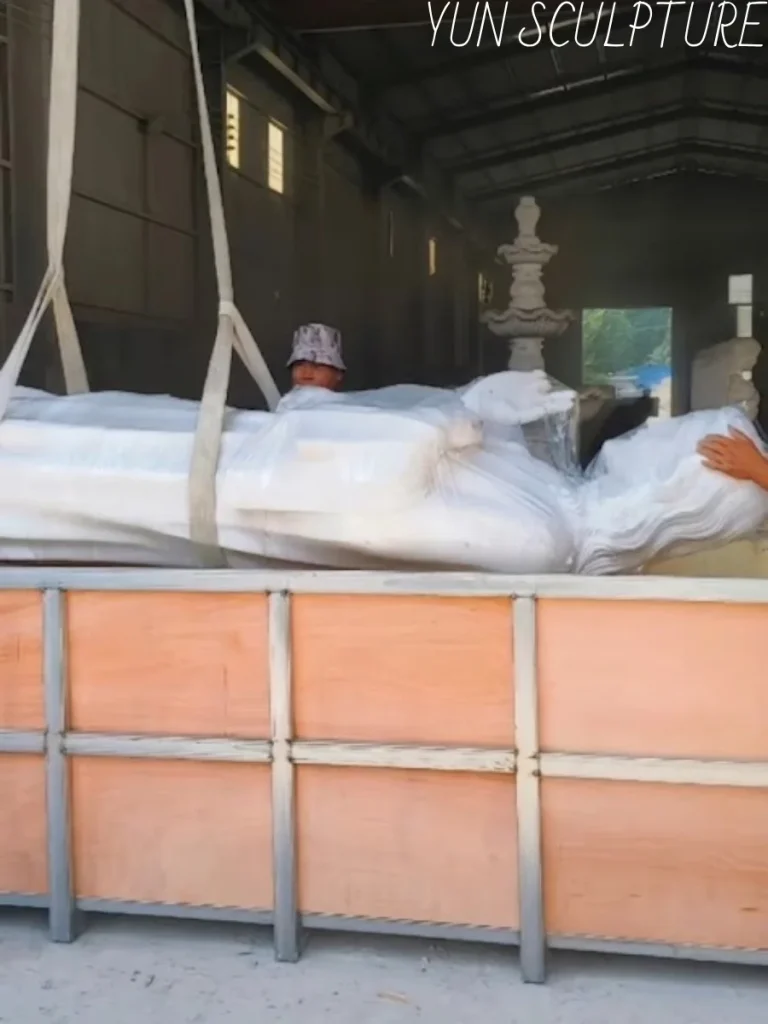
All bronze commissions ship in custom-built hardwood timber crates, internally braced with high-density foam padding formed to the specific geometry of the figure and ray elements. Large commissions are segmented for shipping — figure, rays, and pedestal base shipped as separate crated units — and assembled on site by our installation documentation package.
Philippine customs clearance for bronze religious statuary follows a defined documentary pathway: commercial invoice, certificate of origin from our foundry, material composition certificate for the bronze alloy, and packing list with individual piece weights. We prepare this documentation package as a standard component of every Philippine commission and coordinate with our Manila freight forwarding partner for port clearance and inland delivery.
For provincial installations — Leyte, Samar, Mindanao — we route through regional ports where available and provide trucking coordination to the installation site. The foundation construction, anchor bolt placement, and final assembly are executed by the client’s local contractors working from our stamped installation drawings. We provide remote technical support throughout the installation process and a final inspection checklist for the commissioning client.
The statue that arrives at a Philippine parish courtyard has already survived the South China Sea. It is built to survive everything that follows.
The Material Verdict: Bronze, Marble, and Resin Across a Lifetime
A client who asks which material to choose for a divine mercy statue is asking, at its core, a question about time. Not about the day of installation — every material looks acceptable on installation day. The question is about year fifteen, year thirty, year sixty. The question is about what the statue communicates to the generation of worshippers who had no part in commissioning it.
We answer the question with data, not preference.
Bronze — The Liturgical Standard
Grade A Foundry Bronze — the silicon-bronze alloy of approximately 90 percent copper, 6 percent tin, and trace zinc that we specify for all outdoor sacred commissions — operates on a timescale that no other material available to the devotional sculptor can match.

For a full analysis of bronze’s chemical stability in outdoor environments, see our companion guide: The Complete Guide to Bronze Jesus on Cross Statues. Every other material degrades from installation day forward. Bronze improves.
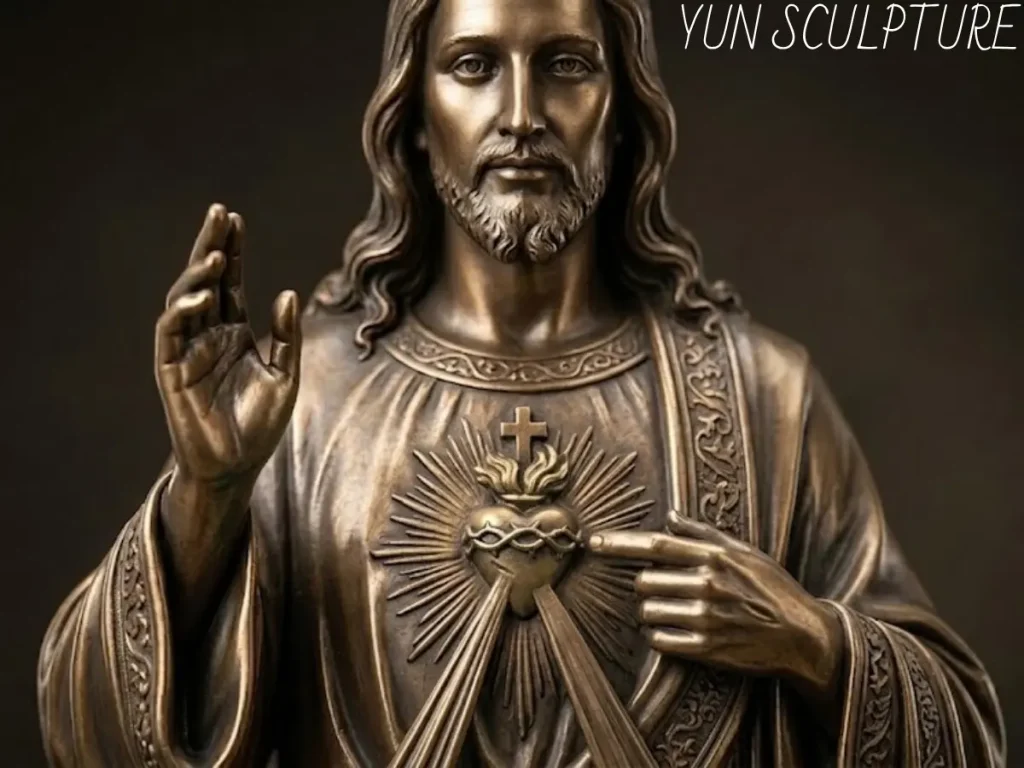
The specific requirements of the jesus divine mercy statue — the three-patina system for ray color differentiation — are fully compatible with this long-term chemistry. The ferric nitrate red patina and the tin-compound white patina, once sealed with microcrystalline wax at installation, stabilize into the same durable oxide chemistry as the surrounding statuary brown. The color distinction between rays does not fade. It deepens, subtly, over decades — acquiring the visual weight of accumulated time that distinguishes a permanent sacred object from a manufactured one.
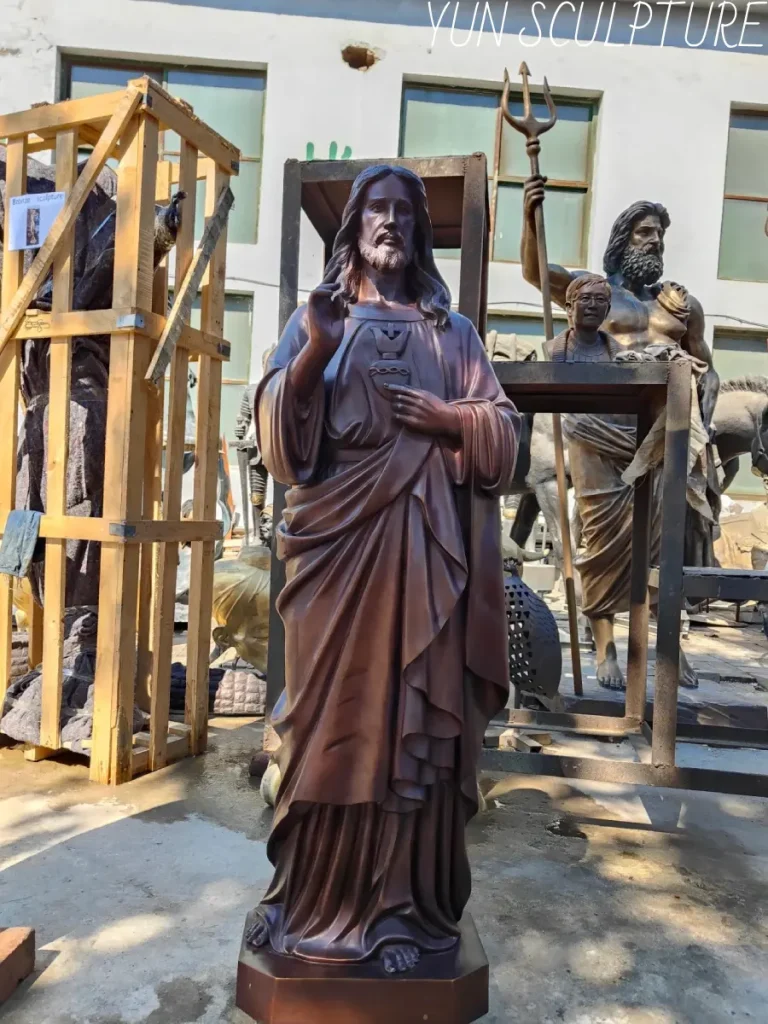
Maintenance requirements over a fifty-year installation life: annual washing with mild soap and water, annual microcrystalline wax application, and a full professional conservation treatment at the twenty-five year mark. Total maintenance cost over fifty years: a fraction of the replacement cost of a single resin or concrete installation.
Marble — Indoor Mastery
A marble jesus statue of the Divine Mercy image occupies a different register of sacred art — cooler, more luminous, carrying the translucent depth that no cast material can replicate.

A jesus marble statue of the Divine Mercy image requires between 30 and 50 percent more skilled labor hours than an equivalent bronze commission. The reason is irreversibility. In clay modeling, an error is corrected by adding or removing material. In bronze casting, errors in the clay are corrected before the mold is made. In marble carving, every error is permanent — a subtraction from a finite block that cannot be undone. The marble carver works more slowly, checks more frequently, and tolerates no approximation. The labor cost reflects this standard.
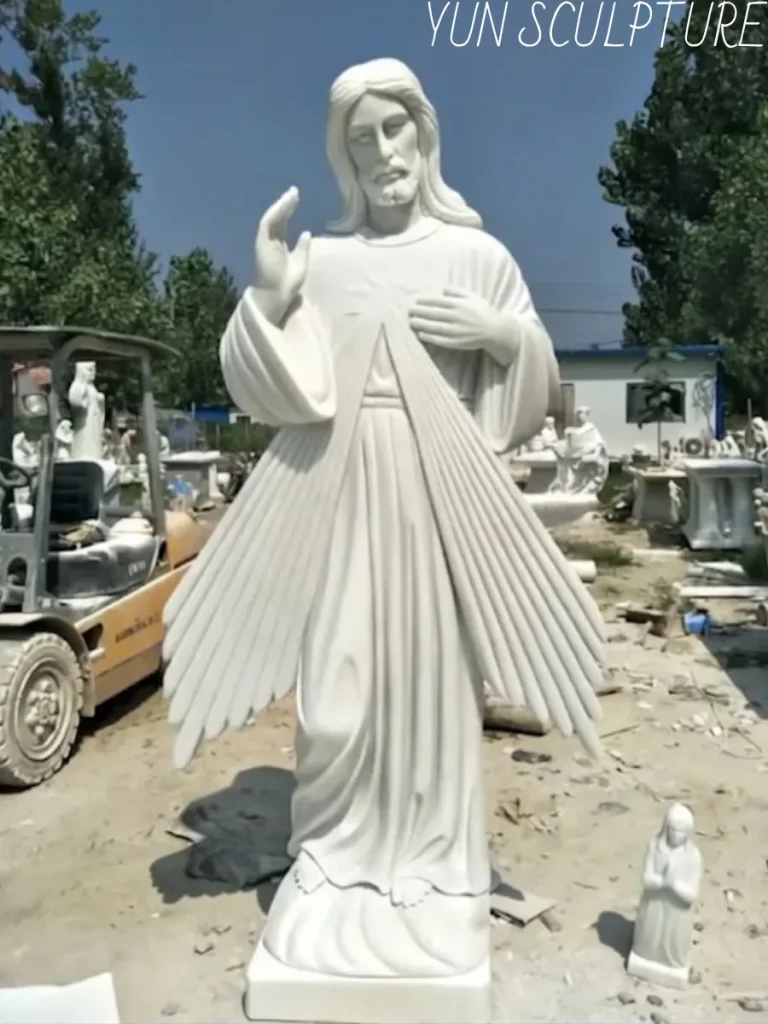

The absolute constraint — interior installation only — is non-negotiable and appears in our delivery documentation for every marble commission. The tinted sealant treatment of the red ray element is not rated for UV exposure. The stone’s micro-porosity is not compatible with freeze-thaw cycling. A marble jesus statue placed outdoors in any climate with seasonal temperature variation or significant UV intensity will show surface degradation within five years. We will not supply a marble Divine Mercy figure for outdoor installation under any circumstances, and we decline commissions where the client’s installation plan cannot accommodate this constraint.
Resin, Fiberglass, and Concrete — The True Cost of Economy
The concrete jesus statue and its resin and fiberglass equivalents represent the dominant material category in the global devotional sculpture market by volume. They are also, measured across a twenty-year installation lifespan, the most expensive options available.
The arithmetic is not complicated. A painted resin divine mercy statue for sale from a wholesale supplier may be acquired for a fraction of the cost of a bronze commission. It will require color restoration within five to eight years in a UV-exposed outdoor environment. It will require structural repair or replacement within twelve to eighteen years in a typhoon-exposure zone. It will require full replacement within twenty to twenty-five years under normal outdoor conditions in most climates.
A bronze commission at three to four times the initial cost of the resin piece will require no structural intervention and no color restoration for forty to sixty years under the same conditions. Measured across two replacement cycles of the resin piece — the timeframe within which a bronze installation requires only routine wax maintenance — the bronze commission is the less expensive option. The client who chooses economy at the point of purchase pays for that choice repeatedly across the installation lifetime.
We present this calculation to every client who raises the cost comparison. We do not argue against economy. We argue for accuracy — the accurate accounting of what each material actually costs across the time horizon that a permanent sacred installation demands.
Who Commissions a Divine Mercy Statue?
The divine mercy statue occupies a specific and consistent position in the devotional landscape of contemporary Catholicism — and the clients who commission serious work in this image reflect that position with remarkable consistency across geographies and institutional contexts.
Catholic Parish and Diocese commissions are the largest segment of our Divine Mercy work by volume. The typical commission originates from a parish building committee overseeing a new construction or major renovation — a new chapel entrance, a renovated sanctuary, an outdoor garden adjacent to the parish hall. The decision chain involves the pastor, the building committee, and frequently the diocese art and architecture office, which may have guidelines on iconographic standards for Divine Mercy representations. We are experienced in navigating this review process and can provide iconographic compliance documentation upon request.
Pilgrimage Sites and Shrines represent the highest-value individual commissions in our Divine Mercy range. A pilgrimage destination — whether an established Marian shrine that has adopted the Divine Mercy devotion, or a newer site built specifically around this image — understands the relationship between a physical sacred object and the devotional journey of the pilgrim better than any other client category. They know that pilgrims travel significant distances to stand before a specific figure in a specific place, and they commission accordingly. Scale, material permanence, and iconographic precision are non-negotiable for this client. Budget is a secondary consideration, not a primary constraint.
Hospital and Healthcare Institutions commission Divine Mercy images with a theological intentionality that differs from parish or pilgrimage contexts. The connection between the Divine Mercy image — Christ’s mercy extended specifically toward those who suffer — and the environment of a hospital chapel or healthcare facility meditation room is explicit and pastorally deliberate. A patient facing a serious diagnosis, a family in a surgical waiting room, a staff member at the end of a difficult shift — the Divine Mercy image speaks to each of these situations with a theological precision that few other sacred images can match. These commissions are typically modest in scale, specified for interior installation, and executed with particular attention to the quality of the figure’s expression and posture.

Private Chapel and Estate clients bring the Divine Mercy image into personal devotional spaces — a family oratory, a private meditation garden, a memorial chapel on an estate. These clients exercise the highest degree of individual artistic specification and the longest deliberation timeline. They may request specific modifications to the standard iconographic form — a particular facial expression, a specific gesture angle, an inscription in a family language — and we accommodate these requests within the boundaries of iconographic fidelity established by the Faustina vision account.

Overseas Filipino Communities represent a client category that exists nowhere else in the global sacred art market with the same intensity. Filipino Catholic communities in the United States, Canada, the Middle East, and across Europe commission Divine Mercy statues for their community chapels and parish spaces with a devotional consistency that reflects the depth of this image’s integration into Filipino Catholic identity. These clients are frequently highly specific about iconographic details — the exact posture, the precise ray configuration, the inscription language — because they are replicating an image they have known since childhood in a new geography.
From Vision to Bronze: The Commission Process
A commission for a large divine mercy statue for sale as a permanent outdoor installation is a structured process with defined stages, clear client decision points, and no shortcuts. We outline the process in full because our experience is that clients who understand what is involved make better decisions — about scale, about material, about timeline — than clients who encounter each stage as a surprise.
Step 1: Theological and Iconographic Brief
Before dimensions are discussed or materials selected, we conduct a detailed brief with the commissioning client on iconographic intent. Which version of the Divine Mercy image is the reference — the Kazimirowski original, or one of the subsequent authorized versions? What is the installation context, and what devotional relationship should the figure establish with the viewer at the primary viewing distance? What language and letterform is specified for the inscription? These questions determine the sculptural brief that every subsequent step must honor.
Step 2: 3D Conceptual Modeling
Our sculptors build a precise digital model establishing proportions, posture geometry, ray configuration, and inscription placement. The ray extension dimensions are calculated against the proportion framework and the site viewing distance data from Step 2. The client reviews and approves the digital model — including a rendered simulation of the three-patina color system for bronze commissions — before physical work begins.
Step 3: 1:1 Clay Sculpting — The Posture Problem
The Divine Mercy figure’s characteristic forward inclination — the subtle lean toward the viewer that is the posture of mercy extended — presents a specific challenge in full-scale clay modeling. The figure’s center of gravity is forward of its foot position. The clay model must be supported by an armature that holds this off-center posture without distorting the surface during the weeks of modeling work.
Our armature system for Divine Mercy figures uses a forward-offset vertical support column that matches the figure’s lean angle, with lateral bracing at the hip and shoulder zones. The ray elements are modeled on separate armature extensions that attach to the primary support at the chest zone, allowing independent adjustment of ray angle and extension during the modeling process.
The client receives detailed photographic documentation of the clay model at three stages: rough block-in, detailed modeling, and final surface resolution. Written approval is required at the final clay stage before mold making begins. Changes requested after this approval are possible but add to the production timeline and cost. Changes requested after mold making are not possible without beginning the clay work again.
Step 4: Three-Zone Patination
The patination process for a Divine Mercy commission follows the three-zone sequence described in Part 2 of this guide. The figure sections are assembled before patination begins, allowing the color zones to be resolved across the full assembled surface rather than section by section. The boundary between the ray patina zones and the figure patina is resolved by hand using fine brushes and chasing tools — a process that requires between eight and twelve hours of skilled labor on a life-size commission.
Final surface sealing with microcrystalline wax completes the patination stage. The sealed surface is photographed in detail and the documentation provided to the client for the maintenance records that will govern the installation’s care across its service life.
FAQ — 12 Core Questions Answered
What is a Divine Mercy statue?
A divine mercy statue is a three-dimensional sacred sculpture depicting the vision recorded by Saint Maria Faustina Kowalska on February 22, 1931 — Christ standing in white garments, right hand raised in blessing, left hand drawing back the garment at the chest, with two rays of light emanating from the heart: one red, representing the blood of Christ and the souls of humanity, one white, representing the water of Baptism and sanctifying grace. The inscription Jesus, I Trust in You appears at the base in the language of the commissioning community. It is, after the crucifix, the most widely commissioned sacred image in the contemporary Catholic world.
What do the red and white rays mean on a Divine Mercy statue?
The meaning of the rays was provided by Christ himself in Faustina’s recorded vision account. The red ray represents the blood of Christ — the living stream of redemption, the souls of humanity purchased at the cost of the Passion. The white ray represents the water that flowed from Christ’s pierced side at the lance of Longinus — the waters of Baptism, the grace that justifies and sanctifies the soul. Together, the two rays constitute a complete theological statement about the nature of divine mercy: that it is not merely an attitude of God toward humanity, but a specific historical act, accomplished in blood and water on a specific afternoon on a hill outside Jerusalem, extended forward in time to every person who stands before this image and speaks the inscription.
Where is the original Divine Mercy image located?
The first painted realization of the vision — executed in 1934 by the artist Eugeniusz Kazimirowski under Saint Faustina’s direct supervision — is preserved in the Church of the Holy Spirit on Aušros Vartų Street in Vilnius, Lithuania. This painting is the primary iconographic reference document for all subsequent representations of the divine mercy jesus statue in any medium. The convent chapel in Płock, Poland, where the original vision occurred in 1931, is a separate pilgrimage site. The Sanctuary of Divine Mercy in the Łagiewniki district of Kraków — where Faustina lived, worked, and is now buried — is the global spiritual center of the devotion and the site most visited by pilgrims seeking proximity to her life and witness.
What is the prayer inscribed on a Divine Mercy statue?
The inscription Jesus, I Trust in You — in Polish, Jezu, ufam Tobie — is the foundational prayer of the Divine Mercy devotion, specified by Christ in Faustina’s vision account as the text to appear on the image. It is not a decorative element. It is a theological directive — an act of faith placed in the mouth of every person who reads it. We have produced this inscription in fourteen languages across our commission history, including English, Polish, Tagalog, Spanish, French, Italian, German, Latin, Vietnamese, Korean, Cebuano, Ilocano, Malay, and Swahili. The letterform, scale, and placement relative to the figure base are calculated proportionally for each commission scale to ensure legibility at the primary viewing distance of the installation space.
What is the largest Divine Mercy statue in the world?
The question of the largest divine mercy statue in the world is one our clients raise frequently, and the answer changes as new landmark commissions are completed across the global Catholic community. Monumental outdoor divine mercy statue installations have been erected at pilgrimage sites across Poland, the Philippines, and the Americas, with corpus heights ranging from 4 to 12 meters or more at the largest sites. What we can state with confidence is that at civic scale — corpus heights above 6 meters — the engineering requirements transition from standard foundry practice to infrastructure-level structural design, and that bronze remains the only material that can deliver both the iconographic fidelity and the environmental durability that a permanent landmark of this significance demands. Clients planning commissions at this scale are invited to contact our structural team directly for a preliminary feasibility assessment.
How much does a life-size bronze Divine Mercy statue cost?
A custom life-size commission — corpus at 180 centimeters, or six feet — cast in Grade A Foundry Bronze with our three-zone patination system for ray color differentiation generally ranges from $9,000 to $20,000, depending on the complexity of the figure modeling, the precision of the ray patination, and the internal engineering requirements of the installation context. The lower end of this range reflects a standard interior altar commission with straightforward installation requirements. The upper end reflects a commission with complex ray geometry, multi-language inscription work, outdoor structural engineering, and foundation drawing preparation. A large divine mercy statue for sale at 3 meters corpus height or above is quoted individually following site assessment and structural calculation. We do not provide indicative pricing for monumental commissions without this documentation.
What material is best for an outdoor Divine Mercy statue?
For any divine mercy outdoor statue — regardless of climate zone, geographic location, or installation context — Grade A Foundry Bronze is the only material we recommend without qualification. The reasoning is detailed in our material science chapter above.
Why is the Divine Mercy devotion so strong in the Philippines?
The intensity of divine mercy statue philippines demand reflects a convergence of historical, theological, and cultural factors unique to the Philippine Catholic context. The Philippines carries the deepest Catholic devotional culture in Asia — a tradition of Christocentric and Marian piety that found in the Divine Mercy image a theologically precise expression of its existing spiritual instincts. The image arrived in the Philippines during a period of significant national suffering, and its central message — that mercy is available to every person regardless of the weight of their history — resonated with particular force in communities that had experienced the violence and displacement of the 20th century. Today, the Divine Mercy devotion is integrated into Filipino Catholic practice at every level, from the grandest urban basilica to the smallest provincial chapel. The divine mercy statue is not, in the Philippine context, a devotional option. It is a devotional given — as fundamental to the physical landscape of Filipino Catholic worship as the crucifix itself.
Can the inscription be produced in different languages?
Yes, in any language for which we can obtain verified liturgical translation documentation. We require written confirmation of the inscription text from a qualified theological source — a bishop’s office, a seminary, a recognized translation authority — before producing any inscription in a language outside our standard commission range. This requirement is not bureaucratic caution. It is theological responsibility. The inscription on a statue of divine mercy is a prayer placed in the mouths of every person who reads it across the installation lifetime. It must be accurate. We have declined commissions where the provided translation could not be verified, and we will continue to do so. Our standard commission range covers fourteen languages; new language commissions require a verification period of two to four weeks before production documentation is finalized.
How long does a custom bronze Divine Mercy statue take to make?
A standard life-size divine mercy statue commission — 180 centimeters corpus, interior installation, standard three-zone patination — requires between 70 and 90 days from signed approval to completed bronze, ready for shipping. This timeline encompasses digital modeling and client approval, full-scale clay sculpting and client photographic review, silicone mold making, lost-wax casting of the corpus and ray elements, chasing and assembly, the three-zone patination sequence, final wax sealing, and crating for shipment. A large divine mercy statue for sale at outdoor landmark scale — corpus above 3 meters, with site-specific structural engineering and foundation drawing preparation — extends this timeline to between 120 and 180 days, depending on the complexity of the structural design and the number of client review cycles required. We do not offer accelerated production timelines. The process has its own integrity, and the integrity of the process is what produces the permanence of the result.
How is a large outdoor Divine Mercy statue installed safely?
A large divine mercy outdoor statue installation requires four elements to be in place before the statue arrives on site. First, a reinforced concrete foundation of specified depth and reinforcement density, constructed and cured to our structural drawings. Second, 316-grade stainless steel anchor bolts set in high-strength epoxy grout to the bolt pattern specified in our foundation drawings, with bolt torque verified before statue placement. Third, a clear crane access path to the installation point, with lifting capacity rated for the statue’s documented shipping weight plus a 25 percent safety margin. Fourth, a qualified installation crew who have reviewed our assembly sequence documentation before the day of installation.
Where do you buy a high-quality Divine Mercy statue?
The answer begins with the question that most buyers do not ask before their first purchase: How long do I need this to last? If the answer is five to ten years, the wholesale catalog options are technically adequate. If the answer is fifty years, a generation, a century — the only correct answer is a direct commission from a professional sculpture foundry with documented experience in lost-wax bronze casting, sacred iconography, and structural engineering for permanent outdoor installation.
A high-quality jesus divine mercy statue is not a product. It is a commission — a collaborative process between a client who knows what the image must mean and a foundry that knows how to make it permanent. The markers of a serious foundry are not difficult to identify: they ask theological questions before design questions; they produce a full-scale clay model for client approval before bronze is poured; they provide structural engineering documentation for outdoor installations; and they can show you commissions that have been standing in the weather for ten, twenty, thirty years and still look like the day they were installed.
A Light That Does Not Fade
Father Emmanuel Reyes stood at the entrance of his rebuilt chapel on the day the bronze divine mercy statue was installed, watching the crane lower the figure onto its concrete pedestal. The rays — red and white, permanent in the chemistry of the metal — caught the afternoon sun of Leyte province for the first time.
He had buried eleven of his congregation after the storm. He had watched a painted resin figure shatter in the wind. He had waited six months for this bronze figure to be made, and he had paid what it cost, and he had built a foundation for it that was engineered to survive the next typhoon and the one after that.

Standing there, he said something that we have not forgotten: “This one will still be here when the people who are children today are old.”
That is the only standard that matters for a sacred object built in permanent materials. Not how it looks on installation day. Not how it compares in price to the catalog alternative. But whether it will still be standing — still proclaiming the same mercy, still extending the same rays toward the same gesture of trust — when the community that commissioned it has passed entirely into the generation that inherits it.
A divine mercy statue built in bronze is not an act of expenditure. It is an act of faith in the future — a declaration, made in metal that will outlast everyone present, that the mercy it depicts is as permanent as the material that carries it.
The vision was given once, to one person, in a small convent room in Płock in 1931. The image it produced has since been placed in the hands of tens of millions of people on every continent. Our work — the clay, the wax, the bronze, the patina, the engineering — is the work of making sure that image is carried in materials worthy of what it carries.
We are ready when you are.
— Elena Zhang & Donghui Zhang, Yun Sculpture