Get in touch with Yun-Sculpture company
Mother and Child in Bronze and Marble: The Ultimate Guide to Custom Mary and Baby Jesus Statues

In 2021, a man named Marco Ferretti contacted our studio with an unusual request and an unusual object: a photograph of a small white marble Madonna and Child, approximately 45 centimeters tall, sitting on a shelf in his late grandmother’s house in Queens, New York. On the base, barely legible, were the words G. Esposito, Napoli, 1923.
His grandmother had carried it from Naples as a young woman. It had sat in three apartments and two houses across a century of American life. Now Marco was building a small private chapel on his property in Connecticut, and he wanted a bronze version — life-size, for outdoor installation — that carried the same iconographic character as the original. Not a copy. A translation.
We spent two months studying the photograph before touching clay.
This is the nature of a mary and jesus statue commission at the highest level of craft. It is not a product selection. It is an act of material translation — taking an image that has existed in one form, in one material, across one lifetime, and rebuilding it in a form and material that will carry it across the next several centuries.
The mary holding jesus statue is the oldest continuously produced sacred image in the history of Christian art. It predates the crucifix as a devotional object. It appears in the Roman catacombs, in Byzantine gold mosaic, in Gothic stone, in Renaissance marble, in Baroque bronze, and in the devotional objects of every Catholic culture on earth. No other sacred image has been rendered in more materials, at more scales, across more centuries, by more hands.
This universality is both the image’s greatest strength and its greatest challenge for the contemporary commissioner. A statue of mary holding jesus can be acquired at every quality level, in every material, from every source. The distance between a $40 resin figure from an online catalog and a museum-quality bronze or marble commission is not merely a difference of price. It is a difference of material honesty — of whether the object that carries this image is worthy of what it carries.
Table of Contents
Table of Contents
The Iconography of Tenderness — Two Traditions, Two Distinct Commissions
Before material or scale is discussed, every serious mary and jesus statue commission must resolve a prior question: which Mary, and which moment?
The history of Christian sacred art has produced two dominant traditions for representing the Mother of God with her Son, and they are not interchangeable. They depict different theological moments, demand different compositional solutions, and speak to different devotional contexts. Confusing them — or treating them as variations of the same image — produces commissions that fail to serve either tradition well.
The Madonna and Child — The Theology of Incarnation
The Madonna and Child tradition depicts the Virgin Mary holding the infant or young Christ — alive, present, often meeting the viewer’s gaze or engaged with his mother in a gesture of tenderness. The theological moment is the Incarnation: God made flesh, held in human arms, fully present in the vulnerability of childhood.
This is the tradition of the baby jesus statue — and it is, in devotional terms, a statement of radical theological optimism. The God who created the universe is small enough to be held. The arms that hold him are a mother’s arms.
Within this tradition, iconographic choices carry precise meaning. The direction of the Virgin’s gaze is one of the most significant: when Mary looks down at the child, the composition is enclosed, intimate, the relationship between mother and son complete in itself. When Mary looks outward — toward the viewer — the composition opens, and the child becomes an offering: this is my Son, given for you. Both are orthodox representations. They produce fundamentally different devotional experiences, and a commissioning client should choose between them deliberately.
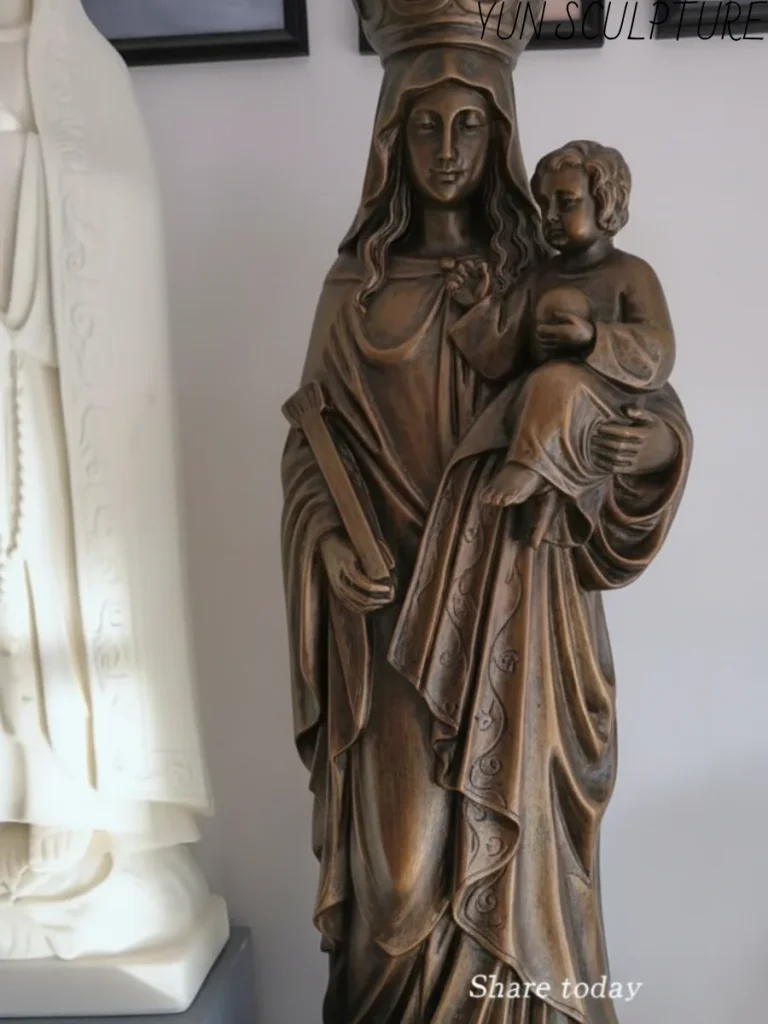
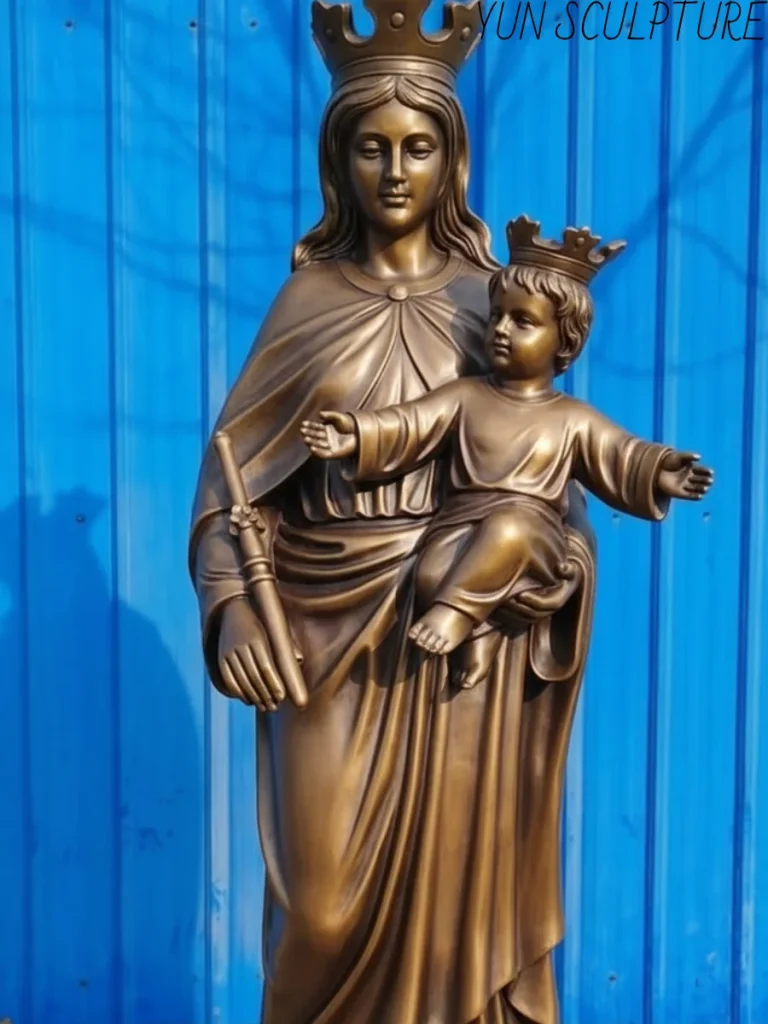
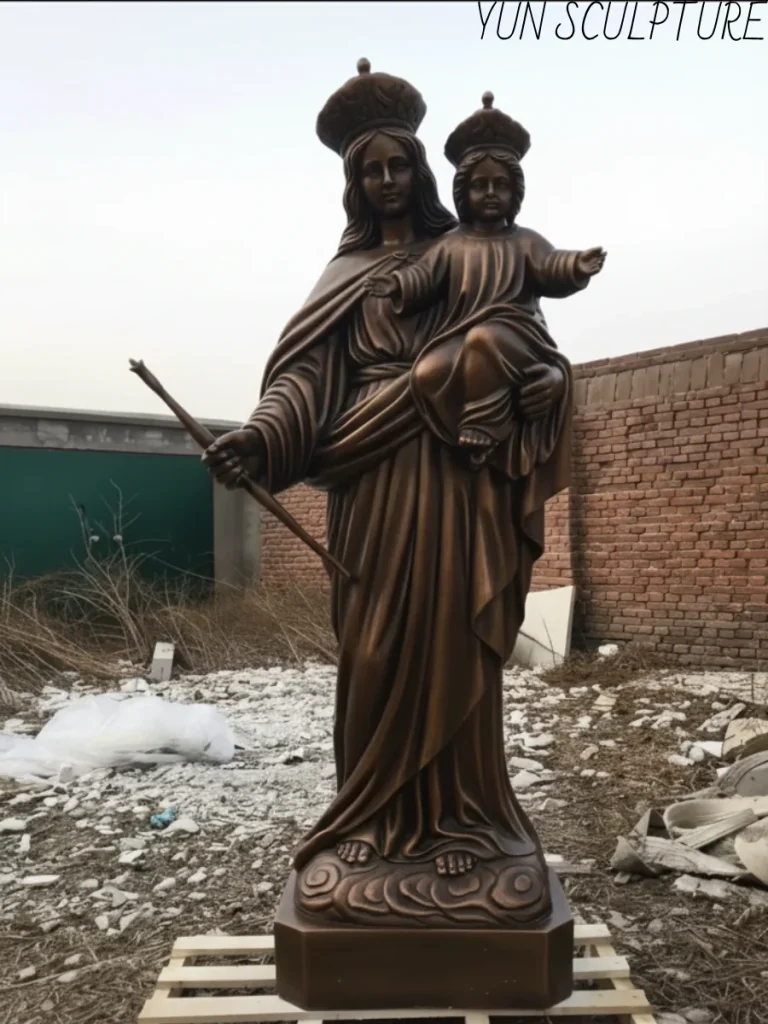
The position of the Christ child carries equal theological weight. An infant held against the chest, swaddled in cloth, emphasizes the human vulnerability of the Incarnation. A child who sits upright on his mother’s knee, one hand raised in the gesture of blessing, is simultaneously infant and King — the theological paradox of the God-man made visually legible. Our sculptors discuss these choices with every client before the clay model begins, because once the posture is established in the 1:1 clay stage, it defines every subsequent decision.
A virgin mary statue with baby jesus in the Madonna and Child tradition is among the most technically demanding commissions in our range — not because of structural complexity, but because of emotional precision. The relationship between two figures must be established through the subtle geometry of their physical contact: the angle of the mother’s arms, the weight distribution of the child’s body, the exact positioning of hands and fingers. These details are the difference between a statue that communicates tenderness and one that merely depicts it.
The Pietà — The Theology of Compassion
The Pietà tradition depicts a different moment entirely: the Virgin Mary holding the body of the adult Christ after the Deposition from the Cross. The theological register shifts from Incarnation to Passion — from the beginning of Christ’s earthly life to its end, and to the moment of grief that precedes the Resurrection.
The word Pietà is Italian for pity or compassion — specifically, the compassion of the mother who holds what remains of her son after the world has finished with him.
This tradition was given its definitive form by a 24-year-old sculptor from Florence working in Rome between 1498 and 1499. Michelangelo Buonarroti’s Pietà, commissioned by the French Cardinal Jean de Bilhères for his funeral chapel in St. Peter’s Basilica, is the work against which every subsequent representation of this subject has been measured. It stands 174 centimeters tall and 195 centimeters wide, carved from a single block of Carrara white marble. It weighs approximately 3,000 kilograms. It is the only work Michelangelo ever signed — his name carved into the sash across the Virgin’s chest — because when he overheard visitors attributing it to another artist, he returned at night and cut his name into the stone. He was 24 years old and he already understood that this object would outlast him by centuries.
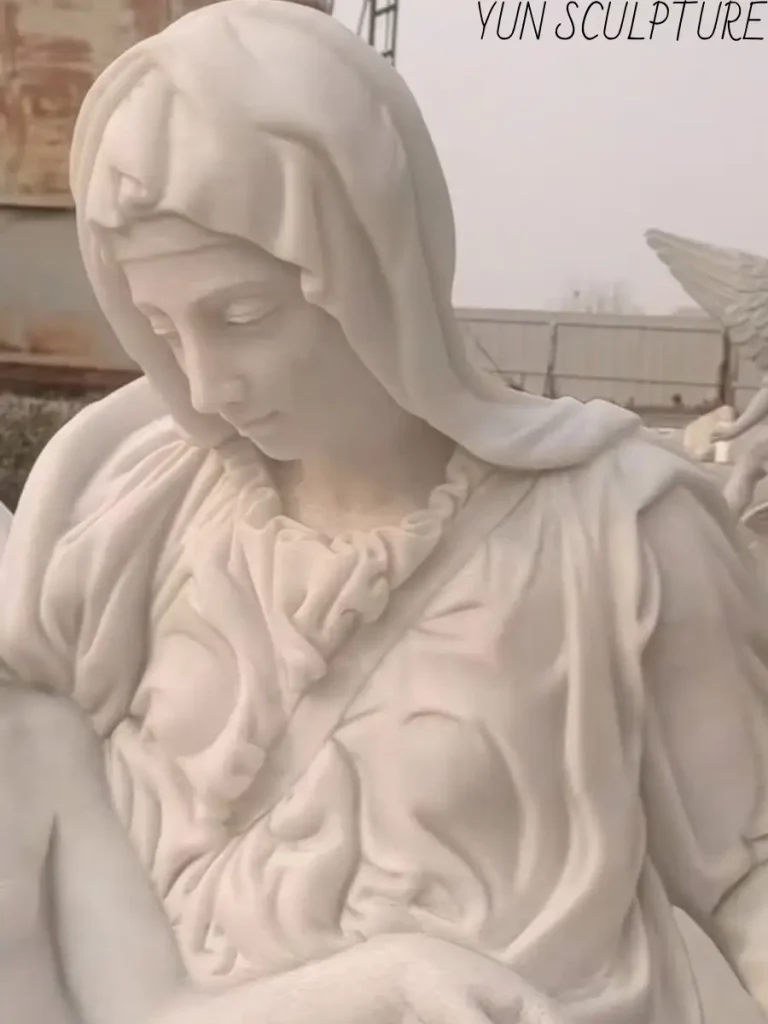
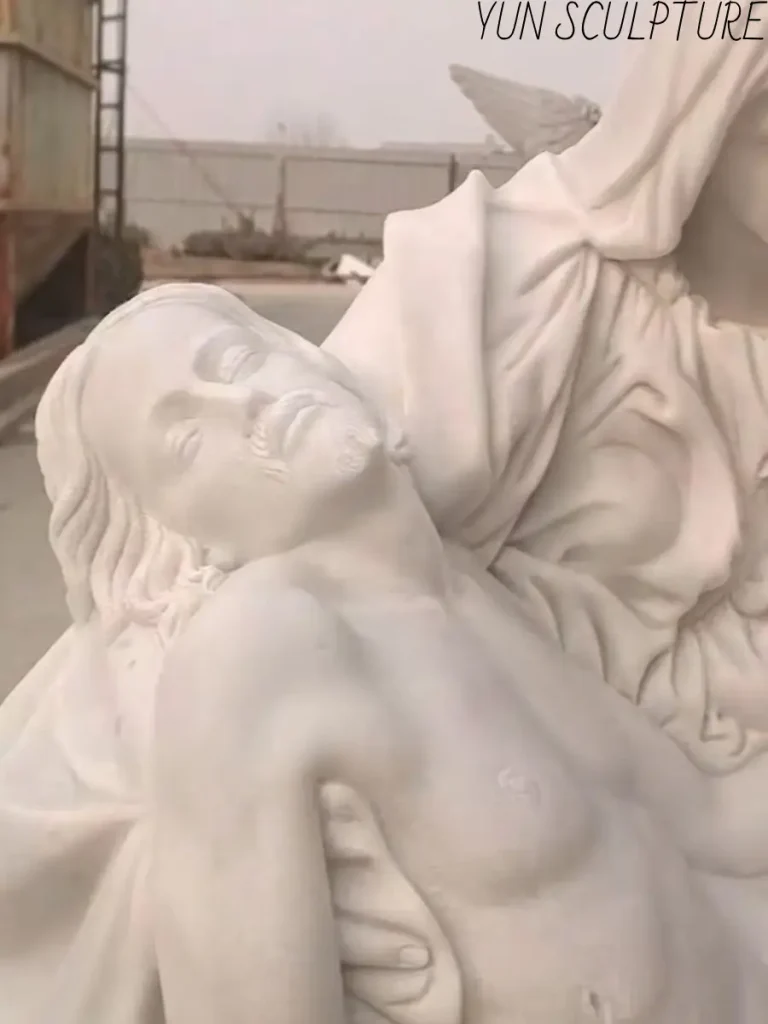
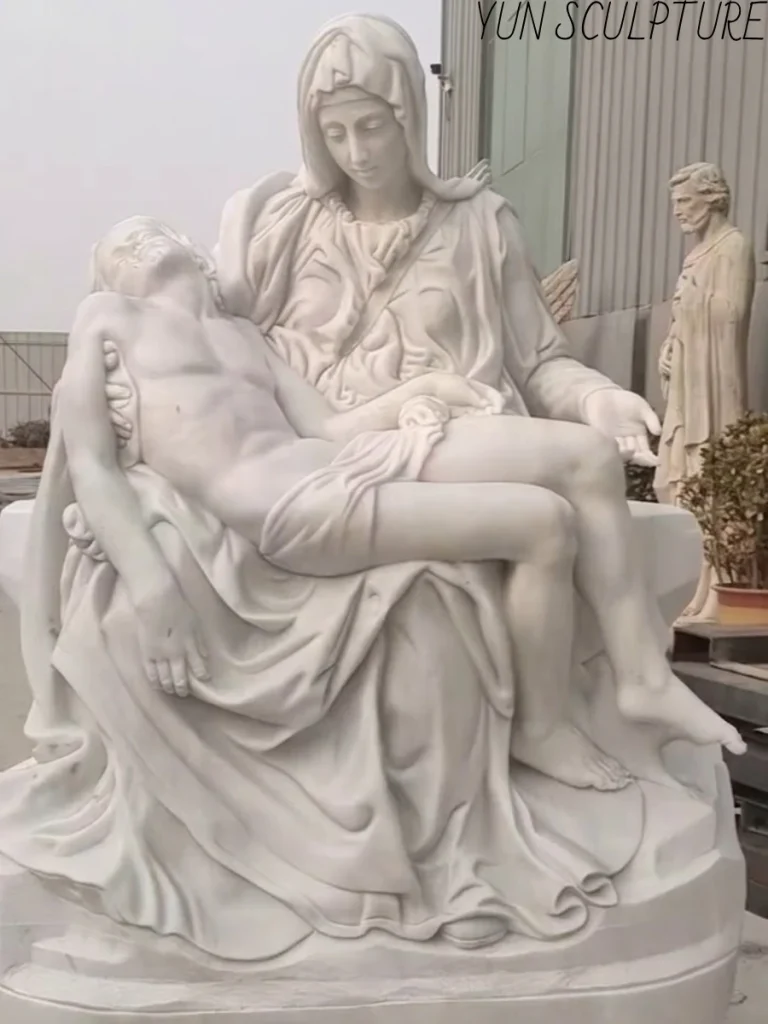
The mary and jesus sculpture michelangelo represents the answer to what appeared to be an unsolvable compositional problem. An adult male body — Christ at the time of his death was approximately 33 years old — must be held across the lap of a seated woman in a way that reads as physically coherent and emotionally true. The natural proportions of the human body make this impossible: a seated woman cannot hold an adult male body across her lap without the composition becoming awkward, the body too large, the arrangement too forced.
Michelangelo’s solution was architectural. He expanded the Virgin’s seated form — the volume of her draped robes, the spread of her knees, the breadth of her lap — to dimensions that exceed natural proportion by approximately 30 percent. The result is that Mary’s seated figure has the structural mass of a woman who might be 2.1 meters tall if standing, while her face and hands retain the delicacy of a young woman. The disproportion is invisible in the finished work because the drapery absorbs it. What the viewer perceives is not a body that is too small or too large, but a composition that feels inevitable — as if there could be no other way to hold this body, in this moment, in these arms.
This is the answer to who made the Pietà, a sculpture of Jesus and Mary: Michelangelo Buonarroti, working in Rome, 1498–1499, and the work remains in the Vatican’s St. Peter’s Basilica to this day.
The Sculptor’s Challenge — What Makes These Subjects Technically Extraordinary
The Madonna and Child and the Pietà present technical challenges that are unlike those of any single-figure religious commission. Both involve multiple figures in physical contact — and physical contact between figures is the hardest problem in figurative sculpture.
A single standing figure has a defined center of gravity, a clear structural logic, a predictable load path from head to base. The moment a second figure is introduced — held, supported, draped across — the structural and compositional logic multiplies in complexity. Every decision made about one figure immediately affects the other.
The Pietà’s Structural Paradox
The Pietà format is, in engineering terms, a horizontal cantilever problem. The body of Christ extends laterally across the Virgin’s lap, with significant portions of that body — the right arm, the lower legs — unsupported by any structural element beneath them. In marble, this problem is managed through the material’s inherent compressive strength and through the careful preservation of connecting stone between elements. In bronze, it requires a different solution entirely.
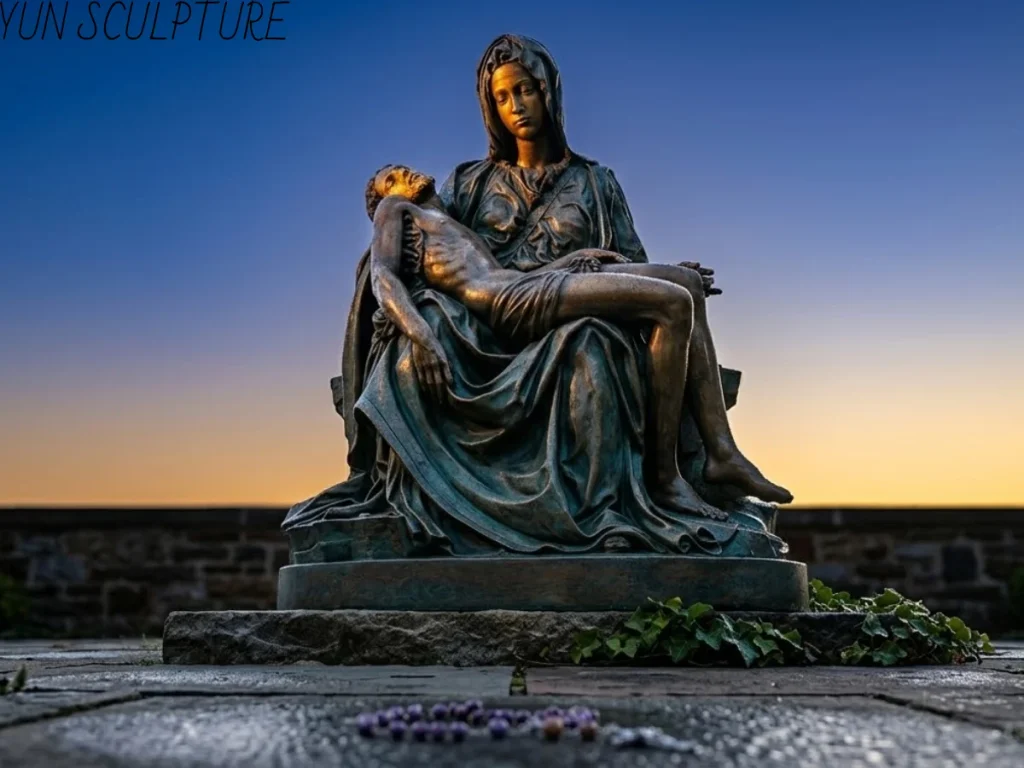
A bronze Pietà commission begins with a structural analysis of the cantilever loads before a single gram of clay is touched. The right arm of Christ — which hangs freely downward in the canonical composition — is the highest-risk element. In Michelangelo’s original, this arm was damaged in a 1972 attack precisely because it is the most exposed and least supported element of the composition. In bronze, we address this through an internal stainless steel reinforcement rib running through the arm from shoulder to wrist, connecting to the primary armature at the shoulder joint. The rib is sized to carry not only the static weight of the bronze arm but the dynamic load of potential impact — because a bronze Pietà installed in a public or semi-public space will, over a century, be subjected to accidental contact from maintenance equipment, weather events, and the accumulated physical engagement of pilgrims.
The lower legs present a related problem. In the seated Pietà composition, Christ’s lower legs extend beyond the Virgin’s lap and are supported only by the drapery that pools at the base of the composition. This drapery must be designed — in the clay model, before the mold is made — to provide structural support as well as visual beauty. The bronze folds of the robe at the base are not merely decorative elements. They are load-bearing columns, and their internal geometry must be sufficient to carry the weight of the leg elements above them without the bronze shell deflecting over decades.
The base of the Pietà composition presents a third structural consideration that is unique to this format. The composition is wider than it is tall — 195 centimeters wide against 174 centimeters tall in Michelangelo’s original. A bronze Pietà scaled to these proportions at life-size will have a center of gravity that is lower and more laterally distributed than any single standing figure. The pedestal design must account for this geometry: a wider, lower pedestal than would be specified for a standing figure of equivalent height, with anchor bolt placement distributed across the full width of the base to resist the overturning moment of the lateral mass.
The Madonna and Child — Softness as a Technical Problem
The Madonna and Child presents a different category of technical challenge: the problem of rendering softness in a hard material.
An infant’s body — the body of the baby jesus statue at the center of the Madonna and Child tradition — is anatomically distinct from an adult body in ways that directly affect the sculptural approach. Infant skin has a quality of softness and rounding that results from subcutaneous fat deposits distributed differently from adult anatomy. The joints are less defined. The musculature is less articulated. The facial features — enormous eyes relative to face size, minimal nasal bridge, prominent cheeks — follow proportions that are immediately recognizable as belonging to infancy and that deviate significantly from adult proportional standards.
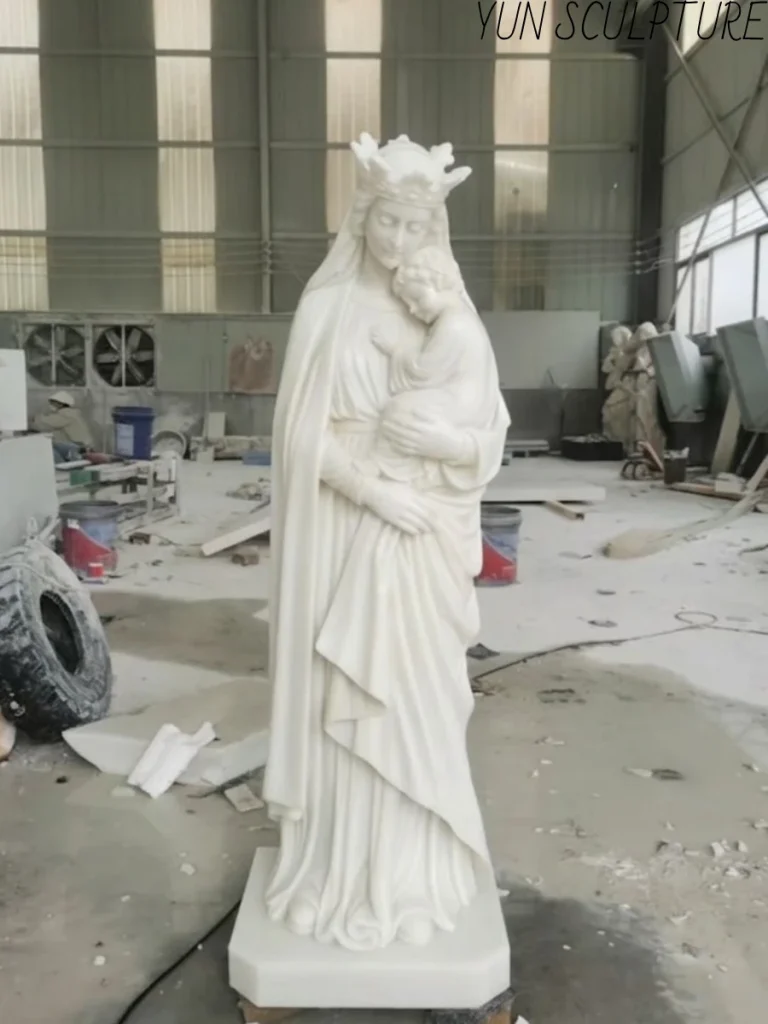
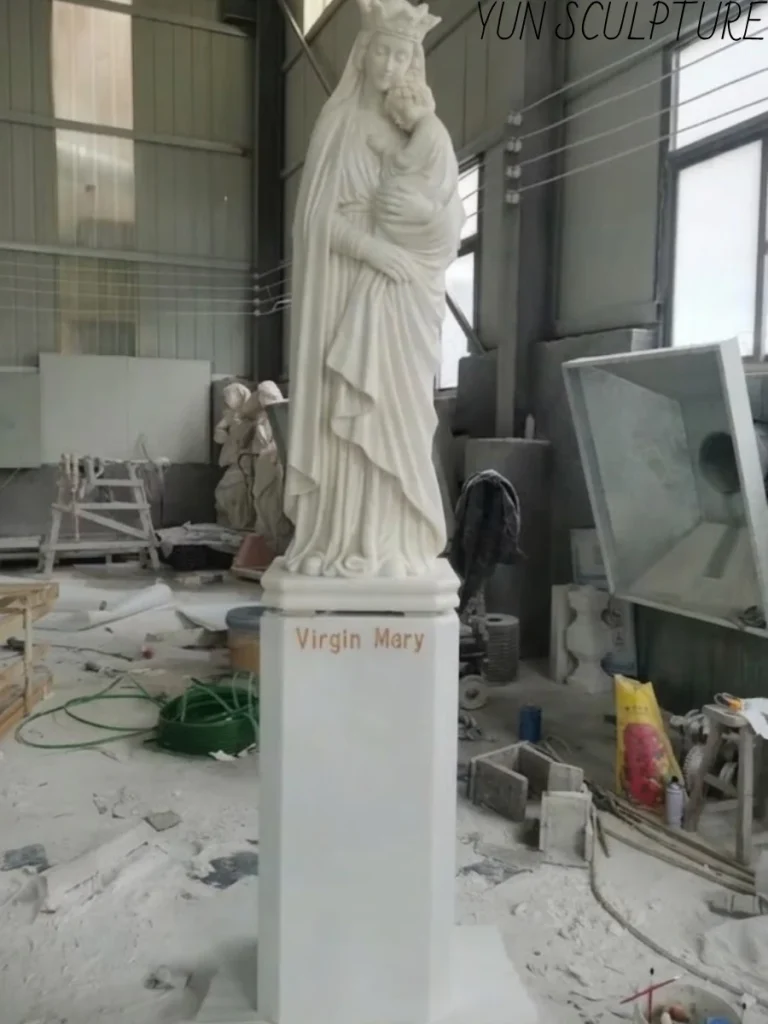
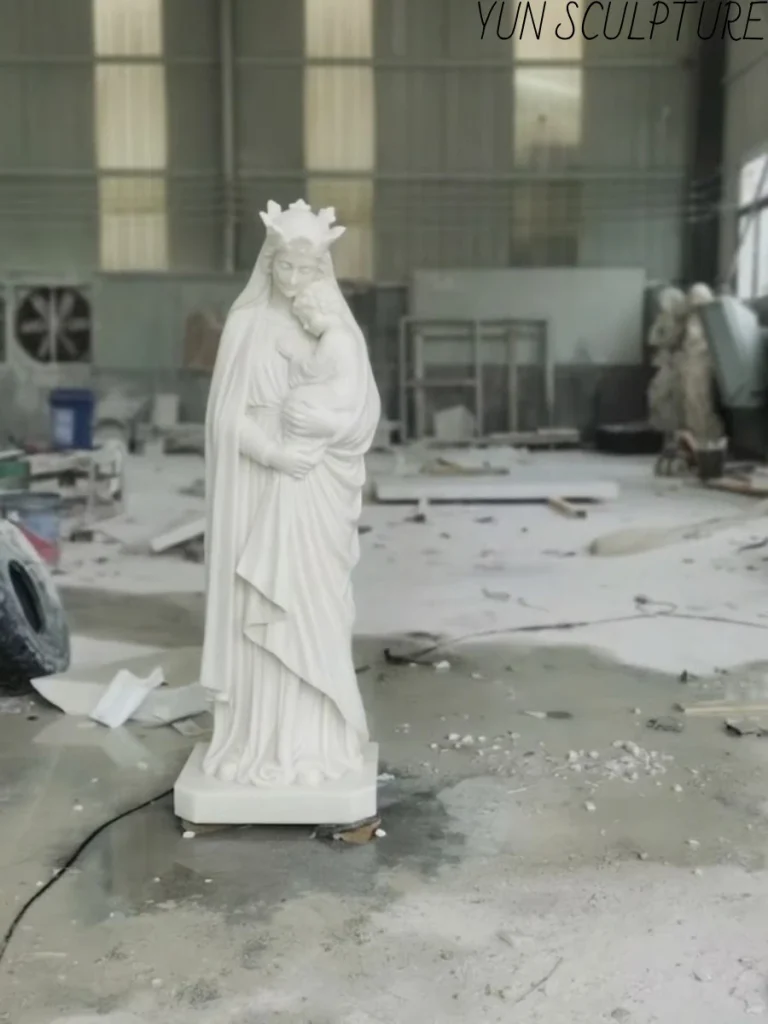
These characteristics are well understood in painting. In sculpture, they present specific difficulties. The very features that make an infant face recognizable — the softness, the roundness, the absence of sharp anatomical definition — are the features that most easily tip from tenderness into blandness in three-dimensional form. An infant face that is not precisely modeled does not look soft and gentle. It looks unfinished.
Our sculptors who specialize in mary and baby jesus statue commissions maintain a separate reference library of infant anatomical studies — photographic and medical — that differs entirely from the adult anatomical references used for single-figure commissions. The proportional rules are different. The surface modeling approach is different. The lighting geometry that reveals the form at the final review stage is different, because the subtle surface of an infant face reads correctly only under diffused, near-frontal light — the same light condition that will prevail in most installation environments.
The contact between Mary’s hands and the infant’s body is the most critical area of the entire composition. The fingers that hold, support, and cradle the child must communicate — through the specific angle and pressure of each finger, through the slight compression of the infant’s flesh where it is held, through the relationship between the mother’s grip and the child’s weight — the complete vocabulary of maternal tenderness. This area receives more attention in the clay review stage than any other element of the composition. It is the area where the emotional truth of the commission is either established or lost.
Marble and Bronze — Equal Voices, Different Languages
The mary and jesus sculpture tradition is unusual among sacred art commissions in that it genuinely supports two primary materials with equal validity — not as first and second choice, but as distinct artistic and devotional languages, each appropriate to specific installation contexts and each capable of achieving results the other cannot.
This is a different position from the one we hold for outdoor single figures, where bronze is the only engineering-appropriate choice. For the Madonna and Child and the Pietà, the material conversation is more nuanced, and it begins with understanding what each material does that the other cannot.
Marble — The Language of Light and Skin
Carrara white marble from the quarries of Tuscany is the material of Michelangelo’s Pietà, of the Venus de Milo, of the Parthenon friezes. Its canonical status in Western figurative sculpture is not arbitrary. It results from a specific optical property that no other readily available sculptural material shares: translucency.
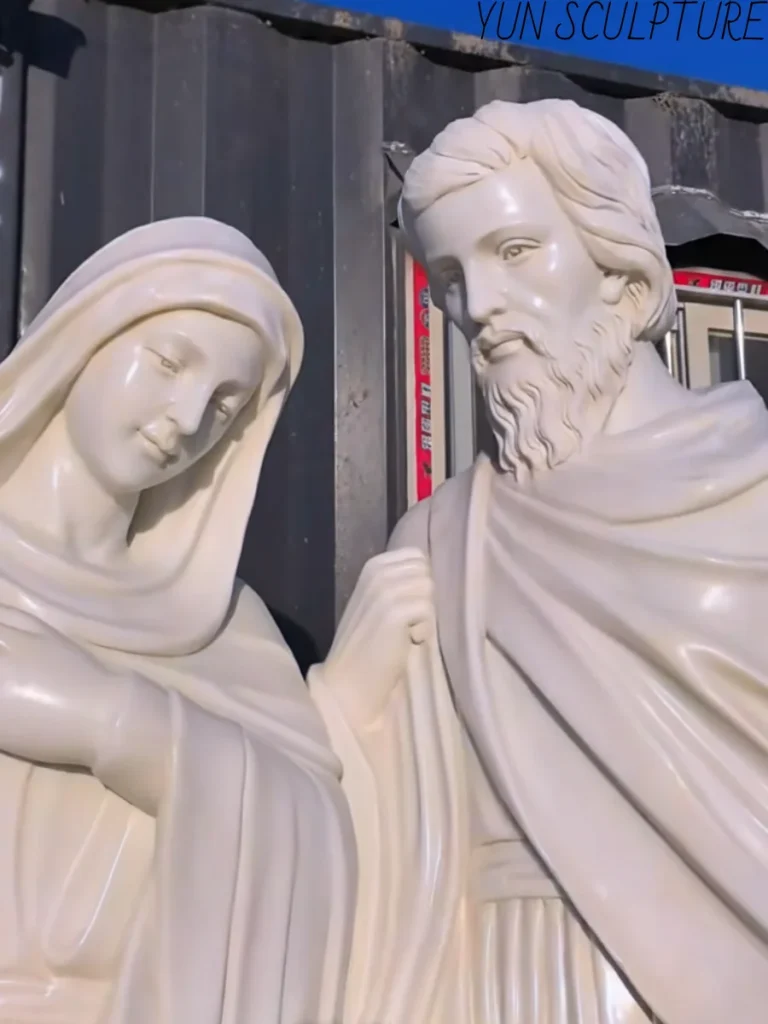
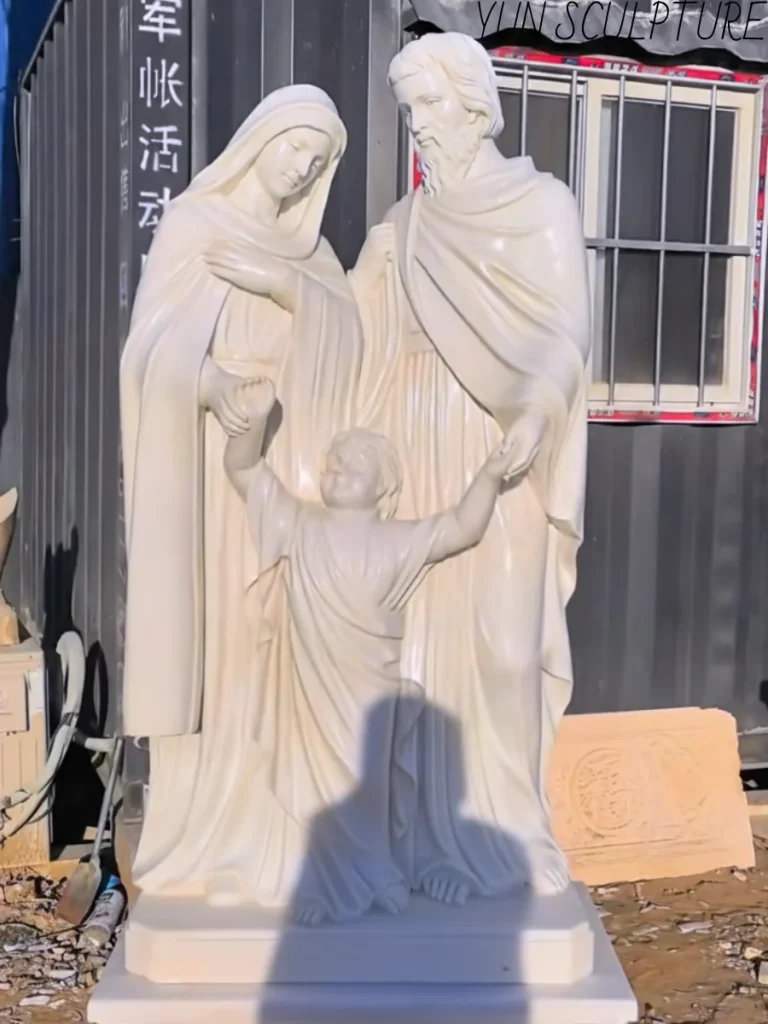
High-quality white Carrara marble transmits light 2 to 4 millimeters into its surface before scattering and returning. This sub-surface scattering produces the quality that Renaissance sculptors called morbidezza — the suggestion of living skin, of warmth beneath the surface, of a material that is not quite inert. In a Madonna and Child commission, this property is directly relevant to the theological content of the work. The infant Christ is the God who took on human flesh. A material that reads as flesh — that carries light within it the way skin carries warmth — is not merely aesthetically appropriate. It is theologically precise.
Chinese Hanbaiyu white marble, quarried primarily in Baoding, Hebei Province, offers a comparable crystal structure with a slightly warmer undertone in certain quarry cuts. We work with both materials and select between them based on the specific visual character the commission requires — Carrara for the cooler, more luminous quality associated with the Italian Renaissance tradition; Hanbaiyu for commissions where a warmer, more intimate surface tone better serves the iconographic intent.
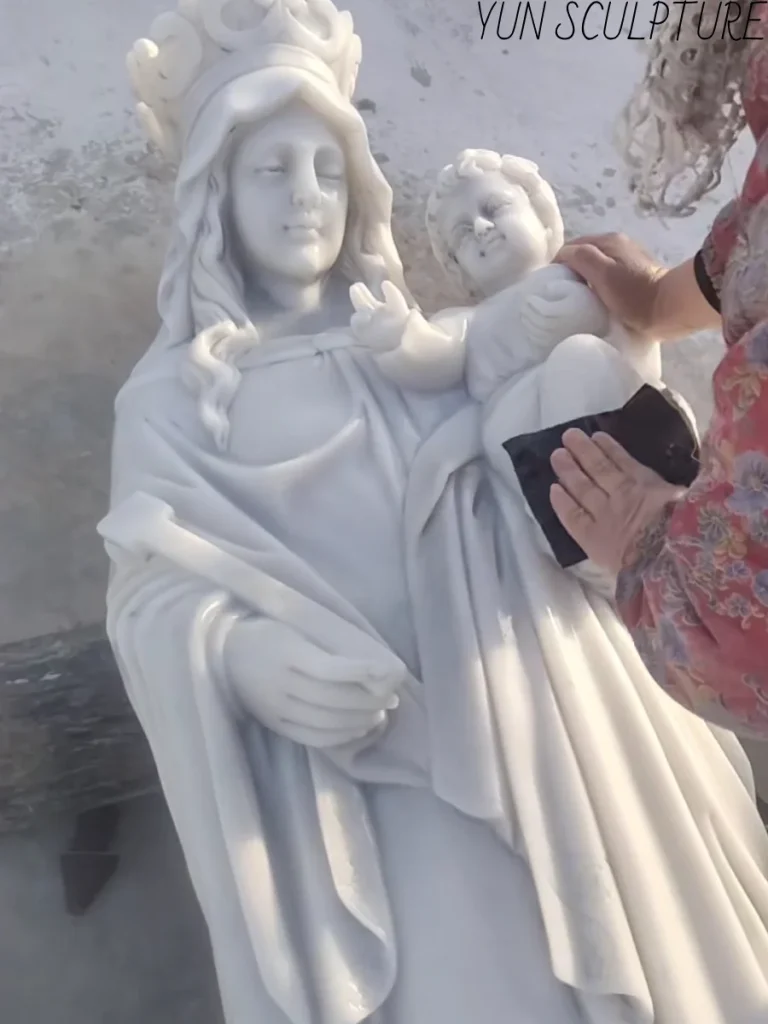
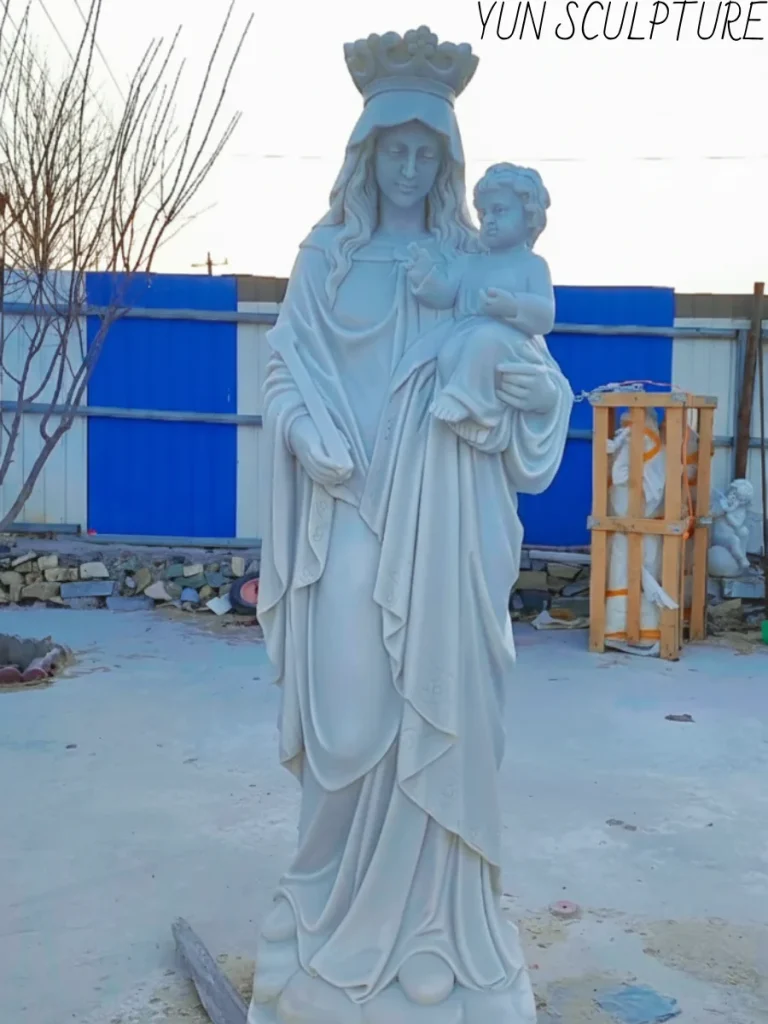
The jesus marble statue format carries one absolute constraint: interior installation only. The micro-porosity of white marble — the same porosity that enables its translucency — makes it vulnerable to water infiltration, biological surface growth, and in climates with seasonal freeze-thaw cycles, to progressive internal fracturing. A marble mary and jesus sculpture placed outdoors in any climate with significant rainfall or temperature variation will show surface degradation within five to ten years. We do not produce marble commissions for outdoor installation, and this constraint is stated explicitly in our delivery documentation.
Within the interior installation context, marble speaks a language that bronze cannot replicate. A white marble Madonna and Child placed in a chapel where morning light enters from the east will appear to change through the day as the light angle shifts — the sub-surface scattering responding differently to raking light than to frontal illumination, the surface appearing to breathe. This responsiveness to light is the defining quality of the material, and it is the reason that no other medium has displaced marble for the highest-quality interior sacred commissions across five centuries of Western art.
Bronze — The Language of Permanence and Presence
Where marble speaks in light, bronze speaks in time. The surface of a well-patinated bronze figure carries the visual weight of accumulated years — a depth and richness that no freshly worked material possesses. This quality is not available at installation. It develops across decades, and it deepens across centuries.
For a statue of mary and jesus intended for outdoor installation — a church courtyard, a cemetery garden, a pilgrimage path — bronze is not merely preferred. It is the only material that can deliver both the sculptural quality the subject demands and the environmental durability the installation requires.
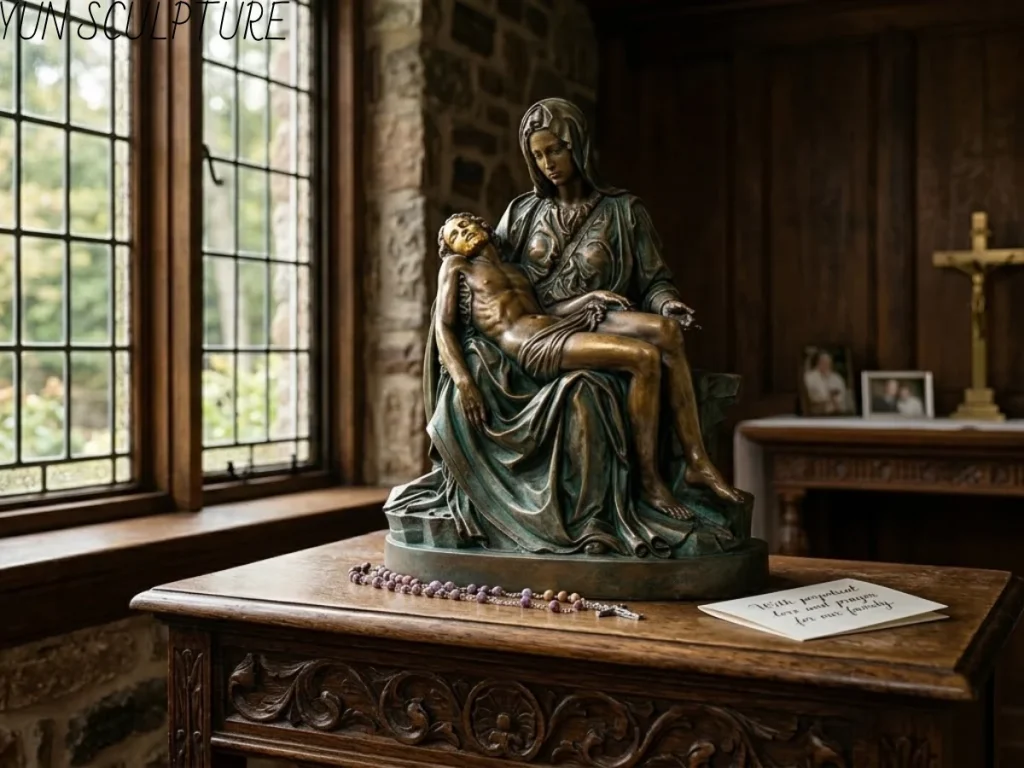
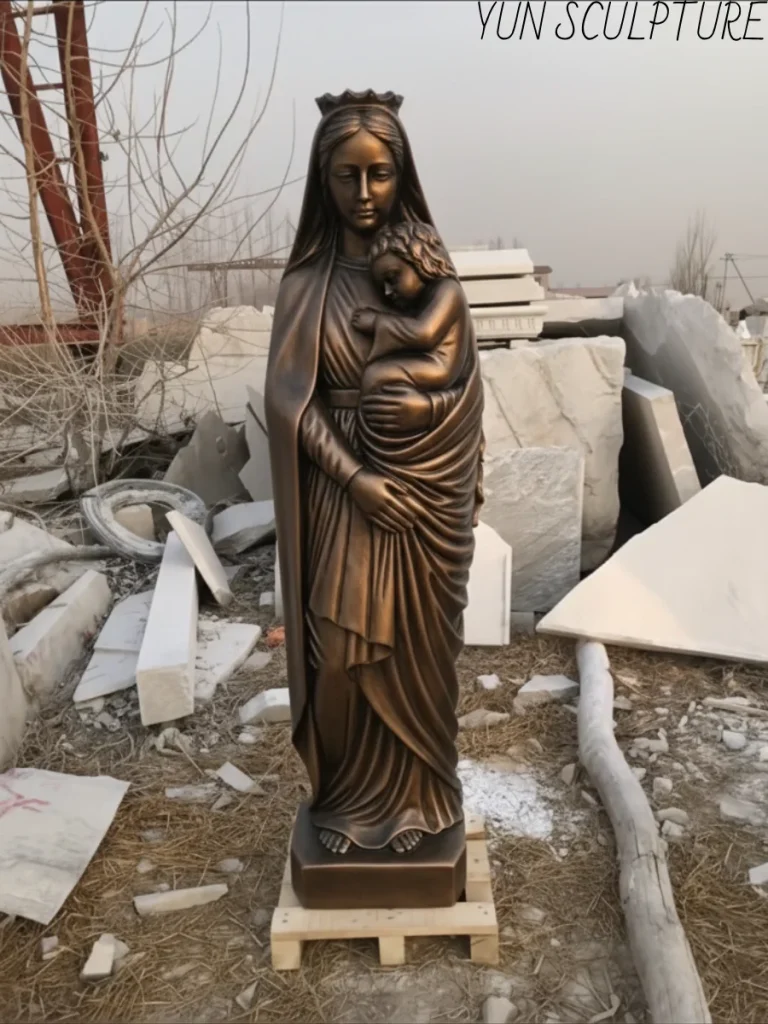
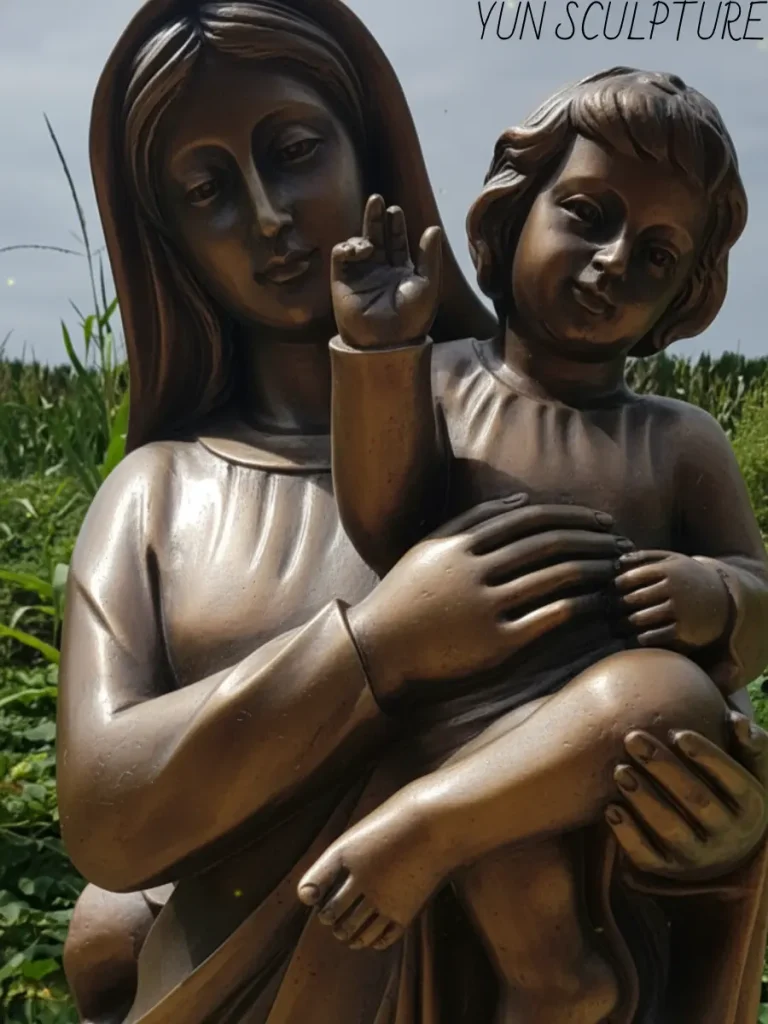
The patination strategy for a Madonna and Child commission in bronze differs significantly from single-figure commissions. Two figures in physical contact must be differentiated by surface treatment — the Virgin’s robes distinct from the infant’s skin, the infant’s skin distinct from the swaddling cloth, the swaddling cloth distinct from the Virgin’s mantle. A virgin mary statue with baby jesus that treats all surfaces in a single uniform patina reads as flat and undifferentiated, the richness of the composition lost.
Our patination approach for multi-figure bronze commissions uses a zone-differentiated treatment:
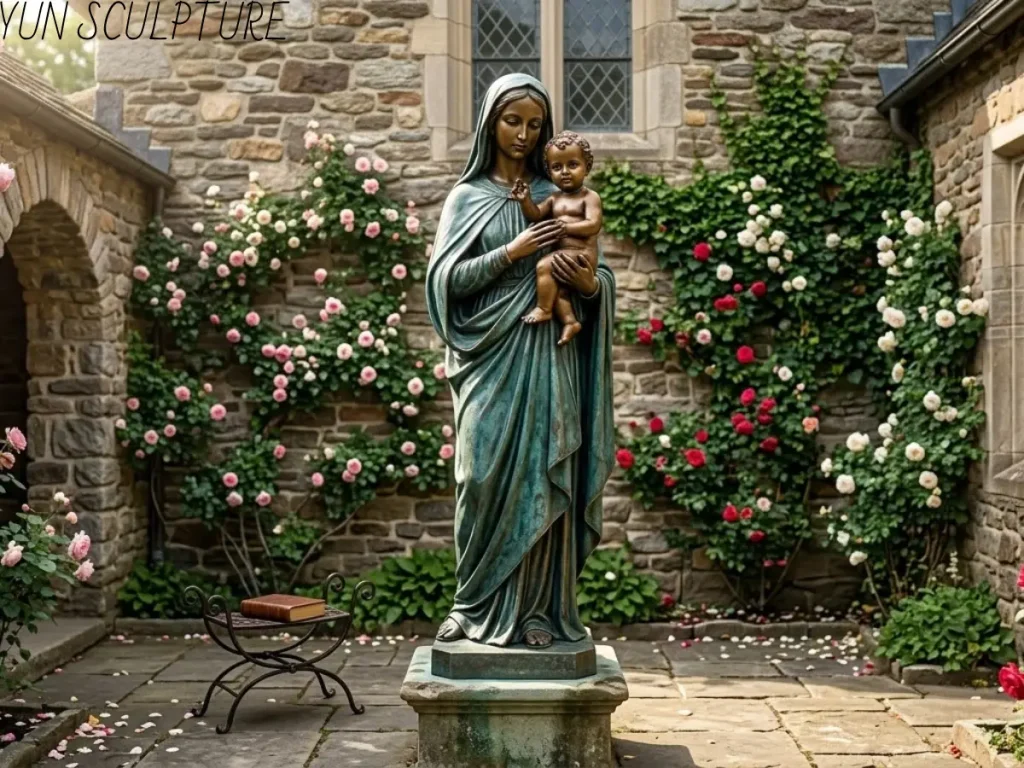
The Virgin’s mantle and outer robes receive a deep verde antique treatment — the blue-green patina that corresponds, in the bronze palette, to the traditional ultramarine blue of the Virgin’s iconographic color. This is not applied color. It is the bronze itself, chemically altered through controlled cupric nitrate application, producing a stable surface that will not fade, chip, or require color restoration across the life of the installation.
The infant’s skin receives a warmer treatment — a statuary brown with enhanced gold highlights on the raised surfaces of the face, hands, and feet. This warmth distinguishes the child’s body from the cooler tones of the surrounding robes and communicates, through the color language of the metal itself, the human warmth of the Incarnation.
The Virgin’s face and hands receive the most precise individual attention of any area of the composition. The patina on skin surfaces must be warm enough to read as living, restrained enough to maintain the solemnity of the subject, and consistent enough to establish the visual unity of the mother and child as a single compositional whole.
This three-zone patination approach requires between 12 and 18 hours of skilled labor on a life-size commission — significantly more than a single-figure bronze of equivalent scale. It is the stage of the process that most directly determines the final emotional character of the work.
Sizing Guide — The Right Scale for Every Sacred Space
| Installation Context | Statue Height | Format | Material |
|---|---|---|---|
| Home prayer room / desk | 20 – 45 cm | Madonna & Child | Bronze or Marble |
| Hospital / hospice chapel | 60 – 90 cm | Madonna & Child | Bronze |
| Small parish chapel altar | 90 – 120 cm | Madonna & Child or Pietà | Bronze or Marble |
| Parish church main altar | 150 – 180 cm | Madonna & Child | Bronze or Marble |
| Cemetery memorial | 120 – 180 cm | Pietà | Bronze |
| Cathedral installation | 180 – 250 cm | Madonna & Child or Pietà | Bronze + Armature |
| Outdoor courtyard landmark | 200 cm + | Madonna & Child | Bronze + Engineered Steel |
The Pietà format requires specific sizing guidance that differs from standing figures. Because the composition is wider than it is tall, the effective visual scale of a Pietà is determined primarily by the width of the composition rather than the height. A Pietà with a Christ figure of 170 centimeters in length will read, in a courtyard or chapel, as a much larger presence than a standing figure of equivalent height. We calculate the visual footprint of Pietà commissions using the diagonal measurement of the composition rather than the vertical height, and we recommend installation spaces that provide a minimum viewing distance of 1.5 times the diagonal for full compositional legibility.
The mary and jesus mini statue category — figures below 45 centimeters — represents a significant segment of our commission work for personal devotional use. At this scale, the technical challenges are different: the infant’s facial features must be resolved at dimensions of 2 to 3 centimeters, which requires our finest detail sculptors and the most controlled lost-wax casting conditions. A 30-centimeter Madonna and Child in bronze or marble that fails to resolve the infant’s face correctly is not a small version of a successful large commission. It is a failed commission at any scale.
Who Commissions a Mary and Child Statue?
The mother mary holding jesus statue occupies a unique position in the sacred art commission landscape: it is requested across a broader range of clients, contexts, and price points than any other single devotional image. The reasons are biographical as much as theological — this image speaks to the experience of parenthood, of loss, of the relationship between a mother and a child, in ways that transcend specific doctrinal commitments.
Catholic Parishes and Dioceses commission the Madonna and Child for altar installations, entrance sculptures, and garden focal points. The Pietà format is frequently commissioned for Passion chapels, memorial gardens adjacent to parish cemeteries, and as part of outdoor Stations of the Cross sequences. Diocese art and architecture offices typically have iconographic guidelines for both formats, and we provide compliance documentation upon request.
Cemeteries and Memorial Gardens represent the largest single market for Pietà commissions. The theological resonance of a mother holding her dead son in a landscape of graves is immediate and profound — it speaks directly to the grief of every family that has buried a child, and to the grief of every parent who knows they will be buried before their children visit this place. Bronze Pietà installations at cemetery entrances and in memorial garden focal points are among the most emotionally significant commissions we execute.
Hospitals, Hospices, and Healthcare Institutions commission Madonna and Child figures with specific pastoral intent. The image of a mother holding a child — alive, protected, held — speaks to patients and families in acute care settings with a therapeutic directness that few other sacred images match. These commissions are typically modest in scale but receive the same precision of execution as our largest landmark pieces, because the people who will sit before them are among the most vulnerable our clients serve.
Italian-American and Catholic Heritage Communities bring a specific commission type that exists nowhere else in our client range with the same frequency: the replication of a family heirloom. A grandmother’s marble Madonna, a great-uncle’s bronze Pietà, a parish’s historic plaster figure — these objects carry biographical meaning that transcends their material quality, and clients who commission their replication are asking us not only to produce a beautiful object but to preserve a connection across generations. We approach these commissions with particular care, because the reference object is irreplaceable and the emotional stakes are higher than any purely aesthetic brief.
Private Chapel and Estate clients commission Madonna and Child figures as the devotional centerpiece of personal sacred spaces. These clients exercise the highest level of iconographic specificity — requesting particular expressions, particular hand positions, particular relationships between the figures — and they typically have the longest deliberation timelines and the most sustained engagement with the clay review process. The finest work we produce often comes from these commissions, because the client’s investment in the details of the clay model produces a level of refinement that institutional timelines rarely permit.
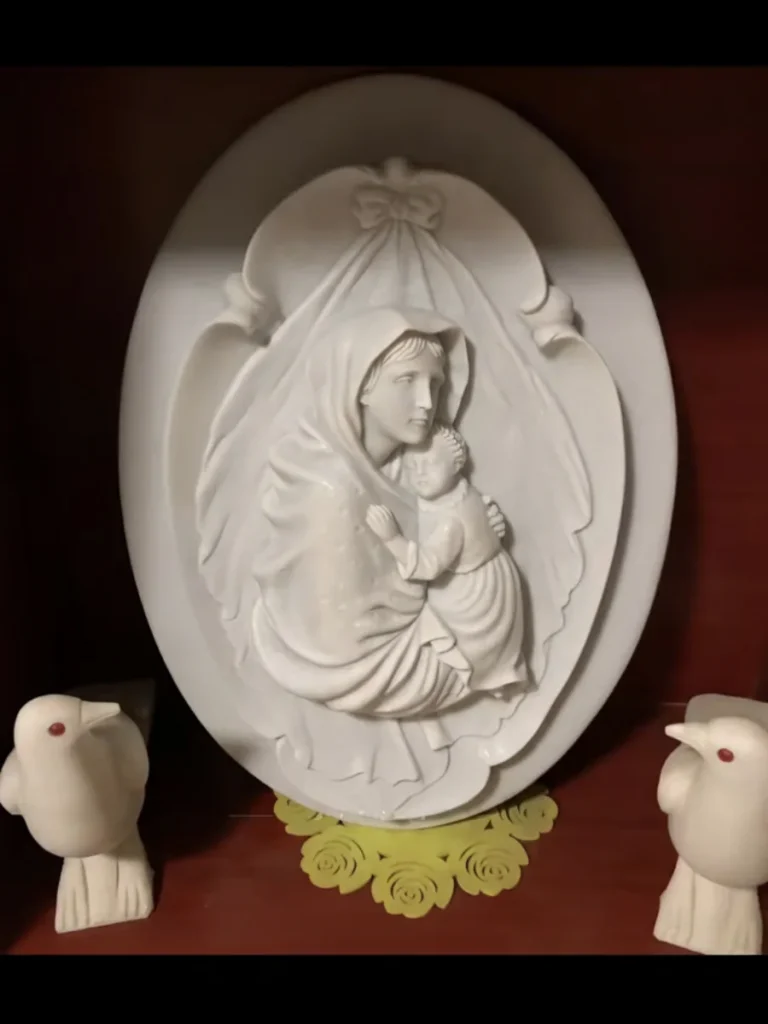
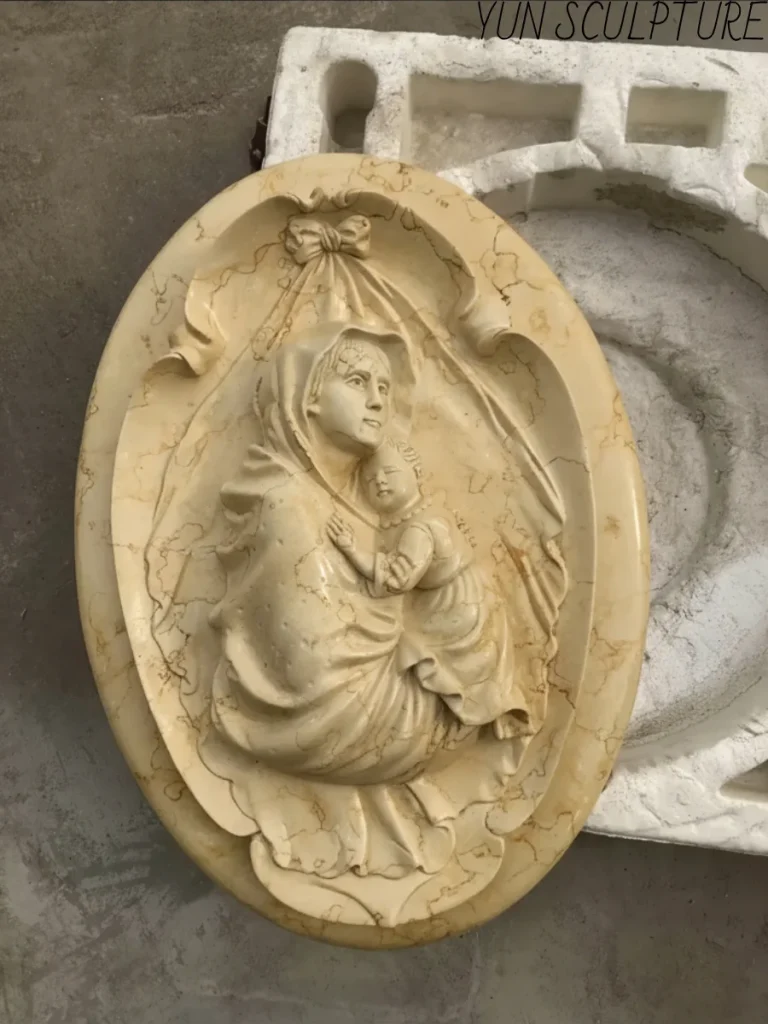
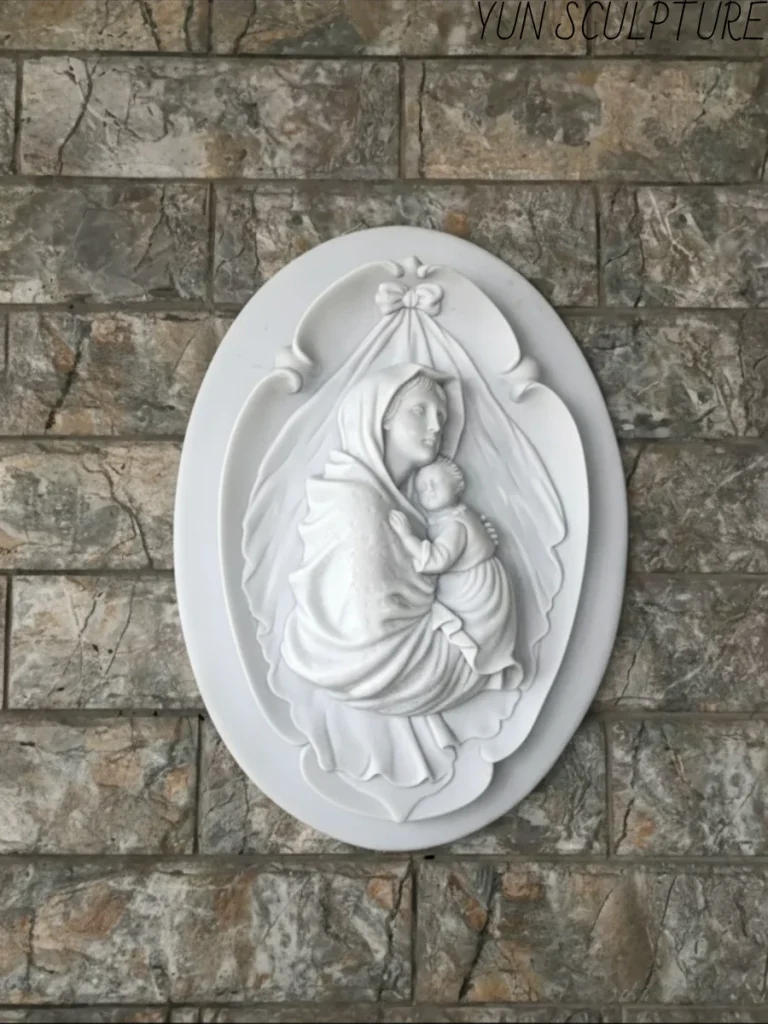
The Holy Family and Nativity Commissions represent an extension of the Madonna and Child brief that deserves specific mention. A joseph holding baby jesus statue commission — or a complete Nativity scene comprising Mary, Joseph, the infant Christ, and supporting figures — is a multi-figure commission of significant complexity. The compositional challenge of establishing visual hierarchy among multiple figures while maintaining the primacy of the mother-child relationship is one of the most demanding briefs our studio undertakes. We recommend a dedicated consultation for any commission involving three or more figures before any design work begins.
FAQ — 12 Core Questions Answered
What is the Pietà?
The Pietà is a specific iconographic tradition in Christian sacred art depicting the Virgin Mary holding the body of the adult Christ after his removal from the Cross — the moment between the Deposition and the burial. The word is Italian for pity or compassion. The tradition has existed in various forms since the 14th century, but its definitive expression is Michelangelo’s marble Pietà of 1499, now in St. Peter’s Basilica in Vatican City.
Who made the Pietà — the sculpture of Jesus and Mary?
Michelangelo Buonarroti, working in Rome between 1498 and 1499, commissioned by the French Cardinal Jean de Bilhères. Michelangelo was 24 years old when he completed it. It is the only work he ever signed — his name is carved into the sash across the Virgin’s chest. The original is carved from a single block of Carrara white marble and remains in St. Peter’s Basilica, Vatican City, where it has stood for over five centuries.
What sculpture shows Mary holding Jesus?
Two distinct traditions answer this question. The Madonna and Child tradition shows Mary holding the infant or young Christ — alive, the theological moment of the Incarnation. The Pietà tradition shows Mary holding the adult Christ after his death — the theological moment of the Passion and the prelude to the Resurrection. Michelangelo’s Pietà in the Vatican is the most famous example of the second tradition. Both are among the most replicated sacred images in the history of Christian art.
Where is the original Pietà located?
Michelangelo’s Pietà has been in St. Peter’s Basilica, Vatican City, since its completion in 1499 — with one exception: it was displayed at the 1964 New York World’s Fair, the only time it has left Italy. It is currently displayed in the first chapel on the right inside the main entrance of the basilica, protected behind bulletproof glass installed after a 1972 attack in which a geologist struck the figure with a hammer, damaging the Virgin’s arm and several fingers of Christ’s hand. The repaired elements are visible to close examination but do not affect the work’s overwhelming visual impact.
What is the difference between a Madonna and Child and a Pietà?
They depict different theological moments in the life of Christ. The Madonna and Child — the baby jesus statue tradition — shows the beginning of Christ’s earthly life: God made flesh, held in his mother’s arms as an infant. The Pietà shows the end of his earthly life: the same body, thirty-three years later, returned to his mother’s arms after the Crucifixion. Together, the two images form a bracket around the entirety of the Incarnation — the first and last time a mother holds her son in this way.
How much does a life-size bronze Mary and Jesus statue cost?
A custom life-size Madonna and Child commission — Mary at approximately 150 to 170 centimeters with infant — cast in Grade A Foundry Bronze with our zone-differentiated patination system generally ranges from $12,000 to $22,000, depending on the complexity of the figure modeling, the detail resolution of the infant, and the installation engineering requirements. A life-size Pietà commission, with its broader compositional footprint and additional structural engineering requirements, generally ranges from $18,000 to $35,000. Both ranges reflect the additional labor of multi-figure composition work relative to single-figure commissions of equivalent scale.
Can you replicate Michelangelo’s Pietà in bronze?
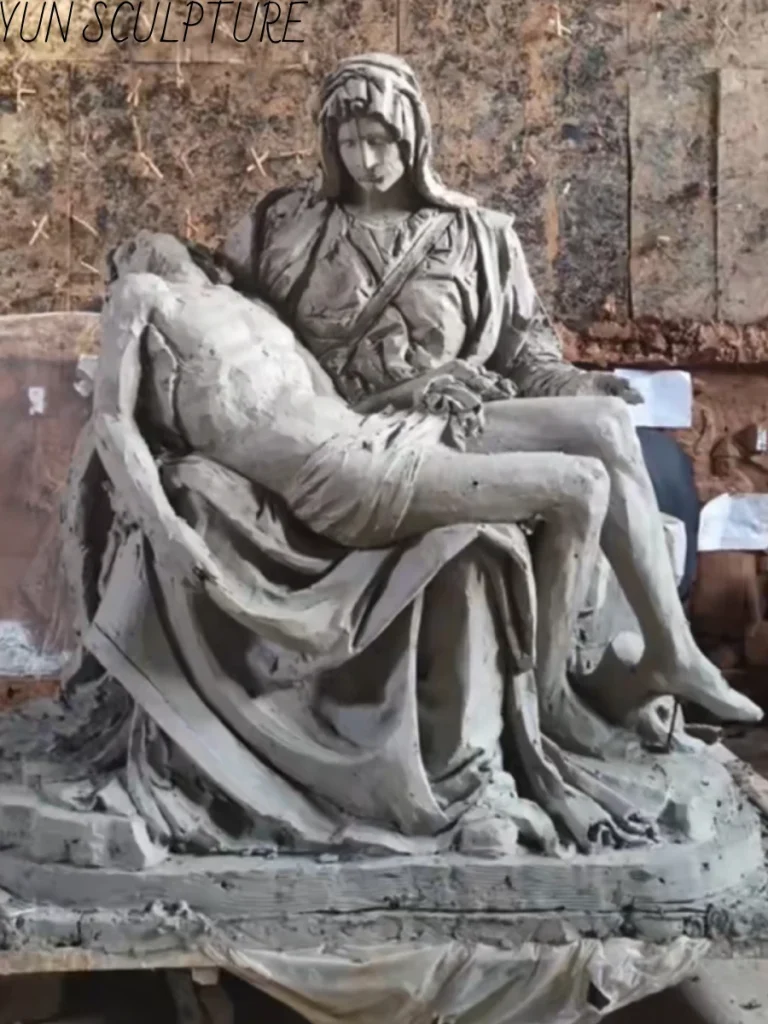
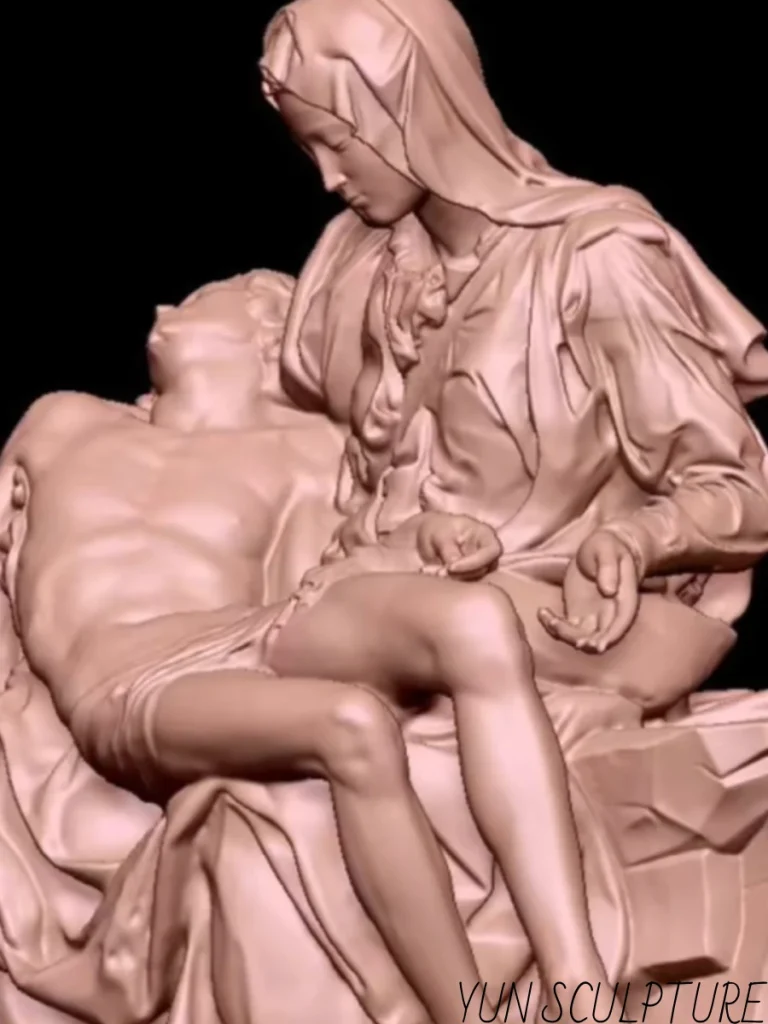
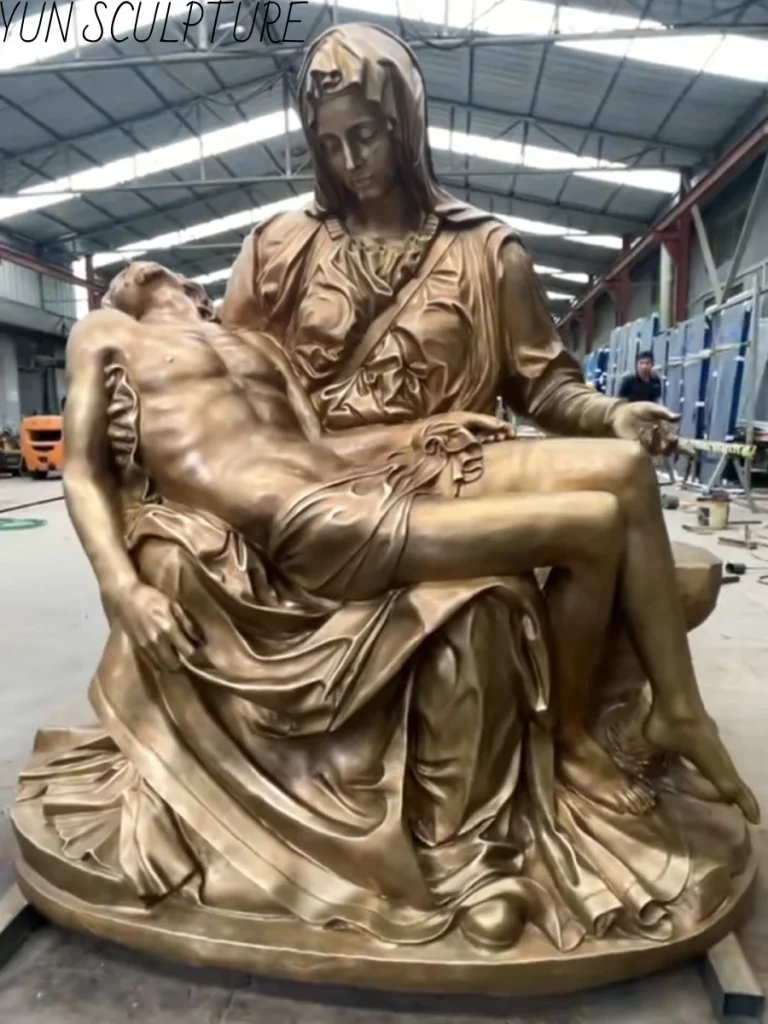
Yes, and we have done so multiple times at various scales. A faithful bronze replication of the Pietà begins with a detailed study of the original’s proportional system — including Michelangelo’s deliberate expansion of the Virgin’s seated volume to accommodate the adult Christ figure. This proportional system must be understood and respected before the clay model begins, because replicating the surface detail without understanding the underlying structural logic produces a result that looks superficially similar but lacks the compositional coherence of the original. Our studio maintains a complete dimensional reference document for the Pietà, updated from the most recent photogrammetric survey data available.
Where do you buy a high-quality Mary and Jesus statue?
The reliable markers of quality in this commission category are not difficult to identify. A serious studio will ask iconographic questions before design questions — which tradition, which moment, which relationship between the figures. They will produce a full-scale clay model for client review before any bronze is poured or any stone is cut. They will have executed multi-figure commissions before and can show you the results. And they will be honest about the material constraints: a studio that offers you a marble statue of mary and jesus for outdoor installation is either uninformed about material science or indifferent to your commission’s longevity. The right studio knows the difference between what is beautiful and what will last, and it builds both into the same object.
How long does a custom Mary and Child bronze commission take?
A standard Madonna and Child commission at life-size scale requires between 80 and 100 days from signed approval to completed bronze. A Pietà commission at equivalent scale — owing to the additional compositional complexity, the structural engineering of the cantilevered elements, and the extended patination process — requires between 100 and 130 days. These timelines are not compressible without cost to quality. The clay review process for a multi-figure commission requires more client engagement than a single figure, and we protect the timeline necessary for that engagement.
Can facial features be customized for our commission?
Yes, within the boundaries of iconographic tradition. The Virgin’s face in our Madonna and Child commissions can be modeled to reference specific ethnic features — a Virgin who reads as Filipino, as West African, as Mexican, as Northern European — because the theological content of the image is not dependent on a specific racial type, and the global Catholic tradition has always depicted the Madonna in the visual language of each culture that venerates her. The infant Christ’s features are adjusted correspondingly. All customization requests are reviewed at the clay modeling stage, with photographs provided to the client for approval before mold making begins.
What size is best for a church altar Mary and Child statue?
A mary with jesus statue at 150 to 180 centimeters — with the Virgin at approximately life-size scale — is the standard for a parish church main altar installation. At this scale, the figure is legible from the nave at distances of 10 to 20 meters, the infant’s features are resolved with sufficient detail to read at moderate distance, and the composition has sufficient visual weight to anchor a liturgical space without overwhelming it. Smaller chapels and side altars are typically served by figures in the 90 to 120 centimeter range.
What material is best for an outdoor Mary and Jesus statue?
For any outdoor installation — courtyard, cemetery, pilgrimage garden, or public space — Grade A Foundry Bronze is the only material we recommend. White marble, despite its extraordinary beauty, is not an outdoor material: its micro-porosity makes it vulnerable to water infiltration, biological growth, and freeze-thaw damage in any climate with seasonal temperature variation. A mary and jesus statue placed outdoors in marble will show surface degradation within five to ten years in most climates. Bronze, with its self-protective patina chemistry, will improve in surface quality over the same period and require no structural intervention for decades.
The Oldest Image, Built to Last
Marco Ferretti’s bronze Madonna and Child was installed in his Connecticut chapel in the spring of 2023. It stands 168 centimeters tall — the Virgin at life-size, the infant held against her left shoulder, his face turned outward toward the chapel entrance. The patina on the Virgin’s mantle carries the deep verde antique of the traditional blue. The infant’s face, resolved at 6 centimeters of bronze, holds the expression that our sculptor spent three weeks of clay work establishing: not quite smiling, not quite solemn, the expression of a child who is completely, unquestioningly held.
At the base, following Marco’s request, we cast a small inscription into the bronze — the name of the Naples workshop from his grandmother’s marble original, and the year: G. Esposito, Napoli, 1923. And beside it, our own mark and the year of completion.
Two names, a century apart, on the same image. The marble that carried it for a hundred years has been translated into a material that will carry it for several hundred more. The mother still holds the child. The child still looks outward.
This is what mary and baby jesus statue commissions are, at their truest: an act of continuity, a decision to carry forward across time an image of a mother and a child that human beings have been making, in every material available to them, for as long as they have had the hands and the belief to do it.
We are ready to build the next century of that continuity with you.
— Elena Zhang & Donghui Zhang, Yun Sculpture