Get in touch with Yun-Sculpture company
St. Joseph and Jesus Statue: Commissioning the Nazareth Workshop Scene

A st joseph and jesus statue can mean two very different things. The first is the devotional classic — Joseph standing tall, the infant Jesus cradled in his arms, a lily in his other hand. Beautiful, familiar, and available in resin from a dozen Catholic supply catalogs. The second is something altogether different: the Nazareth workshop scene, where Joseph and the adolescent Jesus work side by side — tools in hand, gaze connecting, the weight of mentorship made visible in stone or bronze. This guide is about commissioning the second kind.
Table of Contents
Table of Contents
What Was St. Joseph’s Relationship to Jesus?
The Gospel of Luke records something easy to overlook: the people of Nazareth referred to Jesus as “Joseph’s son.” Not a courtesy title. A social reality.
In first-century Jewish culture, a son learned his father’s trade. The skills were not taught in a classroom — they were absorbed through years of shared work. Joseph would have placed tools in Jesus’s hands, corrected his grip, shown him how to measure twice and cut once. For somewhere between fifteen and eighteen years, the Son of God went to work every morning in his father’s workshop and came home in the evening.
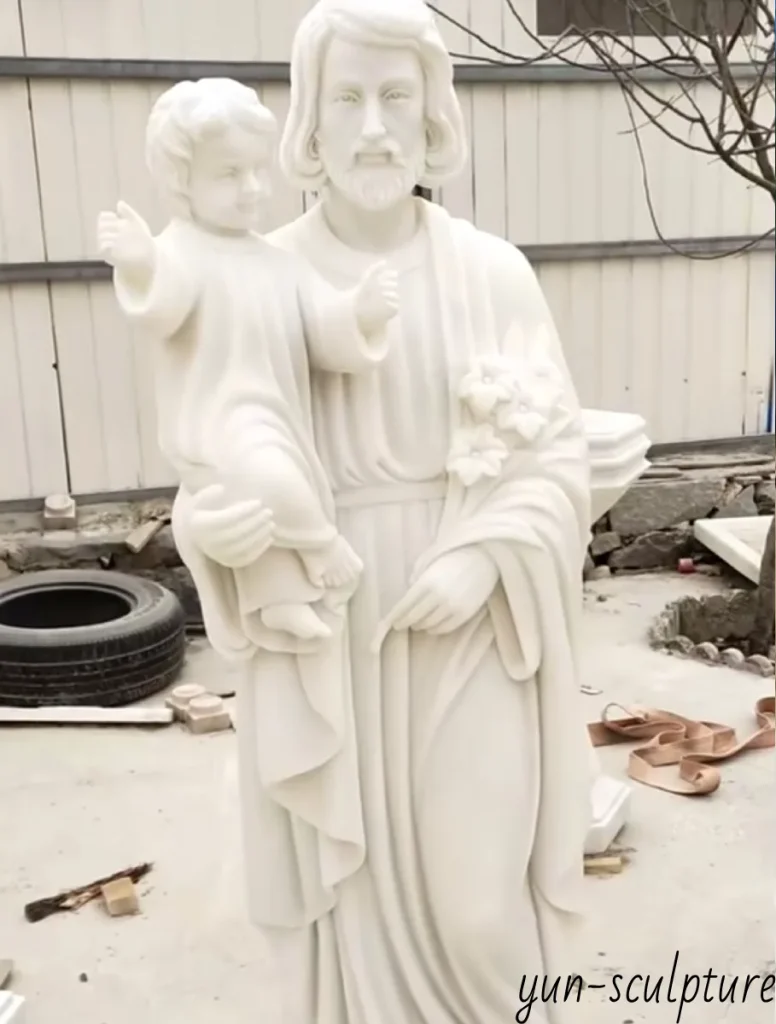
This is the relationship at the heart of a St. Joseph and Jesus statue. Not an image of supernatural guardianship, but of the most ordinary and profound thing a father does: teaching his son how to work well.
For churches, Catholic schools, and family memorial spaces, this scene carries a message that the standard guardian image cannot. It speaks directly to fathers, teachers, and mentors — anyone who has ever shaped a younger person through patient, daily example rather than words.
Who Is Saint Joseph the Carpenter?
The title “carpenter” comes from the Greek word tekton in Matthew 13:55 — a term that means craftsman or builder, not strictly a woodworker in the modern sense. In first-century Palestine, stone construction was far more common than wooden framing, which means Joseph likely worked with multiple materials across structural projects, not only furniture in a small workshop. We explore the full tekton backstory — including the town of Sepphoris and what it means for tool selection — in our Feast of St. Joseph the Worker history guide.
What matters for this commission: the tekton identity makes Joseph a builder of structures, not only a maker of objects. That distinction changes both the tool selection and the visual weight of the father-son scene.
What Is the Symbol of St. Joseph the Carpenter?
Each tool Joseph holds in sacred art carries theological meaning, and in a father-son composition, tool selection defines the emotional and spiritual register of the entire scene.
The carpenter’s square — the most common symbol — represents justice, moral alignment, and righteous work. A Joseph holding the square beside Jesus communicates that the father is teaching the son to measure truly, to build without deviation.
The saw represents the ongoing labor of transformation — raw material becoming useful form. A dynamic workshop scene with Joseph guiding Jesus through a cut communicates active mentorship.
The chisel and hammer, reflecting the tekton identity, emphasize Joseph as a builder of foundations. This combination works especially well in compositions where Joseph demonstrates technique — the hammer mid-swing, Jesus watching.
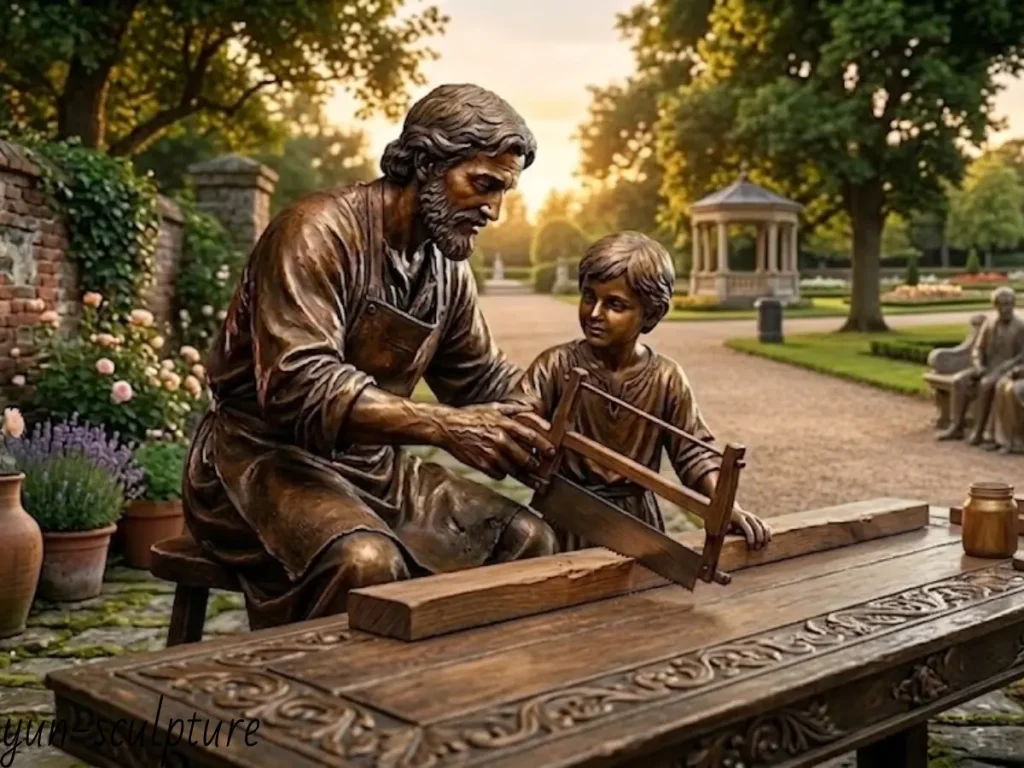
The lily, which appears in the classic guardian image, is typically absent or secondary in the workshop scene. Its presence softens the composition toward fatherhood and purity; its absence sharpens the focus on labor and craft.
One element unique to the father-son scene: the workbench or stone block as a shared focal point. Both figures orient toward the work between them. This creates a triangular visual structure — father, son, material — that anchors the composition and communicates the act of teaching without requiring any text.
Not sure which tool combination fits your institution’s message? Tell us your setting and we will suggest the right composition for your space.
How Do You Design a St. Joseph and Jesus Workshop Scene?
This is where most catalogs stop and where a real commission begins.
The first decision is proportion. Jesus should stand at roughly one-half to two-thirds of Joseph’s height, depending on whether the scene depicts a young child learning or an adolescent already capable. I tend to recommend the adolescent proportion for institutional commissions — it reads more powerfully from a distance, and the emotional dynamic of near-equal figures still clearly separated by experience and authority is more interesting sculpturally than a man holding a small child.
The second decision is gaze. This is the emotional center of the entire sculpture. Joseph looking toward Jesus communicates instruction and responsibility. Jesus looking toward Joseph communicates trust and attention. When their sight lines intersect — even in a static pose — the viewer feels the connection between them. When the gazes diverge, even slightly, the sculpture loses its emotional core. Donghui Zhang reviews gaze alignment in every clay maquette before approval, because errors in this element cannot be corrected after casting.
The third decision is static versus dynamic composition.
A static composition shows both figures holding tools in a moment of pause — side by side, calm, present. The mood is contemplative. It suits chapels, prayer gardens, and spaces where reflection is the primary function.
A dynamic composition shows Joseph in mid-instruction — guiding Jesus’s hands on a tool, pointing at a measurement, demonstrating a technique. The mood is active and relational. It suits school entrances, vocational training centers, and family memorial spaces where the message of mentorship and formation should be immediately legible.
Both are valid. The wrong choice is not between static and dynamic — it is choosing one without considering where the sculpture will live and who will stand in front of it.
We completed a life-size bronze workshop scene two years ago for a Catholic high school in the Pacific Northwest — a school whose identity is built around college preparation and vocational training running side by side. The director wanted Jesus at adolescent height, approximately two-thirds of Joseph’s stature, with a dynamic pose: Joseph’s hands over Jesus’s on a chisel, both looking down at the stone between them. The finished piece stands at the school entrance. Students walk past it every morning before class begins. The director told us afterward that parents comment on it constantly during campus visits — not because it is large or imposing, but because it shows something they recognize. A father teaching a son to do something real with his hands.
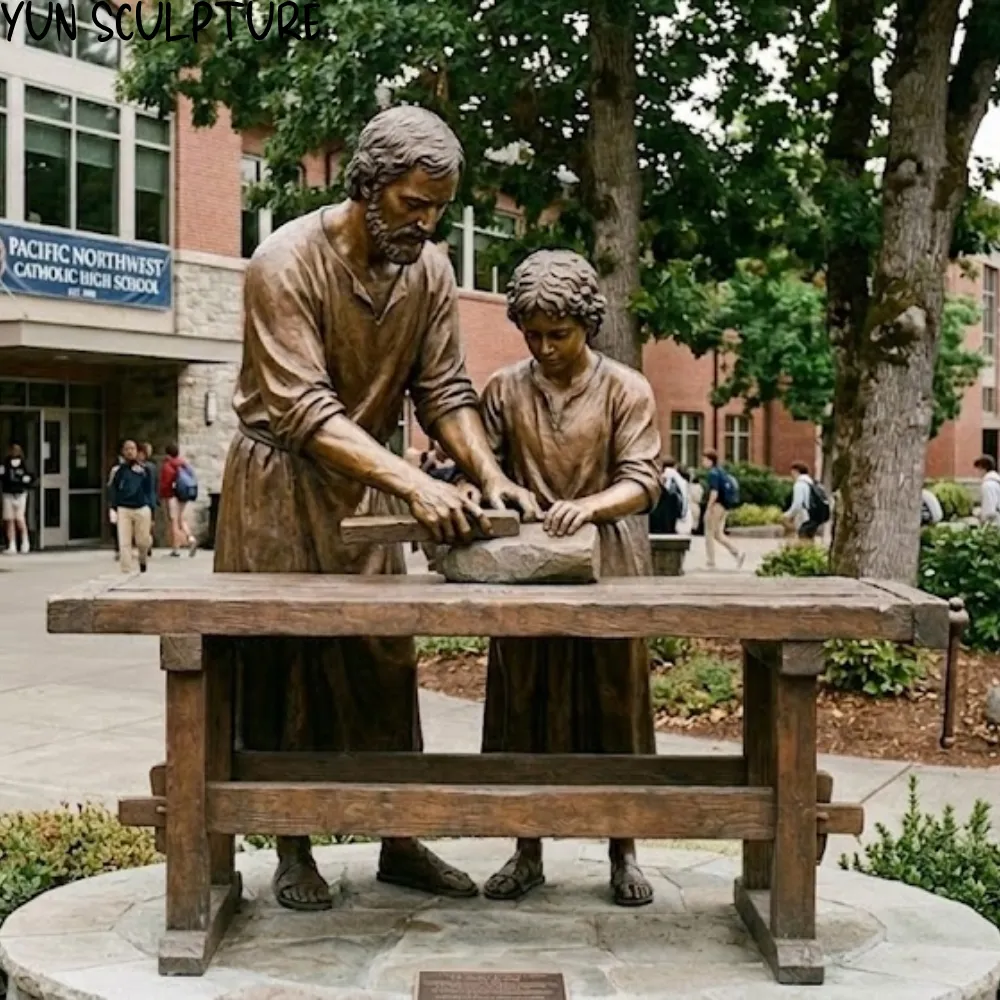
For a two-figure composition in bronze at life-size, Donghui builds internal armature connecting both figures through the shared base, distributing weight across the entire structure rather than through each figure independently. This prevents the stress fractures that can develop at the ankles of single figures when a second figure creates asymmetric load. The base for a life-size father-son bronze runs 24–30 inches, with concrete anchoring recommended for all outdoor installations.
For marble, the structural calculus changes significantly. Extended arms and tool-holding hands are the highest-risk elements — marble is strong under compression but vulnerable under tension, and a hand extended to guide a chisel creates exactly the kind of leveraged stress point that can fail over decades. Donghui limits marble father-son scenes to compositions where both figures are relatively contained — arms close to the body, tools held vertically rather than extended horizontally. For more dynamic poses, bronze is the technically correct choice.
For context on how material selection works across other multi-figure religious commissions, our Holy Family statue commission guide covers the structural principles in detail.
FAQ
Who is the saint holding the child statue?
The most common depiction of a saint holding the Child Jesus is St. Joseph — shown standing with the infant Jesus cradled in one arm and a lily in the other hand. This image represents Joseph’s role as foster father and earthly guardian of Christ. Other saints occasionally depicted holding the Child Jesus include St. Anthony of Padua, who is shown with the infant Jesus appearing to him in a vision, and St. Christopher, who carried the child across a river. In most church and garden contexts, a bearded male figure holding the Child Jesus is almost certainly St. Joseph in his traditional guardian form, distinct from the worker image where tools replace the child and lily.
How old was Jesus when St. Joseph died?
Scripture does not record the death of St. Joseph, and no precise age is given. The most widely accepted theological tradition holds that Joseph died before Jesus began his public ministry — because Joseph is entirely absent from the Gospel accounts of the adult Jesus, while Mary appears repeatedly. Scholars estimate Joseph died sometime during Jesus’s adolescence or early adulthood, possibly when Jesus was in his late teens or early twenties. Catholic tradition venerates Joseph as the patron of a happy death, in part because he is believed to have died in the presence of both Jesus and Mary — the most grace-filled death imaginable. This tradition shapes how many father-son workshop scenes are designed: the adolescent Jesus, not the infant, because their shared years of work were the heart of the relationship.
What makes St. Joseph unique among the saints?
Joseph holds a position in Catholic tradition unlike any other saint: he was the man God chose to be the earthly father of his Son. He speaks no recorded words in the New Testament, yet his decisions — to accept Mary despite uncertainty, to flee to Egypt, to return to Nazareth — shaped the physical circumstances of the Incarnation. He is one of only three figures with more than one universal feast day (alongside Mary and John the Baptist). He is the patron of the universal Church, workers, fathers, craftsmen, the dying, homebuyers, and travelers — a breadth of patronage reflecting the breadth of his responsibilities. And he lived in closer daily proximity to Jesus than any other person in history, sharing meals, work, and ordinary life with the Son of God for nearly two decades.
What saint protects your children?
St. Joseph is the most widely invoked patron for the protection of children and families in Catholic tradition, precisely because God entrusted him with the protection of the Child Jesus under conditions of genuine danger — Herod’s threat, the flight to Egypt, the years of exile and return. His protective role was not symbolic; it was physical and urgent. Other saints frequently invoked for children’s protection include the Guardian Angels, St. Nicholas (patron of children), and the Virgin Mary. For parents commissioning a statue for a home garden or family memorial, a St. Joseph and Jesus statue serves a dual devotional purpose: it honors the father-son relationship and places the household under the protection of the man God trusted with his own Son.
Commission the Nazareth Workshop Scene
The workshop of Nazareth was the place where God chose to spend most of his earthly years doing ordinary work. A bronze or marble father-son scene brings that workshop into your school, garden, or institution — permanently.
Browse our St. Joseph and Jesus statue collection →
Share your space dimensions and vision — receive a free custom commission quote within 24 hours →