Get in touch with Yun-Sculpture company
Golf Statue for Garden: Bronze, Resin, Zinc Alloy & Cast Iron — What You’re Actually Buying

Search “golf statue for garden” on any major retail platform and you will find hundreds of listings using the word bronze. Most of them are not bronze. They are resin, zinc alloy, or cast iron finished to look like bronze — and the difference matters enormously the moment they go outside. This guide explains exactly what each material is, how each one fails, and what genuine foundry bronze actually looks like when you are comparing specifications.
Table of Contents
Table of Contents
What “Bronze” Really Means on a Garden Golf Statue Listing
The word bronze is used in three completely different ways in the outdoor sculpture market, and only one of them refers to actual bronze.
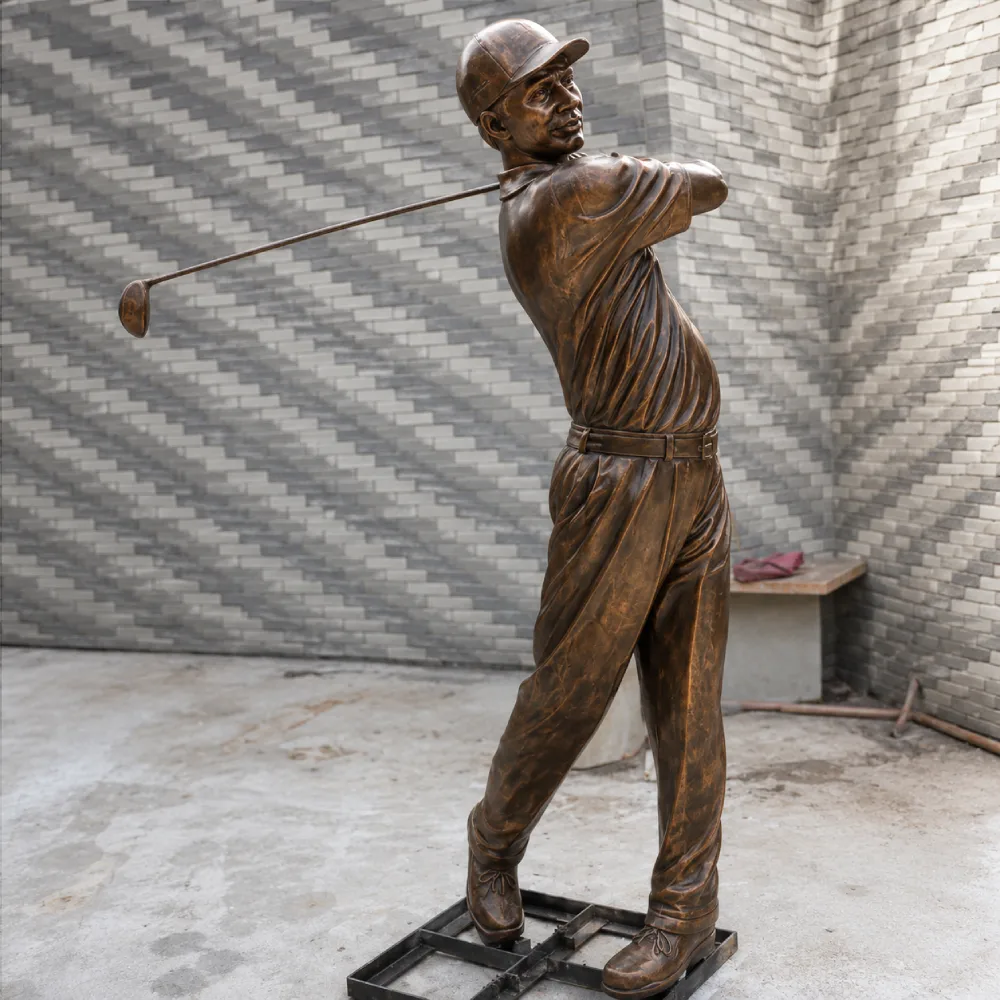
Foundry bronze — sometimes called statuary bronze — is a metal alloy with a copper content above 85%, combined with tin, zinc, and trace elements. It is cast as a liquid metal at approximately 1,100°C into a mold, typically using the lost-wax process. The result is a solid metal object with the structural properties of metal: density, resonance, thermal conductivity, and the ability to form a chemically stable surface patina. This is what the word bronze has meant for four thousand years.
Bronze resin — also marketed as cold-cast bronze or bonded bronze — is a polymer (resin) mixed with bronze powder. The bronze powder content is typically 10% to 30% of total weight. The object is not metal. It is plastic with metal dust suspended in it. It looks similar to bronze at first glance and is significantly cheaper to produce. It is the most common material in the lower end of the garden statue market.
Bronze finish or bronze look describes any object — resin, zinc alloy, cast iron, fiberglass — that has been painted, coated, or electroplated to resemble bronze. The base material has no relationship to bronze whatsoever. Many Wayfair and Amazon listings describe products as having a “classic bronze patina” or “bronze finish” while the product description, if read carefully, states “made of resin” or “electroplated.” The finish is cosmetic. It is not the material.
| Material | What It Actually Is | How It’s Marketed | Copper Content | Outdoor Lifespan |
|---|---|---|---|---|
| Foundry Bronze | Metal alloy, lost-wax cast | “Bronze,” “statuary bronze,” “lost-wax bronze” | 85%+ copper | 50–500+ years |
| Bronze Resin | Polymer + 10–30% bronze powder | “Cold-cast bronze,” “bonded bronze,” “bronze finish” | 10–30% powder only | 2–4 years outdoors |
| Zinc Alloy | Zinc/lead/tin alloy, gravity cast | “Bronze look,” “antique bronze finish,” “metal statue” | 0% | 3–6 years outdoors |
| Cast Iron | Iron alloy, sand cast | “Bronze patina,” “dark bronze finish,” “metal garden statue” | 0% | 1–3 years without maintenance |
| Electroplated Resin | Resin + thin metal surface layer | “Electroplated bronze,” “bronze-dipped,” “metal finish” | Trace surface only | 1–2 years outdoors |
The Three Types of Fake Bronze — and How Each One Fails Outdoors
Understanding why each fake bronze type fails requires understanding what outdoor exposure actually does to different materials. The three types fail in different ways and on different timelines.
Bronze resin fails through UV degradation and moisture infiltration. Resin is a polymer — the same class of material as plastic — and polymers break down under sustained ultraviolet exposure. The surface begins crazing: fine hairline cracks appear, initially invisible, that allow moisture to penetrate the material. In freeze-thaw climates, that trapped moisture expands when it freezes, forcing the cracks wider with each seasonal cycle. I have removed bronze resin garden statues after three winters in the American Midwest that had surface crazing so severe the bronze powder coating was flaking off in sheets, exposing the white polymer substrate beneath.
Zinc alloy — sometimes sold as “zamak” or “pot metal” — fails through galvanic corrosion. Zinc is an active metal that oxidizes readily in outdoor conditions. The oxidation process produces a white powdery zinc oxide deposit on the surface, commonly called “zinc pest” in the trade. Unlike bronze patina, which is protective, zinc oxidation is destructive — it continues eating into the material. A zinc alloy golf statue in a coastal environment with salt air can show visible surface degradation within eighteen months. The casting is also brittle: zinc alloy breaks under impact rather than bending, which means a golf club or a falling branch does not dent a zinc statue — it shatters it.
Cast iron fails through rust. Iron oxidizes in the presence of moisture and oxygen, producing iron oxide — rust — which flakes off the surface, exposing fresh metal to further oxidation. This process is self-perpetuating: unlike bronze patina, which seals the surface, rust actively removes material. A cast iron garden statue without regular maintenance will show surface rust within one to two seasons outdoors. In coastal or high-humidity environments, the process accelerates. Some manufacturers apply rust-inhibiting coatings at the factory, but these coatings require regular renewal and provide only temporary protection.
Year 1–2
Electroplated Resin: Surface coating begins lifting
The thin metal layer delaminates from the resin substrate. Bubbling and peeling appear first at edges and high-contact areas. Underlying resin becomes visible.
Year 1–3
Cast Iron: Rust appears at surface breaks
Any scratch, chip, or factory imperfection exposes iron to oxygen and moisture. Rust develops rapidly and spreads beneath the surface coating. Without repainting, the process accelerates each season.
Year 2–4
Bronze Resin: UV crazing and freeze-thaw damage
Surface hairline cracks appear. In freeze-thaw climates, trapped moisture expands and forces cracks wider each winter. Bronze powder coating begins flaking, exposing white polymer substrate.
Year 3–6
Zinc Alloy: Galvanic corrosion and zinc pest
White zinc oxide deposits appear on the surface. In coastal environments this accelerates significantly. The alloy becomes progressively more brittle. Impact resistance drops — the statue can shatter rather than dent.
Year 1–500+
Foundry Bronze: Patina develops, structure unchanged
Surface color shifts gradually from the foundry finish toward deeper green-brown tones as copper oxide forms. This patina is chemically stable and protective. No structural deterioration on any timeline in recorded use.
Five Tests That Reveal What a Golf Statue Is Actually Made Of
These tests can be applied to any statue before purchase — or to a statue you already own and are uncertain about.
Weight test: Foundry bronze is dense. A life-size bronze golf statue cast in our foundry weighs approximately 150 kg. Even a half life-size figure in genuine bronze — 80 to 90 cm — weighs 30 to 50 kg. If a statue of that size can be lifted by one person without difficulty, it is not solid bronze. Bronze resin figures are typically 5 to 15 kg for a comparable size. Zinc alloy figures are heavier than resin but still significantly lighter than bronze.
Magnet test: Bronze is non-ferrous and non-magnetic. Hold a magnet against any part of the statue. If the magnet sticks, the piece contains iron or steel — it is not bronze. This test identifies cast iron fakes immediately. It does not distinguish bronze from resin or zinc alloy, since none of these materials are magnetic.
Sound test: Tap the statue firmly with a metal object — a key or a coin. Genuine bronze produces a clear, resonant ring that sustains for one to two seconds before fading. Resin produces a dull thud. Zinc alloy produces a flat, dead sound with no resonance. Cast iron produces a low, heavy clunk. The acoustic difference is significant and consistent.
Scratch test: Locate an inconspicuous area — the underside of the base or a recessed area at the back. Using a metal object, make a small scratch. Genuine bronze reveals a warm, reddish-gold metal underneath. Resin reveals white or grey polymer. Zinc alloy reveals a silvery-white metal. Cast iron reveals grey metal that will rust within hours of exposure to air.
Temperature test: Metal conducts heat. Hold your hand against a bronze statue that has been in room temperature for several minutes — it should feel noticeably cool to the touch, like any metal object. Resin feels warm or room-temperature because polymer is an insulator, not a conductor. This test is most useful for distinguishing bronze resin from foundry bronze when weight is difficult to assess.
Test 01
Weight
Lift or estimate the weight. Life-size genuine bronze: ~150 kg. Half life-size: 30–50 kg.
Light = not bronze. Heavy = possibly bronze.
Test 02
Magnet
Hold a magnet against the surface anywhere on the statue.
Sticks = cast iron. Does not stick = bronze, resin, or zinc alloy.
Test 03
Sound
Tap firmly with a key or coin on a solid area of the statue.
Clear ring = bronze. Dull thud = resin. Flat clunk = zinc or iron.
Test 04
Scratch
Scratch a hidden area (underside of base) with a metal object.
Reddish-gold = bronze. White/grey = resin. Silvery = zinc alloy.
Test 05
Temperature
Rest your hand on the statue after it has been at room temperature for several minutes.
Cool to touch = metal. Room temperature = resin or polymer.
Why It Matters for a Garden Golf Statue Specifically
A bronze resin golf statue displayed indoors — on a bookshelf, in a clubhouse lobby, behind glass — will look identical to genuine bronze for years. The failure modes of fake bronze materials are almost entirely triggered by outdoor exposure. This is why the material question is specifically important for garden installations.
A garden golf statue faces ground moisture from irrigation and rain, temperature cycling through seasons, UV radiation for eight or more hours daily in summer, and — in most of the continental United States — freeze-thaw stress for three to five months per year. These are the conditions that separate materials that weather from materials that degrade.
The timeline I have observed in practice: bronze resin garden statues typically show visible surface deterioration within two to four years. Zinc alloy statues in non-coastal climates may last four to six years before structural corrosion becomes visible. Cast iron without maintenance shows rust within one to two seasons. Genuine foundry bronze with annual wax maintenance shows no structural deterioration on any timeline I have personally observed — the oldest bronze statues in continuous outdoor use are measured in centuries, not years.
There is also a weight consideration specific to garden installation. A genuine bronze golf statue at life-size weighs enough that it requires anchor bolts in a concrete foundation to install safely. This is not a problem — it is an advantage. An anchored 150 kg bronze figure is theft-resistant, wind-stable, and structurally permanent. A 15 kg resin figure on a plastic base can be knocked over by a strong wind or removed by anyone who picks it up.
What Real Bronze Actually Costs — and Why the Gap Exists
The price difference between genuine foundry bronze and fake bronze is real, and it is not arbitrary. It reflects actual material and labor costs.
Bronze — an alloy with copper content above 85% — is priced as a commodity metal. The copper content alone in a life-size golf statue represents significant material cost at current commodity prices. The lost-wax casting process requires skilled labor at every stage: clay sculpting, mold making, wax chasing, ceramic shell building, metal pouring, chasing the raw casting, and patination. None of these stages can be automated without compromising quality. A life-size foundry bronze golf statue in a standard pose from our foundry starts at approximately $1,200 for smaller figures and $3,500 for life-size — factory direct, without gallery markup.
A resin golf statue of similar appearance sells for $50 to $300. A zinc alloy piece sells for $100 to $500. These prices reflect the actual cost of polymer and zinc commodity materials plus injection molding or gravity casting — processes that require minimal skilled labor and produce the object in minutes rather than weeks.
The question is not which material is cheaper to buy. The question is which material is cheaper over ten years, accounting for replacement cost. A $200 resin golf statue replaced every three years over ten years costs $600 to $800. A $3,500 genuine bronze golf statue maintained annually costs $3,500 plus perhaps $50 in wax over the same period — and is still structurally sound at year ten, twenty, and beyond. For a permanent garden installation, the economics favor bronze on any timeline longer than five years.
Frequently Asked Questions
What is the difference between bronze and bronze resin?
Foundry bronze is a metal alloy with a copper content above 85%, cast as liquid metal using the lost-wax process. Bronze resin is a polymer (plastic) mixed with 10 to 30 percent bronze powder by weight — the object itself is plastic, not metal. Bronze resin is significantly lighter than foundry bronze, feels warm to the touch rather than cool, and produces a dull sound when tapped rather than a resonant ring. For outdoor garden use, bronze resin degrades through UV exposure and freeze-thaw cycling within two to four years. Foundry bronze is unaffected by either.
How do you spot fake bronze statues?
Five tests identify fake bronze: weight (genuine bronze is very heavy — a life-size figure weighs approximately 150 kg), magnet (bronze is non-magnetic — if a magnet sticks, the piece contains iron), sound (tap with a metal object — genuine bronze rings clearly for one to two seconds, while fake materials produce a dull thud), scratch test (scratch a hidden area — genuine bronze shows reddish-gold metal underneath, while resin shows white polymer), and temperature (bronze feels cool to the touch like all metals, while resin feels room temperature). Combining three or more of these tests gives a reliable identification.
Will a magnet stick to a real bronze statue?
No. Bronze is a non-ferrous alloy and is non-magnetic. A magnet will not stick to genuine bronze. If a magnet sticks to a statue described as bronze, the piece contains iron or steel and is not bronze. This test specifically identifies cast iron fakes. It does not distinguish bronze from resin or zinc alloy — the weight and sound tests are more useful for identifying those materials.
Do resin statues break easily outdoors?
Yes, over time. Resin degrades outdoors through two mechanisms: UV radiation breaks down the polymer structure, causing surface crazing and brittleness; and in freeze-thaw climates, moisture that infiltrates through surface cracks expands when it freezes, forcing cracks wider each winter. A resin garden statue in a northern climate will typically show visible surface deterioration within two to four years. In mild climates with minimal UV and no freeze-thaw cycling, resin lasts longer — but still significantly less than foundry bronze.
How much does a real bronze golf statue cost?
Genuine foundry bronze golf statues start at approximately $1,200 for smaller figures and $3,500 for life-size pieces in standard poses, purchased factory-direct. Modified designs with custom details run $3,500 to $6,000. Fully custom commissions from original reference material start at $6,000. Over a ten-year period, a $3,500 bronze statue maintained annually costs less in total than a $200 resin statue replaced every three years.
Factory Direct · Quyang, China
Browse Our Bronze Golf Statue Collection
Every piece is foundry bronze — lost-wax cast, 85%+ copper content, 5 to 8mm wall thickness, high-temperature chemical patination. No resin. No zinc alloy. No compromises.