Get in touch with Yun-Sculpture company
Male Greek God Statues: Zeus, Apollo, Poseidon & Hercules Buyer’s Guide

A foundry director’s comparison of the four most commissioned male Greek god statues — iconography, size options, material guidance, and what to know before you order.
Table of Contents
Table of Contents
Why These Four: The Most Commissioned Male Greek God Statues
At Yun Sculpture’s Quyang foundry, four male Greek god figures account for the majority of all Greek mythology statue commissions: Zeus, Poseidon, Apollo, and Hercules. This is not a coincidence. These four represent the widest spread of the Greek male ideal across different registers of power, beauty, and human aspiration — and their iconographic attributes are distinctive enough that they read clearly without specialist knowledge.
Zeus embodies authority and cosmic power. Poseidon commands the forces of nature. Apollo represents the disciplined perfection of mind and body. Hercules is the archetype of strength and human transcendence through effort. Together they cover the primary reasons buyers commission male Greek god statues: to signal authority in institutional spaces, to anchor water features and garden programs, to celebrate intellectual and artistic achievement, and to commemorate strength and perseverance.
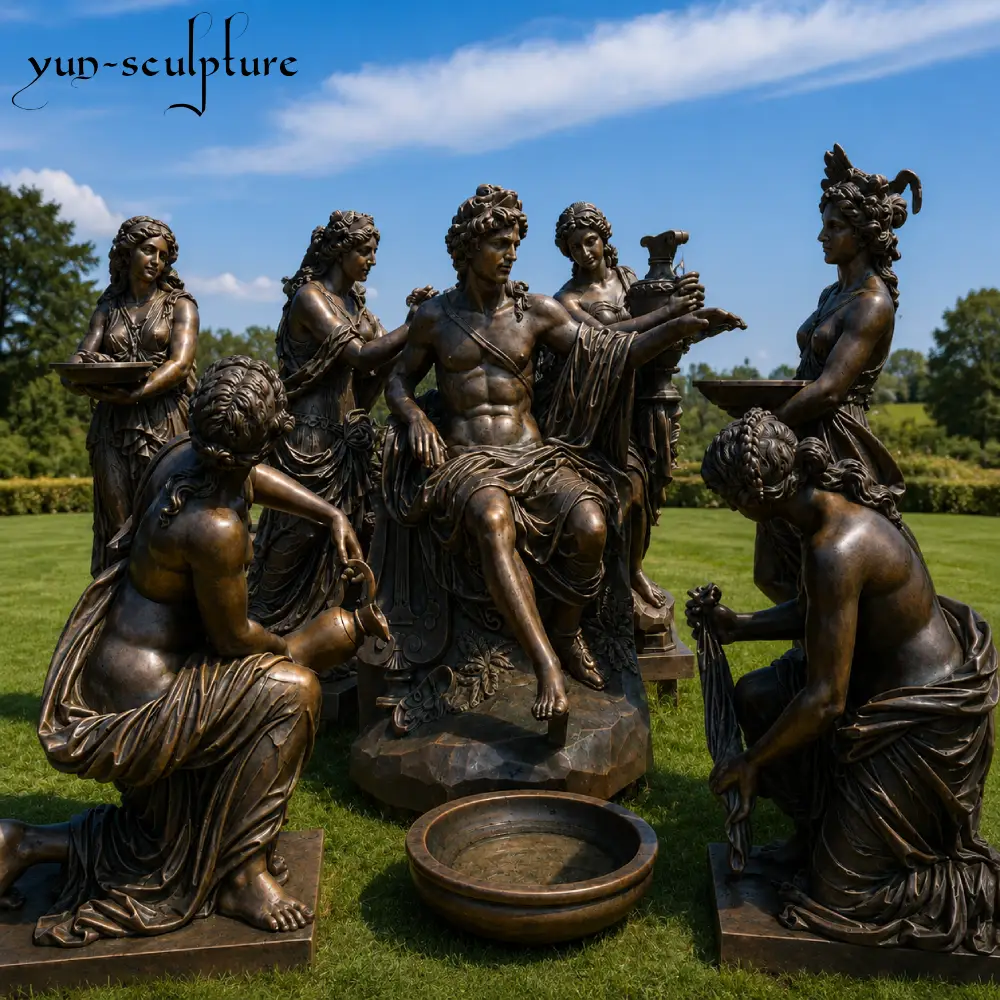
Understanding the specific visual differences between these four gods — what attributes identify each, which poses are historically accurate, and how each reads in different environments — allows buyers to make informed decisions rather than selecting by image search alone. This guide provides that framework from a foundry perspective, based on the commissions we receive and the questions buyers ask most consistently.
For a broader overview of all twelve Olympians and their placement logic, our complete Greek mythology statues guide covers the full pantheon.
Zeus: Iconography, Poses, and Placement
Identifying Attributes
Zeus is identified in sculpture by four primary attributes: the thunderbolt (his weapon and symbol of divine power), the eagle (his sacred animal), the scepter (marking his kingship), and a mature, full beard (distinguishing him from the younger male gods Apollo and Hercules). He is almost always depicted as the most physically commanding figure in the Greek pantheon — broad-shouldered, powerfully built, his proportions calibrated to project authority rather than athletic grace.
The most common Zeus poses in the sculptural tradition are: enthroned (derived from the lost Zeus of Olympia, the most famous divine statue of antiquity), standing with thunderbolt raised (the pose of the Bronze Zeus of Artemision, c. 460 BCE), and standing in a frontal position of formal authority. The enthroned pose is the most frequently commissioned for institutional indoor settings; the striding thunderbolt pose for dramatic outdoor installations.
Common Confusion: Zeus vs. Poseidon
Zeus and Poseidon are the most frequently confused male Greek god figures in the sculptural tradition — their physical attributes are nearly identical (both mature, bearded, powerfully built male figures) and differentiated primarily by a single attribute: the thunderbolt vs. the trident. The Bronze Zeus of Artemision, now in the National Archaeological Museum in Athens, was debated for decades after its recovery from the sea — scholars argued whether the extended right arm originally held a thunderbolt (Zeus) or a trident (Poseidon). When ordering a commission, specifying which attribute the figure holds is essential; our Zeus statue page shows the primary pose options in detail.
Placement Recommendations
- Corporate lobbies and entrance halls: enthroned or standing Zeus in bronze, life-size or larger, projects institutional authority immediately
- Formal garden terminus: a standing Zeus at the end of a formal allée or on an elevated plinth commands the visual axis of the landscape
- University and civic buildings: Zeus’s association with law, justice, and cosmic order makes him appropriate for courthouses, government buildings, and academic institutions
- Indoor formal settings: a Zeus bust in bronze or marble on a marble column is a compact, high-authority option for boardrooms and executive offices
Poseidon: Iconography, Poses, and Placement
Identifying Attributes
Poseidon shares Zeus’s physical type — mature, bearded, powerfully built — but is distinguished by the trident, his three-pronged spear that simultaneously commands the sea, causes earthquakes by striking the earth, and creates freshwater springs. Secondary attributes include the dolphin (his sacred animal), the horse (which he created and gave to humanity in Greek mythology), and occasionally a fish or sea creature at his feet to establish his aquatic domain.
The most historically significant Poseidon pose in the sculptural tradition is the striding figure with arm raised to hurl the trident — a pose that conveys divine force in action rather than static authority. This dynamic pose translates exceptionally well to large-scale outdoor installations, particularly near water. Our dedicated Poseidon statue guide covers all primary pose variants and their historical sources.
Placement Recommendations
- Fountain centerpiece: Poseidon is the definitive deity for fountain sculpture — a tradition running from the Neptune fountains of Renaissance Italy through the great Baroque garden programs of France and Germany
- Pool surrounds and waterfront properties: coastal estates, lakeside properties, and properties with significant water features benefit most from a Poseidon installation
- Maritime and naval institutions: shipping companies, naval academies, and port authority buildings have a natural alignment with Poseidon’s domain
- Garden axis focal points: the dynamic striding pose gives Poseidon strong visual presence as a terminus figure even in garden settings without water
Apollo: Iconography, Poses, and Placement
Identifying Attributes
Apollo is the physical counterpart to Zeus and Poseidon in the Greek pantheon — where they are mature, bearded, and powerful, he is young, clean-shaven, and defined by grace rather than force. He is the kouros type carried to its highest expression: the idealized young male body in which physical perfection and intellectual or artistic achievement are inseparable.
His primary attributes are the lyre (music and poetry), the laurel wreath (victory and poetic achievement), the bow and silver arrows (which bring healing or plague, distinguishing his arrows from Artemis’s hunting arrows), and the sun disk or rays. He is almost always depicted without a beard, in a contrapposto pose that emphasizes the balance and ease of his physical perfection rather than the tension of active force.
The Apollo Belvedere (c. 120–140 CE, Vatican Museums) is the most frequently referenced source for Apollo commissions — a striding figure in which the god has just released an arrow, his body caught in a moment of effortless precision. Our Apollo statue guide covers this and other primary pose sources in detail.
Placement Recommendations
- Music rooms, concert halls, and performance spaces: Apollo’s direct association with music makes him the single most appropriate deity for any space dedicated to musical performance or education
- Creative studios, galleries, and arts organizations: his patronage of poetry, visual arts, and intellectual achievement extends to all creative disciplines
- Medical facilities and healing spaces: his association with healing (as the father of Asclepius, the god of medicine) makes him appropriate for healthcare institutions
- Spa and wellness environments: Apollo’s solar associations and his patronage of physical and mental harmony suit environments dedicated to health and renewal
- Formal garden sun features: as the sun god, Apollo placed at the eastern or southern focal point of a formal garden carries direct cosmological logic
Hercules: Iconography, Poses, and Placement
Identifying Attributes
Hercules is the most immediately recognizable figure in the Greek sculptural tradition — his attributes are so distinctive that misidentification is almost impossible. The Nemean lion skin worn over his shoulders (the trophy of his first labor), and the club (his primary weapon), identify him without ambiguity. His body type is equally distinctive: where Zeus and Poseidon project commanding authority and Apollo projects graceful perfection, Hercules is defined by extreme musculature — the most physically powerful human body the Greek imagination could conceive, developed through labor and trial rather than divine inheritance.
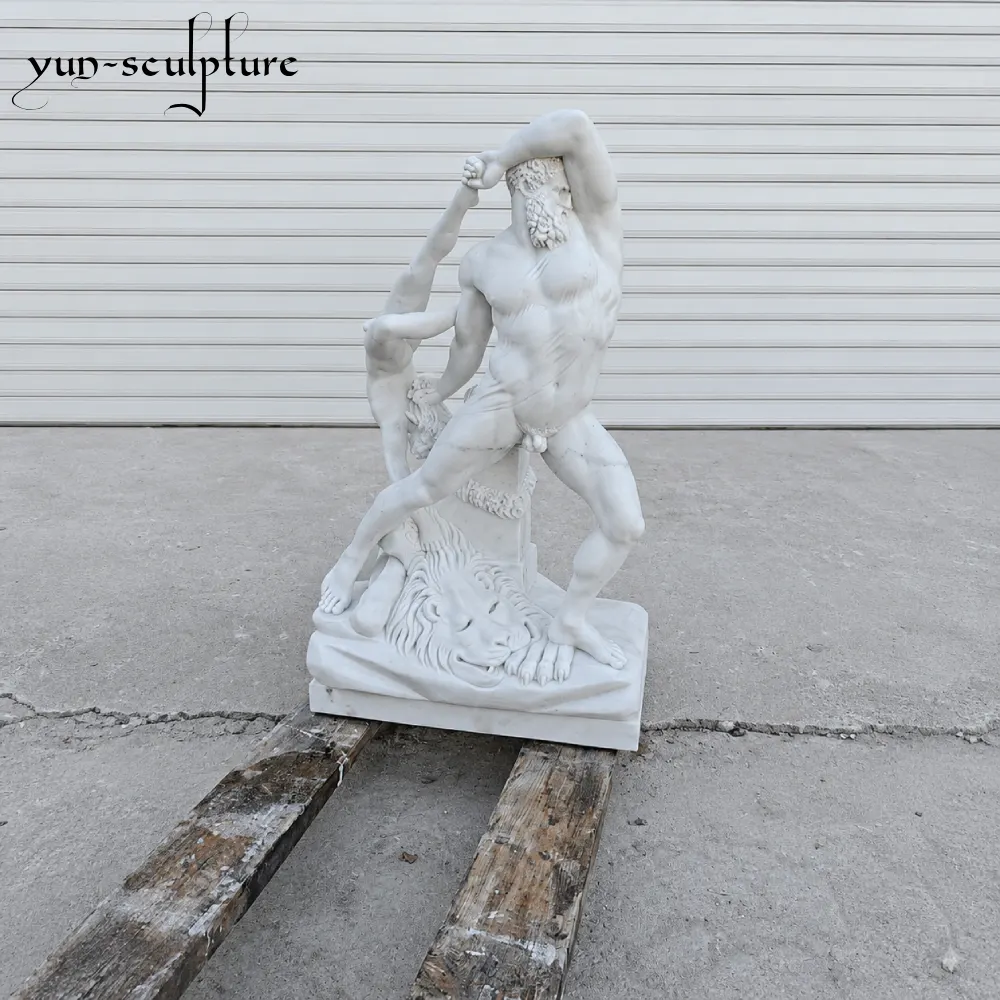
The two most commonly commissioned Hercules poses are the standing rest figure (derived from the Farnese Hercules, c. 216 CE, National Archaeological Museum Naples — the hero leaning on his club, exhausted after his labors, the apples of the Hesperides hidden behind his back) and the active combat figure (Hercules in mid-struggle with the Nemean lion, the Hydra, or other opponents). The Farnese pose is the most frequently requested for indoor installations; active combat poses work well at larger outdoor scales. Our Hercules statue guide covers both pose families with detailed reference images.
Placement Recommendations
- Sports facilities, gyms, and athletic institutions: Hercules is the archetype of physical achievement through disciplined effort — the most appropriate deity for any space dedicated to athletic training and performance
- Corporate and motivational settings: his twelve labors as a metaphor for perseverance through extraordinary challenges makes him a strong choice for corporate environments that want to signal resilience and determination
- Public parks and outdoor monuments: Hercules at heroic or monumental scale reads powerfully in public outdoor settings — his fame is broad enough that no specialist knowledge is required to recognize the figure
- Private estates and trophy rooms: the Farnese pose at life-size or half-life-size in bronze is one of the most prestigious single-figure commissions in the classical tradition
Side-by-Side Comparison: Choosing Between the Four
The table below provides a direct comparison of the four gods across the dimensions that matter most for a buyer making a commission decision.
| Zeus | Poseidon | Apollo | Hercules | |
|---|---|---|---|---|
| Physical type | Mature, bearded, commanding | Mature, bearded, powerful | Young, clean-shaven, graceful | Young to mature, extremely muscular |
| Primary attribute | Thunderbolt | Trident | Lyre or bow | Lion skin + club |
| Dominant pose | Enthroned or striding | Striding with trident raised | Contrapposto, relaxed | Standing rest or combat |
| Primary message | Authority, law, power | Command of natural forces | Beauty, intellect, achievement | Strength, perseverance, triumph |
| Best indoor setting | Lobby, boardroom, civic hall | Atrium with water feature | Music room, gallery, studio | Trophy room, gym, corporate space |
| Best outdoor setting | Formal allée terminus, elevated plinth | Fountain, pool, waterfront | Garden sun axis, terrace | Public park, sports facility |
| Confusion risk | With Poseidon (check attribute) | With Zeus (check attribute) | None — unique physical type | None — unique attributes |
| Most popular material | Bronze | Bronze | Marble or bronze | Bronze |
Size and Pricing Reference
The table below reflects factory-direct pricing from Yun Sculpture’s Quyang foundry for lost-wax silicon bronze and hand-carved White Sichuan Marble. All prices include standard patination or finish, basic pedestal, and international freight to the continental United States. Prices assume standard complexity for each god’s canonical pose; highly dynamic poses or multi-figure compositions are quoted individually.
| Size | Height | Bronze | Marble | Lead Time |
|---|---|---|---|---|
| Desktop / Display | 12–20 in (30–50 cm) | From $800 | From $1,200 | 25–35 working days |
| Half Life-Size | 24–36 in (60–90 cm) | From $2,200 | From $2,800 | 35–45 working days |
| Life-Size | 60–78 in (150–200 cm) | From $4,500 | From $3,800 | 40–55 working days |
| Heroic / Oversized | 80–120 in (200–300 cm) | From $9,000 | From $8,500 | 55–70 working days |
| Monumental | 120 in+ (300 cm+) | Custom quote | Custom quote | Custom timeline |
Note that Hercules commissions at life-size and above typically carry a 10–15% complexity premium over standard standing figures due to the extreme musculature detail required — the Farnese pose in particular demands significant additional clay modeling and metal chasing time to achieve the surface definition that makes the figure recognizable at distance. Apollo commissions in marble are often preferred over bronze at smaller scales because white marble better captures the god’s associations with light, clarity, and classical refinement.
Bronze vs. Marble: Which Material for Which God
Material choice is not neutral for male Greek god statues. Each material carries associations that reinforce or work against the specific deity’s character, and the intended installation environment should drive the decision as much as aesthetic preference.
| God | Bronze Recommendation | Marble Recommendation | Verdict |
|---|---|---|---|
| Zeus | Excellent — warm, weighty, permanent; patina reinforces authority | Good — formal indoor settings only | Bronze preferred for outdoor; marble for sheltered interior |
| Poseidon | Strongly preferred — outdoor water environments demand bronze durability | Not recommended for fountain use | Bronze almost always correct for water feature placement |
| Apollo | Good — brown patina suits the god’s solar warmth | Excellent — white marble aligns with light, clarity, classical refinement | Marble preferred at smaller scales; bronze for outdoor |
| Hercules | Strongly preferred — bronze weight and surface texture reinforce physical power | Acceptable — less common historically | Bronze is the traditional and most visually appropriate choice |
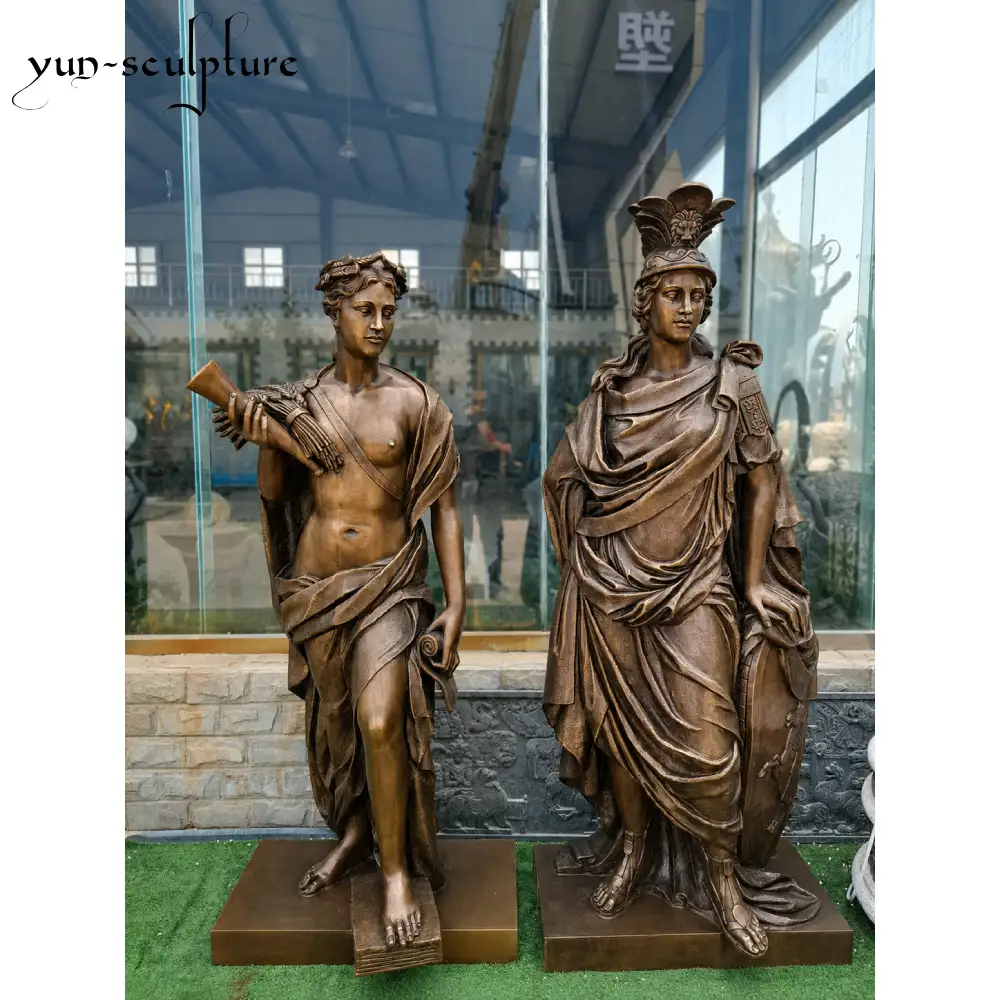
For buyers uncertain between materials, bronze is the safer default for all four gods in outdoor settings — silicon bronze with a brown or antique green patina requires only annual wax maintenance and will outlast any other material in exposed conditions. For indoor settings where white marble is a serious consideration, Apollo and Zeus are the strongest candidates; Poseidon and Hercules read better in bronze in almost all interior contexts.
Frequently Asked Questions
What are male Greek statues called? +
Male Greek statues of idealized young nude figures are called kouros (plural: kouroi) — a term meaning ‘youth’ in ancient Greek. The kouros type, which appears in the Archaic period (700–480 BCE), depicts a standing male figure with arms at sides, one foot slightly forward, and an expression of formal calm known as the Archaic smile. As Greek sculpture evolved through the Classical and Hellenistic periods, the rigid kouros formula gave way to more naturalistic figures with contrapposto poses and individualized expression. Statues of specific gods are referred to by the deity’s name — a Zeus statue, an Apollo statue — rather than by the generic kouros term, which applies specifically to the Archaic type.
Who are the main male Greek gods? +
The principal male Greek gods of the Olympian pantheon are Zeus (king of the gods, thunder and sky), Poseidon (the sea, earthquakes, and horses), Apollo (light, music, prophecy, and healing), Ares (war and courage), Hephaestus (fire and craft), Hermes (commerce, travel, and communication), and Dionysus (wine and theater). Hercules, though born mortal, is elevated to divine status after his death and is closely associated with the male Olympians. Of these, Zeus, Poseidon, Apollo, and Hercules are by far the most frequently commissioned in sculpture for contemporary residential, corporate, and institutional settings.
Who is the most handsome male Greek god? +
Apollo is consistently described in ancient Greek sources as the most beautiful of the male gods — the embodiment of the Greek ideal of male physical perfection combined with intellectual and artistic achievement. His youth, clean-shaven face, and graceful proportions set him apart from the more powerfully built mature gods Zeus and Poseidon. In the sculptural tradition, the Apollo Belvedere (Vatican Museums) has been cited as the definitive representation of ideal male beauty from the Renaissance through the nineteenth century. Hermes is described as beautiful and athletic in ancient sources; Dionysus as soft and androgynous in beauty. Hercules, while not primarily associated with beauty, represents the ultimate in physical power and masculine achievement.
Who are the three brothers of the Greek gods? +
The three brothers of the Greek gods are Zeus, Poseidon, and Hades — the sons of the Titans Cronus and Rhea who divided the cosmos between them after overthrowing their father. Zeus received dominion over the sky and the upper world; Poseidon received the sea; Hades received the underworld. All three are depicted in sculpture as mature, bearded male figures of commanding physical presence, differentiated by their attributes: Zeus by the thunderbolt and eagle, Poseidon by the trident and dolphin, Hades by the bident and Cerberus. Of the three, Zeus and Poseidon are the most frequently commissioned in sculpture; Hades appears less often but is appropriate for memorial and cemetery installations.
What is the most popular Greek god statue for home and garden? +
At Yun Sculpture’s Quyang foundry, Poseidon and Zeus are the most frequently commissioned male Greek god statues for garden installations; Apollo is the most requested for indoor residential settings. Poseidon’s dominance in garden commissions reflects his natural alignment with water features — fountains, reflecting pools, and pool surrounds — where his iconographic logic is immediately clear. Zeus is preferred for formal garden axes, entrance installations, and elevated focal points where authority and visual command are the primary goals. For home interiors, Apollo in white marble suits libraries, music rooms, and formal living spaces; a Zeus or Poseidon bust in bronze suits home offices and executive spaces.
What is the difference between a Zeus statue and a Poseidon statue? +
Zeus and Poseidon statues are physically nearly identical — both depict a mature, bearded, powerfully built male figure — and are differentiated almost entirely by a single attribute: Zeus holds or raises a thunderbolt; Poseidon holds a trident. This similarity is historically attested: the famous Bronze Zeus of Artemision (c. 460 BCE, National Archaeological Museum Athens) was debated for decades after its recovery from the sea, with scholars disagreeing whether the extended arm held a thunderbolt or a trident. When commissioning either figure, specifying the attribute is essential. Secondary differentiators include placement context (Poseidon near water features; Zeus at formal axis termini) and occasional accompanying animals (Zeus with an eagle; Poseidon with a dolphin or horse).
Order Your Male Greek God Statue from Quyang
Zeus, Poseidon, Apollo, or Hercules — all four in bronze or marble, desktop to monumental scale. Share your specifications and we’ll respond within 2 business days with a detailed factory-direct quote.
Order Your Male Greek God Statue from Quyang
Zeus, Poseidon, Apollo, or Hercules — all four in bronze or marble, desktop to monumental scale. Share your specifications and we’ll respond within 2 business days with a detailed factory-direct quote.