Get in touch with Yun-Sculpture company
Apollo Bust Statue: Bronze & Marble for Home & Garden

A foundry director’s guide to Apollo bust statues — the Apollo Belvedere and other principal prototypes, real bronze vs. cast composite materials, size selection, and placement guidance for home interiors and garden installations.
Table of Contents
Table of Contents
Apollo in Sculpture: Why the Bust Format Works
Apollo is the most frequently depicted deity in the entire Western sculptural tradition — more than Zeus, more than Athena, more than any other Olympian. The reason is structural: his physical type, the idealized young male figure in its highest expression, was the central problem that Greek sculpture set itself to solve across three centuries of continuous refinement. Every kouros figure from the Archaic period is proto-Apollo. Every Classical contrapposto figure is working in Apollo’s shadow. The Apollo Belvedere, carved in the 4th century BCE and copied obsessively from the Renaissance through the 19th century, was cited by Winckelmann, Goethe, and Byron as the supreme achievement of human artistic production. The tradition is deep.
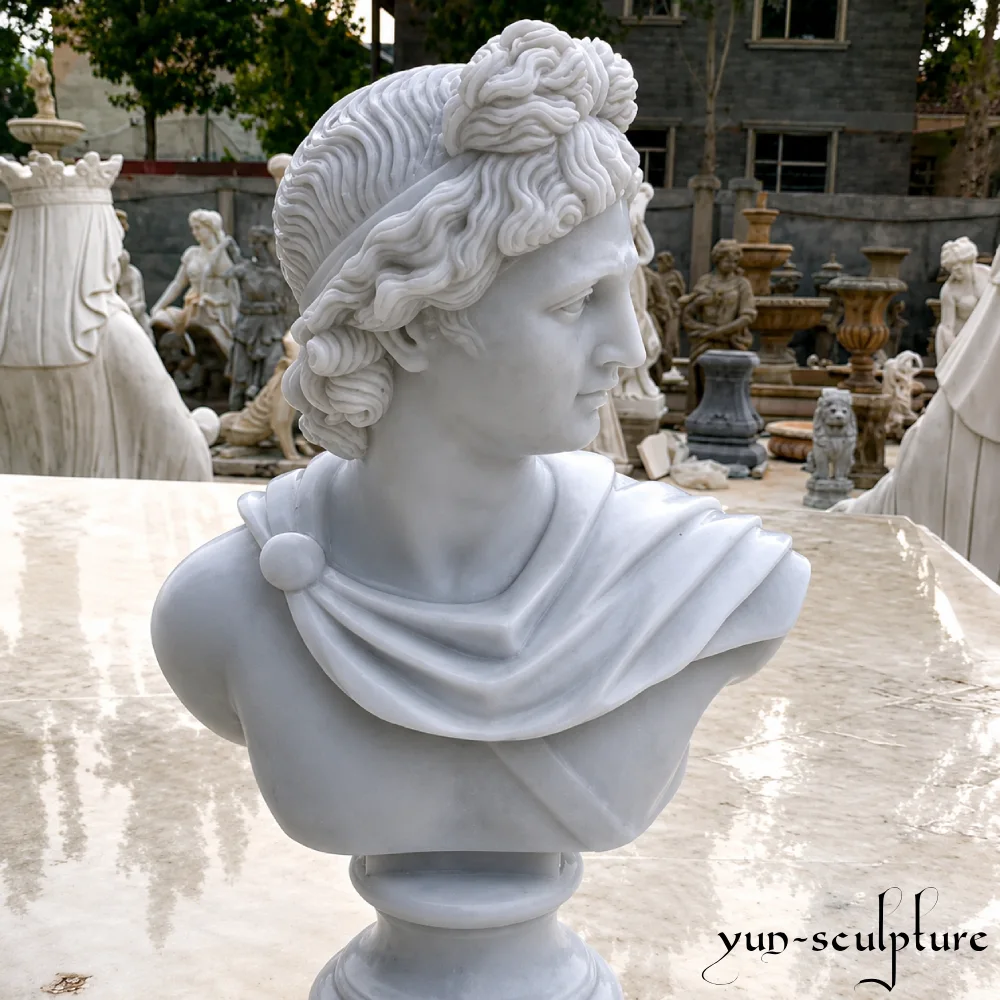
The bust format is particularly well-suited to Apollo for a reason that applies less to Zeus or Poseidon: Apollo’s defining visual characteristics are concentrated in his head and upper body. The elaborately curled hair, the clean-shaven face of idealized youth, the slightly elevated chin of the Belvedere type that gives the impression of a gaze directed toward the horizon — these read at close range in ways that the striding full-figure pose cannot replicate in a domestic or small institutional setting. A well-executed Apollo bust in bronze or marble at half-life-size on a pedestal delivers the full force of the iconographic tradition in a format appropriate for a music room, a private library, a garden niche, or a spa terrace.
For buyers comparing the Apollo bust to the Zeus bust statue or the Athena bust statue — the three most commonly commissioned Greek deity busts — Apollo occupies a distinct register: where Zeus projects cosmic authority and Athena projects disciplined wisdom, Apollo projects harmonious perfection, the beauty of ordered intelligence given physical form.
The Principal Apollo Bust Prototypes
Most Apollo bust statues available today derive from one of three ancient prototypes. Each has a distinct visual character and a different set of historical associations that affect placement decisions.
The Apollo Belvedere Type
The Apollo Belvedere is a Roman marble copy (c. 120–140 CE) of a lost Greek bronze original attributed to Leochares, dated to approximately 325 BCE. It was discovered in the late 15th century and placed in the Belvedere Courtyard of the Vatican, where it became the single most influential sculptural object in European art history for the next three centuries. Winckelmann called it the highest ideal of art among the works of antiquity. Casts of it filled European art academies. Every serious art student in the 18th and 19th centuries drew it, modeled it, and memorized it.
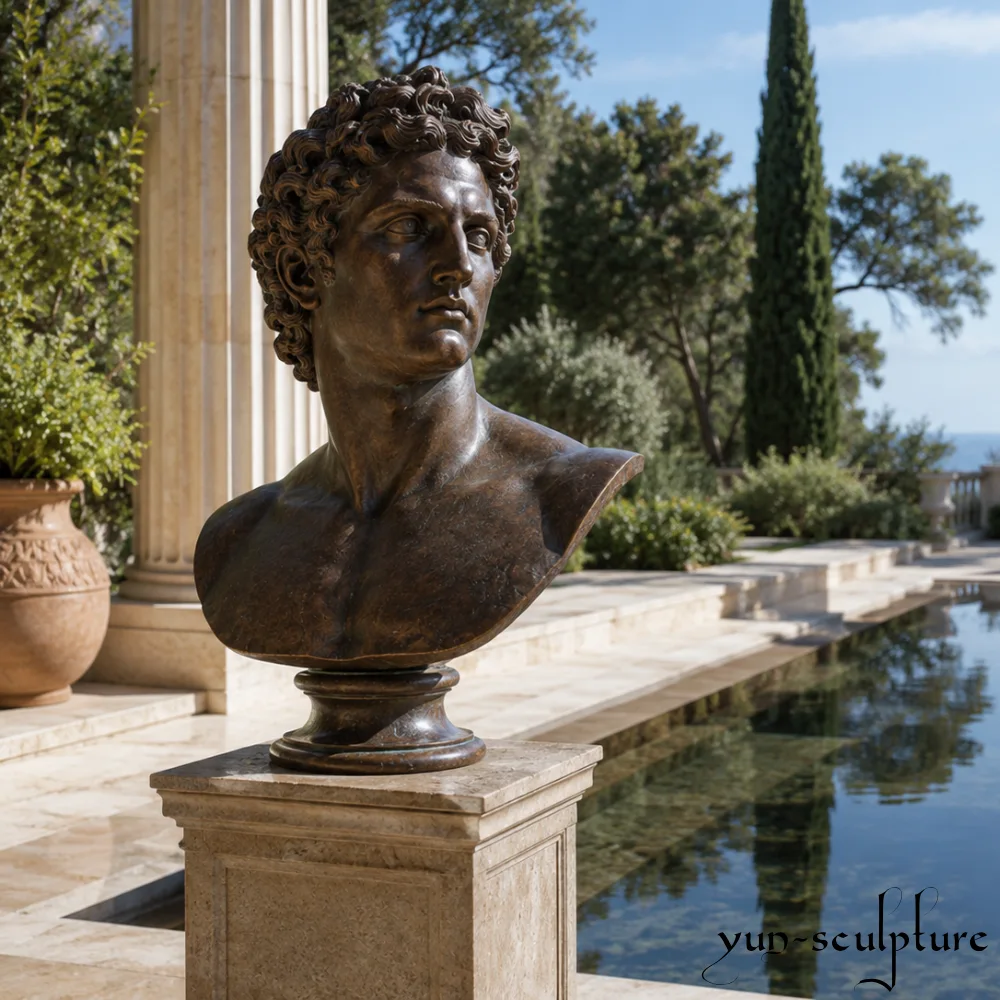
In bust format, the Belvedere type is identified by its slightly elevated chin (the original shows Apollo looking to his left and slightly upward, as if toward a distant horizon or toward the Python he has just killed with his silver arrows), its elaborately arranged curls falling to the shoulders in the full-figure version (abbreviated in bust format to the hair mass above and behind the ears), and the expression of absolute composure — the face of a god who has just exercised divine power and feels nothing but the calm certainty of his own perfection.
For contemporary commissions, the Belvedere type is the correct choice for almost any formal interior or garden installation where recognizability and historical prestige matter. It is the Apollo that buyers, visitors, and clients will recognize — consciously or not — as the canonical Apollo.
The Apollo of Piombino Type
The Apollo of Piombino is a bronze original (not a copy) dated to approximately 500–480 BCE, recovered from the sea near Piombino, Tuscany in 1832 and now in the Louvre. It represents the late Archaic transition to Early Classical — a standing kouros figure whose frontal rigidity is just beginning to relax into the naturalism that the Classical period will perfect. The face has an Archaic smile, the body a formal frontality, but the proportions and surface modeling show an awareness of anatomical reality that the earlier kouros tradition does not.
In bust format, the Piombino type gives an Apollo of archaic dignity and restraint — less dramatically beautiful than the Belvedere, more formally severe, appropriate for spaces where the historical depth of the tradition matters as much as its aesthetic achievement. For private collectors interested in the archaeology of the tradition rather than its most celebrated moment, the Piombino type is a distinguished alternative to the ubiquitous Belvedere.
The Apollo Citharoedus (Lyre-Playing) Type
The Apollo Citharoedus type depicts the god in his role as leader of the Muses — the divine musician who plays the lyre (cithara) and thereby embodies the ordering power of music over the chaos of unformed sound. Several important Roman marble versions survive, most notably the Apollo Citharoedus in the Vatican Museums, showing the god in long robes with his lyre at his side in a pose of formal dignity rather than athletic display.
In bust format, the Citharoedus type is typically shown with a wreath of laurel — Apollo’s sacred plant, the material of the crown awarded to poets and victors — and an expression of meditative calm rather than the outward-directed composure of the Belvedere. For music rooms, recording studios, conservatories, and spaces where Apollo’s patronage of music is the primary intended resonance, the Citharoedus type is more iconographically specific than the Belvedere. Our dedicated Apollo statue guide covers all three types with reference images.
Real Bronze vs. Cast Composite: What the Market Won’t Tell You
The Apollo bust market is one of the most confusing in the Greek sculpture category because of the proliferation of materials marketed under misleading names. Understanding what you are actually buying — and what distinguishes it from a true lost-wax bronze or hand-carved marble — is essential before making any purchase decision.
| Material Name | What It Actually Is | Weight | Magnetic? | Outdoor Durability | Lifespan |
|---|---|---|---|---|---|
| Silicon bronze (lost-wax) | True cast bronze, 85%+ copper | Heavy (life-size bust: 25–40 lbs) | No | Excellent — 100+ years | Indefinite with maintenance |
| “Cold cast bronze” | Resin with bronze powder coating | Light (life-size bust: 4–8 lbs) | Slightly (iron content in resin) | Poor — UV degrades resin | 5–15 years |
| “Galvanic bronze” / “hot-cast” | Resin core with thin electroplated metal layer | Medium-light | No | Poor — plating chips over time | 10–20 years |
| White Sichuan marble (hand-carved) | True natural marble, hand-carved | Very heavy (life-size bust: 60–100 lbs) | No | Good indoors; risk outdoors | Indefinite indoors |
| “Cast marble” / “marble composite” | Crushed marble powder + resin binder | Medium | No | Poor outdoors | 10–25 years |
| Resin / polystone | Petroleum-based polymer | Very light | No | Poor | 5–15 years |
The practical tests for buyers examining an Apollo bust before purchase: lift it — a life-size bronze bust should be heavy enough that two hands are needed and effort is required; a cold-cast piece of the same size is light enough to lift one-handed. Touch the surface — real bronze has a slight warmth and the texture of the patina is chemically bonded to the metal surface; painted or plated surfaces feel uniform and can be scratched with a fingernail to reveal the substrate beneath. Test with a magnet — true silicon bronze is non-magnetic; cold-cast pieces with iron-bearing resin will attract a magnet weakly.
For outdoor garden installations specifically, the material distinction is critical. A resin or cold-cast Apollo bust placed in an exposed garden position will show UV degradation, surface cracking, and patina failure within 3–7 years in most US climates. A true lost-wax silicon bronze Apollo bust will be indistinguishable from new — visually improved, in fact, as the outdoor patina deepens — after the same period. Our Apollo busts are produced in silicon bronze (C87200 alloy, 85%+ copper) at 5–8mm wall thickness, the professional standard for permanent garden installation.
Iconographic Attributes: Reading an Apollo Bust
| Attribute | What It Signifies | Presence in Bust Format |
|---|---|---|
| Clean-shaven face | Youth and divine perfection; distinguishes Apollo from bearded gods | Always present; primary identifier |
| Elaborately arranged curls | Divine beauty; the ordered perfection of the sun god’s light | Present in all types; degree of elaboration varies |
| Slightly elevated chin | The Belvedere type specifically; divine composure and distant focus | Characteristic of Belvedere-derived busts |
| Laurel wreath | Sacred plant of Apollo; crown of poets and victors | Common in Citharoedus type; occasional in Belvedere type |
| Silver bow or quiver | Apollo as the Far-Shooter; divine power at distance | Rarely shown in bust format; sometimes on base |
| Lyre or cithara | Apollo as leader of the Muses; patronage of music | Shown in Citharoedus type; sometimes on base |
| Sun rays | Apollo as the sun god, Helios; light and truth | Occasionally incorporated in hair or crown |
The single most reliable identifier of an Apollo bust is the combination of clean-shaven face and elaborately arranged curls — no other major male Greek deity shares both characteristics. Zeus, Poseidon, and Hades are all bearded; Hermes is sometimes shown beardless but with a winged helmet that immediately distinguishes him; Dionysus is beardless but with ivy wreath and grapevine attributes that differ entirely from Apollo’s. An unattributed beardless young male bust with elaborate curled hair is almost certainly Apollo.
Home Interior Placement Guide
Music Rooms and Creative Spaces
Apollo is the most naturally appropriate deity for any space dedicated to music, creative work, or artistic achievement. A Citharoedus-type Apollo bust — the lyre-playing version — in a music room, recording studio, or composer’s study carries iconographic specificity that the Belvedere type does not. For spaces where the Apollo-music connection matters to the owner and should be legible to visitors, the Citharoedus type in white marble on a dark pedestal at half-life-size scale is the most historically resonant choice.
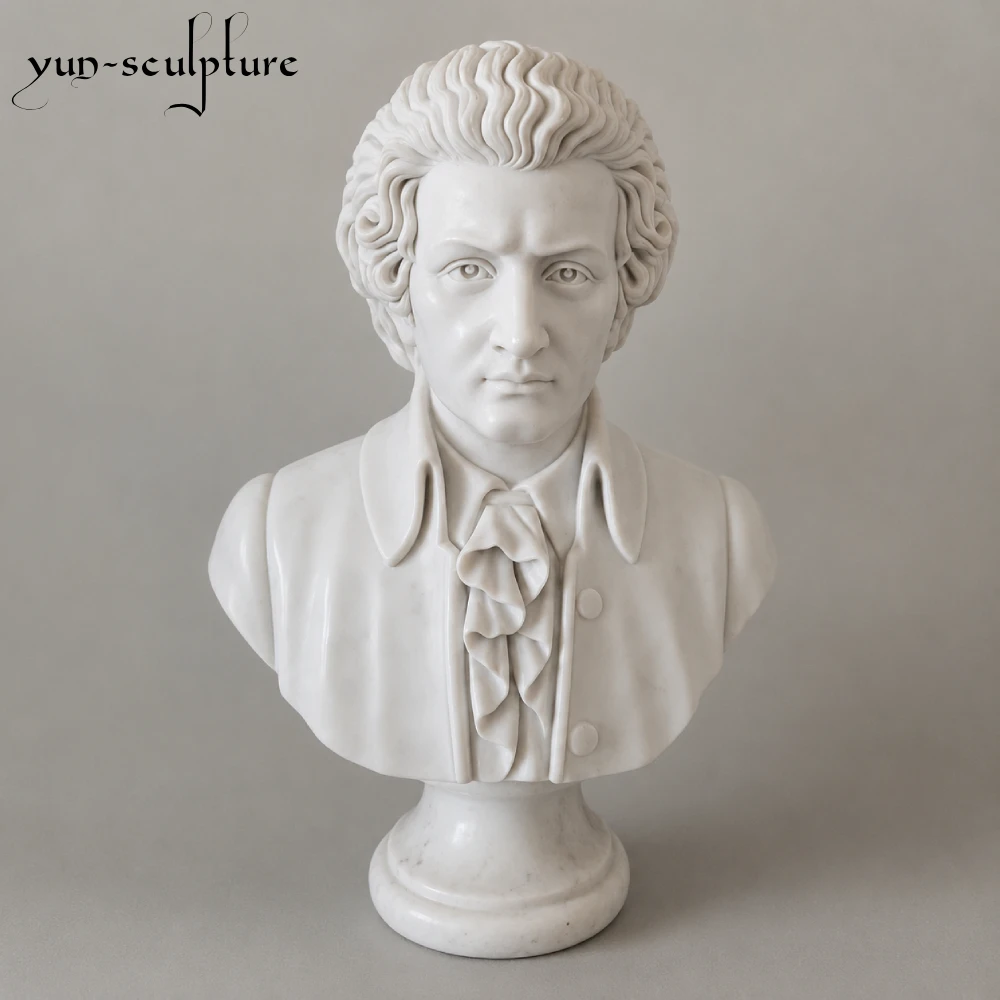
For more general creative spaces — artist’s studios, architects’ offices, writers’ studies — the Belvedere type carries the broader associations of Apollo’s patronage over all the arts and intellectual disciplines, making it the more versatile choice.
Libraries and Private Studies
Where an Athena bust statue in a library signals wisdom and strategic intelligence, an Apollo bust signals a different register of intellectual engagement: the pleasure of knowledge, the beauty of ordered thought, the connection between aesthetic refinement and intellectual achievement. The two deities complement each other directly — Athena as the disciplined mind, Apollo as the inspired mind — and a library installation featuring both busts has strong precedent in the history of European private libraries and institutional reading rooms.
For private libraries, a half-life-size Apollo Belvedere bust in white Sichuan marble on a column pedestal in the 32–40 inch range reads as a considered personal choice rather than an institutional gesture. Bronze is appropriate for darker, more traditional interiors; marble for lighter, more contemporary spaces.
Spa, Wellness, and Healing Spaces
Apollo’s patronage of healing — as the father of Asclepius, god of medicine, and as the deity who presides over the restoration of harmony and balance — makes him directly appropriate for spas, wellness centers, physical therapy practices, and medical facilities where the classical tradition is part of the intended atmosphere. A white marble Apollo bust in a spa reception area or treatment room entrance carries associations with light, clarity, and the restoration of ordered health that no other deity in the Greek pantheon replicates so directly.
Garden Placement Guide
Apollo’s solar associations give his garden installations a cosmological logic that few other deities share. Placed correctly in relation to the sun’s path through a designed garden, an Apollo bust participates directly in the symbolic program of the landscape rather than simply decorating it.
Solar Axis Placement
The most historically resonant garden placement for an Apollo bust or full figure is at the eastern or southern terminus of the garden’s primary axis — the point toward which the garden opens to receive morning or midday light. In French formal garden tradition, Apollo figures were placed specifically at the point in the garden where the sun’s daily path could be observed most clearly; the Apollo fountain at Versailles, placed at the end of the Grand Canal on the garden’s east-west axis, is the supreme example of this logic.
For residential gardens, an Apollo bust on a column pedestal placed at the south-facing end of a formal path or parterre, where it receives direct sunlight for the majority of the day, aligns the sculpture with its deity’s domain in a way that strengthens the installation’s meaning without requiring any specialist knowledge from viewers.
Garden Niches and Hedged Alcoves
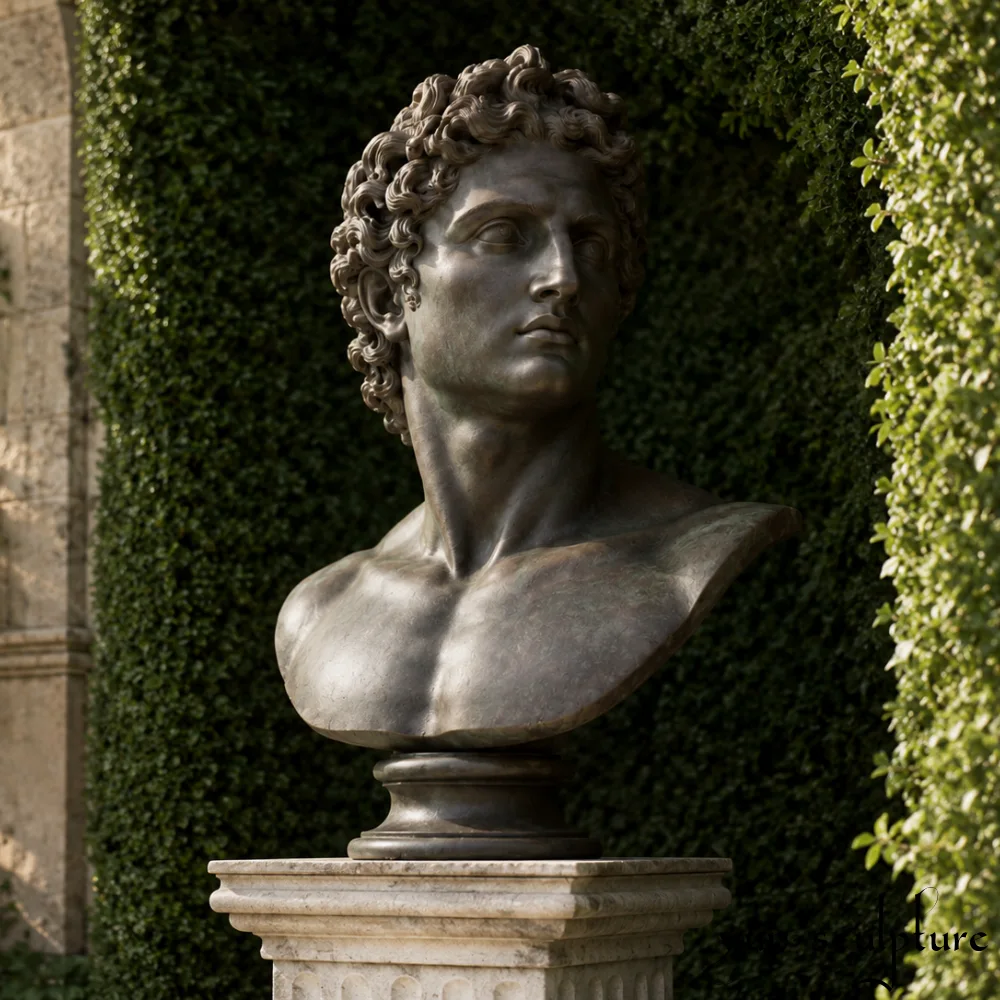
Apollo busts in garden niches — cut into clipped hedges or set into stone walls — have a history running from Roman villa gardens through the great English landscape estates of the 18th century. The niche format frames the bust and focuses attention on it, creating a moment of concentrated beauty within the larger garden program. For this application, a bronze Apollo bust with a brown or antique green patina reads better than white marble, which can lose definition in the dappled light of a garden setting; the warm tonal range of patinated bronze maintains visual presence against both green foliage and stone backgrounds.
Poolside and Water-Adjacent Placement
While Poseidon and Neptune are the traditional deities for fountain centerpieces and pool surrounds, Apollo has a legitimate claim to water-adjacent garden positions through his association with the spring at Delphi and with the sacred springs that appeared where his arrows struck the earth. An Apollo bust on a column pedestal beside a reflecting pool — where the still water mirrors the sky above and the bust reflects in the surface — creates a solar-water combination that has strong visual and mythological coherence. For this application, silicon bronze is essential; marble should not be placed in positions where it will receive regular water splash.
Size and Pricing Reference
| Size Category | Bust Height | Total with Pedestal | Best Context | Bronze | Marble |
|---|---|---|---|---|---|
| Desk / Shelf | 8–12 in (20–30 cm) | 14–20 in (35–50 cm) | Personal desk, bookshelf, console | From $1,100 | From $1,400 |
| Half Life-Size | 14–18 in (35–45 cm) | 22–30 in (55–75 cm) | Mantelpiece, music room console, spa side table | From $1,700 | From $2,200 |
| Life-Size | 20–26 in (50–65 cm) | 32–44 in (80–110 cm) | Garden niche, library pedestal, reception area | From $3,500 | From $3,900 |
| Monumental | 28 in+ (70 cm+) | 48 in+ (120 cm+) | Garden solar axis, institutional lobby | From $6,200 | From $7,000 |
Apollo busts in marble are more commonly requested at the smaller size ranges — desk and half-life-size — where the material’s luminosity and surface refinement are most appreciable at close range. For garden and larger institutional installations, bronze is the standard recommendation due to its weather resistance and superior visual presence at distance. At life-size and above, bronze Apollo busts with a brown patina maintain visual definition against garden backgrounds (foliage, stone, sky) in ways that white marble cannot reliably achieve in variable outdoor lighting conditions.
For buyers commissioning multiple Greek deity busts — Apollo alongside a Zeus bust statue for a corporate or institutional program, or Apollo alongside an Athena bust statue for a library installation — matching the material across all pieces is the most formally coherent approach. Mixed material programs (bronze Zeus, marble Apollo, bronze Athena) can work but require careful pedestal treatment to unify the installation visually. See our complete male Greek god statues buyer’s guide for a full comparison of Zeus, Apollo, Poseidon, and Hercules across all commission variables.
Frequently Asked Questions
What is Apollo bust? +
An Apollo bust statue is a sculptural portrait of the Greek god Apollo — the deity of light, music, prophecy, and healing — rendered in the bust format: head, neck, and upper chest, typically mounted on a pedestal or plinth. Apollo bust statues derive primarily from the Apollo Belvedere, a Roman marble copy of a lost 4th-century BCE Greek bronze original, which became the most influential sculptural work in European art history from the Renaissance through the 19th century. True lost-wax bronze and hand-carved marble are the only materials appropriate for permanent installations and outdoor garden placement; cast composite and resin Apollo busts will degrade significantly within 5–15 years in most conditions.
What does the Apollo statue symbolize? +
An Apollo statue symbolizes the harmonious perfection of mind and body — the Greek ideal of ordered beauty in which physical excellence and intellectual or artistic achievement are inseparable. Apollo’s domains include light and truth, music and poetry, prophecy, and healing. In contemporary settings, an Apollo bust signals a commitment to intellectual refinement, artistic excellence, and the beauty of ordered thought — making it particularly appropriate for music rooms, libraries, creative studios, spa and wellness spaces, and any environment where the values of light, clarity, and cultivated achievement are central.
Did Achilles destroy Apollo’s statue? +
According to some ancient sources and later mythological traditions, Achilles killed Troilus — a young Trojan prince — in the sanctuary of Apollo at Thymbra, defiling the sacred space and killing a suppliant at the god’s altar. This act of sacrilege against Apollo’s sanctuary is cited in some accounts as one reason Apollo guided Paris’s arrow to strike Achilles’s heel, causing his death. The specific act of Achilles destroying a statue of Apollo appears in post-Homeric sources rather than in the Iliad itself. In the mythological tradition, the episode establishes the direct antagonism between Achilles and Apollo that culminates in Achilles’s death.
What is the most famous statue in Pompeii? +
The most famous statue associated with Pompeii is the Apollo of the Temple of Apollo — a bronze figure that stood in the portico of Pompeii’s oldest and most important temple, dedicated to Apollo, in the Forum. The original bronze is now in the National Archaeological Museum of Naples; a cast stands in its original position at the Pompeii site. The Temple of Apollo at Pompeii is one of the best-preserved examples of the importance of Apollo worship in Roman civic life before the eruption of Vesuvius in 79 CE. Several other significant sculptures were recovered from Pompeii and Herculaneum, including the Doryphoros and numerous bronze portrait busts, all now in Naples.
What is the Apollo Belvedere and why is it the standard for Apollo busts? +
The Apollo Belvedere is a Roman marble copy (c. 120–140 CE) of a lost Greek bronze original attributed to Leochares, dated to approximately 325 BCE. Discovered in the late 15th century and installed in the Vatican’s Belvedere Courtyard, it became the most celebrated sculptural work in European art history for three centuries. Winckelmann called it the highest ideal of art among all ancient works; Goethe, Byron, and virtually every significant European artist from the Renaissance through the 19th century regarded it as the definitive standard of ideal male beauty. Its influence through casts distributed to every major European art academy means the Belvedere Apollo is the visual reference most deeply embedded in Western artistic tradition — which is why it remains the standard prototype for contemporary Apollo bust commissions.
Where should an Apollo bust statue be placed in a home or garden? +
For home interiors, an Apollo bust is most appropriate in music rooms, private libraries, creative studios, and spa or wellness spaces. For garden installations, the most historically resonant placement is at the eastern or southern terminus of the garden’s primary axis — the point that receives direct sunlight for the majority of the day — in alignment with Apollo’s solar domain. Garden niches in clipped hedges and stone walls are a well-established format in the Western garden tradition. For all outdoor garden installations, true lost-wax silicon bronze is the required material; cast composite and resin Apollo busts will degrade in outdoor conditions within 3–10 years and are not appropriate for permanent garden installation.
Commission an Apollo Bust Statue from Quyang
Belvedere, Piombino, or Citharoedus type — true lost-wax bronze or hand-carved marble, desk size to monumental. Share your space and placement details and we’ll respond within 2 business days with a factory-direct quote.
Commission an Apollo Bust Statue from Quyang
Belvedere, Piombino, or Citharoedus type — true lost-wax bronze or hand-carved marble, desk size to monumental. Share your space and placement details and we’ll respond within 2 business days with a factory-direct quote.