Get in touch with Yun-Sculpture company
Hades Greek God Statue: The Underworld Ruler for Gothic & Dark Gardens

He was never the villain. A guide to Hades in the ancient sculptural tradition — his true iconography, his classical prototypes, and the gothic and dark garden installations that restore his proper sovereignty over the realm of the dead.
Table of Contents
Table of Contents
Hades: The Misunderstood Sovereign
The Hades available in most contemporary sculpture markets is not the Hades of ancient Greek religion. He is something else entirely — a horned, skull-adorned figure with a spinal scepter and a band of bones across his chest, assembled from centuries of Christian demonology, medieval death imagery, and the character design of video games. This figure is imaginatively interesting. It has nothing to do with ancient Greek belief.
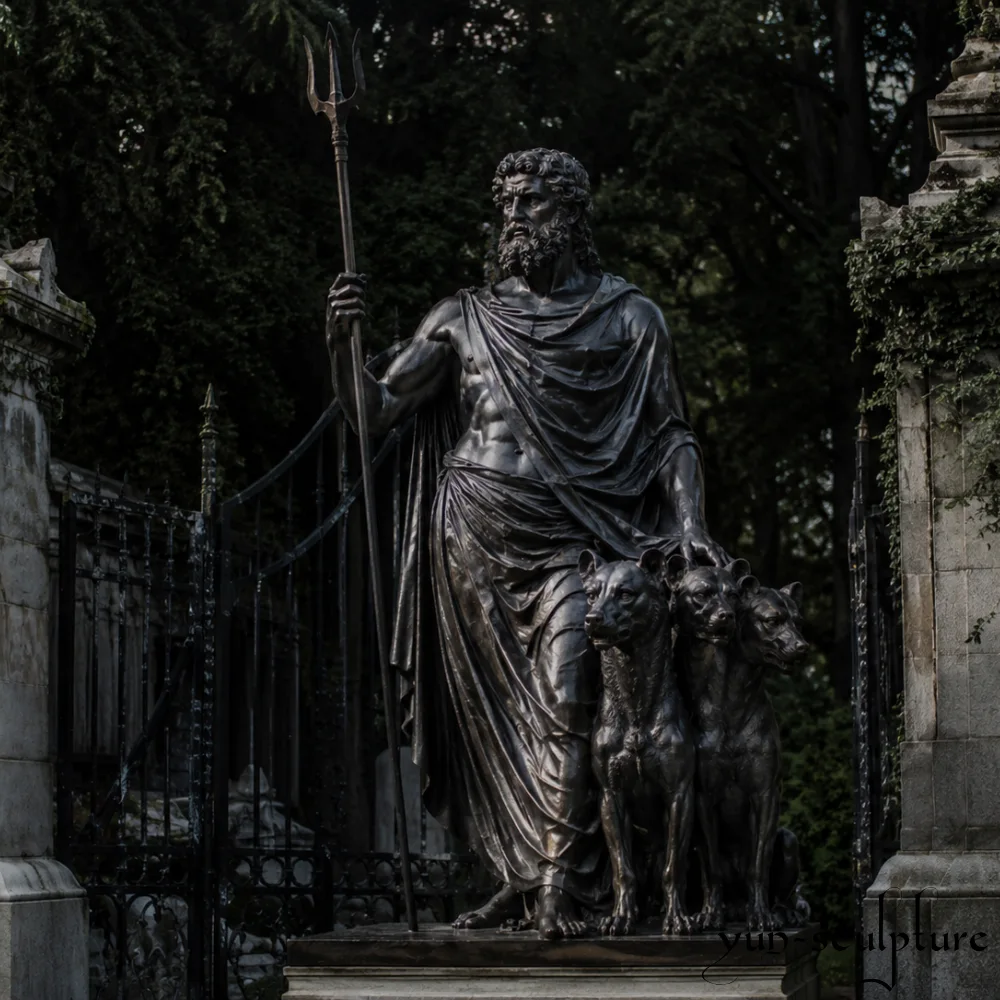
The actual Hades of Greek religion is the eldest son of Cronus and Rhea, the brother of Zeus and Poseidon, a god of absolute authority and implacable justice who rules the underworld not with cruelty but with the impersonal sovereignty of natural law. Every mortal soul — virtuous and wicked alike — passes into his domain at death. He does not pursue the living, does not cause death, and does not torment the dead for pleasure. His realm is simply where all things go when life ends: the inevitable destination that gives the world of the living its meaning by contrast.
This distinction matters enormously for buyers of Hades statues. A cold-cast resin figure of a fantasy demon in a dark garden is a decorative object. A true lost-wax bronze Hades in the classical tradition — modeled on ancient sculptural prototypes, bearing his actual iconographic attributes — is a statement about mortality, sovereignty, and the hidden abundance that lies beneath the earth. The latter belongs in a serious garden program. The former belongs in a gaming room.
This guide is about the latter.
What the Ancient Greeks Actually Believed About Hades
Hades received the underworld when the cosmos was divided among the three brothers after the defeat of the Titans. It was not a consolation prize. It was a domain of absolute completeness: every mortal soul, without exception, would eventually arrive there. Where Zeus ruled a world of contingency — wars won and lost, storms sent and withdrawn, favors granted and withheld — Hades ruled a world of certainty. Nothing escaped him. Nothing ever would.
The Greeks feared Hades not because he was evil but because his domain was inevitable. They avoided speaking his name directly, preferring euphemisms: Pluto (the rich one, because all the mineral wealth buried in the earth was his), Clymenus (the renowned), Eubouleus (the good counselor). When they did build temples to him — which was rare; you do not need to propitiate an inevitability — they were solemn places where no blood was spilled and suppliants lay face-down on the earth to address the god below.
What is most striking about ancient Greek Hades is what he is not. He is not a tempter. He does not bargain for souls. He does not punish the wicked for the pleasure of it — that work is done by the Furies, who are not his servants but independent forces of cosmic justice. He is not even particularly interested in the living. When heroes descend into his realm — Orpheus, Heracles, Odysseus — he is not a villain they must overcome but a sovereign they must address correctly, with the proper rituals and the proper deference. He is the ultimate bureaucrat of the cosmos: impartial, thorough, final.
This is the Hades that ancient sculptors depicted. And this is the Hades that a serious bronze or marble statue restores to contemporary spaces.
Hades in the Classical Sculptural Tradition
Ancient depictions of Hades in sculpture are rarer than those of Zeus, Poseidon, or Apollo — which reflects his position in Greek religious life rather than any deficiency in his mythological importance. You do not build statues of the inevitable. You do not need to propitiate what cannot be refused. The surviving ancient Hades figures are accordingly fewer and often more ambiguous than those of the Olympians above ground.
The Seated Hades of the Capitoline Museums
The most important surviving ancient Hades figure in the round is the seated Hades-Serapis in the Capitoline Museums, Rome — a colossal Roman marble figure (2nd century CE) showing the god enthroned, with Cerberus at his feet and a scepter in his left hand. The figure draws on both the Greek Hades tradition and the Egyptian god Serapis, whose syncretic identification with Hades was common in the Hellenistic and Roman periods. The face is that of a mature, bearded male figure of commanding authority — iconographically close to Zeus but with a quality of solemn withdrawal that distinguishes him from his more externally active brother.
The Capitoline seated type is the most appropriate model for a garden or interior installation where Hades is the presiding deity of a contemplative, memorial, or chthonic-themed space. The enthroned pose carries the full weight of his sovereignty without the dynamic energy of the Olympians above ground — appropriate for a figure who rules a realm where nothing moves except the slow accumulation of souls.
The Hades and Persephone Abduction Type
The abduction of Persephone is the most frequently depicted Hades scene in ancient art — appearing on Greek vases, Roman sarcophagi, and in the famous sculptural group by Gian Lorenzo Bernini (Pluto and Proserpina, 1621–22, Borghese Gallery, Rome) that represents the most technically astonishing marble sculpture of the Baroque period. In this type, Hades appears as a figure of overwhelming physical force — grasping Persephone as she struggles, Cerberus at his heels — but the expression on his face in the most sophisticated ancient versions is not cruelty but something closer to need: the sovereign of the dead taking the one thing his kingdom lacks, a living presence.
For garden installations where the full mythological narrative of Hades and Persephone is the intended program — seasonal plantings, a contemplative garden designed around the cycle of death and renewal — a commission based on the abduction type at life-size or larger creates an installation with genuine mythological depth.
The Hades-Pluto Wealth Type
A third iconographic tradition depicts Hades in his Roman identity as Pluto the Wealthy — the god of underground abundance, the deity who owns all the mineral riches buried beneath the earth. In this type, Hades/Pluto is shown with a cornucopia (the horn of abundance) rather than the bident of death — a visual declaration that the underworld is not only the realm of the dead but the source from which the earth’s fertility and mineral wealth emerge. This less familiar iconographic tradition has strong relevance for garden installations where the themes of underground fertility, seasonal renewal, and the hidden abundance of the earth are more appropriate than the stark sovereignty of death.
Iconographic Attributes: Reading a Hades Statue
| Attribute | What It Signifies | Ancient Authenticity |
|---|---|---|
| Full beard, mature face | Sovereignty and authority; shared physical type with Zeus and Poseidon | Always present in ancient depictions |
| Helm of invisibility (Helm of Darkness) | The power to move unseen; the invisibility of death itself | Rare in sculpture; more common in vase painting |
| Bident (two-pronged staff) | Dominion over the underworld; parallel to Zeus’s thunderbolt and Poseidon’s trident | Present in some ancient depictions; often confused with a scepter |
| Cerberus | The three-headed guardian of the underworld gate | Common in ancient sculpture; primary identifying attribute alongside the bident |
| Scepter | Sovereignty over his realm | Common in enthroned depictions |
| Cornucopia | Hades as Pluto the Wealthy; underground mineral abundance and earth’s fertility | Present in the Pluto-wealth iconographic tradition |
| Key | The locked gate of the underworld; nothing enters or leaves without his authority | Occasional attribute in Roman depictions |
| Dark or black garments | The darkness of the underworld | Indicated in ancient descriptions; difficult to render in stone |
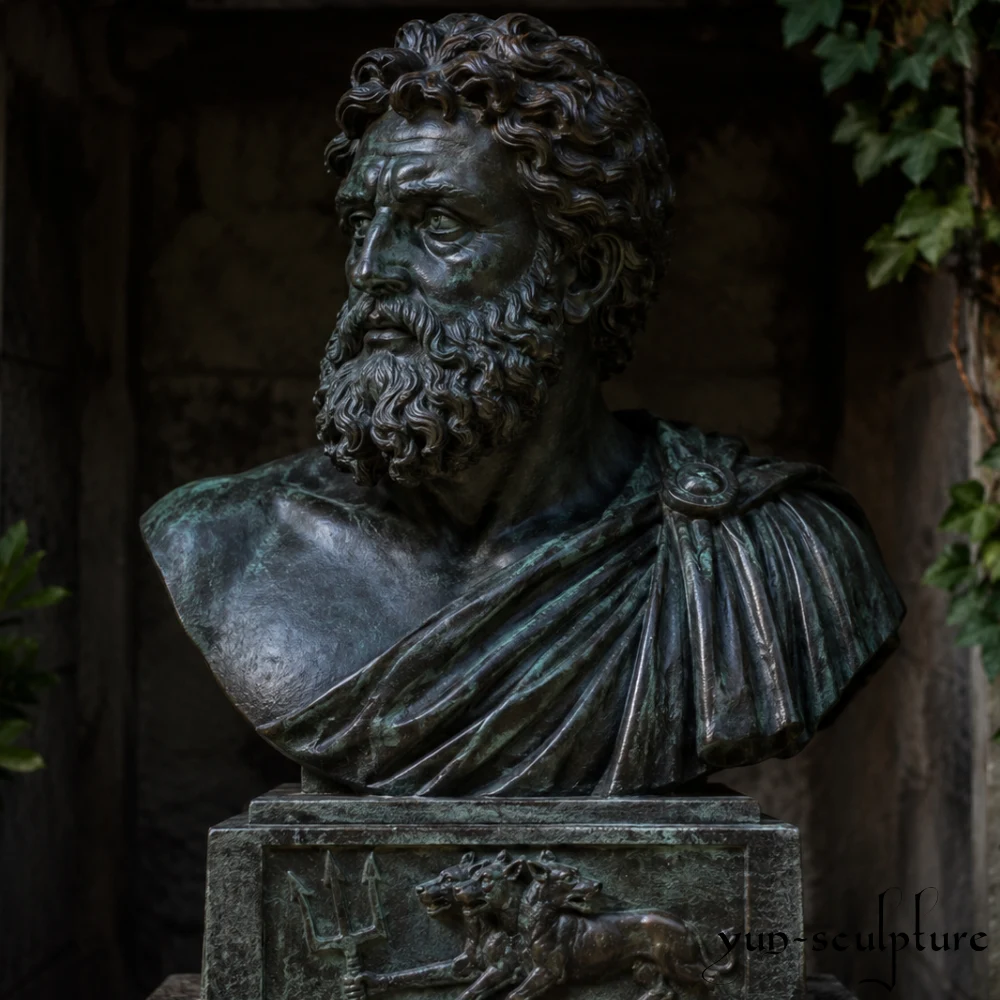
The single most reliable identifier of a Hades figure in ancient art is the presence of Cerberus — no other deity owns a three-headed dog. The bident is the second most reliable attribute, though it appears less consistently than the tridents and thunderbolts of his brothers. A bearded male figure without these attributes risks being read as Zeus or Poseidon; for commissioned garden installations where Hades’s specific identity matters, ensuring Cerberus is present at the figure’s feet is the most reliable iconographic solution.
The skull-adorned fantasy versions of Hades available from most contemporary decorative sculpture suppliers have no basis in ancient Greek or Roman iconographic tradition. They derive from medieval Christian imagery of death and damnation — the Grim Reaper tradition — combined with the aesthetic vocabulary of modern fantasy and gaming design. A collector or garden designer working with the ancient tradition should treat these figures as entirely separate objects from authentic Hades sculpture.
Hades and Persephone: The Myth That Makes Him Human
The myth of Hades and Persephone is one of the oldest and most psychologically resonant narratives in Greek religion. Persephone — daughter of Demeter, goddess of the harvest — is gathering flowers in a meadow when the earth opens and Hades emerges to carry her below. Demeter, devastated, withdraws her gifts from the earth: crops fail, animals starve, the world approaches the end of life itself. Zeus, forced to intervene, sends Hermes to negotiate. Hades agrees to return Persephone — but she has eaten six pomegranate seeds in the underworld, and by the law that governs his realm, anyone who has eaten the food of the dead must return. A compromise is reached: Persephone will spend six months below with Hades and six months above with her mother. The seasons are born.
What is remarkable about this myth is what it reveals about Hades. He does not release Persephone because he is compelled to — he agrees to the arrangement because it is just, because the law of the cosmos supersedes even his desire. And his desire is not the cruelty of a kidnapper but the longing of the sovereign of a dead realm for the presence of life. The most beautiful reading of the myth is that Hades, the god who rules a kingdom of endings, fell in love with a goddess who embodies beginnings — and that the compromise he accepted is the origin of spring.
For garden installations designed around the Hades and Persephone narrative — seasonal planting programs where winter represents Persephone’s descent and spring her return — a Hades statue in a dark garden corner, placed in deliberate contrast to a Persephone or Demeter figure in a sunlit space, creates a garden program with mythological depth that rewards sustained attention across the seasons.
Gothic and Dark Garden Placement Guide
The gothic garden tradition — with its emphases on dark foliage, architectural ruins, memento mori elements, and the deliberate cultivation of melancholy as an aesthetic — has deep roots in Western garden history. The 18th-century English landscape garden regularly incorporated hermitages, ruined temples, and funerary monuments precisely to create moments of contemplative encounter with mortality within a designed landscape. Hades is the most historically appropriate deity for this tradition.
The Memorial Corner
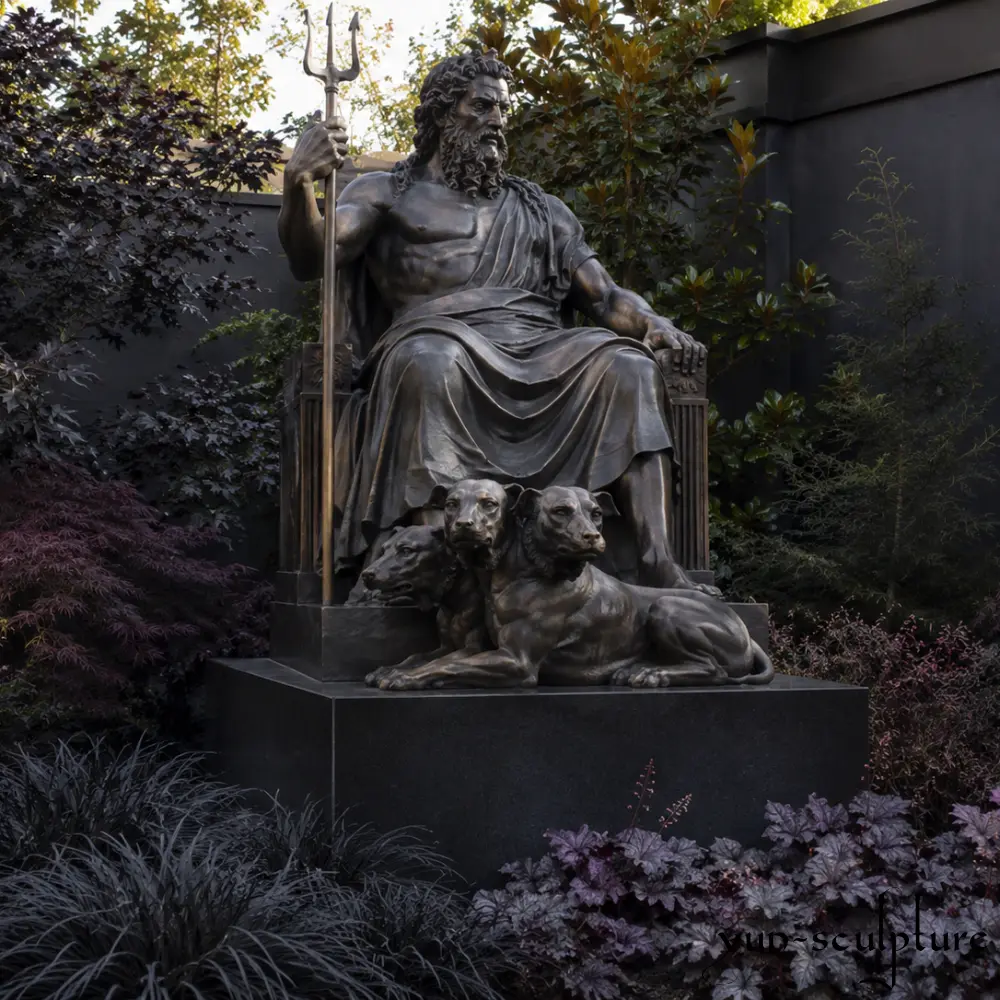
The most direct application of a Hades statue in a garden is as the presiding figure of a memorial space — a corner of the garden dedicated to contemplation, memory, and the acknowledgment of loss. Dark-foliaged planting (black mondo grass, dark elder, deep purple heuchera, black hollyhock) surrounding a Hades figure on a dark stone pedestal creates a space that acknowledges mortality without being morbid — the ancient Greek approach rather than the Victorian one.
For this application, a seated Hades in bronze — enthroned, with Cerberus at his feet — at life-size or larger is the most iconographically resonant choice. The seated pose carries the stillness appropriate to a memorial space; the bronze patina darkens over time in outdoor exposure, deepening toward the black-green that reads as the color of deep earth and underground water.
The Garden of Persephone
A more elaborate garden program based on the Hades and Persephone myth places Hades at the lowest, darkest point of the garden — the point that receives least light, perhaps a sunken garden, a walled enclosure, or the space beneath a large deciduous tree — while Persephone or Demeter occupies the highest, most sun-exposed position. The path between them becomes the garden’s narrative axis: the visitor moves between the realms of death and life, winter and spring, absence and presence.
This program works exceptionally well with seasonal planting that emphasizes the contrast: winter-interest plants (bare stems, seedheads, dark evergreens) around the Hades installation; spring bulbs and summer-flowering perennials around the upper figure. The garden literally enacts the myth across the calendar year.
The Grotto and Underground Feature
Grottos — semi-subterranean garden structures lined with shells, rough stone, or tufa — were a staple of Renaissance and Baroque garden design, and their association with the underground realm makes them the most architecturally apt setting for a Hades installation. A Hades figure placed at the back of a grotto, partially in shadow, with water emerging from the rock face beside it (representing the rivers of the underworld — Styx, Lethe, Acheron), creates a garden feature of genuine mythological coherence.
For grotto installations, bronze is essential — the enclosed, potentially damp environment of a grotto will damage marble over time. A silicon bronze Hades with a dark patina in a grotto setting achieves the visual character of ancient buried bronze: the color of earth, of time, of things preserved in darkness.
The Entrance Guardian
Hades as the keeper of the gate — the deity who controls passage between the world of the living and the world of the dead — has a natural application as a guardian figure at garden entrances, particularly the entrance to a walled garden, a cemetery garden, or any enclosed space where the threshold carries symbolic weight. A standing Hades with Cerberus, flanking or presiding over an entrance gate, invokes his function as the ultimate boundary-keeper: the one through whose gate all things must eventually pass.
For this application, a standing Hades figure at 1.5–2x life-size in dark-patinated bronze creates a visual presence appropriate to a significant architectural threshold. The scale elevation above life-size signals divine rather than human status without requiring the full monumental scale of a public monument.
Bronze vs. Marble for a Hades Statue
For Hades specifically, the material choice is less ambiguous than for most other Greek deities. Bronze is almost always the correct answer — and the reasons are both practical and mythological.
Practically: Hades statues are most powerfully placed in the darkest, most shaded areas of a garden, and in grotto or semi-subterranean settings where moisture is a factor. White marble loses visual definition in deep shade, and it is vulnerable to moisture damage in enclosed settings. Bronze holds its presence in low light — the dark patina reads as a positive visual quality rather than a loss of brightness — and is impervious to moisture.
Mythologically: the ancient Greeks associated Hades’s realm with darkness, earth, and metals — the materials that the underworld produces. A bronze Hades in a dark garden corner participates in this association directly. The warm blackish-brown of an aged silicon bronze patina is the color of deep earth, of underground space, of the realm that lies beneath the world of light and air where the other Olympians reign.
White marble Hades statues are not impossible — the Capitoline Museums’ seated figure is marble — but they are most appropriate for interior spaces where the classical tradition is being invoked without the specifically chthonic garden context. For outdoor gothic and dark garden installations, bronze is the unambiguous choice.
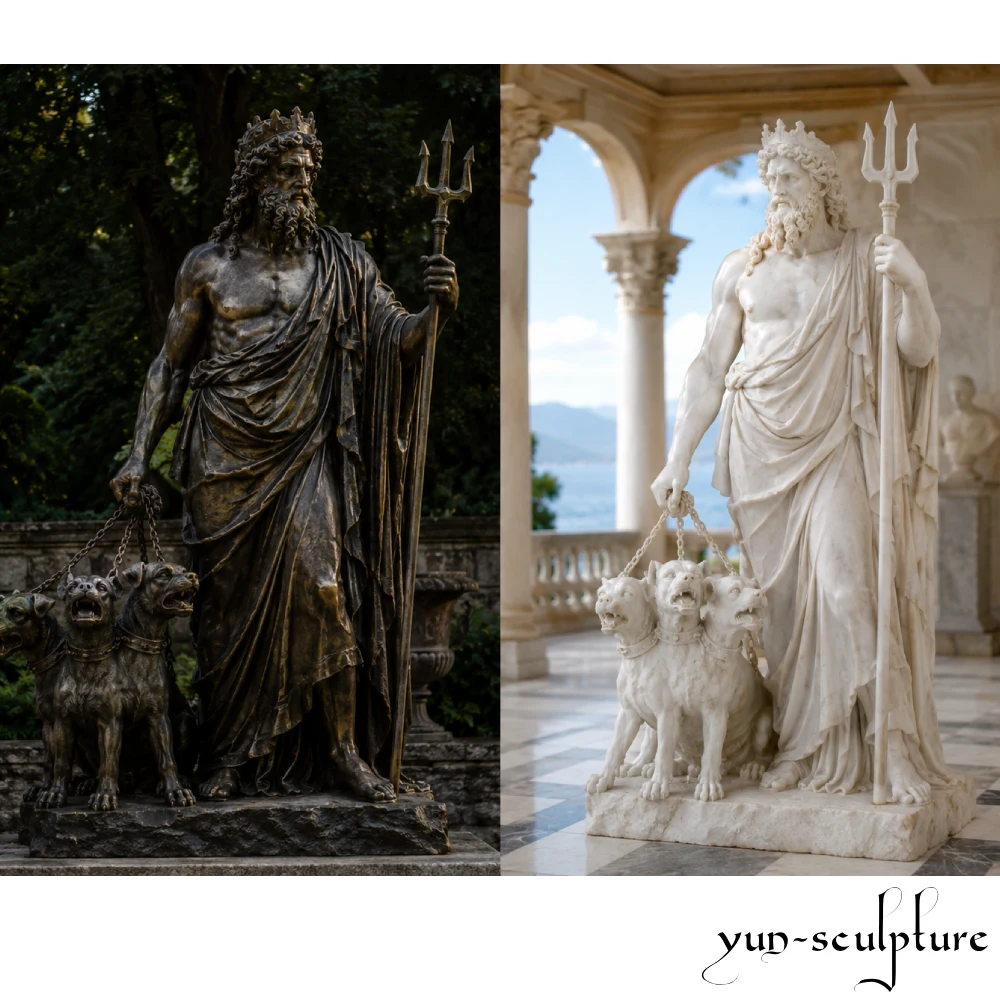
| Silicon Bronze (Dark Patina) | White Marble | |
|---|---|---|
| Outdoor durability | Excellent — 100+ years | Good in temperate climates; risk in freeze-thaw |
| Performance in shade | Excellent — dark patina reads well in low light | Poor — loses definition and presence in deep shade |
| Grotto/enclosed setting | Excellent — impervious to moisture | Not recommended — moisture risk over time |
| Mythological resonance | Direct — bronze is the metal of the earth’s depths | Indirect — marble is associated with the upper world |
| Patina development | Deepens and darkens with outdoor exposure — aesthetically positive for Hades | Develops surface weathering — may require cleaning |
| Starting price (life-size) | From $4,500 | From $3,800 |
| Recommended for gothic garden | ✓ Strongly recommended | Limited to sheltered/interior settings |
Frequently Asked Questions
Is there a statue of Hades? +
Yes, ancient statues of Hades exist, though they are rarer than depictions of Zeus, Poseidon, or Apollo — reflecting his position as a deity of the inevitable whom the Greeks rarely needed to propitiate. The most significant surviving ancient Hades figure is the seated Hades-Serapis in the Capitoline Museums, Rome (2nd century CE), a colossal marble figure showing the god enthroned with Cerberus at his feet. In contemporary production, Hades statues in true lost-wax bronze based on ancient classical prototypes are available from specialist foundries; the majority of commercially available Hades figures are cold-cast resin pieces derived from fantasy and gaming aesthetics rather than the ancient sculptural tradition.
What exactly is Hades the god of? +
Hades is the god of the dead and the sovereign ruler of the underworld — the realm to which all mortal souls travel after death. He received dominion over the underworld when the cosmos was divided among the three brothers after the defeat of the Titans. In his Roman identity as Pluto, he is also the god of underground wealth — all mineral riches, metals, and the buried fertility from which the earth’s crops grow. He is not the god of death itself (that role belongs to Thanatos) but of the realm where the dead reside. He governs with absolute impartiality: every mortal soul, virtuous and wicked alike, passes into his domain.
Was Hades evil or good? +
In ancient Greek religion, Hades was neither evil nor good in the moral sense — he was impartial and inevitable. The Greeks feared him not because he was malevolent but because his domain was inescapable. He did not cause death, did not torment souls for pleasure, and did not pursue the living. Ancient sources consistently describe him as just — severe but fair, the impersonal sovereign of natural law applied to mortality. The villainous Hades of popular culture derives from centuries of Christian influence that mapped the Greek underworld onto the Christian concept of Hell, and from the aesthetic vocabulary of medieval death imagery and modern fantasy design. Neither has any basis in ancient Greek belief.
What did Hades really look like? +
In ancient Greek and Roman depictions, Hades looks virtually identical to Zeus and Poseidon — a mature, bearded, powerfully built male figure of commanding authority. The physical type of the three brothers is the same; they are differentiated by attributes rather than by facial or bodily characteristics. Hades’s specific attributes are Cerberus (his three-headed dog), the bident (a two-pronged staff), a scepter of sovereignty, and occasionally the helm of invisibility. He is not depicted with horns, skull decorations, or any of the death-deity attributes familiar from medieval and modern fantasy imagery — those derive from Christian demonology and modern game design, not from ancient Greek artistic tradition.
Who did Hades fall in love with? +
Hades fell in love with Persephone, the daughter of Demeter and Zeus. In the most widely known version of the myth, Hades abducted Persephone as she gathered flowers, carrying her below to become his queen in the underworld. Demeter’s grief caused the earth to become barren until Zeus negotiated a compromise: Persephone would spend six months below with Hades and six months above with her mother, creating the cycle of the seasons. Persephone became Queen of the Underworld, a figure of genuine authority in her own right. Their relationship — the sovereign of death and the goddess of spring — is one of the most resonant mythological unions in the Greek tradition, and the origin of the seasons themselves.
What makes a Hades statue appropriate for a gothic or dark garden? +
A Hades statue is appropriate for a gothic or dark garden because Hades is the ancient Greek deity most directly associated with mortality, the underworld, and the cycle of death and renewal that gothic garden design explores. Placed in the darkest corner of a garden — in deep shade, within a grotto, at the entrance to a walled enclosure, or at the lowest point of a sunken garden — a bronze Hades statue serves as the presiding deity of that space’s engagement with the inevitable. Unlike fantasy death figures, a classically accurate Hades statue based on ancient prototypes brings 2,500 years of philosophical and artistic engagement with mortality into the garden. The dark patina of outdoor silicon bronze deepens over time in shaded garden conditions, making the material itself an expression of the chthonic associations of the god it depicts.
Commission a Hades Statue from Quyang
Seated sovereign, abduction group, or standing guardian — bronze in dark patina, desktop to monumental scale. Share your garden program and placement details and we’ll respond within 2 business days with a factory-direct quote.
Commission a Hades Statue from Quyang
Seated sovereign, abduction group, or standing guardian — bronze in dark patina, desktop to monumental scale. Share your garden program and placement details and we’ll respond within 2 business days with a factory-direct quote.