Get in touch with Yun-Sculpture company
Life Size Greek Statues for Sale: Bronze & Marble, Factory Direct

Life-size Greek statues are available in genuine lost-wax bronze and hand-carved natural marble, produced to order from foundries and workshops in Quyang, Hebei — the center of China’s sculpture manufacturing industry. The most commonly commissioned figures are Zeus, Athena, Poseidon, Hercules, Apollo, and Aphrodite, at heights ranging from 150 cm to 250 cm for standard life-size and beyond for monumental commissions. This guide covers which Greek figures work best at life-size, what material suits each setting, what genuine life-size production costs, and what to verify before placing a commission.
Table of Contents
Table of Contents
Which Greek Figures Work Best at Life Size?
Not every Greek deity translates equally to life-size scale. The figures that work best share a common quality: a composition that reads with authority from 5 to 10 meters away and holds detail at close range.
Zeus — The king of Olympus is the natural choice for a dominant focal point. A life-size Zeus in dark bronze patina at the end of a garden axis or in a hotel lobby commands a space in a way few other figures can. Our Zeus statue guide covers the major compositional variants — standing with thunderbolt, seated on throne, or bust format.
Athena — Goddess of wisdom and war is among the most formally resolved Greek figures for life-size commission. The combination of helmet, spear, shield, and draped figure creates a silhouette that reads at distance and rewards close inspection. Our Athena statue page covers material and finish options in detail.
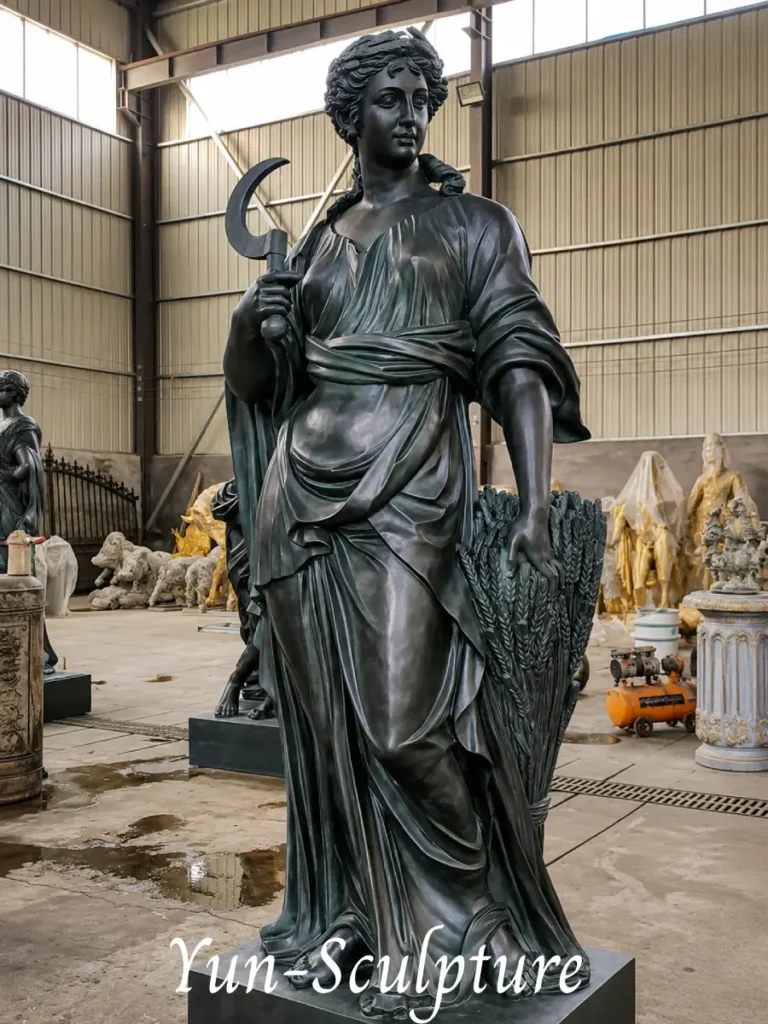
Poseidon — God of the sea works exceptionally well near water features at life-size. The trident gives the figure strong vertical extension above the head height, making it read effectively even when surrounded by garden planting.
Hercules — The muscular figure of Hercules at life-size has a physical presence that more draped figures lack. The Farnese Hercules — leaning on his club, exhausted after his labors — is the most popular compositional reference for life-size commissions.
Apollo — God of light and the sun in the Apollo Belvedere pose is the standard life-size reference: idealized male form, weight on one leg, cloak over the extended arm. Works equally well in marble and bronze.
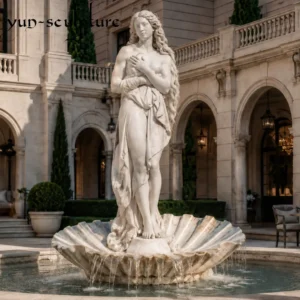
Aphrodite / Venus — The most popular female figure for life-size commission. The Venus de Milo composition — armless, spiral torso — remains the dominant reference. In white marble at life-size, it is among the most formally complete sculptures available.
Browse the full Greek gods collection for the complete pantheon including lesser-ordered figures such as Hermes, Dionysus, Artemis, and Ares.
Bronze or Marble for a Life-Size Greek Statue?
Both materials are appropriate for life-size Greek statues. The decision comes down to setting, climate, and the aesthetic register you are after.
Bronze is the better choice for permanent outdoor installation. Lost-wax bronze — minimum 85% copper content — handles freeze-thaw cycles, UV exposure, and moisture without surface degradation. A life-size bronze Greek statue installed outdoors will develop a natural patina over years: copper-gold to warm brown to verde green, depending on climate and whether the surface is waxed periodically. For garden focal points, hotel courtyards, resort pools, and estate terraces, bronze is the standard specification.
Marble performs at its best indoors or in sheltered outdoor positions. A life-size Zeus or Athena in white marble in an entrance hall, gallery corridor, or covered loggia is a formally different object from its bronze equivalent — quieter, more monumental, with the surface translucency that makes natural stone read differently from any composite or resin alternative. In Mediterranean climates and most of the American South and West, outdoor marble installation is unproblematic with appropriate siting. In freeze-thaw climates, a sheltered position is recommended.
For a detailed breakdown of material grades — from resin to hand-carved natural stone — see our life-size statue guide.
What Does a Life-Size Greek Statue Cost?
Price depends on material, figure complexity, and scale. The following ranges reflect factory-direct pricing from Yun Sculpture in Quyang — without gallery or import markups.
| Figure | Material | Height | Price Range |
|---|---|---|---|
| Single draped figure (Athena, Aphrodite) | Natural marble | 150–180 cm | $3,500–$8,000 |
| Single draped figure | Lost-wax bronze | 150–180 cm | $3,000–$7,000 |
| Muscular figure (Hercules, Zeus standing) | Natural marble | 180–200 cm | $5,000–$12,000 |
| Muscular figure | Lost-wax bronze | 180–200 cm | $4,500–$10,000 |
| Complex figure with attributes (Poseidon with trident, Athena with spear+shield) | Lost-wax bronze | 180–200 cm | $6,000–$14,000 |
| Monumental single figure | Either material | 250 cm+ | Quoted individually |
A standard 6-foot (180 cm) bronze Greek statue in genuine lost-wax bronze runs $4,000–$8,000 factory direct. The same piece through a gallery or importer runs 40–80% higher. Marble at equivalent scale runs $3,500–$10,000 depending on figure complexity and marble color — white marble is the most affordable; colored varieties (Egyptian beige, nero marquina) carry a premium.
What Are the Three Styles of Greek Sculpture?
Understanding the three periods helps when specifying a commission — each has a distinct formal quality that affects how a life-size figure reads in a space.
Archaic (700–480 BC) — Frontal, symmetrical, stylized. The kouros figures of this period stand with arms at sides, weight equally distributed, slight smile. Formal and hieratic — works well in minimalist contemporary interiors where the stylization reads as intentional.
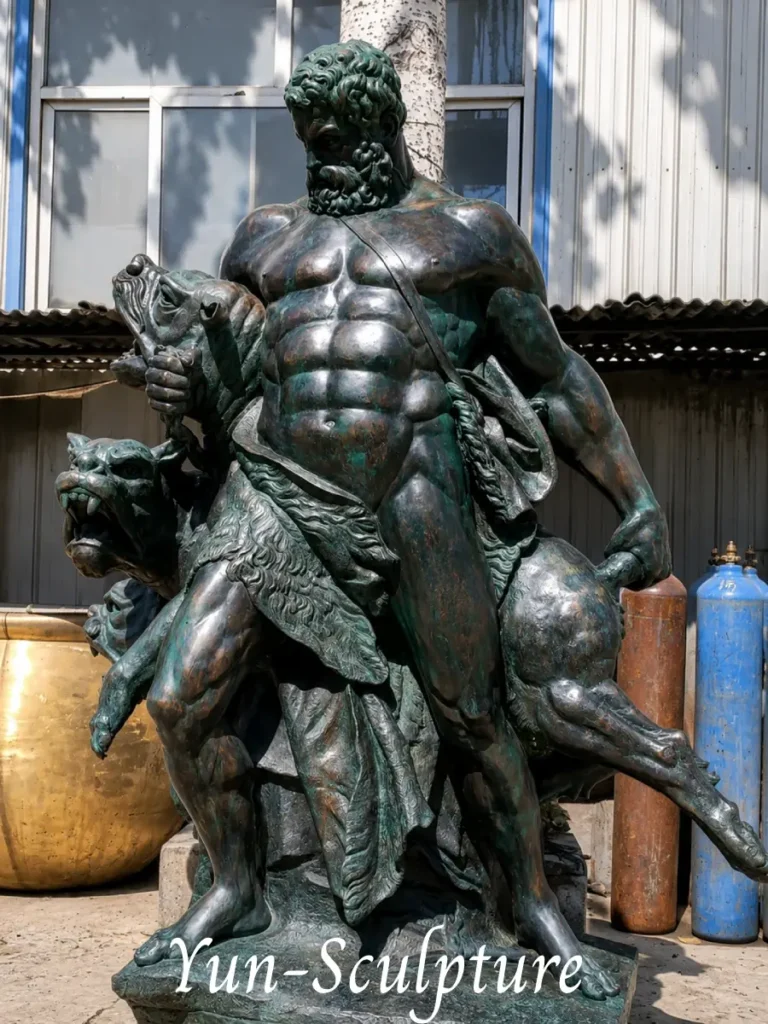
Classical (480–323 BC) — The period of Phidias, Polykleitos, and Praxiteles. Contrapposto weight shift, naturalistic anatomy, idealized but believable human form. The Discobolus, the Doryphoros, the Aphrodite of Knidos. This is the period most buyers have in mind when commissioning a life-size Greek statue — the figures feel alive without the drama of the Hellenistic period.
Hellenistic (323–31 BC) — Emotional intensity, dynamic movement, complex multi-figure groups. The Laocoön, the Winged Victory, the Venus de Milo. Figures twist in space, faces show strain or pathos. More demanding to reproduce at life-size but delivers the greatest spatial presence when executed well.
Most life-size commissions reference the Classical or Hellenistic periods. Archaic figures are less commonly ordered for residential or commercial settings but work well in specific contemporary contexts.
What Are the Colossal Greek Statues?
The ancient world produced several Greek statues at scales far beyond life-size — the most significant of which no longer survive in original form.
The Colossus of Rhodes — A bronze statue of the sun god Helios standing approximately 33 meters tall at the entrance to Rhodes harbor, completed around 280 BC. Destroyed by earthquake in 226 BC. Considered one of the Seven Wonders of the Ancient World.
The Statue of Zeus at Olympia — A seated chryselephantine (gold and ivory) statue of Zeus approximately 13 meters tall, housed in the Temple of Zeus at Olympia. Sculpted by Phidias around 435 BC. Another of the Seven Wonders. Destroyed in late antiquity.
The Athena Parthenos — A 12-meter gold and ivory statue of Athena inside the Parthenon in Athens, also by Phidias. The original is lost; a Roman-period reduced marble copy (the Varvakeion Athena) survives in the National Archaeological Museum in Athens.
For modern monumental commissions at 3 meters and above, Yun Sculpture produces Greek figures at any specified height. Structural engineering requirements apply at 4 meters and above — raise this at inquiry and we will advise on base and armature specifications.
Why Don’t People Make Marble Statues Anymore?
The decline of large-scale marble sculpture in the twentieth century was driven by three factors: the rise of modernism, which rejected figurative representation as the primary mode of serious sculpture; the cost of skilled stone carvers relative to industrial production alternatives; and the shift of major sculptural commissions toward public monuments in cheaper and faster materials.
The craft never disappeared. Quyang, where Yun Sculpture operates, has been a center of stone carving for over 1,500 years — since the Northern Wei dynasty. The concentration of skilled marble carvers in the region means that the techniques used to produce the Venus de Milo and the Apollo Belvedere are still practiced at workshop scale, at costs that make private commission viable for collectors, developers, and institutions who previously had no access to this quality tier.
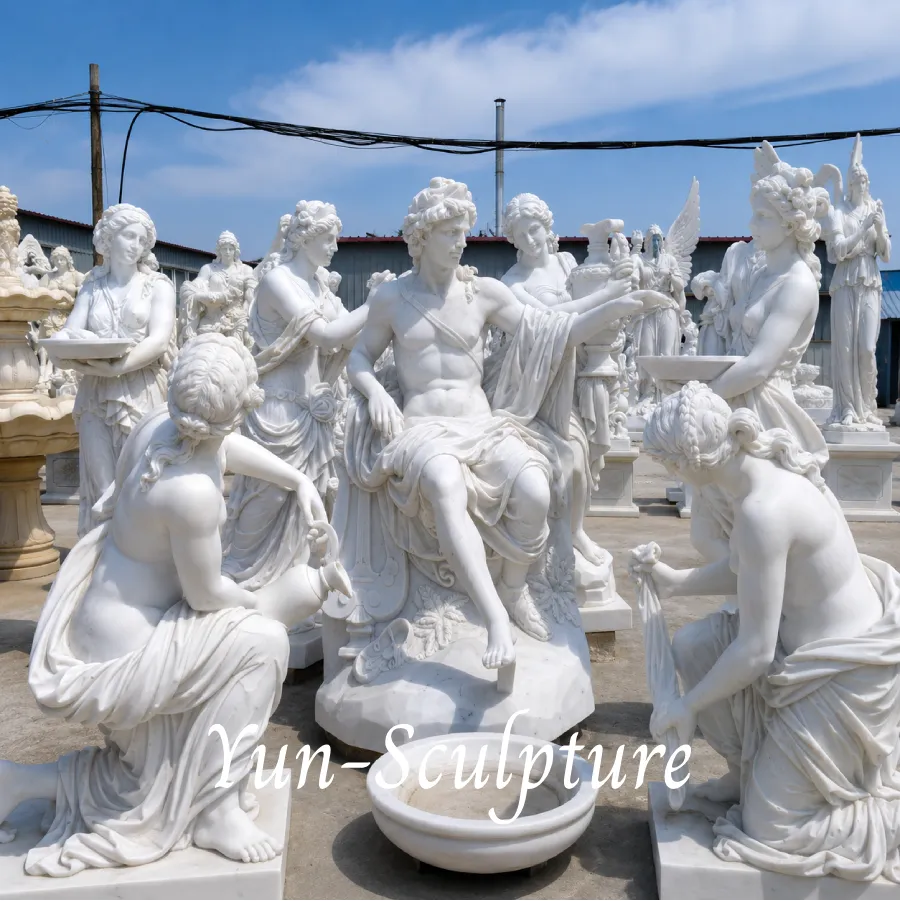
The market for hand-carved marble at life-size is smaller than the mass-produced resin market, but it exists and has grown as the distinction between genuine stone and composite alternatives has become better understood among serious buyers.
Frequently Asked Questions
How much does a life-size statue cost?
A life-size Greek statue in genuine lost-wax bronze costs $3,000–$14,000 factory direct depending on the figure and complexity. Natural marble equivalents run $3,500–$12,000. These are factory-direct prices from Quyang; gallery and import markups add 40–80% to the same piece. Resin and composite alternatives at life-size cost $500–$3,000 but are surface-coating materials — not appropriate for permanent outdoor installation or close-range viewing.How much does a 6-foot tall bronze statue cost?
A 6-foot (180 cm) bronze Greek statue in genuine lost-wax bronze costs approximately $4,000–$8,000 factory direct for a standard single figure. Figures with complex attributes — Poseidon with trident, Athena with spear and shield — run toward the higher end. Cold-cast bronze at equivalent scale costs $500–$2,000 but is resin-based; the bronze content is a surface coating rather than the structural material.What is the most beautiful Greek statue?
By scholarly consensus and museum visitor surveys, the Venus de Milo (Louvre, Paris) and the Apollo Belvedere (Vatican Museums, Rome) consistently rank as the most beautiful surviving Greek statues. The Winged Victory of Samothrace (Louvre) is frequently cited for dynamic beauty. Among male figures, the Doryphoros by Polykleitos — known only through Roman marble copies — defined the Classical ideal of male proportion and remains the formal standard against which Greek male sculpture is measured.What are the three styles of Greek sculpture?
Greek sculpture developed across three distinct periods: Archaic (700–480 BC), characterized by frontal, symmetrical figures with stylized features; Classical (480–323 BC), the period of naturalistic idealization and contrapposto weight shift, producing figures like the Discobolus and the Apollo Belvedere; and Hellenistic (323–31 BC), marked by emotional intensity, dynamic movement, and complex multi-figure compositions like the Laocoön and the Venus de Milo. Most life-size commissions reference the Classical or Hellenistic periods.What is the best material to make a statue out of?
For permanent outdoor installation, genuine lost-wax bronze is the best material — it handles all weather conditions, develops a protective patina, and will last centuries without structural maintenance. For indoor installation or sheltered outdoor positions, hand-carved natural marble is the superior choice — the same material used for the originals, with surface translucency no composite replicates. Resin, cold-cast bronze, bonded marble, and composite stone are appropriate for decorative or temporary use; none is suitable for permanent display at close viewing range.How long will bronze statues last outdoors?
A properly cast bronze statue — minimum 85% copper, lost-wax method — will last centuries outdoors. Ancient bronze figures recovered from the sea after 2,000 years remain structurally intact. For a residential or commercial installation, a genuine bronze statue requires no structural maintenance within any normal human lifetime. Periodic wax application (once or twice annually) slows patina development if a lighter surface color is preferred; left unwaxed, bronze develops the natural verde green patina associated with aged monumental sculpture.Why don’t people make marble statues anymore?
Large-scale marble sculpture declined in the twentieth century due to the rise of modernism, the cost of skilled stone carvers, and the availability of cheaper casting alternatives. The craft continues in concentrated workshop regions — Quyang in China has practiced stone carving for over 1,500 years and remains the world’s primary center for hand-carved marble sculpture. Factory-direct commissioning from Quyang makes life-size marble statues accessible at price points that were previously only available through European intermediaries.What are the colossal Greek statues?
The most significant colossal Greek statues were the Colossus of Rhodes (approximately 33 meters, destroyed 226 BC), the Statue of Zeus at Olympia (approximately 13 meters, destroyed in late antiquity), and the Athena Parthenos inside the Parthenon (approximately 12 meters, lost — known through Roman copies). None of the major colossal originals survives. Modern monumental commissions referencing these works are produced at 3 to 10 meters depending on site requirements.Order a Life-Size Greek Statue from Quyang
Bronze or marble, any Greek deity, 150 cm to monumental. Share your figure, scale, and setting — we respond within 2 business days with a factory-direct quote.