Get in touch with Yun-Sculpture company
Michelangelo’s David Replica: Museum-Quality Bronze & Marble for Sale

Yes — museum-quality replicas of Michelangelo’s David exist, and several institutions display them permanently alongside the original in Florence. The statue has been reproduced in marble, bronze, and resin at every scale since the nineteenth century. The difference between a replica worth owning and one that is not comes down to three things: material, scale, and whether the proportions were taken from the original or from a photograph. This guide covers what separates a genuine hand-carved replica from a molded copy, what scale decisions apply to different settings, and what a commission from Yun Sculpture’s Quyang foundry actually involves.
Table of Contents
Table of Contents
What Is Michelangelo’s David?
Michelangelo’s David is a marble statue carved between 1501 and 1504, depicting the biblical David in the moment before his confrontation with Goliath. It stands 5.17 meters tall including its base — 4.34 meters of figure alone — and was carved from a single block of white Carrara marble that had been abandoned by two previous sculptors as too difficult to work.
The figure represents a departure from earlier David iconography: rather than showing David in triumph after the battle, Michelangelo captured him in a state of concentrated tension — sling over his left shoulder, stone in his right hand, head turned slightly to the left, every muscle engaged but still. The result is one of the defining achievements of Renaissance sculpture: a figure that communicates psychological intensity through physical form.
The original has been housed in the Galleria dell’Accademia in Florence since 1873, moved indoors from the Piazza della Signoria to protect it from weather damage. It is owned by the Italian state and cannot be purchased, loaned, or permanently relocated.
Are There Replicas of Michelangelo’s David?
Yes. Authorized and institutional replicas of the David exist at multiple locations worldwide, and private commissions have been produced continuously since the nineteenth century.
The most significant replicas are the full-size marble copy in the Piazza della Signoria in Florence — placed in the exact position the original occupied from 1504 to 1873 — and the plaster cast at the Victoria and Albert Museum in London, produced in 1857 at the direct request of Queen Victoria. A full-size bronze cast stands in the Piazzale Michelangelo overlooking Florence.
For private collectors, hotels, institutions, and residential estates, hand-carved marble and cast bronze replicas are produced to order. At Yun Sculpture, we produce David replicas in both natural white marble and bronze from our foundry in Quyang, at any scale from 50 centimeters to the full 5.17 meters.
How Many Replicas of David Are There?
No comprehensive count exists. The David is among the most reproduced sculptures in Western art history. Institutional full-size replicas number in the dozens worldwide — major examples exist in Florence, London, Los Angeles, and São Paulo. Private and commercial replicas in marble, bronze, resin, and composite stone number in the hundreds of thousands across all scales and quality tiers.
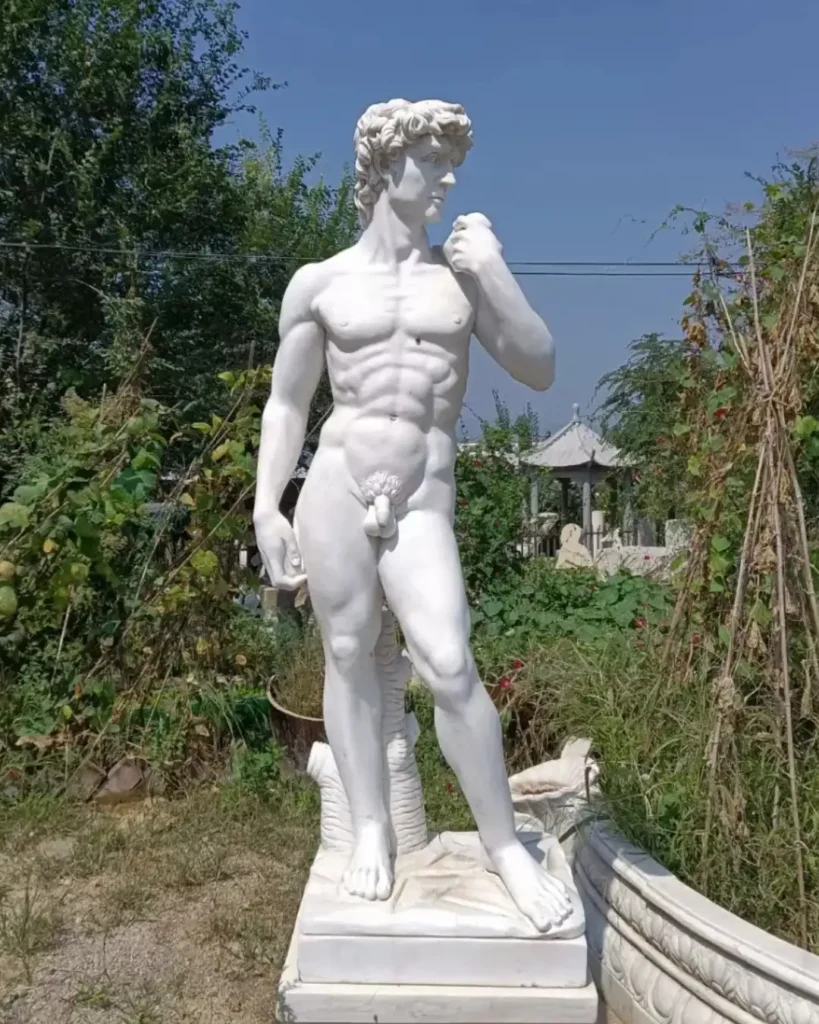
The meaningful distinction is not how many replicas exist but which category a given piece falls into. Hand-carved natural marble replicas — worked from stone by a sculptor with reference to the original’s precise measurements — occupy a fundamentally different category from molded resin pieces regardless of how either is described in a product listing.
Marble or Bronze: Which Material for a David Replica?
The original is white Carrara marble. For a replica intended to read as close to the source as possible — particularly for indoor installation — natural white marble is the correct choice. The surface translucency of well-quarried marble, the way light enters the stone slightly before reflecting back, is the quality that gives the original its particular presence in the Accademia. No composite or resin surface replicates it.
Bronze is the appropriate choice for outdoor permanent installation, particularly at life-size and above. Bronze handles weather, freeze-thaw cycles, and UV exposure without surface degradation. A David in dark or natural bronze patina reads with considerable authority in garden, courtyard, and estate settings — a different aesthetic register from the marble original but a legitimate and historically precedented one. The Piazzale Michelangelo replica in Florence is bronze.
For life-size marble statues in controlled indoor environments — entrance halls, galleries, hotel lobbies, private museums — marble is preferable. For outdoor permanent installation at any scale, bronze is the more durable specification. Both are available from Yun Sculpture at custom dimensions.
What Scale Is Right for a David Replica?
Scale is where most buyers make the critical decision, and the proportions of the original make this more complex than with most figures.
Michelangelo deliberately distorted the David’s proportions for visual effect: the head, hands, and right arm are larger than anatomically correct, calculated to read correctly when viewed from below at the figure’s original outdoor placement. At full scale — 5.17 meters — these proportions are imperceptible as distortions. At reduced scales, particularly below 100 centimeters, they become more apparent and the figure can read as heavy-handed in the upper body.
Practical scale guidance:
| Height | Setting | Notes |
|---|---|---|
| 50–80 cm | Desk, shelf, mantelpiece | Silhouette reads; proportional distortion most visible at close range |
| 100–150 cm | Pedestal display, alcove, terrace | Composition fully legible; suitable for residential interiors |
| 180–220 cm | Entrance hall, hotel lobby, garden focal point | Life-size range; proportional distortion resolves; full figure authority |
| 300–400 cm | Courtyard, estate garden, institutional lobby | Monumental presence; engineered base required |
| 517 cm | Full original scale | Requires structural installation planning |
All Yun Sculpture David replicas are produced to your specified height. If you have an installation space with specific ceiling height or viewing distance constraints, share those at inquiry and we’ll recommend the appropriate scale.
Why Is There a Replica in Florence’s Piazza della Signoria?
The marble replica in the Piazza della Signoria stands in the exact position the original occupied from 1504 to 1873 — 369 years outdoors in the Florentine elements. When the Italian state moved the original to the Galleria dell’Accademia for preservation, the civic authorities commissioned a full-size marble replacement to maintain the visual and historical continuity of the square. The replica was installed in 1910 and remains in place today.
This is the institutional precedent for high-quality replica commissions: the purpose is not deception but continuity — maintaining the presence and function of a significant work in its intended location when the original requires protection.
What a David Replica Commission Involves
At Yun Sculpture, a David replica commission follows the same process as our other figurative sculpture work:
Material selection — white marble or bronze, with finish and patina options for bronze
Scale confirmation — client specifies height; we confirm proportional resolution and base requirements
Production — 35 to 60 working days depending on scale and material; marble commissions at life-size and above run toward the longer end
Base and pedestal — included in commission scope; client specifies material preference (matching marble, granite, or fabricated steel for bronze)
Shipping — crated and insured freight; we handle export documentation from Quyang
For context on how material grades compare across the replica market, our marble replica buyer’s guide covers the full spectrum from resin to hand-carved natural stone — the same material hierarchy applies to David replicas as to any classical figure.
Frequently Asked Questions
Are there replicas of Michelangelo’s David?
Yes. Museum-quality replicas of Michelangelo’s David exist at multiple institutions worldwide, including a full-size marble copy in Florence’s Piazza della Signoria, a plaster cast at the Victoria and Albert Museum in London, and a bronze version at the Piazzale Michelangelo in Florence. Private commissions in marble and bronze are produced to order for collectors, hotels, estates, and institutions.How many replicas of David are there?
No comprehensive count exists. Institutional full-size replicas number in the dozens worldwide. Private and commercial replicas across all scales and materials number in the hundreds of thousands. The David is among the most reproduced sculptures in Western art history. The meaningful distinction is not quantity but quality: hand-carved natural marble replicas occupy a fundamentally different category from molded resin or composite pieces.Where is the original David statue kept?
The original David by Michelangelo is housed in the Galleria dell’Accademia in Florence, Italy, where it has been displayed since 1873. It was moved indoors from its original outdoor position in the Piazza della Signoria to protect it from weather damage. The Galleria dell’Accademia is the only place in the world where the original can be seen.How much is Michelangelo’s David worth?
The original David is owned by the Italian state and is not for sale at any price. Estimated insurance valuations place it above $800 million, though no official figure exists. For replicas: resin pieces at small scales cost $30–$300; bonded marble or composite replicas at 50–100 cm run $300–$2,000; hand-carved natural marble replicas start at approximately $1,500 for 80 cm pieces and range to $15,000 or more for life-size commissions. Bronze replicas follow a similar range.How tall is Michelangelo’s David?
Michelangelo’s David stands 5.17 meters tall including its base — 4.34 meters of figure alone. It was carved from a single block of white Carrara marble. The figure’s proportions are deliberately distorted: the head, hands, and right arm are larger than anatomically correct, designed to read correctly when viewed from below at its original outdoor placement in the Piazza della Signoria.How long did it take Michelangelo to create David?
Michelangelo worked on the David from 1501 to 1504 — approximately three years. He was 26 years old when he began the commission and 29 when it was completed. The marble block had been quarried decades earlier and abandoned by two previous sculptors before Michelangelo took it on.Why is there a replica statue of David in Florence today?
The marble replica in Florence’s Piazza della Signoria was installed in 1910 to replace the original, which was moved to the Galleria dell’Accademia in 1873 for preservation. The original had stood outdoors in the Piazza for 369 years. The replica maintains the visual and historical continuity of the square in the position the original occupied since 1504.Commission a David Replica from Quyang
Hand-carved marble or cast bronze, 50 cm to 5.17 m. Proportions taken from the original — not from a photograph. Share your scale and setting and we’ll respond within 2 business days with a factory-direct quote.