Get in touch with Yun-Sculpture company
Athena Statue: Symbol of Wisdom for Library, Office & Garden

A law firm without an Athena is a room with furniture. A law firm with an Athena is a space that has made a statement: the values that govern what happens here have a name, and that name has three thousand years of institutional history behind it. This is what an athena statue does to a space that no other classical figure quite replicates. Zeus announces power. Poseidon commands a territory. Our complete guide to all twelve Olympians covers what each god’s authority means for a commission — and why Athena’s is the one that changes the intellectual character of a space rather than its emotional register. Hermes marks a threshold. But Athena does something different and more specific: she makes a space serious in the precise way that a library is serious, a court of law is serious, a place where difficult thinking is done and its consequences matter. This guide covers why great institutions have understood this for two and a half centuries, and how that same logic applies to the private library, the executive study, and the garden that belongs to someone for whom intelligence is the governing value.
Table of Contents
Table of Contents
What Athena Does to a Space — The Intellectual Register
The distinction between Athena and other presiding figures is not mythological. It is experiential. Walk into a room where an Athena stands and the room has a different quality of seriousness than a room where a Zeus stands, or a Poseidon, or a Hermes. This difference is not produced by size or material or placement. It is produced by what the figure means — and what Athena means is wisdom as a governing principle, not as an ornament.

Other gods govern domains. Athena governs a quality of mind. She is the goddess of practical intelligence applied to difficult situations: the strategy that wins without brute force, the craft that produces excellence from raw material, the justice that resolves disputes through reason rather than power. These are not mythological abstractions. They are the specific qualities that institutions built around intellectual rigor — law firms, libraries, universities, research institutes — have always needed to declare themselves committed to. This is why Athena has been placed at the entrance of these institutions since the 18th century and why the declaration still works: the figure names what the institution claims to be about, and three thousand years of human investment in that association give the claim weight that no other symbol quite provides.
The practical effect of an Athena in a space is subtle and cumulative. It does not announce itself the way a dramatic sculpture might. Instead, it shifts the register of the room — makes the space feel like a place where serious thought has a home, where the work done there has been acknowledged as mattering, where the person who works in it has been honest about what they value. This is a different kind of authority from the authority a Zeus or a Poseidon brings. It is the authority of intellectual commitment rather than the authority of power.
1
Private Library · Study · Reading Room
Athena Lemnia — The Goddess at Rest
Helmet held rather than worn. No raised spear. Expression turned slightly as if in thought — the most contemplative and intellectual of the Athena types. This is the correct private library commission: Athena in the moment between battles, which is the moment of reading and thinking and deciding. White marble at 80 to 120 cm for a sheltered interior position. The figure should be visible from the primary reading or working position — not commanding the room from the entrance, but present at its edge, thinking alongside whoever works there.
2
Law Firm · Institution · Corporate Entrance
Athena Parthenos — The Goddess Enthroned
Fully armed: spear, shield, helmet, Nike in hand, owl at feet. The complete iconographic program of civic authority and intellectual power. This is the institutional entrance commission — life-size or above, white marble body with bronze weapon attributes for interior settings, bronze throughout for exterior. The figure addresses arrivals: she faces the entrance, the staff and clients arrive toward her. She is the institution’s declaration of its own values, made permanent in stone and metal at the threshold of the space where those values are practiced.
3
Garden · Courtyard · Outdoor Setting
Athena Promachos — The Goddess Advancing
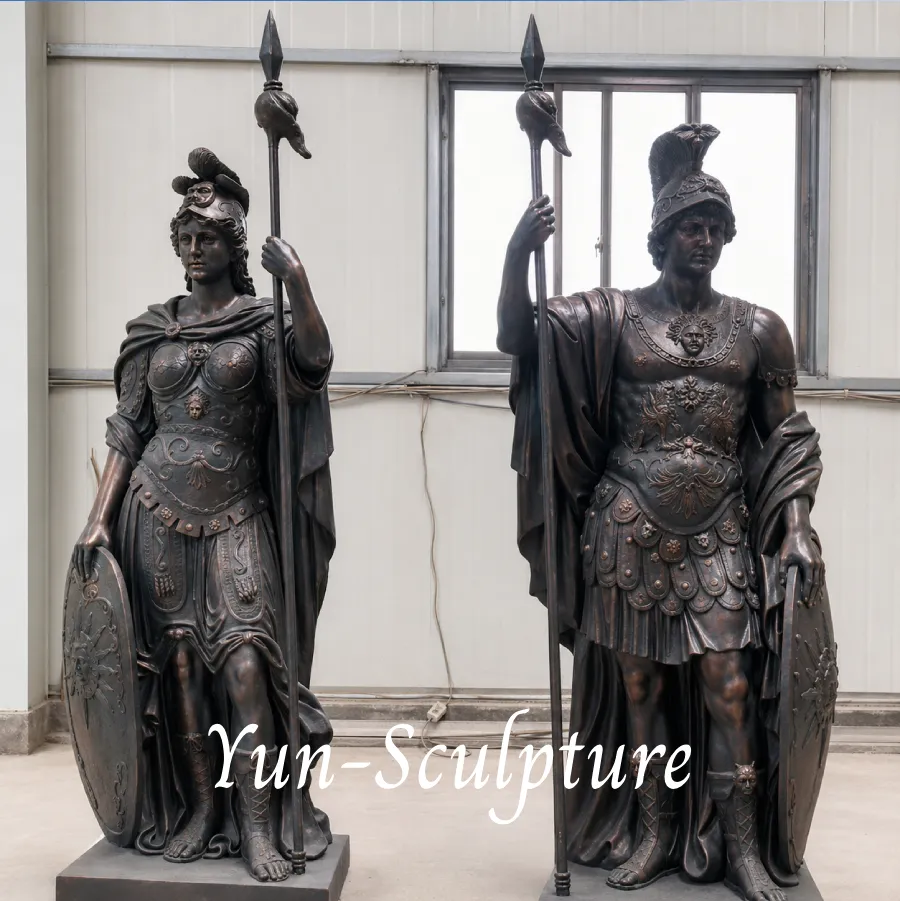
Spear raised, shield forward, helmet on — the warrior in motion rather than enthroned. Cast bronze throughout for outdoor settings: the spear and shield are projecting elements that require bronze’s structural integrity in any climate with temperature variation. An Athena Promachos in a formal garden courtyard or at the approach to a serious institutional building makes a stronger outdoor statement than the Parthenos type — she is in action rather than presiding, which reads more powerfully in open space against sky.
The Institutional Tradition — Why Great Libraries and Courts Have Always Placed Athena
The tradition of placing Athena or Minerva at the entrance of knowledge institutions is not a modern affectation. It is a continuous practice that has run from the great libraries of the Roman world through the institutional architecture of the European Enlightenment to the present day.
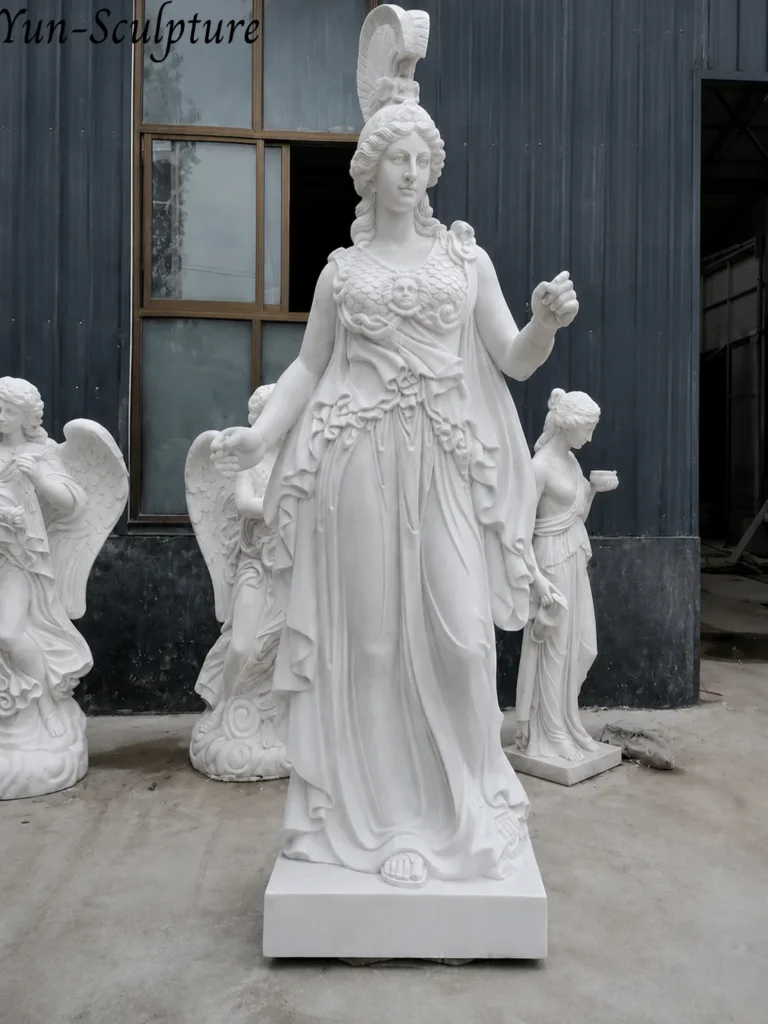
The Library of Congress in Washington DC — the largest library in the world — places Minerva throughout its architecture: in the ceiling mosaics of the Main Reading Room, in the bas-reliefs of the Great Hall, at the symbolic center of an institution that defines itself by the accumulation and preservation of knowledge. The National Academy of Athens places Athena on a marble column at the entrance, flanked by Apollo, in the most direct statement possible about what the institution considers its governing values. The Supreme Court of the United States uses Minerva in its allegorical imagery. The pattern is consistent across two centuries of institutional architecture in the Western world.
These institutions were not making aesthetic choices. They were participating in a three-thousand-year tradition that associated Athena with the specific values their institutions claimed: the careful application of intelligence to difficult problems, the discipline to think before acting, the courage to act on conclusions reached through reasoning rather than force. A private library, a law firm, a consulting practice, a research-oriented office participates in the same tradition when it places an Athena. The scale changes; the declaration does not.
Greek Tradition
Athena
- Goddess of wisdom, strategy, and the protection of cities
- Born from Zeus’s head — wisdom as divine, fully formed
- Patron of Athens — civic intellectual life and political strategy
- Associated with heroes: Odysseus, Perseus, Heracles — wisdom guiding action
- The correct choice when the setting emphasizes strategy and the application of intelligence to difficult problems
- Law firms, executive offices, institutions of civic authority
Roman Tradition
Minerva
- Goddess of wisdom, craft, and specifically schools and academic institutions
- One of the three Capitoline gods — civic importance of the highest Roman order
- Patron of craft guilds, artisans, poets, teachers, physicians
- The library tradition is specifically Minerva’s — Library of Congress, museum reading rooms, academic institutions
- The correct choice when the setting emphasizes learning, scholarship, and the accumulation of knowledge
- Libraries, universities, museums, research institutions
The Owl — When the Full Figure Is Not the Right Choice
Not every space that would benefit from Athena’s presence needs a full standing figure. There is a second Athenian tradition, quieter and more domestic, that runs alongside the monumental one: the owl.
Athena’s owl — the little owl, Athena noctua, which appeared on Athenian coins for centuries and gave the English language the phrase “owls to Athens” — is the most distilled symbol of the goddess’s domain. Not the warrior, not the strategist, not the civic protector: just the creature that sees clearly in darkness, that remains awake when others sleep, that perceives what is hidden. A bronze owl on a library desk or a study mantelpiece says something that a life-size Athena in the same space cannot: it says that wisdom here is personal, private, an attribute of the person who works at this desk rather than a declaration to visitors. The monumental Athena addresses the world. The owl addresses the scholar.
For spaces where a full standing figure would overwhelm the room’s scale or compete with its existing character — a study lined with books that already has a specific accumulated weight — a bronze owl at desktop scale is often the more precise commission. It identifies the space as Athena’s without dominating it. It is the difference between announcing your values and simply living by them.
Scale, Material, and What Your Space Requires
The technical specifications for an Athena commission — which iconographic type, what material, how the mixed-material solution handles the spear and shield, what scale suits which setting — are covered in detail in our dedicated Athena Statue for Sale guide. The short version for this context: the Athena Lemnia type, with helmet held rather than worn and no raised spear, is the correct private library and study commission. The Athena Parthenos type, fully armed, is the correct institutional entrance commission. The Athena Promachos type, in bronze for outdoor settings, is the correct garden commission.
The one scale principle that applies to all three: an Athena should be large enough to read as a presiding presence rather than a decorative object. In a private library at 80 to 120 centimeters, this means a figure that holds its own against the accumulated scale of the books around it. In an institutional entrance at life-size, it means a figure that reads from across the lobby before the detail of the helmet and shield becomes visible. The scale at which she reads as Athena — rather than as a classical figure — is the minimum correct scale for the space.
Frequently Asked Questions
What does the Athena statue symbolize?
The Athena statue symbolizes wisdom applied to action — strategic thought directed toward specific, difficult ends. In an institutional or private setting, her statue declares that the space is governed by intellectual rigor: decisions made with care, work done with skill, reason and justice held to matter. Three thousand years of placing Athena at the entrance of libraries, courts, and institutions gives this declaration an accumulated weight no modern symbol can match.
Are Minerva and Athena the same?
Yes and no. Minerva is the Roman successor to Greek Athena — the same divine entity in a different cultural tradition. In mythology and iconography they are effectively identical. The differences are in emphasis: Athena is the goddess of wisdom, strategy, and civic protection. Minerva is more specifically associated with craft guilds, schools, and academic institutions — the library tradition (Library of Congress, European research libraries) is specifically Minerva’s. Both names are correct for a commission; the choice depends on which tradition the setting wishes to draw on.
Does the original statue of Athena still exist?
The Athena Parthenos by Phidias — approximately 12 meters tall in gold and ivory inside the Parthenon — does not survive. The best record of its appearance is the Varvakeion Athena, a small Roman marble copy in the National Archaeological Museum in Athens. A full-scale reconstruction was completed in 1990 at the Nashville Parthenon. Several other ancient Athena types survive, including the Piraeus Athena (a bronze discovered in 1959, now in the Piraeus Archaeological Museum) and numerous Roman marble copies in major collections worldwide.
What is Athena the protector of?
Athena protects cities and civic life, wisdom and its practical application, craftsmanship and excellence, and the heroes who act with intelligence rather than force. She was patron of Athens and its values: rational governance, the rule of law, the life of the mind. In a modern context, an Athena at the entrance of a law firm or library is an invocation of her protective function — the institution has placed itself under the governance of those values and invited the goddess who has represented them for three thousand years to mark that commitment.
What does Athena mean spiritually?
Athena represents the principle that wisdom is active, not passive — not what you know but what you do with it. She emerged from Zeus’s head fully formed and already armed: wisdom arrives complete and ready to be applied. Spiritually, her presence invites careful thought before action, the discipline to use intelligence rather than force, and the commitment to craft and excellence that makes work worthy of the effort it requires. For those whose work requires sustained intellectual rigor — lawyers, scholars, architects — an Athena is not a decorative choice. It is an honest one.
Factory Direct · Quyang, China
Commission an Athena for Your Library, Office or Garden
Lemnia for the private study. Parthenos for the institutional entrance. Promachos in bronze for the garden. Or a bronze owl, when the full figure says more than the space requires.