Get in touch with Yun-Sculpture company
Life Size Knight Statue: Estate, Hotel & Garden Placement Guide

The knight statue is the only major figure in the Western sculptural tradition that shows nothing. A Greek god reveals the body — the specific proportions and musculature that embody divine perfection. A Renaissance portrait reveals the face — the individual person’s specific likeness, captured and made permanent. But a knight in full plate armor shows neither face nor body nor individual identity. The figure is entirely its armor, entirely the role it represents. This complete visual concealment is the source of the knight statue’s specific power in a space: it represents a code of conduct and a set of values rather than a person who held those values. It is the most impersonal of all figurative statues, and this impersonality is precisely what makes it the correct choice for specific settings that no other classical figure quite serves.
Table of Contents
Table of Contents
The Knight’s Specific Power — Why This Figure Works Differently
Every figurative statue makes a claim about the space it inhabits, but different figures make different kinds of claims. A Zeus at an entrance claims sovereign authority. An Athena in a library claims intellectual seriousness. An Apollo in a garden claims beauty and the ordering of nature. These are claims made through iconography — the thunderbolt, the owl, the lyre — and through the visual tradition that has attached specific meanings to these figures over 2,500 years.
The knight makes a different kind of claim. It has no iconography in the Greek sense — no divine attribute that identifies its domain. It has instead a code: the chivalric code, the specific set of virtues that defined the knight as a social and moral category in medieval European culture. Courage. Loyalty. Courtesy. Justice. Defense of the vulnerable. These are not divine domains but human commitments — things a person or an institution could actually practice. A knight at the entrance of a building does not say “this is the domain of wisdom” or “this is the domain of the sea.” It says: “what happens here is governed by these values.”
This distinction — between divine domain and human commitment — is why the knight statue suits settings that classical figures do not quite reach. A hotel that places a knight at its entrance is making a specific claim about how its guests will be received: with courtesy, with protection, with the full resources of the institution directed toward their experience. A country club with a knight at its gate is making a claim about the standards of conduct that govern membership. A wine estate with two knights flanking its cellar entrance is associating its product with the European heritage of refinement, hospitality, and the long tradition of wine as the beverage of civilization. None of these claims are available to a Zeus or an Athena in the same way.
Most Commissioned
Gothic Full Plate
Visual character
Complete armor coverage from helmet to sabatons; the figure is entirely its armored role. Maximum visual mass and authority. Helmet visor down or up — visor down increases anonymity and authority; visor up adds human presence.
Historical period
14th–15th century Gothic plate tradition — the armor of the Hundred Years War, the Black Prince, the Order of the Garter
Best settings
Estate entrance, hotel lobby, paired flanking installation, any setting where maximum armored authority is the primary requirement
Sword position
Held vertically at side or gripped with both hands on pommel — structural low-stress positions suitable for both bronze and sheltered stone
Contemplative / Legendary
Sword Planted (Arthurian)
Visual character
Knight standing over sword planted point-down in ground — both hands resting on the crossguard, head slightly bowed. The posture of the vigil, the oath, the moment of consecration rather than action.
Cultural register
Arthurian legend and the Round Table tradition; the knight as keeper of a vow rather than executor of force
Best settings
Garden focal point, wine cellar entrance, library or study, any setting where contemplative rather than active authority is the message
Structural note
Sword planted in base element — lowest structural stress of the three types; suits both bronze and protected stone positions
Mounted / Dynamic
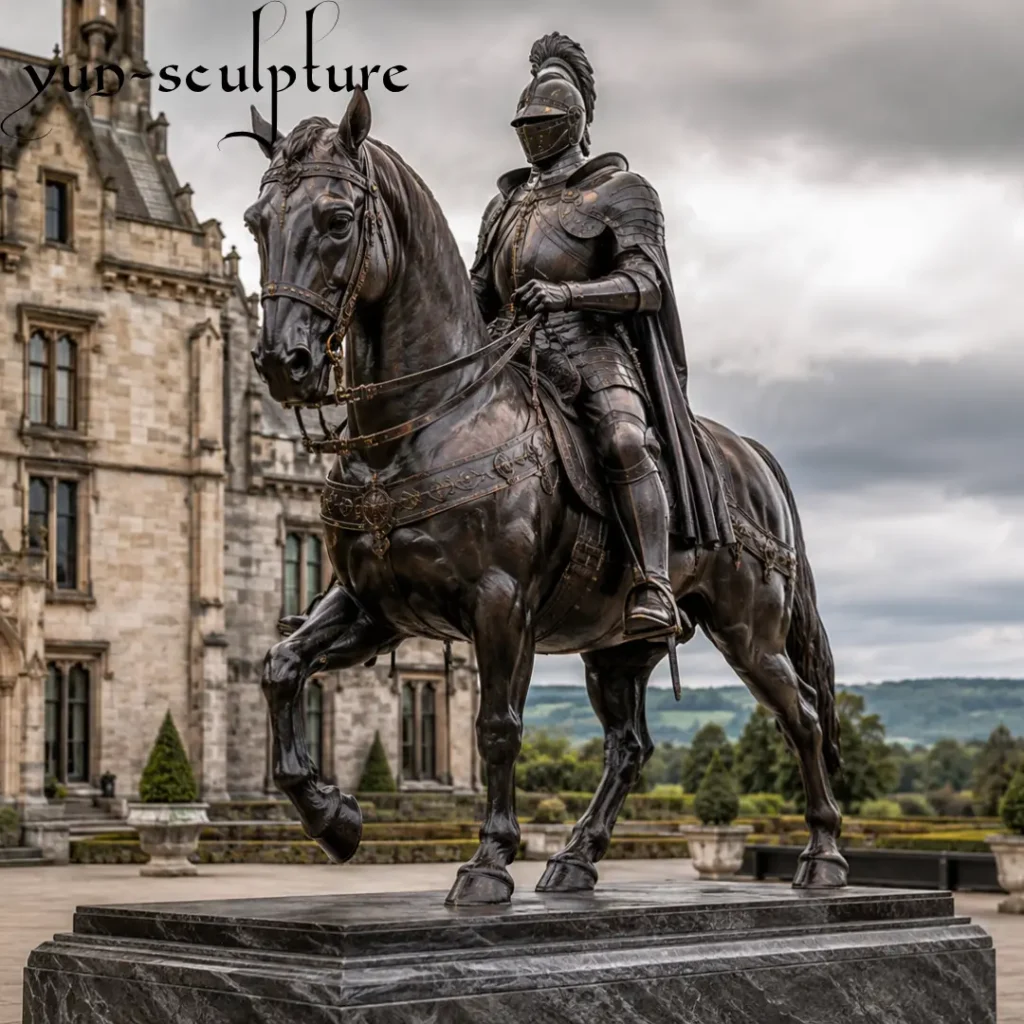
Equestrian Knight
Visual character
Knight on horseback — the most monumental and architecturally demanding of the three types. Combines the armored authority of the knight with the momentum and scale of the equestrian tradition.
Historical tradition
The equestrian statue tradition — from Marcus Aurelius through the great European royal commissions to the present — elevated by the additional element of medieval armor
Best settings
Grand estate entrance, castle forecourt, institutional plaza; requires more space than the dismounted types — minimum 5m clear radius
Structural note
Bronze throughout; all projecting lance and banner elements require bronze’s tensile strength. Significantly heavier than dismounted figures — full engineering specification required
Where Knight Statues Belong — Six Settings, Six Logics
The knight statue’s specific power is location-dependent in a way that some other classical figures are not. A Zeus reads as authority almost anywhere — garden, lobby, plaza, courtyard. A knight reads correctly only in settings where its specific claim — the chivalric code, the institution’s commitment to courtesy and protection — is what the setting needs to communicate. These are the settings where a knight statue is not merely decorative but genuinely purposeful.
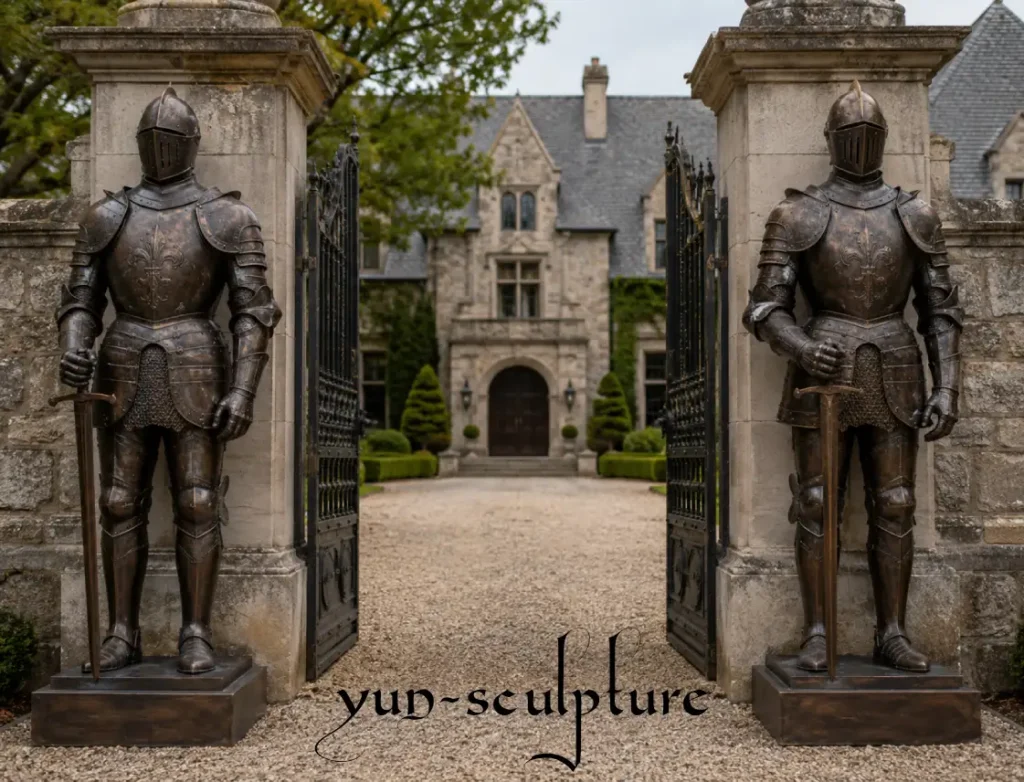
The estate or manor entrance is the most historically authentic setting. Medieval and Renaissance estates placed armored figures at their gatehouse entrances not as decoration but as declaration: this property is defended, its hospitality is governed by a code, its owner belongs to a tradition that extends back through the centuries of European chivalric culture. A life-size knight in full Gothic plate at an estate gate reads this history immediately to any viewer with the cultural context to receive it.
The hotel entrance hall is among the strongest contemporary settings for knight statues, and the one most consistently used by the luxury hospitality industry. The connection between the chivalric code and the concept of hospitality is historically direct: the knight’s specific obligation to protect and serve guests — the duty of hospitality that was written into the chivalric code explicitly — makes the figure at the entrance of a hotel a statement about the institution’s relationship to its guests. The guest is under the protection of the house. The house declares its commitment to their experience. No other classical figure makes this specific statement.
The golf club and country club entrance is a setting where the knight statue has been used with consistent success for reasons that are not immediately obvious but that hold up on examination. Golf’s historical connection to Scotland, to the landed gentry, to the specific culture of the private membership club with its unwritten codes of conduct — this culture is adjacent to the chivalric tradition in a way that makes the knight a more appropriate choice than it might initially appear. The club that places a knight at its gate is making a claim about the standards of conduct that govern its membership: the same courtesy, the same commitment to one’s word, the same code of behavior among peers that the chivalric tradition made explicit and permanent.
The wine estate cellar entrance is a European setting with a specific logic. Wine is the beverage of civilization in the European tradition — the product of patient cultivation, of knowledge passed down through generations, of the specific relationship between a particular piece of land and the wine it produces. A knight at the entrance to the cellar connects the estate’s product to the larger tradition of European cultural heritage: this wine belongs to a world that also produced the great cathedrals, the illuminated manuscripts, the courtly poetry, and the chivalric code that governed the conduct of the civilization that produced all of them.
| Setting | Knight Type | Placement Logic | Configuration |
|---|---|---|---|
| Estate or manor entrance | Gothic Full Plate | Historical authenticity — the chivalric estate declares its values at its threshold | Paired flanking preferred; single figure facing approach as alternative |
| Hotel entrance or lobby | Gothic Full Plate (visor up) | Chivalric hospitality — the institution declares its commitment to the guest’s protection and experience | Single presiding figure or paired flanking at lobby entrance |
| Golf or country club gate | Gothic Full Plate or Sword Planted | Chivalric code of conduct — the club’s standards of membership and behavior declared at the threshold | Paired flanking at gate pillars; bronze for outdoor durability |
| Wine estate cellar entrance | Sword Planted (Arthurian) | European heritage — the estate’s product placed within the broader tradition of European civilization and hospitality | Single figure or pair flanking cellar door; stone suits the setting’s stonework |
| Library or private study | Sword Planted (Arthurian) | The knight as keeper of knowledge and wisdom — the contemplative aspect of the chivalric tradition | Single figure; 100–140 cm scale for interior; marble or bronze both appropriate |
| Institutional or corporate entrance | Gothic Full Plate | Institutional values declared at the threshold — courage, loyalty, justice as organizational principles | Life-size minimum; bronze for outdoor; paired flanking for large entrance |
The Paired Flanking Tradition — Why Two Is More Than Twice One
The single strongest knight installation is not a single figure. It is two figures, positioned to flank an entrance — one on each side of a gate, a doorway, or the primary axis of approach. This tradition has a documented history in European castle and manor architecture that extends back to the 13th century, when armored figures began to appear as decorative and symbolic elements at the entrances of fortified buildings.
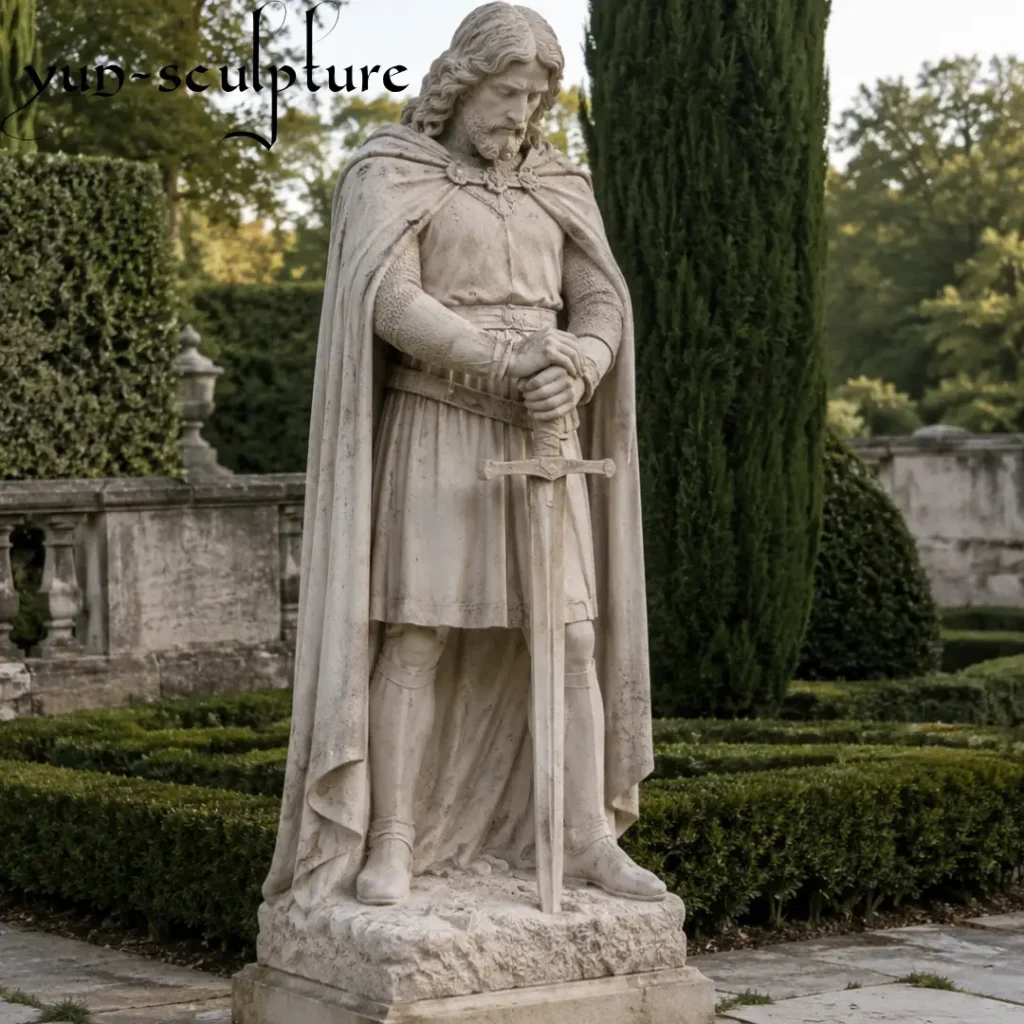
The logic of the paired flanking figure is different from the logic of the single presiding figure. A single knight presides — it stands before the visitor and makes its declaration from the front. Two flanking knights frame — they create a threshold between the world outside and the world within, a passage that the visitor must move through, and this passage makes the entrance both more dramatic and more explicitly guarded. The visitor does not stand before the knights; they pass between them. This is a fundamentally different spatial and psychological experience.
For the paired flanking installation to work correctly, both figures should be produced simultaneously from the same master mold and patinated at the same time. This ensures that the two figures are identical in dimension, in surface detail, and in patina color — which means that over years of outdoor weathering, they will age identically rather than diverging from each other. We produce matched pairs as a single commission with a shared production timeline, and would not recommend producing the second figure separately from the first as a cost-saving measure: the visual divergence that develops between a freshly cast figure and a two-year-old figure sharing the same position is significant enough to undermine the installation’s intended effect.
Material, Scale, and What the Armor Changes
A life-size knight in full plate armor presents two considerations that differ from other life-size figurative commissions: the visual mass of the armor and the structural challenges of the armored attributes.
The visual mass consideration is practical and affects placement decisions. A knight in full Gothic plate armor at 180 centimeters appears visually larger than a 180 centimeter classical nude figure at the same viewing distance. The armor’s horizontal elements — the shoulder pauldrons, the articulated breastplate, the flared gauntlets — extend the figure’s visual width significantly. The helmet’s height adds approximately 15 to 20 centimeters of visual elevation above the figure’s natural crown. At close range, this additional mass reads correctly as the imposing presence of armored authority. At distance, it makes the figure more readable against architectural backgrounds than a more slender classical figure would be. The minimum useful approach distance for a life-size knight — the distance at which the full figure resolves into legible armored detail — is approximately 5 to 8 meters, shorter than the 10 to 20 meters required for the rearing horse or the large Poseidon.
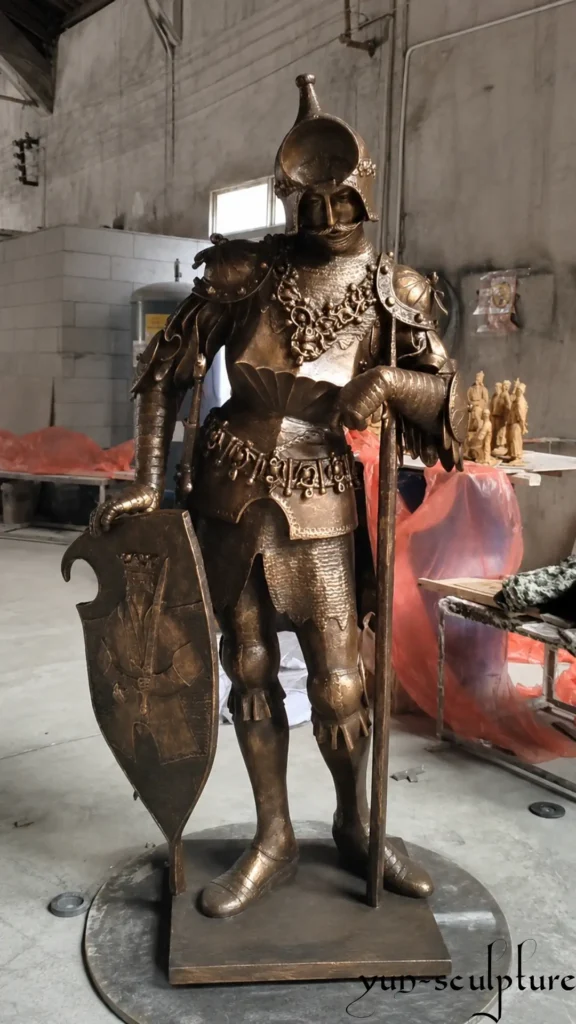
The structural challenges concern the sword. In most knight types, the sword is either held vertically at the figure’s side, planted in the ground at the figure’s feet, or held across the body — and each of these sword positions has different structural implications in bronze and stone. A sword held vertically at the side creates minimal leverage stress: it is essentially a thin vertical element supported along most of its length by the figure’s grip. A sword planted point-down in a base element is similarly low-stress, because the base provides structural support. A sword held horizontally across the body creates more leverage at the wrist and shoulder join, and for outdoor commissions, requires bronze rather than stone at these join points. For our complete material and installation guide, our life size statues buyer’s guide covers the specifications that apply to all armored figure commissions.
Frequently Asked Questions
What does a knight statue symbolize?
A knight statue symbolizes the chivalric code — the specific set of values that defined knighthood in medieval European culture: courage, loyalty, courtesy, justice, and the protection of those in one’s care. Unlike classical gods, which symbolize divine domains, the knight represents human commitments — things an institution could actually practice. A knight at an entrance declares that what happens there is governed by these values: the hotel’s commitment to the guest, the estate’s commitment to heritage, the club’s commitment to its code of conduct.
What are the 5 virtues of a knight?
The five core virtues of the chivalric code are courage (acting rightly in the face of danger), loyalty (fidelity to one’s word and companions), courtesy (the specific code of conduct toward guests and those in one’s care), justice (acting rightly rather than expediently), and protection (the obligation to defend the vulnerable). A knight statue at the entrance of an institution invokes all five as the implicit values under which the institution operates.
What does a knight mean spiritually?
The knight in the medieval European tradition represented the ideal of the warrior whose physical courage was in service of spiritual values: protection of the innocent, defense of what is right, and the specific virtue of hospitality toward guests. The knight’s spiritual significance is less about transcendence and more about conduct — the figure of the person who has committed to living by a code that puts others’ welfare above personal advantage. A knight statue in a home or institution declares that commitment as the governing value of the space.
What symbol represents a knight?
The primary symbols of knighthood in sculpture are the sword (justice and the commitment to defend what is right), the shield (bearing the knight’s heraldic device — individual identity within the chivalric tradition), and the full plate armor itself (the complete covering that transforms the individual into a representative of a role and code). In the Arthurian tradition, the sword planted point-down — Excalibur — is the defining symbol of legitimate authority claimed through worth rather than birth.
How much does a life size knight statue cost?
A life-size bronze knight in full plate armor (180–200 cm) typically ranges from $8,000 to $25,000 factory-direct, depending on armor complexity, pose, and patina. Equestrian knight commissions start at $18,000 and range to $60,000 or more at large scale. Paired flanking commissions are produced as a single order. Our life size statues buyer’s guide covers the full price range, materials, and installation requirements for all life-size commissions.
Factory Direct · Quyang, China
Commission a Life Size Knight Statue
Gothic full plate, Arthurian sword-planted, or equestrian mounted. Single figure or matched paired flanking commission. Bronze for outdoor durability, stone for sheltered interior and garden settings.