Get in touch with Yun-Sculpture company
Race Horse Statue: Thoroughbred, Arabian & Quarter Horse — A Breed Guide for Bronze Commissions

A race horse statue and a god statue have almost nothing in common as commissions. Zeus carries 2,500 years of iconographic tradition — the thunderbolt, the contrapposto, the posture of authority that has been defined and refined since Phidias. A race horse carries no such tradition. It carries breed. The specific slope of a Thoroughbred’s shoulder, the dished profile of an Arabian’s face, the compact hindquarter musculature of a Quarter Horse at full extension — these are visible to anyone who knows horses, and their absence is the first thing a knowledgeable buyer notices. This guide covers the three breeds most commonly commissioned in bronze for race horse statues, what each communicates as a permanent sculpture, and why the breed decision belongs at the beginning of the commission process rather than the end.
Table of Contents
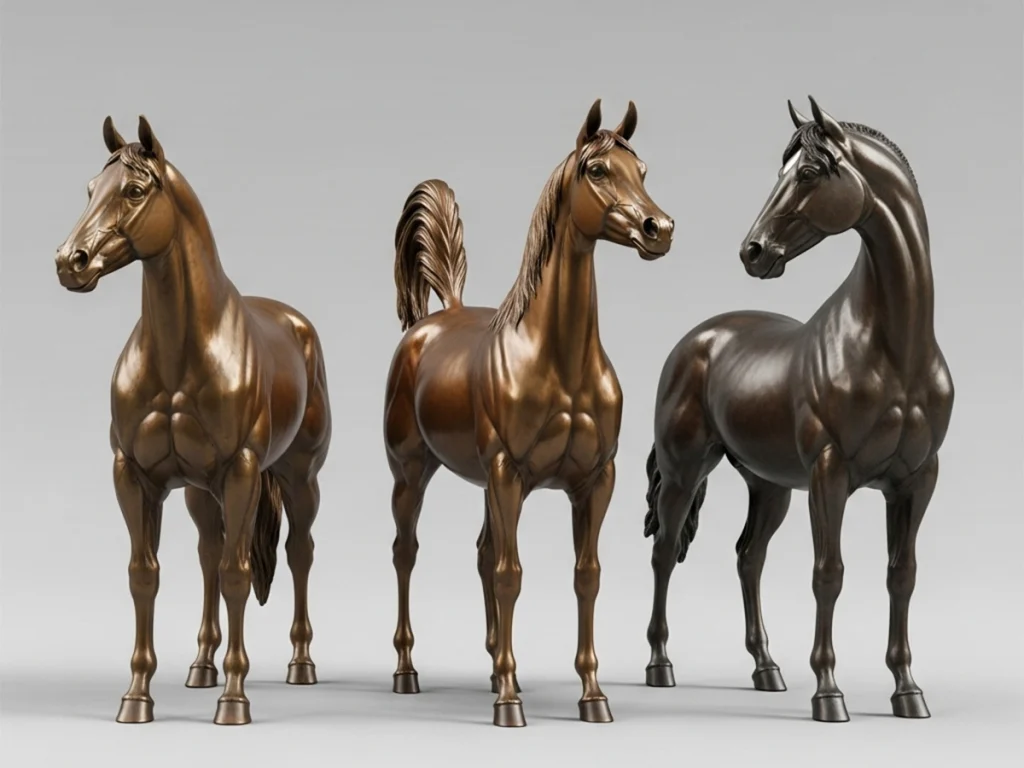
Caption: Comparison of equine anatomy across breeds—muscle mass, leg length, and neck curvature define visual identity.
Why Breed Accuracy Is Non-Negotiable in a Race Horse Statue
Most figurative sculpture subjects carry meaning through iconography. A bronze Poseidon holds a trident. An Athena wears a helmet. The attribute tells you who the figure is. A race horse has no attribute. Its identity is entirely in its anatomy — the proportions of the limbs, the profile of the head, the placement of mass through the body. Get the breed wrong and the figure becomes generic: a horse- shaped object rather than the specific horse whose qualities you are commissioning in permanent material. This is not a minor aesthetic distinction. A commission intended to honor a specific racing tradition, commemorate a champion animal, or establish the identity of an estate as associated with a particular equestrian culture is making a statement that depends entirely on that statement being recognizable. A Thoroughbred that reads as an Arabian, or an Arabian that reads as a Quarter Horse, has failed at its primary purpose before any question of quality in the casting or patina arises. The three breeds most commonly commissioned in race horse bronze statues each represent a distinct racing tradition and carry a distinct aesthetic register in sculpture.
Flat Racing · Classic Tradition
Thoroughbred
Kentucky Derby, Epsom, Arc de Triomphe
Visual character
Lean, angular, long through neck and shoulder; visible vascular detail; elegant without delicacy
Cultural register
The global flat-racing tradition; English and American racing heritage
Best setting
Racing stables, stud farms, racing organization facilities, private commemorative commissions
Endurance Racing · 3,000 Years
Arabian
Oldest breed; founding blood of every Thoroughbred
Visual character
Dished facial profile, arched neck, high tail carriage; simultaneously fine-boned and elastically powerful
Cultural register
Arabian Peninsula heritage, Middle Eastern racing tradition, Bedouin culture, endurance racing
Best setting
Arabian racing operations, Middle Eastern estate commissions, endurance racing facilities, collectors with Arabian cultural connections
Quarter Mile Sprint · American West
Quarter Horse
Most populous horse breed in the USA
Visual character
Compact, heavy hindquarters; wide powerful chest; shorter back than Thoroughbred; visibly massive hindquarter musculature
Cultural register
American West, ranch culture, rodeo, Western heritage; the working partnership between horse and rider
Best setting
Texas and Southwest estates, ranch properties, Western heritage collections, rodeo facilities, cowboy sculpture contexts
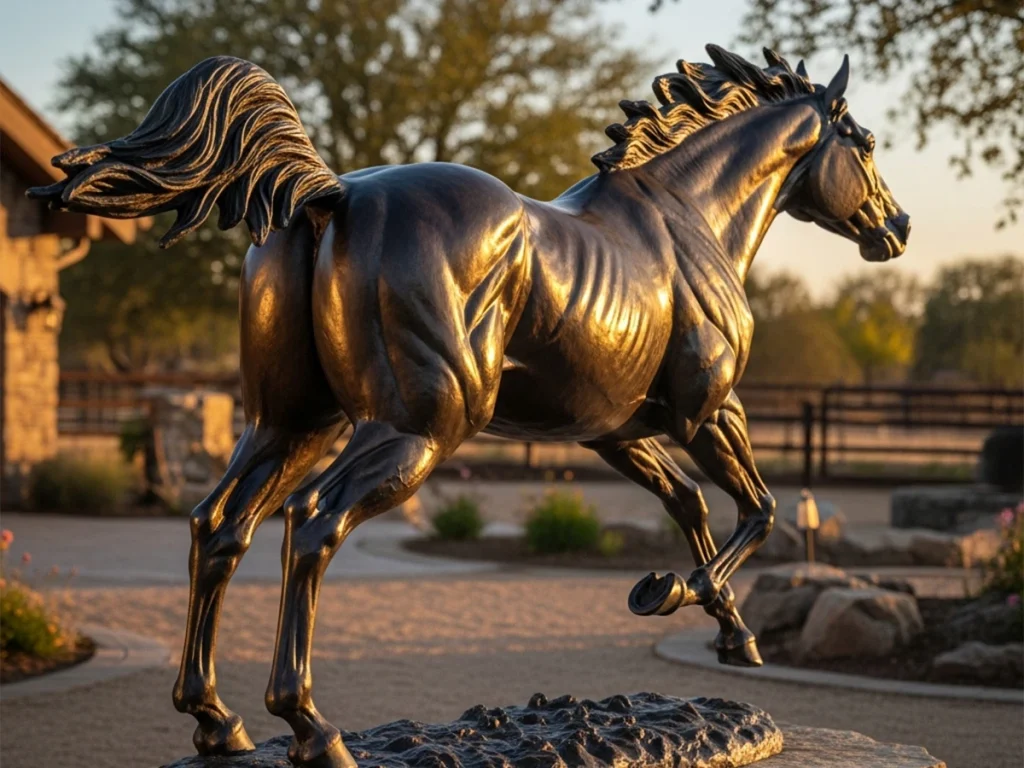
Caption: The dense hindquarter musculature captures the Quarter Horse’s legendary acceleration.
The Thoroughbred — The Classical Racing Icon
The Thoroughbred is the breed most people picture when they hear the words “race horse.” Developed in England in the 17th and 18th centuries through the crossing of native mares with three founding Arabian stallions — the Darley Arabian, the Byerley Turk, and the Godolphin Arabian — the Thoroughbred became the standard for flat racing worldwide. The Kentucky Derby, the Preakness, the Belmont, the Epsom Derby, the Prix de l’Arc de Triomphe: these races are Thoroughbred races, and the image they project is what most of the world understands as the image of racing. In sculpture, the Thoroughbred is defined by its lean, angular anatomy. The breed runs long through the neck and shoulder, light through the barrel, and powerful through the hindquarters in a specific way that differs from the more compact power of the Quarter Horse. The skin sits close to the bone, making the musculature and vascular structure visible at the surface — the veins along the legs and neck that the best bronze horse sculpture captures are Thoroughbred-specific. The head is refined without the extreme concavity of the Arabian: elegant but not delicate. A Thoroughbred race horse statue belongs wherever the racing tradition it represents belongs: at the entrance of a racing stable or stud farm, within a private commission commemorating a specific champion, at the facilities of racing organizations, and in the private collections of owners whose identity is inseparable from the flat-racing world. It is not the correct breed for a Western estate or a Middle Eastern setting where an Arabian would be the culturally appropriate choice — the breed carries a specific cultural register and that register should match the setting.
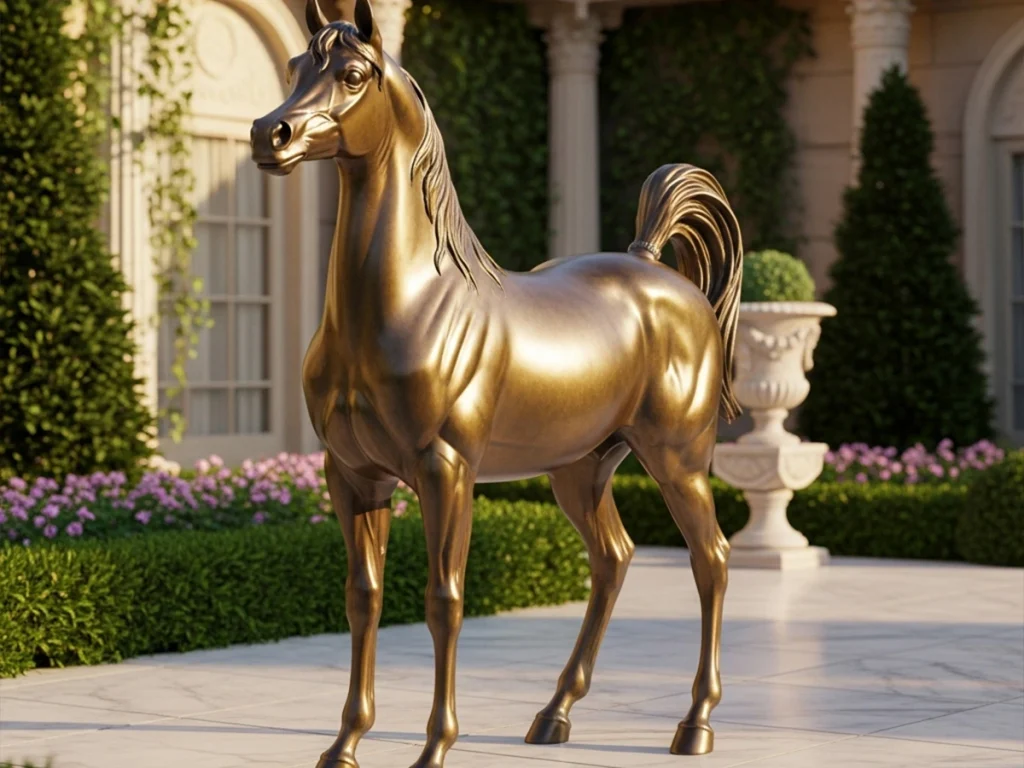
Caption: The lifted tail and dish-shaped face express movement even in stillness.
The Arabian — Endurance, Desert Heritage, Three Thousand Years
The Arabian is the oldest distinct horse breed in the world, with a continuous breeding history of approximately 3,000 years in the Arabian Peninsula. Every Thoroughbred descends from Arabian founding stallions. The Arabian endurance racing tradition — Tevis Cup, the international endurance circuits, the royal Arabian racing programs of Saudi Arabia, the UAE, and Bahrain — is as serious and as demanding as flat racing, operating over distances of 50 to 160 kilometers rather than the mile or mile and a quarter of a Thoroughbred race. In sculpture, the Arabian is defined by its specific anatomical profile — the hallmarks that have been selected for across 3,000 years of deliberate breeding. The dished facial profile, with the concave forehead flowing into an arched nose, is unique to the breed and immediately identifiable in a correctly rendered sculpture. The neck arches high from the shoulder. The tail is carried high, often in a distinctive arch. The overall impression is of a horse that is simultaneously finer-boned than the Thoroughbred and more elastically powerful — the breed was built for endurance over sand and heat, not for the brief explosive effort of flat racing, and this different energy source is visible in the sculpture’s proportions. An Arabian race horse statue carries a cultural weight that the Thoroughbred does not have in quite the same way. The breed is inseparable from the history of Islam, of the Bedouin tradition, of the great stud farms of the Arabian Peninsula. For collectors with Middle Eastern connections, for owners of Arabian racing operations, for estates and institutions that wish to associate themselves with this specific tradition, the Arabian is the correct choice — and nothing else quite substitutes for it.
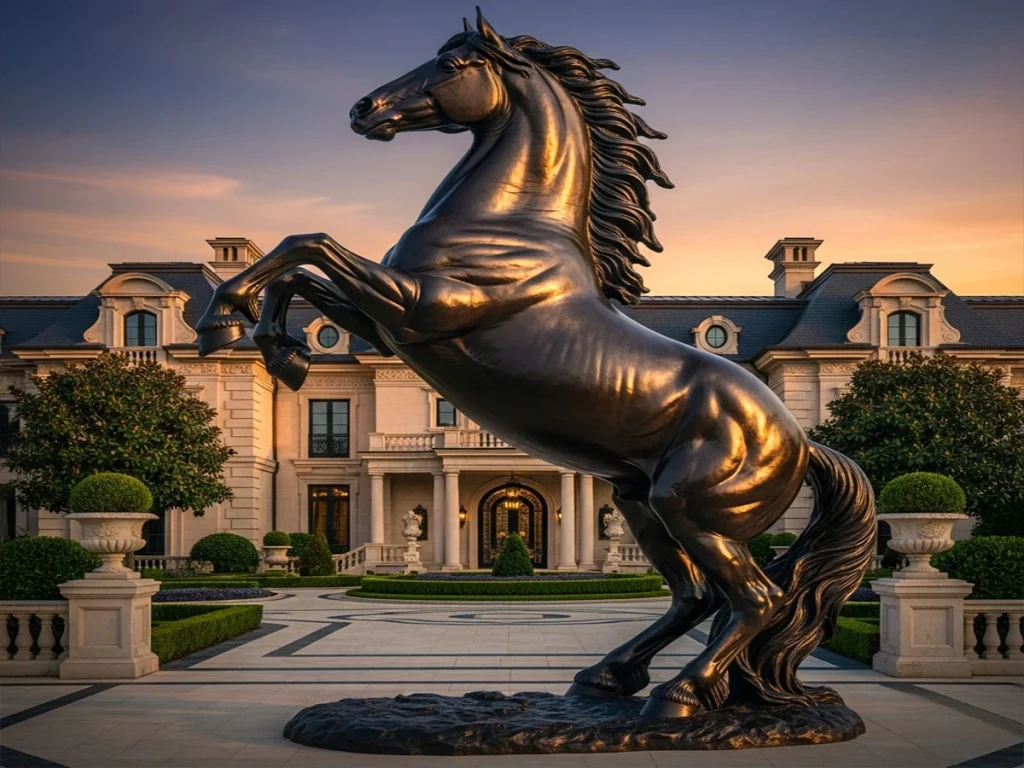
Caption: The elevated foreleg and flowing mane create vertical drama at architectural scale.
The Quarter Horse — American Sprint, American Identity
The Quarter Horse is the fastest horse in the world over short distances. Its name comes from its specific racing tradition: the quarter-mile sprint, which was the standard racing distance in colonial and early American culture before organized Thoroughbred racing established the longer-distance tradition. Quarter Horse racing continues as an organized sport across the American Southwest and Mexico, and the breed remains the most popular horse in the United States by registered population. In sculpture, the Quarter Horse is defined by its compact, explosive anatomy. The breed runs shorter in the back and heavier through the hindquarters than the Thoroughbred, with a wide, powerful chest and a hindquarter musculature that is visibly massive compared to other horse breeds. The skin sits slightly less close to the bone than on a Thoroughbred — there is more muscle mass visible at the surface, giving the Quarter Horse a blockier, more powerful visual profile. The head is shorter and broader than the Thoroughbred, with a flatter profile. The Quarter Horse race horse statue carries American identity in a specific way: it is the ranch horse, the cowboy horse, the horse of the American West as a cultural reality rather than a romantic projection. An estate in Texas or Oklahoma whose owner’s identity is inseparable from ranch culture, rodeo, or Western heritage is the natural setting for a Quarter Horse commission. It is the correct breed for a setting where the American West — its specific work ethic, its relationship between human and horse as partners in labor — is the value being expressed.
| Setting / Commission Type | Recommended Breed | Reason |
|---|---|---|
| Racing stable or stud farm (flat racing) | Thoroughbred | The breed defines this racing tradition; any other breed would be incorrect |
| Champion horse commemoration (specific individual) | Match the individual’s breed | A commemorative commission requires breed accuracy first; the champion’s breed IS the brief |
| Middle Eastern estate or Arabian racing facility | Arabian | The breed’s cultural register matches the setting; a Thoroughbred here would carry the wrong heritage |
| Western / ranch estate (American Southwest) | Quarter Horse | The breed is inseparable from this cultural identity; it is the American West’s horse |
| Private collection — aesthetic preference over cultural specificity | Arabian (most sculptural impact) | The Arabian’s high tail, arched neck, and dished profile produce the most visually distinctive bronze profile among the three breeds |
| Institutional / public setting with no specific cultural connection | Thoroughbred (most universally recognized as a race horse) | The Thoroughbred is what most people picture when they think “race horse” — it communicates the concept most broadly |
Structural Considerations by Breed
The breed decision has structural implications that matter for the commission. The most demanding structural situation in horse sculpture is the rearing pose — both rear legs on the ground, full body weight concentrated at two contact points — and different breeds present different engineering challenges in this pose. The Thoroughbred’s lean anatomy means that a rearing Thoroughbred is somewhat lighter than a rearing Quarter Horse or heavy warmblood at the same scale. This reduces — but does not eliminate — the engineering requirements for the internal stainless steel structure. A life-size rearing Thoroughbred in silicon bronze still requires a 304 stainless steel internal skeleton with welded load paths through the rear legs to the base, and an anchor bolt pattern in the concrete foundation designed to the specific figure’s weight distribution. The Quarter Horse’s heavier hindquarter mass makes the rearing pose structurally more demanding at the same scale. The center of gravity sits further back, and the mass is greater. For rearing Quarter Horse commissions, I increase the internal skeleton specification and the anchor bolt depth beyond the standard Thoroughbred calculation. The Arabian’s anatomy is intermediate — lighter than the Quarter Horse, heavier than a lean Thoroughbred. The breed’s high tail carriage and arched neck in its characteristic stance mean that an Arabian in a half-rear or collected pose has a slightly different weight distribution than a Thoroughbred at the same pose, and the internal structure should be adjusted accordingly. For all three breeds, the galloping pose requires specific attention to the center of gravity in motion. A horse at full gallop has most of its weight forward, supported on front legs — the rear legs are extended backward, not bearing load. This means the galloping pose requires front leg anchoring and internal structure designed for forward-lean load rather than the rearing pose’s backward-lean logic. The breed affects the exact calculations; the principle applies to all three.
Frequently Asked Questions
What is a race horse statue?
A race horse statue is a bronze or stone figurative sculpture depicting a horse associated with the racing tradition — most commonly a Thoroughbred, Arabian, or Quarter Horse. Unlike decorative horse sculptures, a race horse statue is distinguished by breed accuracy: the specific anatomy of the depicted breed should be recognizable to someone familiar with horses. They are commissioned for racing facilities, stud farms, private estates in the equestrian tradition, and commemorative purposes.
What breed is used for most race horse statues?
The most commonly commissioned breed is the Thoroughbred, as it is the breed most associated with major flat racing worldwide — the Kentucky Derby, Epsom Derby, and Prix de l’Arc de Triomphe are Thoroughbred events. The Arabian is correct for Middle Eastern racing commissions and endurance racing contexts. The Quarter Horse is correct for American Western and ranch contexts.
How long does a bronze race horse statue last outdoors?
A bronze race horse cast at 5–8mm wall thickness with a 304 stainless steel internal skeleton and heat-applied chemical patina will last indefinitely outdoors. The variables determining longevity are wall thickness, patina application method, internal structure quality, and installation foundation. Wall thickness below 4mm, spray-applied patina, and inadequate anchoring are the three most common causes of premature failure.
Can I commission a race horse statue of a specific horse?
Yes. Custom portrait commissions require reference photography — 20+ photographs from all angles, including head close-ups, side profile, and front and rear views. Video of the horse in motion is also valuable. The clay model stage, included in every custom commission, is where breed accuracy and individual likeness are established and approved before any metal is committed.
What is the difference between an Arabian and a Thoroughbred horse statue?
The Arabian has a dished (concave) facial profile unique to the breed, a high-set tail carried in a visible arch, and a neck that arches high from the shoulder. The Thoroughbred has a flatter facial profile, a longer neck set into a sloping shoulder, and lean angular musculature with visible vascular detail. Both are fine-boned, but the Arabian’s fine structure accompanies elastic power, while the Thoroughbred’s suggests forward momentum. A correctly rendered bronze of each should be immediately identifiable to someone familiar with horses.
Factory Direct · Quyang, China
Commission a Race Horse Statue in Bronze
Thoroughbred, Arabian, or Quarter Horse — breed-accurate anatomy from reference photographs. Lost-wax bronze, 5–8mm wall thickness, heat-applied patina, installation drawings included.