Get in touch with Yun-Sculpture company
Mary Undoer of Knots Statue Symbols: Every Element of the Iconography Explained

The mary undoer of knots ribbon is the element everyone sees first. But a serious commission begins by reading the entire image — every symbol, every figure, every color — before a single design decision is made. In Schmidtner’s 1700 Augsburg painting, nothing is ornamental. Each element carries theological weight, and in translating that image from canvas to stone or bronze, every element also carries structural weight. This guide explains both.
Table of Contents
Table of Contents
What Does the Lady Undoer of Knots Represent?
The image represents intercession in motion — not a static figure of blessing or protection, but a mother actively at work on her children’s behalf.
In the painting, Mary stands suspended between heaven and earth, positioned in the space between divine grace and human struggle. This vertical axis is theologically precise: she is not in heaven looking down, and she is not on earth looking up. She occupies the intercessory position — the mediating space where human need meets divine grace. Light surrounds her; the earth lies below.
Her posture is working, not ceremonial. Her hands are engaged with the ribbon. Her gaze is focused and attentive — the expression of someone doing something that requires care. This is not the triumphant queen of a processional image, and it is not the contemplative mother of a Pietà. It is a specific emotional register that has no exact equivalent in other Marian devotions: concentrated maternal effort.
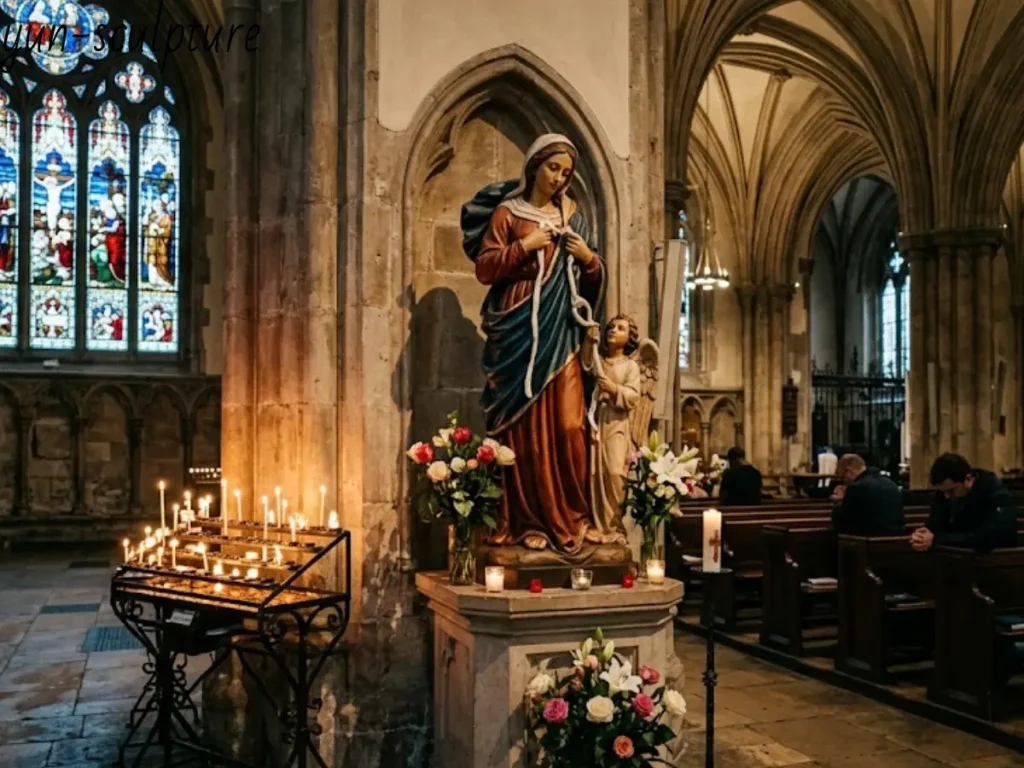
For a sculptor, this emotional register is the most difficult element to execute correctly. A face that reads as serene without attentiveness loses the working quality. A face that reads as concentrated without serenity loses the divine quality. The expression must hold both simultaneously — and it must hold them at whatever scale and distance the statue will be viewed from, which changes the depth of carving required for facial features to read clearly.
What Are the Symbols of the Mary Undoer of Knots?
Each element in the image carries a specific theological meaning. In three-dimensional sculpture, each also carries specific structural requirements.
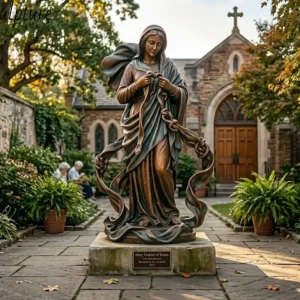
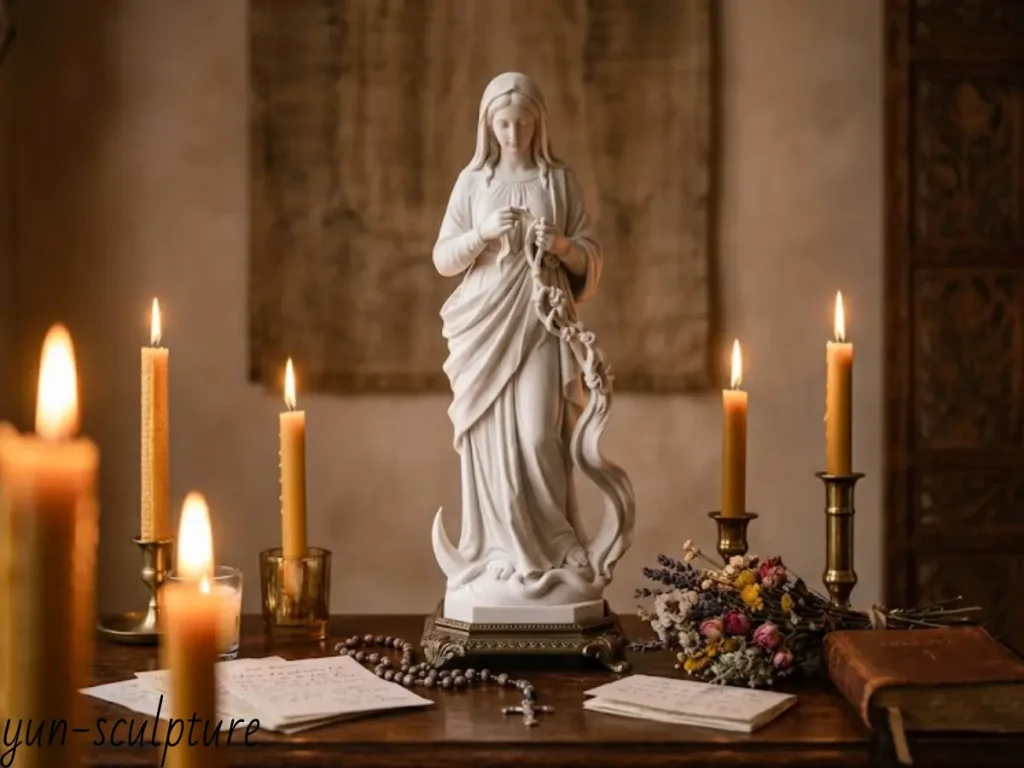
The knotted ribbon is the center of the composition — theologically and physically. The knots represent human struggles: the accumulated entanglements of sin, conflict, suffering, and circumstances that resist resolution through human effort alone. The ribbon itself represents the continuity of a human life — not broken, not replaced, but transformed through intercession. The transition from knotted to smooth is the entire theology of the devotion made visible.
In marble, the ribbon requires internal reinforcement at every stress point — thin sections and overlapping strands are structurally vulnerable, and Donghui Zhang builds stainless steel pins into the stone wherever the ribbon extends away from the figure’s body. In bronze, the lost-wax process allows full three-dimensional rendering of every strand crossing, but the gating and cooling of the casting must be calculated carefully to prevent warping in the ribbon’s thinnest sections.
The serpent beneath her feet fulfills Genesis 3:15 — “she shall crush your head” — representing the defeat of evil at its root. In Schmidtner’s painting, the serpent is itself knotted, making the visual connection explicit: the knots on the ribbon and the serpent’s own condition are related. Mary’s foot resting on the serpent is not a separate theological statement from her hands working the ribbon. They are the same statement at two scales — the personal struggle and its ultimate source.
In sculpture, the serpent is a structural gift: it provides a stable base element and distributes weight downward, which helps anchor the figure. Donghui uses the serpent as a key load-bearing component in marble commissions, ensuring its form is integrated into the base platform rather than appearing as a separate decorative element.
The dove above her head represents the Holy Spirit — present and active in the act of intercession. Mary does not work alone. The dove signals that what her hands are doing is not accomplished through her own power but through cooperation with divine grace. This is the same theological point Saint Irenaeus made in the second century: the knot is loosed through Mary’s obedience, not her authority.
In sculpture, the dove introduces a structural challenge — a small figure projecting above the main mass of the statue, vulnerable to impact and requiring reinforcement at its connection point. For outdoor bronze commissions, Donghui casts the dove as part of the continuous figure rather than attaching it separately, which prevents the stress fractures that develop at attachment points under temperature cycling.
The twelve stars crowning her head come from Revelation 12:1 — the woman clothed with the sun, crowned with twelve stars — representing Mary as Queen of Heaven and connecting her to both the twelve tribes of Israel and the twelve apostles. The number twelve signifies completeness and the full span of salvation history.
In marble, twelve individually carved stars create twelve potential fracture points at their bases. For statues above 36 inches, Donghui recommends a halo band format rather than individually projecting stars — the theological meaning is identical, the structural risk is dramatically lower.
The two angels serve as the narrative mechanism of the image. The angel on Mary’s left presents the knotted ribbon — the human struggle offered for intercession. The angel on Mary’s right receives the smooth ribbon — the struggle resolved through grace. They are not decorative attendants. They structure the narrative flow from left to right, from entangled to free, from petition to response.
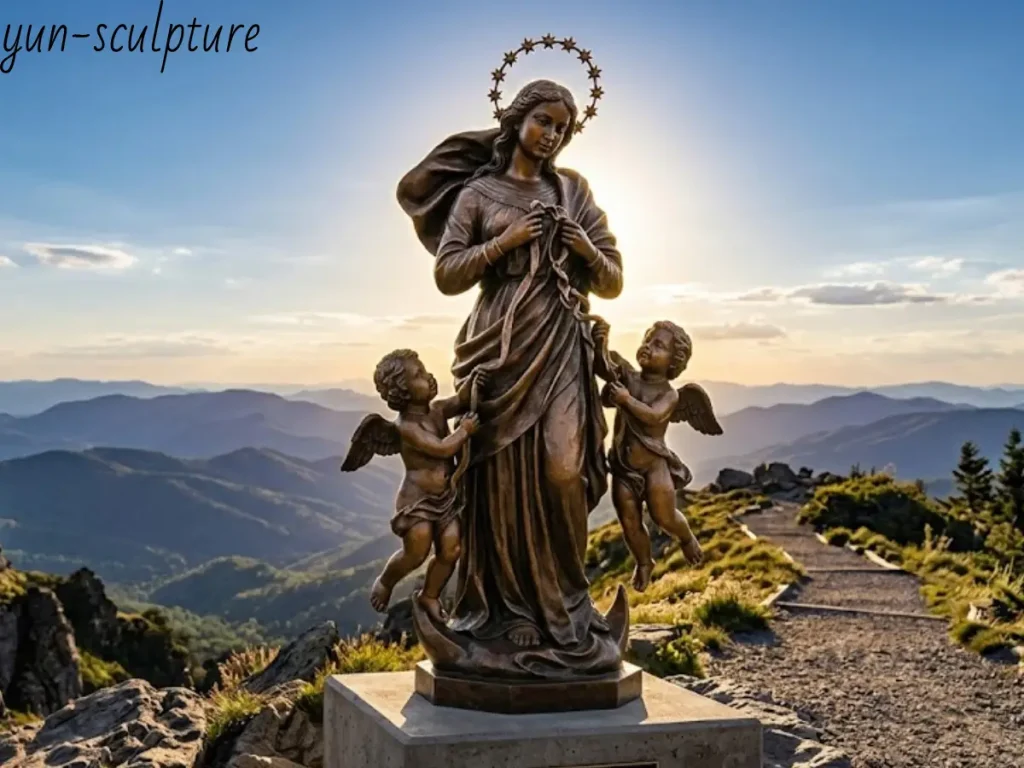
In sculpture, the angels are the primary architectural decision of the commission. Full-figure angels create narrative richness and visual depth, but they shift the center of gravity outward and require a broader base. Half-figure angels emerging from clouds preserve the theological presence while reducing structural complexity. The choice is not stylistic — it is a decision about what scale and installation environment the commission can support.
How Many Knots Should the Statue Have?
This is the question I am asked most often in the commissioning process, and the answer is almost always fewer than the client expects.
Schmidtner’s painting presents a ribbon marked by numerous knots — somewhere between five and nine, depending on how you count the partially visible forms at the edges of the composition. In two dimensions, this density creates visual rhythm and narrative richness without structural consequence. A painted knot weighs nothing and requires nothing from the material beneath it.
In three dimensions, every knot is a structural commitment.
Each knot requires the ribbon strand to pass over and under another strand, creating fully rounded, interlocking volumes in three dimensions. This is what gives a carved or cast knot its visual and tactile reality — the depth, the shadow between layers, the sense that the strands are actually pressing against each other. Donghui notes that a properly executed knot in marble requires access from multiple carving angles, which means each knot adds significant production time and introduces additional stress points into the stone.
For a three-dimensional commission, three to five primary knots is the working range. At this count, each knot can be fully developed — carved in complete round in marble, captured in full wax detail in bronze — with clear over-and-under relationships visible from multiple viewing angles. Each knot breathes. The viewer can follow the strand through the crossing. The theology of the ribbon remains legible.
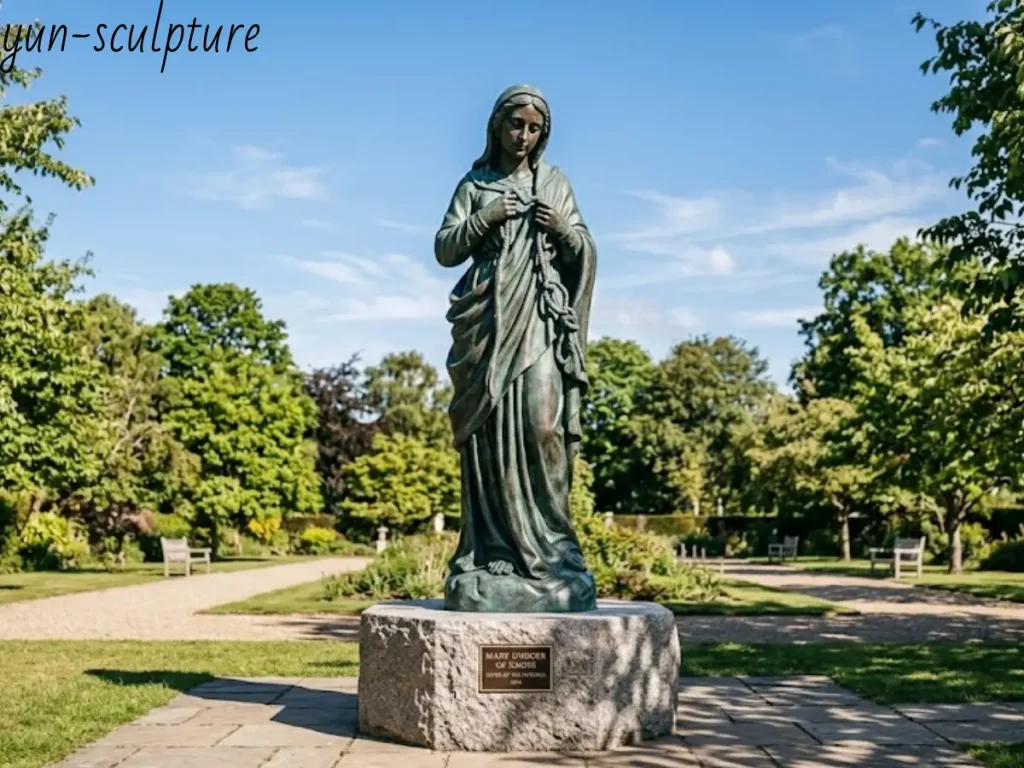
More than five primary knots in a single composition begins to create congestion. The ribbon loses its sense of directional flow. The eye cannot track the transformation from knotted to smooth because the knotted section dominates the visual field. Secondary knots can be suggested in lower relief along the ribbon’s length — this preserves the impression of multiple struggles without each one demanding the structural investment of a primary knot.
The number of primary knots also relates to scale. At 24 inches, three primary knots is the practical maximum — anything more compresses into indistinct texture at that size. At life-size, five primary knots is achievable and fully legible. At 8 feet and above, the knots can be larger and more dramatically articulated, since viewing distance increases the threshold at which detail reads clearly.
How Does a 2D Painting Become a 3D Sculpture?
Schmidtner’s painting exists in the realm of visual illusion. Mary floats between heaven and earth because paint has no weight. The ribbon moves freely through space because a painted ribbon obeys no gravity. The angels hover because perspective creates depth without requiring support.
A sculpture has none of these freedoms. Every element must obey gravity, maintain structural integrity under its own weight and environmental stress, and remain stable for decades or centuries.
The translation from painting to sculpture is not adaptation. It is reconstruction.
Three decisions govern every successful reconstruction of this specific image.
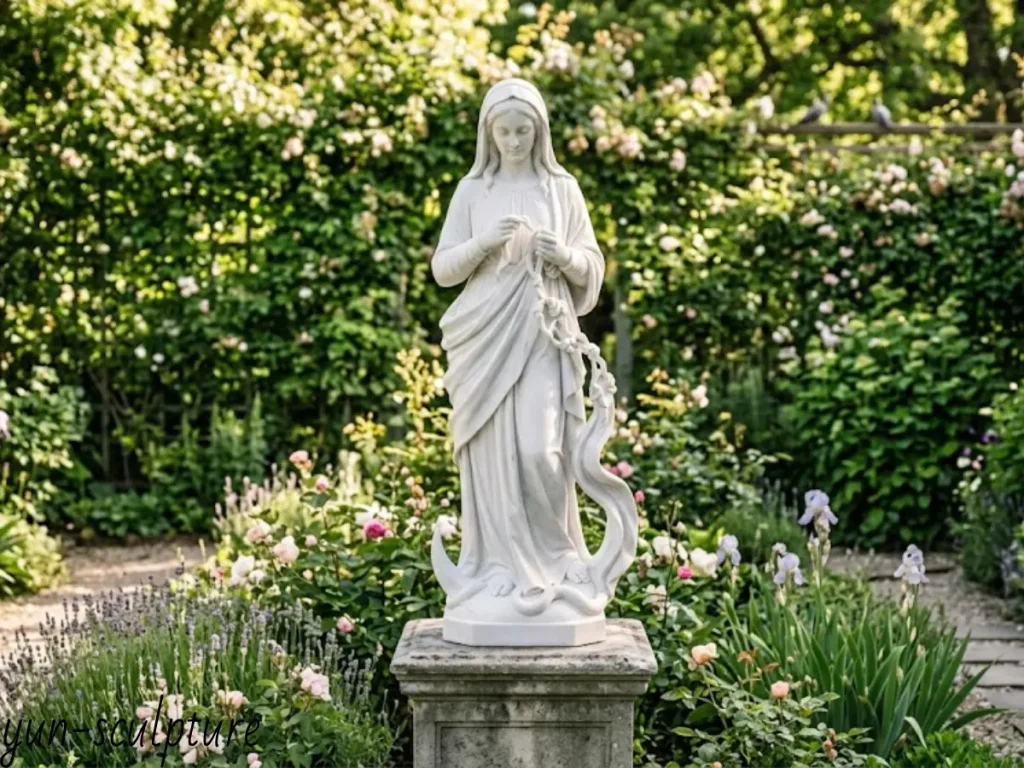
Ribbon support. A fully floating ribbon — both ends hanging free, no connection to the figure’s robes — is achievable in bronze because the material’s tensile strength can sustain extended spans without visible anchors. This creates dramatic movement and stays closest to the painting’s composition. In marble, the ribbon must connect to the figure at multiple points, typically integrated into the hemline or the folds of the robe, which distributes weight downward and minimizes the leverage stress that causes fracture. Each approach creates a different visual language: floating emphasizes the miraculous, connected emphasizes the incarnational.
Angels. In the painting, two angels exist in layered pictorial depth — one slightly behind and above the other, creating a sense of celestial space that a canvas can sustain without any structural consideration. In sculpture, this layered depth must be resolved into a single coherent three-dimensional composition. Full-figure angels, if the commission scale supports them, create the richest narrative. But each angel shifts the center of gravity outward, requiring a broader base and careful weight distribution calculations. A life-size Mary with two full-figure angels requires a base of at least 30 inches to remain structurally stable in outdoor conditions.
The base. In the painting, Mary stands on a crescent moon surrounded by clouds, suggesting suspension above the earth. In sculpture, this must function as a stable platform while preserving the visual impression of floating. The crescent moon becomes a structural element, its curvature integrated into a base platform that distributes the entire weight of the figure. The clouds serve as visual transitions — softening the relationship between the figure and its support without making the support invisible. The serpent, integrated into the base composition, adds both theological completeness and structural stability.
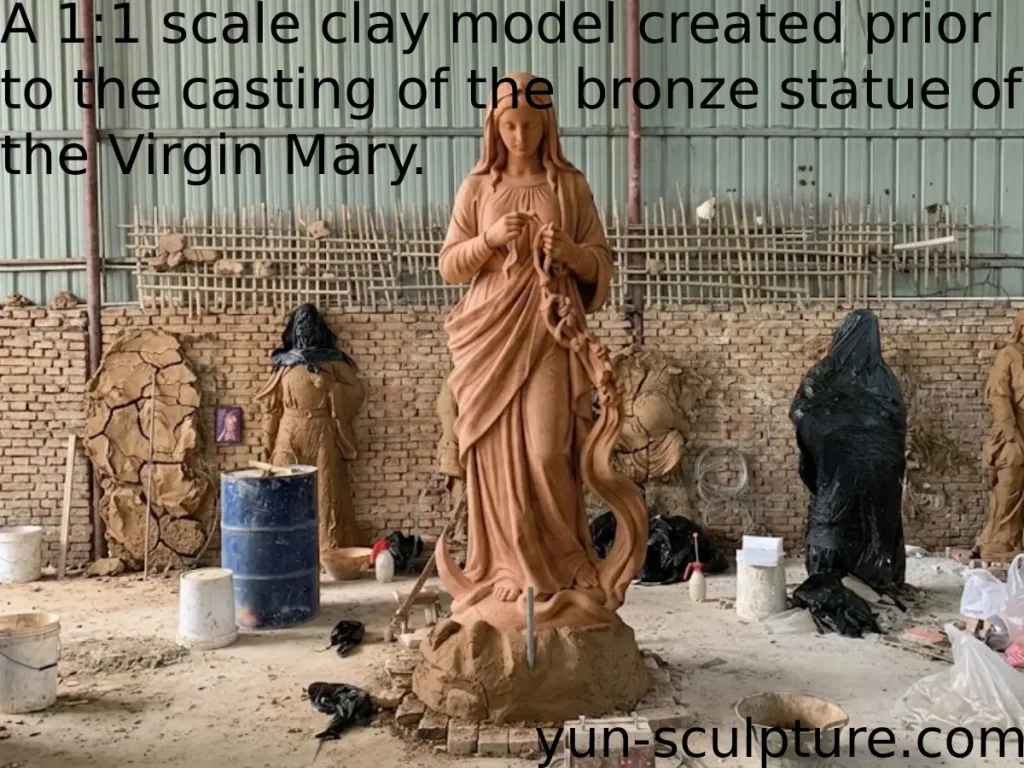
These decisions are finalized in the clay maquette stage before any material is committed. In clay, the ribbon’s behavior in three dimensions becomes visible for the first time — whether it flows naturally from knotted to smooth, whether the knots read from multiple viewing angles, whether the transition feels continuous. No drawing can confirm these qualities. Only the maquette can.
Considering a Mary Undoer of Knots commission? Tell us your installation setting and viewing distance — we will recommend the right knot count, angel treatment, and base design for your space.
For the full guide to material selection and ribbon engineering for this commission, our Mary Undoer of Knots statue marble vs bronze guide covers the structural decisions in detail. For the theological and historical background behind the image, our Mary Undoer of Knots meaning and history guide traces the devotion from 1615 to the present.
FAQ
What does the Lady Undoer of Knots represent?
The image represents Mary’s active intercession in the space between human struggle and divine grace — her hands working the ribbon, the transition from knotted to smooth, the serpent subdued beneath her feet. We cover what this means for a sculpture commission, including the expression and posture required to communicate this specific theological register, in the first section above.
What are three symbols that represent Mary?
Across Catholic iconographic tradition, the three most widely recognized symbols associated with the Virgin Mary are the white lily (representing her purity and the Immaculate Conception), the blue mantle (representing her role as Queen of Heaven and her maternal protection over the faithful), and the twelve stars of Revelation 12:1 (representing her queenship over the full span of salvation history). In the Mary Undoer of Knots image specifically, the knotted ribbon replaces the lily as the primary symbol, with the blue mantle and twelve stars retained. The rose is also widely associated with Mary — particularly in connection with the Rosary — and appears in some versions of the Immaculate Heart iconography.
Why does Mary always wear blue?
The blue mantle in Marian iconography has multiple theological layers. In the ancient world, blue was among the most expensive dyes — extracted from lapis lazuli — and was associated with divinity, royalty, and the heavens. Mary’s blue mantle signals her status as Queen of Heaven and her connection to the divine. In Christian iconography specifically, blue became associated with Mary’s perpetual virginity and her role as the “new Eve” — the color carrying connotations of both celestial dignity and the purity that defined her singular place in salvation history. In the Mary Undoer of Knots image, Mary wears a crimson dress beneath her blue mantle — the red representing her noble, elevated status, the blue representing her heavenly queenship and peace.
Why are there 12 stars around Mary’s head?
The twelve stars come from Revelation 12:1 — a vision of a woman clothed with the sun, standing on the moon, crowned with twelve stars. Catholic tradition interprets this woman as Mary in her role as Queen of Heaven. The number twelve represents the twelve tribes of Israel and the twelve apostles together — the full span of salvation history bridging Old and New Covenants. In Marian iconography, the twelve stars appear consistently across Our Lady of Guadalupe, the Miraculous Medal, and the Mary Undoer of Knots image. In three-dimensional sculpture, twelve individually projecting stars create structural challenges — each star is a potential fracture point at its base — which is why Donghui typically recommends a halo band format for outdoor marble commissions while retaining individually carved stars for indoor pieces where structural risk is lower.
What flower represents Mary? / Why is a lily a symbol of Mary?
The white lily is the flower most closely associated with Mary in Catholic tradition, representing her Immaculate Conception and perpetual virginity — the white petals symbolizing purity, the upright stem symbolizing her dignity. In sacred art, Gabriel carries a lily stem at the Annunciation, and traditional guardian statues of St. Joseph hold a lily to signify the purity of his relationship with Mary. The rose is the second major floral symbol — Mary is called Rosa Mystica (Mystical Rose), and the Rosary itself takes its name from the Latin for rose garland. The rose appears specifically in the Immaculate Heart iconography, encircling the heart. In Mary Undoer of Knots imagery, neither the lily nor the rose appears as a primary element — the ribbon takes their place as the central symbolic object, representing not an attribute of Mary’s person but the human lives she holds in her hands.
The Image in Your Hands
Schmidtner painted what he understood of grace in 1700. Every sculptor who works with this image since has been translating that understanding into a material that must stand, balance, and endure.
The ribbon is the theology. The structure that holds the ribbon is the craft. Both must be right.
Factory Direct · Quyang, China
Get an Exact Quote for Your Mary Statue
Tell us the size, pose, and any custom requirements — we respond within 24 hours with a detailed price breakdown, no obligations.