Get in touch with Yun-Sculpture company
Bronze Golf Statue for Garden & Golf Course: A Foundry Director’s Buying Guide

Most bronze golf statues I see installed at country clubs and private estates fail the same way: the wall is too thin, the patina is sprayed on rather than chemically bonded, and nobody engineered the base for outdoor load. This guide explains what separates a bronze golf statue that lasts fifty years from one that starts deteriorating in five — and what you should ask any foundry before placing an order.
Table of Contents
Table of Contents
Why Bronze — and Not the Alternatives
The outdoor sculpture market is full of materials competing for the same buyer. Cast stone, fiberglass, resin, and zinc alloy all look similar in a product photograph. They do not look similar after three winters outdoors.
Bronze is the only material I recommend without qualification for permanent outdoor golf statues, and the reason is chemical rather than aesthetic. Bronze — an alloy with a copper content above 85% — forms a protective oxide layer on its surface as it weathers. This layer, the patina, is not decay. It is armor. The patina bonds to the metal surface and actively shields the bronze beneath from further oxidation. A properly cast bronze golf statue does not degrade outdoors. It deepens.
The alternatives do not behave this way. Resin and fiberglass are polymers — they respond to UV exposure by becoming brittle, cracking, and eventually delaminating. I have seen resin golf statues installed at resort properties that looked acceptable at delivery and were visibly failing by year three: surface spiderweb cracking, color fading, hollow sections beginning to telegraph through the surface coating. Cast stone is more durable than resin but remains porous, and in freeze-thaw climates, trapped moisture expands inside the material with enough force to fracture it from the inside out.
The practical test: a genuine bronze statue is heavy. A life-size bronze golfer cast in our foundry weighs approximately 150 kg — no single person can lift it. If someone quotes you a “bronze” golf statue that a single person can lift, it is not bronze — it is a coated resin or zinc casting.. Weight is the first verification.
How a Proper Bronze Golf Statue Is Made
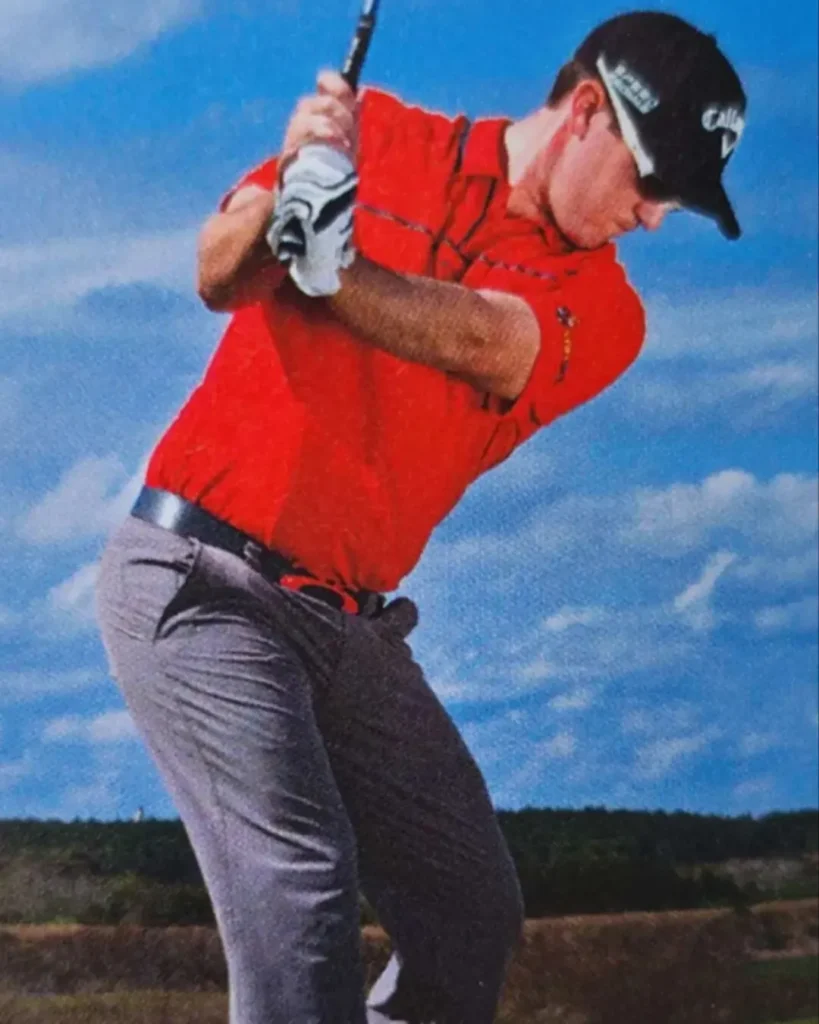
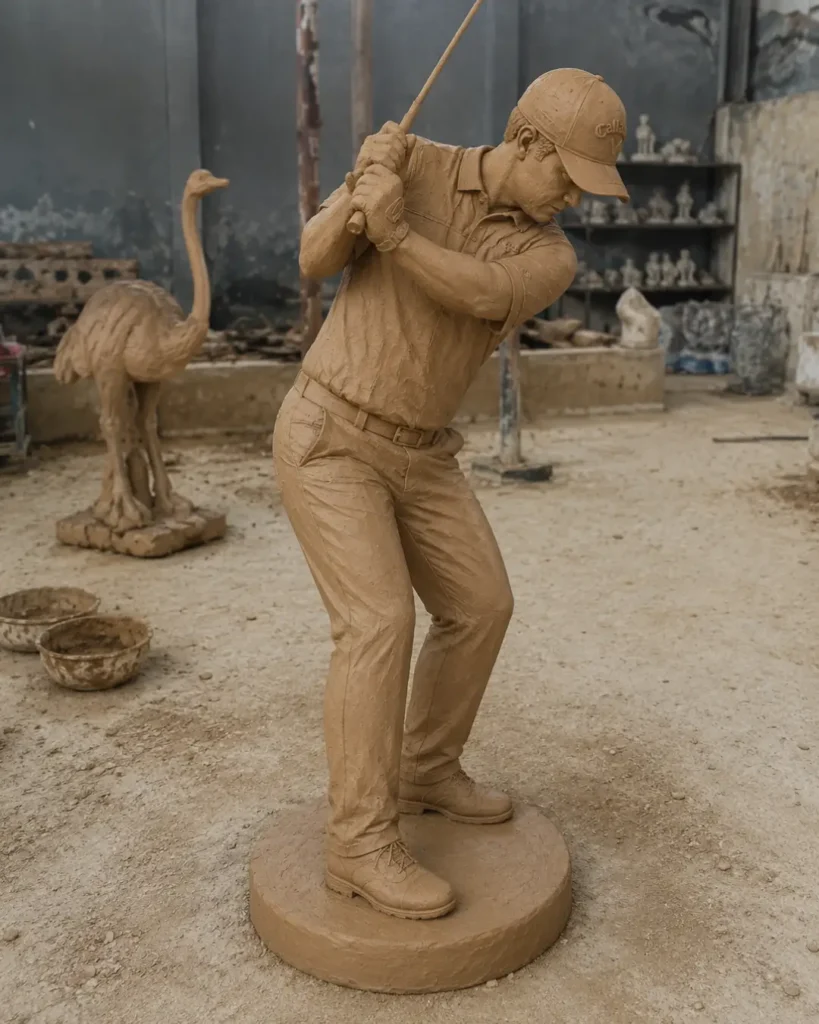
The lost-wax casting process — cire perdue in French — has been the standard for fine bronze sculpture for over four thousand years. The reason it has not been replaced is that no other method produces the same level of detail fidelity in a structural metal casting. Here is what the process actually involves, and why each stage matters for the final statue’s quality and longevity.
1
Clay Sculpting — The Foundation of Accuracy
The process begins with a full-scale clay model, hand-built to the exact dimensions of the final statue. Every detail — the texture of the golfer’s grip, the fold of the trousers at the knee, the weight distribution at the moment of the swing — is resolved in clay before any metal is involved. For custom commissions, the client approves the clay model before we proceed. Changes at this stage cost time. Changes after casting cost both time and material.
2
Mold Making and Wax Casting
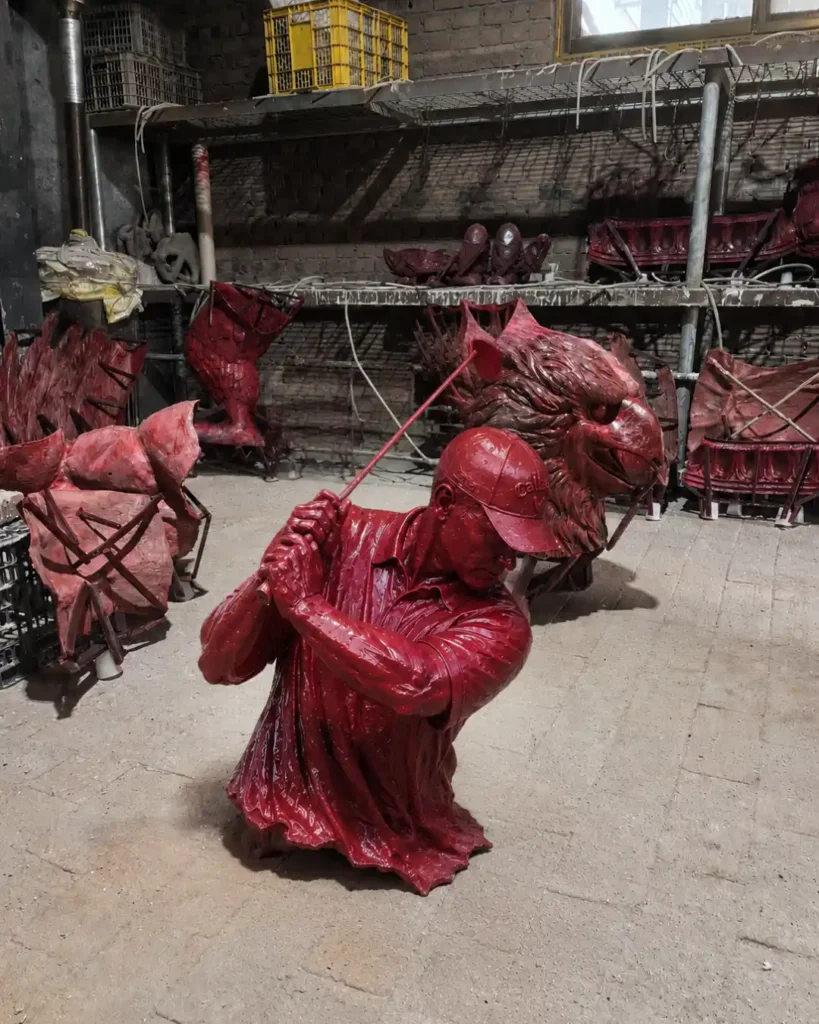
A silicone mold is taken from the approved clay original. Molten wax is poured into the mold to produce a wax positive — an exact replica of the final statue. This wax model is then reviewed, refined by hand, and prepared for the investment casting stage. Wax allows us to achieve surface details that survive intact into the final bronze.
3
Investment Casting — Where Wall Thickness Is Determined
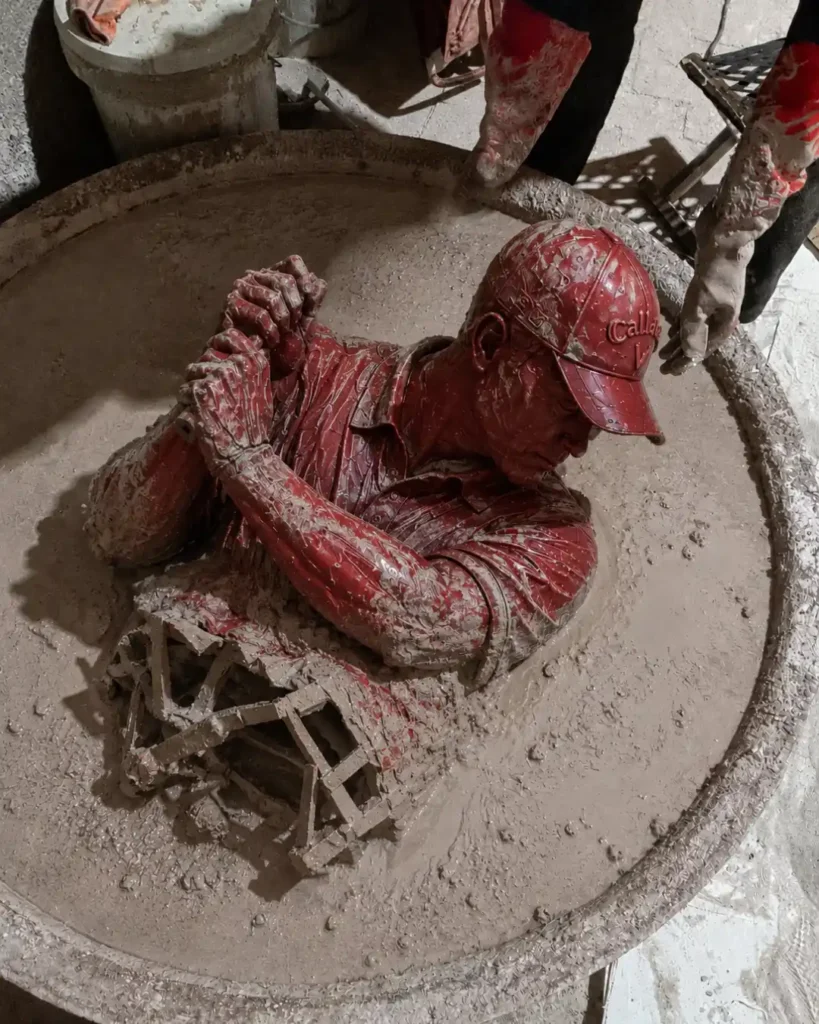
The wax model is coated in layers of ceramic slurry, building up a ceramic shell. When the shell is fired, the wax melts out — leaving a hollow ceramic mold. Molten bronze is then poured in. Our standard wall thickness for golf statues is 5 to 8mm. Many lower-cost foundries pour at 3 to 4mm to reduce material cost. The difference is not visible on delivery. It becomes visible after the first decade outdoors.
4
Chasing and Surface Finishing
After the ceramic shell is broken away and the raw casting emerges, our craftsmen chase the surface — removing casting lines, refining detail, and preparing the bronze for patination. This stage is entirely manual and accounts for a significant portion of production time. A golf statue with fine detail in the face and hands requires more chasing time than a simplified figure.
5
High-Temperature Chemical Patination
We apply patina using high-temperature chemical patination rather than cold application or spray paint. The bronze surface is heated, and chemical compounds are applied to the hot metal. At temperature, these compounds react with the copper in the alloy to form stable, chemically bonded colorants — a patina that penetrates the surface rather than sitting on top of it. Cold-applied or sprayed patinas begin lifting within two to three years outdoors. Chemically bonded patina at temperature is permanent.
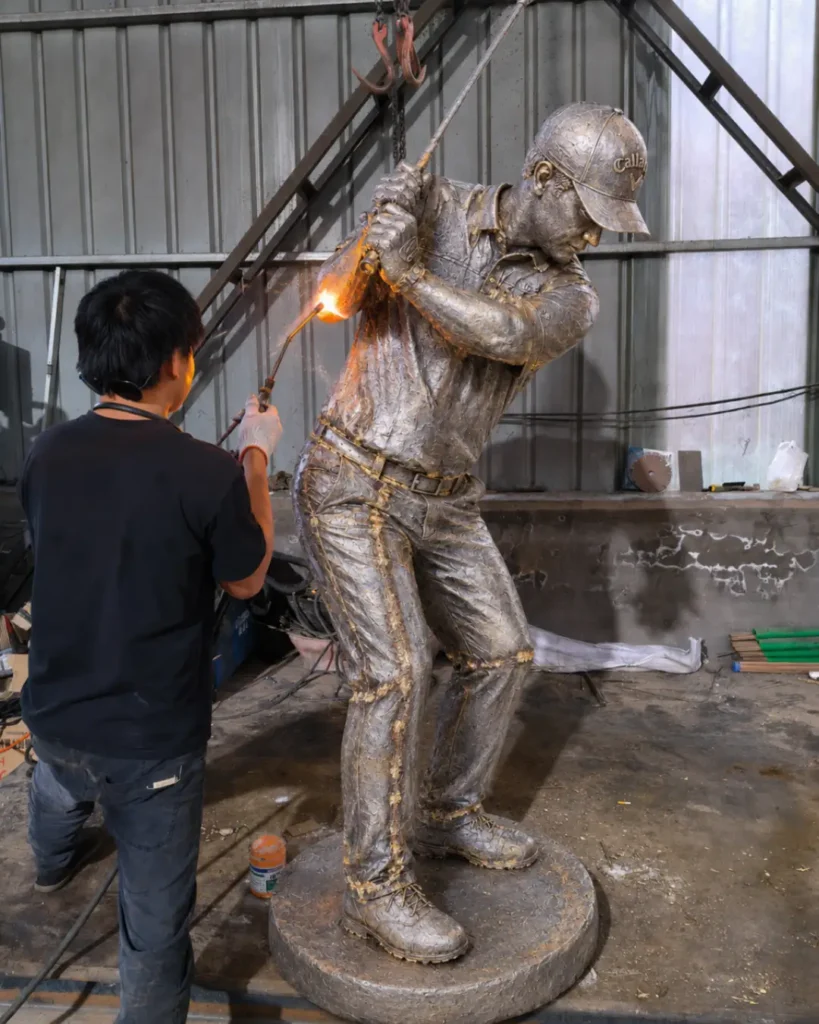
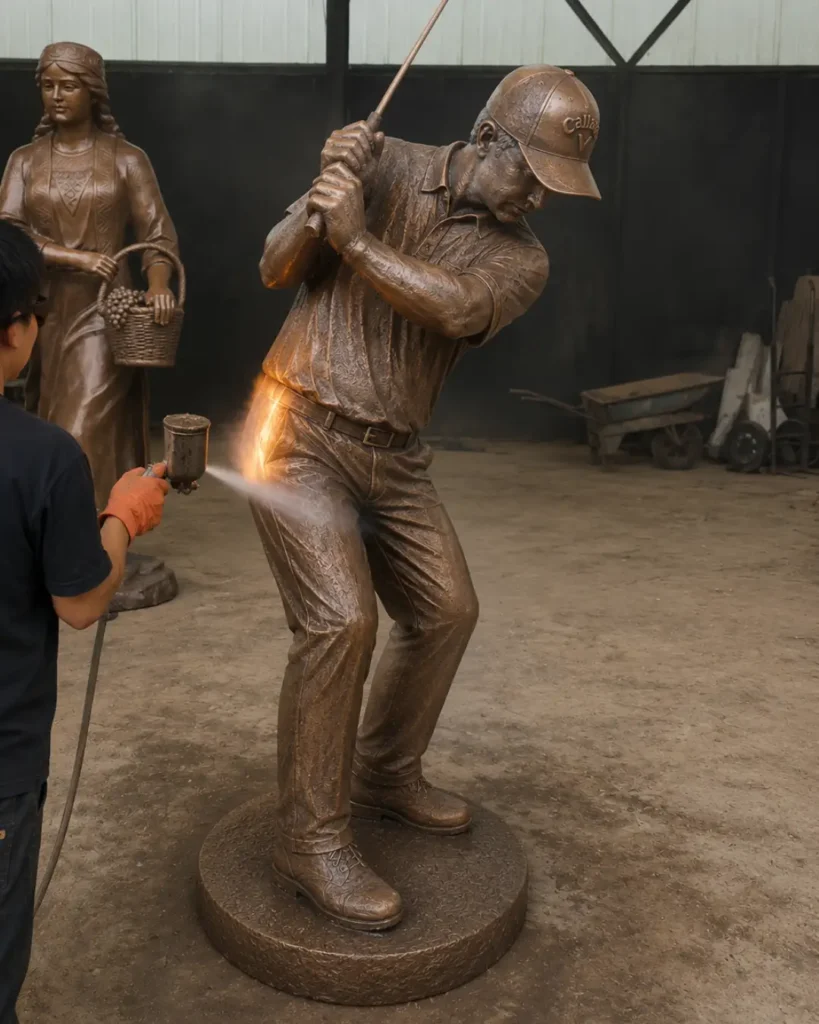
Standard production time from approved clay model to shipping-ready statue is 25 to 35 working days for a standard golf figure. Custom poses or larger-than-life-size commissions extend this timeline and are quoted individually.
Choosing the Right Size for Your Space
Size is the decision most buyers get wrong, almost always in the same direction: they order too small. A bronze golf statue that reads powerfully in a product photograph can disappear against a large clubhouse facade or a wide fairway landscape. The relationship between the figure and its environment determines whether the final installation feels monumental or merely present.
| Size | Approx. Height | Best Setting | Typical Weight |
|---|---|---|---|
| Tabletop / Trophy | 30–60 cm | Clubhouse reception desk, trophy cabinet, indoor display | 5–15 kg |
| Half Life-Size | 80–100 cm | Garden accent, terrace corner, smaller courtyard | 30–50 kg |
| Life-Size | 170–185 cm | Club entrance, fairway landmark, estate garden focal point | ~150 kg |
| Heroic Scale | 200–250 cm | Monumental entrance, large plaza, stadium or resort setting | 200–350 kg |
For any outdoor installation, the statue must be anchored to a concrete base. Life-size bronze figures require a base with a minimum depth of 50 cm and anchor bolts embedded in concrete. We provide the anchor hardware specifications with every outdoor commission. The base itself is the buyer’s responsibility to install before the statue arrives — we supply the exact specifications required.
Where to Place a Bronze Golf Statue
Golf statues are placed in five settings more than any other, and each has different requirements.
Club entrance and reception: The most common placement. A life-size bronze golfer at the entrance communicates immediately that this is a serious institution. The figure should face outward, greeting arrivals rather than standing in profile. A mid-swing pose reads well from a distance; a putting stance works better in enclosed entry courts where viewers approach at close range.
Fairway and course landmarks: Larger-than-life-size figures work best here, where the statue must compete with open landscape. Bronze weathers into the environment over years — the patina shifts toward green and brown tones that integrate naturally with grass and tree lines. A figure positioned on a slight elevation reads better than one placed at grade level in open terrain.
Private estate gardens: Scale down to life-size or half life-size depending on garden dimensions. A bronze golfer placed at the edge of a lawn, facing toward the property’s central axis, creates a sense of quiet occupation — as though someone has just finished a round and paused to look back at the course.
Clubhouse terrace and outdoor dining: Half life-size figures suit this setting better than full life-size, which can overwhelm a terrace space. Position the statue at the perimeter rather than the center — the figure should frame the space, not interrupt it.
Corporate and hospitality lobbies: For interior placements, the patina maintenance requirement changes. Indoor bronze does not weather in the same way as outdoor bronze, and the patina is stable indefinitely without waxing. A high-polish or dark patina finish reads better in controlled interior lighting than the mid-range brown-green typically specified for outdoor pieces.
How Much Does a Bronze Golf Statue Cost?
The price range for bronze golf statues is wide, and understanding what drives cost makes it easier to evaluate quotes accurately.
| Category | Price Range (USD) | What You Get |
|---|---|---|
| Standard catalog figure | $1,200 – $3,500 | Existing pose from foundry archive, standard patina, life-size or smaller |
| Modified standard figure | $3,500 – $6,000 | Existing pose with custom adjustments — equipment details, facial features, specific attire |
| Fully custom commission | $6,000 – $18,000+ | Original sculpt from reference materials or photographs, unique pose, client approval at clay stage |
| Heroic scale (200cm+) | $15,000 – $40,000+ | Monumental figures for institutional or public settings, engineering specifications included |
The largest cost variable in bronze sculpture is not material — it is labor. Bronze is priced by weight, and the material cost of a life-size figure is a fraction of total production cost. What you are paying for is the clay sculpting time, the mold making, the chasing, and the patination. A foundry quoting significantly below these ranges is compressing one or more of those stages — most commonly by shortening the chasing stage, reducing wall thickness, or using cold-applied rather than heat-bonded patination.
Shipping cost is a separate line item and depends on destination. A life-size bronze golf statue ships in a custom wooden crate, fully insured, with specialized freight handling. We provide a delivered cost quote to any US, Canadian, or European port on request.
Frequently Asked Questions
How do I tell if a bronze golf statue is real bronze or a fake?
Weight is the most reliable test. A genuine lost-wax cast bronze golf statue at life-size weighs approximately 150 kg — no single person can lift it. Resin or zinc alloy pieces sold as bronze are a fraction of that weight. The second test is a magnet: bronze is non-ferrous and non-magnetic. If a magnet sticks to any part of the statue, it is not solid bronze. The third test is the patina: genuine chemical patina on heated bronze has variation and depth. Sprayed-on coatings look uniform and flat, and begin to peel or fade within a few years outdoors.
How much does a bronze golf statue cost?
Standard catalog bronze golf statues start at approximately $1,200 for smaller figures and range to $3,500 for life-size pieces in existing poses. Modified designs typically fall between $3,500 and $6,000. Fully custom commissions start at $6,000 and scale upward depending on size and complexity. Heroic-scale figures commonly range from $15,000 to $40,000 or more. Shipping and installation hardware are quoted separately.
What happens to a bronze golf statue left outdoors long-term?
Bronze weathers predictably and attractively. The initial patina shifts over years toward green-brown tones as the copper oxide layer develops. This is not deterioration — it is the same process that has preserved ancient bronze sculptures for millennia. If the original color is important to maintain, the statue should be waxed annually with a microcrystalline wax such as Renaissance Wax.
How long does it take to make a custom bronze golf statue?
Standard production time from approved clay model to shipping-ready statue is 25 to 35 working days. Custom commissions add one to two weeks at the clay modeling stage and require client approval before casting begins. International shipping adds 15 to 25 days to North American and European destinations. For commissions with a specific installation deadline, we recommend beginning the inquiry at least four months in advance.
What is the best pose for a bronze golf statue?
A full swing pose has the strongest visual impact at distance and works well for fairway landmarks and large entrance installations. A putting stance reads better at close range and suits lobbies and garden placements. A standing at-rest pose is the most versatile and tends to age the most gracefully as a permanent installation.
Factory Direct · Quyang, China
Get a Quote for Your Outdoor Golf Statue
We provide full installation specifications, anchor hardware dimensions, and wind load calculations with every outdoor commission.