Get in touch with Yun-Sculpture company
Outdoor Golf Statues: Materials, Sizes & Installation Guide for Garden and Course

Most outdoor golf statues fail not because of poor craftsmanship — but because nobody thought seriously about the environment they were going into. Wind load, ground moisture, freeze-thaw cycling, UV exposure, salt air near coastal properties: these are the forces that separate a statue still standing in twenty years from one that needs replacing in five. This guide covers what outdoor placement actually demands, and how to make the right decisions before anything gets installed.
Table of Contents
Table of Contents
Why Outdoor Placement Changes Everything
An indoor bronze golf statue and an outdoor bronze golf statue can be identical in every way — same foundry, same casting process, same dimensions — and perform completely differently over time. The difference is not the object. It is what the object has to endure.
Indoors, a bronze statue faces essentially no environmental stress. Temperature is stable. Humidity is controlled. UV exposure is minimal. The patina applied at the foundry remains stable indefinitely, and the only maintenance required is occasional dusting. A bronze golf statue in a clubhouse lobby will look identical in thirty years to how it looked on delivery day.
Outdoors, the same statue faces a completely different set of conditions. In northern states and Canada, freeze-thaw cycling puts stress on any material that absorbs moisture — which is why resin and poorly sealed cast stone fail, while solid bronze does not. In coastal environments, salt air accelerates surface oxidation. In high-UV climates like the American Southwest, surface coatings that are not chemically bonded to the metal begin breaking down within a few seasons. Understanding these forces is the first step to making a decision that holds up.
| Climate / Region | Primary Risk | Recommended Material | What to Avoid |
|---|---|---|---|
| Northern US & Canada | Freeze-thaw cycling, heavy snow load | Cast bronze (5–8mm wall) | Resin, cast stone, thin-wall castings |
| Coastal (Atlantic & Gulf) | Salt air, chloride deposition | Cast bronze with annual wax maintenance | Uncoated steel, cheap zinc alloys |
| Southwest (High UV) | UV degradation of surface coatings | Bronze with chemically bonded patina | Resin, spray-painted finishes |
| Mild Climate (CA, FL Gulf Coast) | Minimal — most materials acceptable | Bronze or quality cast stone | Low-grade resin for permanent installations |
| High Wind / Exposed | Wind load on dynamic poses | Bronze with engineered anchor system | Top-heavy figures without proper anchoring |
Bronze vs Other Materials: What Actually Survives Outdoors
The outdoor sculpture market presents buyers with a wide range of materials at very different price points. The differences in long-term performance are significant, and they are not always visible at the point of purchase.
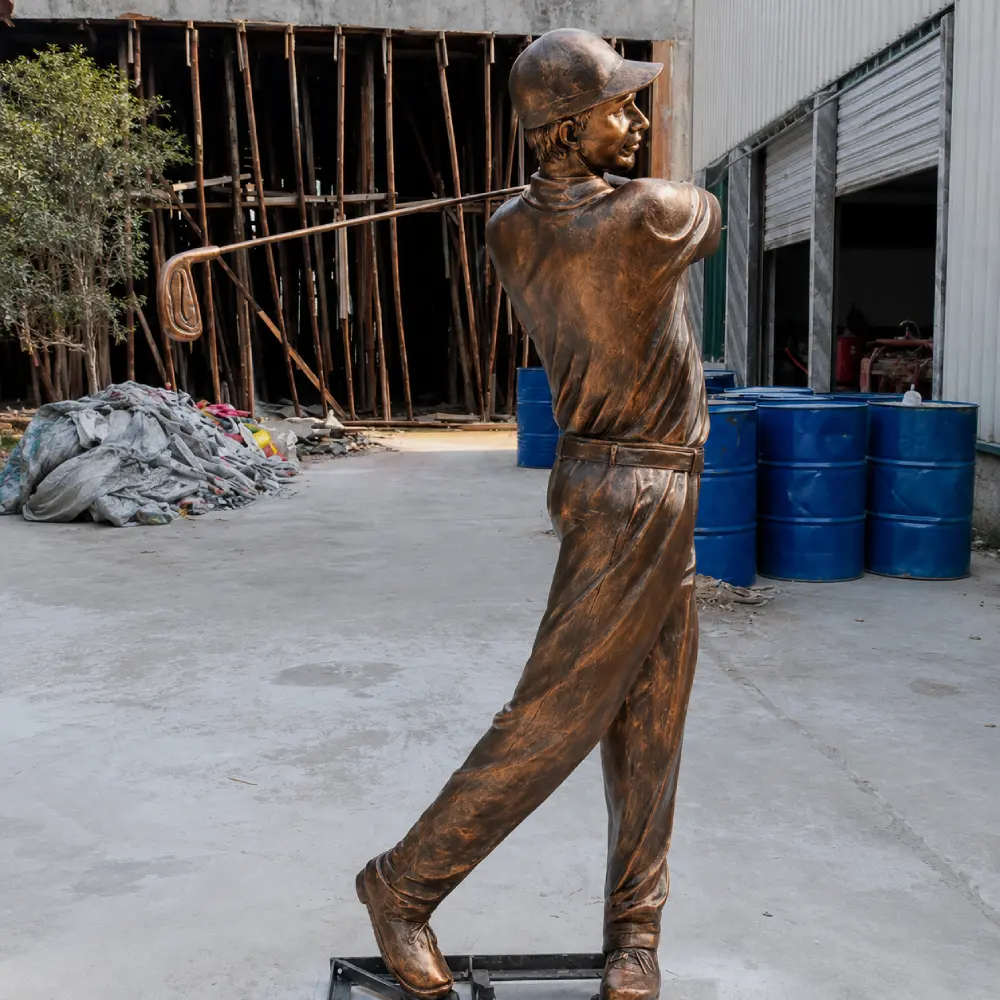
Bronze is the only material I recommend without reservation for permanent outdoor golf statues. The reason is not aesthetic — it is structural. Bronze forms a protective copper oxide patina as it weathers. This patina is chemically bonded to the surface and actively protects the metal beneath it. Outdoor bronze does not deteriorate. It develops. A statue cast with a wall thickness of 5 to 8mm and finished with high-temperature chemical patination will perform identically in year thirty as it did in year one, except the surface color will have shifted toward deeper green-brown tones.
Resin and fiberglass are the most common alternatives at the lower end of the market. Both materials look convincing in photographs and on delivery. Both begin showing stress within two to three years of outdoor exposure: surface crazing under UV, moisture infiltration through micro-cracks, and in freeze-thaw climates, interior delamination as trapped water expands inside the material. I have removed resin golf statues from club installations after less than four years that were structurally compromised. The initial cost saving is not a saving — it is a delayed replacement cost.
Cast stone performs better than resin outdoors but still presents problems in cold climates. The material is porous, and in regions where ground temperatures regularly drop below freezing, absorbed moisture expands and fractures the material from within over repeated seasonal cycles. For mild climates — coastal California, Florida, the Gulf states — cast stone is a reasonable option for garden placements. For anything north of the Mason-Dixon line, bronze is the correct choice.
Stainless steel is worth considering for contemporary architectural settings where the traditional bronze aesthetic does not suit the design context. Stainless steel is effectively weatherproof, develops no patina, and maintains its finish indefinitely with minimal maintenance. The limitation is sculptural detail: the lost-wax casting process produces far finer surface detail in bronze than fabricated or cast stainless steel can achieve. For a golf figure where the texture of the grip, the expression of the face, and the fabric of the clothing matter, bronze is the superior medium.
| Material | Outdoor Lifespan | Freeze-Thaw Performance | Maintenance | Best For |
|---|---|---|---|---|
| Cast Bronze | 50–500+ years | Excellent — unaffected | Annual wax application | All outdoor settings, any climate |
| Stainless Steel | Indefinite | Excellent — unaffected | Minimal — wipe clean | Modern architectural settings |
| Cast Stone | 10–30 years | Poor in freeze-thaw climates | Seal annually | Mild climates only |
| Fiberglass | 5–10 years | Moderate — surface crazing | Regular repainting | Temporary or seasonal installations |
| Resin | 2–5 years outdoors | Poor — interior delamination | High — degrades rapidly | Indoor display only |
Choosing the Right Size for Your Outdoor Space
Size decisions for outdoor golf statues follow different logic than interior placements. Outdoors, there is no ceiling to compress vertical scale and no walls to provide reference. A figure that reads as imposing in a showroom can appear modest against an open fairway or a wide clubhouse facade.
The rule I use with clients is this: measure the primary viewing distance — the distance from where most people will first see the statue — and then choose a figure height that subtends a viewing angle of at least 15 to 20 degrees of the vertical field. In practical terms, this means a statue viewed primarily from 10 meters needs to be taller than one viewed from 3 meters to have equivalent visual presence.
Setting
Private Garden
Recommended: Half to Life-Size (80–185 cm)
Scale to the garden’s primary viewing distance. A figure viewed from a terrace 8 meters away needs at least 100 cm height for meaningful presence. Avoid heroic scale in enclosed garden spaces — it overwhelms the setting.
Setting
Golf Club Entrance
Recommended: Life-Size to Heroic (170–220 cm)
Club entrances are viewed at distance — typically 15 to 25 meters from the main approach. Life-size figures often disappear at this distance. A figure at 185 to 200 cm on a 50 cm base reads correctly from the car park or main drive.
Setting
Fairway Landmark
Recommended: Heroic Scale (200–250 cm)
Open fairway installations compete with landscape. Figures below life-size vanish in the middle distance. Heroic scale — 200 cm and above — reads from 50 meters or more and creates a genuine landmark rather than a decorative accent.
Setting
Terrace & Courtyard
Recommended: Half Life-Size (80–120 cm)
Enclosed outdoor spaces have compressed sightlines. A life-size figure on a terrace of 50 square meters dominates the space. Half life-size figures on a plinth create the right visual weight without overwhelming the architecture.
One decision that is frequently underestimated is the base. A well-designed base does two things: it elevates the figure to an appropriate viewing height, and it provides visual weight that grounds the installation in its setting. A life-size bronze golfer placed directly at grade level on a wide lawn can look unanchored. The same figure on a 40 to 60 cm stone or concrete base reads as intentional and permanent. The base height should be included in the total visual height calculation when assessing scale.
Installation Requirements for Outdoor Golf Statues
Outdoor bronze golf statue installation is not complicated, but it requires preparation that needs to happen before the statue arrives. The most common installation problem I encounter is a client who has the statue on site but no prepared foundation — which means the statue sits in its crate while a contractor is sourced, often for weeks.
For life-size and larger bronze figures, the foundation requirements are non-negotiable. The concrete base must extend at least 50 cm below grade to sit below the frost line in most northern climates. Anchor bolts — typically four stainless steel threaded rods — are cast into the concrete and correspond to mounting holes in the statue’s base plate. We provide the exact anchor bolt pattern and base plate dimensions with every commission so the foundation can be prepared in advance.
1
Request anchor specifications before the statue ships
We provide the exact anchor bolt pattern, base plate dimensions, and foundation load specifications with every commission. This information should go to your contractor before the statue leaves our foundry so the foundation is ready on arrival.
2
Prepare the concrete foundation
The foundation must extend at least 50 cm below grade — deeper in climates with frost penetration below that depth. Four stainless steel anchor bolts are cast into the concrete at the positions specified in our drawings. Allow the concrete to cure fully — minimum seven days — before the statue arrives.
3
Receive and inspect the statue in its crate
Life-size bronze golf statues ship in custom wooden crates, fully insured. Inspect the crate exterior before signing the delivery receipt. If there is visible damage to the crate, photograph it before opening. Open the crate on-site with the installation contractor present.
4
Set and anchor the statue
A life-size bronze figure weighs approximately 150 kg and requires lifting equipment for installation. The base plate is lowered over the anchor bolts and secured with stainless steel nuts. A non-shrink grout is packed between the base plate and the concrete surface to distribute load evenly and prevent moisture infiltration at the joint.
5
Apply initial wax protection
Before the installation is complete, apply a coat of paste wax to the entire statue surface. This first application protects the foundry patina during the initial weathering period and establishes the maintenance baseline for the years ahead.
For statues in exposed coastal or high-wind locations, we recommend an engineering review of the anchor system before installation. A life-size bronze figure presents significant wind load — particularly a dynamic pose like a full swing where the club extends laterally. In locations with sustained winds above 60 mph, the anchor system should be reviewed by a structural engineer. We provide wind load calculations on request for any commission above life-size.
Seasonal Maintenance: Keeping Your Outdoor Statue in Good Condition
Outdoor bronze requires less maintenance than most buyers expect. The material is fundamentally self-protecting. What maintenance is required falls into a simple annual routine.
Once a year — in spring, after the last hard freeze — wash the statue with clean water and a soft brush. This removes winter salt deposits, mineral residue from rain and irrigation, and any organic material that has accumulated in recessed areas. Do not use soap, detergents, or any abrasive material. Water alone is sufficient.
After washing and allowing the surface to dry completely, apply a thin coat of paste wax — Renaissance Wax or any microcrystalline paste wax. Apply with a soft cloth, allow to haze, and buff off. This application takes fifteen to twenty minutes for a life-size figure and provides meaningful protection for the following twelve months. The wax slows patina development, protecting mineral deposits from acid rain, and maintains the surface color closer to the original foundry finish.
In coastal environments where salt air is heavy, wax twice a year — once in spring and once in autumn before the winter storm season. In mild inland climates, once a year is sufficient.
One maintenance mistake worth specifically avoiding: pressure washing. High-pressure water can strip wax coatings and force moisture into any micro-cracks at weld joints. Use hand pressure with a soft brush only.
Frequently Asked Questions
Where can I buy outdoor golf statues?
Outdoor golf statues are available from bronze foundries, sculpture galleries, and online retailers. For permanent installations at golf clubs, estates, or commercial properties, purchasing factory-direct from a foundry offers the best combination of quality, customization, and value. Retail galleries and online marketplaces typically add significant markup and offer limited customization. For life-size and larger pieces, working directly with a foundry also ensures you receive proper installation specifications and anchor hardware, which retailers rarely provide.
How much do outdoor golf statues typically cost?
Outdoor bronze golf statues range from approximately $1,200 for smaller tabletop figures to $3,500 for standard life-size pieces in existing poses. Custom commissions with modified designs start around $3,500 to $6,000. Fully original custom figures start at $6,000 and scale with size and complexity. Heroic-scale pieces for golf club or resort installations typically range from $15,000 to $40,000 or more. Shipping and foundation work are separate costs.
What is the best material for an outdoor golf statue?
Cast bronze is the best material for permanent outdoor golf statues in any climate. Bronze forms a protective patina that actively shields the metal from further weathering — it does not degrade outdoors, it develops. A properly cast bronze figure with a wall thickness of 5 to 8mm and high-temperature chemical patination will perform as well in year thirty as it did on delivery day. Resin and cast stone degrade significantly faster under freeze-thaw cycling and UV exposure.
What size garden statue looks best outdoors?
The correct size depends on the primary viewing distance. For private gardens viewed from 8 to 15 meters, half life-size to life-size figures (80 to 185 cm) work well. For golf club entrances viewed from 15 to 25 meters, life-size to slightly heroic scale (185 to 210 cm) reads correctly. For open fairway placements, heroic scale above 200 cm is necessary for the figure to register as a landmark. The most common sizing mistake is ordering too small.
Can a golf statue be placed on a putting green or fairway?
Yes, with proper installation. Fairway and green-side installations require a concrete foundation extending at least 50 cm below grade, with stainless steel anchor bolts cast into the concrete. The foundation work must be completed before the statue arrives. In exposed locations, a structural engineer should review the anchor system for wind load. We provide wind load calculations and foundation specifications for all outdoor commissions on request.
Factory Direct · Quyang, China
Get a Quote for Your Outdoor Golf Statue
We provide full installation specifications, anchor hardware dimensions, and wind load calculations with every outdoor commission.