Get in touch with Yun-Sculpture company
Greek God Statues for Sale: Which God Belongs in Your Space

Every greek god statue for sale carries a specific cultural claim that most buyers don’t think about until after the purchase: this is a figure who presides over something. Zeus presides over power and justice. Poseidon over water and the open sea. Apollo over light, music, and healing. Athena over wisdom and serious work. The ancient Greeks placed each god’s image in the spaces that matched these domains — and that logic, divine domain mapped onto architectural function, is the most useful framework for choosing which god belongs in your space. This guide works through the eight gods buyers commission most, where each belongs, and what their attributes require in material and scale.
Table of Contents
Table of Contents
Before You Choose a God, Understand What Each One Presides Over
The twelve Olympians are not interchangeable. Each governs a specific province of human experience, and those provinces correspond directly to the spaces and functions of a well-considered home, garden, or institution. Choosing a Greek god statue on the basis of visual appeal alone — without considering what the figure means and where it belongs — produces the same result as hanging a painting without considering the room it will enter. The image may be beautiful. The placement may still be wrong.
The Greeks organized their world around this correspondence. A house had its household gods. A harbor had Poseidon. An agora had Hermes. A library or place of learning had Athena. An outdoor symposium garden had Dionysus. These were not merely decorative choices; they were statements about what each space was for and what values governed it. That intelligence — spatial, theological, architectural — is available to anyone commissioning or purchasing a Greek god statue today. It simply requires knowing which god presides over what.
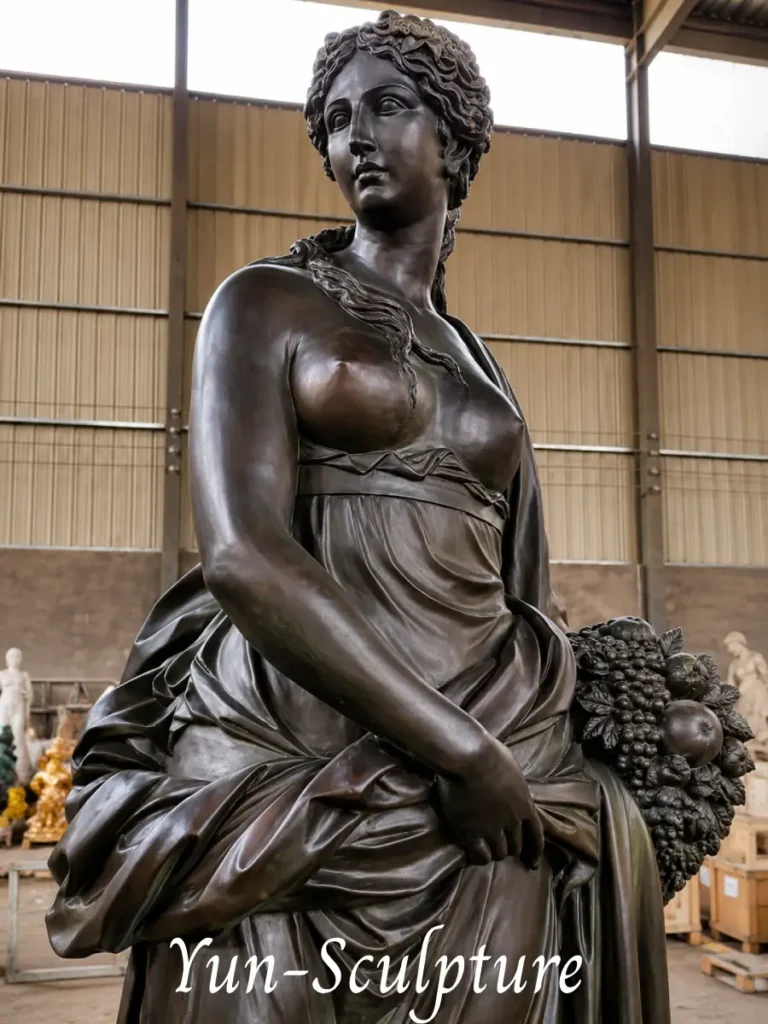
Zeus
Power · Justice · Authority
SettingEstate entrance, corporate plaza, large garden axis point
MaterialCast bronze — the thunderbolt is a projecting element; marble fractures at this point
ScaleLife-size to heroic; authority requires scale
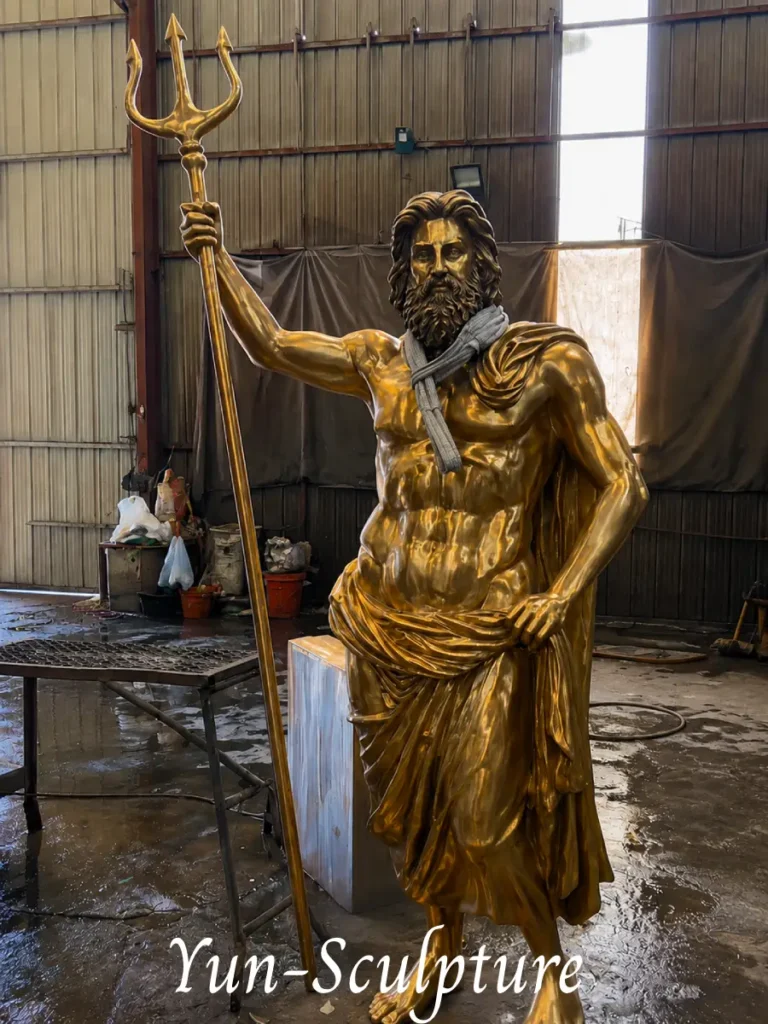
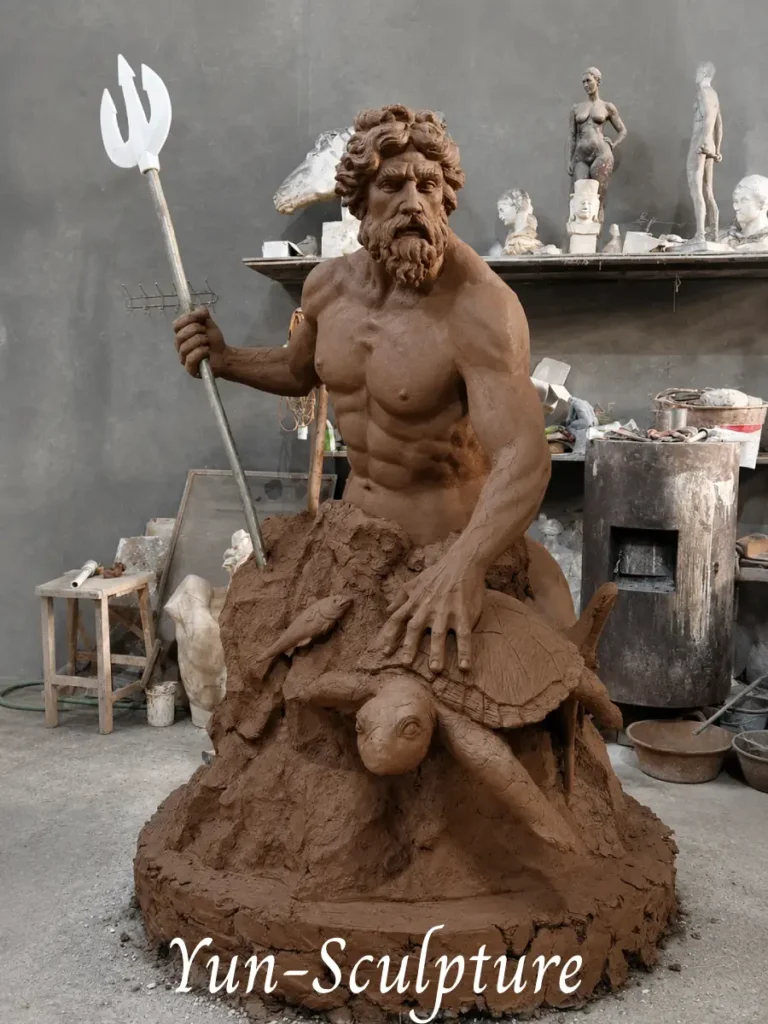
Poseidon
Sea · Water · Horses
SettingPool surround, fountain center, coastal garden, waterfront estate
MaterialCast bronze — outdoors near water; trident requires bronze for structural integrity
ScaleLife-size or larger; the figure belongs to open water and sky
Apollo
Sun · Music · Poetry · Healing
SettingSouth-facing garden, music room, art studio, library, covered loggia
MaterialWhite marble for interior or sheltered positions; bronze for open garden
ScaleGraceful at any scale; 80 cm for interior, life-size for garden focal point
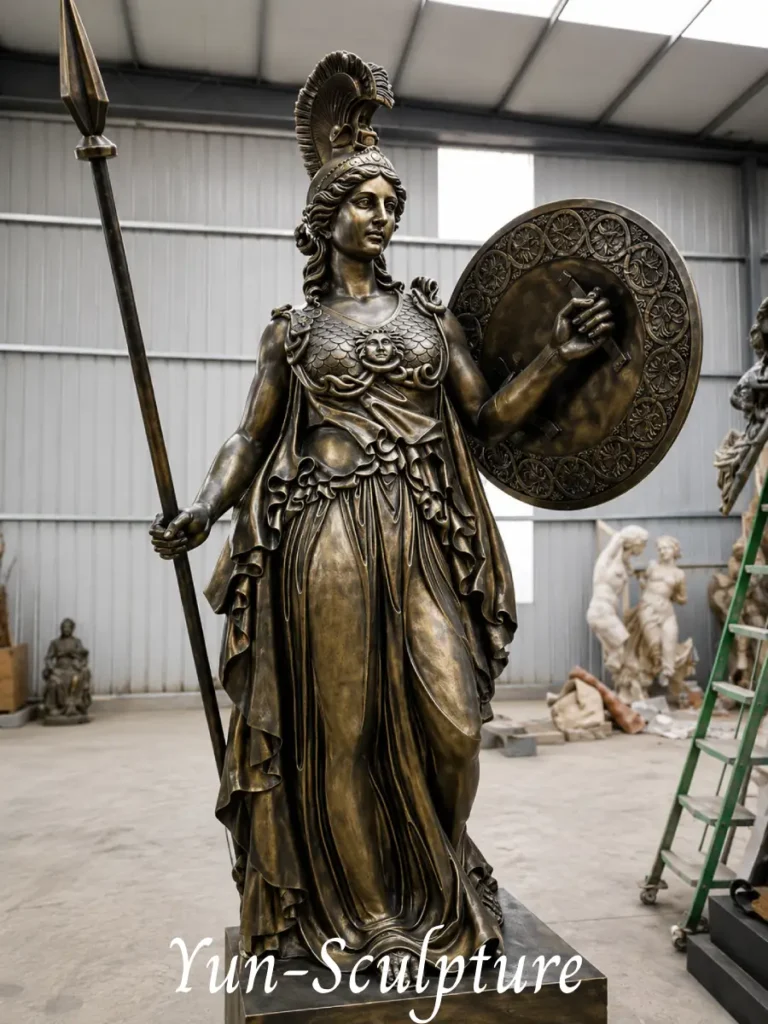
Athena
Wisdom · Strategy · Crafts
SettingLibrary, private study, law firm, academic institution, executive office
MaterialWhite marble — the draped peplos and helmet are exceptional in carved stone
Scale80–120 cm for private interior; life-size for institutional settings
Hermes
Commerce · Travel · Communication
SettingBusiness entrance, reception hall, garden path marker, commercial space
MaterialCast bronze — the caduceus and winged sandals require bronze for structural stability
ScaleMedium to life-size; the figure is traditionally dynamic and light on its feet
Dionysus
Wine · Celebration · Theater
SettingOutdoor dining terrace, wine cellar entrance, hospitality garden, pool area
MaterialEither; the relaxed figure suits both marble’s warmth and bronze’s outdoor durability
ScaleMedium to life-size; the figure rewards a convivial, human-scale encounter
Aphrodite
Beauty · Love · Desire
SettingPrivate garden, fountain surround, spa, covered loggia, bedroom alcove
MaterialWhite marble — the goddess of beauty in white stone is the most natural commission in classical sculpture
ScaleAny; often 80–150 cm for intimate private settings
Ares
Strength · Courage · War
SettingPrivate gym, strong garden axis, military or security institution entrance
MaterialCast bronze — armor, spear, and shield are structurally safer in metal than stone
ScaleLife-size to heroic; the figure carries authority only at scale
What Your God’s Attributes Mean for Material Choice
The choice between white marble and cast bronze for a Greek god commission is not purely a question of taste or budget. Each god carries specific attributes — a weapon, an instrument, a staff, a helmet — and those attributes behave very differently in different materials. Understanding the relationship between a god’s iconography and material behavior is the step most buyers skip, and it is the step that determines whether the commission survives its setting for decades or develops structural problems within years.
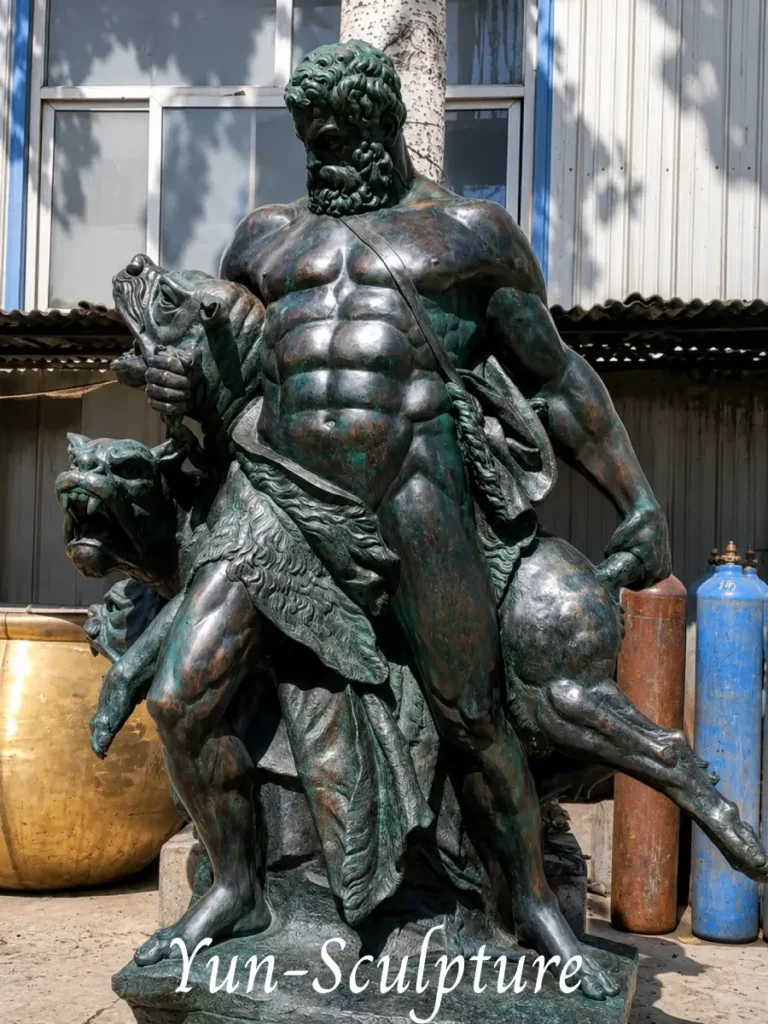
Gods whose iconography includes projecting weapons or staffs present the most significant material decision. Zeus’s thunderbolt, Poseidon’s trident, Hermes’s caduceus, Ares’s spear: each of these is a thin form extending away from the body, creating leverage stress at the point where it meets the figure. In marble, thin projecting elements are the first to fracture — they concentrate stress from wind, handling, and thermal expansion at exactly their weakest point. In cast bronze, the same elements retain structural integrity because of the metal’s tensile strength. For any god whose defining attribute extends away from the body, bronze is the structurally correct material regardless of setting.
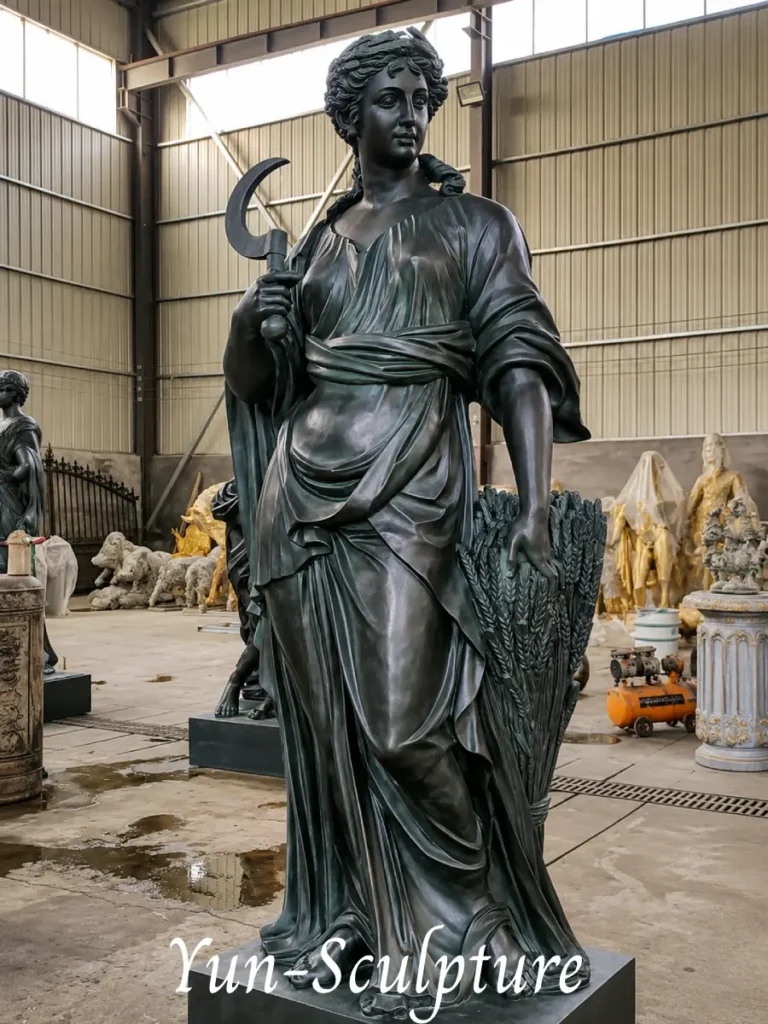
Gods whose iconography is primarily draped — robed in the flowing peplos or himation of the classical period — present the opposite case. Marble handles carved drapery with a fluidity that bronze, even in the most skilled lost-wax casting, struggles to match. The translucency of white marble gives carved fabric the appearance of actual weight and movement, catching light differently in the deep folds than on the high ridges of the cloth. Athena’s draped peplos and aegis, Hera’s formal robes, Demeter’s agricultural dress: these figures are most fully realized in marble, particularly for interior or sheltered outdoor placements where the stone’s subtlety can be appreciated at close range.
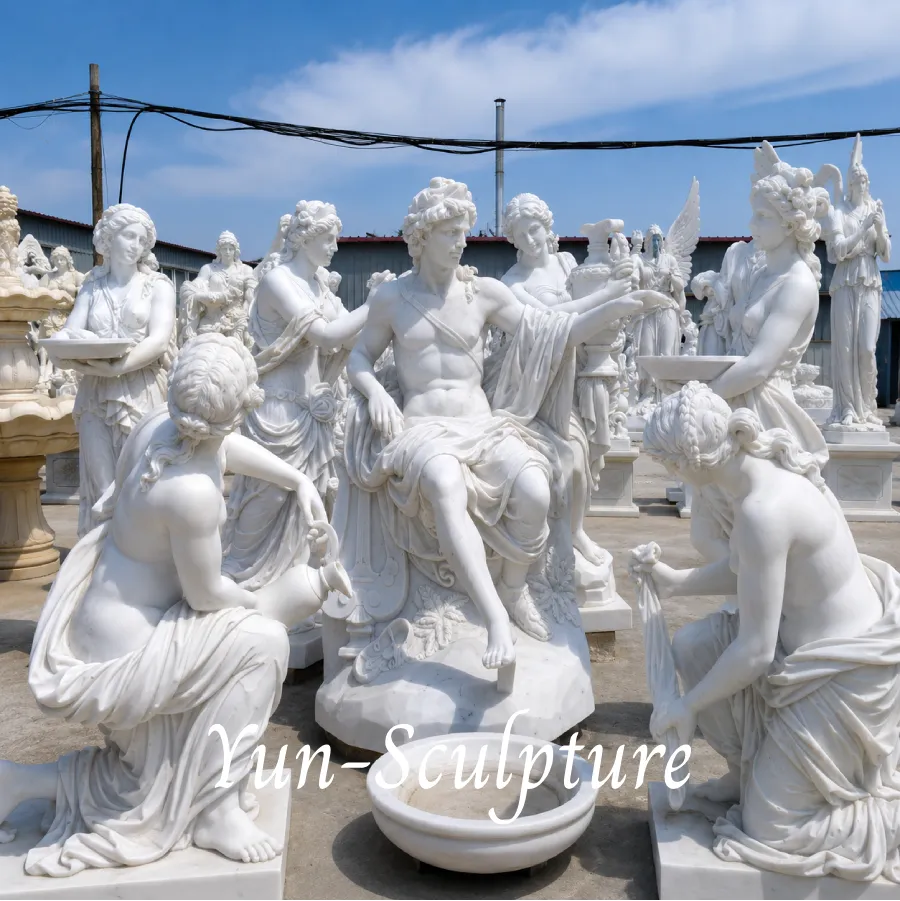
Athletic and partially draped figures — Apollo, Dionysus, a youthful Hermes — sit comfortably in either material. For these, setting determines the choice: marble for an interior library or covered loggia where controlled light reveals the surface modeling, bronze for an open garden or courtyard where weather and distance are the primary conditions.
| Figure Type | Gods | Recommended Material | Why |
|---|---|---|---|
| Projecting weapons or staffs | Zeus, Poseidon, Hermes, Ares | Cast bronze | Thin projecting forms (thunderbolt, trident, caduceus, spear) fracture at the join point in marble. Bronze handles the leverage stress structurally. |
| Draped or robed figures | Athena, Hera, Demeter, Hestia | White marble | Carved marble drapery has a fluidity and translucency that bronze cannot match. The flowing peplos and himation are most fully realized in stone. |
| Athletic or partially draped figures | Apollo, Dionysus, young Hermes, Aphrodite | Either; setting decides | Both materials handle the anatomy well. Marble for interior or sheltered placements where light reveals surface modeling. Bronze for open outdoor positions. |
Scale and Placement: The Decisions That Determine Whether a Commission Works
Greek god statues fail in installation more often through scale errors than through any material or quality deficiency. A figure that is too small for its setting reads as a decorative object rather than a presiding presence — and a Greek god reduced to a decorative object has lost the quality that gives it meaning.
The correct scale for any Greek god commission is determined by two factors: the viewing distance of the primary audience and the architectural scale of the surrounding space. A Zeus at 150 centimeters placed against a two-story estate facade will disappear. The same figure in a private garden courtyard viewed from six meters will command it. I work with clients to establish the primary viewing axis — the angle and distance from which the figure will most often be encountered — before any scale decision is made. The figure needs to be sized for that specific encounter, not for a general idea of “life-size.”
For garden installations, the pedestal is as important as the figure. A Greek god statue at grade level, surrounded by planting that grows to compete with it, loses its authority within a season. Elevated on a stone or marble pedestal — its height calibrated to bring the figure’s face to approximately the viewer’s eye level at the primary viewing distance — the same statue reads with the presence the subject requires. The pedestal is not optional for outdoor Greek god commissions. It is part of the architecture of the installation.
Interior placements follow different logic. An Athena in a library, an Apollo in a music room, a Hermes in an entrance hall: at these scales and in these settings, the figure is encountered at close range, often from multiple angles, over years of daily familiarity. Detail quality matters more than scale authority. A 90-centimeter Athena in white marble, positioned where morning light crosses her face and peplos, rewards sustained acquaintance in ways that a larger but less finely worked piece cannot.
Frequently Asked Questions
What is the most famous Greek god statue?
The most famous surviving ancient Greek god statue is the Apollo Belvedere, a marble figure now in the Vatican Museums that defined the Western ideal of male beauty from the Renaissance onward. The most famous lost statue is the Statue of Zeus at Olympia — one of the Seven Wonders of the Ancient World, approximately 13 meters tall in gold and ivory, destroyed in late antiquity. For modern commissions, Zeus and Poseidon are most frequently requested for large outdoor installations, while Athena and Apollo are most common for interior and institutional settings.
Which Greek god statue is best for a home entrance?
Hermes is the most historically appropriate god for an entrance or threshold — he was the god of travel, transitions, and boundaries, and his image was traditionally placed at doorways and property boundaries in ancient Greece. Zeus conveys authority at the entrance to a large estate. Athena suits the entrance to a library or institution where wisdom defines the space. The choice should match the function of the space being entered, not simply personal affinity for a god’s mythology.
Who is the Greek god of gardens?
No single Olympian governs gardens specifically. The most commonly placed gods in garden settings are Dionysus (nature, wine, outdoor celebration), Apollo (sun, light, abundance), Aphrodite (beauty, placed near fountains and private garden spaces), and Poseidon (for water features). The most useful approach is matching the god’s domain to the garden’s function: a pool surround calls for Poseidon; a private garden for beauty and pleasure calls for Aphrodite; an outdoor entertaining terrace calls for Dionysus.
What does the statue of Zeus represent?
The Zeus statue represents sovereign authority — the power to establish and enforce order across the divine and human worlds. His iconography carries this directly: the thunderbolt, the eagle, the scepter, the commanding posture of a figure who presides rather than serves. In a modern installation, a Zeus statue expresses leadership, protection, and the capacity to judge — which is why he is most often commissioned for estate entrances, corporate plazas, and institutional settings where authority and protection are the values the space is meant to communicate.
What statues bring good luck?
In Greek tradition, Hermes was most associated with good fortune in commerce and travel — his image at a threshold invited favorable outcomes for those entering. Tyche, the goddess of fortune, was specifically invoked for luck and prosperity. In practice, the more useful question is which god’s domain aligns with what you want the space to support: Hermes for a business entrance, Apollo for a creative studio, Athena for a place of study, Aphrodite for a garden meant for beauty and pleasure. Alignment between divine domain and spatial purpose was the Greek logic, and it remains the most coherent framework for these decisions.
Factory Direct · Quyang, China
Commission Your Greek God in Marble or Bronze
Zeus, Poseidon, Apollo, Athena, Hermes — any of the twelve Olympians, in the material and scale your space requires. Every commission begins with the right question: which god belongs here?