Famous ancient Greek statues include Moschophoros, Charioteer of Delphi, Artemision Bronze, Discobolus, Doryphoros, Statue of Zeus at Olympia (lost), Hermes and the Infant Dionysus, Laocoön, Winged Victory of Samothrace and Venus de Milo. Across Archaic, Classical and Hellenistic art, marble and bronze predominated, often brightly painted. See them in Athens, Delphi, Olympia, Rome, Naples, the Louvre in Paris and the Vatican. Roman marble copies preserve many lost bronze designs.
- Time span
- c. 570 BC to the 2nd century BC
- Main materials
- Marble and bronze
- Known only from Roman copies
- Discobolus and Doryphoros
- In the Louvre
- Venus de Milo and Winged Victory
- Life-size replica bust
- From US$2,400 in marble
- Full-size replica
- US$5,000–10,000 in marble
What makes a Greek statue famous
A smile, a shift in weight or the strain of a group struggling together can make a work of Greek sculpture recognizable. Among the most famous ancient Greek statues, the Moschophoros makes its impression standing still. This Archaic calf-bearer faces forward and smiles. By the Hellenistic period, a sculptor could build an entire scene around the movement and distress of Laocoön and his sons.
Between those examples stands the Classical Doryphoros. Imagine standing with your weight on one leg, then tracing a line across your hips and another across your shoulders. The lines take different angles as your body settles over the supporting leg. This stance is called contrapposto, and Polykleitos made it part of his study of human proportions.
Material shaped what a sculptor could do and what a visitor can still see. The Charioteer of Delphi, a surviving Greek bronze, was made by lost-wax casting. Our workshop guide follows how a bronze statue is cast by the lost-wax method. Ancient sculptors also used bright paint on their work.
Bronze was valuable enough to melt down, and many Greek bronzes were lost. Roman copies of Greek statues preserve some of those designs in marble. Marble has less tensile strength than bronze, so a copyist might carve a support shaped like a tree trunk to carry part of the load. Some Roman sculptors took careful measurements, while others adapted a figure to their patron’s taste.
The ten works below are arranged by the date of the Greek design. For the deities themselves and how to recognize them in sculpture, see our guide to Greek mythology statues.
The 10 most famous ancient Greek statues
The ten include surviving Greek statues, designs preserved by Roman copyists and a wonder of the ancient world that has been lost. For the Discobolus and Doryphoros, the date belongs to a bronze and the museum location to a surviving Roman marble copy.
Moschophoros (the Calf-Bearer)
The Moschophoros is a marble figure of a man carrying a calf, carved about 570 BC. Its Greek name gives us the familiar English title, the Calf-Bearer. The title suggests effort, yet the first things to notice about the man are how still he stands and how quietly he smiles.
Fragments of the statue were found on the Acropolis in Athens. When complete, the figure stood about 165 cm (65 in) tall, so you can picture meeting the calf-bearer at close to eye level. The Moschophoros is in the Acropolis Museum, Athens.
Charioteer of Delphi
The Charioteer of Delphi is a surviving Greek bronze of a driver who once belonged to a much larger sculpture. The figure dates to about 478–474 BC and stands 180 cm (about 71 in) high. Look closely at the eyes. The sculptor used inlay to give them a surface distinct from the bronze of the surrounding face.
Looking at the driver alone gives only part of the subject. The group also included his chariot and horses. Picture the life-size man with his team of horses and you get a sense of how far the original sculpture extended beyond the figure visitors see today.
The charioteer was found in 1896 at the Sanctuary of Apollo at Delphi. He remains in Delphi today, where you can see the bronze in the Delphi Archaeological Museum.
Artemision Bronze
The Artemision Bronze is a cast figure of a god whose identity turns on an object missing from his hand. Made about 460 BC, the bronze stands over 200 cm (about 79 in) tall. Even at that scale, the surviving figure leaves room for two quite different readings.
If the god held a thunderbolt, he would be Zeus. A trident would identify him as Poseidon. The object he once held is missing, so scholars still debate which of those names belongs to the figure. The question of who made the bronze is open as well.
Myron and Onatas are the names long associated with the bronze, though neither can be named with certainty. Fishermen found the figure off Cape Artemision in 1928. The place of discovery supplies the name that works for either reading of the statue. The Artemision Bronze is in the National Archaeological Museum, Athens.
Discobolus (the Discus Thrower)
The Discobolus is Myron’s statue of an athlete throwing a discus. Myron made the figure in bronze about 450 BC. The Greek bronze has been lost, and Roman sculptors who copied the athlete are the reason we can still see the design.
One of those versions bears a name of its own, the Discobolus Lancellotti. Carved in marble, it stands about 156 cm (61 in) high. In a still figure, you see the athlete at one instant and supply the rest of the movement in your imagination.
If you set out to see Myron’s discus thrower in Rome, the Lancellotti is the figure to look for. Its museum name lets you pick out this particular Roman copy among the versions that preserve the pose of the lost bronze. The marble is in the National Roman Museum at Palazzo Massimo, Rome.
Doryphoros (the Spear-Bearer)
The Doryphoros is Polykleitos’s Spear-Bearer, a figure he used to illustrate his treatise on ideal proportions, the Canon. He made the Greek original in bronze about 450–440 BC. The figure is known today through Roman marble copies.
To see how proportion works in the statue, start with the leg that carries the weight. As the figure settles onto it, the axes through the body shift against one another. Trace the direction of the hips and then the shoulders to see how the change travels through the figure. This is the stance called contrapposto.
Polykleitos gave an idea that he had set down in writing a form a viewer could examine in the round. The best-known marble copy was found at Pompeii. To see that version of the Spear-Bearer today, visit the National Archaeological Museum, Naples.
Statue of Zeus at Olympia
The Statue of Zeus at Olympia was a seated image of Zeus by the sculptor Phidias and one of the Seven Wonders of the World. Made about 430 BC, it showed the god on a cedarwood throne. The statue rose to almost 12 m (40 ft), a height all the more striking once you picture Zeus seated.
Gold and ivory covered the figure. Try to picture the change in surface from the wood of the throne to the ivory and gold of the god seated on it.
The name of the work still tells you where an ancient visitor would have gone to see it. The statue stood in the Temple of Zeus at Olympia. The work itself is lost.
Hermes and the Infant Dionysus
Hermes and the Infant Dionysus is a marble sculpture that brings Hermes and the young Dionysus together. The work dates to the 4th century BC and is carved from Parian marble. The sculpture is attributed to Praxiteles.
The most telling detail is a change in the surface of the stone. Across the face and torso, the marble has been brought to a high polish. On the back, the rasp and chisel have left marks you can still distinguish. A different view of the same piece of stone can reveal the work that went into bringing it to a polish.
If you want to look at this group as a carver might, start where you can see the tool marks. Then return to the face and look for how thoroughly the polish has softened the evidence of the hand that worked the stone. You can see Hermes and the Infant Dionysus in the Archaeological Museum of Olympia.
Laocoön and His Sons
Laocoön and His Sons is a marble group showing the Trojan priest Laocoön and his two sons under attack from sea serpents. The sculptors Agesander, Polydorus and Athenodoros made the group after a Hellenistic original of about 200 BC. That date refers to the design on which the surviving marble is based.
The serpents give the eye a way through a scene crowded with bodies. Follow the threat from the father to either son and each figure’s predicament becomes part of the same attack. The emotion of the group comes from seeing what is happening to a family whose members are all caught up in the struggle.
The group came to light in Rome in 1506, in the area of the Baths of Trajan. Today Laocoön and His Sons is in the Vatican Museums.
Winged Victory of Samothrace
The Winged Victory of Samothrace is a marble figure of Victory standing on the prow of a ship. It was carved from marble from the island of Paros and probably dates to 190 BC. The prow gives the sculpture a setting you can recognize even though the head and arms are missing.
Charles Champoiseau found the sculpture on Samothrace in 1863. About 110 fragments were unearthed, but neither the head nor the arms came to light. The prow was recovered in 1879. With the prow beneath her again, you can look up from the bow and see the winged figure as part of a single composition.
The statue has stood at the top of the Daru staircase in the Louvre since 1883. To see the figure from below as you approach its ship’s prow, take the stairs to Room 703 in the Denon wing.
Venus de Milo
The Venus de Milo is a Parian marble statue usually identified as Aphrodite. Carved around 130–100 BC, it stands 202 cm (6 ft 7 in) tall. Its familiar name links that usual identification with Melos, the island where it was found in 1820.
The farmer who discovered the statue also found fragments of an arm and a hand. Those pieces are easy to overlook if your starting point is the armless figure on view today. The discovery also left open the question of whom the statue represents. Aphrodite is the usual reading, though Amphitrite and Victory have also been suggested.
Our guide to the history and meaning of the Venus de Milo looks more closely at the work behind that familiar name. You can see the marble itself at the Louvre in Paris.
Where to see them today
| Statue | Period | Material | Where it is today |
|---|---|---|---|
| Moschophoros | Archaic, about 570 BC | Marble | Acropolis Museum, Athens |
| Charioteer of Delphi | Classical, about 478–474 BC | Bronze | Delphi Archaeological Museum |
| Artemision Bronze | Classical, about 460 BC | Bronze | National Archaeological Museum, Athens |
| Discobolus | Classical, about 450 BC (bronze lost) | Roman marble copy | National Roman Museum, Rome |
| Doryphoros | Classical, about 450–440 BC (bronze lost) | Roman marble copy | National Archaeological Museum, Naples |
| Statue of Zeus at Olympia | Classical, about 430 BC | Gold and ivory | Lost |
| Hermes and the Infant Dionysus | Classical, 4th century BC | Parian marble | Archaeological Museum of Olympia |
| Laocoön and His Sons | After a Hellenistic original of about 200 BC | Marble | Vatican Museums |
| Winged Victory of Samothrace | Hellenistic, probably 190 BC | Parian marble | Louvre, Paris |
| Venus de Milo | Hellenistic, about 130–100 BC | Parian marble | Louvre, Paris |
The Louvre in Paris brings two of the ten together, the Venus de Milo and the Winged Victory of Samothrace, which stands on its ship’s prow at the top of the Daru staircase. In Greece, you can see the surviving bronze of the charioteer in Delphi, where it was found, and the Artemision Bronze in the National Archaeological Museum, Athens. For the Roman marble copies, look for the Discobolus Lancellotti in Rome and the Doryphoros from Pompeii in Naples. Olympia has the marble Hermes and the Infant Dionysus, while the gold and ivory statue that once stood in its Temple of Zeus is lost.
Replicas: how these statues are made again today
To make a Greek statue replica, we agree on the scale, material and form with the buyer before laying out the figure. For a work with missing parts, one of the first decisions is whether to reproduce the sculpture as it survives or to complete it.
Bust or full figure
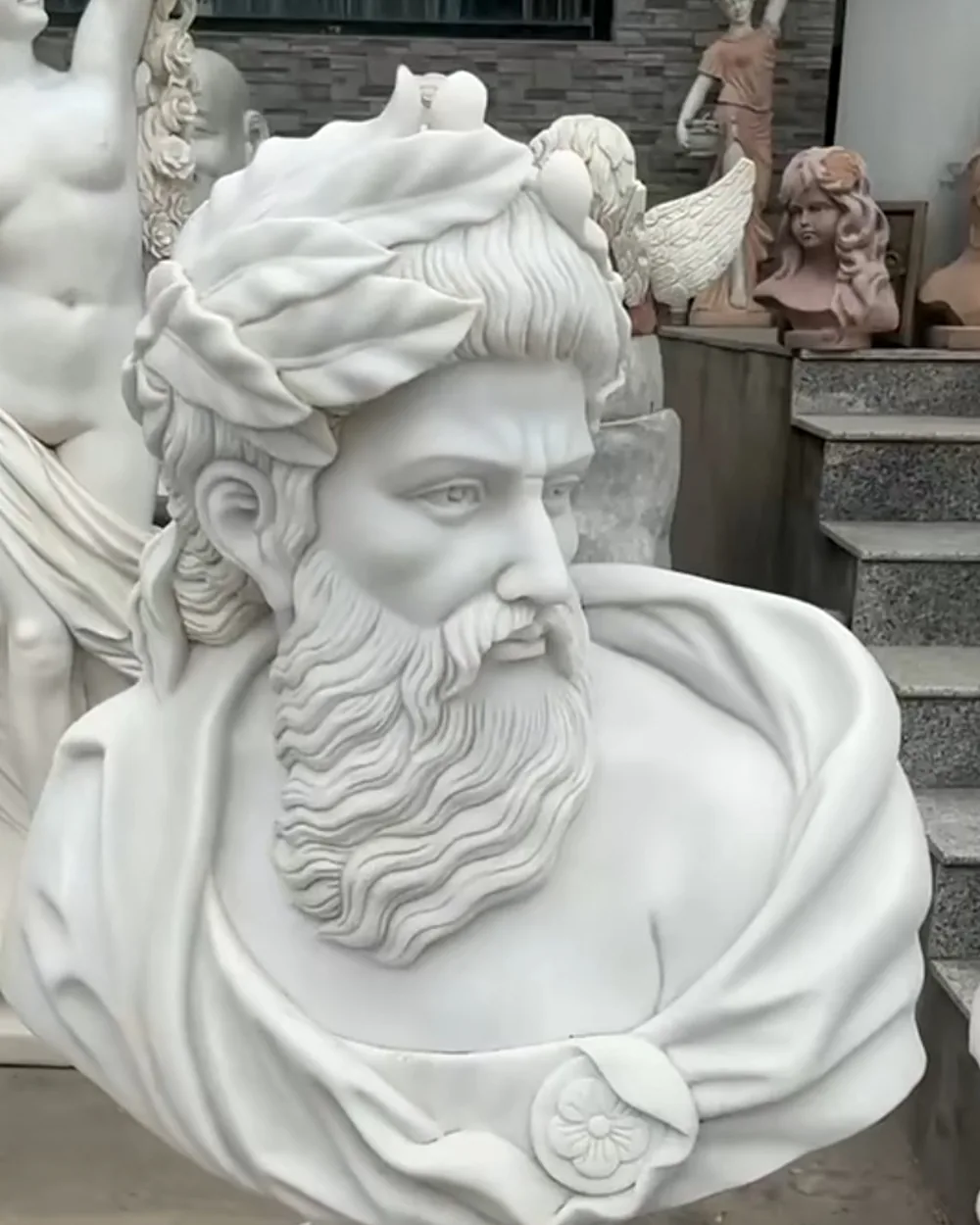
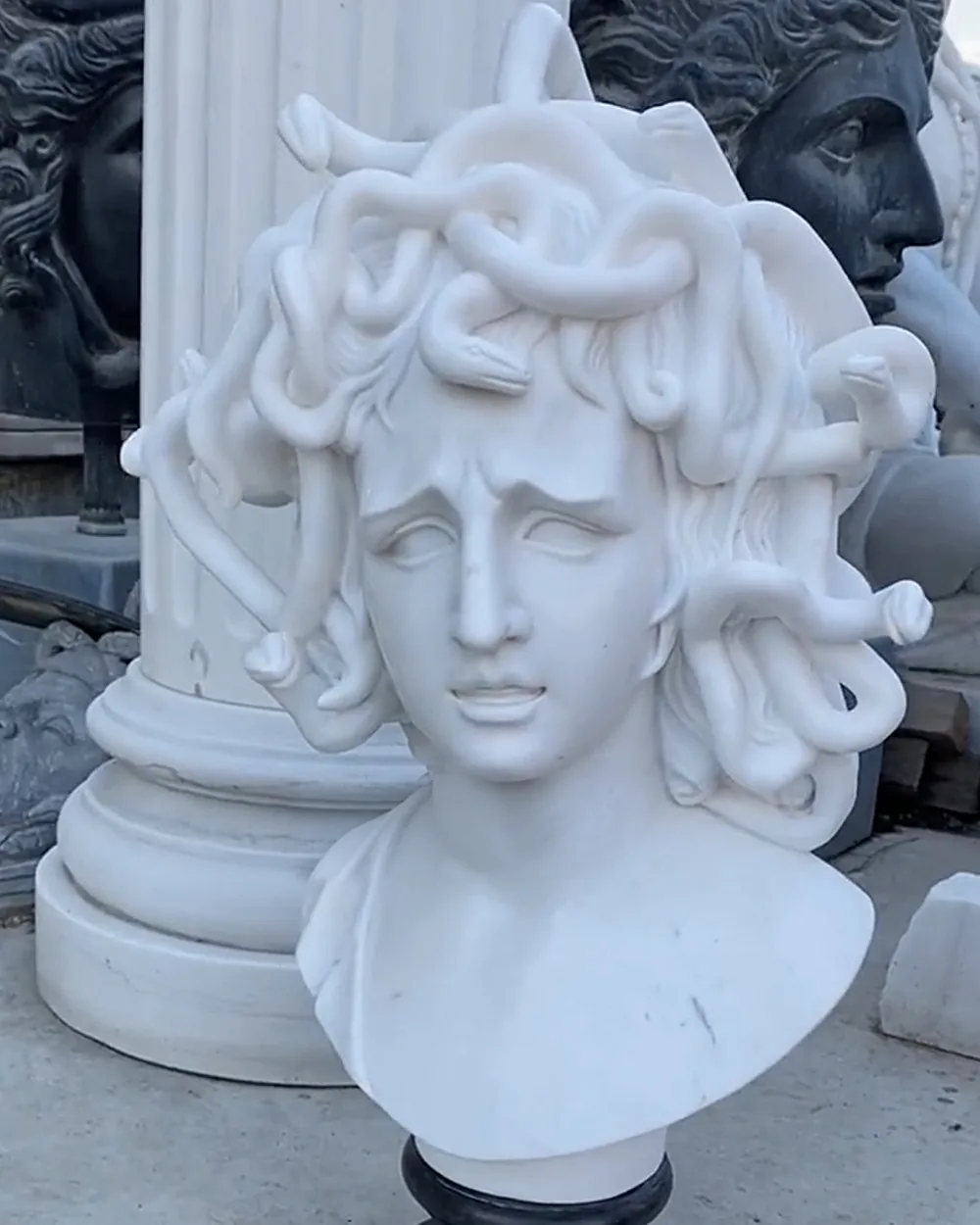
A bust gives the face its own space in a study or another interior. Two examples we carved in Quyang are Zeus and Medusa, both in Sichuan white marble and about 50–70 cm (20–28 in) high. You can see both in our collection of famous busts in marble and bronze. For a garden or an entrance hall, a full figure lets you see the stance and its relationship to the base.
Stone or bronze
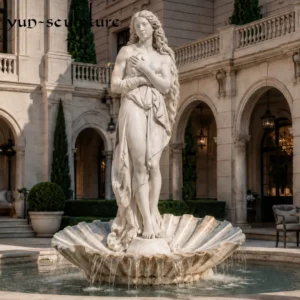
For a full figure in stone, we carve a single block of natural marble. Choices include Guangxi white marble and Egyptian beige marble. The figure takes shape within that one block, including where a fold of cloth crosses the body or an arm extends away from it.
You can commission a marble version of a bronze original or a bronze version of a marble original. A commission for a marble Charioteer, for instance, would take its pose from the figure at Delphi and its color from the stone you select. Our statuary bronze contains 85% or more copper, and we cast it with 5–8 mm (about 0.2–0.3 in) walls.
How a replica is made
For our classical masterpiece replicas, we begin with a design drawing showing the figure as you want it made. Free design drawing and quote within 12 hours. No deposit needed. We then make a 3D model for your approval, included in the order, and revise it until you are satisfied.
For the stone carving, we use a 3D scan or existing digital data to lay out the figure at the agreed size. A machine roughs out the block to establish the main forms. A carver then works by hand to finish the details the machine has left for this stage.
The hardest passages to carve are often folds of clothing. In the Laocoön group, the challenge is following a serpent around one figure and into the space occupied by the next. The carver has to keep each body legible wherever the three figures and the serpents cross.
A raised arm presents a different problem. Parts that project on their own are the easiest to break, and an arm extending clear of the body is a good example. Its position deserves a close look when you review the model.
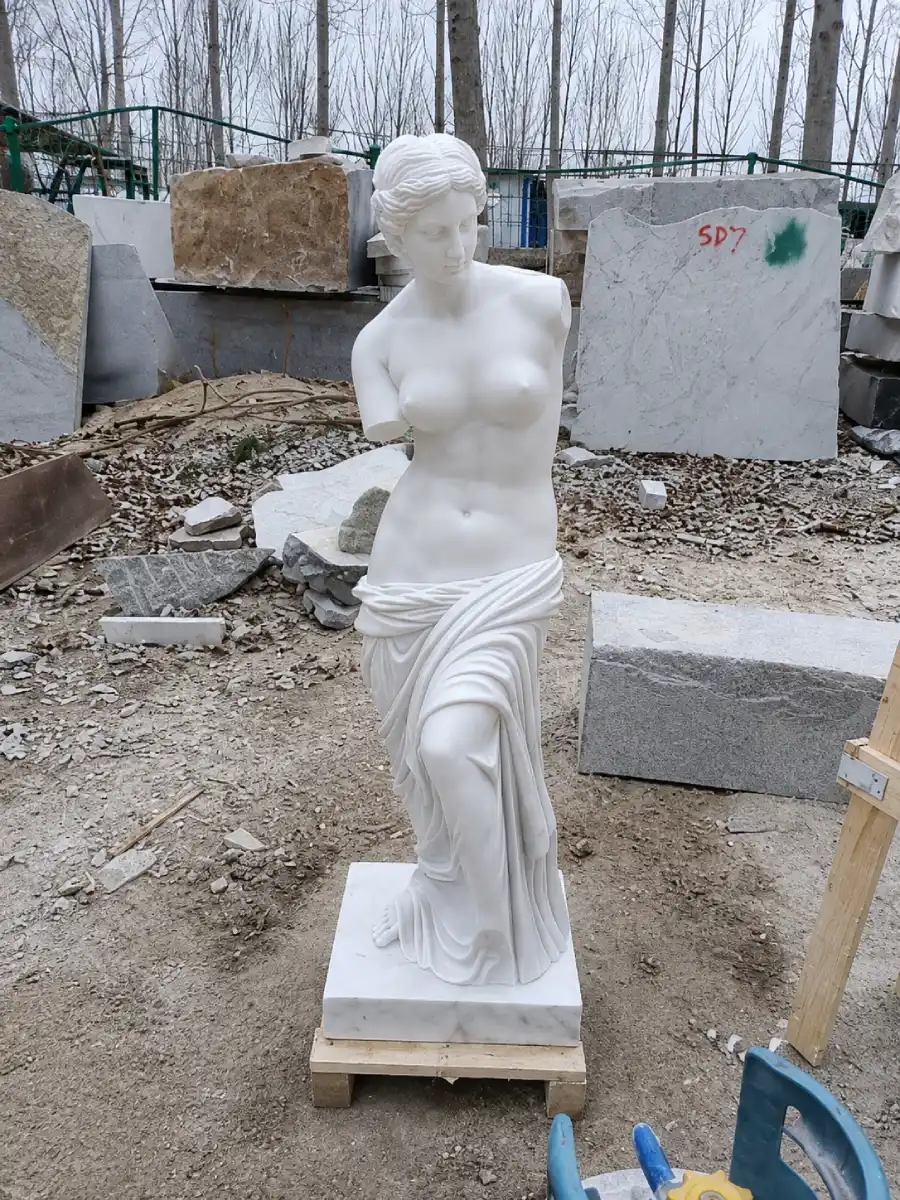
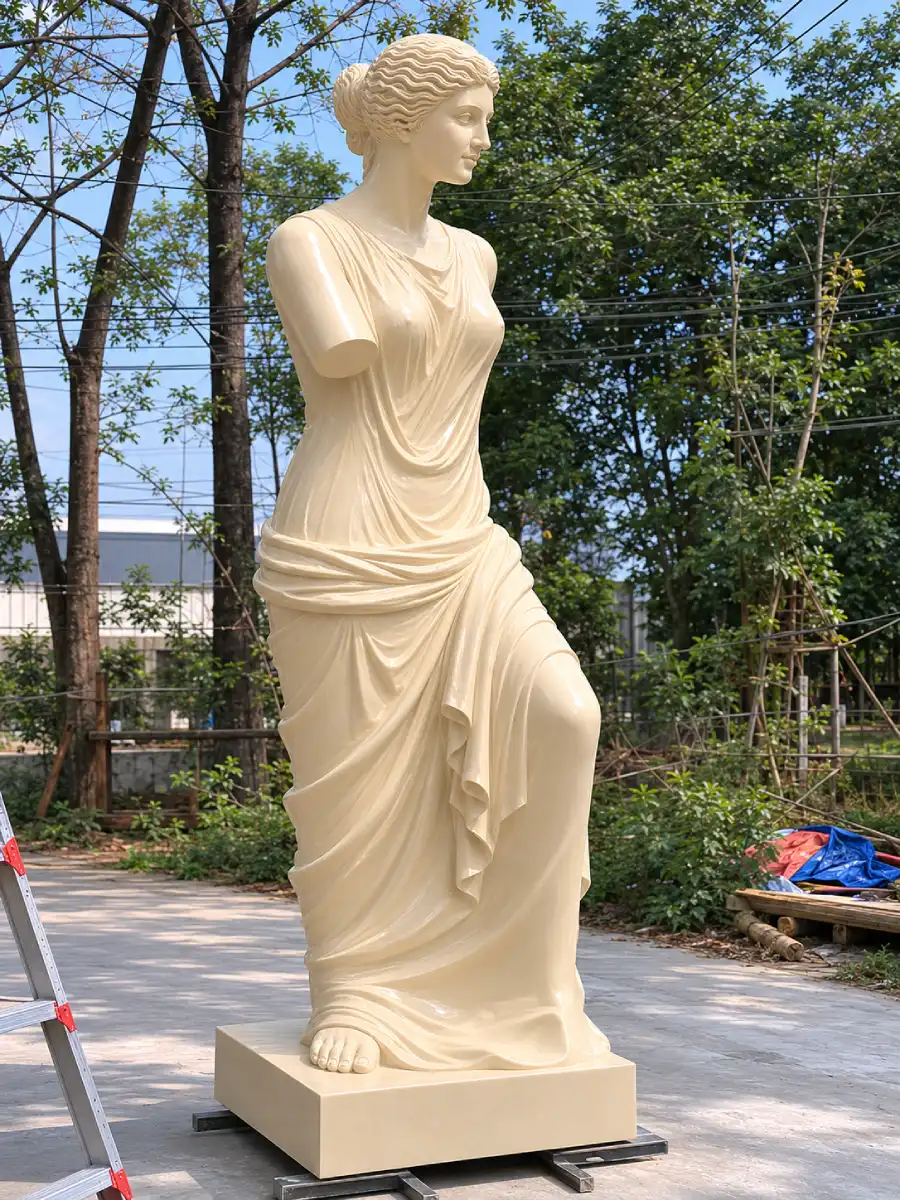
By default, we follow the surviving sculpture. For a Venus de Milo, that means carving the figure without arms. For a Winged Victory, it means leaving the head and arms missing. If you want those parts completed, we can show that choice in the design.
The original base is part of a full-figure replica and is included in its price. For the Winged Victory, that includes the prow of the ship. It gives the figure the same setting a visitor sees beneath her feet at the Louvre.
You can keep the figure in its surviving form and still ask for an aged finish. We include that finish at no extra charge.
What a replica takes
Reference prices for busts and full figures are in the table below.
For a full figure at the size of the original, allow US$5,000–10,000 in marble or US$6,500–13,000 in bronze, FOB Tianjin. For a reduced figure, the ranges are US$3,500–8,000 in marble and US$4,500–9,000 in bronze. Most replicas take 35–45 days to produce.
Our bronze warranty covers weld failure and breakage caused by quality problems for 3 years. Changes in the surface color fall outside that coverage. The marble breakage warranty is 6 months.
When planning the foundation and unloading, allow for the difference in weight between solid stone and hollow bronze. At 200 cm (about 79 in) high, a solid marble full figure has an estimated net weight of 600–900 kg (1,320–1,980 lb). A hollow bronze of the same height is estimated at 170–280 kg (375–620 lb). Both estimates exclude the wooden crate.
What a Greek statue replica costs
These are FOB Tianjin factory references; we can also quote DDP delivery with customs clearance and delivery to your address. Bust heights include the chest. For a full figure, the reference is the height of the original sculpture.
| Replica | Size | Marble | Bronze |
|---|---|---|---|
| Classical bust | About 60–70 cm (24–28 in), life-size | US$2,400 | US$2,800 |
| Classical bust | About 90–100 cm (35–39 in) | US$2,800 | US$3,300 |
| Full figure, reduced size | Smaller than the original | US$3,500–8,000 | US$4,500–9,000 |
| Full figure, original size | As the original, e.g. Venus de Milo 202 cm (6 ft 7 in) | US$5,000–10,000 | US$6,500–13,000 |
- 35–45 days for most replicas
- Marble 6-month breakage warranty, bronze 3 years
- Free design drawing within 12 hours
Frequently asked questions
Who is the most famous Greek sculptor?
Phidias, who made the Statue of Zeus at Olympia, is one of the best-known Greek sculptors. Myron made the Discobolus, and Polykleitos made the Doryphoros. Hermes and the Infant Dionysus is attributed to Praxiteles, while the sculptor of the Artemision Bronze remains uncertain.
Was there a statue of Zeus?
Yes. Phidias’s Statue of Zeus at Olympia was one of the Seven Wonders of the World and is now lost. The Artemision Bronze may also represent Zeus. For a modern example, our Quyang workshop has carved a Zeus bust in Sichuan white marble.
Are famous Greek statues originals or Roman copies?
Both survive. The Charioteer of Delphi, Artemision Bronze, Winged Victory of Samothrace and Venus de Milo are Greek originals. The Discobolus and Doryphoros are known through Roman copies, while Laocoön and His Sons is based on a Hellenistic original.
Were Greek statues originally painted?
Yes, ancient Greek sculptors used bright colors on their statues. The bright color was part of how the statues were meant to be seen.
What is considered the most beautiful Greek sculpture?
There is no agreed ranking of beauty in Greek sculpture. The Venus de Milo gives you one example to judge for yourself, a figure in Parian marble usually identified as Aphrodite. Its identity is still debated.
Where can you see famous Greek statues today?
Athens, Delphi and Olympia have Greek sculptures on view, and the Louvre in Paris has both the Venus de Milo and the Winged Victory of Samothrace. In Italy, see the Discobolus Lancellotti in Rome and the Doryphoros in Naples. Laocoön and His Sons is in the Vatican Museums.
Can you buy a replica of a famous Greek statue?
Yes. Our FOB Tianjin marble prices are US$5,000–10,000 for an original-size full figure, from US$3,500 for a reduced figure and from US$2,400 for a life-size bust. You receive a free design drawing first, then a 3D model to approve. Most replicas take 35–45 days to produce.
- Written by
- The Yun Sculpture workshop team in Quyang, Hebei, China. Our sculptors and casters have more than 20 years of experience.
- How we checked
- Prices, lead times, alloy and warranty terms come from our factory records. Other facts come from the sources below.
- Last updated
- November 2026
- Sources
- A stairway to Victory – The Daru staircase, Musée du Louvre
- 6 Ancient Greek Sculptures You Should Know, DailyArt Magazine
- Aphrodite, known as the “Venus de Milo” (print caption), Réunion des musées nationaux – Grand Palais
- Roman Copies of Greek Statues, The Metropolitan Museum of Art
- Roman copies of ancient Greek art, Smarthistory
- Polykleitos, Doryphoros (Spear-Bearer), Smarthistory
- Charioteer of Delphi, Smarthistory (via Lumen Learning)
- Delphi Charioteer, World History Encyclopedia
- Marble statue of a Discobolus (Discobolus Lancellotti), Hellenic Ministry of Culture
- Statue of Zeus, Encyclopaedia Britannica
- Statue of Zeus at Olympia, World History Encyclopedia
- Yun Sculpture factory records: classical bust and full-figure replicas (stone, method, reference prices, production time, estimated weights).